C-71 Senate committee hearings: My take
2024/12/09 Leave a comment
While I have followed the debates and discussions regarding “lost” Canadians over the years, this was my first time testifying on the issue in the context of C-71 along with many familiar faces. My one ongoing observation is despite all the language around up to one million “lost” Canadians, the reality is that most “lost” Canadians appear not want to be found, with only about 20,000 citizenship proofs issued (2 percent) since the first fix for those who lost their citizenship.
The other general comment pertains to the government’s policy choice of not having the same time limit to meet the residency requirement as for Permanent Residents. The statement by officials that this is intended to make it easier and more flexible for applicants suggests that officials, and likely the minister, have not learned many lessons from the overly facilitative approach for Permanent Residents, international students and temporary workers, all of which the government has since rolled back.
We shall see the SOCI report in a few weeks and will see what points they took on and which ones they don’t.
The following is my take on the major points raised during Senate’s SOCI pre-study hearings on the Bill.
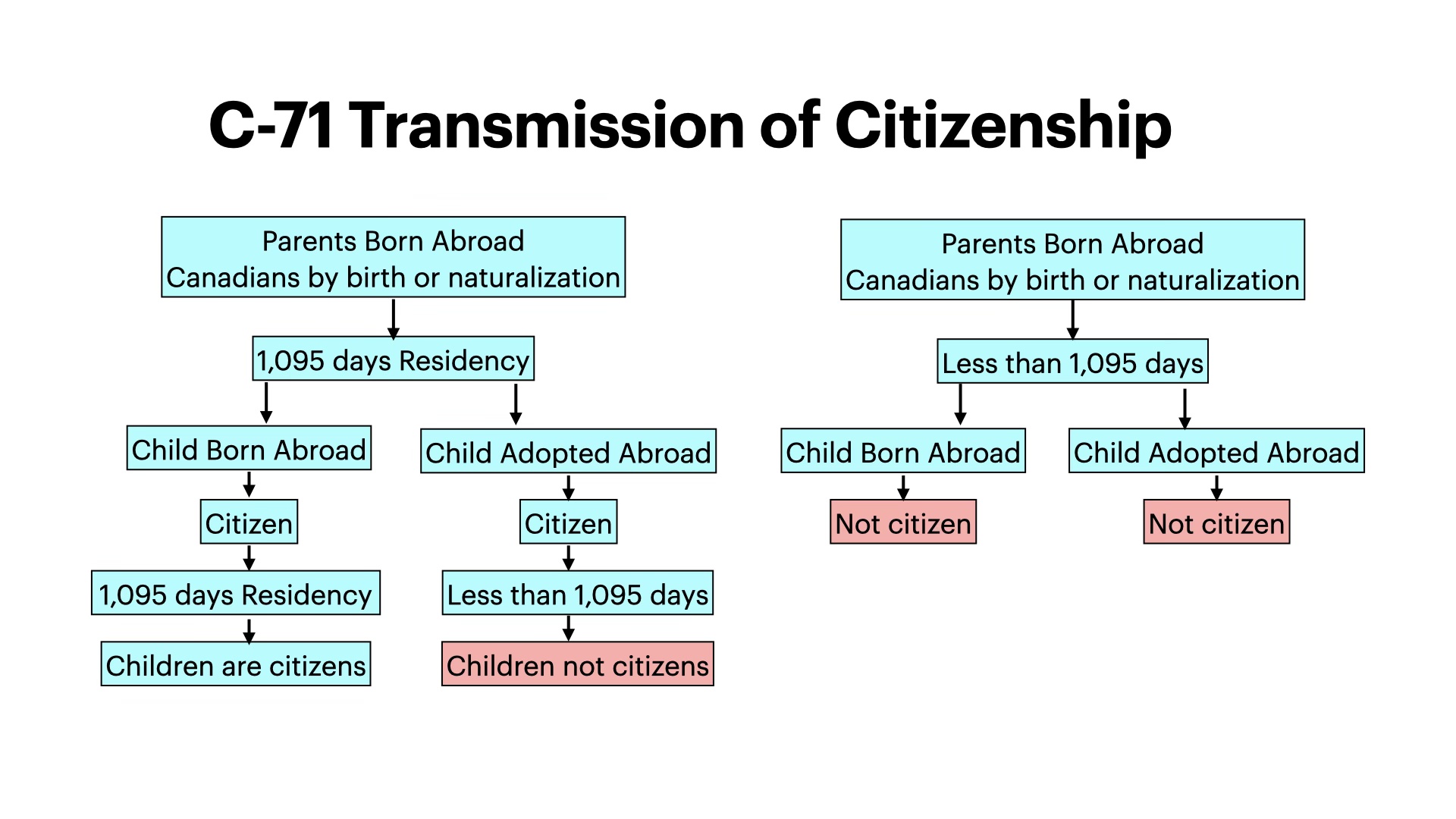
Connection test: 1,095 days cumulative with no time limit (C-71) vs within 5 years: My earlier article and formal submission advocating for the residency requirement to be limited to the same 5 year period as per citizenship applicants provoked discussion at the Senate’s SOCI, with a number of senators questioning the rationale for the government’s decision.
Minister Miller argued that it was unlikely that the residency requirement would be “spread over forty years” and that a longer time period still means a “fairly important connection,” citing Lebanese Canadians as an example, the “Canadians of convenience” example that was the genesis of the first generation cutoff. (Miller’s riding is about three percent Lebanese ethnic origin). The Minister also indicated concerns that the five-year limit would create another series of “lost Canadians.”
Officials further noted that the aim of C-71 was to be facilitative, citing examples of persons coming to Canada annually for summer vacations or family visits. Notably, neither the Minister nor officials addressed the operational complexities of a residency requirement with no time limit. Most witnesses and senators support a connection test.
The appropriateness of a residency-base connection test was accepted by most witnesses.
There was some discussion about whether the lack of a time limit increased the risk of “citizens of convenience,” with the Minister not believing it would (I had previously indicating more likely without a five-year limit).
The possibility of using the electoral list as a basis for a connection test was raised. Given that only about 57,000 persons living outside Canada were issued ballots, only a small fraction of those living abroad, hard to see how this would be a valid alternative.
Numbers affected and operational impact: The Minister and officials provided existing operational data but, beyond generalities, did not share any more detailed internal analysis. There are about 700 applications under the interim measures for those affected by the first generation limit. The Minister does not anticipate that “wild scenarios of hundreds and thousands” will materialize. Officials did not appear to have undertaken any analysis similar to that in my submission that provides estimated orders of magnitude. The other element of note is that the understandable focus was on the immediate cases, those born abroad and unable to transmit their citizenship. There was little to no discussion of the future operational impact and numbers when those second generation children born-abroad had children of their own also born abroad (as is the case of my grandson, who would have to meet the residency test).
Awareness and clarity: Predictable and legitimate calls for efforts to make those affected aware of the change, with officials indicating their efforts to make persons aware of the interim measures with work underway to prepare once Bill C-71 comes into force. The issue of readability of the current Act and the need for a new Act in lay language was raised, with the Minister noting his agreement in principle but not a priority in the final months of the government’s mandate.
Indian status and citizenship: That some Indigenous persons have Indian status but not citizenship and vice versa was raised, with the Minister noting “ridiculous situations” and that citizenship should be automatic but there were examples of First Nations that were not Canadian.
Adoptions: The CBA raised the issue of the difference between naturally born children, whose citizenship starts on the day of birth, in contrast to adopted children, who only obtain citizenship when the adoption is approved, recommending that the US and British approach of the effective date of adoption being the date of birth of the child. Hard for me to see any practical impact of current policy or substantive inequalities but understand importance to adoptee parents.
Similarly, I find it difficult to understand the arguments that internationally adopted children, citizens by grant under S 5.1 are being discriminated against compared to naturally born children. (If I recall correctly, the direct route under S 5.1 was a response to parents who wanted their adopted child to be treated identically to a natural-born child, and not under the Permanent Resident pathway as an immigrant. In my view, hard to have it both ways and there does not appear to be any substantive differential treatment in C-71).
The Minister himself, noting the test applies to the parents, not the child, did not see an inequality. Officials in a clear presentation clarified that natural and adopted are treated as similarly as possible and that not requiring the connection test for international adoptions could mean that citizenship could be passed on through generations without residency in Canada.
Transcript below (preliminary): “If Bill C-71 is amended to eliminate the substantial connections test in the international context and begins to treat adopted persons as if they were naturalized citizens and not citizens by descent, as is in the case for children born abroad to Canadians, this will result in differential outcome for the two groups. Children adopted abroad by Canadians would benefit preferential treatment compared to children born abroad to Canadians, who would then be subject to different and more onerous requirements in order to pass on citizenship by descent.
If Bill C-71 were to eliminate the substantial connection requirement, again in an international adoptions context, it could mean that a child born abroad and adopted to a Canadian parent could then also adopt a child abroad and pass on citizenship despite never living in Canada. This would mean citizenship by descent could be passed down through generations of people who have never lived in Canada.”
When I worked on these issues some 14 years ago, I always found a graphic was helpful on how C-71 would work with my effort below:

 Multicultural Meanderings