Immigration point systems – What’s the point? | The Economist
2016/07/13 Leave a comment
Good overview of the shift towards an employment-offer based point system but mischaracterizes this as a shift away from using points – it is just that the weighting system has changed, in Canada’s case, from a human capital model, to one that privileges immigrants with concrete job offers (50 percent of all points):
Canada created the world’s first points system, in 1967. Would-be immigrants who scored highest on youth, education, experience and fluency in English or French were offered permanent residency. In 1979 Australia created a similar system. Both countries were abandoning racist schemes that had favoured whites (Australia ran one called “bring out a Briton”). Henceforth, the aim would be to lure talent, wherever it was from.
The new systems soon attracted admirers. New Zealand built a points-based immigration system in 1991; Britain, the Czech Republic, Denmark and Singapore began to experiment. But it gradually became clear that Australia and Canada were much better at attracting accomplished immigrants than at using their skills.
Employers were unimpressed with the new arrivals’ qualifications and foreign work experience. In Australia, 13.5% of recently arrived immigrants who had applied from overseas under the points system were unemployed in late 2013, compared with just 1% of those who had come in with a job offer. Pure points systems “don’t work”, says Madeleine Sumption of the Migration Observatory at Oxford University.
Another problem in Canada was that the number of applicants exceeded the number allowed in each year. At the worst point, applicants for the Federal Skilled Workers programme were waiting up to eight years for a decision. Businesses complained that superb applicants were languishing behind merely decent ones.
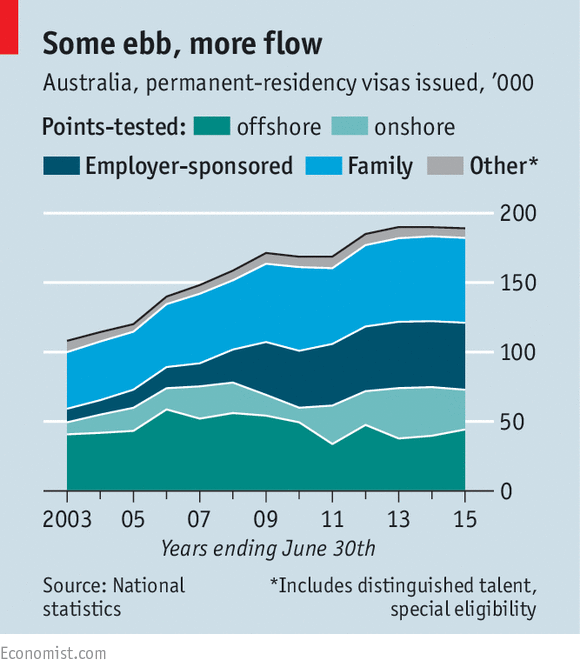
To deal with these flaws Australia and Canada have transformed their immigration systems. Both now weigh local work experience and job offers more heavily. Between 2002-03 and 2014-15 the number of Australian visas granted on the basis of job offers rose five-fold, from 9,700 to 48,300 (see chart). In Canada, the points system has been reworked so that any skilled applicant with a job offer scores higher than any applicant without.
Both countries have also inverted the process of applying for visas. Instead of putting applicants in a queue, they now invite people merely to express an interest in migrating. Those who pass an initial points test are put into a pool, where they can remain for a year or two. Every so often the best candidates are skimmed off and invited to apply for visas. Companies and provinces can trawl the pool, looking for promising immigrants to sponsor. Anybody they pluck out is likely to get a visa quickly.
These reforms seem to have had some effect. Immigrants to Australia are still less likely than natives to be economically active, but the gap has closed—from 9.8 percentage points in 2002-03 to 6.3 points in 2013-14. Canada’s huge backlog has gone: many of those stuck in the queue were ejected and given their fees back.
Businesses are less happy, though. In Canada, a firm that wants to offer a job to a foreigner must prove that it tried and failed to hire a Canadian—a slow, costly and sometimes daft process. Kumaran Thillainadarajah, an immigrant entrepreneur who founded a firm as a student, had to explain why he and not a native should be chief executive. The system is too cumbersome, says Sarah Anson-Cartwright of the Canadian Chamber of Commerce. She looks enviously at Britain, which has a fast-track visa scheme for technology workers.
….Britain’s experiment with a points-based system in 2008 was also thwarted by business pleading. The scheme was never as flexible as Australia’s or Canada’s. But at least it was simple—until the lobbying began. Firms moaned that vital foreign workers were blocked because they lacked the required qualifications. Carve-outs were duly created: butchers and ballet dancers were given special treatment and footballers were not required to speak English. What remained of the system was then bulldozed by a Tory-led government that had pledged to slash immigration.
A simple immigration system that attracts global talent, calms the natives and gives businesses the workers they crave seems an impossible dream. Perhaps it is also a foolish one. Governments cannot know what kind of immigrants their economies will require because they do not know how their economies will evolve. There will always be special pleading and exceptions. As Mr Byrne puts it: “Migration systems are complicated because people are complicated.”

 Multicultural Meanderings