Immigration advocates take Ottawa to court over refugee treaty with U.S. 

As was expected and they have a case, no matter how inconvenient, as it gets stronger day-by-day with clear incidents of USA and ICE over-reach and undermining protections:

The federal government is facing a legal challenge arguing that its oversight of a two-decade-old refugee treaty with the United States is “fundamentally flawed.”

The bilateral agreement is premised on both countries being safe for asylum seekers. It prevents refugee claimants passing through the U.S. from seeking protection in Canada and vice versa. 

Canada is legally required to regularly review its neighbour’s human-rights record and refugee protections as part of the treaty, the Safe Third Country Agreement, or STCA. Ottawa has not publicized its findings since 2009. 

In January, U.S. President Donald Trump ordered a sweeping immigration crackdown that has heightened asylum seekers’ risk of detention and deportation. Immigration rights groups have asserted that migrants and asylum seekers have been held in “secret” detention at the northern border. 

In an application for judicial review, the Canadian Association of Refugee Lawyers (CARL) and the South Asian Legal Clinic of Ontario (SALCO) argue that the lack of publicly available information about Ottawa‘s refugee monitoring process shields the government from accountability − and could violate the Constitution.

“This is so crucial because what we see happening at the Canada-U.S. border is quite troubling,” said lawyer Maureen Silcoff, who is representing CARL in the legal challenge.

Advocates in Canada have long maintained that cracks in American refugee protections leave asylum seekers at risk, raising concerns about the legality of the STCA treaty. Executive orders issued by the U.S. President in January, which initiated drastic immigration changes, have heightened fears over detention conditions for asylum seekers and rapid deportation without due process. 

Sujit Choudhry, who is representing SALCO in the case, said that without detailed evidence of how Ottawa determines its neighbour is safe for asylum seekers, it is impossible to know if Canada is complying with its legal obligations to refugee claimants.

An inaccurate designation – one that results in refugee claimants at the Canadian border being returned to the U.S. and then deported to a country where they would face torture – would violate the Canadian Constitution, he added. …

Source: Immigration advocates take Ottawa to court over refugee treaty with U.S.
Rempel Garner: Canada’s immigration system needs massive, wholesale reform. 

Gives a strong sense of where the Conservative opposition will likely focus on immigration. Mainly overall levels and program integrity. Focus is on the impact on housing and healthcare for immigrants and non-immigrants alike, not values. She is right in stating the need for “wholesale reform” (or at least major reform) but silent on the need for some form of commission to lay out issues and options. Some of her assertions are excessively partisan or exaggerated but the issues are real.

And of course, is coy on what the right level of immigration would be, back to the last year of the Harper government, less or more:

…I am presently convinced that nothing short of wholesale reform of the entire system, starting with the process by which the federal government sets and counts immigration levels, will fix the mess the Liberals have created. With millions of people currently in Canada with temporary permits about to expire, the government must urgently entirely rethink the criteria by which people are allowed to stay and enter the country – and then consistently enforce the same. Overall immigration levels need to be drastically reduced and the problem of millions of people with no legal reason to be in Canada must be addressed head on, for there to be any future hope of program or system reform.

Having only been officially on the job for a couple of days, I will consult with stakeholders and our newly expanded Conservative caucus and appointed Shadow Ministers on how they feel we should hold the government to account on this issue. Immigration policy affects all of their communities and files, and not necessarily in a homogenous way. However, what I will be pitching to them as a starting point are the following principles – which the Conservative Party has already generally established as our macro-level position on immigration.

As a first principle, the government must be forced to take action on something that they’ve already acknowledged, that present overall immigration levels must be massively and immediately curtailed. What is the correct number to allow you to enter the country, you ask? Whereas academics and special interest groups have recently often the loudest voices on that front, the reality is that the lived experience of millions of Canadians have been ignored. And many of those Canadians, grappling with job losses, soaring housing costs, and lengthy healthcare wait times, believe the ideal immigration number is far less than what it is now, zero—or even negative. It falls to the Liberal government to justify any figure they propose by first validating these concerns – which have been long ignored – and addressing the systemic strains exacerbated by high immigration. Every parliamentarian must hold the government accountable on this front, demanding decisive action and transparent data.

As a second principle, the Liberals must be made to acknowledge that the immigration system is so strained that simple tweaks are insufficient and sidestep the core issue: Canada’s capacity to absorb newcomers successfully. Fraud, abuse, and massive backlogs now plague everyimmigration stream, with the unifying problem being unchecked inflow coupled with countless people living in the country without legal status. Without significantly reducing overall immigration, massively tightening temporary resident permit criteria, and promptly removing those with no legal right to remain, the pressure on the system will simply shift elsewhere—such as illegal border crossings leading to work permits or temporary residents with expired permits claiming asylum. The bureaucratic dysfunction underpinning Canada’s immigration system cannot be resolved while piling on more entrants, while unscrupulous actors manipulate the system, visa standards stay lax, asylum backlogs grow, and deportations are delayed.

Finally, parliamentarians must to have the courage to address head-on the uncomfortable questions that underpin both of these principles (of which there are many and will be the topic of future columns), while remaining compassionate. Every policy decision made on this file has a human face and story – for newcomers and long-standing Canadian citizens alike. So, the Liberals must be made to rethink the criteria and circumstances in which we will allow people into the country, but also when we won’t, and then held to account to strictly enforce those rules. Only then can our systems and processes make sound and expedited decisions on when to allow or deny someone entry, remove them, and prevent profiteers from profiting from failure.

Solving these challenges is integral to virtually every other area of government policy – from the economy to health care, housing, and more.

Failure is not an option. So giddyup, back in the immigration saddle again.

Source: Canada’s immigration system needs massive, wholesale reform.

MPs revive bid scrapping requirement to swear oath of loyalty to the King 

Hard to see this as a priority:

MPs are reviving a bid to end the centuries-old requirement to pledge loyalty to the monarch before they take their seats in Parliament, with many favouring an option to swear allegiance to Canada instead. 

The Bloc Québécois is preparing to table a private member’s bill scrapping the obligation, which dates back to the Constitution Act of 1867.

MPs, including Prime Minister Mark Carney, have this week been swearing the oath to King Charles III so they can take their seats in the new Parliament afterthe election. They are barred from doing so unless they pledge allegiance to the monarch. 

The initiative by the Bloc comes as the King and Queen Camilla prepare to visit Ottawa next week, where the King will open Parliament by reading the Speech from the Throne. 

The King’s decision to read the speech is being seen in Ottawa as bolstering Canada’s sovereignty, after U.S. President Donald Trump’s stated wish to annex the country.

But Bloc MPs plan to boycott the Throne Speech in the Senate, as they do when it is read by the Governor-General, the monarch’s representative in Canada. Their bill to update the oath is expected to be tabled within weeks. 

“As usual, we will not be attending the Throne Speech, neither in the Senate or in the House, where the speech is broadcast,” said Bloc Québécois spokesperson Julien Coulombe-Bonnafous. “We plan on tabling a bill to revise the oath-taking process for MPs.” 

A 2023 attempt by former Liberal MP René Arseneault to reform the swearing-in process did not get enough support to progress in Parliament. 

His private member’s bill sought to give MPs and senators the option of swearing an oath to the monarch or to pledge to carry out their duties “in the best interest of Canada while upholding its Constitution.” The bill received the backing of Bloc, NDP and Green MPs, as well as some Liberals – including current ministers Joël Lightbound and Julie Dabrusin – and several Conservatives, including newly promoted mental-health critic Mike Lake. 

Mr. Lake said that, although he personally supported swearing an oath to the monarch, MPs should have a choice of whether to do so. 

Source: MPs revive bid scrapping requirement to swear oath of loyalty to the King

Processing times for some Canadian immigration applications have surged, but not others. Here’s why

Some interesting comparative data:

There are fewer applications in Canada’s immigration system and the backlog has shrunk in the past year. But why are applicants for some programs seeing a spike in processing times?

As of the end of March, the Immigration Department had 1,976,700 permanent and temporary residence applications in its queue, including 779,900 that surpassed service standards and are deemed backlogged. The total number was down by seven per cent compared to more than 2.1 million a year ago, when the backlog stood at almost 900,000.

Yet, processing time for permanent residence for spouses and common law partners from within Canada (but outside Quebec) has skyrocketed to 29 months from 10 months; sponsorships of parents and grandparents to 36 months from 24; skilled immigrants nominated by provinces to 20 months from 11; and candidates destined for Atlantic provinces, up to 11 months from seven.

Those seeking to extend their stay in Canada have also seen longer wait times: for visitor extension, to 161 days from 88 days; for study permits, to 236 days from 55 days; and for work permits, to 238 days from 101 days.

“If you submit an application, it could show 120 days, but all of a sudden it shoots up to 226 days,” said Tamara Mosher-Kuczer of the Canadian Immigration Lawyers Association. “The processing time is changing constantly, so it means absolutely nothing.” 

The Ottawa lawyer said these surging processing times are at least in part the results of the federal government’s reduced immigration levels announced last October, and they reflect its changing priorities.

In response to a public outcry over surging population growth that has contributed to the housing affordability crisis and strained government services, Ottawa has reduced its annual intake of permanent residents by 21 per cent to 395,000 this year, 380,000 in 2026 and 365,000 in 2027.

It’s also slashing the temporary resident population in Canada, including international students and foreign workers, by 445,901 this year and 445,662 in 2026, while increasing it modestly by 17,439 in 2027. The goal is to reduce its proportion in the country’s overall population from 7.3 per cent to under five per cent in three years. 

“They have these targets and they don’t want to exceed these targets,” said Mosher-Kuczer. “They’re slowing the flow, so that the next cohort goes into the next year.”…

Source: Processing times for some Canadian immigration applications have surged, but not others. Here’s why

Canadian Immigration Tracker First Quarter 2025

My regular update on key immigration programs, now being updated on a quarterly basis.

Impact of government caps and restrictions can be seen for temporary workers and international students, with levelling off of new permanent residents.

Ministerial mandate letter and related public statements indicate that government likely to maintain current limits and levels until 2027.

This year’s levels plan, which will likely include temporary residents as was the case for last year, will provide confirmation of the government’s intention.

As usual, slide 3 highlights the changes by program.

Producer behind American citizenship reality show first pitched format to CBC with Jonathan Torrens

Of interest, less a survivor zero-sum approach than it first appeared:

Canadian-American producer Rob Worsoff has spent the past week being raked over the coals for pitching a reality TV show to the U.S. Department of Homeland Security – one where immigrants would compete for a fast-track to American citizenship.

The British tabloid Daily Mail, which broke the story and reported that Homeland Security Secretary Kristi Noem was backing the idea, dubbed the concept “insane.”

American magazine The New Republic called Mr. Worsoff‘s idea “twisted” and “barbaric,” while a column in The Guardian declared: “We’ve entered the realm of the truly depraved.”

But Mr. Worsoff protests that The American, as his unproduced show is tentatively titled, is not a “Hunger Games for immigration.”

Instead, the Montreal-born producer, an American immigrant himself, says that he has long imagined a reality show that would humanize the immigration process – and, in fact, he first pitched the idea in a Canadian version to the CBC alongside TV personality Jonathan Torrens in 2006.

The Canadian was a show that took place in every province and celebrated what it means to be Canadian,” recalls Mr. Worsoff, over the phone from Los Angeles, of the earlier unproduced version of the reality competition….

Source: Producer behind American citizenship reality show first pitched format to CBC with Jonathan Torrens

ICYMI: Former top bureaucrat Jocelyne Bourgon calls for bold public service reform to match Carney’s economic plan

As always, the challenge lies in the doing, but a good list:

…Among areas to start with:

Previous promises: Governments should take a hard look at pre-election and election commitments. If they no longer fit the fiscal or policy needs, restructure, postpone – or drop them. Finding cheaper ways to deliver them should also be on the table, too.

Review temporary funding: Governments have long relied on “temporary funding” for short-term initiatives, which can be up to 30 per cent of some departments’ budgets. This distorts the true deficit picture, encourages governments to focus on “announceables,” and leaves others to manage expiring funds. Review them to ensure these initiatives align with government priorities, such as reducing dependency on the U.S., or to phase them out altogether.

Tax Expenditures: Canada’s tax system hasn’t been reassessed since the 1960s, and most tax credits and exemptions haven’t been reviewed since the ’80s. Bourgon says revisiting them could yield more savings than any program review could.

Simplify, simplify, simplify: A key step is to simplify – everythingFrom regulations, legislation, to forms to internal processes, simplification is its own type of reform, and one that could make government more effective and less costly.

Agencies and Structures: When Bourgon was clerk, there were 109 departments, agencies, and Crown corporations. Today, there may be 250 – or more. That growth has brought over 2,000 senior executives, each with internal supports. Has it improved results? She suggests full portfolio-level reviews to cut, consolidate, or integrate agencies.

Central agencies: Since 2000, the budgets of the Privy Council Office, Treasury Board, and Finance have soared — up 250 per cent, 540 per cent and 220 per cent respectively. Bourgon says it’s time to review them. When central agencies get too operational, she warns, they lose the big picture. Bogged down in transactions, they stop thinking strategically – and when excellence slips, the public service falls behind its global peers.

Start at the top: Look at political staff. Their ranks have swelled to 765, up 60 per cent since 2011 and six times more than the U.K., a country with nearly double our population. Shrink the number and refocus their roles on building political alliances, maintaining party unity, and managing Parliament. The savings might be small, but the message is powerful.

And, she notes, a smaller cabinet also performs better – and costs less.

Source: Former top bureaucrat Jocelyne Bourgon calls for bold public service reform to match Carney’s economic plan

ICYMI – May: Could ‘mission government’ solve Ottawa’s delivery problems?

Agree with overall assessment. Political and bureaucratic will central to any efforts:

…Longtime bureaucrats say they’ve seen other versions of this before—tiger teams, super ministers, special cabinet committees—and that mission government is just the latest trendy management brand to fix age-old problems. One noted the government already has many of the tools it needs to fix things. What it takes is political will and strong, focused leadership. Without that, the system reverts to the status quo—and resists change. 

“I’m not sure it really matters how you do it. What you need is the prime minister to say, ‘This needs to get done,’ and a political co-ordination mechanism to drive it across departments. So, call it mission or whatever.” 

Many bureaucrats expect Carney to govern like a CEO focused on priorities, outcomes, and results. Some anticipate he’ll be ruthless if progress stalls. Others question whether his central banking background fully prepares him for the operational demands of governing. 

In his first press conference as prime minister, Carney outlined his priorities: meeting with Trump, cutting internal trade barriers, launching nation-building projects, accelerating housing, tightening border security, and toughening bail for some crimes.

Those familiar with early briefings say Carney’s mindset seems clear: “’How quickly can we do this? How do we accelerate? How do we show action?’ There’s a rigor to the way he thinks, and the system will have to adapt to keep up. It’s kind of refreshing to see,” said one senior bureaucrat.

Source: Could ‘mission government’ solve Ottawa’s delivery problems?

ICYMI: Tate Britain is forcing gallery visitors to confront history and social issues. Could it be turning people off? 

Nuance and balance are important:

…Apart from the bureaucratic mindset, it is the lack of nuance that most exasperates critics. Waldemar Januszczak, the influential art writer, complained in The Sunday Times recently of the Tate’s “growing obsession with identity politics and the dour exhibition-making that results from it,” which he wrote was partially to blame for a decline in visitors. “People don’t go to art galleries to be lectured or turned into better citizens. They go to be transported,” he added.

Art critics panned Tate Britain’s 2023 rehanging of its permanent collection – a major undertaking for a gallery of its stature – for losing a sense of wonder in art. Jonathan Jones of the left-leaning Guardian newspaper said that “today’s Tate Britain is where art goes to sleep. That’s largely because it is committed to a worthy view of art.”

Several commentators took issue with the large text introductions on the wall of each room and the labels next to paintings in the 16th-, 17th- and 18th-century rooms of the collection. They typically contain three to four paragraphs of social history with repeated mentions of the slave trade, the great wealth of the landed classes who profited from empire and then a line or two about where the artists in the room fitted in. Commentary about style and craft is noticeable by its absence.

Artists working 300 to 400 years ago are often held to the standards of today. At Tate Britain, masters such as Thomas Gainsborough, Joshua Reynolds and George Stubbs are chided for painting “flattering portraits, scenes of contented workers, and idyllic landscapes,” when in fact “British society, both here and across an expanding empire, is far from cohesive or peaceful.”

“My advice,” said Roger Turner, a private tour guide leading a party of six from a suburban London church around the permanent collection recently, “is not to look at the labels. These information boards are essentially propaganda. They prevent people from looking at the paintings and appreciating them.”

Tate Britain suffers its own particular discomfort over the slave trade, which is addressed on its website and in written displays at the gallery. 

Originally called the Tate Gallery, it was founded by a legacy from Henry Tate, who made his fortune as a sugar refiner whose company later merged into the global giant Tate & Lyle. As the gallery notes, Mr. Tate may have begun his business a couple of decades after the abolition of the slave trade in the British Empire, but his industry was rooted in slavery. …

Source: Tate Britain is forcing gallery visitors to confront history and social issues. Could it be turning people off?

Settlement Services: 2024 data

For some reason, IRCC does not regularly publish use of settlement services on open data and thus I submit annual requests. The following slides contrast 2024 with previous years by service, region and province.

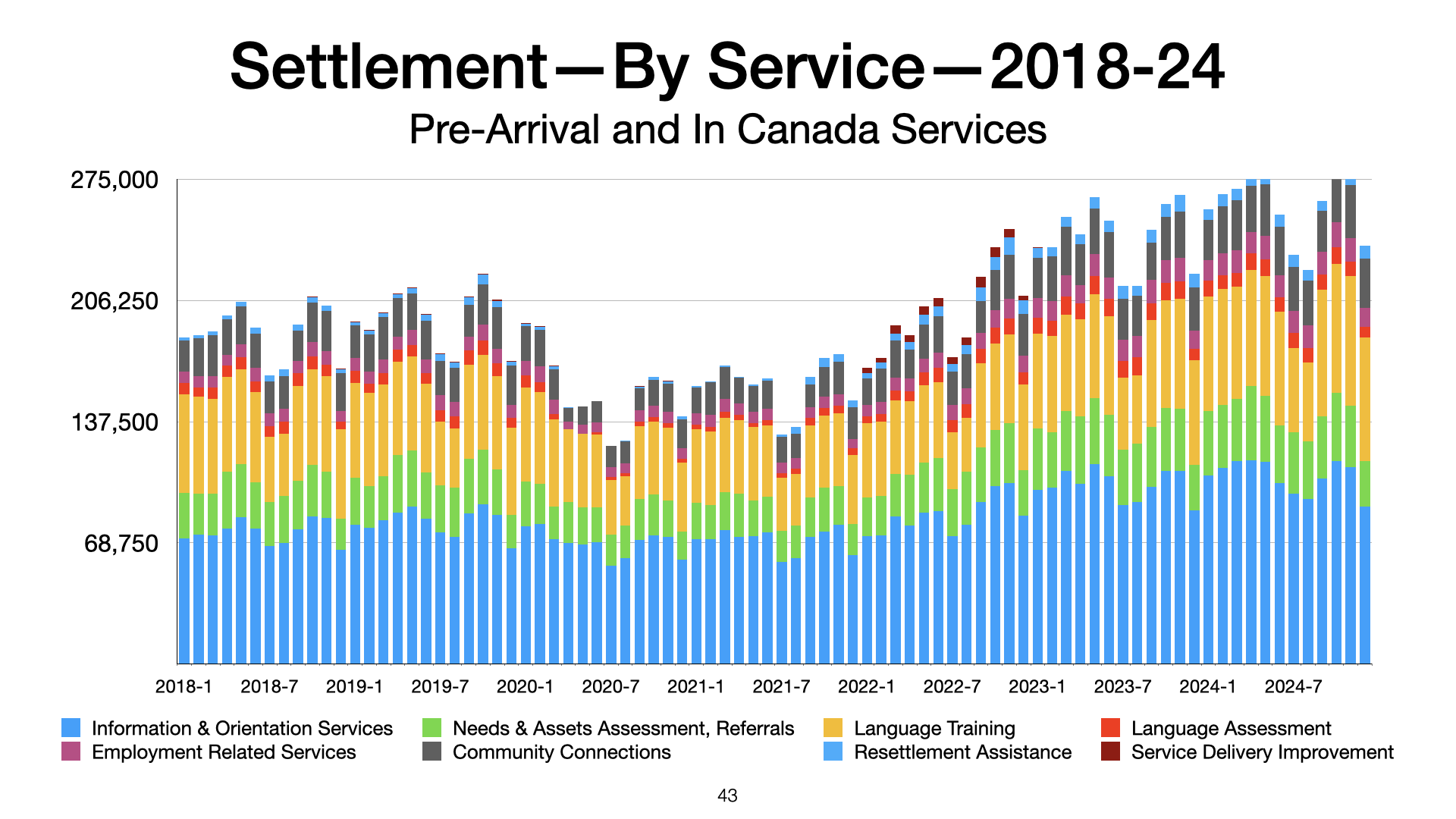
Starting with monthly data, the first chart shows the pandemic dip has been completely eclipsed by post pandemic growth:

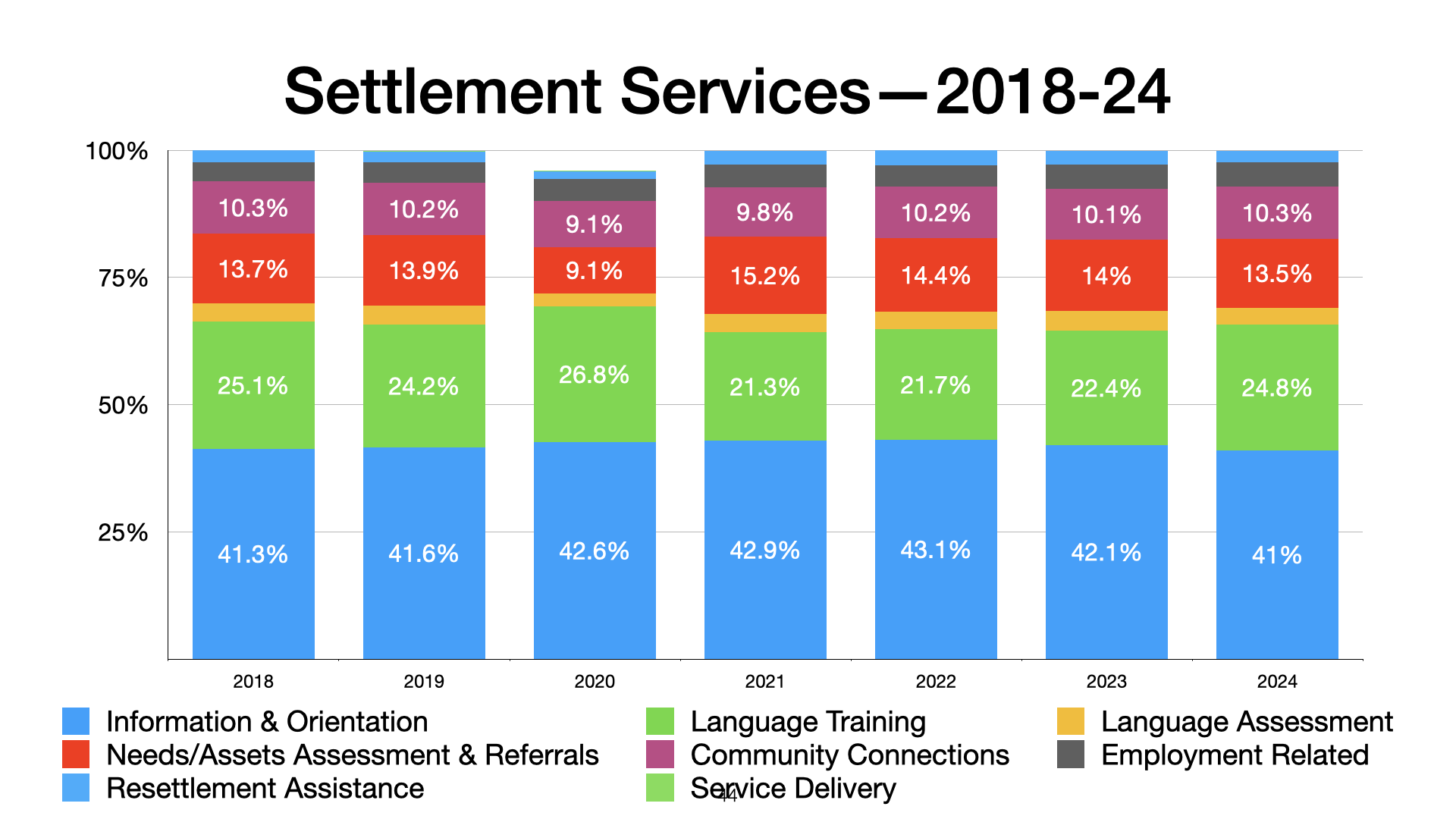
The next chart shows how the proportion of different services has remained relatively constant:

The regional breakdown highlights the sharp increase in settlement services to Europe, driven entirely by those from Ukraine:

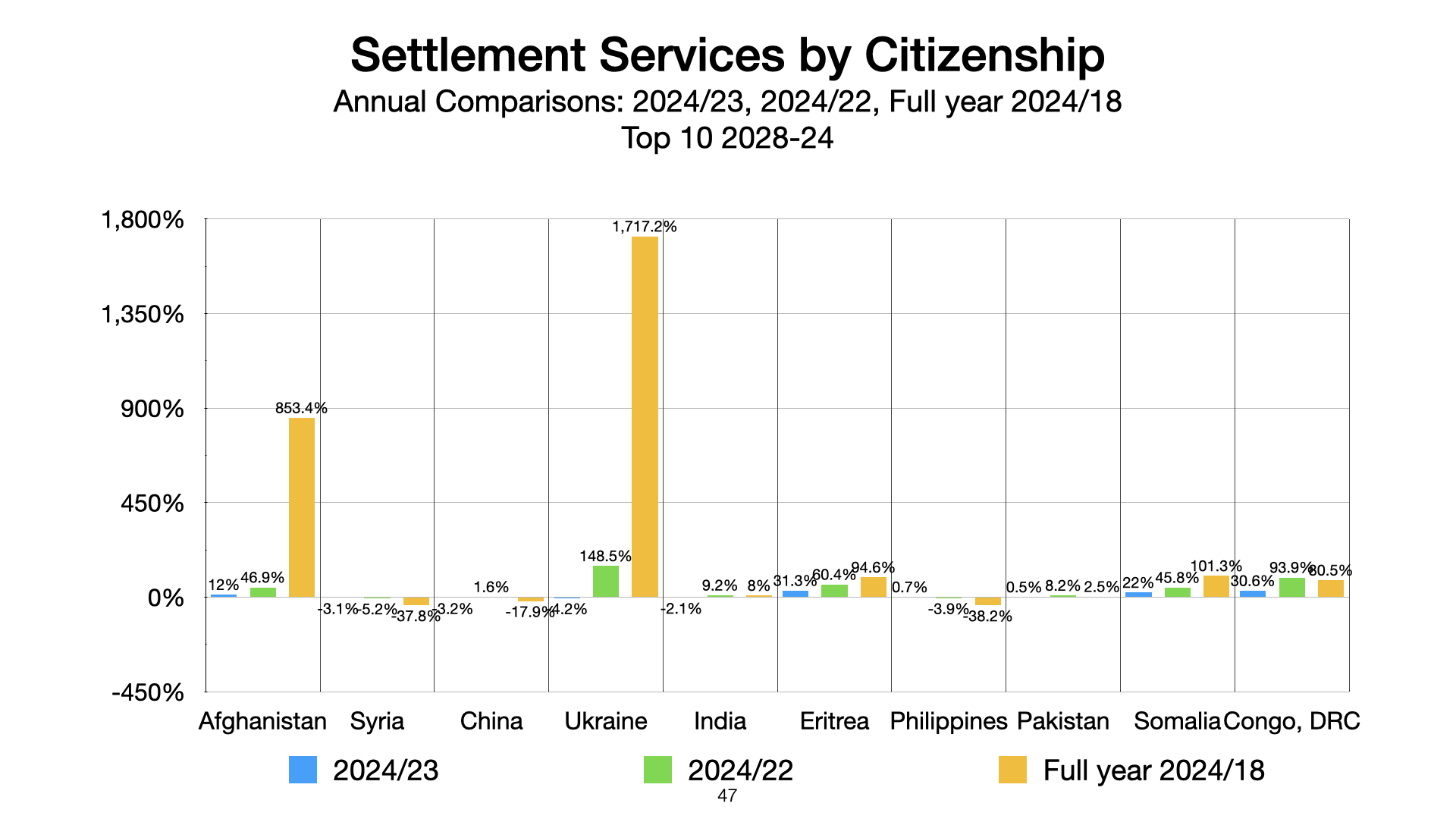
The country view shows not unsurprisingly that it has been Ukraine and Afghanistan where growth has been greatest:

Lastly, usage by province, comparing recent and overall period changes, with Atlantic Canada and Ontario having the largest increase since 2018 (most Quebec settlement services are delivered by the province, not the federal government so hard to compare trends):