The poll referred to in the Elghawaby/Farber op-ed was in 2019, not 2007, and discomfort with Muslims in Quebec has polled somewhat higher than elsewhere in Canada over various polls and time periods.
Quebec periodically has these debates, as Labelle is right to remind us, and of course polling reflects the issues and controversies of the day, and the specific formulation of questions:
Les déclarations de l’ancienne journaliste Amira Elghawaby, nommée au poste de représentante spéciale du Canada chargée de la lutte contre l’islamophobie, suscitent un tollé, avec raison. Elle a, entre autres fausses nouvelles, fait référence aux résultats d’un sondage réalisé en 2007 par la firme Léger selon lesquels 59 % des Québécois se considéraient comme racistes. En tant que journaliste, elle aurait pu examiner de plus près ce sondage pour en constater les failles. Mais un quelconque objectif plus ou moins caché l’aura sans doute emporté sur son éthique de travail.
Le fatidique sondage de 2007
Le 15 janvier 2007, en plein contexte de débats intenses sur les accommodements raisonnables, après que le conseil municipal d’Hérouxville eut adopté un code de conduite ciblant les accommodements religieux, LeJournal de Montréal publiait un sondage réalisé par la firme Léger Marketing par le biais de deux sondages Internet, entre décembre 2006 et janvier 2007, avec un titre choc : « 59 % des Québécois se disent racistes ».
Or, à l’instar de mes collègues Rachad Antonius et Jean-Claude Icart, chercheurs spécialisés comme moi en sociologie du racisme, ces résultats m’apparaissaient immédiatement suspects. Dans la foulée, nous avons publié deux articles à ce sujet, l’un dans La Presse, l’autre dans la revue Éthique publique. Selon notre analyse, plusieurs raisons expliquaient ces résultats aberrants : une définition douteuse du racisme, l’agrégation de catégories non agrégeables, ce que l’on apprenait des attitudes concernant les accommodements raisonnables en comparaison, et l’absence des Premières Nations.
Une définition douteuse et des résultats contradictoires
La définition scientifique du racisme consiste en ceci : « Une idéologie qui se traduit par des préjugés, des pratiques de discrimination, de ségrégation et de violence, impliquant des rapports de pouvoir entre des groupes sociaux, qui a une fonction de stigmatisation, de légitimation et de domination, et dont les logiques d’infériorisation et de différenciation peuvent varier dans le temps et l’espace ».
Or, les sondés devaient réagir à une définition lacunaire : « … au niveau populaire, tous comportements, paroles, gestes ou attitudes désagréables, si mineurs soient-ils à l’égard d’une autre culture… ». Il est peu probable que tous aient saisi la signification profonde du terme « racisme » pour ensuite se juger « racistes ». En fait, ils devaient répondre à des questions (12 à 22) concernant davantage les relations interculturelles, voire l’ethnocentrisme, plutôt que le racisme. Il y avait donc d’entrée de jeu une utilisation déficiente du mot racisme pour exprimer toute une gamme d’attitudes délicates interprétables de façon variable.
Un deuxième problème était le regroupement des sous-catégories (fortement raciste, moyennement raciste, faiblement raciste, pas du tout raciste). Ceux et celles qui se disaient fortement racistes étaient fusionnés avec ceux et celles qui se disaient moyennement ou faiblement racistes, d’où le fameux total de 59 %. Or, que signifiaient exactement le « moyennement raciste » ou le « légèrement raciste » ?
Autre donnée contradictoire : la grande majorité des Québécois (77 %), tout comme la majorité des membres des « communautés culturelles » (80 %) estimaient qu’il n’y a pas de « races » humaines plus douées que d’autres (question 3). Et 78 % des membres des dites « communautés culturelles » déclaraient se sentir bien accueillis.
Comment expliquer ces résultats si 59 % des Québécois étaient racistes ?
D’autres contradictions sur les accommodements raisonnables
Il faut souligner que le sondage Léger Marketing de janvier 2007 s’est tenu dans un contexte chargé. L’opinion publique était chauffée à blanc par les politiciens et les médias sur la question des accommodements raisonnables à caractère religieux.
Dans le même sondage, Léger a donc cru bon d’introduire deux questions sur cet enjeu de société : « Quel énoncé correspond le mieux à votre opinion ? 1. Tous les immigrants devraient respecter les lois et règlements du Québec même si cela va à l’encontre de certaines croyances religieuses ou pratiques culturelles ; 2 « Il est nécessaire d’adopter des accommodements à nos lois et règlements pour ne pas obliger les immigrants à aller à l’encontre de leurs croyances religieuses ou pratiques culturelles ». Le résultat obtenu fut le suivant : « La très grande majorité des Québécois (83 %) croient que les immigrants devraient respecter les lois et les règlements du Québec, même si cela va à l’encontre de certaines croyances religieuses ou pratiques culturelles. Chez les membres des communautés culturelles, 74 % sont du même avis ».
En conclusion, on peut aussi se demander pourquoi le sondeur distinguait « communautés culturelles » et « Québécois », une question de fond dont l’importance politique et citoyenne est immense. Et pourquoi la dimension autochtone a été alors complètement évacuée de l’enquête Le Journal de Montréal publiait en janvier 2007 un tableau intitulé « L’immigration en 5 minutes », dans lequel les 130 165 membres des « Premières Nations » figuraient parmi les « importantes communautés culturelles du Québec » issues de l’immigration ! Une gaffe désespérante…
On peut aussi se demander s’il ne serait pas pertinent de mener des sondages sur les types de préjugés relevant du Québec bashing systémique qui sévit au sein des minorités (un prototype étant celui pratiqué par Mme Elghawaby), à l’égard des Québécois dits « de souche », un incontestable tabou à affronter.
Of note. Legitimate case – MPs voted unanimously in support:
At midnight on Dec. 27, Uyghur public speaker Abdulla Abdulhamit was home when armed Turkish police broke into his house. He was arrested and sent to a deportation centre. Despite numerous attempts by other Uyghurs in Turkey to learn his status, the authorities have not released any information and his fate remains unclear. His family and friends fear that he will be sent back to China, where he is likely to be executed.
In Canada, our Parliament has been clear that Beijing is perpetrating a genocide of the Uyghurs, and they voted unanimously to call it that, consistent with the United Nations 1948 Genocide Convention. While some have criticized Liberal cabinet ministers for being absent from the vote, we can be sure that if the Prime Minister had opposed it, the Liberal whip would have persuaded Liberal MPs to vote nay.
But what can Canadians tangibly do to help the Uyghurs? Liberal MP Sameer Zuberi proposed a motion to call on the government to design a program to bring 10,000 Uyghurs and other Turkic Muslims to Canada over two years. These are Uyghurs in other countries where they are at daily risk of being arrested and deported back to China to be incarcerated in indoctrination camps – what witnesses described to the Parliamentary Committee on Foreign Affairs and International Development as concentration camps – where deaths, torture, rapes and forced sterilizations of womenare common, and where some detainees are executed without trial.
Nearly two million Uyghurs have spent many months of indoctrination in China’s prison-like facilitiesbefore being sent to an actual prison or to factories in other parts of the countryas forced labour. Few are sent home. According to Human Rights Watch, China has put half a million Uyghurs in prison after their time in a camp. This is often because they were not sufficiently contrite in renouncing their culture and religion or accepting the political ideology of Xi Jinping Thought. More than a million Uyghur children are already in indoctrination schools or state-run orphanages to learn Chinese and Xi Jinping Thought, many without sufficient food or clothing for cold weather.
Uyghurs who have escaped west to Middle Eastern and Central Asian countries have often left China without documentation, and so have become stateless. Officials and agencies in those countries may be vulnerable to China’s political and financial pressure. Consequently, the Uyghurs are often deprived of services such as health care, schooling, and work or residence permits that would allow them to integrate into the community. It is therefore difficult for them to meet their basic social needs or develop future employment prospects. These Uyghurs are also at serious risk of rendition to China. Thousands have already been sent back only to disappear into the camps and prisons, or worse.
China’s policy of genocide for the Uyghur people is well known around the world. Less known is Beijing’s identification of “nine forbidden countries,” including Turkey and the UAE, where Chinese citizens should not go unless they have an approved reason to be there. These countries are popular destinations for Uyghurs, as they are already home to established communities of that culture. By having an explicit policy, Beijing can try to pressure those countries to deport any Uyghurs. Indeed, it has been reported that the UAE has a Chinese-run detention centrefor Uyghurs and other critics of China in Dubai.
The vote on Mr. Zuberi’s Motion-62 will be held in the House of Commons on Feb. 1. The first and second debates in October were strongly supported by MPs of all parties, so success is a good possibility. If passed, Immigration, Refugees and Citizenship Canada will design a funded program for 2024 to 2026 to bring Uyghurs and other Turkish Muslims as refugees from third countries to Canada, where they will be safe and will contribute positively to society as thousands of other Uyghurs have already. We have done this before for Vietnamese, Syrians and others who have become stellar citizens.
Hundreds of Uyghurs will be in the gallery of the House of Commons for the vote. If Motion-62 passes, it will give Canadians the concrete measures that Parliament’s earlier vote on the genocide really demands. And if cabinet ministers vote in favour, they will be giving a strong signal for meaningful action. Canada will be leading the world in supporting Uyghur refugees at dire risk – people such as Abdulla Abdulhamit.
Mehmet Tohti is executive director of the Uyghur Rights Advocacy Project. Margaret McCuaig-Johnston is a senior fellow with the Graduate School of Public and International Affairs at the University of Ottawa.
Quiconque veut venir en visite au Canada pourrait devoir s’armer de patience avant de pouvoir le faire. Alors qu’Ottawa avait promis une réduction du temps de traitement et promettait un retour à la normale à la fin de 2022, Le Devoir a constaté que les délais officiels pour obtenir un visa de visiteur n’ont pas diminué et qu’ils ont, au contraire, explosé.
En six mois, entre juillet 2022 et janvier 2023, les délais affichés ont empiré dans 179 pays sur 195. Dans certains cas, les autorités consulaires canadiennes mettent parfois un an et demi à traiter des demandes de visa, selon les données officielles affichées sur le site d’Immigration, Réfugiés et Citoyenneté Canada (IRCC) que Le Devoir a compilées.
« Ce n’est pas juste les délais en ligne qui sont longs, c’est ça aussi dans les faits », affirme Me Léa Charbonneau-Lacroix, avocate associée chez Brunel Immigration et qui traite plusieurs dossiers de visas de visiteur. Celle-ci a déposé des demandes au printemps, à l’été et à l’automne derniers pour des clients. Elle a reçu plusieurs approbations récemment et, « tous pays confondus », les délais étaient de huit ou neuf mois. « Des pays d’Afrique, d’Amérique du Sud, d’un peu partout, détaille-t-elle. Des fois, des gens veulent venir en vacances et ils vont attendre un an pour avoir une décision. C’est un peu irréel. »
En Tanzanie, les délais battent des records. Alors qu’un visa pouvait être obtenu en 64 jours en juillet dernier, il met maintenant dix fois plus de temps à être délivré, soit plus d’un an et demi (611 jours). Au Honduras, alors que le temps d’attente était de 82 jours en juillet, il est passé à 502 jours en janvier. Au Nicaragua, la situation est pratiquement la même, à quelques jours près.
Les délais s’allongent partout, même en Europe. Au Royaume-Uni, les délais sont 22 fois plus longs. Les Britanniques n’ont pas besoin de visa, mais ceux qui ne sont pas citoyens et qui ont besoin d’un visa de visiteur pour le Canada peuvent y déposer une demande. Ils doivent désormais attendre 222 jours, alors qu’un tel visa prenait à peine dix jours à être délivré il y a six mois. En Grèce, un visa qui prenait trois semaines à arriver met maintenant dix fois plus de temps.
Promesse non tenue ?
L’été dernier, à la suite d’une série d’articles du Devoir sur les longs délais de traitement pour les visas de visiteur et les permis de travail, le ministre de l’Immigration, Sean Fraser, avait réitéré l’engagement d’Ottawa de diminuer les délais pour permettre le retour aux normes de service d’ici la fin de l’année.
« On est vraiment proches du pic attendu [de l’attente pour un visa], avait affirmé le ministre Fraser fin août dernier. C’est possible qu’il y ait encore une hausse pendant à peu près un mois, mais on s’attend à ce qu’il y ait ensuite une réduction considérable du temps d’attente pour la délivrance d’un visa de visiteur [ou] pour différentes voies d’immigration. »
Selon le site de l’IRCC, la « norme de service » est un délai de 14 jours pour un visa de visiteur.
« Ce n’est pas ça qui se passe, tranche Me Léa Charbonneau-Lacroix. Nous ne sommes vraiment pas à un retour à la normale, loin de là. »
Une demande déposée par son cabinet en mai pour un client résidant en Côte d’Ivoire, où le délai officiel de traitement est de 518 jours, est toujours en attente. « C’est un dossier avec un certain risque de refus, mais ce n’est pas un dossier problématique. Ce n’est pas quelqu’un avec des antécédents, dit-elle. C’est vraiment étonnant. »
« Avant la pandémie, un bureau de visa qui avait des délais d’un mois, on trouvait ça anormalement long, renchérit-elle. On avait des gens qui voulaient voyager dans trois ou quatre mois et, normalement, on avait une décision avant. Là, il faut qu’une personne s’y prenne un an en avance si elle veut voyager au Canada. »
IRCC s’explique
La pandémie COVID-19 a causé un arriéré important dans le traitement des demandes. Plusieurs demandes datant d’avant la levée des restrictions pour voyager en septembre 2021 n’ont pas été traitées, et le gouvernement fédéral assure avoir embauché les 1250 employés qu’il avait promis pour la fin 2022 afin d’accélérer le traitement.
« Il est également important de noter qu’au fur et à mesure que nous traitons l’arriéré de demandes, les délais de traitement peuvent être faussés par des valeurs aberrantes, en particulier les demandes de notre ancien inventaire qui étaient auparavant en attente pendant une longue période et qui sont maintenant en cours de traitement, écrit IRCC au Devoir. Une fois l’arriéré de ces demandes éliminé, nous commencerons à voir des délais de traitement plus représentatifs de la réalité. »
14 jours
C’est la « norme de service » pour l’obtention d’un visa de visiteur, selon le site d’IRCC, mais dans plusieurs pays, les délais dépassent 100 jours.
Le délai par pays est mesuré sur la base du temps qu’il a fallu pour traiter 80 % des demandes déposées au cours des deux à quatre derniers mois.
Le cabinet du ministre Sean Fraser insiste de son côté pour dire qu’il y a eu des « améliorations importantes au cours des derniers mois ». « Sur une base mensuelle, le Canada traite désormais plus de demandes de visas de visiteur qu’avant la pandémie, écrit-on. Rien qu’en novembre 2022, plus de 260 000 visas de visiteur ont été traités. En comparaison, la moyenne mensuelle en 2019 était d’environ 180 000 demandes. »
Délais « de non-traitement »
Cette explication convainc à moitié. La présidente de l’Association des avocats et avocates en immigration, Stéphanie Valois, trouve cet allongement des délais « gênant » pour le gouvernement. « Comment peut-il demander aux gens des tarifs pour le traitement des dossiers alors que manifestement, ce n’est pas traité ? »
Me Denis Girard parle même de « délais de non-traitement ». L’avocat tente depuis le 28 juillet dernier d’aider une mère résidant au Bénin à obtenir un visa de visiteur pour qu’elle puisse venir visiter son fils, un résident permanent. Celle-ci était encore sans nouvelle en date du 29 janvier, soit six mois plus tard. Les délais officiels étaient de 167 jours en septembre l’année dernière. Ils ont ensuite bondi à 209 jours en novembre, pour repasser à 160 jours le 25 janvier.
Me Charbonneau-Lacroix dénonce surtout le manque de fiabilité des délais officiels affichés. « Moi, je dis à mes clients, n’achetez pas de billets d’avion tant que vous n’avez pas de visa dans votre passeport, parce qu’en ce moment, on peut s’attendre à tout et son contraire, lance-t-elle. C’est un peu embêtant pour les personnes qui veulent organiser un voyage, visiter leur famille. Ils ne peuvent se fier à rien de tangible. »
Of note. Perhaps instead of trying to delay the trend, more thought and preparation is needed to prepare and manage the decline:
The shoe has dropped. The big one. China, the most populous country on the planet for centuries, this month reported its first population decline in six decades, a trend that is almost certainly irreversible. By the end of the century China may have only around half of the 1.41 billion people it has now, according to U.N. projections, and may already have been overtaken by India.
The news has been met with gloom and doom, often framed as the start of China’s inexorable decline and, more broadly, the harbinger of a demographic and economic “time bomb” that will strain the world’s capacity to support aging populations.
There is no doubt that a shrinking global population — a trend expected to set in by the end of this century — poses unprecedented challenges for humanity. China is only the latest and largest major country to join a club that already includes Japan, South Korea,Russia, Italy and others. Germany would most likely be in decline too if not for immigration, and many others could begin shrinking in the years ahead. (The United States is expected to grow moderately in coming decades, largely because of immigration.) Median U.N. projections point to global population peaking in the mid-2080s at more than 10 billion, but if fertility rates continue to drop, the decline could begin decades earlier.
But the alarmist warnings are often simplistic and premature. The glass is at least half full. Shrinking populations are usually part of a natural, inevitable process, and rather than focus excessively on concerns like labor shortages and pension support, we need to look at the brighter spots for our world.
There is no need for panic; we’ve made that mistake before.
In the second half of the 20th century the world was panicking about unstoppable population growth. The number of people on the planet more than tripled in seven decades, from 2.5 billion in 1950 to around eight billion in 2022. Turns out, that was a transitory phase when mortality rates fell faster than fertility rates because of improved nutrition and public health, and relative peace.
But panic can lead to hasty policy and human tragedy. This reached its fullest form with China’s extreme birth-control campaigns launched in the late 1970s and which caused immense suffering, mostly for women, through forced abortions or fines and other penalties for breaking rules that restricted most couples to having only one child. Until those limits were scrapped beginning in 2015, hundreds of millions of Chinese women underwent sterilization procedures or had intrauterine devices inserted.
The population declines seen today in some countries have come about largely as a happy story of greater longevity and freedom. Fertility rates worldwide dropped from more than five births per woman in the early 1960s to 2.3 in 2020. Credit greater investment in child and maternal health everywhere: A mother who successfully brings her child to term and an infant who survives to childhood lower birthrates because parents often don’t feel the need to try again. Greater availability of free or affordable contraception has also reduced unwanted births.
China, South Korea and Japan are now all in population decline, but this is in part because of rapid increases in income, employment and education. The number of South Korean women who went on to postsecondary education rose from 6 percent in 1980 to more than 90 percent by 2020; China and Japan also have seen big gains. Lower birthrates stem in part from greater personal and reproductive freedom, such as the choice to stay unmarried, higher pay and more professional opportunities for women in these nations.
More women in the work force is a recipe for even greater productivity and prosperity and could help ease labor concerns among falling populations. More women than ever are rising to leadership positions in business, media and politics.
Compared with a half-century ago, people in many countries are richer, healthier and better educated and women are more empowered. China’s population, for example, is shrinking and aging, but its people are more educated and have a longer life expectancy than at any time in the country’s history. Expanded educational opportunities guarantee a spot in a university for almost every person born today in China, including more women than men.
Average world life expectancy has increased from 51 years in 1960 to 73 in 2019, and even more so in China, from 51 in 1962 to 78 in 2019. Increases of that magnitude reshape lives and open up opportunities unimaginable when life spans were shorter, such as workers remaining productive later in life and growing markets for older consumers in areas like tourism, nutritional supplements and medical devices, among others.
Fewer people on the planet, of course, may reduce humanity’s ecological footprint and competition for finite resources. There could even be greater peace as governments are forced to choose between spending on military equipment or on pensions. And as rich nations come to rely more on immigrants from poorer countries, those migrants gain greater access to the global prosperity currently concentrated in the developed world.
This new demography brings new challenges, including the need to offer quality and affordable child care, make college education more affordable and equitable, provide guaranteed minimum income and make societies more gender equal. Governments should abandon the mindless pursuit of economic growth in favor of well-being for citizens.
There is no reason the world’s population must keep growing or even remain level. And just as earlier panic led to harmful policies in China and elsewhere, efforts to raise fertility — which may prove futile — risk viewing women once again as birth machines.
Global population will inevitably decline. Rather than trying to reverse that, we need to embrace it and adapt.
That is the focus of a new drive against racism, anti-Semitism and discrimination of all kinds that was announced Monday by French Prime Minister Elisabeth Borne.
The four-year plan starts with educating youth with a required yearly trip to a Holocaust or other memorial site exemplifying the horrors that racism can produce. It includes training teachers and civil servants about discrimination and toughening the ability to punish those denounced for discrimination.
Arrest warrants will be issued to those who use freedom of expression for racist or anti-Semitic ends.
Unusually, the plan includes fighting discrimination against Roma.
“There will be no impunity for hate,” Borne said, presenting her plan with 80 measures at the Institute of the Arab World.
Tolerance is on the rise, “but hate has reinvented itself,” she said.
“Our first challenge is to look squarely at the reality of racism and anti-Semitism and cede nothing to those who falsify history, who rewrite our past, forgetting or deforming some pages,” Borne added.
Some people working for years in French associations against racism and discrimination are skeptical about the plan, reject it outright or are reserving their judgement.
Even Kaltoum Gachi, a co-president of the anti-racist MRAP organization — which contributed a proposal — told The Associated Press that her group “will be vigilant to see if, concretely, (the plan) bears fruit.”
France’s government has rolled out a succession of plans over five decades, the latest in 2018, to grapple with racism, anti-Semitism and discrimination. Still, the estimated number of victims who suffered as least one racist, anti-Semitic or xenophobic attack was 1.2 million per year, according to the National Consultative Commission on Human Rights.
Social media and a rising far-right fearful of the disappearance of the nation’s Christian roots in an increasingly multi-cultural France have added new dimensions to the fight against racism. Generations of citizens from former colonies in mostly Muslim north and west Africa have over decades given the nation a new face.
Gachi, the MRAP co-president and a lawyer, told those attending the presentation that 25 years ago, her younger brother Kamel failed in numerous requests for a job interview with an automaker — until he changed his name to Kevin.
Just on Monday, Gachi, a lawyer, said in an interview with The AP that she spoke with a youth with the same problem, a humiliating experience that leaves a lasting mark. She added that dignity, not just equality, is part of the equation.
Names, addresses and looks have long been a roadblock for people with origins outside France. Regular testing in private and public places of employment will be part of the new anti-discrimination effort, though the exact method is still being devised.
Borne said her plan will also offer victims of racism and discrimination the possibility to file complaints outside a police station, and in a “partially anonymous” way. She did not elaborate.
The plan will also make it “an aggravating circumstance” if someone in authority, such as a police officer, uses racist or discriminatory words to someone.
However, Borne’s plan dodges some sensitive areas, notably failing to directly tackle discrimination and racial profiling within the nation’s powerful police force.
Omer Mas Capitolin, a founder of the grassroots Community House for Supportive Development, said the measures are not sufficient.
“There is a denial of systemic discrimination,” not mentioned once in the plan, he told the AP.
His organization is one of a group of NGOs that launched a class action suit in 2021 against France’s powerful police in 2021, contending that it lawfully propagates a culture leading to systemic discrimination in identity checks. But for Mas Capitolin, who spoke on a personal level, alleged systemic discrimination goes beyond law enforcement to sectors like housing and jobs.
Mas Capitolin also criticized the timing for unveiling the plan on a day parliament opens debate on a hotly contested pension plan and on the eve of a planned protest march.
Representative of the favourable commentary to her appointment. I agree, if she hadn’t been public on her opposition to Bill 21 and the public attitudes behind it and previous Quebec debates, she would have no credibility. It is more with respect with her other positions that questions can be asked:
It took 18 months for the Trudeau government to carry through on its promise to name a “special representative” to combat Islamophobia. It took just 24 hours for that appointment to blow up in its face.
Last Thursday the government announced it had named Amira Elghawaby to the position. Elghawaby is well known to us at the Star; she’s been contributing thoughtful, insightful articles to our opinion pages for several years on all sorts of subjects, with a focus on social justice issues.
It was an excellent and well-deserved appointment. The government patted itself on the back for making it a few days before the anniversary of the Quebec City mosque massacre. Prime Minister Justin Trudeau called it an “important step” in the fight against “hatred in all its forms.”
Cue the outrage in Quebec. A federal Liberal minister (Pablo Rodriguez) professed to be “profoundly insulted” as a Quebecer by Elghawaby’s comments. Trudeau called on her to “explain” them. By Monday, the Quebec government was demanding her resignation. And Pierre Poilievre found the time to craft a video attacking Trudeau for appointing someone he smeared as “anti-Quebec, anti-Jewish and anti-police.”
Poilievre’s attack is particularly sleazy. His real target isn’t Elghawaby. She’s just road kill in his assault on the Trudeau government and all its works.
It’s also BS. The idea that Elghawaby thinks Quebecers are Muslim haters is based on an article she co-wrote in 2019 for the Ottawa Citizen with Bernie Farber, who is a human-rights activist as well as being Jewish. They cited a poll showing 88 per cent of Quebecers who hold anti-Muslim views supported Bill 21, and wrote that “unfortunately” most Quebecers seemed at that moment to be swayed “by anti-Muslim sentiment.”
Frankly, viewed in the context of the time, when Quebec had just passed the most discriminatory law in modern Canadian history, the article is remarkably moderate. It decries the “tyranny of the majority” and ends with an appeal to uphold “basic human rights and dignity” for all.
Elghawaby’s other supposedly offensive comments have also been twisted out of shape. As for being “anti-Jewish,” her appointment was welcomed by the Centre for Israel and Jewish Affairs, the country’s leading Jewish organization, as well as by Irwin Cotler, Canada’s special representative on antisemitism. If she’d taken anti-Jewish positions, you’d think they’d have noticed.
I don’t agree with quite a bit of what Elghawaby has written, such as her view that Canada should abolish the monarchy. But so what? I haven’t seen a thing she’s written that goes beyond the bounds of reasonable debate (and no, I don’t include the occasional badly worded tweet).
As a human-rights activist she challenges Canadian complacency, but that hardly disqualifies her from serving (in the words of the government’s announcement) as a “champion, adviser, expert and representative” on fighting anti-Muslim hatred. On the contrary.
Some will argue that, regardless of all this, her appointment is “divisive” — the evidence being the reaction to it in Quebec. But the truth is that while hatred of all sorts knows no political boundaries, there is a particular problem with the way Quebec handles issues of religious tolerance and minorities.
The evidence for that is plain for all to see in Bill 21 itself, which is blatantly discriminatory and racist in effect if not in intent. Sure, there’s a complicated history behind all this. But if Islamophobia can’t be frankly confronted in Quebec, of all places, there’s no point in having a national representative on the issue.
On Monday, the prime minister said he’s satisfied with Elghawaby’s explanation of her past remarks and she will remain in place. That’s absolutely the right decision. In fact, the uproar around her appointment is the best possible demonstration of the need for putting someone like her in the job.
Valid contrast. One does have to question the Liberal’s vetting process and their political understanding of Quebec as this reaction among the Quebec commentariat and politicians was likely:
One of the more astonishing scenes in Canada’s recent political history occurred over the weekend as Prime Minister Justin Trudeau, his Quebec lieutenant and Canadian Heritage Minister Pablo Rodriguez, and Industry Minister François-Philippe Champagne took turns wagging their fingers at Amira Elghawaby. She had been installed only the day before as Canada’s first official representative to combat Islamophobia, on the eve of the anniversary of the 2017 massacre at the Islamic Cultural Centre in Quebec City.
Champagne said he was “worried.” He suggested Elghawaby should take time to reflect upon what she had done. From his fainting couch, Rodriguez declared himself “wounded and shocked as a Quebecer.”
“I certainly don’t agree with her words and I expect her to clarify them,” Trudeau tutted.
Elghawaby’s crime? Elghawaby’s campaigning against Islamophobia actually extends to Quebec.
The controversy began Friday when La Presse unearthed a 2019 op-ed in the Ottawa Citizen, co-written by Elghawaby and fellow Canadian Anti-Hate Network board member Bernie Farber, lamenting the recent passing of Bill 21 — the Quebec legislation, now in force, banning civil servants in certain positions of state authority (notably teachers) from wearing religious garb on the job.
“Unfortunately, the majority of Quebecers appear to be swayed not by the rule of law, but by anti-Muslim sentiment,” Elghawaby and Farber argued. “A poll conducted by Léger Marketing earlier this year found that 88 per cent of Quebecers who held negative views of Islam supported the ban.”
This is not a controversial statement — certainly not by the standards of those who campaigned against Bill 21, as any reasonable appointee to Elghawaby’s new position would have done, Bill 21 being the most Islamophobic thing going in this country.
The pointless 15-year “reasonable accommodations” psychodrama that produced the Bouchard-Taylor Commission, the Parti Québécois’ failed “values charter” and eventually Bill 21 had some Jewish content, particularly around the issue of kosher food at Montreal’s Jewish General Hospital. The Supreme Court’s 2006 decision allowing Sikh students to wear kirpans at school is somewhere in the primordial ooze of this debate.
But no one can honestly deny that the vast majority of the angst was over Islam, and what some of its adherents choose to wear. The notion that the hijab (as opposed to the niqab or burqa) represents a radical, political and evangelical form of Islam is commonly heard in Quebec, and almost never anywhere else in Canada.
The aforementioned 2019 Léger poll found Quebecers’ “net positive” view of Catholics — i.e., positive minus negative – was 66 per cent; of Jews, 55 per cent; of Muslims, 37 per cent. Moving on to personal religious symbols, the net positive view of crucifixes was 59 per cent. The net positive view of kippas was 37 per cent. Of hijabs, 28 per cent. (Keep that in mind the next time someone tells you Bill 21 was a principled extension of the Quiet Revolution. It’s a neat trick, casting off the shackles of the Catholic Church while remaining resolutely pro-crucifix.)
When put on the defensive, Bill 21 supporters will often point out that the idea has support in the Rest of Canada. It’s true to a point: An Abacus Data poll last year found 30 per cent of Canadians outside Quebec liked the idea. But the figure in Quebec was 53 per cent. And rather crucially, Quebec is the only province where any politician in any party has even proposed such a law, never mind followed through on it to popular acclaim.
Elghawaby, an activist and journalist, has committed other rhetorical crimes, especially from the Quebec-nationalist point of view. In 2021, she declared herself nauseated by University of Toronto historian Joseph Heath’s contention that “the largest group of people in this country who were victimized by British colonialism, subjugated and incorporated into confederation by force, are French Canadians.” She has advocated for prayer rooms in public schools, and for including non-Christian holidays on official Canadian calendars. You could hardly pick two better positions to empurple a nationalist with a newspaper column or a seat in a legislature.
“One wonders how this person, with so many prejudices against Quebecers and clearly incapable of understanding the importance of secularism in the historical and social development of Quebec, could help improve the ambient climate and mutual understanding,” professors Nadia El-Mabrouk and François Dugré argued this weekend in La Presse.
She can’t. Almost certainly, no one can. Discussions in this country about Islamophobia, racism, minority rights and everything in that neck of the woods exist in two hermetically sealed chambers: One for Quebec, and one for everyone else. It’s basically impossible to speak to both worlds at once. But if anyone were capable of it, the minimum they would need is to be appointed by a government willing to support her when one world or the other got a bit offended.
As it stands, both the Quebec government and the opposition Conservatives in Ottawa are demanding Elghawaby’s resignation. The Liberals, having denounced her for no good reason, are making it easier, not harder, for them to do so. And they look as ridiculous doing it in Quebec as in the Rest of Canada. Asked Monday by reporters how he responded to the calls for Elghawaby to resign, Trudeau offered up some typically tawdry bafflegab: “She is there to speak for the community, with the community, and build bridges across. Obviously she has thought carefully over many years about the impacts that various pieces of legislation, various political positions, have had on the community. Her job now is to make sure that she’s helping the government and helping everyone.”
Not for the first time with the Trudeau gang, we are left with two simple but baffling questions: What the hell do they think they’re doing? And why haven’t they heard of the internet?
Le Devoir had three commentaries on the appointment, highlighting how this appointment and her comments on Bill 21 and anti-Muslim sentiment have resulted in a “cue the outrage” response, even if her comments were in line with what other commentators and public figures have and continue to state.
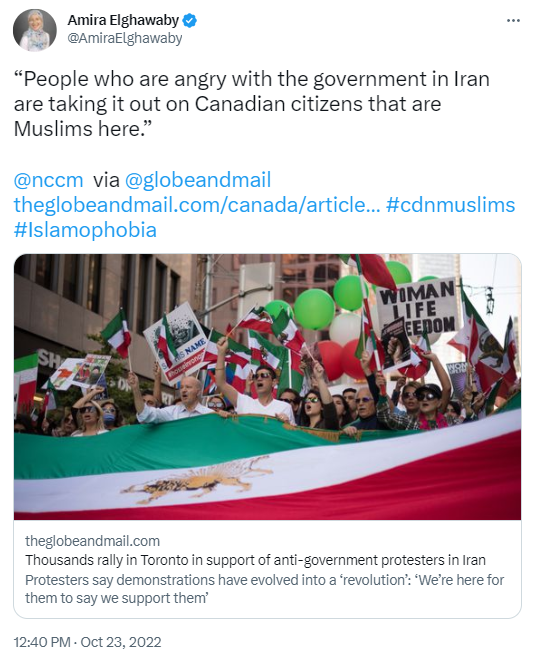
Interestingly, there has also been some pushback by members of the Iranian Canadian community, partly driven by their visceral reaction to the hijab, given that the Iranian regime forced it on women and the recent protests against the mandatory hijab and regime. Kaveh Shirooz has been active on twitter pointing out that Elghawaby has argued that “People who are angry with the government in Iran are taking it out on Canadian citizens that are Muslims here,” rather than criticizing the Iranian regime for its repression (Google search does not show any other commentary on the Iran protests unless I missed it).
I suspect that her appointment may be more divisive within the Canadian Muslim community than might first meet the eye, between the more secular and more religious.
Will be interesting to see whether these reactions continue or fade out:
.@HonAhmedHussen: in 2021, I told the CBC that we need to distinguish between anti-Muslim hatred [obviously bad] and opposition to Islam as an ideology [which is everyone’s right]. This was Ms. @AmiraElghawaby‘s reply. Will she make that distinction in her new role? twitter.com/HonAhmedHussen…
.@HonAhmedHussen I note that as people were (and continue to be) slaughtered in Iran for the right to live free of religion, this was Ms. @AmiraElghawaby ‘s contribution. I’ve been close the protests in the diaspora: to suggest that targetting Muslims represents anything but the absolute most minor fringe in these protests is absolutely dishonest. And yet that’s what Ms. Elghawaby chose to focus on. This was a poor choice, Minister.
Lisée: “I want to puke”
Elle m’a eu au mot « vomir ». En anglais, puke. Je parle d’Amira Elghawaby, la nouvelle conseillère spéciale de Justin Trudeau en matière d’islamophobie et d’antiracisme. C’était il y a huit mois. Le Globe and Mail avait mis sur son fil Twitter le texte d’opinion d’un professeur de philosophie de l’Université de Toronto, Joseph Heath, affirmant que les concepts utilisés par les militants antiracistes canadiens, importés des États-Unis, ne pouvaient s’appliquer correctement à l’histoire canadienne du racisme.
Mme Elghawaby a commenté le tweet, choisissant et retranscrivant spécifiquement le passage qui suit : « Enfin, il convient de noter que le plus grand groupe de personnes dans ce pays qui ont été victimes du colonialisme britannique, subjugué et incorporé à la confédération par la force, sont les Canadiens français. » Au-dessus de cette citation, la militante a écrit : « I’m going to puke » (« Je vais vomir »).
Croyez-moi, j’ai tenté de trouver une autre explication. Mais la seule qui s’impose est la suivante. Mme Elghawaby était à ce point outrée que quelqu’un rappelle qu’en nombre, sinon en intensité, les francophones ont été les plus grandes victimes du colonialisme que sa réaction ne fut ni de contre-argumenter, ni d’affirmer Lison désaccord, ni d’ignorer simplement ce point de vue. Non. Elle a souhaité que tous ses abonnés sachent que la seule évocation de l’importance de l’oppression vécue par les Canadiens français lui causait une violente réaction, physique — au sens propre, « viscérale » — de rejet.
Justin Trudeau, qui était fier de présenter sa nouvelle recrue dimanche à la commémoration de l’horrible tuerie de la mosquée de Québec il y a six ans, a déclaré qu’elle était la personne choisie pour « bâtir des ponts avec les Québécois et les autres Canadiens ». Si c’est vrai, on aimerait avoir la liste de ceux qui n’ont pas été retenus. Don Cherry ? Amir Attaran ?
Pablo Rodriguez qui est, comme l’a dit récemment M. Trudeau au sujet d’un autre de ses ministres, un « bon Québécois », s’est déclaré « profondément insulté et profondément blessé » par un autre propos formulé par écrit par Mme Elghawaby. En effet, dans un texte, toujours en ligne, dans l’Ottawa Citizen, cosigné par l’ex-président de la section ontarienne du Congrès juif canadien Bernie Farber et s’opposant à la loi 21, on lit : « Malheureusement, la majorité des Québécois semblent influencés non pas par la primauté du droit, mais par des opinions négatives envers l’islam. Un sondage réalisé par Léger Marketing plus tôt cette année a révélé que 88 % des Québécois qui avaient des opinions négatives sur l’islam appuyaient l’interdiction. » (Je dois avouer que j’ai moi-même des opinions négatives envers le christianisme, l’islam et toutes les autres religions.)
Cela voulait-il dire que Mme Elghawaby estimait que les Québécois sont islamophobes, selon le mot désormais accepté à Ottawa et qui signifie à la fois sentiment anti-musulman et toute critique de l’islam, quelle qu’elle soit ? Mais non ! Qu’allez-vous chercher là ? Sur son fil Twitter, la dame nous a rassurés vendredi dernier : « Je ne crois pas que les Québécois sont islamophobes ; mes commentaires passés faisaient référence à un sondage au sujet de la loi 21. » Affirme-t-elle maintenant que ce sondage était fautif ? A-t-elle de nouvelles données ?
Si elle s’est trompée dans ce texte, elle a récidivé dans un autre, de 2020, du Toronto Star. Après avoir cité un membre de la communauté musulmane de Québec, Rachid Rafah, affirmant qu’« au Québec, les gens ne peuvent pas admettre qu’il y a des problèmes dans cette société. Je ne sais pas pourquoi ». Elle ajoute : « Il n’y a pas que la plupart des Québécois qui sont dans le déni », trop de Canadiens le sont aussi.
Si on prend le temps de lire ses écrits un peu plus vieux, on ne peut que déceler une constante dans son appréciation des Québécois, superbement étalée dans ce texte de 2013 du Star sur la charte des valeurs. Elle cite d’abord le livre A Fair Country, de John Ralston Saul : « Dans tout le monde occidental dans la seconde moitié du XIXe siècle, les civilisations de la classe moyenne, enchaînées et obsédées par l’empire ont progressivement glissé vers les peurs paranoïaques du XXe siècle. Peur de quoi ? Peur de la perte de pureté — sang pur, pure race, purs traits nationaux et valeurs et liens. »
Son commentaire : « Il aurait pu écrire cela au sujet du Québec d’aujourd’hui. Les sondages favorables à la charte indiquent que [Pauline] Marois a puisé dans une paranoïa viscérale de l’autre qui hante parfois les communautés avec un effet tragique. » Elle se désole ensuite que certains se résignent à ce que « la province ne changera jamais, restant un bastion forcé et statique de la culture et de l’identité françaises ; un rêve partagé qui nie le rôle et la présence des Premières Nations au départ, et celles des minorités qui sont venues plus tard ? ».
Plus près de nous, son texte de l’Ottawa Citizen recèle une autre pépite. Elle y donne un avis bien senti, spécifiquement sur François Legault : « Le premier ministre de la province continue de nier l’existence de l’islamophobie, y compris les expériences des Québécoises qui disent avoir ressenti un racisme croissant au cours des derniers mois. Les politiciens qui flattent les tendances xénophobes doivent être appelés sur le tapis. » Bang !
Avis à ceux qui assisteront à leur première rencontre : apportez vos sacs à vomir.
Interprétant de façon abusive un sondage sur l’attitude des Québécois à l’égard de l’islam, Amira Elghawaby a écrit en 2019 que « la majorité des Québécois semblaient influencés non pas par la primauté du droit, mais par un sentiment antimusulman ». Il est difficile de savoir ce qui est pire : que les Québécois s’opposent à la règle de droit ou qu’ils soient antimusulmans. On peut constater que la représentante spéciale, pur produit de l’idéologie multiculturaliste canadienne, a pris quelques libertés avec les faits. Le communiqué du premier ministre la décrit d’ailleurs comme une journaliste primée et une militante, comme s’il n’y avait pas là contradiction dans les termes.
Un passage d’une chronique publiée dans The Globe and Mail par le professeur de philosophie Joseph Heath, de l’Université de Toronto, lui a donné envie « de vomir », avait-elle écrit spontanément sur Twitter en 2021. Un passage où l’universitaire faisait observer que le plus grand groupe de personnes qui furent victimes du colonialisme britannique au Canada, c’étaient les Canadiens français.
La thèse de Joseph Heath est pourtant intéressante. Il relève qu’au Canada anglais, on utilise l’acronyme américain BIPOC (Black, Indigenous and people of color), qui ne correspond à la réalité canadienne des relations raciales. Aux États-Unis, les Noirs représentent la minorité raciale la plus importante, et de loin, que ce soit en nombre ou en raison de son poids historique. Dans l’énumération, les Autochtones, qui représentent 5 % de la population canadienne, devraient venir avant les Noirs, qui sont trois fois moins nombreux, et les francophones avant les Autochtones en raison de leur nombre. Donc, au lieu de l’acronyme américain BIPOC, le professeur Heath propose l’acronyme FIVM (pour Francophone, Indigenous and visible minority) pour désigner les plus importants groupes minoritaires au Canada. Il souligne que contrairement aux États-Unis, où on analyse les conflits sociaux à travers « une lentille raciale », le Canada n’a pas cherché à « racialiser » les différences ethniques entre ses citoyens. L’idée qu’un immigrant débarquant au Canada en provenance d’Éthiopie a vraiment quelque chose en commun avec un descendant d’esclaves africains présents sur le continent depuis 300 ans est « non seulement une fiction : c’est une fausse représentation pernicieuse ».
Il faut croire que l’influence américaine est forte puisque, dans le communiqué du premier ministre, la description de tâches de cette nouvelle représentante spéciale amalgame la religion — la lutte contre l’islamophobie — au racisme systémique et à la discrimination raciale.
Certains voudraient qu’Amira Elghawaby s’excuse — c’est le cas du chef parlementaire du Parti libéral du Québec, Marc Tanguay — ou retire ses propos. Mais ce ne serait là que parfaite hypocrisie. La représentante spéciale du Canada incarne un courant de pensée fort répandu au Canada anglais, où l’on est viscéralement contre la conception québécoise de la laïcité et de l’équilibre recherché entre différents droits qui, dans une société, peuvent entrer en conflit.
Au débat des chefs en anglais, lors de la dernière campagne électorale fédérale, la question posée au chef du Bloc québécois, Yves-François Blanchet, dont la prémisse était que « le Québec a un problème de racisme » parce que le gouvernement caquiste a fait adopter la loi 21 sur la laïcité et la loi 96 sur la langue témoignait de ce consensus au Canada.
On peut être en désaccord avec des aspects de la Loi sur la laïcité de l’État — c’est la position du Devoir, d’ailleurs —, mais ce n’est pas une loi xénophobe ni antidémocratique. Comme le soulignait le juge Robert M. Mainville dans une décision partagée de la Cour d’appel du Québec sur une requête interlocutoire demandant la suspension de la loi 21 (présentée par l’ancien employeur d’Amira Elghawaby, le National Council of Canadian Muslims), « la conception de la symbolique religieuse et sa place dans l’espace public ne sont d’ailleurs pas perçues de façon identique par chaque société, la Loi sur la laïcité de l’État en est un exemple frappant au sein du Canada ». Et encore : « On peut constater que la question de l’égalité des sexes en regard du foulard islamique ne se prête pas à des réponses simples ou évidentes. »
Justin Trudeau a dit que la nouvelle représentante resterait en poste. Soit. Mais puisqu’elle crache (ou vomit) sur la société québécoise, que, manifestement, elle méconnaît, qu’elle reste chez elle. Le phénomène de l’islamophobie au Canada anglais devrait amplement l’occuper.
Il serait absurde de nier que l’islamophobie, tout comme le racisme, existe au Québec, au même titre qu’ailleurs au Canada et un peu partout sur la planète. Le premier ministre Legault convient lui-même que nous ne sommes pas à l’abri de ces maux, même s’il réfute leur caractère systémique.
Cela dit, non seulement le raccourci pris par Amira Elghawaby pour affirmer que « la majorité des Québécois » est animée par un sentiment anti-musulman était insultant, mais il témoignait au surplus d’une malhonnêteté intellectuelle qui ne plaide pas en faveur de la nouvelle représentante spéciale du gouvernement Trudeau dans la lutte contre l’islamophobie.
S’il était vrai, comme l’indiquait un sondage Léger, que 88 % des islamophobes appuyaient la Loi sur la laïcité de l’État (loi 21), on ne pouvait pas inverser la proposition et affirmer que la majorité des partisans de la loi étaient islamophobes. Mme Elghawaby a parfaitement le droit de ne pas aimer la loi 21 et de la combattre, mais cela ne l’autorise pas à faire un procès d’intention aussi gratuit qu’injuste à ceux qui la soutiennent.
Même si on voulait lui donner le bénéfice du doute en invoquant un manque de disposition pour les mathématiques, elle a tenu dans le passé d’autres propos qui laissent peu de doute sur les sentiments qu’elle éprouve envers le Québec.
Le député péquiste des Îles-de-la-Madeleine, Joël Arseneau, s’est montré passablement indulgent en parlant d’une « incompréhension » de la société québécoise. Cela ressemble davantage à une détestation. Même le ministre fédéral du Patrimoine, Pablo Rodriguez, s’est dit « blessé et choqué comme Québécois ». C’est dire. • • • • • On ne peut pas s’opposer à la vertu. Toute mesure visant à lutter contre l’islamophobie et à faciliter l’intégration des musulmans à la société canadienne est assurément la bienvenue.
La question est de savoir pourquoi Justin Trudeau a choisi une militante « pure et dure » comme Mme Elghawaby pour occuper un emploi qui va exiger beaucoup de doigté pour favoriser les rapprochements, au Québec comme dans le reste du pays. Lancer des anathèmes n’est assurément pas la meilleure façon d’y parvenir.
Les « clarifications » qu’elle a apportées n’ont pas satisfait le gouvernement Legault, qui exige son départ, mais M. Trudeau est tout disposé à s’en contenter. D’ailleurs, il l’aurait nommée de toute façon, a-t-il reconnu. S’il a pu être agacé par la maladresse de sa recrue, le fond de ses déclarations ne l’a manifestement pas troublé.
Le premier ministre et Mme Elghawaby partagent la même aversion pour la loi 21. Dans l’exercice de ses nouvelles fonctions, elle persistera sans doute à dire tout le mal qu’elle en pense, avec la bénédiction de son patron. M. Trudeau aurait voulu jeter de l’huile sur le feu qu’il n’aurait pas pu faire un meilleur choix.
Toute attaque contre la loi 21 provoque maintenant une réaction épidermique chez M. Legault, comme on l’a vu encore dernièrement quand son homologue canadien a réitéré son intention de la contester et de limiter l’utilisation préventive de la disposition de dérogation.
Dimanche, il brillait par son absence lors de la commémoration du massacre de la grande mosquée de Québec. Il n’avait sans doute pas très envie d’entendre les porte-parole du Centre culturel islamique lui reprocher une loi qui « vient chambarder tout ce qu’on fait comme travail pour le vivre-ensemble ». • • • • • L’indignation provoquée par la nomination de Mme Elghawaby rappelle celle qui avait accueilli, en janvier 2021, la nomination de la géographe Bochra Manaï au poste de commissaire à la lutte et à la discrimination systémiques à la Ville de Montréal, Mme Manaï ayant été précédemment porte-parole du Conseil national des musulmans canadiens.
M. Legault avait aussi qualifié cette nomination d’« erreur » en raison de la « croisade personnelle » de Mme Manaï contre la loi 21 qui, selon elle, avait fait du Québec « une référence pour les suprémacistes extrémistes ».
Le chef du Parti québécois, Paul St-Pierre Plamondon, avait déploré que la mairesse Plante utilise des fonds publics pour « imposer son idéologie » et prédit que la nouvelle commissaire allait semer la division. Manifestement, ses propos étaient insultants. Depuis deux ans, on n’a cependant entendu personne se plaindre de son travail.
Il est sans doute de bon ton de réclamer le départ de Mme Elghawaby, mais il est clair que M. Trudeau ne reviendra pas sur sa décision. Dès lors, la meilleure attitude à adopter est peut-être celle du chef du Bloc québécois, Yves-François Blanchet, qui a réclamé une rencontre avec la représentante spéciale.
Sans se faire trop d’illusion sur son acte de contrition, le chef du Bloc se dit prêt à entendre de plus amples explications. Qui sait, lui-même pourra peut-être lui expliquer certaines choses qu’elle ignore sur le Québec. Il sera toujours temps de déchirer sa chemise si elle ne veut toujours pas comprendre.
The arrival of Syrian refugees in Canada a few years ago is a well-known “feel-good” story. Images of Justin Trudeau greeting refugees at the airport and private citizens stepping up as sponsors are etched in the minds of many Canadians. The compelling stories of particular refugees and families who suffered hardship and became successful, such as Tareq Hadhad of Peace by Chocolate in Antigonish, N.S., and Abdulfatah Sabouni of Aleppo Savon in Calgary, have been showcased as wonderful examples highlighting the resilience and entrepreneurial spirit of Syrian newcomers. But what about the other refugees who arrived with them, most of whom are living outside the media spotlight?
Canada acted quickly to take in 40,000 Syrian refugees in a short span of time between November, 2015, and December, 2016, and it is important to know how they are doing today (and not just through the success stories captured by the media).This is the question that the Environics Institute sought to answer in a national study with a representative sample of Syrian refugees on their lived experience since arriving in Canada.
The answer is that Syrian refugees who arrived in the first wave are doing remarkably well. Our study shows that most Syrian refugees who arrived in 2015 and 2016 have established new lives for themselves and their families in Canada, largely overcoming the initial hurdles that face all refugees (and especially those who come from societies with different languages and cultures). The research shows that most are supporting themselves financially and have achieved functional fluency in English or French. Their children are doing well in school, they feel accepted by other Canadians and identify strongly as Canadian, and are active members of their local communities. These refugees, having had only a few years to create new lives in a foreign place, are notably optimistic about the future for themselves and their children.
Not everyone is doing equally well and many continue to face challenges, most notably with employment and underemployment, along with other immigrants who find their native credentials of little value in the Canadian workplace. Achieving financial security and accessing affordable housing are issues for some refugees, as they are for many Canadians. And many of these refugees miss having family nearby and struggle to become comfortable with an unfamiliar culture.
But the big picture is positive. Canada rose to the occasion through an unprecedented effort by governments, civil society and citizens, to open the country and make it home for Syrians fleeing a horrendous humanitarian crisis. And these refugees are now contributing to their communities and the country in important ways. Only now are other countries taking our lead, with the U.S. announcing a similar program just last week.
It is important to remember the tragic story of Alan Kurdi, a two-year-old Syrian boy pictured lying face down on a Mediterranean beach in 2015, which helped spark the Canadian response to the Syrian refugee crisis. Alan’s story continues to serve as a powerful reminder of the dangers and hardships facing many refugees, and how a country and its people can respond in a meaningful way. We did so once before on a large scale, in the late 1970s, when Canada stepped up to accept more than 60,000 people fleeing war and persecution in Southeast Asia.
These examples demonstrate that Canadian society – not just our governments – has both the interest and the capacity to get directly involved in making this country a welcoming refuge. Canada was the first country to make it possible for private citizens and faith-based institutions to sponsor refugees. Our research highlights the essential role that private sponsors played in Syrian refugees’ successful resettlement. And we know from one of our other studies that many Canadians across the country – estimated to be around four million – are interested in getting directly involved in helping refugees in this way. Our governments can and should do whatever they can to enable and support this goodwill.
Doing so requires a more robust level of focus and effort. The scale of support provided to Syrians has not been sustained, with subsequent waves of refugees now arriving from Afghanistan and elsewhere. The effort put into Syrian resettlement, compounded by the protracted COVID-19 pandemic, has pushed government agencies, settlement support services and private sponsors to their limits.
There is much to be learned from our recent experience in welcoming Syrian refugees, and we now have the opportunity – and responsibility – to repeat this accomplishment on a sustainable basis. Canadian institutions and citizens stepped up in a big way to welcome Syrians. Let’s find a way to make this an enduring feature of our country’s future.
Michael Adams is the founder and president of the non-profit Environics Institute for Survey Research. Jobran Khanji is the community outreach co-ordinator for the Institute’s Syrian Refugee Lived Experience Project. Keith Neuman is a senior associate with the Environics Institute.
In contrast to the overly sympathetic article on efforts to rehabilitate ISIS returnees, a needed counterpoint from the experience of Yazidi women who were raped, tortured and otherwise abused by ISIS men and women. Not sure if Justice Brown and the court considered this context in his ruling:
The looming return of alleged ISIS members to Canada has brought trauma, worry and fear to people who were invited to Canada as a safe haven after the terrorist group all but destroyed their ancient community in northern Iraq.
“When I first heard the news, I felt the strength leave my body,” Huda Ilyas Alhamad told CBC News in her Winnipeg apartment. She is one of 1,200 survivors of the Yazidi genocide who were resettled in Canada; she spent years as a slave of ISIS members.
“I had to sit down right away. I was heartbroken and terrified at the same time because on one hand they had promised to protect us and bring us here and give us safety, and on the other hand they’re offering that same entryway for these very people who raped and tortured us on a daily basis.”
The Yazidis are members of an ancient Kurdish-speaking farming community in northern Iraq who practice their own monotheistic religion. They were victims of one of the worst atrocities of the 21st century at the hands of the Islamic fundamentalist terror group, which set out to eradicate the Yazidi people in a brutal campaign launched on August 3, 2014.
‘Heartbroken and betrayed’
Earlier this month, the federal government agreed to repatriate 19 Canadian women and children from northeastern Syria, where they have been held in Kurdish-run detention camps for suspected ISIS members and their families.
Jamileh Naso, president of the Canadian Yazidi Association, said Yazidis feel grateful to Canada. Many have settled in Winnipeg.
“Canada was one of the first countries to respond to the plight of the Yazidis,” she said. “And they couldn’t be any more happy or grateful that they would come to a country like Canada where they could feel safe and protected, in a country that stood for all these great values of freedom, of rights, of justice, of accountability and all these things the Yazidi community wanted to see.”
Naso praised the work of Winnipeg’s Jewish community to help reunify families and privately sponsor Yazidi refugees, but she said others in the city have helped as well.
“This has really been a grassroots local community effort to reunite these families and this is what Canada is about,” she said.
The ISIS repatriation order, she said, has left Yazidi families feeling “heartbroken and betrayed.”
“A lot of them just broke down into tears because they thought this news was completely unbelievable. It can’t be true,” she said.
“We have submitted applications for family reunification to reunite with our family members who were in ISIS captivity. And here they are bringing the perpetrators of these crimes of genocide to Canada. And they know in most cases that these folks will not face trial. The evidence is not here and the witnesses aren’t here. They are giving a free pass for their part in genocide and terrorism.
“It’s really disappointing, not just for those in the Yazidi community, but for those across Canada who believe in liberal values, and that we should be a country that’s standing up for victims and survivors.”
A peaceful community destroyed
“Before ISIS arrived, we were very happy. We had 13 people in my family,” Huda Alhamad told CBC News at her Winnipeg home. She was 17 years old in August, 2014, when ISIS attacked.
“It was always loud and noisy in the house, but I loved it. We would go to work, we would come home, we would have dinner as a family.”
As ISIS closed in, Huda’s family and thousands of others sought refuge on the slopes of the Yazidis’ traditional refuge of Mount Sinjar. But they were captured, along with thousands of other Yazidi civilians. ISIS members then began to separate them by age and gender.
Huda said she believes the gunfire she heard as she was driven away after the initial separation of family members was the start of the massacre of older community members.
ISIS had different plans for different segments of the Yazidi population. The youngest boys were taken from their families to be converted to Islam and raised as jihadi fighters and suicide bombers. Thousands of older boys and men were murdered. Young women and girls, like Huda and her three sisters, were separated for sale to ISIS members as slaves.
The ISIS slave market
“They went around taking down names, ages, family members, who was connected to who, and then they started separating by looks,” Huda said. “They came in like we were cattle, what looked good, what didn’t look good. Who was too old, who had kids, how many kids they had.”
“My sisters and I were taken to a separate room with a lot of the other young women and we were all sold.
“About 100 ISIS members came into the room. There were about 200 of us, and they all came in and started just grabbing us for themselves. And I, along with another young Yazidi girl, was taken by one of the ISIS members.”
Girls as young as 10 were taken as slaves by ISIS members. After raping them for a time, members would often sell them on. Many girls were sold multiple times.
Huda’s sisters were taken by other ISIS members. Years would pass before she learned they had survived.
Huda’s parents and older brother were never seen again. “Other than the four family members I’m with here, and then my two sisters and my brother who are in a refugee camp now, I’m not sure what happened to the others,” she said.
Yazidis told CBC News there is a misconception that the women of ISIS were less culpable or less violent than the men.
“The women were worse than the ISIS fighters. The women would beat us constantly,” said Huda. “They would refuse to feed us. I would usually get beaten with a cable by the wives of the ISIS fighters, and they would laugh at me, they would spit at me, they would kick me, and that was on a daily basis. And then when their husband would come, he would rape me.”
Naso said Huda’s experience with the women of ISIS is common among survivors.
“Almost all of them can tell you that when they were in captivity, the women played as much of a role as the [ISIS] fighters did in torturing them, in keeping them captive, in keeping notes on them and saying what they were doing, constantly beating them,” she told CBC News. “The females had just as much to do with the inhumane treatment of the Yazidis as the men did.”
Stolen children
Yazidis continue to arrive in Canada as individuals struggle to reunite the surviving members of families torn apart by ISIS.
Ayad Alhussein is just 13 years old. He spent five of those years in ISIS captivity and three more in a displaced persons camp. He arrived in Winnipeg only two months ago, rescued by two older sisters he had forgotten he even had.
“I’ve only been told now how hard my sisters worked with organizations here in Winnipeg like Operation Ezra (a reunification program sponsored by the Jewish Federation of Winnipeg) and the Canadian Yazidi Association,” he said. “How they submitted paperwork three years ago and went back and forth with the government and different people to try to get me here.”
Ayad was young enough to be spared by ISIS when his family was captured. Twelve members of his family have not been seen since August 2014.
ISIS raised the youngest Yazidi boys to be jihadi fighters and suicide bombers. Ayad forgot his native Kurmanji and learned to live in Arabic. He doesn’t remember his life before capture.
Forgotten identity
“I was five years old when I was captured, so I didn’t really have an idea of who my community was or who my family was or anything like that,” he said. “And like the other little boys around me, I just kind of did whatever they did. At first I was scared, but then it just became normal.”
Normal, he said, included almost daily beatings (the boys were told they would make them tougher), military training, weapons drills and religious indoctrination.
“And that continued on until I met some others [slightly older Yazidi captive boys] who told me that I wasn’t a part of this. I had family elsewhere,” he said. “And then I started learning more and more as the years went by. And when I finally reached the camp after five years of captivity, that’s when I started to learn my mother tongue.”
Today, Ayad is in school in Winnipeg, learning English with the help of cousins. He said he’s happy in Canada and hopes to become a doctor.
But recent developments have rocked the teenager.
“When I heard the news that they would be bringing ISIS members here, I was terrified. That had not been that long since I came here,” he said. “The whole point of coming to a country like Canada was to be offered safety and security. If they’re bringing those people here, those terrorists, how am I supposed to feel safe?”
‘We don’t believe the government understands’
Huda said the news has brought on anxiety and panic.
“If I see somebody who semi-resembles one of the [ISIS] members, my heart starts beating really quickly,” she said. “Sometimes I cry, sometimes I just have to drop everything I’m doing and go home right away. And that’s been the case for the past five years. This news has just doubled that and I feel that all the time now.
“I’m scared to send my kids to school. What if they recognize some of us?”
Huda said it hurts to see ISIS families being reunited while her own sisters are still living in dangerous refugee camps.
“That’s all I could really ask for, if I could be reunited with my sisters here. We’ve worked on their paperwork, we’ve submitted for family reunification,” she said. “But for the past almost three years now, we have yet to hear anything about how their file is going.
Like many Yazidis, Huda said she believes the federal government and rights organizations working on behalf of suspected ISIS detainees are naive about the nature of the people they’re helping.
“We don’t believe the government truly understands. I mean, we’ve tried to share our story multiple times. We told them about the atrocities we faced,” she said.
“The government was the one who recognized it as genocide. They’re the ones who said yes, what they were doing to the Yazidi community constitutes genocide. They are raping women. They are separating families. They’re trying to annihilate this community off the face of the earth.
“And yet here they are, bringing these very members, these individuals who chose to leave this country, this security, these freedoms, and go there and join this group that is committing these crimes. And so it doesn’t make sense to us.”
‘No repercussions’
Although talking about her captivity is wrenching, Huda said “it’s more important than ever that people know exactly what types of monsters they are, and we’re inviting them into the country with no repercussions.”
If the Canadian government or anybody has questions about what ISIS was doing in Iraq and Syria,” she added, “you can come talk to me.
“If you have questions about what women and girls had to face, how they were tied up and treated like slaves, how were they were sold, how 10-year-olds were raped, how girls were ripped from their mothers’ arms and taken into separate rooms and they could hear them being raped. If you want to hear about why we should keep people like that out, you can come talk to me.
“I feel like I could talk for days about what had happened to us and share stories of the horrors I saw. But with this decision to bring in those very people who caused all this pain and suffering, does it even matter if we tell our stories anymore?”