Meggs: Immigration and the Vote

Taking some of the government’s arguments in favour of self-administered oaths of citizenship and increased reliance on virtual ceremonies (except for those with Minister Miller!) to the extreme, Meggs argues that “If that’s how little we value citizenship, why do we make it so difficult to achieve?” why not move to complete “self-check-out” and provide voting rights to permanent residents at the municipal level, along with an integrated Permanent Residents to Citizenship process.

IMO, Meggs is to quick to state that political parties ignore the concerns of Permanent Residents, given that many have relatives and friends who are citizens, and that most Permanent Residents will become citizens:

Canada has been pretty clear about the benefits we expect from the nearly 500,000 immigrants now arriving annually, especially the wealth and economic growth we need them to generate.

But what’s in it for them?

Unless the pathway to citizenship speeds up dramatically, Canada will soon be home to millions of permanent residents who work, pay taxes, can even serve in Canada’s Armed Forces, but are prohibited from voting or running for office.

Those are in addition to the nearly one million Canadian residents in temporary work or study programs, more than 70 percent of whom aspire to stay.

The Discover Canada booklet, available to all would-be immigrants hoping to become Canadian, describes our country as a place guided by “a belief in ordered liberty, enterprise, hard work and fair play.”

What’s fair about taxation without representation?

Canada’s history provides ample evidence that those denied the vote – whether women, Japanese Canadians, Chinese Canadians, Indigenous or any other group – are also denied basic rights and subject to exploitation and discrimination.

A recent Abacus poll showed that Canadians remain generally enthusiastic about immigration, yet increasingly uneasy about the pressure on already-strained services like housing, education and health care. (Of course, both education and health care would collapse without foreign students’ fees and immigrant health workers’ skills.)

Those most affected by those shortfalls are immigrants themselves, confronted by constant economic and social hardship as they seek to put down roots.

Nonetheless, they prevail. The 2021 census showed that immigrants – people who were born elsewhere, immigrated to Canada and became citizens – already make up nearly one quarter of the electorate.

That share would be even higher if the 60 percent of “non-citizens” in the census tally, mostly people of working age and almost all engaged in the workforce, could vote. A large proportion of this group are young people who should have a right to participate in decisions that will affect them for the rest of their lives.

In cities like Toronto, Montreal and Metro Vancouver, where the majority of newcomers seek to settle, those hundreds of thousands of new voters could reshape the political landscape. Until they join the electorate, their concerns are of no interest to campaigning politicians.

As things stand, permanent residents wait a minimum of three years before becoming eligible to apply for citizenship, often after years of effort to achieve permanent resident status.

To be fair, Canada has had some limited success in reducing wait times to achieve citizenship, moving the citizenship test online and even allowing successful applicants to self-administer the oath. (Unfortunately, Queen Elizabeth II remains our sovereign, according to Discover Canada’s downloadable study guide, a potential pitfall to applicants trying the multiple-choice and true/false online test.)

These efficiencies undermine the gravity and responsibility of achieving Canadian citizenship even as they seek to streamline the process. The once momentous milestone of citizenship is reduced to something akin to self-checkout.

If that’s how little we value citizenship, why do we make it so difficult to achieve?

Why not combine the permanent resident and citizenship process into one, reserving the right to revoke citizenship within a given time frame if certain criteria aren’t met?

In the meantime, provinces should allow permanent residents to vote at the municipal level, as cities like Vancouver, Toronto, Calgary and Hamilton have all proposed in recent years.

The cost of inaction is well captured in the painful past experience of Japanese Canadians.

In October 1900, naturalized citizen Tomeikichi Homma marched into the Vancouver Court House and demanded to be registered to vote. The elections officer, relying on racist provincial election rules, said he would go to jail before he registered “a Jap.”

Homma’s challenge was upheld by two BC courts before finally being overturned at the Privy Council in London, then the British empire’s highest court. It would be nearly 50 years before Japanese Canadians got the vote, after suffering through the forced dislocation and internment of the Second World War.

In his judgement upholding Homma’s right to register, BC Judge Angus McColl warned:

“The residence within the province of large numbers of persons, British subjects in name, but doomed to perpetual exclusion from any part in the passage of legislation affecting their property and civil rights, would surely not be to the advantage of Canada, and might even become a source of national danger.”

His warning applies equally to Canada today. Yes, Canada’s permanent residents will get to vote, eventually. We should make that wait as short as possible.

. . .

ABOUT THE AUTHOR:

Geoff Meggs – Geoff is a Canadian politician, political operative and communications expert, who served on Vancouver, British Columbia’s City Council from 2008 to 2017. He was first elected in the 2008 municipal election, and resigned his seat on city council in 2017 to accept a job as chief of staff to John Horgan, the Premier of British Columbia. Prior to his election to City Council in 2017, Geoff served as Executive Director for the BC Federation of Labour.

Source: Meggs: Immigration and the Vote
Russia ‘systematically’ forcing Ukrainians to accept citizenship, US report finds

Of note, continuing weaponizing of citizenship:

Ukrainians living in Russian-occupied territory are being forced to assume Russian citizenship or face retaliation, including possible deportation or detention, a new US report has said.

Yale University researchers found that residents of the Luhansk, Donetsk, Kherson and Zaporizhzhia regions were being targeted by a systematic effort to strip them of Ukrainian identity.

Ukrainians who do not seek Russian citizenship “are subjected to threats, intimidation, restrictions on humanitarian aid and basic necessities, and possible detention or deportation, all designed to force them to become Russian citizens,” the report said.

Russia’s actions were “classic war crimes in the sense that they are restricting or limiting through this process people’s ability to access critical services and resources that Russia is required to allow all people to access, such as healthcare, and humanitarian systems,” Nathaniel Raymond, the executive director of Yale School of Public Health, told CNN.

Moscow claims to have given Russian passports to more than 3 million Ukrainians since 2014, after the annexation of Crimea and occupation of Ukrainian territories since the launch of its full-scale invasion in 2022.

Russian prime minister Mikhail Mishustin said in May that Moscow had given passports to almost 1.5 million people living in parts of Ukraine’s Donetsk, Luhansk, Zaporizhzhia and Kherson regions seized since October last year.

“This number has grown since then, with leaders of the so-called Luhansk People’s Republic (LPR) claiming that three-quarters of residents of that oblast [region] had received Russian citizenship,” the report said.

Russian president Vladimir Putin has signed a series of decrees to compel Ukrainians to get Russian passports, in violation of international humanitarian law, the report said.

The report included a timeline of increasingly aggressive measures to pressure or force Ukrainians to become Russian citizens, starting in May 2014, when Russia illegally annexed Crimea. The timeline continues ahead to July 2024, when, according to new Russian laws, residents without Russian citizenship would be considered “foreigners” or “stateless” and can be detained in detention facilities and/or deported to Russia.

  • March 2014: Russia illegally annexes Crimea and passportisation begins.Nine months after annexation, Russia claims that over 1.5 million people in Crimea have received Russian citizenship.

  • February 2022: Russia’s full-scale invasion begins and Moscow captures parts of Kherson and Zaporizhzhia regions. Three months later, citizenship application in Kherson and Zaporizhzhia is simplified. This follows the simplification of citizenship applications in Donetsk and Luhansk in 2019. In September 2022. Russia illegally annexes Luhansk, Donetsk, Zaporizhzhia and Kherson.

  • 18 March 2023: Russia introduces a law on unilateral renunciation of Ukrainian citizenship introduced. The policy allows residents to “renounce” their Ukrainian citizenship unilaterally. Two days later, Putin calls for passportisation to be accelerated and local occupation authorities quickly announce new passporting offices and mobile teams.

  • 27 April 2023: Russia adopts a law that will allow authorities to detain or deport residents without Russian passports. Starting July 2024, residents without Russian citizenship will be considered “foreigners” or “stateless”.

  • 6 June 2023: Destruction of the Kakhovka dam, resulting in widespread flooding and displacement. Russia’s forces use the aftermath to push citizenship on residents. Russian passport holders are made eligible for compensation for the flood damage, whereas Ukrainian passport holders are eligible only for only a small flat payment.

  • 26 June 2023: Planning begins for deportation and detention facilities. The head of the so-called “Donetsk People’s Republic” announces a planning group to study facilities for detaining residents without Russian passports for deportation.

  • 1 July 2024: Ukrainian residents who have not accepted Russian citizenship can be detained and/or deported, including to remote areas of Russia.

The report said: “While states are afforded wide discretion under international law with regards to conferring nationality, customary international law clearly forbids the imposition of citizenship without consent or under duress.”

Source: Russia ‘systematically’ forcing Ukrainians to accept citizenship, US report finds

Immigration Canada staff in postings abroad mocked, harassed by managers: employee survey

Of note. Wonder what the data says about separations by the various equity groups and disaggregated groups for IRCC (overall government data indicate lower for visible minorities, particularly for Black public servants How well is the government meeting its diversity targets? An intersectionality analysis):

Multiple employees at the federal government’s Immigration Department said they were subject to racist micro-aggressions, harassment and professional marginalization during postings in its offices abroad, according to a survey commissioned by Immigration, Refugees and Citizenship Canada.

Staff cited management making fun of their accents, and group leaders expressing “overt disdain and even hatred for people from certain countries and for immigrants to Canada in general, using racial slurs and stating support for violence against people from other countries,” according to a summary of the survey’s findings published by the department.

“Being a black person here is an extreme sport. I kid you not. We are not protected,” one employee is quoted saying in the document.

Source: Immigration Canada staff in postings abroad mocked, harassed by managers: employee survey

Tellier: Et si François Legault se fourvoyait…

The independentiste take:

Le 25 mars dernier, lors de la fermeture du chemin Roxham, le premier ministre Legault était triomphant : nous cesserions d’être submergés par un flux incontrôlable de demandeurs d’asile. Nous apprenons maintenant que cela n’a nullement été le cas. Le flux est aussi imposant qu’avant.

Il y a quelques jours, nous apprenions que six jeunes hockeyeurs ukrainiens qui ont été acclamés au tournoi annuel de hockey pee-wee de Québec l’hiver dernier revenaient à Québec pour y étudier. Oh, surprise !, ils viennent étudier à l’école secondaire « publique » de langue anglaise St Patrick’s de Québec.

Ces enfants ne satisfont pas aux critères généraux d’admissibilité aux écoles publiques anglophones du Québec, leurs parents n’ayant pas la citoyenneté canadienne et leurs frères et soeurs n’ayant jamais reçu la majeure partie de leur enseignement primaire en anglais au Canada.

De plus, cinq des six joueurs ne sont pas, non plus, à la charge d’une personne qui séjourne temporairement au Québec. Reste une dernière possibilité de se qualifier pour être admissibles à l’enseignement en anglais dans une école secondaire publique du Québec : être admis en raison d’une situation particulière.

Venir d’un pays agressé par une puissance nucléaire constitue une situation particulière, c’est incontestable, tout comme peut l’être le fait de venir d’un pays soumis à une dictature ou d’un pays éprouvé par des cataclysmes naturels (incendies de forêt, tremblement de terre, hausse du niveau des mers, inondations, typhons, tempêtes tropicales, sécheresse, etc.), par des persécutions, des guerres civiles, une inflation galopante, une banqueroute nationale et le reste.

Tous ces gens possiblement admissibles ont potentiellement plus de chances de s’inscrire dans les écoles primaires et secondaires publiques anglophones du Québec que les « Québécois francophones de souche » eux-mêmes. Nous sommes dans l’absurdité absolue.

Improvisation

Nous nageons, en matière d’immigration au Canada (et conséquemment, au Québec), dans l’improvisation et l’arbitraire les plus complets. S’ajoute à cela la décision du Canada anglais et de son gouvernement national de passer de 40 à 100 millions d’habitants au Canada d’ici 75 ans ; cela, sans qu’à aucun moment ne soit prise en considération l’incidence qu’une telle politique est susceptible d’avoir sur ce qui fut longtemps (jusque vers 1835) la majorité du Canada, la « nation » québécoise (officiellement reconnue comme telle par le Parlement canadien).

Face à tout cela, François Legault et la CAQ optent pour la politique de l’autruche. Les victoires sur papier sont célébrées, mais l’évidence du cul-de-sac dans lequel nous nous trouvons comme population francophone en Amérique ne les incite aucunement à remettre en question le cadre constitutionnel qui nous condamne à l’assimilation du fait :

1- De l’absence totale de prise sur les migrations interprovinciales ;

2- De l’omniprésence d’établissements primaires et secondaires anglophones à travers le territoire du Québec ;

3- De la marginalisation accélérée de la population francophone et du Québec à l’intérieur du Canada.

Tout homme d’État responsable ferait tout pour que la seule et unique voie de sortie, soit celle de la souveraineté, soit examinée avec sérieux. Or, le premier ministre Legault et son parti sont chaque jour plus fédéralistes et plus antisouverainistes.

Depuis sa fondation, la CAQ n’a jamais eu d’objectif plus évident que de tuer le mouvement souverainiste en se prétendant « nationaliste » tout en étant secrètement aussi fédéraliste que le Parti libéral du Québec. Sans la fondation de ce parti, Pauline Marois aurait, selon toute vraisemblance, eu droit à un premier mandat majoritaire et à un deuxième mandat, au moins minoritaire.

Un vrai parti québécois fédéraliste et nationaliste (ce que fut l’Union nationale de Maurice Duplessis) doit, au minimum, veiller à ce que le poids démographique du Québec ne chute pas à l’intérieur du Canada. Or, la CAQ opte à la fois pour l’extinction du mouvement souverainiste et pour la réduction voulue et planifiée du poids du Québec à l’intérieur de l’ensemble canadien. Cela est tout simplement suicidaire.

Face à l’histoire, François Legault et la CAQ porteront une immense responsabilité advenant notre transformation en simple groupe ethnique assimilé parmi d’autres. En sont-ils conscients ?

Source: Et si François Legault se fourvoyait…

Coalition of Black communities concerned anti-racism measures under unfair scrutiny after death of former TDSB principal

Understandable. But similarly need to be mindful of counterproductive approaches as this case illustrates:

A coalition of Black community organizations in Ontario is expressing concern that a government review of the circumstances that led to the death of a former Toronto District School Board principal will put anti-racism and equity measures under unfair scrutiny.

Speaking in front of the provincial legislature in Queen’s Park on Wednesday, representatives of the organizations said the death of the principal, Richard Bilkszto, is being used to dismantle these diversity measures at school boards and to discredit Kike Ojo-Thompson, an anti-racism trainer who led a workshop the former principal attended two years ago.

Mr. Bilkszto retired from the school board in 2019 after more than two decades in education, but continued to work on a contract basis. His lawyer, Lisa Bildy, has said he died in July by suicide. He had filed a lawsuit against the school board, alleging it had failed to protect him after a confrontation with Ms. Ojo-Thompson during the workshop.

Ontario Education Minister Stephen Lecce characterized Mr. Bilkszto’s allegations as “serious and disturbing” in a statement last month. He said that his government would review the circumstances that led to the educator’s death.

It is not clear if the workshop played any role in the death. Even so, the incident has galvanized right-wing commentators, who have been critical of equity, diversity, and inclusion training at school boards. The government has said it will investigate what happened during the workshop as part of its probe.

The group outside the Ontario legislature on Wednesday called for transparency in the government’s review.

“Any attempt to remove or restrict anti-racism education in this province will have severe and detrimental consequences perpetuating inequities and hindering the progress we have collectively made in fostering an inclusive and compassionate learning environment,” Amanuel Melles, executive director of the Network for the Advancement of Black Communities, told reporters.

“Any attempt to remove and restrict anti-racism education in this province, based on the death of one individual, is an intentional appropriation of the death for political gains,” he added. “This will not happen under our watch.”

Idris Orughu, a community organizer, told reporters there is an “active campaign to villainize and undermine anti-racism work in this province.”

The organizations are calling for the province to meet with them, reaffirm its commitment to anti-racism work and “denounce the scapegoating” of the trainer and her consulting firm, which is called the KOJO Institute.

In a statement on Wednesday, Grace Lee, a spokesperson for Mr. Lecce, said that while the review “into these disturbing allegations will occur, we remain firm that professional anti-racism and anti-discrimination training will continue.”

Before his death, Mr. Bilkszto was outspoken about diversity and equity issues. Last year, his name appeared on the conference agenda for New Blue, a newly created right-wing political party in Ontario. He was scheduled to speak on critical race theory in schools.

In his lawsuit, Mr. Bilkszto alleged that Ms. Ojo-Thompson “implicitly referred” to him as a racist and a white supremacist during the workshop, which was a professional-development course for administrators. Mr. Bilkszto alleged that senior school staff did not stop the harassment. He said this was contrary to the school board’s policy of protecting the well-being and safety of its employees.

None of the allegations have been proven in court.

A statement of claim provided by Mr. Bilkszto’s lawyer said that, during a session, Mr. Bilkszto expressed an opinion that challenged a claim by Ms. Ojo-Thompson that Canada was more racist than the United States and had “never reckoned with its anti-Black history.”

Mr. Bilkszto, who had previously taught in Buffalo, N.Y., disagreed and referred to Canada’s education and health care system. He said it would have been an “incredible disservice to our learners” to suggest Canada lagged the U.S. in this way.

In a session the following week, Ms. Ojo-Thompson emphasized the previous interaction with Mr. Bilkszto “as being a ‘real-life’ example of ‘resistance’ in support of white supremacy,” the statement of claim said.

Mr. Bilkszto said he was berated in front of his peers and felt humiliated, according to the claim.

In May, 2021, Mr. Bilkszto filed a mental stress injury claim with the Workplace Safety and Insurance Board over the training. The WSIB decision, which was provided to The Globe and Mail by his lawyer, was in his favour. He was awarded almost two months of lost earnings in a ruling that described Ms. Ojo-Thompson’s behaviour during the training sessions as “abusive, egregious and vexatious.”

His lawyer, Ms. Bildy, said in a statement that the incidents caused her client “severe mental distress” and that he “succumbed to this distress.”

In a statement on the KOJO Institute’s website last week, Ms. Ojo-Thompson said her company would co-operate with the government review. She said allegations made by Mr. Bilkszto were false. The incident, she said, is “being weaponized to discredit” anti-racism work.

Source: Coalition of Black communities concerned anti-racism measures under unfair scrutiny after death of former TDSB principal

Urbaniak: Becoming a Canadian citizen should require a ceremony

Another good commentary on the need for ceremonies. New immigration minister Miller likes attending ceremonies so perhaps he can ensure that most new Canadians can as well:

Last week, the federal cabinet had a major shuffle.

The new ministers and the re-positioned ministers did not “self-administer” their oaths and declarations. They were not sitting by themselves in their living rooms with no one watching when they assumed their new roles.

On the contrary, they were expected to attend a ceremony.

The ritual, the formality and the gravity of the event at Rideau Hall – steeped in symbolism – signalled to the ministers and to everyone that ministerial appointments are important.

Well, becoming a Canadian citizen is very important. Canada is important.

Becoming a Canadian citizen merits a ceremony in most cases, not just in occasional cases by request.

The government of Canada is wrong to push self-administered, on-line oaths with no ceremony of any kind.

This policy was recently announced in the Canada Gazette, the official record of federal government notices and decisions.

Inspirational Canadian

In 2018, I came across the obituary of Kamal Akbarali. I was sad to see it. I had met Judge Akbarali several times as a high-school student in the 1990s.

Kamal Akbarali was a citizenship judge, and he performed the role very well. He was also an inspirational Canadian. He loved this country.

My fellow students and I had the pleasure of attending a few public citizenship ceremonies at which Judge Akbarali presided. We were the “audience.” We were there to welcome and acknowledge the new Canadians, our soon-to-be-fellow citizens. Some of them were our peers from school.

Judge Akbarali made an impression on me.

I remember being moved by what he said about his own journey. It sounded like the stories of my own grandparents, who found freedom and possibilities and affirmation in Canada.

Judge Akbarali came to Canada from Pakistan in 1965. At the ceremonies, he talked about how he got started in this country. He took on a career in finance and started a family.

Judge Akbarali talked about the plight of refugees, about democracy, about peace, about service to others, about respect for Indigenous Canadians and people from all over the world.

In other words, he talked about Canada and aspirations for Canada.

Although full of gratitude, he did not insist the country was perfect. In his view, a good citizen is compassionate, sometimes critical and always constructive.

As Judge Akbarali spoke, I could almost feel the beautiful vastness and diversity of the country. I felt hopeful and motivated.

After each ceremony, a beautiful cake would be rolled out so that we could celebrate our fellow Canadians. The new citizens had just gone through a life-changing, emotional event.

Bureaucratic efficiency?

The stated rationale for the move toward self-administered oaths is administrative efficiency – easing the backlog by “three months of processing time.” (The change, however, is slated to be permanent.)

There is essentially no acknowledgment of the value of civic symbolism, public celebration and instilling a sense of community by the act of officially gathering.

To clear backlogs, additional part-time officiants – respected citizens — could be brought on by Ottawa. They could help with processing. They could preside at ceremonies by request. (Nova Scotia recently did this with a successful recruitment push for part-time administrative justices of the peace for civil weddings. I happen to be one of them.)

What can we do now?

I believe this is a case where a personally addressed note, in your own words, to your member of parliament could have some impact.

A petition

Also, please check out the excellent petition by Andrew Griffith, a former senior public servant in the federal Department of Immigration, Refugees and Citizenship.

You can sign it electronically on the website of the House of Commons. It is labelled as petition e-4511.

The petition calls on the Minister of Immigration, Refugees and Citizenship to “abandon plans to permit self-administration of the citizenship oath.”

The petition also urges Ottawa to “revert to in-person ceremonies as the default, with virtual ceremonies limited to 10 per cent of all ceremonies.”

Griffith believes backlogs can be addressed by other efficiencies and by holding more ceremonies on evenings and weekends.

I concur. I hope the minister listens.

The minister’s name is Marc Miller, and he assumed his current role in a ceremony – the same one that was held at Rideau Hall last week.

Dr. Tom Urbaniak, professor of political science and director of the Tompkins Institute at Cape Breton University, is the author of six books. The most recent is “In the Public Square: A Citizen’s Reader.”

Source: URBANIAK: Becoming a Canadian citizen should require a ceremony

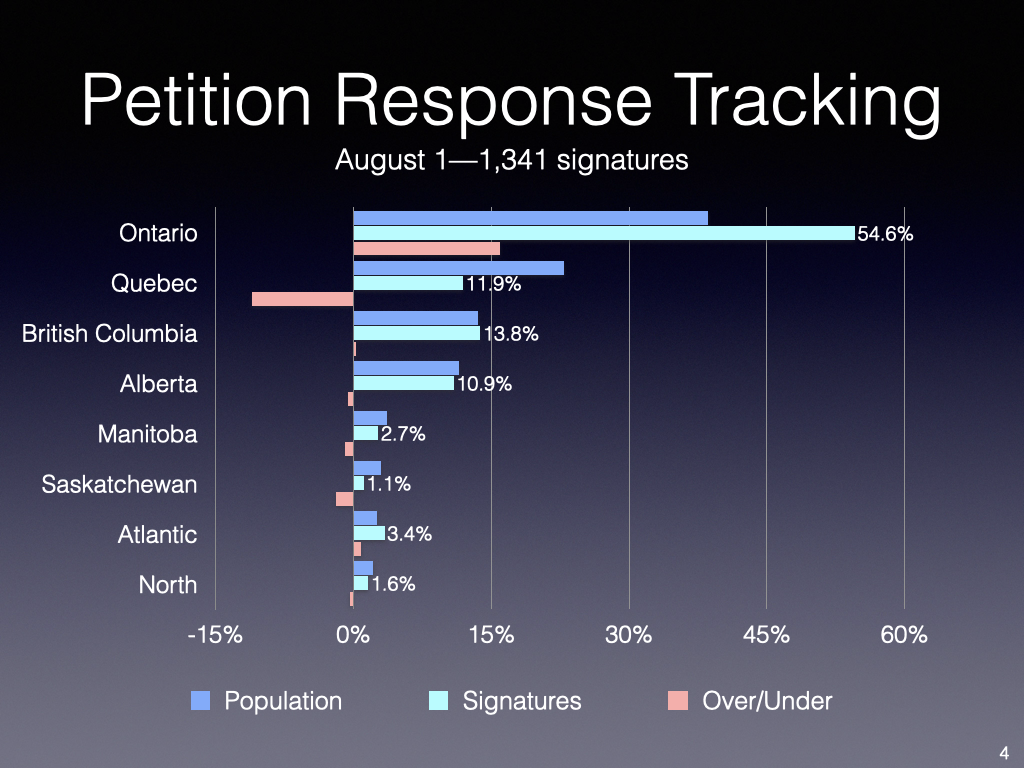
Petition e-4511 – Opposing self-affirmation of the #citizenship oath “citizenship on a click” – Signatures to August 1

The chart below breaks down the 1,341 signatures as of 1 August by province. While Ontario remains over-represented, this is gradually becoming less so. Quebec overtook Alberta this week and, if current trends continue, will approach or surpass British Columbia, thanks to my friend and partner on this petition, Richard Babczak.

And if you haven’t yet considered signing the petition, the link is here: https://petitions.ourcommons.ca/en/Petition/Details?Petition=e-4511

What I wish someone told me about working in Canada when I first immigrated

Good practical advice:

When you’re a new immigrant to Canada and entering the corporate workforce, you need to strike a fine balance. You need to believe in your value and in what you bring to the table, but also work to integrate into a whole new culture in which the learning curve can be steep. In the decades since I began that journey myself, I’ve gained a number of insights I wish someone had told me when I first arrived. I’ve also learned what some of the obstacles are that hinder growth and how to overcome those hurdles.

Obstacles that hinder growth

Communication styles may not be what you’re used to

I once had a manager who was a senior vice-president and managed more than nine nationalities. He said he initially tried the Canadian approach in other places he worked, but quickly discovered that each group wanted to be spoken to in a certain way. The British wanted things non-emotional while the Spanish were the opposite: he had to show he cared. French people wanted to start with an argument. He had to develop a playbook for speaking to groups from each nationality. But not every manager will have this skill level, so you may need to adapt.

In Canada, people often take a softer approach to communication than in some places. Feedback is often sandwiched – a positive, a negative, then another positive. If you don’t understand what a person means, be straightforward and ask direct questions. Don’t just let your imagination fill in the blanks. Also, be curious. Take the time to learn about what’s considered rude, passive-aggressive and so on, to prevent possible missteps.

Canadian corporations operate with flatter hierarchies than in some places

While there is hierarchy in the corporate structure, it’s not exercised the same way you may be accustomed to. I have seen examples of people who come from cultures in which having a title means they expect to be trusted blindly and to be treated like the boss. That’s acceptable in some cultures, but it doesn’t work that way in Canada. Leaders and managers are often less autocratic. This can play in your favour, in the sense that if you’re adaptable, you can gain advantage in a flatter structure that generally has decent respect for workers. However, if your mindset is stuck and you come from a place of entitlement or thinking that people owe you something, it will backfire.

One major difficulty can be feeling undervalued

Employers are often proud of being Canadian, and it can make employees, potential hires and even students feel that others are not good enough. Despite Canada’s messages about welcoming immigrants and valuing diversity, there is a difference between that initial PR machine and the on-the-ground experience, where people may make you feel like you don’t have the right accent or sufficient Canadian work experience.

And let’s be real – you may be subjected to discrimination, bias and racism. I myself have been isolated and bullied, and I’ve faced language barriers as a francophone; even after all these years, my mind works differently than those whose first language is English.

These factors can hinder your growth.

Tips to thrive

Networking is key

If you come here as an adult, you may not have school or university networks or friend circles. Join organizations, attend events and seek out networks to join. Find mentors and people who can guide and support you. Doing this, and finding the right mentor, can give you a real boost. Canada is a place where, overall, people take a favourable view of immigration and where there are many opportunities, but it’s important to be proactive.

Learn about your host country

Of course, you both should be learning about each other, but as an immigrant, you should take the lead. Learn about Canada’s customs and traditions. Don’t stay within your community exclusively – expand and meet others, including people who aren’t like you. It may be worth investing some time and money into additional formal education, too. It might not be easy, but it’s worth the effort, both for the diploma and for the connections you make while you’re doing it.

That being said, when you’re an immigrant, it’s not about becoming a different person.

Remember your value

You’re willing to face risk – or you wouldn’t be here. Keep that bravery, that sense of risk-taking. You may need to work harder or prove yourself more, and without drawing on that strength, you may quickly become disgruntled.

Be confident that you add value. Don’t come at it from the perspective of begging. If you’re here, it means you are adding value to this country. You add diversity to the table and it’s important. Celebrate your difference and see it as the positive that it is.

Finally, be willing to help other immigrants with the things you learn along the way. That, too, is an added value you can bring to Canada thanks to your own perspective and insights. Entering the workforce as an immigrant can be tough, but you’re tougher.

Karima-Catherine Goundiam is the founder and chief executive officer of digital strategy firm Red Dot Digital and business matchmaking platform B2BeeMatch.

Source: What I wish someone told me about working in Canada when I first immigrated

Henrietta Lacks’ descendants reach a settlement over the use of her ‘stolen’ cells

Of note (The Immortal Life of Henrietta Lacks is well worth reading):

The family of Henrietta Lacks has reached a settlement with a science and technology company that it says used cells taken without Lacks’ consent in the 1950s to develop products it later sold for a profit.

Lacks was being treated for cervical cancer at Johns Hopkins University in 1951 when doctors removed cells from her tumor without her knowledge or permission.

Those cells — now known as HeLa cells — had remarkable properties that allowed them to be endlessly reproduced, and they have since been used for a variety of scientific breakthroughs, including research about the human genome and the development of the polio and COVID-19 vaccines.

Lacks’ descendants have argued that she and other Black women were “preyed on” by a group of white doctors in the 1950s and that her family was never compensated for the use of her genetic material, which made such profitable scientific advancements possible.

“Not only were the HeLa cells derived from Henrietta Lacks — the HeLa cells are Henrietta Lacks,” Ben Crump, an attorney for the family, said during a news conference Tuesday.

Thermo Fisher Scientific, a Massachusetts-based science and technology firm, previously asked a judge to dismiss the case, arguing in part that the plaintiff’s claims were too old.

In nearly identical statements, the company and attorneys for Lacks’ family said the “parties are pleased that they were able to find a way to resolve this matter outside of Court and will have no further comment” on the settlement.

The terms of the settlement agreement are confidential.

Attorneys for Thermo Fisher Scientific said in an earlier court filing that only a “handful” of the many products that the company sells are “HeLa-related.”

Lacks’ life was the subject of a popular nonfiction book, The Immortal Life of Henrietta Lacks, and later a film of the same name starring Oprah Winfrey.

On its website, Johns Hopkins University says that it never profited from Lacks’ cells and that, though the collection and use of her cells was “an acceptable and legal practice in the 1950s, such a practice would not happen today without the patient’s consent.”

Speaking at Tuesday’s news conference, Alfred Carter, one of Lacks’ grandsons, called it a “day that will go down in history.” He noted that Tuesday was Henrietta Lacks’ 103rd birthday.

“It couldn’t have been a more fitting day for her to have justice, for her family to have relief,” he said.

Source: Henrietta Lacks’ descendants reach a settlement over the use of her ‘stolen’ cells

Chris Selley: In Canada, even Muslims can be conservatives

As can any group. Ibbitson and Bricker made the point about many immigrant-origin communities being more socially conservative in their 2014 book, The Big Shift but this has not hampered the Liberal government in the three subsequent elections, suggesting less important than other issues.

But valid that all parties need to be more careful in their ethnic and religious vote targeting to avoid greater divisiveness just as they also need to ensure inclusive messaging. Not an easy balance…:

Canada’s media-political universe continues to indulge one of the more fascinatingly insulting ideas in recent memory: That some socially conservative Muslims are lining up in opposition to LGBTQ- and especially gender-related school activities — drag queen story times are a prominent example — because they’ve been duped or manipulated into it by non-Muslim conservatives, especially those awful Americans.

There’s a far simpler explanation, of course: Muslim conservatives are leery-to-outraged by such things for the same reason non-Muslim conservatives are, namely some combination of religious and cultural norms, the shock of the new, and good old-fashioned gut instinct.

In addition, many Muslim-Canadians have their roots in countries where homosexuality is forbidden, never mind celebrated at elementary schools. It would be downright shocking if they had arrived pre-installed with Trudeauvian social values.

But some Canadian liberals just can’t seem to accept this.

“To some, the recent protests have been an example of conservative Muslims pushing back against causes championed by the left — which have in the past included standing against Islamophobia — amid concerns that prevailing progressive ideals conflict with their religious teachings,” the Toronto Star reported this week. “To others, it has tones of political manipulation, with members of a minority group being used to mask a larger push toward intolerance.”

“For white supremacists, expanding their base this way, or even appearing to grow support for their ‘causes’, offers (an) advantage,” Star columnist Shree Paradkar observed. “(I)mages with visibly Muslim people in their midst make for an effective cover.”

Paradkar called the situation “heartbreaking,” which epitomizes the condescension inherent in this narrative: After all Canada has done for these people, they take up with … with … conservatives? Woe!

Prime Minister Justin Trudeau has ushered this idea from the country’s faculty lounges and opinion pages into the mainstream, lately lecturing real live Muslim Canadians in the flesh about the error of their ways. “Misinformation” about school curriculums and activities is “being weaponized by people who are not doing it because of their interest in supporting the Muslim community,” he recently admonished parishioners at a Calgary mosque. “These are people on the far-right who have consistently stood against Muslim rights and the Muslim community.”

There it is again — this idea that Muslims are defaulting on some kind of debt.

It’s an Upper Canadian twist on the narrative that’s taken hold in Quebec in recent years: Where Quebec nationalists and conservatives would rather Muslims abandon their hijabs and embrace French-style secularism (because it’s such a success!), liberals in the Rest of Canada are happy for Muslims to worship and dress as they please, just so long as they don’t fraternize with social conservatives or take up social-conservative causes.

This is not the multiculturalism that the Liberals market to potential immigrants — the freedom to believe and worship and influence Canadian society as they choose. It’s more akin to blackmail: “We support you. We stand with you. It’d be a shame if we stopped, wouldn’t it?”

I’m using a very loose definition of “social conservative” here, incidentally. A Léger poll for the Conservative Party of Quebec, published in May, found 38 per cent of Quebecers felt drag queen story times were inappropriate for children. Many if not most would bristle at being called socially conservative. And most would not show up outside a school to protest about it.

But there’s no good reason Muslims shouldn’t pursue so-con causes in Canada unabashedly. And if they make “unlikely allies” with their non-Muslim so-cons, as the media often put it, I submit that’s for one very bad reason: The paranoia over Islamic terrorism and mass Muslim migration that took hold in some quarters after 9/11, which thankfully in Canada has proven unfounded. If that’s now far enough behind us that conservative Muslims and non-Muslims can make common cause in pursuit of common interests, I dare say we might even be looking at a good-news story.

Surely Canada would be better off if its parties and candidates stopped courting ethnic and religious voters en bloc, as if membership in a certain community ought to determine one’s position on housing policy, or the GST, or carbon pricing, or all the other things that affect our day-to-day lives. It would be a big change for Conservative strategists as well as Liberal ones, but we would be much stronger for it as a nation.

Source: Chris Selley: In Canada, even Muslims can be conservatives