COVID-19 Immigration Effects – June 2023 update

Given IRCC delays in issuing citizenship data, have combined the May and June report.

At the half year mark, the government is on target to meet the levels plan for Permanent Residents (however misguided), with 263,000 to date or 57 percent of 465,000. The percentage of Temporary Residents transitioning to Permanent Residents averages about 50 percent for both time periods.

The number of temporary residents continues to grow, with 385,000 compared to 185,000 for the January-June 2002 period for the International Mobility Program and 114,000 compared to 75,000 for the Temporary Foreign Workers program.

The same pattern applies to International students: 242,000 compared to 202,000 for the January-June 2002 period.

For asylum claimants: 53,000 compared to 37,000.

Unlike the above, the number of new citizens has no impact on housing, healthcare and infrastructure as they are virtually all here in Canada. Interestingly, this is the only program that has seen a decline in the January-June periods: 177,000 compared to 184,000 although still historically strong.

Terry Beech’s tall order: revamping service delivery

Count me among the sceptics on this one. My experience with Service Canada 2004-7 and efforts to implement a citizen-centred approach ran into resistance from the policy hierarchy and its original vision of being a one stop shop shrunk into remaining service delivery of ESDC services. The one non ESDC service, passports, was poorly managed by the policy centre, IRCC, and ESDC service delivery, with the large backlogs when predicted travel resumes.

Given the complex nature of government responsibilities and accountabilities, not to mention the concrete challenges in any modernization effort, I wouldn’t expect any significant results before the election:

Terry Beech claims his new job as Canada’s first ever minister of citizens’ services shows the government means it this time. Delivering services to Canadians is a longstanding weakness of government, and he says a big problem is that politicians have had little interest in it.  

“I think first and foremost, we just haven’t focused enough of our attention and time on it,” Beech said in an interview.  

“This is an opportunity for us to better understand all the systemic challenges that exist, but also to say our government and prime minister is committed to high-quality service delivery. We are so committed, in fact, that we are setting up a new ministry.” 

Service delivery has been an Achilles heel of government for 30 years. It’s why Service Canada – which Beech is now responsible for – was created as a one-stop shop for all government services to focus on delivery and citizen satisfaction.    

Service has always taken a back seat to policy. Prime ministers, ministers and even deputy ministers pay little attention until a crisis hits. That approach was on full display as Canadians eased out of the pandemic and faced shambolic lineups for passports, immigration and air travel.   

Beech acknowledges cabinet ministers haven’t kept a close enough eye on the “end-to-end customer experience.” Cabinet puts all its effort into making policy decisions and assumes they will be implemented and delivered the best way possible.  

As minister, he will make sure delivery will be part of policy discussions from the start. That way, ministers will have a better handle on what government does well and what it doesn’t, which will reduce snags or setbacks when services are rolled out.  

“Without cabinet ministers having an eye to potential constraints or opportunities to provide exceptional levels of service, those opportunities get missed. Now those opportunities will be front and centre in the discussion.”  

Beech founded the company HiretheWorld.com. He understands tech and is customer-oriented, and sees his new job as a natural fit. “This is really an entrepreneurial opportunity.”  

He said Canadians’ user experience is his priority, making sure their needs are first and at the centre of all services. (Critics have long argued departments tend to design services around what government does rather than what Canadian want.) 

And what do citizens want?  

Canadians live digitally when they shop and work and expect the same when dealing with their governments. They want single IDs, digitally issued permits, applications, approvals and information. And they want it fast on their personal devices, 24/7.  

They roil when they can’t get the same service ordering a passport as they do when buying from Amazon. Why can’t government track Canadians’ interactions with departments and use that information to improve or customize services?  

Beech wants to do all that and more.  

“My number one priority probably goes back to my vision for this role, which is waking up every day thinking about how I can improve customer service and the customer service experience for every Canadian,” he said. “That’s literally what’s going to be on the piece of paper that I pull out of my desk every morning and think about as I go into every meeting,” he said.   

Waiting to see 

All this should be music to the ears of critics who have long pressed for government to put the customer back into service and bring it into the digital age.  

So far, reaction is mixed. Public servants are waiting to see what levers and authority Beech will have. The pieces of this new portfolio have started to come together, but there are more to come, including ministers’ mandate letters. 

Service Canada opened in 2005 with the vision of a one-stop shop for all government services. It is housed at Employment and Social Development Canada (ESDC) and most of the services it offers are bundled around the benefits ESDC provides – EI, OAS, CPP and disability benefits.  

Service Canada also includes the team that runs Canada.ca, the government’s website and digital home. A new order-in-council transferred the Canadian Digital Service (CDS), a swat team of tech geeks, from Treasury Board to ESDC.  

A chief service czar with access to the government’s digital swat team, “could be a pretty big deal,” according to Aaron Snow, the former CEO at the digital service.  

But the devil will be in the details, tweeted Ryan Androsoff, founder and CEO of Think Digital, a consulting firm on digital transformation.  

“I think even the most well-intentioned person is being set up to fail if they don’t actually have the authority to make change across that entire service spectrum,” he said in an interview.  

It’s unclear whether Beech will have authority to direct departments, such as Canada Revenue Agency, Parks Canada or the Canada Border Services Agency, which also provides services. As services improve, Beech hopes other departments will want Service Canada to deliver its services.  

The growing fear among digital-government advocates is that CDS, created to help all departments improve their services, will move to ESDC and die.  

The big question is whether CDS will remain independent and report to Beech or be folded into ESDC’s IT branch – which one IT expert called the most risk-averse and “slowest moving IT division of any department I know.” (Beech says ESDC is a department that jokes its archaic computer system is nearly old enough to collect old-age benefits and uses so much paper it has to be stored in the basement because it’s too heavy to be stored on the floors above.) 

Looks like 1998 

Ralph Heintzman, a former senior bureaucrat, said many of the problems with service delivery are the same as in 1998, when he first presented Treasury Board ministers with a plan for Service Canada.  

On top of disinterest among politicians and senior bureaucrats, there are all the systemic reasons – chronic underfunding, old technology systems that need replacing; outdated procurement, poor trained and disengaged staff, lack of planning and little accountability for poor service.  

The Service Canada rollout was billed as the single biggest operational reform in federal history. It was the first agency to cut across the government, creating much debate over how traditional ministerial accountability squares with the way government works – a conundrum that continues today. 

The Trudeau government took several stabs at fixing service delivery, including a ministerial task force to deal with fallout over passport delays. But the government is now in its third term with trust falling like a stone and Conservative leader Pierre Poilievre jumping on any botched service as another sign that government is broken. 

Former Treasury Board president Scott Brison took a big step to fix things when he pressed to have digital minister in his title and to have departments use technology to change the way government does business and serves Canadians.  

He pitched it as central to making government relevant and restoring Canadians’ confidence. He set up the Canadian Digital Service, modelled after a service in the U.S. The American service recruited top Silicon Valley talent and embedded its own start-up in government, known as 18F, to help improve services. 

Beech’s appointment also comes at a time when some Liberals feel the public service dropped the ball on service and let them down in executing their policies. Former top bureaucrat Janice Charette said in her annual report that the public service is focused on upping its game.  

“I know there were moments when the public service fell short of Canadians’ expectations on service. In these instances, we faced the situation humbly and adjusted how we did things to improve results. We remain steadfast in our commitment to learn from these experiences and continually improve how we deliver,” she wrote.

Ambition exceeded capacity 

Sahir Khan, executive vice-president at the University of Ottawa’s Institute of Fiscal Studies and Democracy, said the Liberals’ activist agenda was simply too ambitious for the capacity and capability of the public service.  

“The Liberals count on the state being able to deliver. The Harper government did not. It was trying to shrink the state, but a progressive ideology that enlarges the state depends on that state being able to deliver, and it is difficult to do.”   

Michael Wernick, a former clerk of the Privy Council Office and now Jarislowsky Chair in Public Sector Management at University of Ottawa, said the Liberals “lost their focus and traction on public service capability” and “if you don’t invest in capability, you can’t deliver.” 

But Androsoff worries the cultural and organizational changes needed to improve services, from the way it hires, recruits, manages and procures, are getting lost.   

The service conundrum is wound up in the way the government is organized, its structures and rules. It’s built on a Westminster principle of ministerial accountability, in which ministers are responsible for their departments, but policies and services straddle all departments.  

Some argue the heart of the passport fiasco is that the program is run by three departments with no one ultimately responsible.  

“You’ve got a bunch of very complex governance arrangements shared between a variety of actors across boundaries,” said Androsoff. “That situation makes it almost impossible to drive change. That’s the core structural piece that has to change if we really expect government to make dramatic progress on service delivery.”  

Many argue that Beech’s success could hinge on what kind of role Treasury Board takes under its new president, Anita Anand.   

Anand holds many of the cards. She oversees spending, has the chief information officer reporting to her and has all the policies governing digital and service, people management and information. Beech didn’t land a seat as a member or an alternate on the powerful Treasury Board cabinet committeethat Anand chairs.  

“She can be the gigantic rubber stamp of a cabinet committee or be air traffic control that keeps a third-term government out of trouble,” said Khan. “You’ve got to figure out which one you want to be. (Treasury Board) has all the tools, legislative and otherwise, to do it. It’s a matter of capacity and will.” 

Source: Terry Beech’s tall order: revamping service delivery
Des demandeurs d’asile qui s’adaptent plutôt que de combattre en vain

Given ongoing levels of asylum claimants, some suggestions to facilitante their integration at the local level. Silent on the need for faster processing and decisions on asylum claims, however:

Le 20 juillet dernier, dans un article du Devoir Un nombre record de demandeurs d’asile passent désormais par les aéroports »), on apprenait que les demandeurs d’asile n’étaient pas moins nombreux à entrer au pays depuis la fermeture du chemin Roxham.

En effet, en suivant la courbe des entrées chaque mois comparativement à l’année précédente, on anticipe que le nombre de demandeurs d’asile admis en 2023 au Canada serait vraisemblablement similaire à celui de 2022. Si la frontière terrestre au sud apparaît plus imperméable, les demandeurs d’asile arrivent dorénavant en plus grand nombre par les airs.

Après quelques mois, le constat se pose donc simplement : la fermeture de chemin Roxham ne semble pas avoir eu d’effet sur le nombre de demandeurs d’asile qui entrent au Canada. Le phénomène d’arrivée des migrants qui touchaient jusqu’à récemment principalement l’Europe et les États-Unis est désormais une réalité chez nous. Si cette tendance a été longtemps ignorée, elle devient maintenant incontournable.

Pour faire face à cette question de manière pragmatique, il faut davantage s’intéresser au continuum de services d’accueil et à leur coordination, une réflexion qui tarde à se faire. Une meilleure cohérence entre les politiques publiques devrait être recherchée afin de s’assurer de l’accueil et de l’intégration de ces migrants, mais aussi de l’atteinte des objectifs nationaux chers au Québec, notamment celui de la francisation et de l’accès égal à des opportunités.

À cet égard, un écueil d’envergure est la collaboration entre les différents ordres de gouvernement. Cette coordination entre les ordres de gouvernement et les organismes qui offrent la majorité des services d’installation et d’intégration doit reposer sur une séparation claire des pouvoirs et responsabilités, un alignement des stratégies ainsi qu’un financement proportionnel au niveau d’engagement de chacune des parties prenantes.

Échelle locale

Également, et la recherche est claire à cet effet, la coordination des services voués aux nouveaux arrivants doit être menée à l’échelle locale pour être optimale. Le gouvernement du Québec, qui est responsable des services d’accueil et d’intégration en vertu de l’entente qu’il a ratifiée avec le gouvernement fédéral en 1991, doit absolument s’appuyer sur les lieux de concertation municipaux ou régionaux qui ont développé l’expertise des défis et sur les ressources disponibles sur le terrain.

Pour l’instant, Québec, qui a transféré des compétences aux villes après l’abolition des conférences régionales des élus il y a presque 10 ans, peine à reconnaître le leadership de celles-ci dans la coordination des services locaux. Ses programmes et financements devraient être alignés sur les stratégies et les priorités locales, plutôt que d’en faire fi.

Les efforts et ressources seraient ainsi mieux alloués. De même, avec la mise en place des agents d’aide à l’intégration (les AAI, comme ils sont désignés par le milieu), Québec dédouble un service existant sans que ces agents aient la capacité d’arriver à la cheville de l’expertise qui s’est développée à travers les années dans les organismes communautaires.

L’arrivée des demandeurs d’asile crée d’ailleurs une pression immense dans les communautés, ses organismes et institutions, particulièrement dans la grande région de Montréal. Ce sont largement eux qui offrent les services d’installation, de francisation, pour l’aide à l’emploi ; ils accueillent les enfants dans les écoles, logent et équipent les familles, etc.

Or, les organismes sur le terrain vous le diront : pour faire connaître leurs services, il leur est souvent impossible d’entrer en contact avec les demandeurs d’asile pris en charge par PRAIDA, le programme québécois chargé des demandeurs d’asile. Ceux-ci finissent par accéder aux services des organismes du milieu, mais pas sans embûches.

Pour s’assurer de la pleine intégration des immigrants, notamment des demandeurs d’asile, et ce, dans l’intérêt de la société québécoise, Québec doit reconnaître le rôle stratégique joué par les communautés locales et s’assurer de les outiller adéquatement.

Responsabilité mondiale

En bref, il faut entrevoir une suite aux discussions concernant l’accueil des demandeurs d’asile, et ce, à tous les ordres de gouvernement. Il n’est pas étonnant que les décideurs aient bien voulu croire (du moins en apparence) que la fermeture du chemin Roxham aurait tout réglé : l’arrivée des migrants en Europe et aux États-Unis a largement polarisé les débats politiques depuis quelques années. La réalité canadienne demeure toutefois que le nombre de demandeurs d’asile qui passent ses frontières est minime par rapport à ce qui a été observé ailleurs.

À juste titre, la ministre de l’Immigration, de la Francisation et de l’Intégration, Christine Fréchette, rappelait cet hiver que les demandeurs d’asile étaient avant tout des humains, exhortant ainsi à un peu d’humanité dans le débat public.

Les demandeurs d’asile sont admis officiellement au Canada comme réfugiés dans environ 50 % des cas après un processus administratif permettant d’évaluer leur demande. C’est donc dire que dans une large proportion, on juge qu’effectivement, leur sécurité et même leur vie sont menacées dans leur pays d’origine.

Établir ses pénates ici relève pour eux d’un exploit suivant un parcours difficile, et une chance inespérée de vivre en paix. Si ces migrants quittent leur terre natale, c’est qu’elle leur est devenue hostile pour de nombreuses raisons : groupes armés, conflits, persécution pour des motifs politiques et religieux, ainsi que les changements climatiques… Et bien sûr, les pays occidentaux ont aussi leur rôle à jouer, en amont, pour atténuer ces crises mondiales.

Source: Des demandeurs d’asile qui s’adaptent plutôt que de combattre en vain

David Rosenberg: Why immigration could be good for housing affordability in the long run

Not to be facetious, but in the long run we are dead! Time lags matter and it is clear that current immigration policies, with some specific exceptions, are not helping address Canada’s chronic productivity gap:

We have been vocal critics of Ottawa’s aggressive immigration policy from the perspective of creating further strains on a national housing market that is already stretched to the limit from an affordability standpoint due to a lack of supply. Creating a nation of renters because of a persistent multi-year housing bubble exacerbated by the immigration-fuelled boom in demand for residential real estate, is surely going to exert negative and unstable effects on the economic fabric and society as a whole.

It would be nice if the federal government began to focus its attention toward putting more emphasis on importing construction workers and skilled tradespeople, that much is for sure. After all, real residential investment is at -18.7 per cent year over year, and negative for seven quarters in a row — and all the while, Canada’s population and housing needs have been rising inexorably.

The Canada Mortgage and Housing Corp. (CMHC) estimates that Canada needs an additional 3.5 million units by 2030 to restore affordability — so the federal government would be well advised to ask immigrant applicants whether they know how to work with hammers and nails. The country also has a deficiency of health-care workers that should be more adequately addressed in this aggressive immigration policy, but we shall save that file for another day.

Before going down the rabbit hole of lamenting the excess demand effects on housing from the record levels of immigration that have boosted population growth to two per cent at an annual rate, far above historical norms and, outside of Iceland, at the very high end of the range in the industrialized world, the beneficial impact on Canada’s growth potential from the supply side must be addressed.

And that is because one way to deal with the housing affordability crisis in Canada is to find ways to boost national income — income being the denominator in the classic homeowner affordability ratio. From that perspective, this immigration policy could very well end up carrying with it more benefits than costs, and counterintuitively prove to be a development that could redress the inherent imbalances in the national housing market.

Immigration does add to home price inflation on the demand side by elevating housing prices over the near-term. But on the supply side, it is disinflationary by filling in labour shortages and increasing productivity — which then helps provide a positive underpinning for real incomes. And it is the prospect that real income growth rises on a secular basis that is at the root of a positive “take” one can adopt on this aspect of immigration.

While difficult to quantify the net effect of the supply and demand contributions of immigration, the comprehensive models we designed show that supply effects outweigh demand — so if you take a holistic, or what is called a “general equilibrium,” view of this demographic shock, increasing immigration can indeed be disinflationary. Again, this is positive for real incomes — and this could be a real key towards helping resolve the affordability challenge.

Our models show that when net international immigration flows are accounted for, the downward inflation impact is highly statistically significant. That is very encouraging — and why the Bank of Canada has taken a very even-handed approach to this issue, with Governor Tiff Macklem commenting on the supply-side benefits of an ambitious immigration stance.

What is fascinating is that immigration, if done right, can also be a factor that reverses the structural decay in Canadian labour productivity — which has been negative year over year for the past nine quarters. High-skilled immigrants from the “economic category” of Canada’s immigration program are a solution to this problem. In fact, what seems to go under-reported is that immigration in Canada is now focused on this “economic category” — in other words, more than half of recent immigrants are “elected based upon their potential economic contribution to meet labour market needs.”

A public policy focus to improve productivity and thus decrease inflation and bolster real incomes should involve a concentration in immigration on sectors like health care and construction — to help fill in labour shortages.

Bottom line: Ensuring that we have a sensible immigration policy in Canada means using it as a tool to redress, not compound, the housing affordability crisis and a distorting real estate price bubble that just keeps getting bigger.

But the good news in all this is that immigrants in Canada do get integrated into the labour market rather quickly.

The employment rate among landed immigrants and non-permanent residents (64.6 per cent — it was 61.6 per cent in Dec 2022) has been higher than those born in Canada (62.4 per cent) every month since May 2021. The gap is now at a historic high of 2.2 percentage points.

The change in the employment rate has also been much faster for immigrants and non-permanent residents than for those born in Canada, meaning they contribute toward a backdrop of rising incomes in nominal terms.

Statistics Canada has found in its own research that the “median wage of economic immigrant principal applicants surpasses that of the Canadian population one year after admission.” Immigrants pull their economic weight, in other words, and the historical record shows a trend toward labour market involvement and to improved productivity. In fact, research published by Statistics Canada found a positive relationship between the immigrant share in the business sector and growth in labour productivity, with productivity expanding by 1.9 per cent for every 10-percentage-point increase in the share of immigrants at a firm.

While we and others have been focused on the very short-term effects of the immediate demand rush the immigration policy is having on housing, perhaps we all need to take a longer-term view of the supply-side income benefits and how that can help ease the affordability problem plaguing the younger cohorts of society.

That said, it is clear that in the here and now, ensuring that the immigrants flowing into the “economic category” have experience in the building trade sector would also go a long way towards providing relief for a housing market that is clearly short of the supply needed to realign home prices to more normal levels relative to incomes.

David Rosenberg is founder and president of independent research firm Rosenberg Research & Associates Inc. To receive more of David Rosenberg’s insights and analysis, you can sign up for a complimentary, one-month trial on the Rosenberg Research website. Atakan Bakiskan is a junior economist at Rosenberg Research.

Source: David Rosenberg: Why immigration could be good for housing affordability in the long run

Griffith: Canada badly needs an immigration reset 

My latest, hoping to provoke a more concrete discussion on what a reset needs and what it would mean:

The government has largely ignored the impact of high levels of immigration on housing availability and affordability, health care and infrastructure. Belated recognition that current policies are not working to the benefit of all Canadians may be the reason behind the appointment of a new minister of Immigration, Marc Miller, and the reassignment of  the former minister of Immigration, Sean Fraser, to housing and infrastructure.

Minister Fraser arguably will have to deal with some of the mess he and the government created with the large increases in both permanent and temporary residents, pushing up housing costs and burdening existing infrastructure. Minister Miller will likely be more attuned to concerns about immigration given that he is from Quebec and thus more familiar with immigration critiques regarding the demographic impact on Quebec.

Moreover, the nature of conversations has changed. When, some two years ago I wrote an article for Policy Options entitled Increasing immigration to boost population? Not so fast, there were few voices questioning the government’s planned expansion of immigration. Now, there are almost weekly commentaries and reports, ranging from the banks to economists, the International Monetary Fund and others, noting deteriorating productivity, housing availability and affordability, stress on health care and infrastructure. Even the major boosters of increased immigration have shifted their messaging to “growing well” or even calling for a pause in increases.

While immigration is not solely responsible for the increase in housing costs, the link is being seen and could lead to newcomers being the scapegoats for poor policy decisions. The significant drop in support for the Liberal government may reflect this very personal issue to Canadians.

While at Immigration, Fraser was able to increase levels easily, whereas as housing and infrastructure minister, he will be confronted with the real time lags, making it impossible to show concrete results before the 2025 election. So it’s not a matter of “better communications” but rather of complex delivery with a wide range of government and private sector actors.

Miller, depending on his mandate letter, has an opportunity to reset or at least adjust  immigration policies and programs to take account of recent commentary and realities. He will not be able to ignore these issues even if his initial comments confirm planned increases. The annual plan on the number of immigrants this fall provides an opportunity for a reset should the government choose to do so.

Given that a complete pivot to a more evidence-based approach is unlikely, here are some modest suggestions that make sense from an immigration and economic perspective that may be politically sellable.

To start with, the plan should be broadened to include plans for temporary residents levels rather than just permanent residents levels, given that some 60 per cent of all new residents are temporary workers and students, many of whom transition to permanent residency.

Given time lags in building housing, increasing the capacity of the health-care system and addressing infrastructure gaps, the government should freeze 2023 levels of 465,000 for the next few years. More ambitiously, the government could reduce future levels to the lower 2024 range of 410,000.

The current open-ended levels on temporary residents (students and workers) should be replaced by hard ranges based on 2023 levels for similar reasons. Furthermore, the government needs to consider seriously the introduction of a cap-and-trade system for temporary residents to reduce the numbers over time to address weak productivity, as the University of Waterloo’s Mikal Skuterud has suggested.

Lastly, the government needs to take steps to further broaden the plan to include the impacts of immigration on housing, health care and infrastructure, including measures to address these impacts, rather than as a discrete program.

Miller’s mandate letter will indicate the extent to which this is possible. But these changes would not necessarily be perceived as divisive or xenophobic given that the impacts on housing, health care and infrastructure affect everyone, immigrants and Canadian-born alike. Failure to pivot to a more comprehensive approach that incorporates these considerations into immigration programs will not only worsen the quality of lives of Canadians but may prove politically damaging to a government long-in-the-tooth and losing popular support.

Source: Griffith: Canada badly needs an immigration reset

Veal: Amid Canada’s housing crisis, immigration needs to be slower, more focused 

Yet more questioning:

High expected immigration is the main reason that Canada’s total output will likely increase by 1.5 per cent annually in 2023 and 2024, according to the headline numbers from the International Monetary Fund World Economic Outlook. That would be the highest in the Group of Seven.

But that document also includes the predicted changes in output per person. That is a better measure of the change in the average standard of living, as it adjusts for Canada’s high population growth. The 2023 and 2024 predictions for the country are –0.6 and 0.1, a cumulative decrease over the two years. That’s the worst performance in the G7.

Part of this has to do with the lack of investment to complement the inflow of people. The most obvious symptom is Canada’s housing crisis.

The writer, Max Frisch, famously commented on European guest worker immigration: “We wanted workers, but people came.” People need homes, and Canada doesn’t have enough of them – even for its resident population. The high prices from the resultant high demand weigh heavily on the economy. While we wait for housing progress, this country needs slower and more focused immigration.

Immigration in general can be good for the economy. The fact that per capita GDP is expected to decline amid heavy immigration doesn’t mean that those already in Canada will on average be worse off; a good part of the reduction in that metric is due to low-income migrants bringing down the average.

Many of us already here will likely be made better off through the contributions of the newcomers. This is particularly clear in the caring and agricultural sectors. And in the long-term, while it is less clear at higher levels, immigration may bring important macroeconomic advantages. Immigrants can bring new ideas and entrepreneurship.

Moreover, Desjardins economist Randall Bartlett finds that these very high rates of immigration are the only way to prevent large increases in the proportion of the population that is 65 and over. Permanent immigrant families will also help share the national debt, especially as they experience increases in productivity and income.

But, as experts such as Mr. Bartlett have pointed out, high immigration is only sustainable if something can be done about housing, and this is not easy.

In the short term, the housing crisis cannot be solved – it can only be mitigated. Building new housing takes time. In the meantime, reducing immigration temporarily to prepandemic levels would help. Those levels would still provide ample room for home construction workers if necessary, as well as other high-skilled workers in strategic areas.

In principle, the current permanent immigration target could still be met with the reductions coming from the temporary side. For example, the student visa program could be limited with allocations used to incentivize educational institutions and their municipalities to do more on housing.

In the medium term, a solution requires more than doubling the inflow of housing units – Herculean even without the headwind of higher interest rates. It is no coincidence that federal cabinet minister Sean Fraser was recently shuffled from the immigration portfolio to housing.

But it is a three-levels-of-government problem, and municipalities do not face the same urgency from the aging population. In communities where most voters own rather than rent housing, the net political pressures may be against permitting increases in housing supply that might dampen housing prices.

Broader resistance to increased immigration will almost surely come. The brunt of unaffordable rents is borne by those with lower incomes. These are largely the same individuals who may be losing out on the higher wages, the greater flexibility in work arrangements, and the benefits of productivity-increasing capital and training that employers might turn to were there not the alternative options of hiring recent immigrants or accessing the Temporary Foreign Worker program.

But none of this is the fault of those who move here, and nothing changes the ultimate economic benefits of immigration. Canada must cherish immigrants, helping them settle as much as possible – but we need some breathing space to be able to do so properly.

Michael Veall is a professor of economics at McMaster University.

Source: Amid Canada’s housing crisis, immigration needs to be slower, more focused

New temporary foreign worker pilot program to speed up approvals for some employers

Good critical comments by Banerjee and Skuterud regarding possible abuse and the ongoing favouring of reduced labour costs to employers. That being said, for repeat users, simplification has merit but as in so many areas of immigration policy, these change fail to address the immigration-related challenges of housing, healthcare and infrastructure:

The federal government is making it easier for businesses to bring temporary foreign workers into Canada, announcing a new “recognized employer” program aimed at speeding up the approval process for companies with a track record of using foreign labour.

The three-year pilot program is designed to reduce the amount of paperwork companies need to submit to justify bringing in outside workers.

It’s the latest expansion of the temporary foreign worker (TFW) program, whose use has exploded over the past year as the federal government has eased restrictions on short-term foreign labour. And it comes alongside a record surge in immigration, which is increasing the country’s labour supply but also adding demand to Canada’s overheated housing market and public services.

Randy Boissonnault, the new Minister of Employment, Workforce Development and Official Languages, said the change to the TFW program would “cut red tape” and help companies manage widespread labour shortages.

The move was applauded by the Canadian Chamber of Commerce, which has long lobbied for a trusted employer carveout in the TFW program.

Some labour economists, however, warned that further expansion of the program could undercut wages in Canada and make it more difficult to identify companies that are exploiting vulnerable workers.

“It could be a good thing for addressing kinds of critical labour shortages,” said Rupa Banerjee, the Canada Research Chair in economic inclusion, employment and entrepreneurship of Canada’s immigrants at Toronto Metropolitan University.

“But if this kind of a system is not really closely monitored, scrutinized, audited, it’s easy for sort of mundane and everyday examples of abuse and exploitation to kind of become even more rampant in the system,” she said.

As it stands, companies need to submit a Labour Market Impact Assessment (LMIA) before applying to hire temporary foreign workers. The purpose of the LMIA is to show that there are no Canadians or permanent residents who are able to fill the job.

Under the new system, employers who can demonstrate “a history of complying with program requirements” will be given a three-year approval to bring in temporary foreign workers, and won’t have to submit an LMIA before each application. Eligible employers will need to have had three successful LMIAs in the past five years for workers who are deemed to be “in-shortage,” and will be subject to a “more rigorous upfront assessment,” the government said in a news release.

The pilot program will be open to agriculture businesses in September and employers from all other industries starting in January.

This is the second notable change to the TFW program in just over a year. Last spring, the federal government said companies could hire up to 20 per cent of their staff through the program’s low-wage stream, up from the previous 10-per-cent cap. And in seven industries with acute labour shortages – such as restaurants, construction and hospitals – the cap was moved to 30 per cent for a year, then extended to this fall.

The TFW program is largely used as a recruitment tool for farm workers. During the first quarter of this year, employers were approved to hire more than 25,000 workers through agriculture streams, according to figures published by Employment and Social Development Canada, which decides on LMIA applications. General farm workers are easily the most sought-after role in the TFW program, with more than 22,000 approved positions in the first quarter.

But as Ottawa has eased access to foreign labour, employers have ramped up their recruitment of low-wage employees from abroad. Companies were approved to fill about 22,000 roles through the program’s low-wage stream in the first quarter, an increase of about 275 per cent from four years earlier. Cooks are the No. 2 occupation of highest demand, with nearly 3,000 positions approved from January through March. Truck drivers, food counter attendants and seafood plant workers are also in high demand.

Diana Palmerin-Velasco, senior director of the future of work at the Canadian Chamber of Commerce, welcomed the announcement and said it could improve access to the TFW program for smaller employers.

“There are whole sectors of the economy that are dependent on temporary foreign workers,” Ms. Palmerin-Velasco said. “What we have heard from our members is that it’s not that easy for employers. There is a lot of administrative burden, it can be a very complex application process. And when we think about small businesses, it’s not really accessible.”

Mikal Skuterud, an economics professor at the University of Waterloo, questioned the government’s rationale for expanding the program. The Canadian labour market has been exceptionally tight over the past year-and-a-half, as demand for workers has outstripped supply. However, in recent months, job vacancies have been trending down and the unemployment rate has risen.

“We’ve had a 25-per-cent reduction in job vacancies since May, 2022, and if you measure labour market tightness, that’s also been dropping,” Prof. Skuterud said.

He added that recent research into temporary foreign workers suggests that they tend to suppress wage growth within companies that use them. “And so we’re going through a period where real wages for low skilled workers in this country are not increasing. The most recent data looks like they’re decreasing. And so it’s all about where this government’s priorities are,” he said.

Source: New temporary foreign worker pilot program to speed up approvals for some employers

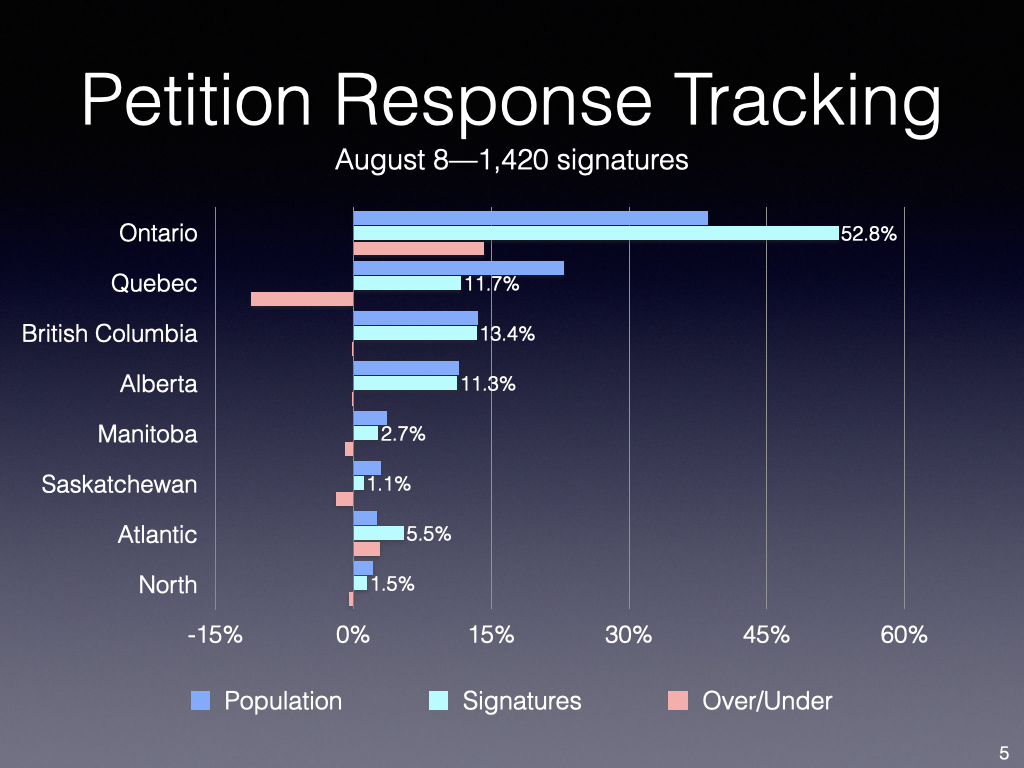
Petition e-4511 – Opposing self-affirmation of the #citizenship oath “citizenship on a click” – Signatures to August 8

The chart below breaks down the 1,420 signatures as of 8 August by province. No major changes by province although Nova Scotia had the highest weekly increase of over 100 percent.

And if you haven’t yet considered signing the petition, the link is here: https://petitions.ourcommons.ca/en/Petition/Details?Petition=e-4511

William Watson: In 2023 is it possible to have a reasoned discussion of immigration?

Good commentary, but ducking the numbers question:

Marc Miller just finished five years as a federal minister working on Indigenous issues. Now, ironically, he’s minister of immigration, encouraging an influx of new Canadians many Indigenous Canadians think hasn’t served them so well.

He’s better off than the person he’s replacing, however, rising Liberal star Sean Fraser. After 21 months at immigration, Fraser is off to housing, infrastructure and communities to work on the big headaches caused for, ahem, housing, infrastructure and communities by the record number of immigrants he let in. It’s just desserts of a sort you don’t often see in politics — even if the prime minister’s recent disavowal of federal responsibility for housing, motivated more by hot-potato politics than respectful regard for the constitutional division of powers, may let Fraser off the sharpest of those three hooks.

Minister Miller says he’ll listen to arguments about whether current immigration targets are correct. The official target has been bumped up to 500,000 a year from 400,000, though in 2022 we hit 1.2 million — the only target Ottawa has bested in recent years.

But the minister will only listen so much. Attack lines are at the ready. As he said shortly after taking his new office: “In every wave of migration that Canada has had, there has been a segment of folks that have blamed immigrants for taking houses, taking jobs, you name it. Those are people that don’t necessarily have the best interest of immigrants at heart and we have to call that out when we see it and we won’t hesitate to do that.” No one who has watched the prime minister drive wedge after wedge into Canadian policy debates over the last eight years has the slightest doubt the Liberals will do that. People who would like to debate the immigration targets may well be anti-immigrant, Miller’s statement suggests, which is but one step of slippery logic away from the R-word: racis

In this day and age, of course, we never actually discuss a policy issue: we look for the slightest doctrinal misstep in our ideological adversaries’ arguments and pounce, self-righteously claiming the moral high ground while accusing our opponents of having fallen into an ethical ditch.

Immigration seems an area where informed and informative debate will be especially difficult. So kudos to TD Economics for recently issuing a short study of the issue: “Balancing Canada’s pop in population,” by Beata Caranci, James Orlando and Rishi Sondhi. At a time when big banks seem to specialize in serving up politically correct pablum, this piece raises hard questions about how desirable a big boost in immigration is.

Nobody opposes some level of immigration. The question is: how much? In theory, there is an optimal level where the benefits brought by the next new member of our society just offset the costs he or she imposes. In theory, both short-run and long-run costs and benefits can be considered. In theory, they can even be discounted by an appropriate interest rate. Policy should hit that sweet spot and not go beyond it.

In practice, the optimal level is very hard to calculate. People will disagree — perfectly reasonably — on what, and how big, the benefits and costs are, how they may change as more people come, and what the discount rate should be. (Do you know what interest rates will be 10 years from now?) On the whole, I think the TD Economics folks are too optimistic about our ability to discover this right “balance,” but they do us all a great service by describing some of the costs of high rates of immigration.

For instance, if the inflow stays high, we may need 500,000 more housing units (i.e., homes) over the next two years — which seems a task well beyond the capacity of our politico/builders/planners complex. As for health care, the OECD ranked us 31st among 34 member-countries in acute care hospital beds per capita in 2019 — and we’re rapidly raising the number of our capitas without commensurate increases in beds.

There’s also some doubt as to whether immigration is serving the econo-strategic purpose governments have laid out for it, which is to provide young, skilled and therefore high-earning labour that can pay enough taxes to finance the health care and retirement incomes of us older folk. But 40 per cent of people in the rapidly expanding temporary foreign worker program work in agriculture, forestry and fishing, and another 15 per cent in accommodation and food. Those are important jobs which, increasingly, people born here won’t do. But they aren’t the tax bonanzas we locals are looking for.

Immigration may even raise interest rates. Eventually it increases the economy’s capacity but in the short run it boosts demand, which is the last thing we need as we fight inflation. To make sure that doesn’t get out of control, the Bank of Canada may have to keep interest rates 50 basis points higher than if immigration rates were lower. Which hardly helps us build new housing or infrastructure.

Every one of those points is debatable, of course. So let’s have the debate. And don’t anyone use the R-word.

Source: William Watson: In 2023 is it possible to have a reasoned discussion of immigration?

Castel: La dimension géopolitique du cabinet Trudeau

Reasonable analysis:

Les observateurs s’entendent pour dire que le remaniement du Conseil des ministres fédéral par Justin Trudeau a occasionné un bouleversement majeur, l’ensemble de l’opération devant lancer un message économique. Or le plus extraordinaire, c’est de constater que le découpage de la représentativité sociale et géographique des nominations est resté quasi identique.

Nonobstant l’importance des portefeuilles, la question de la parité femmes/hommes ne se pose plus depuis 2015. Avec le remaniement de janvier 2021, on compte désormais cinq femmes parmi les dix ministres au sommet de l’ordre de préséance.

Ledit découpage fait aussi référence à la préoccupation qu’il y a, autant du côté du premier ministre que du côté des premiers intéressés, à ce que les régions se sentent adéquatement représentées. Certains choix comportent une forme de remerciement régional en même temps que des arrière-pensées électorales.

Le nombre de ministres par province est resté inchangé : l’Ontario en a 16 (41 %) ; le Québec, 11 (28 %), les provinces de l’Atlantique, 6 (15 %), la Colombie-Britannique, 4 (10 %) et les provinces des Prairies, 2 (5 %). Ces proportions, les mêmes que celles ayant suivi les élections de 2021, sont d’abord le reflet du poids démographique des provinces, mais elles sont aussi motivées par la préoccupation de solidifier les bases libérales locales dans des régions fragilisées depuis 2019 (Atlantique, Québec rural) tout en envoyant un message attractif aux régions historiquement rébarbatives, comme les Prairies ou le sud de l’Ontario rural.

La force du Parti libéral du Canada (PLC) réside dans les régions urbaines. C’est aussi sa faiblesse, puisque l’accès au gouvernement se gagne moins avec des votes qu’avec des sièges. Treize ministres proviennent de la grande région de Toronto, six de la région de Montréal et quatre de la région de Vancouver. Hormis un ministère torontois supplémentaire, le premier ministre garde le même nombre de ministres urbains, avec trois nominations pouvant être motivées par un souci de solidifier un siège menacé : Arif Virani à Toronto, Soraya Martinez Ferrada à Montréal et Jenna Sudds à Ottawa.

Suivant les élections de 2019, le PLC s’appuie sur une chaîne de quelques petits blocs ruraux et une série de zones urbaines isolées. Plusieurs ministres (Patty Hajdu, Marie-Claude Bibeau, Pascale St-Onge, François-Philippe Champagne) viennent de ces espaces stratégiques.

Depuis lors, une douzaine de francophones font partie du Conseil des ministres. Au Québec, la progression du Bloc québécois renforce l’importance de chaque poste ministériel en dehors de Montréal. Hors Québec, le jeu de chaise musicale est délicat, car chaque perte est souvent mal ressentie. C’était le cas pour Ginette Petitpas Taylor en novembre 2019 et c’est maintenant le cas pour Mona Fortier à Ottawa.

Cela dit, certains coups comptent double, car l’Ouest est représenté, depuis 2021, par Randy Boissonnault, un francophone militant d’Edmonton, et Dan Vandal, un Métis de Winnipeg, appelé au cabinet en 2019.

Sous les gouvernements Trudeau, trois Autochtones ont fait partie du Conseil des ministres. Si 10 des 18 députés autochtones ont été élus sous la bannière libérale, les élections de 2019 on fait du Nouveau Parti démocratique la force montante dans les régions boréales et nordiques ainsi que dans les régions de Winnipeg, d’Edmonton et de Vancouver, où des candidats autochtones se présentent.

La question de la diversité ethnique et religieuse est devenue incontournable, notamment à Toronto. À commencer par la vice-première ministre, on peut avancer qu’une quinzaine de ministres ont une origine ethnique autre que britannique ou française. Onze ministres (28 %) correspondent à l’un des groupes que Statistique Canada associe aux minorités visibles.

L’entrée ou la sortie de chaque personne au cabinet affecte l’ensemble d’un édifice déjà compliqué. Le premier ministre s’est sans doute rendu compte que, vu le nombre de paramètres à considérer, la seule façon de sortir de la quadrature du cercle passait par une augmentation du nombre de ministres. Ainsi les cabinets sont-ils passés de 31 à 37, puis à 39 membres, à chaque lendemain d’élections (2015, 2019, 2021). C’est le remaniement de juillet 2018 qui inaugure cette tendance, avec 35 membres.

De plus, à la fin du premier mandat de Justin Trudeau, le Québec et surtout l’Ontario ont gagné en influence, alors que les Prairies ont perdu des plumes, ce qui ne fut pas favorable aux élections de 2019. En n’allant pas chercher de ministre supplémentaire dans l’Ouest pour plutôt ajouter un ministre de Toronto, tout en faisant des changements stratégiques à Montréal et à Ottawa, le chef du Parti libéral du Canada donne l’impression qu’il pense aux prochaines élections, où il jouera défensif, pour recourir au langage sportif.

Source: La dimension géopolitique du cabinet Trudeau