Top official from China’s Xinjiang says ‘Sinicisation’ of Islam ‘inevitable’

For the record:

Xinjiang’s top Communist Party official said on March 7 that the “Sinicisation” of Islam in the Muslim-majority region in north-western China, where Beijing is accused of human rights abuses, is “inevitable”.

“Everyone knows that Islam in Xinjiang needs to be Sinicised, this is an inevitable trend,” regional party chief Ma Xingrui told reporters at a largely scripted briefing on the sidelines of China’s annual parliamentary sessions in Beijing.

Rights groups accuse Beijing of widespread abuses against Uighurs, a mainly Muslim ethnic minority that numbers around 10 million in Xinjiang, including denying them full religious freedoms. Beijing vigorously denies any abuses.

Chinese President Xi Jinping has repeatedly called for the “Sinicisation” of religions including Islam, Buddhism and Christianity, urging followers to pledge loyalty to the Communist Party above all else. About two-thirds of mosques in Xinjiang have been damaged or destroyed since 2017, according to an Australian think-tank report.

During the news conference, Mr Ma and other regional officials praised Xinjiang’s economic development, refuted the United States’ allegations of forced labour and cultural genocide, and tried to paint the region as open to foreign tourism and investment.

Mr Ma, a high-flying former governor of prosperous Guangdong province who was transferred to Xinjiang in 2021, stressed the need to “coordinate security and development”.

“The three forces are still active now, but we cannot be afraid (to open up) because they exist,” he said, using a political slogan referring to “ethnic separatism, religious extremism and violent terrorist forces” in Xinjiang.

Beijing in 2017 launched a security crackdown in Xinjiang after a spate of violent ethnic protests, which saw more than a million people from several Muslim minorities detained in re-education camps, rights groups allege.

“We have carried out a severe crackdown on terrorist activities, promulgated and implemented anti-terrorism laws to… combat various forms of terrorism,” senior Xinjiang parliamentarian Wang Mingshan said.

But the briefing was largely focused on Xinjiang’s economic development, tourism potential and what the officials described as cultural preservation.

In 2023, Xinjiang received 565.7 billion yuan (S$105 billion) in central government transfers accounting for 72.7 per cent of local government spending, as well as more than 19 billion yuan in fiscal aid from other provinces, the region’s chairman Erkin Tuniyaz said.

Mr Ma was flanked by two Xinjiang officials sanctioned by the US over human rights abuses in Xinjiang – Mr Tuniyaz and former regional chairman Shohrat Zakir.

Officials also said that more than 4,390 foreigners visited Xinjiang in 2023, and that newly installed renewable energy capacity in 2023 totalled 22.61 million kilowatts, bringing the total installed in the region to 64.4 million kilowatts – nearly half of Xinjiang’s electricity capacity.

Xinjiang is a major base for solar cell production, a sector that has been tainted by allegations of forced labour. 

Source: Top official from China’s Xinjiang says ‘Sinicisation’ of Islam ‘inevitable’

Only two universities are offering programs for people stuck in citizenship limbo. Why aren’t there more?

Given the recently announced caps on international students and other funding constraints, unlikely these programs will expand significantly. And suspect that university admistrations would run by their legal experts the assertion that “charges and prosecutions using these provisions are highly unlikely,”:

…According to a 2023 York U paper on the issue, without programs like the ones at York and TMU, after students with precarious status turn 18, they are often “blocked from accessing postsecondary education either because they do not have study permits or because they cannot afford prohibitively expensive international tuition fees.”

This is made worse by the fact that “in recent years the Canadian government has ‘increasingly relied on temporary status to manage migration’, which, in turn, ‘facilitates multitude forms of temporariness’,” the paper states.

“You’re stuck in that point in time because you can’t go forward, and you definitely can’t go back,” says Vernetta, who had been waiting “many years” for her PR application to be processed. “It’s a kind of permanent temporariness.”

Tanya Aberman, who coordinates both programs, says “that’s why it became so important to create this pathway: as people are trying to navigate the immigration system, they are still able to pursue their education and pursue their dreams.”

To Vernetta, it made “a world of a difference.”

“The sanctuary scholars program allows you to move forward, even though it’s just within the space of education, but at least you have that sense of control over your life,” she says. “It’s something in your life that you can control, that you’re making progress in.”

Aberman says students are officially categorized with the province as “Non-Canadian, status unknown (refugees and other foreign students in Canada whose status is unknown).”

In its answers to NCM, IRCC said students considered to be foreign nationals and studying without a study permit “may be determined inadmissible to Canada on the basis of non-compliance with the Act and/or Regulations.”

“As well, the CBSA may conduct criminal investigations when it is determined that organizations/individuals have deliberately circumvented the Immigration and Refugee Protection Act.”

However, Aberman assures the program is based on absolute confidentiality and students only report their status to her. In fact, she says, professors and other staff aren’t even aware of which students are in the program.

This is absolutely key, says Vernetta, because “when you have precarious status, that fear of exposure, of being found out, is very real … Just one unfortunate encounter and you’re going to be exposed.”

That’s why Aberman says “it would be wonderful” and “a positive thing” to expand the programs nationwide.

Yet, outside of those two institutions — which have limited spaces (TMU’s fall cohort, for instance, only admitted 20 students) — people with precarious status continue falling through the cracks.

According to a The Varsity news report from last October, the administration for Toronto’s other major institution — University of Toronto — is “dragging its feet,” avoiding direct questions as to when a similar program might be implemented there.

“We are engaging in conversations and consultations to understand the particular educational barriers that people with precarious immigration status face and possible models to address them. Discussions on this issue are ongoing and no decisions have been made,” a U of T spokesperson is quoted as saying.

The York U academic paper notes that institutions may be fearful that by admitting students without a study permit — which is a violation under IRPA — they may be culpable too.

But “charges and prosecutions using these provisions are highly unlikely,” the authors argue. “Moreover, if such charges were pursued, there is a good argument to be made that the Courts would find the relevant provisions unconstitutional.”

Even if an institution is penalized for breaking the law, they argue, “this is one of the limited sets of circumstances where pushing back against the law — and even breaking the law if necessary — would be warranted.”

Ontario’s Ministry of Colleges and Universities did not reply to NCM’s multiple requests for comments as to their position on such programs and what legal or other barriers institutions might face in implementing them.

Immigration, Refugees and Citizenship Canada (IRCC) replied through email, saying provinces and territories are “responsible for education.” It added that “most people attending elementary or secondary schools in Canada are minors and have the right to study while in Canada. Not all of them require a study permit.”

Source: Only two universities are offering programs for people stuck in citizenship limbo. Why aren’t there more?

OECD: Misuse of Citizenship and Residency by Investment Programmes

Likely more effective not to have these programs at all given this misuse:

Citizenship and residency by investment (CBI/RBI) programmes are government-administered programmes that grant citizenship or residency to foreign investors by expediting or bypassing normal migration processes. These programmes can help spur economic growth through foreign direct investment, but they are also attractive to criminals and corrupt officials seeking to evade justice and launder the proceeds of crime reaching into the billions of dollars. This report highlights how CBI programmes can allow criminals more global mobility and help them hide their identity and criminal activities behind shell companies in other jurisdictions. It highlights the vulnerabilities of these complex and international investment migration programmes, including the frequent use of intermediaries, involvement of multiple government agencies, abuse by professional enablers and lack of proper governance of the CBI/RBI programmes. The report proposes measures and examples of good practice, that can help policy makers and those responsible for managing the investment migration programmes address these risks. These include an in-depth analysis and understanding of how criminals can exploit CBI or RBI programmes and incorporating risk mitigation measures, such as multi-layer due diligence, in the design of the investment migration programme.

Source: Misuse of Citizenship and Residency by Investment Programmes

Removing Shamima Begum’s citizenship is a cruel, politically-motivated policy has done nothing to keep us safe

Revocation, without considering statelessness or “ownership” of problematic citizens, is indeed more politically motivated than justified.

As the case of “Jihadi Jack” illustrates, it also allows countries to export their problems to other countries in cases of dual citizens.

That ministers are prepared to do this to British kids shocks me every time I go there.

It is also where Shamima Begum has been imprisoned without charge or trial for the past five years.

Former Home Secretary Sajid Javid deprived her of British citizenship when she was 19 years old and mourning a third child, and she has been stuck there, stripped of all her rights, ever since.

Yesterday a group of United Nations legal experts weighed in on her case. “There is a credible suspicion that Ms Begum was recruited, transferred and then harboured for the purpose of sexual exploitation,” they said.

Last month, Britain’s own Court of Appeal referred to “the likelihood that she was a child victim of others who wished to exploit her for sexual or extremist reasons”.

It is well-documented that ISIS targeted vulnerable British girls and young women and that UK institutions failed in their duty to protect them.

Remember, Shamima was 15 years old and studying for her mock GCSEs when she was groomed. The idea that she should be sent into exile for the rest of her life because she was targeted by a trafficking gang runs contrary to good sense and basic humanity.

Former Supreme Court Justice Jonathan Sumption has made the point that depriving Ms Begum of UK citizenship leaves her stateless. The United Nations legal experts agreed.

The Government’s claim that she could be a citizen of Bangladesh, a country she has never visited and that has publicly stated it will not accept her, reveals a racist, two-tier citizenship regime.

Britain is alone among G20 nations in stripping citizenship in bulk. Only Bahrain and Nicaragua have deprived more people of citizenship in the last two decades.

This cruel, politically-motivated policy has done nothing to keep us safe – in fact security experts agree that the detention camps are ticking timebomb. That’s why every one of our allies is repatriating families from North East Syria.

Maya Foa is the Director of Reprieve

Source: Removing Shamima Begum’s citizenship is a cruel, politically-motivated policy has done nothing to keep us safe

Report: Audiences demand diversity in films, Hollywood can do more

The regular annual report, just ahead of the Oscars:

Ahead of Hollywood’s biggest night, UCLA published a new study Thursday looking at diversity within the film industry.

It found people of color making gains in the major categories in 2023 — film leads, total actors, directors and writers. However, women suffered losses in the acting and writing categories. Both groups remain underrepresented in all major employment categories, according to the study.

Hollywood was in a tough spot in 2023, still recovering from the pandemic and undergoing strikes by the Writers Guild of America and the Screen Actors Guild. But movies such as Barbie and The Hunger Games: The Ballad of Songbirds and Snakes helped bolster box offices, according to the study, which examined global and domestic earnings of theatrically released movies.

The study found that in 2023, films with casts that were 31 to 40 percent people of color earned the highest median global box office receipts, while films with casts that were 11 percent people of color were the poorest performers. The study also found that female moviegoers bought the majority of opening weekend domestic tickets for three of the top 10 movies in 2023.

The study noted that franchise films posted the highest earnings of their film series when they embraced more diversity. The examples included movies such as Creed 3, Scream 6, and John Wick: Chapter 4, which featured lead actors of color and casts with 50 percent or more actors of color.

“Films that embrace diversity are more likely to resonate with audiences, leading to box-office success and ultimately long-term sustainability for the industry,” wrote Darnell Hunt in a statement. Hunt is the UCLA executive vice chancellor and provost, and co-founder of the report.

Behind the scenes, representation for lead actors, total actors, directors, and writers of color hit 11-year highs. Also, top films featuring more than 50 percent cast diversity outnumbered less diverse films. But the study cautions that these numbers are likely a reflection of decisions made in 2020, following the murder of George Floyd. “The question is if this upward trend of diversity will continue,” Hunt wrote.

Women did not make any gains in the top Hollywood jobs in 2023, according to the study. The only category where they remained stagnant was in directing, where 1.5 out of 10 theatrical film directors were women. Films directed by white women were found most likely to have the smallest budgets, despite the huge success of Barbie, which made over $1.4 billion globally.

While this study only examined theatrical releases, a separate study looking at the streaming industry is set to come out later this year.

Source: Report: Audiences demand diversity in films, Hollywood can do more

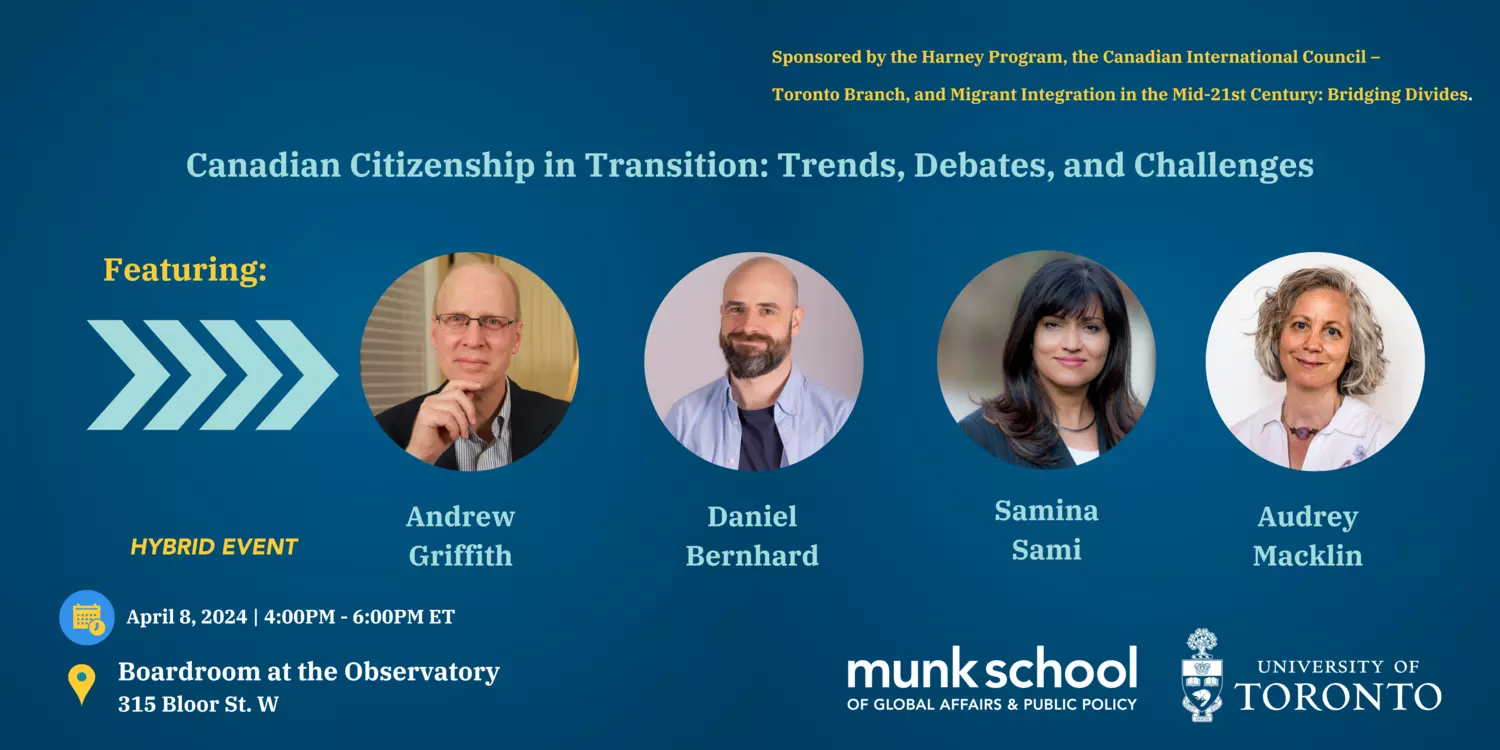
Canadian Citizenship in Transition: Trends, Debates, and Challenges

Looking forward to this timely discussion given recent trends and issues, and the need to maintain and strengthen meaningfulness and belonging of citizenship process, requirements and ceremonies.

Hope some of you can attend in person or virtually.

Please join our panel of experts to discuss trends, debates, and challenges in Canadian citizenship. Topics will include (but not be limited to) the precipitous decline in Canada’s naturalization rate; the suitability of self-administered online naturalization ceremonies and citizenship oaths; concerns over citizenship acquisition through birth; impediments to new Canadians’ access to licensed professions and position of economic, social, and political power; conflicting ideas of what constitutes ‘good’ citizenship and Canadian national identity (as reflected in citizenship guides and courses, government pronouncements, and public discourse); and the consequences of changing immigration policies for newcomers’ access to citizenship. This is a timely and important event that will be of interest to anyone interested in Canadian citizenship both now and in the future.

Source: Canadian Citizenship in Transition: Trends, Debates, and Challenges

Paul: Civil Discourse on Campus Is Put to the Test

More such dialogues needed:

The same week that a U.C. Berkeley protest ended in violence, with doors broken, people allegedly injured, a guest lecture organized by Jewish students canceled and attendees evacuated by the police through an underground passageway, a group of academics gathered across the bay at Stanford to discuss restoring inclusive civil discourse on campus. The underlying question: In today’s heated political environment, is that even possible?

Over the course of two packed days of moderated and free discussion, we would try to test it out.

Paul Brest, a professor emeritus and former dean at Stanford Law School and one of the conference’s organizers, arrived at Stanford in 1969 in the throes of Vietnam War protests. The windows of the conservative Hoover Institution on campus had to be boarded up. In later years, violence broke out in protests over South Africa.

“Back then, it was students against the institution,” he told me. “Now it’s very different because it’s student against student.”

Because I’d written about the difficulties students have had engaging in civil discourse, including a couple of columns on incidents at Stanford, I was one of two journalists invited to take part. Hosted by Stanford Law School and the Stanford Graduate School of Education, the conference brought together professors, deans and academic leaders who were largely liberal, with libertarians and a few conservatives and progressives in the mix. Unfortunately, one of the organizers told me, most of the invited progressives, which is to say the group that currently dominates campus debates, refused to come.

But those who did attend engaged in lively good-faith discussion about several hot-button topics ranging from free expression on campus to institutional neutrality. I’ll write about several of these in the future, but will begin with one of the most divisive: diversity hiring statements, the requirement that all job applicants demonstrate their commitment to advancing diversity, equity and inclusion goals.

Brian Soucek, a professor at the U.C. Davis School of Law and an advocate of D.E.I. statements, started the panel off by making his case. Mere statements of belief in D.E.I. are not enough, he said. In an effort to reach consensus on what a D.E.I. hiring statement should look like, in lieu of U.C. Davis’s current required statement, he proposed an abbreviated version that asked candidates specifically about D.E.I. shortcomings and gaps in their fields of discipline and concrete steps they’ve taken or plan to take to address them.

The rest of the panel wasn’t having it.

Amna Khalid, a historian at Carleton College, endorsed the goal of diversifying staffs. The problem isn’t principle or legality, she said, it’s practice. Diversity according to whom? And in what context?

“It’s always ‘historically excluded and underrepresented,’” she said. “But historically when? Conservatives could argue they have been historically excluded. What’s underrepresented at Hillsdale College will be different from what’s underrepresented in the U.C. system.”

“We all know that there’s a strong political orientation bias being perpetuated,” she continued. “‘Not a good fit,’ they’ll say. It’s fundamentally dishonest and it creates more problems than it addresses.”

“People in the most elite systems know how to game the system,” Jeff Snyder, a professor of educational studies at Carleton, added. “It’s a privileged box-ticking exercise that ultimately degrades the purpose.” Together, he and Khalid filed an amicus brief for the plaintiffs against Florida’s Stop WOKE Act.

Imagine flipping the litmus test on its head, Snyder said. Suppose the requirement was a statement of patriotism at the University of Florida. Suppose they say, just as D.E.I. advocates will say, that the definition of patriotism is expansive. And suppose he writes that his vision of patriotism is political protest in the model of Colin Kaepernick. He wouldn’t get the job. Nor would he get a job if he wrote a D.E.I. statement for Carleton saying he mentored members of the campus N.R.A. group or the Young Republicans Club, both of which are underrepresented minorities on campus. D.E.I. statements are inherently ideological. A chilling effect is inevitable.

“What they want are non-straights, nonwhites and non-men,” said Musa al-Gharbi, a sociologist at Stony Brook University. “But they don’t say it that way. There’s a lack of forthrightness that breaks people in these situations.” In his field, men are underrepresented, and queer scholarship is overrepresented. “But it strains credulity to say that anyone would read a D.E.I. statement about someone’s queer work and say that’s an overrepresented group.”

Soucek gamely continued his defense against what he called “anecdata.” He described an approach Berkeley tried out in 2018, in which it considered candidates’ D.E.I. statements first, before looking at the rest of their applications. Anyone whose D.E.I. statement didn’t pass the first round was eliminated from the next pool.

“People criticized Berkeley afterward that Berkeley didn’t even consider the applicants’ credentials,” Soucek said. “But I would say that D.E.I. statements are credentials.” And let’s be honest, he said. If you look at the cover letter first, you’re privileging another set of credentials first: people’s names — which can tell you a lot — their institutions, their mentors and connections. This was just another and no less valid approach to narrowing the pool.

Why not anonymize all applications? Khalid responded. In fields like history, political science and computer science, 11 universities dominate 50 percent of all tenure positions. Whatever they’re doing now, diversity efforts clearly aren’t working. She compared D.E.I. statements to D.E.I. diversity training. “The whole ‘Look into your hearts and say how racist you are — that does nothing,” Khalid said. “Painful, excruciating and pathetic is the only way to describe them.”

Simply requiring D.E.I. statements gives a pass to universities for not fixing existing problems, added Carol Sumner, the chief diversity officer of Northern Illinois University. She then raised another question: “Is the statement the problem or is it the subjectivity of the person reading the statement you don’t trust?”

Richard Thompson Ford, a professor at Stanford Law School, expressed concern that poorly designed D.E.I. encourages essentialist thinking — the idea that all women or members of the group have similar views or experiences. In his view, D.E.I. programs can be “a way to offload responsibility from the rest of the university and take pressure off them for what actually could be substantive policies that are harder and more expensive.”

One thing on which everyone agreed: Schools are failing at real diversity. D.E.I. statements aren’t necessarily helping. Instead of potentially creating new problems, academia needs to fix existing ones.

“We all had the shared view that diversity and inclusion are good, but that there are legitimate concerns about how we promote these things,” Brian Soucek told me when I spoke to him afterward. Addressing those knotty issues in open dialogue is a good place to start.

Source: Civil Discourse on Campus Is Put to the Test
Judy Weissenberg Cohen: Does ‘MeToo, unless you’re a Jew,’ hold true?

Valid question:

…Then Oct. 7, 2023, happened. Hamas, a listed terrorist entity in Canada since 2002, launched a surprise armed attack on Israel. They massacred more than 1,200 innocent civilians, they kidnapped children, and they raped women. Victims hiding for their lives witnessed the stunningly savage atrocities committed against women and children. The survivors shared their eyewitness accounts. The butchery was meticulously catalogued by the soldiers and first responders — and by the terrorists themselves, who proudly shared footage of their murderous assaults.

Although intentionally documented, the sexual violence has since been denied by Hamas. Many human rights groups — even those with feminist leanings — were either slow to respond, made false equivalencies, or remained silent. It was only after weeks of pressure that Mélanie Joly, Canada’s minister of foreign affairs, finally condemned Hamas, in early December. Human rights organizations whose focus is on the protection of women also remained silent for months. It took the UN eight weeks to put out a statement. And yet, when a report with unsubstantiated accusations of sexual violence levied against Israel was published, Joly and many others commented within hours.

Were they silent about Israeli (Jewish) women because the UN’s women’s groups have aligned themselves with Hamas, whom they view as representing the oppressed? And, if they are the oppressed, they can’t possibly have committed rape?

Does the popular hashtag #MeTooUnlessUrAJew hold true?

Is the rape of women during wartime as inevitable as antisemitism?

While I am grateful for how far Holocaust studies have come in recognizing both the unique vulnerability and resilience of women, it is difficult to see silence about the weaponization of gender-based sexual violence continue. Once women suffered this in silence; we must not, 79 years after the end of the Holocaust, allow Jewish women, or any person, to ever do so again.

I am 95, and I am tired, but this is not the time to be idle. On International Women’s Day, we need to listen to women, to hear their voices, and to speak for those who have been silenced. Regardless of our politics, in this we must all be fearless.

Special to National Post

Hungarian-born Judy Weissenberg Cohen survived the Auschwitz-Birkenau Concentration and Death Camp and Bergen-Belsen Concentration Camp. She was liberated in 1945 following a four-week-long death march. Judy immigrated to Canada in 1948 and worked in the garment industry in Montreal, moving to Toronto in 1961. She is an activist in anti-racism and Holocaust education, with a focus in women’s experiences.

Source: Judy Weissenberg Cohen: Does ‘MeToo, unless you’re a Jew,’ hold true?

Former cabinet minister Selina Robinson resigns from NDP caucus, says she felt unsupported as Jewish woman

Missed opportunity for much needed dialogue:

…In her remarks, Robinson said she felt unsupported as a Jewish woman in her party, and that there are antisemitic voices in the NDP caucus.

Robinson, first elected in 2013, had already announced her retirement and said she won’t be running again in the provincial election this October.

Minister claims double standard in caucus

Robinson resigned her cabinet post as minister of post-secondary education last month after saying modern Israel was founded on “a crappy piece of land.”

Speaking Wednesday afternoon, Robinson said there is a “double standard” within the NDP over how different groups are treated.

“There have been numerous colleagues of mine, intentionally or unintentionally, who have said antisemitic things,” she said. “The Jewish community heard apologies from them, they were accepted and things carried on.”

In contrast, Robinson said she faced continued backlash despite apologizing on multiple occasions and committing to taking anti-Islamophobia training.

“There’s a double standard,” she said, describing herself as the “lone voice,” providing the perspective of Jewish British Columbians within the provincial government.

Robinson also said her decision to step down as a cabinet minister was based on feedback from the premier that he did “not see a way forward” for her to continue in the role.

Asked for a specific example of antisemitism within the party, Robinson cited recent remarks from Burnaby North NDP MLA Janet Routledge. During a debate on the throne speech in February, Routledge compared accusations from opposition party members that the NDP government was incompetent to Nazi propaganda.

“The Holocaust ended in death camps,” Routledge said, attributing her words to a Holocaust survivor in England. “But it started with words. Words are powerful, so let’s use them to bind us together as a civilized society, not tear us apart.”

Robinson said that comparison diminished the reality of the Holocaust, when the Nazis systematically murdered six million Jews.

“To her credit, she apologized right away,” Robinson said, adding she accepted Routledge’s apology — but that same acceptance had not been granted to her.

She also cited comments from Mable Elmore, the parliamentary secretary for anti-racism, whom Robinson said had “outraged the Jewish community” with remarks about the Middle East conflict in November.

“She didn’t lose her role as a result of those comments that were hurtful to that community, but I did lose my role, I was asked to step down,” she said, without further describing Elmore’s remarks.

Robinson said she had asked Premier David Eby if she could work with Muslim and Jewish communities to promote dialogue between them.

She said she wanted to work with the two communities that were “in agony and pain and suffering and fear, and reduce the division that we are seeing because I think that’s the role of government.”

“The premier’s office said they weren’t interested in doing that and that really shattered my heart,” she said.

“If government’s not interested then I can’t be part of a government that chooses to be silent while people are suffering.”

Robinson, who has also previously served as finance minister, said she hadn’t heard from Eby or any other members of the B.C. NDP caucus since informing them of her decision.

NDP house leader denies claims

Speaking to media Wednesday, NDP house leader Ravi Kahlon denied Robinson’s claims of antisemitism or double standards, and said the concerns Robinson voiced during her resignation had not previously been raised by her in caucus.

In his written statement, Eby said Robinson had “made a mistake, and she was doing the work to address the harm that was caused.”

“I wish she had brought her concerns to me directly so we could have worked through them together.”

Kahlon said both the premier and other parties had spoken out on several occasions against instances of antisemitism, including as recently as the past week.

“What we can do is make sure B.C. continues to be a welcoming place for everyone,” he said.

Source: Former cabinet minister Selina Robinson resigns from NDP caucus, says she felt unsupported as Jewish woman

StatsCan: Use of Government COVID-19 Liquidity Support Programs by Immigrant-owned Businesses and Those Owned by Canadian-born Individuals

Of interest, with the same standard factors – gender, education, landing year and language skills – playing a role:

“Immigrant-owned businesses were more likely to be affected by the COVID-19 pandemic than other businesses, as they were more concentrated in industries requiring in-person contact and were smaller in scale. To support businesses affected by the pandemic, the Government of Canada launched various COVID-19 liquidity support programs, including the Canada Emergency Wage Subsidy (CEWS), the Canada Emergency Commercial Rent Assistance (CECRA), the Canada Emergency Rent Subsidy (CERS) and the Canada Emergency Business Account (CEBA). These programs were designed to help affected businesses by partially covering their main expenses, such as wages, rent and property expenses. This paper combines data from the Canadian Employer–Employee Dynamics Database with data from these four support programs to study the use of the programs by immigrant-owned businesses and to compare the results with those of businesses owned by Canadian-born individuals. The results indicate that businesses majority-owned by immigrants were more likely to receive the CEBA and the CECRA or the CERS and less likely to receive the CEWS than businesses owned by Canadian-born individuals after controlling for other factors. However, businesses majority-owned by immigrants received slightly higher dollar values than those owned by Canadian-born individuals, regardless of the program. Among immigrant-owned businesses, the characteristics of the owners, such as gender, education, landing year and language skills, played an important role in the use of the liquidity support programs. For example, businesses whose owners arrived in Canada more recently were less likely to receive the CEWS, and they received a lower dollar value. Businesses whose owners spoke neither English nor French were less likely to receive the CERS, the CECRA or the CEWS, and they received the lowest dollar value when all the programs were combined.”

Read the full report: https://doi.org/10.25318/11f0019m2024002-eng