Pollara: Populism without populists: New polling reveals Canada’s puzzling political contradiction

Interesting:

…Taken together, these patterns define Canada’s distinctive condition of populism without populists: a democratic tension between demand and acceptable political expression. Canadians articulate strong grievances about elite unresponsiveness and systemic unfairnes, and yet resist leaders who adopt the rhetorical and stylistic markers of populism seen elsewhere. The appetite is for accountability and renewal, not for theatrical confrontation or institutional disruption.

For political leaders, this configuration creates a subtle but consequential hazard. Self-identifying as populist offers little reward and significant reputational risk. Canadians overwhelmingly reject figures who embody the style of American right-wing populism. At the same time, the grievances that animate populist movements elsewhere, such as distrust of elites, dissatisfaction with institutions, and perceptions of distant and unresponsive governance, are unmistakably present.

Despite this aversion to populism as a label or style, recent political developments demonstrate that Canadian politicians are increasingly being held accountable by electorates animated by populist expectations around transparency, fairness, keeping promises, follow-through, and genuine influence. Leadership challenges, caucus revolts, and relentless scrutiny signal tensions between authority and responsiveness.

This is the inconvenient democratic reality confronting Canada’s political class. Politicians of all stripes are being held accountable by voters who expect to be heard, respected, and acted upon. Parties should be reminded that in the end, those who govern must answer to those who elected them.

Source: Populism without populists: New polling reveals Canada’s puzzling political contradiction

Diversity of candidates is fundamental to trust in political leadership

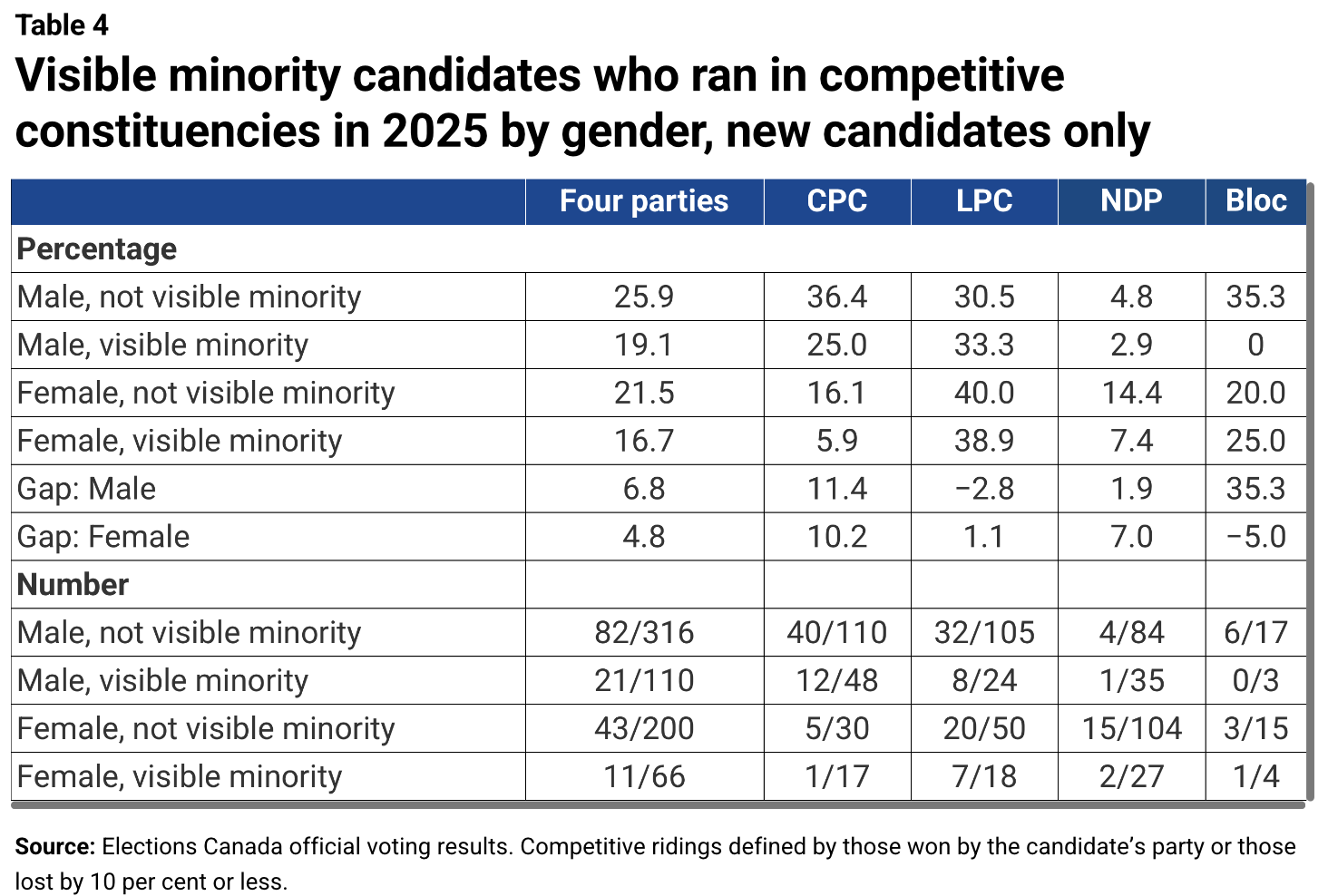
I think her arguments overstate concerns over candidate selection by ignoring the fact that the vast majority of candidates selected by the three major parities is visible minority majority ridings (i.e., those ridings with visible minorities forming more than 50 percent of the population) are in fact visible minorities themselves, over 80 percent in ridings with 70 percent visible minorities, over 40 percent in ridings with between 50 and 70 percent. Even in ridings with between 20 and 50 percent visible minorities, over 20 percent are visible minority candidates.

Of course, just like women candidates, visible minority candidates are more likely in non-competitive ridings:

…Party networks and the limits of recruitment

Part of the job of political parties is to select candidates who will win their seats and thus aid in the party’s quest for power.

However, party recruiters tend to select candidates from their own networks, which are mainly comprised of people like themselves. If recruiters are mostly white men – and that’s been the case historically – then most candidates will likely be white men. Changing this trend requires changing both the recruiter and their networks.

Some parties have tried to combat this by insisting that riding associations look harder for more diverse candidates. The New Democrats are notable here.

But local executives can undermine these efforts even once a candidate has been chosen. For example, a Black lesbian candidate told me that her Liberal riding association said it didn’t have a lot of money for her campaign, yet had no trouble finding more cash for the white men who ran before and after her. These actions can send the message that only white men should apply to be candidates.

Social media scrutiny as a new barrier

In addition, social media scandals are an emerging barrier to candidacy. They first became an issue earlier this century when several federal and provincial candidates were forced to step down after problematic posts came to light. Negative headlines led parties to tighten candidate vetting as a result.

But heightened scrutiny runs the risk of excluding Indigenous, queer and feminist individuals who definitely don’t share the party’s views on everything or whose views may have changed over the years, yet their original posts can still be found online. This could also deter some young people from running because many of them have documented their lives and views online since adolescence.

Scrub one’s social media sites, you say? That doesn’t always work. It’s not uncommon for party operatives to document the online accounts of people they expect to run for office in the future – both to protect themselves and to inflict reputational harm on their opponents. The inability to fully erase one’s online presence means candidate vetting will likely get tougher.

This reality might make it even harder for diverse candidates to make it to the electoral starting line. If so, white men’s dominance in our legislatures and leadership positions will continue.

Barriers such as these make it harder for Canadians of all backgrounds to contribute to our collective governance. More importantly, ongoing resistance to diverse candidates can undermine political trust. If political parties don’t trust diverse people to hold power, why should diverse Canadians trust politicians to govern on their behalf?

Dr. Angelia Wagner is an assistant lecturer and adjunct professor in the department of political science at the University of Alberta. 

Source: Diversity of candidates is fundamental to trust in political leadership

Parkin: The limited prospects for a “rebel alliance”

More interesting analysis by Parkin and Environics, written in response to the Globe editorial. Main takeaway, problem appears to be more on the Alberta side in terms of resentment:

The Globe and Mail published a special editorial this Sunday on the alliance between the Quebec and Alberta governments in support of greater respect and autonomy for their provinces. You can read it here

I am going to weigh in. What’s the point of having a Substack if you can’t drop everything you had planned for the morning in order to share some charts?

The editorial, on the whole, is not wrong. Quebecers and Albertans share many frustrations. Our survey confirms they are the two provinces where support for more provincial powers is highest. But there are two specific nuances that are worth noting, since they arguably constrain the prospects for any Quebec-Alberta “rebel alliance.”

The first is one of the findings that jumped out early on in the Confederation of Tomorrow survey project. Quebecers who are critical of federalism are more likely than those who are not to support an asymmetrical distribution of powers (the option in the survey is: “the federal government should offer more powers to those provinces that want them, so that the federal system can respond to the different needs that some provinces may have”). But this is not the case in Alberta, where more insist on the equality of provinces: there is no greater openness to asymmetry among disgruntled Albertans. While many Quebecers and Albertans will find common ground in feeling disrespected within Canada, their solutions are not the same: the asymmetry that represents a step forward for autonomist Quebecers actually represents a step backwards for autonomist Albertans….

The second finding comes from a question added to the survey more recently, about the perceived contribution that the people in each of the country’s major regions make to Canada.

Relatively few Quebecers (12% overall) say that western Canadians contribute less than their fair share to Canada, and the proportion that holds this view is only slightly higher (16%) among Quebecers who don’t feel their province is treated with respect. 

Far more Albertans (54%) say that Quebecers contribute less than their fair share to Canada, and this rises to a striking 81 percent among Albertans who don’t feel their province is treated with respect….

In short, whatever it is that annoys some Quebecers about federalism, it’s not their sense of what’s going on in the west. But one of the things that annoys some Albertans about federalism is precisely their sense of what’s going on in Quebec.

Resentment of Quebec (among other things) continues to fuel western alienation. The potential for a meaningful Quebec-Alberta alliance that leads us to a reformed federation, along the lines discussed in The Globe and Mail’s editorial, will be limited until Albertan leaders try to address and even defuse that resentment. 

Source: The limited prospects for a “rebel alliance”

Adam Pankratz: The NDP is here to rescue us from ‘cis’ men

Patrick Lagacé has the more serious yet witty take below this take by Pankratz:

…Among the various requirements to be approved to run for the poisoned chalice of NDP leader is a Nomination Signature Form, which must be signed by 500 members in good standing of the NDP. So far, so normal. Then, as is too often the case for the new left, normal leaves the room to be replaced by grievance and nonsense.

And so, to ensure common sense is entirely absent from the signature process, the NDP requires “at least fifty percent (50%) of the total required signatures must be from members who do not identify as a cis man,” and “a minimum of one hundred (100) signatures must be from members of equity-seeking groups, including but not limited to racialized members, Indigenous members, members of the LGBTQIA2S+ community, and persons living with disabilities.”

If there were any lingering doubt, the party of the working class is now definitively the party of identity politics and grievance culture. This is the language that broadcasts to Canadians that the message the NDP got from their electoral drubbing is that they must be even more radical.

While the NDP’s tone deafness to public sentiment is remarkable, the manner in which it facilitates the exclusion of women is even more staggering. Nowhere, readers of the rules will note, is it specified that 50 per cent of signatories must be female, only not “cis man.” That is to say, a candidate can be approved with a combination of cis men and trans women, all natal males, without the need to seek the approval of a single female. While this scenario is admittedly unlikely, it is staggering that a party so hell bent on “inclusivity” and “equity” is so obviously comfortable with the erasure of women from its inclusion criteria. By refusing to mention the word “woman” anywhere, the NDP have signalled their virtue, all while displaying the electoral communications sophistication of trepanned gnat….

Adam Pankratz is a lecturer at the University of British Columbia’s Sauder School of Business.

Source: Adam Pankratz: The NDP is here to rescue us from ‘cis’ men

Legacé: Le NPD domine dans UQAM—Les-Nids-De-Poule

…Le NPD déconne parce que l’immense majorité de la population canadienne est cisgenre. Ce n’est pas une opinion, c’est un fait : les non-cis – transgenres et non-binaires – composent très exactement 0,33 % de la population canadienne de plus de 15 ans selon le recensement de 2021, soit 100 815 personnes sur 30,5 millions de personnes.

Mais oui, limitons le nombre d’hommes cisgenres qui peuvent appuyer une personne désirant diriger le NPD, ça me semble une excellente façon d’élargir la tente politique de ce parti !

Là où le NPD déconne aussi, c’est pour la vérification de l’étiquette de tous ces signataires. Comment les instances néo-démocrates vont-elles vérifier si un signataire est cisgenre… ou pas ?

S’il est 2S, soit bispirituel autochtone ?

Et véritablement autochtone ?

J’ai un TDA diagnostiqué : suis-je en situation de handicap ?

Passage sublime du texte de Catherine Lévesque dans le Post : Le parti n’a pas répondu immédiatement à savoir comment les dirigeants du parti vérifieraient si les signataires s’identifient comme cisgenres ou faisant partie d’un groupe « en quête d’équité ».

Pour authentifier les cis, va-t-on demander aux signataires de baisser leur pantalon ?

Pour le 2S, euh, comment on vérifie cela ?

Je cesse de déconner : le NPD a bien le droit de faire ce qu’il veut, même divorcer formellement de la majorité des Canadiens qui ne sacralisent pas leur sexe, leur genre, leur sigle, leur orientation sexuelle, leur patrimoine culturel. Bref, la moyenne des ours-es.

Mais dans le rayon du signalement de vertu, ces règles sont presque aussi niaiseuses que le discours anti-raciste-anti-colonialiste-anti-patriarcal qu’on retrouve dans les associations facultaires les plus militantes de l’UQAM.

Le NPD est sorti des élections du 28 avril avec le pire résultat depuis sa fondation, tant dans le nombre de députés que dans sa part du vote populaire. Il a perdu le statut de parti officiel au Parlement. Son chef Jagmeet Singh a fini troisième dans sa circonscription.

Source: Le NPD domine dans UQAM—Les-Nids-De-Poule

… The NDP is messing around because the vast majority of the Canadian population is cisgender. It’s not an opinion, it’s a fact: non-cis – transgender and non-binary – make up exactly 0.33% of the Canadian population over the age of 15 according to the 2021 census, or 100,815 people out of 30.5 million people.

But yes, let’s limit the number of cisgender men who can support a person wishing to lead the NPD, it seems to me an excellent way to expand the political tent of this party!

Where the NDP also messes up is for the verification of the label of all these signatories. How will the New Democratic bodies verify whether a signatory is cisgender… or not?

If he is 2S, or indigenous bispiritual?

And truly indigenous?

I have a diagnosed ADD: am I disabled?

Sublime passage from Catherine Lévesque’s text in the Post: The party did not immediately respond to how party leaders would verify whether the signatories identify themselves as cisgenders or part of a group “in search of equity”.

To authenticate the cis, will we ask the signatories to lower their pants?

For the 2S, uh, how do we check this?

I stop fooling around: the NDP has the right to do what it wants, even formally divorce the majority of Canadians who do not sanctify their sex, gender, acronym, sexual orientation, cultural heritage. In short, the average of bears.

But in the radius of virtue reporting, these rules are almost as silly as the anti-racist-anti-colonialist-anti-patriarchal discourse found in the most militant faculty associations of UQAM.

The NDP came out of the April 28 elections with the worst result since its foundation, both in the number of deputies and in its share of the popular vote. It has lost the status of official party in Parliament. His leader Jagmeet Singh finished third in his riding.

French:The Corporate Logo That Broke the Internet

The usual distraction and “flood the zone” tactics by the Trump administration and its enablers:

…The process of stoking outrage has another effect: It crowds out the news cycle. Most Democrats I know would be shocked at how little the average Republican knows about Trump’s actual conduct and his actual wrongdoing. Republicans can, however, cite chapter and verse about left-wing outrages and left-wing overreactions to Trump.

That creates a reality where they simply can’t conceive of how any reasonable, rational person would vote Democratic or oppose the president and his policies.

The Sweeney and Cracker Barrel stories highlight the new right’s theory of change. It sees the social liberalization of America as primarily an elite-driven phenomenon. According to this narrative, the left seized the most powerful institutions of American life and then imposed its delusional and unnatural ideas from the top down, in part through shaming, fear and bullying.

The solution, then, is obvious. Either seize or destroy left-dominated institutions, replace them with right-dominated institutions and elites and then impose conservative values on society, if necessary, through the same intolerant means.

This is why you see some figures on the right turning even to Marxists, such as Antonio Gramsci, to inspire them to “cultural hegemony.”

In this version of the right, cancel culture is only a problem if you’re not the one doing the canceling. The conservative argument for liberty for all is replaced by a populist will to power, one so all-consuming that it exercises veto power over corporate logo redesigns it does not like.

At the moment, MAGA’s cultural power is on the rise, but it’s ultimately on a fool’s errand. Can anyone look at the history of the last 10 years and say that bullying or intolerance helped the left? Or is it more accurate to say that the worst excesses of left-wing cancel culture helped trigger the public reaction that ushered MAGA back into power?

MAGA’s intolerance won’t fare any better. Constant outrage is energizing, at least for a while, for partisans and activists. It’s exhausting for everyone else. The more that MAGA tries to bully America, the more resentment it will build. Bullies only win for a while, and when the backlash to the backlash comes, MAGA will have only itself to blame.

Source: The Corporate Logo That Broke the Internet

Brooks: The Rise of Right-Wing Nihilism

With the Trump administration arguably being the example, with its substantive weakening of public and private institutions, reversing long standing efforts to improve equality, and the consistent coarse nature of public discourse, enabled by normally more responsible Republicans, business and others:

…Other people, of course, don’t just cope; they rebel. That rebellion comes in two forms. The first is what I’ll call Christopher Rufo-style dismantling. Rufo is the right-wing activist who seeks to dismantle D.E.I. and other culturally progressive programs. I’m 23 years older than Rufo. When I was emerging from college, we conservatives thought we were conserving something — a group of cultural, intellectual and political traditions — from the postmodern assault.

But decades later, with the postmodern takeover fully institutionalized, people like Rufo don’t seem to think there’s anything to conserve. They are radical deconstructors. In a 2024 dialogue between Rufo and the polemicist Curtis Yarvin, published by the magazine IM-1776, Rufo acknowledged, “I am neither conservative by temperament nor by political ambition: I want to destroy the status quo rather than preserve it.” This is a key difference between old-style conservatism and Trumpism.

But there’s another, even more radical reaction to progressive cultural dominance: nihilism. You start with the premise that progressive ideas are false and then conclude that all ideas are false. In the dialogue, Yarvin played the role of nihilist. He ridiculed Rufo for accomplishing very little and for aiming at very little with his efforts to purge this university president or that one.

“You are just pruning the forest,” Yarvin said dismissively. He countered that everything must be destroyed: In general, Yarvin is a monarchist, but in this dialogue he played a pure nihilist. One version of nihilism holds that the structures of civilization must be destroyed, even if we don’t have anything to replace them with. He argued that all of America has been a sham, that democracy and everything that has come with it are based on lies.

The Rufo/Yarvin dialogue was sent to me by a friend named Skyler Adleta. Skyler had a rough childhood but has worked his way up to become an electrician and is now a project manager for a construction firm. He lives in southern Ohio, in a community that is mostly Trump-supporting. He himself generally supports the president. I know him because he is also a fantastic writer who contributes to Comment, the magazine my wife edits.

Skyler told me that in his community he is watching many people lose faith in the Rufo method and make the leap into pure nihilism, pure destruction. That is my experience, too. A few months ago, I had lunch with a young lady who said, “The difference is that in your generation you had something to believe in, but in ours we have nothing.” She didn’t say it bitterly, just as a straightforward acknowledgment of her worldview.

Faith in God has been on the decline for decades; so has social trust, faith in one another; so has faith in a dependable career path. A recent Gallup poll showed that faith in major American institutions is now near its lowest point in the 46 years Gallup has been measuring these things. But the core of nihilism is even more acidic; it is the loss of faith in the values your culture tells you to believe in.

As Skyler and I exchanged emails, I was reminded of an essay the great University of Virginia sociologist James Davison Hunter wrote last year for The Hedgehog Review. He, too, identified nihilism as the central feature of contemporary culture: “A nihilistic culture is defined by the drive to destroy, by the will to power. And that definition now describes the American nation.”

He pointed to our culture’s pervasive demonization and fearmongering, with leaders feeling no need to negotiate with the other side, just decimate it. Nihilists, he continued, often suffer from wounded attachments — to people, community, the truth. They can’t give up their own sense of marginalization and woundedness because it would mean giving up their very identity. The only way to feel halfway decent is to smash things or at least talk about smashing them. They long for chaos.

Apparently, the F.B.I. now has a new category of terrorist — the “nihilistic violent extremist.” This is the person who doesn’t commit violence to advance any cause, just to destroy. Last year, Derek Thompson wrote an article for The Atlantic about online conspiracists who didn’t spread conspiracy theories only to hurt their political opponents. They spread them in all directions just to foment chaos. Thompson spoke with an expert who cited a famous line from “The Dark Knight”: “Some men just want to watch the world burn.”

This may be where history is leading. Smothering progressivism produced a populist reaction that eventually descended into a nihilist surge. Nihilism is a cultural river that leads nowhere good. Russian writers like Turgenev and Dostoyevsky wrote about rising nihilism in the 19th century, a trend that eventually contributed to the turmoil of the Russian Revolution. The scholar Erich Heller wrote a book called “The Disinherited Mind” about the rise in nihilism that plagued Germany and Central Europe after World War I. We saw what that led to.

It’s hard to turn this trend around. It’s hard enough to get people to believe something, but it’s really hard to get people to believe in belief — to persuade a nihilist that some things are true, beautiful and good.

One spot of good news is the fact that more young people, and especially young men, are returning to church. I’ve been skeptical of this trend, but the evidence is building. Among Gen Z, more young men now go to church than young women. In Britain, according to one study, only 4 percent of 18- to 24-year-olds went to church in 2018, but by 2024 it was 16 percent. From the anecdotes I keep hearing, young people seem to be going to the most countercultural churches — traditionalist Catholic and Eastern Orthodox.

They don’t believe in what the establishment tells them to believe in. They live in a world in which many believe in nothing. But still, somewhere deep inside, that hunger is there. They want to have faith in something.

Source: The Rise of Right-Wing Nihilism

    ‘1984’ Hasn’t Changed, but America Has

    All too true, even if there have been previous chilling periods:

    …Banning books doesn’t stop at the local level.This year, after Mr. Trump signed three executive orders aimed at combating “wokeness,” the Department of Defense’s education agency removed and reviewed more than 500 titles from its school system, including, according to one report, Aldous Huxley’s “Brave New World,” which the C.I.A. had sent to the Eastern Bloc. Federal funding agencies have compiled a list of more than 350 banned words and phrases, including “women,” “diversity” and “ethnicity.”

    In the Cold War, the United States chose “freedom” — democratic freedom, freedom of speech, intellectual freedom and freedom of choice — as its key point of difference with the Soviet enemy. Since the end of World War II, U.S. presidents from both parties have wrapped themselves in the rhetoric of the “free world” that they led. When Ronald Reagan — who spearheaded the Cold War “freedom” agenda and oversaw an upswing in C.I.A. literary programs — spoke to the British Parliament in 1982, he invoked “the march of freedom and democracy,” which would “leave Marxism-Leninism on the ash-heap of history.” It was no coincidence that George Minden, the leader of the C.I.A. book program, once described his operation as “an offensive of free, honest thinking.”

    Mr. Trump, JD Vance, Ron DeSantis and their fellow travelers expound the virtues of the First Amendment while dismantling guardrails against disinformation and working to suppress political ideas they oppose. Book bans aren’t their only tool. They also block access for independent journalistsintimidate news organizations and defund outlets they perceive as hostile to the MAGA agenda, including NPR, Radio Free Europe/Radio Liberty, Radio Free Asia and Voice of America.

    There are two lessons from the history of the C.I.A. book program that the book banners would do well to heed. One is that censorship — whether by Communists, fascists or democratic governments — tends to create demand for the works it targets. (That, and Mr. Trump’s Orwellian tactics, may explain why “1984” has been surging up the book charts in recent years.)

    The other is that the totalitarians lost the Cold War, and freedom of thought won the day. The former Polish dissident Adam Michnik, whose own works were promoted by the C.I.A., presumably without his knowledge, said: “It was books that were victorious in the fight. We should build a monument to books.”

    Charlie English is the author of, among other books, “The CIA Book Club: The Secret Mission to Win the Cold War with Forbidden Literature.”

    Source: ‘1984’ Hasn’t Changed, but America Has

    Saunders: No, politics haven’t become polarized. Only one side has moved to the extremes 

    Indeed:

    …What has especially caused Ms. Harris – and other moderate leaders after her – to be falsely associated with the far left is the constellation of issues and hysterias known on the right as “gender,” as well as the memory of mass protests and riots against police violence during the pandemic years. Although there definitely are far-left activists on both subjects, Mr. Harris had absolutely nothing to do with them; instead, she said little about either, and quietly took mainstream positions on both issues.

    But the mainstream has become measurably more tolerant. Same-sex marriage, for example, has become so acceptable to the majority of voters that even Mr. Trump doesn’t publicly attack it. It’s moderate, centrist views, not far-out radical ones, that have come under attack.

    This week a study by Vancouver-based polling firm Research Co. asked Americans and Canadians what they thought about “political correctness.” They weren’t asking about Mr. Trump’s ultra-PC desire to, for example, consider removing mentions of slavery from national parks; rather, they asked about “language and/or behaviour that seeks to minimize possible offences to racial, cultural and gender identity groups.”

    The results were very pro-PC: Six out of 10 Canadians, and a majority of Americans, said they support political correctness – and in both countries, the pro-PC proportion of the population has increased since 2022.

    That doesn’t mean that middle-of-the-road voters are drifting to the far left. It means that moderate, mainstream political views have become more open and tolerant – and therefore hated by Trump-like figures on the rightward extreme. For all the noise they throw at these normal views, it’s worth remembering that they’re the only ones who are polarized.

    Source: No, politics haven’t become polarized. Only one side has moved to the extremes

    Nicolas: De Los Angeles à Kananaskis

    Discomforting possible parallel. We will see this upcoming weekend:

    ….Ce qui se passe à Los Angeles représente un tournant, sur deux principaux aspects.

    Premièrement, sur le fond, soit la violence politique envers les personnes immigrantes. Les agents de contrôle de l’immigration (ICE) arrêtent des parents sur leurs lieux de travail pendant que leurs enfants sont à l’école et tentent de se déployer dans des écoles primaires pour y interroger des enfants. On a vu d’autres enfants être privés de leur droit à être représentés par un avocat et être interrogés seuls par les autorités. On a déjà vu aussi, un peu partout au pays, des gens être « déportés » vers des prisons du Salvador et à Guantánamo. J’utilise le mot « déportés » entre guillemets, puisqu’il n’est pas question de retourner les gens vers leur pays d’origine : il s’agit plus de kidnappings. Dans une ville comme Los Angeles, s’en prendre à la population immigrante au statut irrégulier, c’est s’en prendre au tissu social, économique et communautaire de la métropole. La population résiste, parce que les personnes qui sont ciblées par ICE sont indissociables de la population même.

    Si l’on considère que les personnes qui ne possèdent pas la citoyenneté d’un pays n’ont pas de droits fondamentaux, la démocratie est déjà mise à mal.

    Deuxièmement, sur la résistance politique qui se déploie face à ICE. Lorsque des citoyens décident de dénoncer le fait que des parents soient séparés brutalement de leurs enfants, ou que des enfants soient séparés brutalement de leurs parents, ils exercent leur liberté de conscience politique, leur liberté d’expression et leurs droits civiques. En déployant des agents militaires sans le consentement du gouverneur de l’État, et sans que la situation le justifie, Trump franchit encore une autre ligne. La question grave qui se pose désormais, c’est : existe-t-il dorénavant une possibilité que les élections de mi-mandat ne soient pas des élections libres ? Parce que lorsqu’on commence à gérer le débat politique par l’intimidation armée, où et quand s’arrête-t-on, et pourquoi ?

    Revenons au Canada, et à la tentation, qui remonte par soubresauts, de « normaliser » nos relations avec États-Unis. Bien sûr, vu que notre économie est en jeu, ça se comprend tout à fait. Mais il existe un risque sérieux, vu le rythme où Washington s’enfonce, que nos liens avec nos voisins nous entraînent aussi vers l’abysse avec eux. Et par abysse, j’entends ici une forme d’abysse morale. Si la démocratie est précieuse pour les Canadiens, on ne peut s’attacher aussi intimement à un régime déterminé à la fragiliser, chez nous comme chez eux.

    Alors que le G7 s’ouvre à Kananaskis, en Alberta, j’ai certaines appréhensions. L’Histoire ne se répète jamais, mais je crois que l’on peut tout de même tirer certaines leçons de l’échec monumental des Accords de Munich de 1938. J’espère que les chefs d’État seront plus rapides, cette fois-ci, à reconnaître en leur sein l’acteur qui affiche un mépris ouvert pour la règle de droit.

    Source: De Los Angeles à Kananaskis

    …. What is happening in Los Angeles represents a turning point, on two main aspects.

    First, on the substance, either political violence against immigrants. Immigration Control Officers (ICE) arrest parents at their workplaces while their children are in school and try to deploy to primary schools to interview children. Other children have been deprived of their right to be represented by a lawyer and questioned alone by the authorities. We have also seen, all over the country, people being “deported” to prisons in El Salvador and Guantánamo. I use the word “deported” in quotation marks, since there is no question of returning people to their country of origin: it is more about kidnappings. In a city like Los Angeles, attacking the irregular immigrant population is attacking the social, economic and community fabric of the metropolis. The population resists, because the people who are targeted by ICE are inseparable from the population itself.

    If we consider that people who do not have the citizenship of a country do not have fundamental rights, democracy is already being damaged.

    Secondly, on the political resistance that is unfolding against ICE. When citizens decide to denounce the fact that parents are abruptly separated from their children, or that children are abruptly separated from their parents, they exercise their freedom of political conscience, their freedom of expression and their civil rights. By deploying military agents without the consent of the governor of the state, and without the situation justifying it, Trump crosses yet another line. The serious question that now arises is: is there now a possibility that midterm elections are not free elections? Because when we begin to manage the political debate through armed intimidation, where and when do we stop, and why?

    Let’s go back to Canada, and to the temptation, which is rising by ups, to “normalize” our relations with the United States. Of course, since our economy is at stake, it is quite understandable. But there is a serious risk, given the pace at which Washington is sinking, that our links with our neighbors also lead us to the abyss with them. And by abyss, I mean here a form of moral abyss. If democracy is valuable to Canadians, we cannot be so intimately attached to a regime determined to weaken it, both at home and at home.

    As the G7 opens in Kananaskis, Alberta, I have some apprehensions. History never repeats itself, but I believe that we can still learn some lessons from the monumental failure of the 1938 Munich Agreements. I hope that the Heads of State will be quicker, this time, to recognize within them the actor who displays an open contempt for the rule of law.

    Visible minorities in the GTA increasingly supporting Conservatives: U of T study

    Interesting and relevant study. Think the shift largely reflects economic concerns and affordability, particularly among younger voters, whether visible minorities or not, and the effectiveness of Conservative outreach and engagement:

    Federal and provincial Conservatives are winning over more visible minority voters in the GTA, a new study has found.

    According to researchers at the University of Toronto’s School of Cities, visible minorities in the GTA, who make up more than half of the population, are increasingly backing Conservative candidates in federal and provincial elections. The study, out Wednesday, considers anyone, besides Indigenous people, who are non-Caucasian in race or non-white in colour as a visible minority, as defined by Statistics Canada.

    The findings are based on federal and Ontario election results over the past two decades, including the two most recent national and provincial elections earlier this year.

    “What used to be a weak spot for the right is now a growing base,” Prof. Emine Fidan Elcioglu and research assistant Aniket Kali wrote in the study, noting the Conservatives have historically been seen as the party of the white and wealthy, at least until recent years.

    “The more diverse the riding, the stronger the Conservative numbers.”

    The researchers point to the federal election in April as an example.

    Ridings where visible minorities make up the majority shifted rightward by 10 to over 20 percentage points compared to the 2021 federal election — higher than the Conservatives national gain of 7.6 percentage points in the vote count. Most of these ridings are located in the 905 belt around Toronto, which the Star previously reported denied Prime Minister Mark Carney’s Liberals a majority government thanks to a blue wave.

    While the researchers had a sense that some visible minorities have shifted to the right when it comes to voting, the findings still had some surprises. 

    “It was quite stark to see just how consistent the polls were over time,” Kali said in an interview.

    There are multiple reasons for this shift in voting behaviour, according to the researchers.

    First is a decades-long, concentrated attempt by the Conservative party to reach racialized communities through efforts such as multilingual ads and attending religious festivals. Conservatives have also recruited a lot of visible minority candidates — including more than the Liberals and NDP in the April federal election, according to a separate study.

    All this, Elcioglu and Kali said, came as the Liberal party was increasingly being seen as “a party of broken promises” around affordability, housing and other issues.

    “The Liberal arty and the sort of disenchantment with (Justin) Trudeau is certainly part of the puzzle,” Elcioglu said, “but it doesn’t explain everything.”

    Another reason for the shift to the right is changing attitudes among second-generation Canadians.

    In interviews with 50 second-generation Canadians around the GTA — most of whom were either South Asian or Chinese — Elcioglu said she heard that people thought voting Conservative meant becoming more “Canadian.”

    “It’s a way to say, ‘I made it. I belong. I’m not voting like my Liberal party immigrant parents,’” Elcioglu said of the responses she heard in the interviews.

    Although the study shows growing support among visible minority voters for the Conservatives, the researchers stressed that this group of people is not a monolith.

    “Immigrants and minorities are a serious political constituency in the GTA.  They have serious issues and the party that organizes them on those issues and speaks to those issues is going to win some loyalty.”

    Elcioglu said this understanding will be important for the Liberals and NDP if they want to win seats in future elections.

    “Progressive parties shouldn’t assume that they have the support of racialized voters,” she said. “They need to do more listening and speak to the real issues.

    “They need to go out into the suburbs.”

    Source: Visible minorities in the GTA increasingly supporting Conservatives: U of T study