The Case for Teaching Ignorance – The New York Times

Good advice to all of us, whether policy makers or not, on uncertainty and the need to understand the limits of available evidence:

Presenting ignorance as less extensive than it is, knowledge as more solid and more stable, and discovery as neater also leads students to misunderstand the interplay between answers and questions.

People tend to think of not knowing as something to be wiped out or overcome, as if ignorance were simply the absence of knowledge. But answers don’t merely resolve questions; they provoke new ones.

Michael Smithson, a social scientist at Australian National University who co-taught an online course on ignorance this summer, uses this analogy: The larger the island of knowledge grows, the longer the shoreline — where knowledge meets ignorance — extends. The more we know, the more we can ask. Questions don’t give way to answers so much as the two proliferate together. Answers breed questions. Curiosity isn’t merely a static disposition but rather a passion of the mind that is ceaselessly earned and nurtured.

Mapping the coast of the island of knowledge, to continue the metaphor, requires a grasp of the psychology of ambiguity. The ever-expanding shoreline, where questions are born of answers, is terrain characterized by vague and conflicting information. The resulting state of uncertainty, psychologists have shown, intensifies our emotions: not only exhilaration and surprise, but also confusion and frustration.

The borderland between known and unknown is also where we strive against our preconceptions to acknowledge and investigate anomalous data, a struggle Thomas S. Kuhn described in his 1962 classic, “The Structure of Scientific Revolutions.” The center of the island, by contrast, is safe and comforting, which may explain why businesses struggle to stay innovative. When things go well, companies “drop out of learning mode,” Gary P. Pisano, a professor at Harvard Business School, told me. They flee uncertainty and head for the island’s interior.

The Case for Teaching Ignorance – The New York Times.

Don’t LOL, the kids can still spell: Renzetti

Elizabeth Renzetti on the state of kids spelling and the evolution of language:

“Healthy languages change,” Mr. Shea said. “Dead languages are static.”

The linguist and psychologist Steven Pinker also delivers a liberating smack on the nose to pedants and doomsayers in his recent book, The Sense of Style. “The problem with the Internet-is-making-us-illiterate theory, of course, is that bad prose has burdened readers in every era,” he writes. Television and radio were once blamed for a decline in writing skills; now, it’s texts and Twitter. But, as he argues, college students are actually writing more these days than ever before, and they do not make more mistakes than their predecessors or “sprinkle their papers with smileys.”

Instead of seeing a degradation brought about by technology, Mr. Pinker identifies a long-existing division between bad prose, which is bloated, rule-obsessed and obscure, and good prose, which is vibrant, direct and clear. And he banishes treasured notions, such as the idea you can’t start a sentence with a conjunction, to grammar’s slagheap. To deftly split an infinitive is accepted. Prepositions can be placed anywhere they want to cling to. (The rules around prepositions and other parts of speech, Mr. Pinker demonstrates, have more to do with centuries-old fashion than clarity or common sense.)

In other words, language is its own thing, shifting and transforming before our eyes, as much the possession of teenagers as the people who grew up on Strunk and White. “When it comes to correct English, there’s no one in charge,” Mr. Pinker writes. “The lunatics are running the asylum.” And that’s how it should be.

Don’t LOL, the kids can still spell – The Globe and Mail.

The persistence of history | Islam and Slavery – The Economist

Good and needed piece:

But while IS’s embrace of outright slavery has been singled out for censure, religious and political leaders have been more circumspect about other “slave-like” conditions prevalent across the region. IS’s targeting of an entire sect for kidnapping, killing and sex trafficking, and its bragging, are exceptional; forced labour for sexual and other forms of exploitation is not. From Morocco, where thousands of children work as petites bonnes, or maids, to the Syrian refugee camps in Jordan where girls are forced into prostitution, to the unsanctioned rape and abuse of domestics in the Gulf, aid workers say servitude is rife.

Scholars are sharply divided over how much cultural mores are to blame. Apologists say that, in a concession to the age, the Prophet Muhammad tolerated slavery, but—according to a prominent American theologian trained in Salifi seminaries, Yasir Qadhi—he did so grudgingly and advocated abolition. Repeatedly in the Koran the Prophet calls for the manumission of slaves and release of captives, seeking to alleviate the slave systems run by the Greeks, Romans, Byzantines and Jewish Himyarite kings of Yemen. He freed one slave, a chief’s daughter, by marrying her, and chose Bilal, another slave he had freed, to recite the first call to prayer after his conquest of Mecca. His message was liberation from worldly oppression, says Mr Qadhi—enslavement to God, not man.

Other scholars insist, however, that IS’s treatment of Yazidis adheres to Islamic tradition. “They are in full compliance with Koranic understanding in its early stages,” says Professor Ehud Toledano, a leading authority on Islamic slavery at Tel Aviv University. Moreover, “what the Prophet has permitted, Muslims cannot forbid.” The Prophet’s calls to release slaves only spurred a search for fresh stock as the new empire spread, driven by commerce, from sub-Saharan Africa to the Persian Gulf.

… No labour practice has drawn more international criticism than the kafala system, which ties migrant workers to their employers. This is not slavery as IS imposes it; migrants come voluntarily, drawn by the huge wealth gap between their own countries and the Gulf. But the system “facilitates slavery”, says Nicholas McGeehan, who reports for Human Rights Watch on conditions in the desert camps where most such workers live. The Gulf’s 2.4m domestic servants are even more vulnerable. Most do not enjoy the least protection under labour laws. Housed and, in some cases, locked in under their employer’s roof, they are prey to sexual exploitation.

Again, these workers have come voluntarily; but disquieting echoes persist. Many Gulf nationals can be heard referring to their domestics as malikat (slaves). Since several Asian governments have suspended or banned their female nationals from domestic work in the Gulf out of concern for their welfare, recruitment agencies are turning to parts of Africa, such as Uganda, which once exported female slaves. Some domestic servants are abused with irons and red-hot bars: resonant, says Mr McGeehan, of slave-branding in the past.

….Gulf states insist they are dealing with the problem. In June Kuwait’s parliament granted domestic servants labour rights, the first Gulf state to do so. It is also the only Gulf state to have opened a refuge for female migrants. Qatar, fearful that reported abuses might upset its hosting of the World Cup in 2022, has promised to improve migrant housing. And earlier this year Mauritania’s government ordered preachers at Friday prayers to publicise a fatwa by the country’s leading clerics declaring: “Slavery has no legal foundation in sharia law.” Observers fear, though, that this is window-dressing. And Kuwait’s emir has yet to ratify the new labour-rights law.

Rather than stop the abuse, Gulf officials prefer to round on their critics, accusing them of Islamophobia just as their forebears did. Oman and Saudi Arabia have long been closed to Western human-rights groups investigating the treatment of migrants. Now the UAE and Qatar, under pressure after a wave of fatalities among workers building venues for the 2022 World Cup, are keeping them out, too.

Internal protests are even riskier. Over the past two years hundreds of migrant labourers building Abu Dhabi’s Guggenheim and Louvre museums have been detained, roughed up and deported, says Human Rights Watch, after strikes over unpaid wages. Aminetou Mint Moctar, a rare Mauritanian Arab on the board of SOS Esclaves, a local association campaigning for the rights of haratin, or descendants of black slaves, has received death threats.

Is it too much to hope that the Islamic clerics denouncing slavery might also condemn other instances of forced and abusive labour? Activists and Gulf migrants are doubtful. Even migrants’ own embassies can be strangely mute, not wanting criticism to curb the vital flow of remittances. When Narendra Modi, India’s prime minister, visited the UAE this week, his nationals there complained that migrant rights were last on his list. Western governments generally have other priorities. One is simply to defeat IS, whose extreme revival of slavery owes at least something to the region’s persistent and pervasive tolerance of servitude.
The persistence of history | The Economist.

Send in the psychologists to study the psychologists: Salutin | Toronto Star

Salutin on the role of psychologists and other social scientists, and the need to recognize for them to abandon some of their scientific pretensions:

New York Times’ reporter James Risen, a U.S. Senate committee which included former torture victim John McCain and, finally, a report commissioned by the APA itself, all confirmed the odious role played by psychologists and the APA. Top executives, including their chief of ethics, have been let go/resigned. All this is percolating through formal and informal sessions at the convention.

The social sciences have always generated ethical outrages — they deal, after all, with people, not electrons or chemical compounds. But nothing stimulates bad behaviour among the expert class like wars or terror attacks.

Anthropologists for instance have had a long, questionable record among the “primitive” peoples they first “examined” — either with noble intentions or as straight imperial tools. But since 9/11 the Human Terrain Systems (HTS) approach has been under fire, much like the APA situation. In Afghanistan or Iraq the idea was to use their “ethnographic” info to help “map” local societies in order, ultimately, to control and even “target” individuals, either for assassination (recently, by drones) or capture and interrogation, in which case, presumably, the guys from the APA could step up and join in.

What’s surprising about this is that anyone’s surprised. The root of their stupefaction, I’d say, is the delusion that the sciences — psychology, sociology, anthropology, economics etc. — are sciences at all, in the sense of the physical sciences. They aren’t.

They lack the basic qualities of “real” sciences, like clear terms, definitions, and theories, as Noam Chomsky recently noted. The terms they have are used “very loosely,” with a “strong ideological component.” In the 19th century, when their modern versions arose, they hitchhiked on the prestige and success of the natural sciences, appropriating the very word; and basked in the glow of Galileo or Newton. Unlike Prometheus, they didn’t so much steal fire from the gods to give to men; they stole false fire and hawked it. Economists, for instance, failed to see the housing bubble and the crash of 2008. True, some scruffy outsiders, like American Dean Baker, got it right, but all they did was look at the evidence and apply common sense, much as Aristotle would have.

In fact they should probably just drop the science pretensions and go back to where they belong: the inexact realm of the humanities, with the inevitable downgrading that would entail. Psychology was part of the philosophy departments not so long ago; and politics wasn’t a science — it went with economics in something called Political Economy that was more like history.

The late John Seeley, a superb sociologist and psychologist, spent much of his career effectively pursuing his own tail; pondering how to study something of which you were a part and which had made you what you were. It was like studying your own back at the same time as it relentlessly pushed you forward. “We may also hear,” he wrote, “in any serious piece of social science writing as in any poem — the cry of a soul calling for attention, obliquely but obstinately, to who he is, what he is, what he wants, what he suffers, who is with him and against.”

He’d have understood how objective “scientists” could happily verify that waterboarding isn’t torture. They aren’t just social observers, they’re social agents, with their own motives and needs that also deserve careful research.

Send in the psychologists to study the psychologists: Salutin | Toronto Star.

The dichotomy of life as a gay Palestinian with Israeli citizenship

Interesting vignette:

For the 27-year-old, a well-known socialite in Tel Aviv’s LGBT community, the city is a haven for gay men, but Abu Seif says he considers himself a Palestinian and that as such, he can never fully integrate.

His struggles, along with those of two other protagonists are the subject of “Oriented,” a new Israeli documentary, touted as the first to focus on gay Palestinian citizens.

…During an interview this week at a spacious apartment in Jaffa — the mixed Arab-Jewish city merged with Tel Aviv — the three protagonists of “Oriented,” sporting the latest trend in beards, could easily be mistaken for any hip Jewish residents of Tel Aviv.

The liberal Israeli city is considered a gay refuge in an otherwise largely intolerant Middle East, where in some places, gays are persecuted and sometimes killed. Same-sex relations are punishable by death in Iran, Mauritania, Saudi Arabia, Sudan and Yemen. Some gay Palestinians in the West Bank and Gaza Strip have fled their conservative homes to come out in Tel Aviv. Even in Jerusalem, the same gay friendly climate does not always thrive.

Abu Seif is critical of Israel, his country of citizenship, over its policies toward Palestinians but also criticizes the Palestinian society, where homosexuality remains taboo and where there is little tolerance for gays.

On his documents, he is an Arab citizen of Israel, like the two other protagonists in “Oriented” — 27-year-old Fadi Daeem and 26-year-old Naeem Jiryes. The Arab minority makes up about 20 percent of Israel’s population.

All three are fluent in both Arabic and Hebrew and easily switch between the languages. But while in Tel Aviv their sexuality is hardly an issue, they say their national identity is.

“At the airport while my Jewish partners … are already at the duty free, I’m still being checked,” said Abu Seif, referring to the extra level of scrutiny Arab Israelis often face. “So I’m for sure not an Israeli gay man. I’m gay something. So I’m gay Palestinian.”

The dichotomy of life as a gay Palestinian with Israeli citizenship – Israel – news | Haaretz.

After 600 Days of ‘With Flowers,’ Ai Weiwei Has His Passport Back

As a fan of Ai Weiwei’s work, enjoyed this profile and the news that he has his passport back:

On Wednesday morning, as he has every day for the past year and a half, Ai Weiwei placed a bouquet of flowers in the basket of a bicycle that stands outside his studio in Beijing. The selection included carnations and baby’s breath. The day before, he’d picked sunflowers. He started the week with lilies.

For more than a year and a half, China’s infamous dissident artist has arranged his blooms in a daily demonstration against the confiscation of his passport. Titled With Flowers, the work is part-protest, part-performance art. But no longer: After four years, the artist announced via Instagram on Wednesday that the Chinese government had returned his passport. Since 2011, after Ai was arrested on charges of tax evasion, jailed for 81 days, and then released, the government had kept it confiscated, and refused him any other travel papers.

With Flowers endured for about 600 days. Ai started the performance on November 13, 2013, more than two years into his confinement. The demonstration serves as an extraordinary record of his confinement: He placed the flowers outside the aquamarine door at 258 Caochangdi, home to his art studio as well as his design and architecture firm, FAKE Design. They were mighty arrangements, rarely modest, all formally documented on Flickr. Ai is both active and savvy on social media (which is part of what prompted his trouble with the authorities), and his flowers traveled far beyond the plastic basket on his black Giant bike via posts on Flickr, Instagram, and Twitter.

After 600 Days of ‘With Flowers,’ Ai Weiwei Has His Passport Back – The Atlantic.

Salman Rushdie to Grads: Try to Be Larger Than Life

Salman Rushdie’s more interesting approach to grad speeches and the need for skepticism:

You need to have, and refine, and hone, what Ernest Hemingway said every writer needs: a really good s— detector. He said it. (Once again, good advice for writers turns out to be excellent advice for life.)

The world in which you have grown up is unusually full of crap. In the information age, the quantity of disinformation has grown exponentially. If you seek the truth, beware of what Stephen Colbert unforgettably named “truthiness” or, for those with a bit of Latin, “veritasiness.”

Maybe you’ve come across the famous saying of President Abraham Lincoln. “The internet,” Lincoln said, “is full of false quotations.” Listen to your president. Be skeptical about what you swallow. It’s good for the digestion.

I sometimes think we live in a very credulous age. People seem ready to believe almost anything. God, for example. Sorry this is the controversial bit. Sorry to the theology people over there. Shocking how many Americans swallow that old story. Maybe you will be the generation that moves past the ancient fictions. As John Lennon recommended, imagine there’s no heaven. It’s easy if you try. That’s maybe one antique truthiness which perhaps you can finally replace with the truth.

But it’s not just God. There’s also yoga, veganism, political correctness, flying saucers, Birthers, 9/11 denialists, Scientology, and, for Pete’s sake, Ayn Rand. When the Modern Library asked readers to vote for the best novels of all time, books by Ayn Rand came in at #1, 2, 7, and 8, and books by L. Ron Hubbard – I was going to say fiction by L. Ron Hubbard, rather than nonfictional religious texts, but hey, what’s the difference – came in at #3, 9, and 10.

The only real authors that made it into the top ten were Tolkien, Harper Lee and George Orwell. If that isn’t scary enough, opinion polls regularly show that the most trusted news network in the USA is Fox News. The American appetite for bad fiction seems limitless, including very bad fiction indeed masquerading as fact – Iraqi weapons of mass destruction, for example, or Hillary Clinton’s alleged Benghazi cover-up – an inexhaustible appetite for nonsense.

Maybe you will be the beady-eyed generation that starts seeing through the disinformation, the badly imagined blah, the lies. If you can do that, if you can scrape away all the layers of gibberish that are being poured daily over the wonders of the world, maybe you will be the generation that reminds itself that it is, indeed, a wonderful world, and gets rid of the various kinds of snake-oil salesmen who are selling a world they made up for their own benefit.

Salman Rushdie to Grads: Try to Be Larger Than Life | TIME.

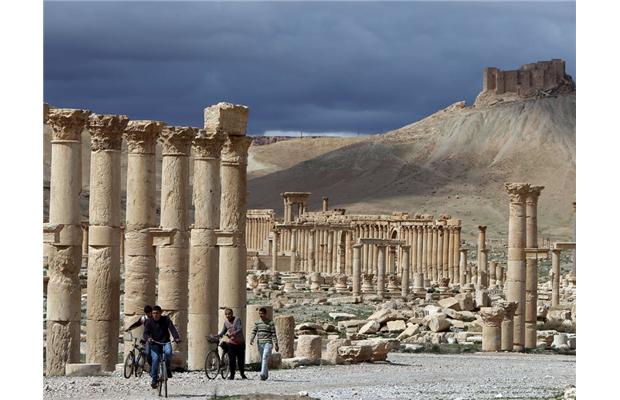
Syria warns 2,000-year-old city is in danger of being ISIL’s next cultural atrocity

PalmyraSad. Another one of the places I visited many years ago and is a world cultural and historical treasure:

A Syrian official called on the international community Thursday to protect the 2,000-year-old ruins of the ancient city of Palmyra, now threatened by the advance of the Islamic State of Iraq and the Levant. Fighting between ISIL and Syrian government forces has come within 2 km of the 2,000-year-old UNESCO World Heritage Site, which once attracted thousands of tourists to its towering Roman colonnades and temple to the god Baal. If Palmyra falls into ISIL’s hands,

Syria warns 2,000-year-old city is in danger of being ISIL’s next cultural atrocity.

ICYMI: Glenn Gould inspires Apple workers today just as he did Steve Jobs

Not surprising. Good professors find models and metaphors for the values they wish to impart:

When it comes to obsessively meticulous attention to detail, it seems Apple employees could learn something from Glenn Gould.

At the company’s internal Apple University — a somewhat secretive institution by reputation — professor Joshua Cohen delivers three-hour seminars on the late, great Canadian pianist to classes of 15 students.

Those pupils typically occupy “senior leadership positions” at the tech giant, says Cohen in a recent telephone interview.

“The conversations we have are conversations about the human qualities that Gould has that are important for doing something that’s really extraordinary — in the way that his musical performance was extraordinary,” Cohen says.

“That craft-person’s attention to detail is an important focus of the conversation about him. And it strongly resonates with people here.”

Cohen, a longtime faculty member at MIT who received his PhD in philosophy from Harvard, focuses much of his attention on Gould’s 1955 debut recording “Bach: The Goldberg Variations.”

At the time, it was rarely recorded and considered to be a preposterously demanding piece of music.

But the then-22-year-old Gould attacked it with characteristic doggedness and brazen self-assurance.

Cohen’s presentation at Apple University touches on Gould’s belief in music’s “ethical importance,” part of what fuelled his lofty ambition. He re-recorded certain arias for his debut over and over and over, in search of perfection.

The infamously eccentric Gould could be stubborn, a personality trait that seems to strike a chord with Apple decision-makers.

“It’s his willingness to be unreasonable — meaning, not to worry about the conventional ways of playing things, and to have a strength of conviction about there being a right way to do them,” Cohen says.

One might be tempted to draw parallels between Gould and exacting Apple visionary Steve Jobs.

The late Jobs was, in fact, a fan, and told biographer Walter Isaacson that he was fond of comparing Gould’s original 1955 recording of the “Goldberg Variations” to the second edition he issued just before his death in 1981.

“They’re like night and day,” Jobs was quoted as saying in “Steve Jobs.”

“The first is an exuberant, young, brilliant piece, played so fast it’s a revelation. The later one is so much more sparse and stark. You sense a very deep soul who’s been through a lot in life. It’s deeper and wiser.”

Which did Jobs prefer?

“Gould liked the later version much better. I used to like the earlier, exuberant one,” Jobs said. “But now I can see where he was coming from.”

I often find myself writing on my Macbook listening to Gould, as his music helps me focus.

Glenn Gould inspires Apple workers today just as he did Steve Jobs – Business – CBC News.

Peer reviewer tells female biologists their study would be better if they worked with men

While I have a general preference for mixed teams (and most of the evidence I have seen supports mixed teams), this is taking it too far. But given the subject of the paper (sexism), one can see the possibility of bias.

However, the peer review should focus on the substance and the assumptions of the study, rather than the gender of the authors:

“I read it through a couple of times trying to figure out whether it was a joke,” Head tells As It Happens guest host Tom Harrington. “[When I showed it to my colleagues], both male and female, they were unanimously outraged. It confirmed what I initially thought… The tone was completely condescending and the sexist comments were peppered throughout the review. I don’t know what they were trying to achieve, really.”

“It would probably also be beneficial to find one or two male biologists to work with (or at least obtain internal peer review from, but better yet as active co-authors), in order to serve as a possible check against interpretations that may sometimes be drifting too far away from empirical evidence into ideologically biased assumptions.”

– Excerpt from anonymous peer review

Ironically, their paper was about sexism. Head and Ingleby conducted a survey of 244 biology PhD students and found that women had worse job prospects than their male colleagues, possibly due to gender bias.

“We initially sent an appeal to the journal when we first received the review back,” she says. “We thought it was taking them too long to respond — all we received from them was a form letter apologizing for the delay. But really, this is an open-and-shut case. We couldn’t see why it was taking so long, and we didn’t want to see this swept under the carpet.”

Head and Ingleby decided to share excerpts of their review on Ingleby’s Twitter account. It went viral.

“Everyone paid attention it seemed,” she says with a laugh. “My co-author posted the tweets just before I went to bed at 11 p.m. Australian time. I woke up the next morning and Science magazine had covered the Twitter storm… it’s been really crazy, the response.”

In less than 24 hours, PLOS ONE issued a statement of apology and announced their appeal was in process.

“PLOS regrets the tone, spirit and content of this particular review. We take peer review seriously and are diligently and expeditiously looking into this matter. The appeal is in process. PLOS allows Academic Editors autonomy in how they handle manuscripts, but we always follow up if concerns are raised at any stage of the process. Our appeals policy also means that any complaints of the review process can be fully addressed and the author given opportunity to have their paper re-reviewed.”

– PLOS One statement

Peer reviewer tells female biologists their study would be better if they worked with men – Home | As It Happens | CBC Radio.