Limiting the number of Muslims allowed to immigrate to traditionally Christian nations would be a prudent decision on the part of politicians, said U.S. Cardinal Raymond L. Burke.
During a pro-life and pro-family conference in Rome May 17, the day before Italy’s March for Life, Burke outlined his views on immigration.
“To resist large-scale Muslim immigration in my judgment is to be responsible,” Burke said, responding to a written question.
Islam “believes itself to be destined to rule the world,” he said. “You don’t have to be a rocket scientist to see what has happened in Europe,” the cardinal said, citing the large Muslim immigrant populations in France, Germany and Italy.
Burke’s comments are the latest addition to a debate among Catholics regarding the application of Gospel precepts to the large numbers of migrants arriving in Western nations from Africa and the Middle East.
In early May, Cardinal Konrad Krajewski, the pope’s almoner, told a reporter that the Vatican would refuse a papal blessing to Matteo Salvini, Italy’s deputy prime minister, who is known for his restrictive immigration policies.
Burke said that the while the Church must be generous to “individuals that are not able to find a way of living in their own country,” this is not the case for many Muslim migrants, “who are opportunists.”
The cardinal mentioned the book No Go Zones: How Sharia Law is Coming to a Neighborhood Near You, written by former Breitbart News reporter Raheem Kassam, as evidence that Muslim immigration is having an effect even in the United States.
Pope Francis has made a generous attitude toward migrants a cornerstone of his pontificate, underlining the Christian duty to “welcome the stranger” over political or demographic considerations, although he repeatedly has added that government leaders have a responsibility to assess how many migrants their countries truly can integrate. Such an assessment should include the financial costs of helping immigrants learn the local language and customs, the pope has said.
Answering the written question from a conference participant, Burke said Christian nations’ abandonment of traditional moral norms has been a cause of Europe’s Muslim influx.
“Muslims have said that they are able today to accomplish what they were not able to accomplish in the past with armaments because Christians no longer are ready to defend their faith, what they believe; they are no longer ready to defend the moral law,” the cardinal said.
Another reason for the demographic shift, the cardinal said, is that “Christians are not reproducing themselves,” referring to the widespread use of contraceptives.
In this context, Catholics have a duty to instruct migrants on “what is bankrupt in the culture” into which they are received. To the extent possible, Catholics should even to try to work with them “to recover what is true culture,” which includes a recognition of the dignity of life, respect for sexual morality and proper worship of God, the cardinal said.
In view of these considerations, limiting “large-scale Muslim immigration is in fact, as far as I’m concerned, a responsible exercise of one’s patriotism,” Burke said.
In April, Burke contributed a foreword to a book titled, Love for the Papacy and Filial Resistance to the Pope in the History of the Church, by Roberto de Mattei, an Italian historian.
“At a time of profoundest spiritual and moral crisis, the Catholic Church needs more than ever before to recall her sacred tradition, unbroken from the time of the apostles,” the cardinal wrote.
Burke, 70, is perhaps best known as one of four cardinals who, opposed to the possibility that some divorced and civilly remarried couples might eventually be readmitted to the sacraments, wrote a series of “dubia” or doubts about Francis’s 2016 exhortation on the family, Amoris Laetitia.
Valid points by the groups not being invited to testify:
Le refus du gouvernement Legault d’entendre les groupes religieux directement visés par le projet de loi sur la laïcité démontre, selon ceux-ci, que son lit est déjà fait et que les consultations l’entourant ne sont qu’une mascarade.
Des représentants d’organisations juives, musulmanes, sikhes et même de l’Église unie du Canada ont vivement dénoncé, mardi à Montréal, le mutisme du gouvernement caquiste qui, à leurs demandes d’être entendus aux audiences de la commission parlementaire sur le projet de loi 21, n’a répondu que par des accusés de réception sans invitation.
«Le gouvernement voit cette loi comme un fait accompli», a déclaré Avi Finegold, porte-parole du Conseil des rabbins de Montréal, alors que les consultations s’entamaient à Québec.
«On dirait qu’ils essaient simplement de masquer le tout avec quelques journées de consultations, pour une loi aussi majeure», a-t-il déploré.
Déficit d’ouverture et d’inclusion
Pour ces organisations, il est inconcevable que les personnes directement touchées par cette loi soient ainsi ignorées.
«Le fait qu’on ne soit même pas invités aux consultations fait en sorte que notre opinion, pour eux, n’est même pas valide», a pour sa part avancé la porte-parole du Conseil national des musulmans canadiens, Sara Abou-Bakr, qui ne s’est pas gênée pour faire la leçon au gouvernement caquiste sur la notion d’inclusion.
«C’est sûr qu’ils ont pris cette décision-là sans même avoir l’idée d’avoir un Québec inclusif et sans même inclure tous les citoyens du Québec. L’ouverture, c’est d’inclure tout le monde. L’ouverture, ce n’est pas d’inclure les personnes (..) dont on sait qu’elles vont déjà être de notre avis. L’ouverture, c’est donner à tout le monde la chance égale de parler que ce soit pro-loi ou contre la loi.»
Cette exclusion des groupes directement touchés est particulièrement mal accueillie par Samaa Elibyari, du Conseil canadien des femmes musulmanes.
«Les femmes voilées, c’est-à-dire celles qui portent le hijab, seront les premières victimes. Il est donc déplorable que notre voix ne soit pas entendue à ce sujet», a-t-elle dit.
Selon elle, l’exclusion imposée par le gouvernement Legault «trahit un esprit de parti pris».
«Comment pouvez-vous justifier que les personnes qui sont les plus touchées ne sont pas représentées ?» demande-t-elle, faisant valoir que «ce n’est pas seulement les femmes qui seront affectées, c’est toute la famille, c’est toute la communauté» puisque la restriction à l’emploi devient une conséquence matérielle tangible.
Le voile comme signe d’inclusion
Les organisations font valoir que le discours d’ouverture à la diversité du gouvernement caquiste peut difficilement être soutenu dans les faits s’il est incapable de faire preuve d’ouverture pour l’étude de son projet de loi.
Plus encore, souligne Sara Abou-Bakr, le port d’un signe religieux pourrait s’avérer un puissant argument en faveur de l’inclusion.
«Le fait que je porterais un symbole religieux en travaillant pour le gouvernement mettrait l’emphase sur le fait qu’on vit dans un Québec inclusif», avance-t-elle.
Sur le fond, les organisations ne s’en cachent pas : elles perçoivent toutes le projet de loi 21 comme un instrument de discrimination.
«Nous estimons qu’il s’agit d’une discrimination encouragée par l’État, une légalisation de la discrimination, et ça affectera tout le monde», a de son côté déclaré l’imam Musabbir Alam, de l’Alliance musulmane canadienne.
«La loi 21 est une loi qui va renforcer la division de la société québécoise», a renchéri Sara Abou-Bakr.
Avi Finegold, de son côté, a cherché à contrer les discours de peur qui entourent ce débat.
«Nous ne devrions pas avoir peur de la religion. Nous n’essayons pas de convertir qui que ce soit. Nous sommes ici pour vivre nos vies et pour avoir notre foi religieuse exprimée de la manière dont nous le voulons l’exprimer», a-t-il dit.
Les organisations n’écartent pas la possibilité d’aller vers des recours juridiques pour contrer l’éventuelle loi et préparent également des activités de soutien à leurs revendications.
Around this time of the year, the edge of the Taklamakan desert in far western China should be overflowing with people. For decades, every spring thousands of Uighur Muslims would converge on the Imam Asim shrine, a group of buildings and fences surrounding a small mud tomb believed to contain the remains of a holy warrior from the eighth century.
Pilgrims from across the Hotan oasis would come seeking healing, fertility, and absolution, trekking through the sand in the footsteps of those ahead of them. It was one of the largest shrine festivals in the region. People left offerings and tied pieces of cloth to branches, markers of their prayers.
Visiting a sacred shrine three times, it was believed, was as good as completing the hajj, a journey many in underdeveloped southern Xinjiang could not afford.
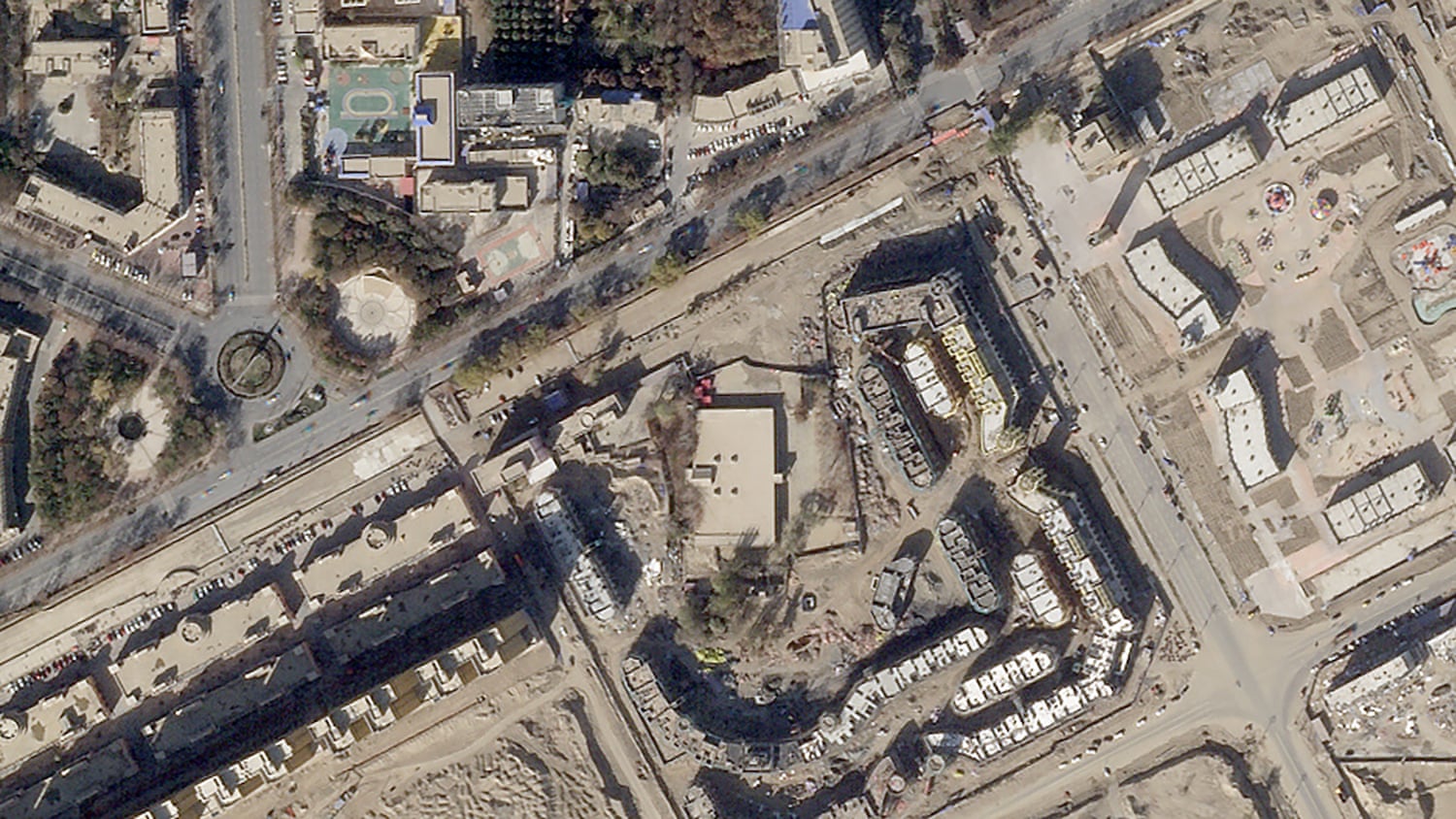
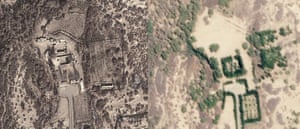
Before and after images of the Imam Asim Shrine. Credit: Digital Globe/ Planet Labs
But this year, the Imam Asim shrine is empty. Its mosque, khaniqah, a place for Sufi rituals, and other buildings have been torn down, leaving only the tomb. The offerings and flags have disappeared. Pilgrims no longer visit.
It is one of more than two dozen Islamic religious sites that have been partly or completely demolished in Xinjiang since 2016, according to an investigation by the Guardian and open-source journalism site Bellingcat that offers new evidence of large-scale mosque razing in the Chinese territory where rights groups say Muslim minorities suffer severe religious repression.
Using satellite imagery, the Guardian and Bellingcat open-source analyst Nick Waters checked the locations of 100 mosques and shrines identified by former residents, researchers, and crowdsourced mapping tools.
Out of 91 sites analysed, 31 mosques and two major shrines, including the Imam Asim complex and another site, suffered significant structural damage between 2016 and 2018.
Of those, 15 mosques and both shrines appear to have been completely or almost completely razed. The rest of the damaged mosques had gatehouses, domes, and minarets removed.
A further nine locations identified by former Xinjiang residents as mosques, but where buildings did not have obvious indicators of being a mosque such as minarets or domes, also appeared to have been destroyed.
Uprooted, broken, desecrated
In the name of containing religious extremism, China has overseen an intensifying state campaign of mass surveillance and policing of Muslim minorities — many of them Uighurs, a Turkic-speaking group that often have more in common with their Central Asian neighbours than their Han Chinese compatriots. Researchers say as many as 1.5 million Uighurs and other Muslims have been involuntarily sent to internment or re-education camps, claims that Beijing rejects.
Campaigners and researchers believe authorities have bulldozed hundreds, possibly thousands of mosques as part of the campaign. But a lack of records of these sites — many are small village mosques and shrines — difficulties police give journalists and researchers traveling independently in Xinjiang, and widespread surveillance of residents have made it difficult to confirm reports of their destruction.
The locations found by the Guardian and Bellingcat corroborate previous reports as well as signal a new escalation in the current security clampdown: the razing of shrines. While closed years ago, major shrines have not been previously reported as demolished. Researchers say the destruction of shrines that were once sites of mass pilgrimages, a key practice for Uighur Muslims, represent a new form of assault on their culture.
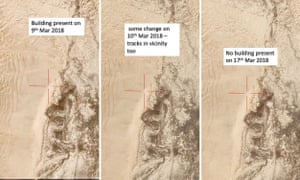
Three-way composite of Jafari Sadiq shrine. Photograph: Planet Labs
“The images of Imam Asim in ruins are quite shocking. For the more devoted pilgrims, they would be heartbreaking,” said Rian Thum, a historian of Islamat the University of Nottingham.
Before the crackdown, pilgrims also trekked 70km into the desert to reach the Jafari Sadiq shrine, honouring Jafari Sadiq, a holy warrior whose spirit was believed to have travelled to Xinjiang to help bring Islam to the region. The tomb, on a precipice in the desert, appears to have been torn down in March 2018. Buildings for housing the pilgrims in a nearby complex are also gone, according to satellite imagery captured this month.
Before and after imagery of the Jafari Sadiq shrine. L-R Dec 10 2013, April 20, 2019. Photograph: Google Earth/ Planet Labs
“Nothing could say more clearly to the Uighurs that the Chinese state wants to uproot their culture and break their connection to the land than the desecration of their ancestors’ graves, the sacred shrines that are the landmarks of Uighur history,” said Thum.
‘When they grow up, this will be foreign to them’
The Kargilik mosque, at the centre of the old town of Kargilik in southern Xinjiang, was the largest mosque in the area. People from various villages gathered there every week. Visitors remember its tall towers, impressive entryway, and flowers and trees that formed an indoor garden.
The mosque, previously identified by online activist Shawn Zhang, appears to have been almost completely razed at some point in 2018, with its gatehouse and other buildings removed, according to satellite images analysed by the Guardian and Bellingcat.
Three locals, staff at nearby restaurants and a hotel, told the Guardian that the mosque had been torn down within the last half year. “It is gone. It was the biggest in Kargilik,” one restaurant worker said.
Another major community mosque, the Yutian Aitika mosque near Hotan, appears to have been removed in March of last year. As the largest in its district, locals would gather here on Islamic festivals. The mosque’s history dates back to 1200.
Despite being included on a list of national historical and cultural sites, its gatehouse and other buildings were removed in late 2018, according to satellite images analysed by Zhang and confirmed by Waters. The demolished buildings were likely structures that had been renovated in the 1990s.
Two local residents who worked near the mosque, the owner of a hotel and a restaurant employee, told the Guardian the mosque had been torn down. One resident said she had heard the mosque would be rebuilt but smaller, to make room for new shops.
“Many mosques are gone. In the past, in every village like in Yutian county would have had one,” said a Han Chinese restaurant owner in Yutian, who estimated that as much as 80% had been torn down.
“Before, mosques were places for Muslims to pray, have social gatherings. In recent years, they were all cancelled. It’s not only in Yutian, but the whole Hotan area, It’s all the same … it’s all been corrected,” he said.
Activists say the destruction of these historical sites is a way to assimilate the next generation of Uighurs. According to former residents, most Uighurs in Xinjiang had already stopped going to mosques, which are often equipped with surveillance systems. Most require visitors to register their IDs. Mass shrine festivals like the one at Imam Asim had been stopped for years.
Removing the structures, critics said, would make it harder for young Uighurs growing up in China to remember their distinctive background.
“If the current generation, you take away their parents and on the other hand you destroy the cultural heritage that reminds them of their origin … when they grow up, this will be foreign to them,” said a former resident of Hotan, referring to the number of Uighurs believed detained in camps, many of them separated from their families for months, sometimes years.
“Mosques being torn down is one of the few things we can see physically. What other things are happening that are hidden, that we don’t know about? That is what is scary,” he said.
The ‘sinicisation’ of Islam
China denies allegations it targets Muslim minorities, constrains their religious and cultural practices, or sends them to re-education camps. In response to questions about razed mosques, foreign ministry spokesman Geng Shuang said he was “not aware of the situation mentioned”.
“China practices freedom of religion and firmly opposes and combats religious extremist thought… There are more than 20 million Muslims and more than 35,000 mosques in China. The vast majority of believers can freely engage in religious activities according to the law,” he said in a faxed statement to the Guardian.
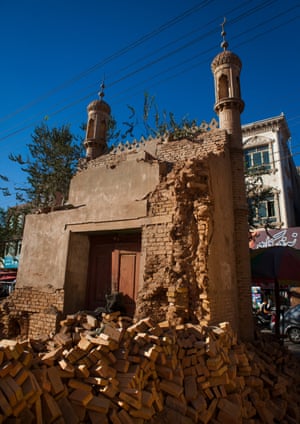
A demolished mosque in the old town of Kashgar, Xinjiang Uyghur autonomous region, China. Photograph: Eric Lafforgue/Art in All of Us/Corbis via Getty Images
But Beijing is open about its goal of “sinicising” religions like Islam and Christianity to better fit China’s “national conditions”. In January, China passed a five-year plan to “guide Islam to be compatible with socialism”. In a speech in late March, party secretary Chen Quanguo who has overseen the crackdown since 2016 said the government in Xinjiang must “improve the conditions of religious places to guide “religion and socialism to adapt to each other”.
Removing Islamic buildings or features is one way of doing that, according to researchers.
“The Islamic architecture of Xinjiang, closely related to Indian and Central Asian styles, puts on public display the region’s links to the wider Islamic world,” said David Brophy, a historian of Xinjiang at the University of Sydney. “Destroying this architecture serves to smooth the path for efforts to shape a new ‘sinicised’ Uighur Islam.”
Experts say the razing of religious sites marks a return to extreme practices not seen since the Cultural Revolution when mosques and shrines were burned, or in the 1950s when major shrines were turned into museums as a way to desacralise them.
Today, officials describe any changes to mosques as an effort to “improve” them. In Xinjiang, various policies to update the mosques include adding electricity, roads, news broadcasts, radios and televisions, “cultural bookstores,” and toilets. Another includes equipping mosques with computers, air conditioning units, and lockers.
“That is code to allow them to demolish places that they deem to be in the way of progress or unsafe, to progressively yet steadily try to eradicate many of the places of worship for Uighurs and Muslim minorities,” said James Leibold, an associate professor at La Trobe University focusing on ethnic relations.
Critics say authorities are trying to remove even the history of the shrines. Rahile Dawut, a prominent Uighur academic who documented shrines across Xinjiang, disappeared in 2017. Her former colleagues and relatives believe she has been detained because of her work preserving Uighur traditions.
Dawut said in an interview in 2012: “If one were to remove these … shrines, the Uighur people would lose contact with earth. They would no longer have a personal, cultural, and spiritual history. After a few years we would not have a memory of why we live here or where we belong.”
A four-year study into faith communities in Australia and the UK has found Muslims experience acts of violence on an individual basis like no other religious adherents, leading to calls for better early education in religious awareness.
Key points:
The Interfaith Childhoods project has already spoken to 340 people from religious communities in six cities across Australia, Great Britain
The lead researcher has found difficulties of religious life in Australia is felt most strongly by Muslim women
The study will form the basis of a large-scale public art program discussing social values in relation to different faiths in young children
In the midst of conducting her research, RMIT University’s Professor Anna Hickey-Moody said she was disturbed when she heard the experiences of Muslim Australians, prompting her to lead the call.
“The mosque [where] I spent most of the week in Adelaide has had young men, white men, driving around the mosque in a car with the windows rolled down pretending to shoot it. I mean, that’s terrifying,” she said.
Since 2016, 340 people from religious communities have been interviewed in six cities across Australia and Great Britain for the Interfaith Childhoods project.
They included lower socio-economic communities in Sydney, Adelaide, Canberra, Melbourne, London and Manchester.
Professor Hickey-Moody brought together children and their parents, asking the children to create art about their identities and then interviewing their parents in-depth about their experiences of living in Australia.
Ending in 2020 and funded by the Australian Research Council, it will be the first Australian study to create a large-scale public art program discussing social values in relation to different faiths in young children.
“One child in south-east London drew a globe where he pinned where he began, as in where he was born in Somalia, and then the flight around the world and the different places where he’s been and where he ended up. It was his story of home,” Professor Hickey-Moody said.
But it was when she interviewed the parents, particularly the Muslim women, when she heard the full extent of difficulties of religious life in Australia.
“She was talking about how complicated that is to experience as a mother. She wants her daughter to have a religious life, but she’s also scared to teach her daughter a way of life that might allow her to be vulnerable.
“One story that stuck in my head … [a woman] and her sister were in town in Adelaide and they saw an older woman that was struggling with her walking frame and they went to try and help her because they realised she wasn’t going to make it across the lights.
“When they got to the walking frame to try and help her, she looked at them with this visceral hate and said ‘get your hands of me you bitches, I’m just coming for you, I’m coming to tell you to get back where you came from’.
“Her sister burst into tears because she was so shocked, and she [the older woman] burst into laughter.”
Adelaide seen to be the most unaccepting city
Across all of the cities involved in the project, the researchers found stories from Adelaide to be the most distressing.
“It has a less multicultural community, it’s a less international community, and I think there’s not the kind of cosmopolitan consciousness that requires understanding social difference,” Professor Hickey-Moody said.
One Muslim woman in the Adelaide focus group burst into tears as she recalled the moment another women came right up to her face and yelled at her to “get out of here”.
I am not a right-winger. I am ashamed to say that I discovered Sir Roger Scruton only four years ago when an argument in a Washington DC think-tank led to a search for contemporary philosophers who took a long view of civilisation, history, ideas, and implications of philosophy.
It happened when I was an advisor to Tony Blair and visited Washington DC for a think-tank meeting representing Tony. There, left-wing Muslim activists, who put their community’s interests before their country, accused me of being a ‘neoconservative’ because I argued that the national security of our countries and peoples mattered more than any Muslim community identity. A safer country, logically, meant a safer Muslim community.
The attacks from them kept coming that I was a ‘neo-con’. To better understand what was really meant by ‘neo-con’, I started to read Leo Strauss, the so-called founder of neo-conservatism. This German Jewish philosopher worked wonders for my growing appreciation and learning of how the West was built on the ideals of Athens and Jerusalem; his own struggles as a Jew with the modern West were instructive for me.
I discovered, through Strauss, the great Muslim philosophers, particularly al-Farabi (d.950) and Avicenna (1037). I was hooked. Here were renowned Muslim luminaries who honoured Socrates, Plato and Aristotle and merged early Islam with the classical West. Knowledge was not limited to the Quran or the Bible, but came from the great Greek pagans too.
This encounter and subsequent discovery drew me to seek out Sir Roger as the supervisor for my doctoral research for six reasons.
First, he is fair to the contributions made by Muslim philosophers to the West. He is not dismissive of God and divinity, as is fashionable among too many Nietzschean academics. In his seminal A Short History of Modern Philosophy he writes how al-Farabi, Avicenna and Averroes ‘all of them Muslims’ ‘systematised and adapted’ Aristotelian thought. Where others sought to downplay or ignore Muslim contributions to the emergence of the modern West, Scruton was true to the historical record.
In his book on Spinoza, among the greatest of the Enlightenment thinkers, Scruton repeatedly emphasises that Spinoza was reading the Muslim philosophers of Andalusia before Spinoza read Descartes or Hobbes. Commenting on Spinoza’s Spanish Jewish ancestry, Scruton writes:
‘For several centuries such people had lived relatively securely in the Spanish peninsula, protected by the Muslim princes, and mingling openly with their Islamic neighbours. Their theologians and philosophers and scholars had joined in the great revival of Aristotelian philosophy […]’
In The Soul of the World Scruton admiringly quotes Muslim mystics and heaps praise on Ghazali and Rumi, quoting from the latter’s verses and shows a grasp of the Muslim mystical mind.
For me, it was clear that Scruton’s objection was not to the Islam of beauty, co-existence, spirituality, poetry, civilisation, art and architecture. But like millions of Muslims, his fight was with the literalists, the supremacists, the Islamists and Salafists. Islam of the philosophers and mystics belongs firmly in the West and is part of the West’s heritage.
Second, sitting in class I was taken aback by his polymathic mind. In addition to his mastery of an array of disciplines, not a single tutorial has passed to date where he has not referenced the Quran in Arabic or Avicenna’s thoughts, Ghazali’s writings, Rumi’s poetry or others. Even when discussing the Austrian genius Ludwig Wittgenstein, Scruton could see and identify parallels with Islamic Sufism, the immersion in God. It is often Scruton evoking verses from the Quran on the soul, the Sun, the galaxy, and I am left catching up trying to match my Arabic recall with his.
Third, leading Muslim theologians in the West understand and respect Scruton. Here is Shaikh Hamza Yusuf, described by the Guardian as ‘arguably the West’s most influential Islamic scholar’, in deep and detailed discussion with Scruton on ‘sacred truths’. Then here is Scruton and Yusuf discussing ‘What Conservatism Really Means’. Shaikh Hamza’s admiration for Scruton has directed many Muslim influencers around the world to better understand conservatism as explained and advanced by Scruton: identify what we love in civilisation and then protect these virtues and values from current threats so that our children can also find a beautiful world.
Fourth, Arab Muslim princes and scholars are asking questions about how they can reform, and what went wrong with the Arab spring that led to Islamist revolutionaries taking over in Egypt, and to this day angling in Damascus, Gaza, Jordan, Tunisia, Libya, Kuwait, Bahrain, even Saudi Arabia. What is the way forward to head off Marxism-influenced Islamist revolutionaries, but still make political reforms? Like Scruton, they wish to take the long view and in that I have seen them reading Scruton’s Fools, Frauds and Firebrands to better understand the dangers to civilisation. If the kids are reading Chomsky and Zizek, the grown-ups are with Scruton.
Fifth, he cares deeply for the values informing architecture and aesthetics in the Muslim world. It was from Scruton that I heard about Marwa al-Sabouni, an architect, hijab-wearing Muslim, trying to rebuild her native Homs in Syria. Not only has Scruton mentioned her book to every willing audience, he has invited her to think-tank events in London, including here at Policy Exchange. Here was a philosopher who applied his thinking and worked with Muslim women to build and bolster places and identity in the most difficult parts of the world.
Finally, Scruton does not shy away from the tough questions, the true hallmark of a philosopher with a philosophy. I liked his courage and the fact that the mob could not silence him. For me, yes, anti-Muslim hatred exists and must be uprooted but ‘Islamophobia’ is an oxymoron: Islam seeks peace and how can people have a fear of peace?
The Muslim Brotherhood, their naïve acolytes, and their left-wing allies have used accusations of ‘Islamophobia’ to try to silence criticism of Islam and Muslim practices. Scruton often tells me that Islam and Muslims need to remember the spirit of the witty and wise 13th century Molla Nasreddin Hodja, who laughs at himself. Scruton is right to say that we Muslims take ourselves too seriously, too mired in victimhood narratives and need to re-embrace the Greek spirit of comedy and mockery.
Scruton is not a binary thinker: he admires Islam, but is critical of it too. Scruton is asking tough questions: can Muslims learn to put country before faith community? Do away with notions of blasphemy and accept liberty? Those questions need answers. For all of our futures depend on it.
If Muslim countries and communities make progress towards liberty, pluralism and peace, it will be because their conservative instincts were helped, understood, and respected by an Englishman fond of wine and hunting, music and aesthetics. And long may he live.
The U.S. Commission on International Religious Freedom has released its annual report in the aftermath of attacks on mosques in New Zealand, churches in Sri Lanka and synagogues in the United States.
“It’s coming at a time when religious freedom concerns, for lots of reasons, are getting more attention across the board,” USCIRF Commissioner Johnnie Moore tells NPR.
The 2019 report identifies 16 countries that engaged in or tolerated egregious violations. China sits prominently on that list. “It takes the strongest stance against China in the history of the USCIRF,” Moore says.
In the midst of trade discussions with the United States, Chinese authorities detained as many as 2 million Uighurs, an ethnic and predominantly Muslim minority, the report says. “We believe it’s partially an intent to solidify China’s hegemony in the world,” Moore says. Concerns for the safety of Uighurs aren’t new; they were included in the first USCIRF report.
The Chinese government also raided or closed hundreds of churches, banned unauthorized religious teachings and continued a practice of surveillance of Tibetan Buddhists, the report says.
Russia continued a downward spiral of religious liberty, using the pretense of combating extremism to repress minorities. Authorities investigated 121 Jehovah’s Witnesses and imprisoned 23 members of the Christian domination, according to the commissioners. Some $90 million in church property was taken from the community.
Jarrod Lopes, spokesperson for Jehovah’s Witnesses at the New York world headquarters, tells NPR that troubles persist in Russia. “Since last April, there hasn’t been a month without a home raid — usually several each month,” he says. In February, the organization said agents stripped worshippers naked, doused them with water and shocked them with stun guns.
“As any reasonable person would imagine, it’s definitely not easy for Jehovah’s Witnesses in Russia to live each day not knowing what tomorrow will bring,” Lopes says. The group was outlawed in 2017.
Crimea, which Russia annexed from Ukraine in 2014, saw authorities kidnap, torture and imprison Tatar Muslims while Christian minorities suffered harassment, raids and looting in Russian-backed, separatist enclaves.
For the first time last year, the report says, the U.S. State Department placed Russia on a Special Watch List for governments linked to grave violations.
In Myanmar, where nearly 88% of citizens are Buddhist, religious minorities found little justice. The government and military denied there was a campaign to extinguish Rohingya Muslims through systematic rape, torture and mass killings.
False claims that spread on Facebook exacerbated hate, and two Reuters journalists were handed long prison sentences for investigating Rohingya killings. After more than 700,000 people fled Myanmar for neighboring Bangladesh, the U.S. State Department described the crackdown as ethnic cleansing and the U.S. Holocaust Memorial Museum labeled the crisis a genocide.
In northern Myanmar, fighting between the military and ethnic armed groups displaced thousands of civilians, including Christians. Security forces blocked humanitarian aid, held civilians hostage and stopped journalists from entering conflict zones to report on the crisis.
In Pakistan, extremist political parties drove hate speech, and threats of religious minorities and blasphemy laws were used to suppress Hindus, Christians, Sikhs, Ahmadis (a Muslim sect with beliefs differing from the country’s dominant Sunni version of Islam) and Shiite Muslims.
Its designation as a “country of particular concern” came even as the government granted visas for 3,500 Indian Sikhs to visit historic temples and Prime Minister Imran Khan publicly defended a Christian woman who was on death row for allegedly insulting Islam.
Among the other countries with egregious religious freedom violations were Syria, North Korea, Saudi Arabia, Sudan and Iran, where a senior official led an anti-Semitic conference and accused Jews of “manipulating the global economy and exaggerating the Holocaust.”
The report also names five entities as violators of religious freedom, including ISIS and the Taliban in Afghanistan. Yemen’s Houthi rebels are new to the list.
The report informs U.S. policy and is heard across the globe, Moore tells NPR. “Literally in the last four or five months, three prisoners of conscience that were advocated for [in the past] were released in Iran, in Pakistan and in Turkey.”
USCIRF also announced Monday that it will launch a database of victims in places with the most systematic, flagrant and sustained violations. The commission says it will start collecting data later this year.
Less than a week after the attack on the Twin Towers in New York on 11 September 2001, US President George W. Bush gave a remarkable speechabout America’s “Muslim Brothers and sisters”. “These acts of violence,” he declared, “violate the fundamental tenets of the Islamic faith.” After quoting from the Quran, he continued, “The face of terror is not the true faith of Islam. That’s not what Islam is all about. Islam is peace.”
This speech is remarkable, not only for its compassion towards Muslims in the face of the attack on the US, but also because Bush was contradicting what has been, since the beginnings of Islam, the standard Western perception of this religion – namely that it is, at its core, a religion of violence.
Since its beginnings in the Arabia of the 7th century CE, the religion of Muhammad the prophet had pushed against the borders of Christendom. Within 100 years of the death of Muhammad in 632 CE, an Arabian empire extended from India and the borders of China to the south of France. Militarily, early Islam was undoubtedly successful.
Since that time, for the Christian West, regardless of the Islamic precept and practice of religious tolerance (at least as long as non-Muslims did not criticise the prophet), Islam has remained often threatening, sometimes enchanting, but ever-present. Indeed, the West created its own identity against an Islam that it saw as totally other, essentially alien, and ever likely to engulf it.
Thus, from the 8th century to the middle of the 19th, it was the virtually unanimous Western opinion that Islam was a violent religion whose success was due to the sword.
That Islam is, at its core, a violent religion is an attitude still present among some today. In the aftermath of the horrific murder of 50 Muslims in Christchurch by an Australian right wing nationalist, the conservative Australian politician Fraser Anning declared (straight out of the West’s medieval playbook), “The entire religion of Islam is simply the violent ideology of a sixth century despot masquerading as a religious leader, which justifies endless war against anyone who opposes it and calls for the murder of unbelievers and apostates.” Any violence against Muslims, he suggested, was therefore their own fault.
Anning has been roundly condemned for his statements by both sides of politics. He is clearly wildly out of step with mainstream public opinion in Australia. A change.org petition with more than 1.4 million signatures has been delivered to Senator Mehreen Faruqi, Australia’s first Muslim senator.
Clearly, blaming innocent people at prayer for their deaths at the hands of a right wing zealot crossed all the boundaries. But Anning’s view of Islam does echo an historic Western emphasis on the use of force in Islam as an explanation for its success.
This was, of course, part of an argument about the relative truth of Christianity and Islam. According to this, the success of Islam was due solely to the sword. The success of Christianity, having renounced the sword, was due to divine favour. The one was godly, the other Satanic.
This Western image of a benign, peaceful Christianity against a malevolent, violent Islam was a mythical one. With few exceptions, its proponents ignored both the violence that often went along with the spread of Christianity and the religious tolerance that often accompanied the extension of Islam. But the myth did reflect the deep-seated Western horror, always potent in the collective imagination, of being literally overrun by the fanatical hordes.
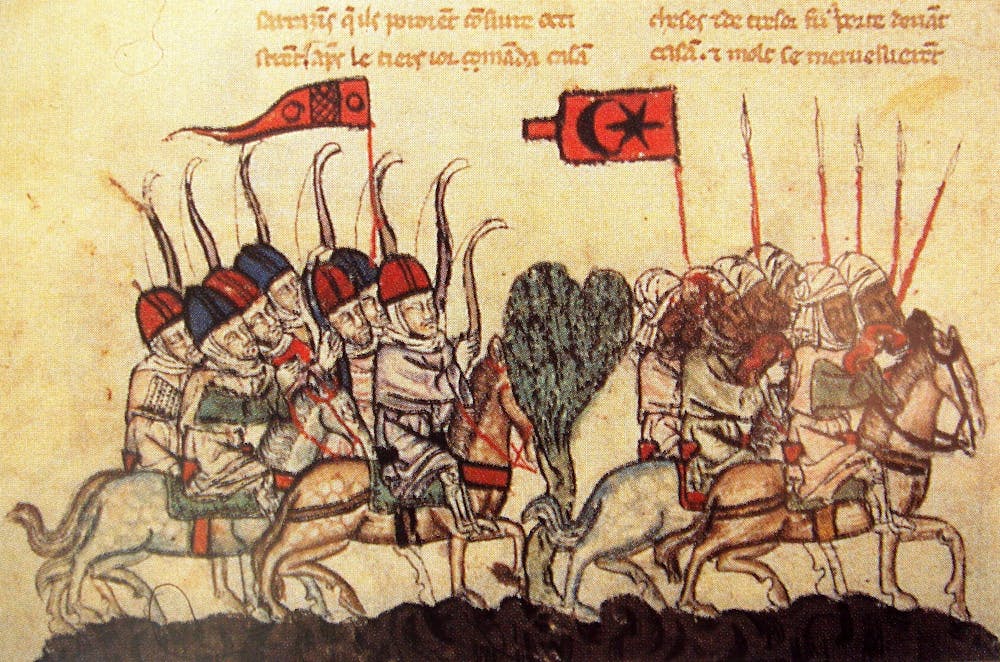
A 14th century miniature depicting Crusaders at The Battle of Wadi al-Khazandar (Battle of Homs) of 1299.Wikimedia Commons
Ripe for colonialism
In the 19th century, however, attitudes did begin to change. Muhammad was, on occasion, imagined not as the ambitious, profligate impostor of old but as a “silent great soul”, a hero who spoke “from Nature’s own heart”, as Thomas Carlyle called him. The Dublin University Magazine described him in 1873 as “one of the greatest ever sent on earth”.
Islam too now came to be seen more benevolently. The increasing cultural and global political power of the West rendered obsolete the traditional fear of being overwhelmed by Islam. The “religion of force” was now meeting a greater secular force, that of the imperial West. Islam no longer looked as threatening as it once had. The doctrine of Jihad (holy war), declared The Quarterly Review in 1877, “is not so dangerous or barbarous a one as is generally imagined”.
Islamic cultures now came to be seen as spheres of Western patronage, secular and religious. The image of a vibrant, active, progressive West against a passive, inert Islam was congenial to colonial enterprise. Ironically, the religion of aggressive action now came to be viewed as passively stagnant, decadent and degenerate, ripe for domination by an assertive West.
The inability of Western commentators in the 19th century to endorse a newly submissive Islam arose from a deep-seated Western incapacity to treat Islam on equal terms. Indeed, the greater value of the West over all those it variously characterised as backward, degenerate, or uncivilised was a central feature of most discussions of non-Western forms of life.
In short, Islam and progress were incompatible. And there was a strong tendency throughout the Victorian period to blame Islam for all the imagined ills of Oriental societies – the moral degradation of women, slavery, the physical and mental debilities of men, envy, violence and cruelty, the disquiet and misery of private life, the continual agitations, commotions, and revolutions of public life.
Contemporary times
Cut to the 21st century and a post-imperialist age, and Muslim nationalisms are again on the rise, not only in the Middle East and North Africa, but in Indonesia, India and Pakistan. The West once again feels under threat. The myth of Islam as essentially violent has re-surfaced. But, interestingly, it has done so in a different way.
On the one hand, the growth of terrorism has moved the imagined military threat of Islam from the borders of the West to its very centres – to London, Paris, New York.
On the other hand, Islam is now seen as a cultural threat as much as a military one. Even at its most benign, it is perceived as threatening Western values by virtue of the Muslims in its midst, stubbornly refusing to acquiesce to Western values. Thus the need to keep Muslims out. In December 2015, to the outrage of many Americans, then presidential candidate Donald Trump called for a ban on Muslims entering the US. Better the enemy kept outside the wall than the enemy within.
The refusal of the UK to allow Shamima Begum, the school girl who left London in 2015 to join ISIS, to return to England is the most recent example of the fear of home-grown terrorism and the enemy “within”. That she appears to endorse a violent Islam and is lacking in remorse has not helped her cause.
In addition, a new discourse has emerged of Islam as having failed to have a Reformation and an Enlightenment as did the West. Thus, for example, former Prime Minister of Australia Tony Abbott declared in December 2015 that Islam has never had its own version of the Reformation and the Enlightenment – the two events that seem to symbolise for Abbott the transition from barbarism to civilisation.
“It’s not culturally insensitive,” he declared, “to demand loyalty to Australia and respect for Western civilisation. Cultures are not all equal. We should be ready to proclaim the clear superiority of our culture to one that justifies killing people in the name of God.”
Does Islam need an Enlightenment like Europe had in the 18th century? Well yes, in the sense that European governments finally legislated freedom of religion to stop Catholics and Protestants slaughtering each other. Like Christianity in Europe in the 17th century, Islam in the 21st is as much at war with itself (especially in the conflict between Sunnis and Shiites) as it is at war with the West.
So, in the light of this history of Western attitudes to Islam, what are we to make of President Bush’s claim that Islam really is a religion of peace and that Muslim terrorists are, as a consequence, not true Muslims?
At its simplest, it is a recognition that there are vast numbers of Muslims, indeed the majority by far, both inside and outside the West, who endorse the virtues of tolerance, compassion, kindness and – simply put – just getting on with each other and with others.
It is also a recognition that multicultural and multi-religious societies thrive on unity and not divisiveness. As then Australian Prime Minister Malcolm Turnbull put it in March 2017, “What I must do, as a leader, and what all leaders should do in Australia, is emphasise our inclusivity, the fact that we are a multicultural society where all cultures, all faiths are respected and that is mutual. So, trying to demonise all Muslims is only confirming the lying, dangerous message of the terrorists.”
Many religions under one name
It is foolish to deny that there is a violent edge to Islam, as there is to Christianity and Judaism. In all these traditions, there is the tension between the idea of a God whose will is always good and a God whose will is always right.
And where God is seen as a being whose will can transcend the good (as he is in Islam, Christianity and Judaism), evil acts committed in his name can abound. Both peace and violence can equally find their justification in the Muslim, Christian and Jewish idea of God.
The willingness of the Islamic State group to accept reponsibility for the horrific bombings in Sri Lanka indicates their belief that such acts are in accord with the will of God.
That said, the question of whether Islam is essentially violent is not one that any longer makes much sense (if it ever did). The supposed fundamental oppositions between the West and Islam fail to map on to any reality.
“Islam” and “the West” are no longer helpful banners behind which any of us should enthusiastically rally. There really is no clash of civilisations here, not least because the notion of “civilisation”, Islamic or Western, really doesn’t have any purchase in a globalised world.
Moreover, we now know that it is difficult to identify the essence of any religion and futile to search for one. Any one religion is really many religions under the one name. So there are many Islams – Sunni and Shiite, but also Indonesian, Albanian, Malaysian, Moroccan, Pakistani, all culturally nuanced in quite different ways. This was evident in the many nationalities of those at prayer in the Christchurch mosques.
So too, there are many Christianities, often so different as to be hardly recognisable as parts of the same tradition – think Pentecostal snake handlers in the American south, Catholic peasants in Sicily devoted to the Virgin Mary, or cool Lutherans in Scandinavia.
The fault line in modern religion doesn’t go to a clash between civilisations or even to a clash between religions so much as to a struggle within religions and within cultures, between theologies, ethics, political ideologies, ethnicities, exclusivism and inclusivism.
It is a struggle between liberals and conservatives, fundamentalists and moderates, reason and revelation. It is a battle within theologies between a God who is thought to be knowable through nature, man and history and a God who is thought to be only knowable through the revelations contained in the inerrant pages of the Torah, the New Testament or the Quran.
It is a struggle within all religions between those who believe there are “many paths to Heaven”, endorse freedom of religion, encourage tolerance and support mutual respect against those who believe there is only “one way to Paradise” and desire to impose this on everyone else, whatever it takes.
Indonesia conducted its presidential election on April 17, the fourth direct presidential election since the country’s transition to democracy in 1998. The election pitted two long-term rivals against each other: incumbent President Joko Widodo (popularly known as “Jokowi”) and former Suharto-era General Prabowo Subianto. It was one of the most divisive elections in Indonesia’s 73-year old history as an independent nation. It also saw Islam being used as a tool to create divisions in the largest Muslim-majority country in the world—a political cleavage that could divide the fourth most populous country in the world for a generation or more.
Two distinct political camps have emerged from the election, largely based on different interpretations of Islamic political theology and regional identities. Jokowi, who is widely expected to win re-election according to preliminary returns, is supported by a coalition of moderate Muslims living in central and eastern Java, the most populous island in Indonesia. Many are members of Nadhlatul Ulama (NU), Indonesia’s largest Muslim organization. Jokowi also enjoys wide support among Indonesia’s substantial non-Muslim minority. Meanwhile, Prabowo is supported by conservative and hardline Muslims living primarily in the western coast of Java, as well as in the islands of Sumatera and Sulawesi.
During the eight-month campaign period, hardline Islamists within the Prabowo camp have portrayed Jokowi as a leader who lacks strong Islamic credentials and who is planning to implement policies to repress deeply religious Muslims. In return, NU members who supported Jokowi have portrayed these hardliners as religious extremists who wish to turn Indonesia into an Islamic or caliphate-based state.
Many of Prabowo’s Islamist supporters were former participants of 2016-17 Defending Islam movement (Aksi Bela Islam)—a movement to remove former Jakarta Governor Basuki Tjahaja Purnama (popularly known as “Ahok”), who was a former Jokowi ally. A Christian of Chinese descent, Ahok was accused of committing religious blasphemy after he misspoke in a campaign rally.
Up to one million Muslims participated in the rallies sponsored by the Defending Islam movement. They ranged from members of hardline groups like Islamic Defenders Front (FPI) and Islamic Community Forum (FUI) to those affiliated with Muhammadiyah—Indonesia’s second largest Islamic organization, which tends to be moderate theologically but is less inclined to support Jokowi’s policies (compared to NU). These rallies resulted in Ahok’s re-election defeat and subsequent conviction for religious blasphemy, for which he served two years in prison.
Emboldened by their success, former Defending Islam activists—now calling themselves “Alumni 212”—set their next political target: President Jokowi himself. They aligned themselves with Prabowo long before the presidential election campaign started in August 2018 by forming groups like #2019ChangePresident (#2019GantiPresiden), which staged mass rallies and protests against Jokowi between March and September 2018.
The president feared the #2019ChangePresident group so much that he ordered law enforcement officers to disband its rallies and brought criminal charges against some of the group’s leading figures, including NGO activist Ratna Sarumpaet and singer Ahmad Dhani. These resulted in a growing concern that Jokowi is responding to the challenge from hardline Islamists by using authoritarian measures.
Once the formal campaign period began, Alumni 212 aligned themselves with Islamic parties like the Prosperous Justice Party (PKS) and the National Mandate Party (PAN) to support Prabowo’s presidential bid. It formally endorsed Prabowo in September 2018, even though Prabowo reneged on his promise to pick an Islamic cleric (ulama) as his running mate. Prabowo selected billionaire Sandiaga Uno as his vice-presidential candidate instead.
Under pressure to increase his Islamic credentials, Jokowi chose Indonesia’s most senior Islamic cleric: Ma’ruf Amin, head of the Indonesian Council of Ulama (MUI), who was also NU’s supreme leader. It was done despite concerns from pro-democracy and human rights advocates regarding Amin’s track record on religious and other minorities. As long-term head of MUI’s religious edicts (fatwa) commission, Amin was thought to be responsible for the issuance of fatwas condemning Ahmadi Muslim minorities (2005) and LGBT people (2012), which resulted in increased number of communal violence and persecutions against the two groups in the last decade.
However, Amin’s selection as Jokowi’s vice-presidential nominee solidified the NU leadership’s support for Jokowi. He received endorsement from its leaders and leading clerics, who also campaigned heavily for his re-election.
Meanwhile, in addition to Alumni 212, PKS, and PAN, Prabowo also received endorsements from Indonesia’s leading popular ulama—such as Abdul Somad, Abdullah Gymnastiar, and Adi Hidayat. These ulama are active internet users to propagate their teachings and have millions of social media followers, particularly among young Muslims between the ages of 20 and 35.
The mobilization of mainstream Islamic groups like NU in Jokowi’s camp and Alumni 212 and other hardline groups in Prabowo’s camp caused this year’s presidential campaign to take an ugly turn. The hardliners painted Jokowi as a “non-devout Muslim” and an “anti-Islamic” leader who plans to impose new restrictions against Muslims’ religious freedom. Meanwhile, NU clerics have accused Prabowo of siding with radical Islamists, claiming he plans to turn Indonesia into a caliphate state.
Research by the Indonesia Program of the S. Rajaratnam School of International Studies (RSIS) in battleground provinces like Central Java, East Java, West Java, and South Sulawesi clearly shows that mobilization efforts done by hardline supporters of Prabowo were responsible for increasing Prabowo’s support among religious voters within these provinces. However, NU leaders’ portrayal these groups as radical Islamists with an extremist agenda also mobilized its followers—who mainly live in Central and East Java—to support Jokowi as well.
The polarized rhetoric used by both sides during this campaign might have contributed to the record voter turnout: estimated to be around 80 percent. It is now feared that the religiously-based polarization strategies used during the election might have long-term repercussions in Indonesian politics and society. Alumni 212 is now planning a new series of mass rallies to challenge the election results. Tough statements issued by Indonesian Armed Forces Chief Hadi Tjahjanto and National Police Chief Tito Karnavian in response to this plan indicated that Jokowi might be considering additional crackdown measures against these Islamists, in an effort to further marginalize them from Indonesia’s public sphere.
To conclude, a new axis of Islam and politics is emerging in Indonesia today. Hardline Islamists will continue to challenge Jokowi during his final five-year term as Indonesia’s president. However, if he decides to crack down against them, it might result in further deconsolidation of Indonesia’s democracy, which will be a setback in Indonesia’s trajectory as a Muslim-majority democratic nation.
The mass murder of Christians in Sri Lanka stunned many observers, not only because of the obvious barbarism of the act but because the prime target was Christians, and during Easter and in church. For those of us who have been writing and broadcasting for decades about the persecution of Christians, however, this obscenity came as little surprise.
Back in 2012, I was hosting a nightly television show and on one occasion my guest was a Christian minister from the Middle East. He asked me if he could put a Bible on the desk in front of him during the interview. I politely told him that I’d rather he didn’t, because it might look like proselytizing. He replied that he understood, but that this particular Bible might be of interest to the viewers. It had been in Our Lady of Salvation Syriac Catholic cathedral in Baghdad on October 31, 2010 when a Sunni Muslim terrorist group known as the Islamic State of Iraq attacked the church, murdering 58 people and wounding more than 75.
The book being held in front of me was almost beyond reading, as its pages were glued together in purple lumps, sticky with the blood of the men, women and children who had been slaughtered that warm evening in a place of peace, in a city where Christians had lived and flourished for almost 2000 years. This was not a holy book to be preached from, but a holy book of martyrdom that preached. Its hardly legible pages spoke entire volumes, its red-turned-to-brown stains cried out to a still largely indifferent world.
The Baghdad attack, however, was merely one example of the war on Christianity. Even Pope Francis, hardly militant in these areas, told a group of 40 Jewish leaders, including the then head of the World Jewish Congress, Ronald S. Lauder, “First it was your turn and now it is our turn.” In February, 2014, U.S. representative Chris Smith, chairman of the congressional panel that oversees international human rights issues, told a congressional subcommittee that discussion of “anti-Christian persecution is not meant to minimize the suffering of other religious minorities who are imprisoned or killed for their beliefs” but to make it clear that Christians “remain the most persecuted religious group the world over.”
More than 300-million Christians are threatened with violence or face legal discrimination, forced conversion, and daily threats. In countries such as Egypt, Saudi Arabia, Pakistan, Nigeria, and elsewhere they are frequently imprisoned and tortured on false charges of drinking and blasphemy, and in Iraq the exodus of Christians has been so great that the faith may even cease to exist in any meaningful sense in years to come.
But this is a good example of why we have to be very selective and informed in how and what we judge. Saddam Hussein was a brute, but he didn’t persecute Christians. It was the western invasion of Iraq that smashed the stability of the place, empowering Islamist groups and leading to the full-scale attack on the Christian minority. Similarly in Syria, Christians are generally protected, and in Palestine the national conversation was traditionally shaped by Greek Orthodox Christians. In Egypt the story is sadly different, in Turkey there is hardly even a concept of a “Turkish Christian,” and in Pakistan the once respected Christian minority is now intimidated and frightened.
This is not an issue of Islam refusing to accept Christianity, but of radicalized Islam and of ignorant, sadistic fanatics not accepting anybody but their own – they also slaughter Muslims who refuse to adopt their gruesome twisting of the Muslim faith. Yet Christians are without doubt the main victims of this systemic persecution and violence, and the western world says relatively little.
The reasons are complex, but one of the causes is that conservative Christians in North America and Europe so frequently claim victimhood, usually when they show intolerance towards LGBTQ people. This absurd boast of martyrdom leads to cynicism about the very real horrors experienced by Christians in other parts of the world. On a grander scale, when George W. Bush launched imperial campaigns in majority-Muslim areas and spoke of a Christian motive there was an understandable if misplaced anger. If Bush and his people were Christian, how could Christians be vulnerable and persecuted?
Then there is sheer ignorance, with the political and media class having so little experience of peoples outside of their comfort zone. There’s an assumption that Christians are somehow like them, are white and secure, powerful and prosperous, and thus not the correct demographic at all for sympathy. The middle-class solipsism of all this is nauseating.
The inescapable fact is that Christians are indeed a highly persecuted group in large parts of the world, and that Christianity even faces disappearance in the places where it was born. It is not a western faith but one rooted deeply in the Middle East, and its adherents in much of that region, and in Asia and Africa, demand our help and solidarity. If we choose between marginalized groups, and ignore one for whatever reason we conjure, we are failing in our intelligence, compassion, and humanity.
At a time when Islam’s place in the modern world is a matter of global contention, Brunei, a small monarchy in Southeast Asia, has offered its two cents. By April 3, the nation, which is predominantly Muslim, had begun adhering to a new penal code with harsh corporal punishments. Accordingly, gay men or adulterers may be stoned to death, and lesbians may be flogged. Thieves will lose first their right hand, and then their left foot.
Understandably, these bits of news brought outcries from the United Nations, human rights organizations and celebrities like George Clooney. In return, the Brunei government dismissed all criticisms, reminding the world that the country is “sovereign” and “like all other independent countries, enforces its own rule of laws.”
As a Muslim, I should first tell my coreligionists in Brunei that their argument is not very good. Of course every country can enforce its own laws, but the content of those laws isn’t immune from criticism when it violates human rights. Otherwise, we would have no basis to criticize China’s totalitarian persecution of Uighur Muslims or the illiberal bans on “religious symbols,” including the Islamic head scarf, in France and, more recently, Quebec.
However, the real issue isn’t Brunei. It is Islamic law, or Shariah, the penal code from which law is applied not just in Brunei but in about a dozen other nations as well, such as Saudi Arabia, Iran and Sudan. It includes brutal corporal punishments that shock the rest of the world. It also criminalizes acts that shouldn’t be crimes at all — such as consensual sex, loss of faith in Islam (“apostasy”) and the right to criticize it (“blasphemy”).
Muslims who insist on keeping or reviving these measures have a simple logic: Shariah is God’s law, and enforcing it is a religious duty. But their blind literalism is wrong for three reasons.
First, the corporal punishments in the Quran — amputation of limbs and flogging — may simply be related to the context of the Quran. In seventh-century Arabia, where the Prophet Muhammad lived, there were no prisons in which to incarcerate and feed people for a long time. For the same reason, corporal punishments — much cheaper and easier than imprisonment — were the universal norm until a few centuries ago. The Hebrew Bible commanded many of them, as did pre-modern European laws.
Second, much of the Shariah is actually man-made. Islamic scholars expanded jurisprudence based on debatable reports about the words and deeds of the Prophet, as well as the norms of their time. That is how blasphemy, apostasy and drunkenness, none of which is penalized in the Quran, became crimes.
Third, Islamic jurisprudence was developed for Muslims only, whereas Christians and Jews had their own laws. But all modern nation-states, including Brunei, are both centralized and diverse. So imposing Shariah as the law of the land will go against the rights of minorities, in addition to unorthodox Muslims.
All of those arguments are persuasively made by reformist thinkers in Islam. But I doubt that conservative authorities in Brunei will have much heart for them. So let me call on them to check an authority they can’t dismiss that easily: the Ottoman Empire, the last Islamic superpower of the world and the last seat of the Sunni Caliphate.
The Ottomans, who followed the flexible Hanafi school of jurisprudence, were pragmatic about law from the beginning. Decrees issued by sultans introduced fines or prison sentences instead of corporal punishments, rendering the latter often practically obsolete.
Moreover, in the mid-19th century the Ottomans initiated a major Reform (Tanzimat) era, which included the Imperial Ottoman Penal Code of 1858. The French-inspired law was designed to be valid for all Ottoman citizens, regardless of their religion, and remained in practice until the end of the empire with some modifications. It replaced all remaining corporal punishments in Ottoman law with prison sentences or forced labor. It also decriminalized apostasy and penalized blasphemy, or “interference with religious privileges,” with only “imprisonment of from one week to three months” (Article 132).
The penal code’s section on sexual crimes is worth a look, for it is much more liberal than the laws Brunei just began implementing 161 years later.
According to Article 200, for example, “an abominable act” with “a girl who has not yet been married to a man” was an offense — but only when done “by force.” In other words, consensual premarital sex was not a crime.
Extramarital sex, or adultery, was an offense under Article 201 — but to be punished with a prison sentence of “three months to two years,” not stoning to death.
What about homosexuality? The Ottoman penal code didn’t say anything about it. John Bucknill and Haig Utidjian, who translated the law into English in 1913, noted, “It will be observed that unless committed with force” or upon a minor, “sodomy is not a criminal offense under the Ottoman Penal Code.”