Teachers need ongoing anti-Black racism training, not workshops, elective courses, experts say

Of note, both the specific context of anti-Black and broader context of anti-racism training in general. Challenge, of course, for teachers to integrate this into the existing curriculum rather than being another add-on along with other demands on their time:

Although her daughters, Savannah and Sahara, are in their first few years of elementary school, Cshandrika Bryan of Ajax, Ont., has already seen a wide range of examples in how the Black experience is reflected inside their classrooms.

At six-year-old Savannah’s former school, Bryan recalled, her teacher included Black voices in everyday lessons and helped guide fellow teaching staff in interactions with Black families.

Source: Teachers need ongoing anti-Black racism training, not workshops, elective courses, experts say

Beaman: The problem with Canada’s delusions of inclusivity and multiculturalism

While I agree with Beaman on the need to “to contextualise them [anti-Muslim hate] within broader patterns of inequality, discrimination and violence against a wide range of groups, including Indigenous people, Black people and other people of colour.” To which I would add, antisemitism, anti-LGBTQ, women, along with the intersectional dimensions.

And I would argue that the situation is not as bleak as described, and that there has been progress over the years, albeit slow:

On Sunday 6 June, while out for an evening stroll in London, Ontario, the Afzaal family, Salman Afzaal (aged 46), his wife Madiha Salman (44), their 15-year-old daughter Yumna, nine-year-old son Fayez and Mr. Afzaal’s 74-year-old mother Talat were run over by a 20-year-old male driving a pickup truck.

The whole family was killed except for Fayez. The driver has been chargedwith terrorism and four counts of first-degree murder. Police have saidthat the attack is likely deliberate and the family were targeted because they were Muslim.

This attack is not an isolated incident in Canada.

Last year, on the evening of 12 September, 58-year-old Mohamed-Aslim Zafis was stabbed to death outside the International Muslim Organization mosque in Toronto. On 29 January 2017, a shooting at the Islamic Cultural Centre of Quebec City left six men dead. After the province of Quebec passed Bill 21 in 2019, banning the wearing of religious symbols by public school teachers and civil servants, among others, incidents of harassment and discrimination against Muslim women increased.

Despite a pervasive image of Canada and Canadians as inclusive, diverse and multicultural, there is an alternative Canadian reality that includes violence, hatred and discrimination against minority groups, including Muslims.

Multiculturalism is enshrined in the Canadian Charter of Rights and Freedoms, as is religious freedom and protection from discrimination based on religion and ethnicity. Thus, there are structural legal protections in place that help promote inclusion and diversity, which are currently at the core of Canadian domestic and foreign policy.

‘Currently’ because only a few years ago the federal government under then prime minister Stephen Harper went to court in an attempt to banZunera Ishaq from wearing her niqab during the ceremony to become a Canadian citizen (the government lost).

The same Conservative government promised during the 2015 election to establish a “barbaric cultural practices” hotline. The question is why, despite the Charter and strong programmes of multiculturalism, inclusion and diversity, does Islamophobia in Canada persist and even seem to be growing? The short answer is that the social imaginary, or the way people think about the collective ‘us’, has not been redefined in inclusive ways.

Who is ‘us’?

In her response to the murders of 51 Muslims during Friday prayers at two mosques in Christchurch, New Zealand on 15 March 2019, Prime Minister Jacinda Ardern noted that many of those who were affected “may even be refugees here. They have chosen to make New Zealand their home, and it is their home. They are us.”

Hateful acts impact those immediately involved, their communities and all of us

Ardern’s comment gets to the heart of the matter: Who is ‘us’? In addition to legal and policy promises of inclusion, acknowledgement of diversity and recognition of multiculturalism, an inclusive conceptualisation of ‘us’ in civil society is essential.

In contrast, there is ample evidence that a significant number of Canadians hold a narrower view of who belongs to ‘us’. A 2017 poll into religious trends in the country revealed that Islam is viewed unfavourably by almost half of all Canadians (46%), and that less than 35% of respondents (32% in Quebec, 34% in the rest of Canada) view Islam favourably.

In 2017, when Bill M-103, a non-binding motion to “condemn Islamophobia and all forms of systemic racism and religious discrimination”, was introduced to parliament by Liberal MP Iqra Khalid, a poll found that a third of Canadians believed that the bill was a “threat to Canadians’ freedom of speech”.

Some 42% of respondents said they would vote against the bill, while 55% believed that anti-Muslim attitudes and discrimination were “overblown” by politicians and the media. The motion was passed by a significant margin, 201-91.

Real equality

In my recent book ‘The Transition of Religion to Culture in Law and Public Discourse’, I explore through legal cases the transformation of majoritarian Christian religious practices and symbols into ‘culture’ in Canada, France and the United States.

For example, the use of prayers and religious symbols such as crosses and crucifixes in government and public spaces are generally seen as being integral to ‘our’ culture and heritage. Narratives of ‘universality’ (‘this is important or relevant to all of us’), minimization of harm (‘this doesn’t really hurt anyone’), and invocation of ‘our values’ are all part of the process by which religion is reconfigured as culture.

I argue in the book that this phenomenon is a strategy aimed at preserving a narrow conceptualisation of ‘us’ that excludes minority groups, who are ‘imagined’ out of Canada’s history and culture. The defence of potentially alienating practices and symbols traps us in a hierarchical holding pattern.

If we Canadians are to live well together, these must be renegotiated in a manner that recognises all parties to the conversation as equals, and in some instances as being in need of redress for past wrongs. And ‘they’ must be included in the social imaginary of ‘us’.

“Islamophobia will continue to exist until Canada dismantles its other oppressive systems. While there is still anti-Blackness, there will still be Islamophobia. While there is still anti-Indigenous racism, there will still be Islamophobia. Under white supremacy, there will always be Islamophobia,”said Maryam Azzam, a Muslim student at Ryerson (‘X’) University in Toronto. She was speaking after the attack on the Afzaal family.

While it is important to name Islamophobia and anti-Muslim racism as distinct phenomena, it is also important to contextualise them within broader patterns of inequality, discrimination and violence against a wide range of groups, including Indigenous people, Black people and other people of colour.

Hateful acts impact those immediately involved, their communities and all of us. They result in fear, powerlessness and alienation. They undermine civil society, create hierarchies of belonging (‘us’ versus ‘them’) and impact the exercise of freedoms.

It is vital that in the new diversity that is emerging in Canada and in a complex future, equality must be conceptualised not only as a legal principle, but as something that people enact in day to day life – as ‘deep equality’. This is not mere tolerance or accommodation, but a robust understanding of the inherent dignity and worth of each of us in the project of living well together.

Source: https://www.opendemocracy.net/en/global-extremes/the-problem-with-canadas-delusions-of-inclusivity-and-multiculturalism/

Why doctors want Canada to collect better data on Black maternal health

Need this for many groups:

A growing body of data about the heightened risks faced by Black women in the U.K. and U.S. during pregnancy has highlighted the failings of Canada’s colour-blind approach to health care, according to Black health professionals and patients.

Black women in the U.K. and U.S. are four times more likely to die in pregnancy or childbirth than white women, according to official data. A recent U.K. study published in The Lancet found that Black women’s risk of miscarriage is 40 per cent higher than white women’s. In Canada, that level of demographic tracking isn’t available.

“For our country, we don’t have that data. So it’s difficult to know exactly what we’re dealing with,” said Dr. Modupe Tunde-Byass, a Toronto obstetrician-gynecologist, and president of Black Physicians of Canada. “We can only extrapolate from other countries.”

Source: Why doctors want Canada to collect better data on Black maternal health

The Big Read: High time to talk about racism, but Singapore society ill-equipped after decades of treating it as taboo

Interesting long read, given Singapore’s early history and the efforts since then to “manage” its diversity:

When former national sprinter Canagasabai Kunalan and his wife, Madam Chong Yoong Yin, both 79, saw the viral video of a polytechnic lecturer making racist remarks to an interracial coupletwo weeks ago, they couldn’t believe their eyes.

The video evoked memories of 1964, when the couple were given the ultimatum by their families to end their relationship or leave their homes — because one of them was Indian and the other was Chinese — amid the racial tensions that were gripping Singapore.

“Singaporeans now are so educated … how can we still think like this?” said Mr Kunalan.

The racial riots between the Malays and Chinese in Singapore following its merger with Malaysia in 1963 plunged the country into nationwide violence. Houses were burnt down, the police were deployed to enforce curfews and people were beaten and killed.

Yet, even in the most uncertain of times, there were also people of different ethnic groups standing together regardless of race.

Older generations of Singaporeans recounted how people stepped up in solidarity when emotive racial conflicts shattered the peace.

Mr Kunalan, who was then a 22-year-old sprinter preparing for the 1964 Tokyo Olympics, said: “The riots were happening in different areas in Singapore. Surprisingly, in my kampung (village), it was peaceful. There were no tensions at all. Or maybe we just didn’t know what was happening on the other side.”

Mr Lionel de Souza, 78, a former police officer who worked as a community liaison officer in Geylang during the 1964 racial riots, recalled how Singaporeans volunteered in droves for “goodwill committees” as well as the Vigilante Corps to help keep the peace in volatile areas during curfew hours.

Comprising an equal number of Chinese and Malay volunteers, they and Mr de Souza would patrol their beat in Kampung Kim Hong and talk to residents in coffee shops and town halls to help dispel suspicion between the different Chinese and Malay groups that were then segregated in different villages.

“There were allegations that people on one side were shooting fire arrows at the other, and rumours were flying everywhere,” said Mr de Souza of the situation then.

Singapore has since come a long way from those dark days of violent racial conflict, having taken early steps as a newly independent nation to abandon colonial-era race-based policies, and pledging to not let racial fault lines divide society.

Following its independence, the young Republic embarked on a unique path among nations of the time as a multiracial and multicultural country, one that affirms its ethnic diversity as a strength and recognises the rights of minorities.

Dr Janil Puthucheary, Senior Minister of State for Communications and Information, said in an interview with TODAY: “Many societies have had to wrestle with (race, racism and multiculturalism) around the world, but the place that multiculturalism has in our aspirations as a people is quite special. It is fundamentally why we became an independent country.”

Because of Singapore’s diverse society and the dynamics among the major cultural and ethnic groups, the topic of race is present in every discussion, every issue, and every policy.

“You need to then understand our social context, our historical context and our future in order to have a dialogue about race productively in Singapore,” said Dr Janil.

Yet, the topic of racism has returned to the fore once again following recent events, including the street confrontation between the Ngee Ann Polytechnic lecturer and an inter-ethnic couple as well as other viral videos of racially-charged encounters.

Commenting on the video, Law and Home Affairs Minister K Shanmugam had said in a Facebook post: “I used to believe that Singapore was moving in the right direction on racial tolerance and harmony. Based on recent events, I am not so sure anymore.”

Activists, community organisers and academics spoken to agree that the conversations of race need to move forward productively in the age of social media where tensions are inflamed easily.

And when the heat surrounding the recent incidents fades away, some good may emerge from these episodes if Singaporeans can understand the experiences of others and engage with each other in good faith, several said.

Associate Professor Chong Ja Ian, a political scientist from the National University of Singapore (NUS), said: “It is important, in my opinion, to identify these biases and stereotypes and understand where they come from and how they link to the various fears, anxieties, suspicions, frustrations that people have.

“Some of this will look ugly, but if we can start addressing them bit by bit, with understanding, there is a good chance we can move forward.”

Pondering about what the recent racist incidents say about the state and direction of Singapore’s hard-won racial harmony, older Singaporeans such as Mr Kunalan and Mr de Souza know that the stakes are high.

“We never want that (racial riots) to happen again, which is why we should all feel strongly about protecting our racial harmony,” said Mr de Souza.

WHAT IS RACISM?

The Oxford English Dictionary today defines racism as acts of prejudice, discrimination and antagonism by a person, community or institution against a person or people based on their race and ethnic identity.

And by this definition, racism is usually experienced by people from minority racial groups that are subjected to such acts of discrimination.

But as contributing writer Ben Zimmer for The Atlantic magazine wrote, even dictionaries had to revise their definitions about racism.

Before 2020, the Merriam-Webster Dictionary primarily defined racism as “a belief that race is the primary determinant of human traits and capacities and that racial differences produce an inherent superiority of a particular race”.

It was also defined as “a doctrine or political program based on the assumption of racism and designed to execute its principles”. This secondary definition was refined to “the systemic oppression of a racial group to the social, economic, and political advantage of another”, following the Black Lives Matter protests in the United States last year.

Mr Mohamed Imran Mohamed Taib, founding board member of the Centre for Interfaith Understanding (CIFU) in Singapore, said that racism is essentially formed from two components — that a race has essential traits and characteristics, and whether these are behind the inequalities and disparities between the races in society.

“Therefore, racism is any act, system or policy that appeals to or reinforces ‘essentialised’ perceptions of racial groups that strengthens the political, economic or cultural inequalities between the races in society,” he said.

Regardless of which definition is best, the debate of what racism is, and what makes an action or speech racist, has also emerged in Singapore in recent days.

In May, an Indian woman was called racial slurs and kicked in the chest by a Chinese man while brisk-walking along Choa Chu Kang Drive. He had insisted she wear a mask even though she was exercising.

A month later, Ngee Ann Polytechnic lecturer Tan Boon Lee was seen in a viral video confronting and making racist remarks towards an inter-ethnic couple, while proclaiming to be a racist himself.

Allegations by a former student that he had made Islamophobic remarks in class surfaced a week later. The polytechnic has since said it would sack Mr Tan, after completing investigations into the two matters.

Another video was uploaded the same week of a Chinese woman hitting a small gong repeatedly while an Indian man was ringing a prayer bell outside his public housing flat as part of his daily prayers.

But the debate about what constitutes racism grew loudest online in the case of Ms Sarah Bagharib, who had called out the People’s Association for using a cutout of her wedding photo — sans the couple’s faces — as part of Hari Raya decorations without her permission.

Netizens were split on the issue. Some claimed that the matter is not a case of racism but one of cultural insensitivity. Others were wont to point out that racism does not exist in Singapore, which prides itself on its multiracial society.

Another viewpoint was that the blunder was made because of a lack of understanding of the Malay culture that had stemmed from ignorance that needed to be dismantled.

As Dr Nazry Bahrawi, a senior lecturer at the Singapore University of Technology and Design, put it, two narratives have emerged about the state of race relations here — one says Singapore is racially harmonious, and another says that it is still not quite there.

“The first has been the official position reproduced on many occasions and in many spheres, while the latter is a position that has received less airing because it is perceived to be less valid, making those who raise it seem like they are troublemakers or have an agenda to divide society,” said Dr Nazry.

For race discourse to be productive, Singaporeans from all walks of life must first be able to establish that racist acts are not condoned by society.

“Because, if so, then it would be considered outlandish that people who call out racism are seen as playing the race card,” he said, adding that these people might be commenting from a position of privilege as they may not have experienced racism.

Asked about this, Dr Janil, who is also the chairperson of the non-profit OnePeople.sg (OPSG), said it is not a bad thing that there are people who state that they have never experienced racism or have never seen it happen.

The turning point is when they find out that because not everyone shares this view, they may be “energised” to improve the experiences of others, he said.

“The uncharitable view is to say ‘hello, wake up, you don’t know what’s going on and you don’t recognise (racism)… But the glass half-full version is, aren’t we lucky that there are some people who have actually had this experience in Singapore, it’s a sign … that maybe we’ve made some progress.”

Such views are also heard among people who participate in OPSG’s initiatives on race as well, especially among younger participants who have been “blessed with a positive experience about race”, but also could learn about the negative experiences of others, Dr Janil added.

The Singapore Government has taken the approach that racism exists here, he emphasised.

“What we want to be sure of is that our policies, our systems, our approach, is to understand that there is racism, and we must always push against it,” said Dr Janil.

Comparing indicators of racial and religious harmony from 2013 and 2018, a study by the Institute of Policy Studies (IPS) and OPSG in 2019 found that while racism exists, it is not widespread in Singapore.

Lead researcher Dr Mathew Mathews said about 10 per cent of Chinese respondents in the study and around 20 per cent of minorities said that they had experienced racial tension in the 2018 study. There was little change from the results of the 2013 findings.

“When asked about specific incidents, most cited they had felt insulted at how perhaps social/mainstream media had portrayed their race or cultural practices – so there is certainly some racism here, but it is not rampant,” said Dr Mathews.

WHY SOME STILL CONSIDER IT TABOO

On the other hand, some people felt that the recent spate of racist incidents is an indication that racism in Singapore not only exists but has been gathering speed for some time, though hidden from view because of a lack of discourse and the difficulty in detecting unintentional and unconscious forms of racism.

Dr Peter Chew, a senior lecturer of psychology at the James Cook University, explained that overt racism tends to be low in Singapore due to the function of laws that protect racial harmony here, such as the Sedition Act.

The Act makes it illegal for anyone in Singapore to promote feelings of ill-will and hostility between different races or classes of the population.

Laws like these do well to keep overt racism in check but also have an effect of quieting discourse about race, he said.

“This reluctance could be due to a misunderstanding of what constitutes racism.

Anecdotally, some individuals think that talking about race or pointing out racist incidents is, by their very nature, racist,” said Dr Chew.

A 2016 CNA and IPS study, which was also led by Dr Mathews, found that two-thirds of respondents felt that discussions of race could lead to tension.

Raising such issues may be deemed “too sensitive”, and so issues about race and culture tend to be thought of as private matters rather than meant for broader conversations, said the researcher.

Agreeing, Mr Gosteloa Spencer, founder of community group Not OK SG, said this could be due to generations of Singaporeans suppressing talk of racism, discrimination, and racial inequality for fear of creating rifts among the different ethnic communities.

He believes it is this inhibition that led to casual racism, where people make jokes, off-handed comments, or exclusionary body language based on race. These acts also often go unnoticed and unaddressed.

“Just because it’s casual, does it make it okay to pass a racist comment?” he added. “Racism is racism, no matter what form it takes.”

Mr Sharvesh Leatchmanan, co-founder and editor of Minority Voices, which serves as a platform for minorities who have faced discrimination to come forth and share their experiences, said the concept of racial tolerance that is entrenched in the Singapore identity has also been problematic.

“Over time, this tolerance runs out … as can be seen from the recent acts of racism on social media. We need to move away from tolerance to acceptance and celebration.”

But while Singaporeans may have held back on talking about race in the past, some said that this is rapidly changing in the age of social media, where racially charged incidents can be quickly shared online and go viral.

And these incidents also encourage others to speak up and to call out racist acts publicly.

Mr Sharvesh, 24, said he received more than a hundred submissions from people sharing their stories of discrimination over the past week.

Ms Priyahnisha, who goes by one name, is the founder of non-profit organisation Mental ACT, which champions mental health services in the Indian community.

She noted the overwhelming response recently to any content on racism that she or her organisation put up on social media.

The 29-year-old full-time professional counsellor at a social service agency added: “As soon as we post, the likes, comments and shares really escalate and it has actually been way off the charts as compared to any of the other content we have put up in the past couple of months”.

The problem is that when people talk about race, their past inexperience means they lack the language and protocols needed to discuss it in a constructive manner, said those interviewed.

NUS’ Assoc Prof Chong said: “Singaporeans are not the best-equipped to handle such discussions because we have put them aside for so long.”

“But there are opportunities to learn … What is important is to not hastily conclude that the other side has bad faith, especially if the other party is engaging from a position of relative weakness and vulnerability,” he added. “It is through such engagement that we develop a vocabulary and approach suitable for our society.”

‘SAFE AND BRAVE’ SPACES … NOT JUST BEHIND CLOSED DOORS 

Earlier this month, Mr Jose Raymond started the Call It Out SG movement with three others to raise awareness of issues pertaining to race following the slew of racist incidents here. “This is simply a case of minorities saying that enough is enough and that racism is inexcusable,” he said.

“Perhaps in the past, when minorities faced racism, we didn’t have the tools to articulate ourselves properly or the courage to call it out. Now we do,” added the former Singapore People’s Party chairman.

The movement urges people to call out instances of racism that they see, and has gained momentum in the light of the recent incidents.

On the flipside, while the process of publicly calling for accountability and boycotting if nothing else seems to work, has become an important tool of social justice, Mr Spencer said it is difficult to control the extent of it and make sure things do not go out of hand.

Associate Professor Daniel Goh, an NUS sociologist specialising in race relations, noted that it is people’s “duty to call out racism when we see it”.

“The question is how we do it,” he said.

“We should do it in a respectful way that seeks to educate each other and deepen intercultural understanding, and the large part of the burden should not fall on the victims or members of ethnic minorities to do so, members of the ethnic majority should do so too.”

For more severe forms of discrimination, such as getting fired from a job, physical violence, or the shaming of ethnic minorities in a classroom setting, for example, victims should call for institutional and legal redress, said the former Workers’ Party (WP) Non-Constituency Member of Parliament (NCMP).

“The key calculus for me is how to balance education with redress, and my hope is that the victim is not alone in calculating this and can depend on witnesses and friends, especially those from the ethnic majority, for help and support,” said Assoc Prof Goh, who had stepped down from WP’s leadership due to health reasons but remains a party member.

Referring to the parliamentary replies to MP Faisal Manap (WP-Aljunied) earlier this year on the issue of the tudung, Assoc Prof Goh said the authorities rely on “back channels” for discussions and resolutions, and to manage racial relations in a pragmatic and careful way.

Mr Faisal had asked in Parliament whether the Government would relook allowing Muslim women in uniformed services to don the tudung. In response, Minister-in-charge of Muslim Affairs Masagos Zulkifli said the topics that involve racial and religious insensitivities have to be discussed away from the glare of the public.

Mr Masagos said this is because “public aggressive pressure” can only make compromise harder and any government concession to religious pressure would also cause other groups to adopt similarly aggressive postures.

Assoc Prof Goh highlighted examples of safe spaces where such issues could be discussed, such as the Inter-Racial and Religious Confidence Circles.

“A space is safe when all participants can come to speak confidently and freely of their experiences with the expectation that everyone will listen and seek deeper understanding as equals and peers, all in a respectful manner without fear of discrimination, harassment, criticism or emotional violence,” said Assoc Prof Goh.

But the Government would have to adapt to changing trends in internet culture, social media and social justice. He noted that for younger generations of Singaporeans, the internet and social media make up “the natural space for their articulation (on issues of concern) … not back channels”.

Mr Raymond agreed, stating that racism does not hide behind closed doors.

Responding, Dr Janil, who is from the ruling People’s Action Party, said there will always be a need for both public discussions and private dialogues.

“It is not an either-or. Race is a multifaceted issue,” he said.

OPSG, for example, has moved its activities online in the course of the pandemic. Despite the usual people-to-people nature of its engagements, it has been able to maintain participation rates and in some cases, reach out to new spaces for people to be involved in.

Outside of the non-profit, Dr Janil observed that in the last five years, there are already increasing numbers of Singaporeans engaging in the online space to push back against extreme views.

“(They are) basically saying, ‘hey look, here’s the middle ground, let’s find a way to bring peace to this’. So in that sense I guess they are trying to create some safe space online and it’s tough because the online space is often dominated by extreme views,” said Dr Janil.

Aside from safe spaces, CIFU’s Mr Imran also urged the creation of “brave spaces” for people to confront their own views while listening to the experience of those at the receiving ends of racism.

“A brave space involves the willingness to interrogate our own assumptions and take a stand to correct our inability to see privilege and other blindspots that we have. A safe space opens up the conversation. But a brave space ensures that the conversation becomes transformative and not a mere exchange of stories,” he said.

POLICIES WHICH SHAPED SOCIETY

In its history, Singapore has relied on a panoply of policies to maintain a harmonious state, and to ensure minority representation in the highest echelons of governance.

The Housing and Development Board’s Ethnic Integration Policy, for example, helps to ensure a balanced mix of various ethnic communities in public housing estates and prevent the formation of racial enclaves.

The four self-help groups — the Chinese Development Assistance Council, Eurasian Association, Singapore Indian Development Association and Yayasan Mendaki — were also conceived to build resilient communities.

The Group Representation Constituency (GRC) scheme, along with the reserved presidential election, was implemented to enshrine minority representation in leadership positions and Parliament.

These policies and laws are part of what builds a brand of “active and inclusive multiculturalism”, as described by then Deputy Prime Minister Tharman Shanmugaratnam in 2017.

Such an approach is distinct from the “live and let live” mindset in many other countries, which has resulted in communities elsewhere that are living apart and also growing apart, he said.

The key is not to dilute or weaken the various cultures in the hope of developing a single, common culture, nor is it to strengthen each separate culture. The former will likely create a confused cultural identity, while the latter will not foster a strong national identity, Mr Tharman had said.

But following the recent spate of racist incidents, some people have also questioned whether it was still useful to retain the traditional Chinese, Malay, Indian and Others (CMIO) framework, the foundation on which many policies have been based upon.

Speaking in a webinar organised by Academia.sg website last week, Dr Lai Ah-Eng, an adjunct senior fellow associate at NUS’ University Scholars Programme, said the CMIO model imposes a racialised lens and tends to ignore “hybridities” such as mixed marriages.

“Do we throw out this CMIO framework as some people have argued for, or should we do a more reduced and careful referencing by ethnicity, bearing in mind that some groups at least still want their ethnic identities as part of a larger range of multiple identities,” said Dr Lai.

Associate Professor Anju Mary Paul, an international migration scholar from the Yale-NUS College, said in the webinar that the CMIO model serves as a neat and a simple model which helps people go about their daily lives.

“But as Singapore society becomes increasingly complex, this model is showing some strain,” she said.

As of 2018, more than one in five couples who tie the knot are in mixed marriages, according to official statistics.

Dr Nazry said it is important to understand that racism is not “natural” because race itself is a social construct, as many scholars have said.

“Now, this does not mean that the sense of belonging to an ethnic community is not real — this is influenced by our context, family, society and personal experiences.

“I think we can begin with the acknowledgement that diversity exists within our own ethnic community … This sounds simple, but it is not as practised as it should be,” Dr Nazry said.

Dr Janil said that the CMIO framework is a policy tool and should not be conflated with the goals of multiculturalism in Singapore. Any social policy or social intervention that is based on a racial categorisation will need such a framework, he added.

“You can remove racial categorisation from your (NRIC), but that is not going to prevent someone knowing what you look like when you sit across from them at an interview table or pass them on the street,” he said.

Experts said what is needed is a keener interest in each other’s cultures, which is something that has to be established from young.

Mr Mohamed Irshad, former Nominated MP and founder of interfaith group Roses of Peace, highlighted the importance of cultural education as a possible way to move forward in the race discourse.

“We know about all the different public holidays of various races and religious groups … Beyond that do people know the various non-public holiday events and occasions that the different racial and religious groups observe?” said Mr Irshad, 31.

“As a country, we can do a lot more in educating people about the various cultural nuances across various ethnic groups.”

Such engagement must be a constant effort in schools and workplaces, and not just something done on Racial Harmony Day, he added.

ROLE MODEL SOCIETY NEEDS TO FIND ITS OWN WAY, AGAIN 

Singapore may have come a long way from the 1964 riots to build a multiracial and multicultural society, but it is clear that this is always a work-in-progress for the country, said people interviewed.

Former national sprinter Mr Kunalan said he was thankful that even interracial marriages like his are celebrated now, despite the noise.

Though he believes this racial progress will continue, he is worried that recent cases of racism may fuel anger among Singaporeans.

“Because there was a lot of anger and when you have anger, there is always a danger that something might explode,” he added, speaking from his experiences back in the day.
CIFU’s Mr Imran reiterated that the stakes for Singapore are high: “We cannot allow racism to fester and divide society. Striving for racial equality even if it cannot be fully realised, is crucial. The national pledge that says ‘regardless of race, language or religion to build a democratic society’ should continue to be our guiding principle.”

With racial tensions flaring up in many countries today, there are also few positive examples of multiculturalism that Singapore can learn from.

Dr Janil said: “We took that unprecedented step in 1965 when we set out on this path … There is no one else with our unique history, and there’s no one else that has gone down this road before. But we have been down this road for many decades and we should learn our own lessons first.”

In 2013, former Chief Justice Chan Sek Keong gave a lecture to the Singapore Academy of Law on the growth of multiculturalism in Singapore. He said that if demography is destiny, then Singapore’s destiny is to be a multicultural state.

“If its citizens are unable to share a common space suffused with shared values, the people will forever be unable to forge a nation that can survive and prosper,” Mr Chan said then.

In an email to TODAY, Mr Chan, 83, agreed that the recent racist incidents have highlighted how racism is innate in Singapore’s society. Positive dialogue is sorely needed to move the topic forward constructively, he said.

After decades of being held up around the world as a role model society for multiculturalism and multiracialism, Singapore seems to be at a crossroads — and it now needs to find its own way again, having blazed the trail for others.

Surely though, it is doing so from a position of strength, said several academics interviewed.

While some believe that the recent incidents reveal deeper issues that need to be addressed, there is little doubt that inter-racial ties in Singapore are built on a solid foundation, and Singaporeans also need to be careful to ensure that societal fault lines are not exploited by nefarious forces within and outside the country.

Looking back, media consultant Ian de Cotta, 62, attributed this foundation to the kampung spirit which had its heyday in the aftermath of the 1964 racial riots.

“Our neighbours’ doors were always open, even at night, and people would just walk in to chit chat and have coffee,” he said. “This kampung spirit that was so deeply rooted in our people was something that worked in Singapore’s favour.”

Agreeing, Mr Kunalan added: “To live harmoniously like in the kampung … there must be understanding and there must be forgiveness.”

With Singapore’s kampung days long gone, the younger generations would do well to remember the adage as they find their own way forward.

Source: The Big Read: High time to talk about racism, but Singapore society ill-equipped after decades of treating it as taboo

MPs’ study of systemic racism in policing concludes RCMP needs new model

Yet more indication of the RCMP’s challenges with no easy or quick solutions:

It’s time for Canada to have a “reckoning” about the RCMP, says the chair of a House of Commons committee that studied systemic racism in policing.

John McKay, a Toronto Liberal MP and chair of the House public safety committee, said the Mounties are a globally known Canadian icon, but it’s time to acknowledge the RCMP’s “quasi-military” existence is not working for all Canadians.

“There is a season and a time for a reckoning for every country and its institutions,” McKay said at a news conference Thursday.

“This in my judgment is a time for Canada to have a reckoning with itself and with its premier institutions.”

The public safety committee began the study of systemic racism in policing in June 2020, after weeks of protests in Canada and the United States following the murder of George Floyd under the knee of a Minneapolis police officer.

Floyd’s death also turned a spotlight on racism and police in Canada. Jack Harris, the NDP public safety critic, moved a motion to study systemic racism in policing on June 23, 2020, and the committee agreed. The report was issued Thursday, based on 19 meetings, testimony from 53 witnesses and more than a dozen written briefs.

The report says MPs on the committee can conclude only that “systemic racism in policing in Canada is a real and pressing problem to be urgently addressed.”

But the MPs also admit that this report is just the latest in a long list of studies and reviews that concluded the same thing, none of which led to much change.

Harris said Thursday “it is more clear than ever before that the RCMP needs transformational change” but is worried because he says the Liberal government under Prime Minister Justin Trudeau “has a history of failing to act on reports.”

“The time is now to take serious and concrete action. The RCMP needs to move away from the paramilitary colonial model to a police service model with strong civilian oversight.”

The committee also calls for mandatory data collection on excessive use of force, better training on de-escalation and responding to people in a mental health crisis, more diversity in police forces and oversight bodies, and better funding for Indigenous police forces, including in urban areas with large Indigenous populations.

The MPs also want better parameters for when force is permitted to be used by police, and “serious consequences” for RCMP officers who use force excessively.

The Conservatives, in a supplementary report, urged more work on that front, saying it is not clear from the witnesses whether the problem is in guidelines for use of force, or a lack of training and enforcement regarding those guidelines.

The committee has requested that the government provide a “comprehensive response” to the report.

Moya Teklu, executive director and general counsel at the Black Legal Action Centre in Toronto, said the “most promising” recommendations in the report are decriminalizing simple possession of drugs, offering pardons to people previously convicted of simple possession, and ensuring police discretion to offer alternatives to the courts be used equitably for Black and other racialized youths.

She is less enthusiastic about the impact of more training and oversight for the RCMP, saying there isn’t much evidence they’ll help.

“Demilitarization is an important step,” she said. “But only if it also means spending less money on policing.”

Teklu said the report’s findings are not new for Black and Indigenous communities.

“An acknowledgment of the existence and reality of systemic racism at different levels of government is important,” she said. “A reduction in the Black and Indigenous prison populations, and a reduction in the number of Black and Indigenous people that are stopped, questioned, surveilled, arrested, beaten and murdered by police is more important. That is the real change we want to see.”

Quebec Liberal MP Greg Fergus, who chairs the Parliamentary Black caucus and participated in the committee’s study, agreed the existence of systemic racism is not a revelation.

But he said the committee has done valuable work in listening and responding to multiple witnesses who were able to speak about the issue in depth.

“What’s also new is that there’s a road map now, because of this report, this unanimous report of parliamentarians from all walks of life,” he said. They have laid out a very clear process forward to make the changes, “not only in the RCMP but in police services across the country which can be inspired by this.”

“That’s what’s new. That’s what’s important. That’s what’s necessary.”

Source: MPs’ study of systemic racism in policing concludes RCMP needs new model

The attack in London did not occur in a vacuum. It is a reflection of my city – and of Canada

Money quote:

“Every Indigenous issue is our issue. Every anti-Asian hate crime, every Islamophobic attack, should be seen as a crime against all of us. Every Black life lost senselessly is interconnected. Our colonial past is still affecting us in our everyday lives, making it easier for some to live, while others continue to suffer.”

A strong reminder of the need to focus on the commonalities of prejudice, discrimination and racism, that sometimes get lost in the legitimate concerns and fears of individuals and communities:

They were killed within walking distance of where I live. A Muslim family, out for an evening stroll.

I walk the same path they took, pray at the mosque where they prayed and even attended the same high school as the daughter. These faces I have seen as I grew up in this community – gone.

Heartbroken? Yes. Shocked? No.

London is my home. But hate, racism and Islamophobia have a deep history here. The Ku Klux Klan established a presence in London in 1872, sowing their hate within the fabric of our city. Fast forward to 2017, when an anti-Islam protest was initiated in this city by the Patriots of Canada Against the Islamization of the West (PEGIDA); roughly 40 members and supporters attended. London has been and still is a hot spot for right-wing extremism, Islamophobia and white supremacist activity.

Growing up in northwest London, my family was one of the few visible Muslims in our neighbourhood. Our home and car were targeted and vandalized monthly. Each time we would just wash off the yolk and clear away the shells, but the stench and fear remained. My parents were always putting on a brave face for their children, playing it down by telling us that it must just be some mischievous kids on the block. After reporting this to the police a few times we gave up, as nothing came of it. But I knew it worried them. They never wanted me to travel alone, especially at night. We had conversations about how the way I looked made me a target, how I needed to be more careful than other kids.

Years before Yumna Afzaal walked the halls of Oakridge Secondary School, my friends and I faced severe opposition from parents – and even some staff – who didn’t want us to create a safe space for Muslim students to practise their faith. This is my London, my Canada.

If we deny that we have a problem, then we will never address the root cause. This is not a lone attack or an incident that occurred in a vacuum. It is a reflection of our city and our country as a whole. Nor are Islamophobia, Indigenous rights, anti-Black racism and antisemitism separate problems. They are all a part of structures created from a colonial past. One that has benefitted from divide-and-conquer policies and depended on “othering” those who are different.

If Canada calls itself a mosaic, then that mosaic is under attack by those who want to destroy it with our blood.

Yet, there is always hope. Thousands attended the vigil at the London Muslim Mosque on Tuesday. People from all walks of life came out to show solidarity to the Muslim community – strangers assuring us, “we are with you, you are loved.”

Just as it took the support of one teacher to stand up as an ally and support the Muslim students at Oakridge Secondary School when I attended all those years ago, what this community needs right now is you. Every Londoner, every Canadian, needs to be an ally. Stand up against the overt aggression but also, perhaps more importantly, against the microaggressions and other forms of racism you have ignored for far too long in your daily lives. Do you speak or act differently when the person looks different than you? Do you politely ignore the racist, Islamophobic, antisemitic, anti-Asian or anti-Indigenous comments you hear from your colleagues, your extended family, your political party? Letting those seemingly big and little things go has brought us here, to this.

I have to commend Jeff Bennett, a former Progressive Conservative Party candidate for London West, for calling it out as it is. “We must take stock of the part we play,” he wrote in a widely shared Facebook post. “No more saying, ‘Oh grandpa is not really racist. He was just raised differently.’ Well that ‘differently’ is not okay. Canada has a racist, unacceptable history. It’s time we call it out, own it and take action.”

Every Indigenous issue is our issue. Every anti-Asian hate crime, every Islamophobic attack, should be seen as a crime against all of us. Every Black life lost senselessly is interconnected. Our colonial past is still affecting us in our everyday lives, making it easier for some to live, while others continue to suffer.

I hope my neighbours in London choose to stand up in solidarity and take action. I hope you all do.

Source: https://www.theglobeandmail.com/opinion/article-the-attack-in-london-did-not-occur-in-a-vacuum-it-is-a-reflection-of/?utm_medium=email&utm_source=Globe%20Opinion&utm_content=2021-6-11_17&utm_term=The%20attack%20in%20London%20did%20not%20occur%20in%20a%20vacuum.%20It%20is%20a%20reflection%20of%20my%20city%20–%20and%20of%20Canada&utm_campaign=newsletter&cu_id=Rqd6QY2S4RGuLkori%2FBTxpYjpobGjy%2F8

Khan: The London attack reaffirms why Muslims often feel unsafe in their own country

Good commentary:

Every few years, I feel very vulnerable and unsafe. This is one of those times.

On Sunday, five members – three generations – of a Muslim family went out for a walk on a summer’s evening in London, Ont., an opportunity relished by many Canadians during the COVID-19 pandemic. For this family, it was a regular activity before returning home to offer the sunset prayer, according to a neighbour.

Yet this simple act of enjoying nature with one’s family is no more because of an act of pure, unadulterated hatred.

While waiting at a stoplight, Madiha Salman, her husband Salman Afzaal, 15-year-old daughter Yumna, nine-year-old son Fayez, and 74-year-old mother-in-law were allegedly rammed by a 20-year-old driver who, according to police and witnesses, deliberately accelerated his pickup toward the family, targeting them because they were Muslim.

Initially, police said the extended family requested to keep the victims’ names private, but the family identified them in a statement Monday. Only Fayez survived. Now an orphan, he is recuperating in hospital.

What kind of world are we living in?

For Muslims, it is unfortunately one where the slow drumbeat of hate-filled violence has become louder. The 2017 Quebec City massacre, in which worshippers were gunned down at a mosque – a place of spiritual refuge – shook all of us to the core.

As a nation, we vowed to fight the scourge of Islamophobia. Muslims wondered if a visit to their local mosque might be their last. Such was, and is, the fear. Enhanced safety features – including screened entries and guards – became the uneasy norm.

Yet this was still not enough back in September, when 58-year-old Mohamed-Aslim Zafis was killed outside an Etobicoke, Ont., mosque by an apparent white supremacist. Mr. Zafis was a volunteer caretaker of the mosque he cherished. On that fateful evening, he sat outside, controlling entry to the mosque in compliance with COVID-19 protocols. The accused perpetrator slipped behind Mr. Zafis, slashed his throat and fled.

Violence is happening all over the country. This year alone, there have been multiple reported assaults in Edmonton, where strangers have threatened Muslim women. In at least five cases, women were pushed, kicked and/or punched in public.

Calgary has similarly witnessed numerous cases of assault against Muslims; three involved women physically attacked in broad daylight because of their hijab. Understandably, the women have been emotionally and physically traumatized.

And now, a family has been killed in London. Is it any wonder why Muslims – especially women – don’t feel safe?

Yet this country is far greater than the hate-filled zealots who seek to intimidate, sow fear and spread the bigotry that fuels them. The outpouring of grief and support from Canadians has been a balm to the shock felt by Muslims across the land.

Since the news came out about the attack, I have received heartfelt messages of support, including the following from my friend and colleague Myriam Davidson: “It breaks my heart,” she wrote. “The best I have is we are here standing with you. There is no place for Islamophobia in our communities – it is despicable. Whenever a synagogue gets attacked – what brings me comfort is when non-Jews speak up, call it out and reaffirm that we are an inclusive society where this is not tolerated. So I’m modelling the best I know how.”

And that is the key: reaching out the best way each of us can. Our society will be stronger for it. While Muslims will rely on their faith for spiritual succour, we will need emotional support from others to overcome our fears and to know that we are valued members of the Canadian family.

There are many ways to help. Some Muslims are fearful to go for a simple walk, so offer to accompany them. Donate to a fund for nine-year-old Fayez. Attend a vigil. Perhaps the most powerful gesture is to simply say, “I am here for you.”

Last week, I was mesmerized by the haunting, powerful rendition of O Canada by Winnipeg folk singer-songwriter Don Amero, accompanied by Elders Wally and Karen Swain, prior to a Habs-Jets playoff game. While Mr. Amero sang, I asked myself: “How does he have the fortitude to sing an anthem of a country whose government, for 150 years, committed cultural genocide against the Indigenous peoples of this land?”

I know I could not. Yet Mr. Amero taught me something that resonates today, which is that the power of love, of resilience, of dignity always conquers bitterness.

We will come together – whether it is to address deep-rooted historical prejudices against Indigenous communities, or contemporary hatred against minority communities. Let us dig deep into the well of human compassion to continuously build a more just, inclusive society.

Source: https://www.theglobeandmail.com/opinion/article-the-london-attack-reaffirms-why-muslims-often-feel-unsafe-in-their-own/

Contrasting commentaries on the London killings

Contrasting commentaries, starting with Rupa Subramanya, who while providing perspective on racism in Canada and how it also exists between minority groups, downplays the extent of racism and Islamophobia. Noor Javed provides a useful counterpoint on her lived experiences:

There is certainly no question that hate crimes against many minority groups — including Jewish, Muslim and Asian Canadians — have been on the rise recently. Statistics Canada found that police-reported hate crimes increased in 2019 from the previous year, and reports of anti-Asian hate crimes have surged throughout the pandemic.

A 2019 Ipsos Reid poll found that 26 per cent of respondents believed that prejudice against Muslims had become “more acceptable” in the previous five years. This compares to 21 per cent for refugees, 23 per cent for immigrants as a whole and 15 per cent or less for other minority groups, including Indo-Canadians and Jewish-Canadians.

Any evidence that racism is on the rise is deplorable and every racist incident must be condemned in the strongest possible terms. However, Singh does the cause of fighting racism no favours by taking an extreme and exaggerated position that I, as an immigrant and person of colour, cannot agree with. Are there racists in Canada? Sure. Is Canada a racist country? Absolutely not.

Source: No, Jagmeet, Canada is not a racist country. It’s one of the most tolerant places on earth

Noor Javed, on her lived experiences:

In the early morning hours, the day after the most recent terror attack in Ontario, I couldn’t sleep.

It was still dark when I got out of bed and did the only thing that would comfort my heart: I prayed for the Afzaal family — Salman Afzaal, Madiha Salman, 15 year-old Yumna, her grandmother, Talat, and nine-year-old survivor Fayez. The family were intentionally run down by a truck in their hometown of London, Ont., on Sunday as they took an evening stroll in their neighbourhood.

They were the victims of what police are calling an anti-Muslim hate attack.

I cannot help thinking about my own experiences with Islamophobia as a visible Muslim journalist in the so-called “most diverse city in the world.”

Nothing I experienced compares to the trauma faced by the family and friends of the Afzaal family — including Fayez, who will live with this horrific incident and the loss of his family forever. Or the family of Mohamed-Aslim Zafis, who was murdered last year by a neo-Nazi in Etobicoke as he sat outside the International Muslim Organization mosque. Or the children who buried their fathers in Quebec City after the mosque shooting in 2017 — and the many survivors who are still struggling to cope in its aftermath.

But the many incidents of Islamophobia, or anti-Muslim hate as I prefer to name it, that I have faced have weighed down on me over the years. They have affected the career choices I have made. They have impacted my mental health. They have deeply hurt me — and still do.

When I tried to list all the incidents of hate that I have experienced since I became a journalist — both in my job and on a day-to-day basis — I hit 30 before I stopped. I could have gone on.

There is an unspoken code that journalists of colour quickly learn when they start in the profession: if you want to survive in this industry, you must have thick skin.

When I got my first barrage of hate mail as an intern at the Star 15 years ago, and turned to a colleague for support, he looked at my hijab and said: if you want to survive, you will need to have Teflon-like skin. Let the hate bounce off you. Don’t let it stick.

But the truth is, even when you tell yourself it doesn’t impact you, it still does.

Every email in your inbox with someone telling you they hate you because of your hijab.

Every letter calling you a “dirty raghead.”

Every tweet telling you to go back to where you came from.

Every person who walks by and whispers “You’re disgusting.”

Every smear campaign calling you a terrorist.

Every time someone doubts your news judgment because you are a “lying Muslim.”

Every time someone asks if you were a token hire.

Every time you go to the public editor, nearly in tears, when the hate gets too much to bear.

Every time you realize that your colleagues enjoy the luxury of white privilege, their names and skin colour affording them a protection that you have never had — and never will.

I will stop there.

You look for ways to cope. But the hate slowly chips away at you and at the idea that we have been so conditioned to believe: How can this be happening here in Canada, the most accepting country in the world?

Let me tell you: It’s been happening for years. The hate is not new. And neither is the violence.

But the haters have gotten more brazen. More hateful. More organized. More dangerous.

So when the Afzaal family was killed for just being Muslim this week, it broke me.

Years of online hate, of politicians benefiting from anti-Muslim policies, of pundits spewing anti-Muslim rhetoric, of trolls questioning if our pain was even real, has done exactly what it was meant to. It turned people against us. It has led them to hate us so much that they want us dead.

This week, I had a conversation that I never imagined I would have with my children, ages seven and 10. I had feared telling them about the incident, but they saw the cover of the newspaper and asked me what happened in London on Sunday night.

I sat them down, and told them about a beautiful family, who looked very much like our own, who went for a walk, but didn’t make it home.

They looked at my tears, and my hijab, and shared their thoughts: “That’s so scary.” “I don’t ever want to cross a street again.”

And then came the hard questions:

“Who will take care of the little boy?”

“Why would that man do that to them? Could it happen to us?”

“Are you scared, mama?”

I’m not scared, little ones. I’m tired.

Source: ‘Are you scared mama?’: Years of anti-Muslim hate chip away at you. The killing of the Afzaal family in London broke me

David Olusoga on race and reality: ‘My job is to be a historian. It’s not to make people feel good’

Thoughtful interview:

History’s purpose isn’t to comfort us, says David Olusoga, although many in the UK seem to think it is. “History doesn’t exist to make us feel good, special, exceptional or magical. History is just history. It is not there as a place of greater safety.”

As a historian and broadcaster, Olusoga has been battling this misconception for almost two decades, as the producer or presenter of TV series including Civilisations, The World’s War, A House Through Time and the Bafta-winning Britain’s Forgotten Slave Owners. His scholarship has been widely recognised: in 2019, he was awarded an OBE and made a professor at the University of Manchester. (He is also on the board of the Scott Trust, which owns Guardian Media Group.) Yet apologists for empire, in particular, like to dismiss him as a “woke historian” in an attempt to politicise his work or flatly deny the realities that he points out.

Now he can expect more flak, thanks to the new edition of his book Black and British: A Forgotten History.

First published in 2016, and made into a TV series the same year, the book charts black British history from the first meeting between the people of Britain and the people of Africa during the Roman period, to the racism Olusoga encountered during his own childhood, via Britain’s role in the slave trade and the scramble for Africa. It is a story that some of Olusoga’s critics would prefer was forgotten.

Hostility to his work has grown since the Brexit vote, shooting up “profoundly since last summer”, he says, speaking over Zoom from his office in Bristol. “It has now got to the point where some of the statements being made are so easily refutable, so verifiably and unquestionably false, that you have to presume that the people writing them know that. And that must lead you to another assumption, which is that they know that this is not true, but they have decided that these national myths are so important to them and their political projects, or their sense of who they are, that they don’t really care about the historical truths behind them.

“They have been able to convince people that their own history, being explored by their own historians and being investigated by their own children and grandchildren, is a threat to them.”

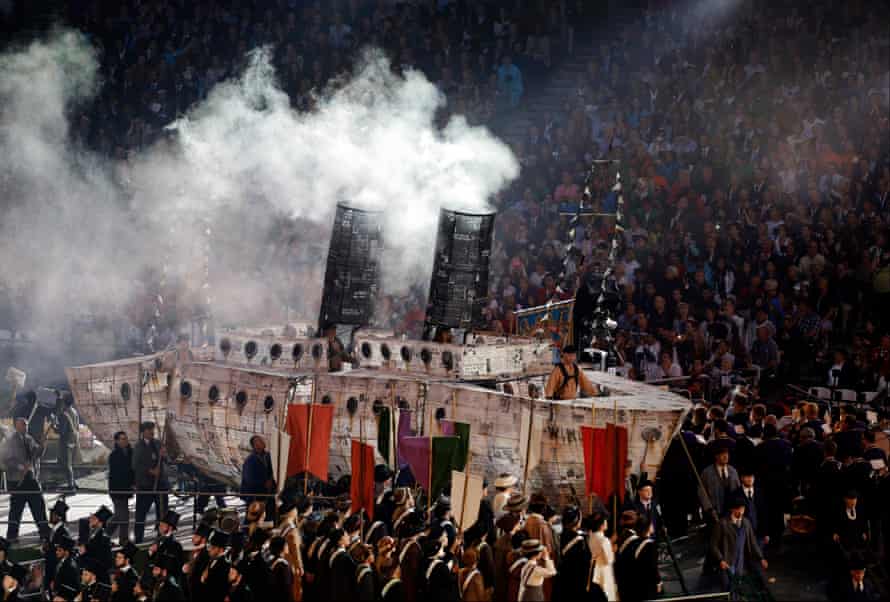
A recreation of the Empire Windrush at the opening ceremony of the London Olympics in 2012
‘You have to have a real tenure in the country to play your ancestors’ … a recreation of the Empire Windrush at the opening ceremony of the London Olympics in 2012. Photograph: Lee Jin-man/AP

For Olusoga, 51, this hostility can in part be explained by ignorance. “If you were taught a history that the first black person to put his foot on English soil was stepping off the Windrush in 1948, then this can seem like a conspiracy,” he says.

But there is a deeper issue at play. “If you have been told a version of your history and that is part of your identity, it’s very difficult when people like me come along and say: ‘There are these chapters [that you need to know about].’ People feel – wrongly in my view – that their history is being undermined by my history. But my history isn’t a threat to your history. My history is part of your history.”

When the book was published in 2016, it ended on a hopeful note. Olusoga was writing just a few years after the London Olympics, in which a tantalising view of Britain emerged – a country at ease with its multiculturalism, nodding with pride to the arrival of the Windrush generation in 1948. Black Londoners dressed up as their ancestors for the opening ceremony, “with long, baggy suits, holding their suitcases”, says Olusoga. “You have to have a real tenure in the country to play your ancestors.” That moment, he says, was profoundly beautiful.

But that upbeat note has begun to feel inaccurate – an artefact of a more optimistic time. In the new edition of Black and British, which includes a chapter on the Windrush scandal and last year’s Black Lives Matter protests, Olusoga describes that moment in 2012 as a mirage. The summer afterwards, vans bearing the message “Go home or face arrest” were driven around London as part of Theresa May’s notorious “hostile environment” strategy, aiming to make the UK inhospitable for undocumented migrants. Thousands of people who had lived legally in the UK for decades, often people who had arrived from the Caribbean as children, were suddenly targeted for deportation.

In 2020, protesters in more than 260 British towns and cities took part in BLM protests, thought to be the most widespread anti-racist movement since the abolition of the slave trade. A statue of the slave trader Edward Colston was toppled in Bristol; a Guardian analysis suggests about 70 monuments to slavers and colonialists have been removed, or are in the process of being removed, across the UK.

But this movement for racial justice has been met with a severe backlash. In January, Robert Jenrick, the secretary of state for housing, communities and local government, said he would introduce laws to protect statues from what he called “baying mobs”. The government’s recent review on racial equality concluded controversially that there was no institutional racism in areas including policing, health and education, despite all the evidence to the contrary.

“I’m really frightened about the future of this country, and frightened about people using forces of race and racism for electoral reasons and not being cognisant about how difficult it is to control those forces after elections have been counted,” says Olusoga. “I’m really frightened about the extent to which people are able to entirely dehumanise people who they deem to be their enemies in this culture war.”


Olusoga was born in Lagos in 1970, to a white British mother and a Nigerian father, moving to his mother’s home town, Gateshead, at an early age. As one of a handful of mixed-race families on the council estate where they lived, they were regularly terrorised by the far right. The violence culminated in a brick being thrown into the family’s home, wrapped in a note demanding they be sent “back”. He was 14. Eventually, the family had to be rehoused.

His early experience of education was also distressing. “I experienced racism from teachers in ways that are shocking if I tell them to young people at school now,” says Olusoga. He was dyslexic, but the school refused to get him tested until he did his GCSEs: “It was the easier story to believe that this kid was stupid because all black kids are stupid.” When he finally got his diagnosis and support – thanks in large part to his mother’s fierce determination – Olusoga went to study history at the University of Liverpool, followed by a master’s degree at Leicester.

Olusoga was confident about having two identities, despite the prejudice he had encountered. He was proud of being a black Nigerian of Yoruba heritage and was perfectly happy being part of his mother’s white working-class geordie tradition. But he has always had a third identity.

“I’m also black British – and that had no history, no recognition. It was presented as impossible – a dualism that couldn’t exist, because whiteness and Britishness were the same thing when I was growing up. So, to discover that there was a history of being black and British, independent from being half white working-class and being half black Nigerian, that was what was critically important to me,” he says. His book does its best to uncover that history, exploring the considerable presence of black people in Britain in the age of slavery, as well as the part played by black Britons in both world wars.

He says that some of the aggression shown towards black historians who write honestly about Britain’s past comes from people who think “this history is important because it gives black people the right to be here”. They hold on to the belief that the UK was a “white country” until the past few decades and refuse to accept evidence that shows the presence of black people goes back centuries. But this is to fundamentally misunderstand what drives him and also why this history is important for black people.

“I don’t feel challenged in my right to be proud to be British,” he says. “I’m perfectly comfortable in my identity. I’ve looked at this history because it’s just exciting to be part of a long story. This comes out of wanting to enrich life, not seeking some sort of needy validation of who I am.”

He found it refreshing to see the UK’s history of empire and colonialism acknowledged in last summer’s anti-racist placards, with one popular slogan stating “The UK is not innocent”. “A generation has emerged that doesn’t need history to perform that role of comfort that its parents and grandparents did,” he says.

As for black people’s experiences in Britain, he says, there is a “hysterical” level of anger if you point out that many have lived in some form of slavery or unfreedom. Recently, historians have uncovered notices of runaway enslaved people or advertisements for their sale. This adds to the evidence that thousands of black people were brought to Britain, enslaved as well as free.

“It brings slavery to Britain and therefore undermines the idea that it doesn’t really matter because it happened ‘over there’,” says Olusoga. “It short-circuits an idea of British exceptionalism. And there are a lot of people for whom that idea of exceptionalism is a part of how they see themselves. I’m really sorry that the stuff I do and that other people do is a challenge to that, but my job is to be a historian. It’s not to make people feel good.”

Olusoga is often accused of pursuing a political agenda. He is asked, for instance, why he doesn’t speak about the Barbary slave trade of the 16th to 18th centuries, in which Europeans were captured and traded by north African pirates. He has a simple response: that he has been trying to get a programme made about it for his entire career and it is finally happening.

He gives another example: “I have been accused literally hundreds of times of ignoring the slavery suppression squadron that the Royal Navy created after 1807.” Its task was to suppress the Atlantic slave trade by patrolling the coast of west Africa. “I think the chapter in Black and British about that is 30,000 words, which is as long as some books.”

What his more extreme critics fail to understand, he adds, is that he is loyal to history and not a political agent. He remains committed to one goal: to uncover the stories of those who have long been deemed unimportant. When he wrote his first book on the 1904-08 Namibian genocide, he went to mass graves where he saw bones sticking out of the ground. “We promised the victims of that genocide that we would be their voice, we would fight for them and we would tell their story – and we use every skill we have to do that.

“I care deeply about people who were mistreated in the past. I care about the names on slave ledgers, I care about the bones of people in Africa, in mass graves in the first world war and in riverbeds in Namibia. I care about them. I think about them when I read the letters, when I look at their photographs and their faces. No one gave a damn about them. That’s my job – to care about them. And I will be ruthless in fighting for them.”

Source: David Olusoga on race and reality: ‘My job is to be a historian. It’s not to make people feel good’

Buckingham Palace’s Institutional Racism Revealed in Damning Unearthed Documents

Of interest:

Less than three months ago, Meghan Markle and Prince Harry accused an unnamed member of the royal family of having asked a racist question about the likely color of any of their then-unborn children’s skin.

In response, Prince William told reporters, “We are very much not a racist family.”

However, British newspaper the Guardian today revealed that the monarchy has explicitly employed racist hiring practices and that it continues to claim a special exemption from British equality legislation.

Source: Buckingham Palace’s Institutional Racism Revealed in Damning Unearthed Documents