Discovery of secret list of alleged Nazi war criminals in Canada raises questions about government secrecy

Of note (embarrassing to various Canadian governments that refused their release):

U.S. researchers have found what they say is a late draft of a secret list of more than 700 suspected Nazi war criminals believed to have settled in Canada after the Second World War, prompting fresh calls for the federal government to finally unseal and release the full list.

A research team led by UCLA historian Jared McBride, an expert on war crimes in the Second World War, has unearthed what he concludes is an annotated version of the list of alleged war criminals in this country examined by a 1986 Commission of Inquiry led by retired Superior Court of Quebec judge Jules Deschênes.

Anonymized descriptions of such individuals living here were published in Part 1 of the Deschênes inquiry report. But the second half of the report, naming them, has been kept secret for decades, despite calls to release it, including from historians, Jewish groups and the Canadian Polish Congress.

Last year, the government rejected an access to information request from The Globe and Mail to make it public. The Globe has seen the list of names, and accompanying notes on their investigation, unearthed by the UCLA team.

Jaime Kirzner-Roberts, senior director of policy and advocacy at the Friends of Simon Wiesenthal Center, said “there is no longer any rationale for the government to continue to keep these documents secret.”

“The government must immediately release the full case files and once and for all reckon with the truth instead of preserving the shameful cover-up that has shielded war criminals for so many years,” she said.

Prof. McBride found the partly redacted ledger, which includes notes on identity checks, in a batch of documents collated by the RCMP in the Canadian government’s archives….

Source: Discovery of secret list of alleged Nazi war criminals in Canada raises questions about government secrecy

‘Rising problem’ of ghost consultancies hits man who lost $12K trying to get Canadian visa for wife

Another example:

Krishan Jogia turned to an immigration consultancy before landing in Toronto in 2023, only to realize later — after spending thousands of dollars — that he had been dealing with a “ghost” consultancy apparently operating illegally in Canada.

Jogia, a dual Canadian-Australian citizen, sought the services of Canada Global Migration Consultants (GMC) for a Canadian visitor visa for his wife, Luana Cabral de Carvalho. They eventually received it, but things didn’t go as smoothly when they tried again for her spousal visa.

WELCOME TO CANADAIs it worth immigrating to Canada? These newcomers say it comes at a cost
IN DEPTHRegulator taking too long to rule on ‘bad actor’ immigration consultants, critics say
“Canada GMC visually, like if you’ve seen their YouTube, Instagram and website, comes off as very polished,” Jogia said. “When you call them, you get a proper help desk with hold music and everything.”

However, in early 2024, Jogia said, their consultant “just disappeared.” For months, he said, the consultancy kept ignoring them and shuffled them around to different colleagues. The two were able to get hold of that consultant, who is a registered immigration consultant, directly. He told them, in an email seen by CBC News, that they left Canada GMC due to “their unethical work practices.”

“We started really aggressively trying to pursue a refund, and that’s when they just stopped replying and just ignored us,” Jogia said.

Source: ‘Rising problem’ of ghost consultancies hits man who lost $12K trying to get Canadian visa for wife

Court denies certification of $2.5-billion Black civil servants class action lawsuit

Successful in raising the profile and issue, but ultimately failed at court. And the plaintiffs assertion that “they deserve real change” discounts the overall improvement among Black public servants in terms of hirings, promotions and separations:

A Federal Court judge on Monday dismissed a motion to certify a proposed class action lawsuit that was launched by Black public servants in 2020 who alleged there was systemic racism within the public service.

In an “order and reasons” document, Justice Jocelyne Gagne said the case did not sufficiently meet the class action requirement that the claims raise common issues.

Gagne also said the scope of the plaintiffs’ claim “simply makes it unfit for a class procedure.”

Filed in 2020, the class action sought $2.5 billion in damages because of lost salaries and promotion.

The Black Class Action Secretariat, a group created as a result of the lawsuit, is seeking long-term solutions to address systemic racism and discrimination in the public service, including compensation and the appointment of a Black equity commission.

Gagne said the court acknowledges the “profoundly sad ongoing history of discrimination suffered by Black Canadians” and that plaintiffs have faced challenges in the public service.

However, she said the plaintiffs didn’t present an adequate litigation plan and that they failed to present a ground for the court to assert jurisdiction over the case.

The document also said there are several class actions against individual federal departments and agencies alleging racial discrimination, which “overlap significantly with the present action.”

Proposed class members, the judge said, “would therefore be included in the class definition of these other class proceedings.”

The Black Class Action Secretariat said in a news release Monday that the ruling was a “major disappointment, but it is not the end of our fight for justice.”

“For five years, this has been a David vs. Goliath battle, and while today’s outcome is frustrating, it only strengthens our resolve,” the organization said.

The news release said systemic anti-Black racism has long been recognized by the federal government and that the plaintiffs will meet with their legal team to “explore next steps.”

In 2023, a grievance ruling by the Treasury Board Secretariat found that the Canadian Human Rights Commission discriminated against its Black and racialized employees. In 2024, an internal report found that public servants working at the Privy Council Office were subject to racial stereotyping, microaggressions and verbal violence.

“For decades, Black public service workers have faced systemic discrimination, and today’s decision does nothing to change that reality,” Thompson said.

A Federal Court hearing took place last fall to help determine whether the class-action lawsuit could proceed.

At the time, the federal government filed a motion to strike, asking the judge to dismiss the case. The government argued that Black public servants could file grievances or human rights complaints.

The government also called to remove Canadian Armed Forces and RCMP members, as well as Department of National Defence and Correctional Service Canada employees as class members because of similar class action lawsuits against those departments.

Thompson says the government used procedural barriers to “avoid addressing the merits of this case, rather than standing on the side of fairness and accountability.” The government has spent around $10 million fighting the class action.

“Black workers deserve more than recognition of past harms — they deserve real change,” he said.

Source: Court denies certification of $2.5-billion Black civil servants class action lawsuit

HESA: The Future of Equity, Diversity, and Inclusion in Canadian Higher Education

Interesting and likely realistic take:

…There are, furthermore, two big differences between Canada and the US with respect to EDI that are worth keeping in mind. The first is that EDI in Canada had very little to do with the composition of the student body; unlike the US, students from racialized backgrounds are substantially over-represented (as compared to the general population) in the student body up here. This is not to say that students from all racialized backgrounds are over-represented, but more are than are not (see back here for more on this). As a result, EDI in Canada tends to be much more about representation at the staff level, and specifically—given the politics of the institution—about academic staff. And to the extent that diversity in hiring, pay and promotion is at the heart of Canadian EDI efforts, current practice in academia is not all that far off the standard in the Canadian private sector, where diversity initiatives have been the norm for quite some time. This is why there aren’t that many Boards of Governors, even in Conservative places like Alberta, that have really blinked at EDI hiring initiatives.

The second is that the prominent presence of Indigenous peoples and the legacy of Truth and Reconciliation add a complicating layer to the whole issue. Indigenous peoples are generally not included in most EDI processes because it is recognized that, for historical and Treaty reasons, they absolutely should not be lumped in with other under-represented groups in terms of process, even if both are deserving of and would benefit from greater efforts at inclusion. Having two separate processes is complicated and can at a superficial level look a bit wasteful and politically complicated, but at the end of the day, that complication works in favour of EDI, institutionally speaking. No one—and I mean no one—is going to try and reverse Indigenization initiatives at Canadian universities. And because at least some of the aims of EDI & Indigenization are parallel (ish), going after one but not the other is hard to justify. 

So, given all of that, what is the future of EDI in Canada? Well, it depends a bit on which part of EDI we are talking about. I don’t think we are going to reverse course on equity in hiring. Cluster hires will probably continue for a little while yet for the simple reason that alternatives simply have not been very effective at moving the needle on racial equity (we’ve been doing that with female profs for about 40 years now, and while we are getting closer to parity, it has taken an unconscionable amount of time to get there). Neither do I think many institutions are going to change tack in terms of trying to create more welcoming environments: in an era of tight budgets, universities and colleges are going to do all they can to be seen as good employers on non-financial stuff.

Where I suspect we will see change will be in the tendency to add staff positions for the specific purpose of addressing issues of Equity, Diversity and Inclusion. This is a place where a larger set of suspicions both in government and the professoriate about “bureaucratization” and “administrative bloat” will be decisive. This won’t necessarily reduce the amount of work to be done, so it probably will mean that more of it is done off the side of someone’s desk. I also suspect that institutions will look less favourably on equity groups’ requests for separate university events (e.g. Lavender Graduation ceremonies). 

Will this result in a tamping down of the (muted) culture wars in Canadian higher education? No. Some people will remain opposed to things like land acknowledgements, and the aging white guy irritation with Canadian history departments being insufficiently “positive” about Canada (meaning, in practice, centering narratives on any groups other than white settlers) isn’t going to go away either. Culture wars never end. Friction will continue.

And so too, broadly, will EDI. Words and tactics might soften or change, and a variety of other institutional challenges (mainly but not exclusively financial) may mean that the issue will never again be quite as central to university policy as it was in 2020 and 2021. But we’re not headed in the same direction as the US.

Source: The Future of Equity, Diversity, and Inclusion in Canadian Higher Education

Christopher Dummitt: Canadians need a proud, not guilt-ridden Canada

Ongoing arguments for a needed correction:

…The second key element of any national cultural policy ought to be a more realistic approach to pluralism. Canadians live in a country of different ethnic, linguistic, and religious groups. We aren’t unified. But the fundamental error of the last decade was to do diversity wrong — to engage in a downward spiral of national subtraction. Out of a well-intentioned, but horribly mistaken desire to protect certain historically marginalized groups, we kept demoting our national heroes out of a belief that they “harmed” people in the present.

A pragmatic pluralism would recognize that one people’s hero will be another’s villain. This absolutely should not mean dishonouring anyone because one group says they are hurt.

Heritage harm is a choice. No one has to be offended when they walk into a school named after someone whom they don’t respect. Conservatives aren’t psychologically damaged when they fly out of Pearson airport. Nor do Liberals suffer when they tour the Diefenbunker. Francophones don’t need to avert their gaze as they drive through Durham region just because Lord Durham once advocated for their assimilation. And a Wendat/Huron Canadian doesn’t need to feel threatened when driving past Tyendinaga Mohawk Territory just because the Mohawk people once wiped out Huronia.

Any Canadian party that wants to be seriously considered as a defender of the nation should promise a pragmatic pluralism which builds up and doesn’t tear down our country. Each group of Canadians should be allowed to keep their historical heroes. Instead of tearing down John A. Macdonald statues, a new federal government should promise to raise statues of figures like Tecumseh or Big Bear. Canada is a diverse country. We can have a diverse set of historical heroes. No one gets a veto. Individual Canadians can choose to be harmed by a name if they want — but our national government needs to be bigger than this — stronger and more resilient.

What’s more, a third key promise ought to be the adoption of a culturally mature notion of diversity. Canada hasn’t always looked the way it does today. People in the past didn’t think the same or act the same. A responsible national government would take pride and celebrate this diversity.

Canada’s prehistory was dominated by Indigenous peoples who have fascinating histories that long-predate the origins of Canada itself. We ought to celebrate these histories. And this shouldn’t mean just pretending that pre-contact Indigenous peoples were benign environmental-loving hippies. We should tell the more accurate and much more fascinating stories of conflict and war and struggle.

From the time of New France up to the 1960s, most Canadians could trace their ancestors back to two places — France and the British Isles. This is just a fact of history and demography. We don’t need to apologize for it. We were an overwhelming white western European colony. We shouldn’t expect our historical figures for much of our history to represent the diversity of multicultural Canada in 2025. They didn’t, and they don’t.

We could instead celebrate the amazing fact of Canadian governments in the 1960s — first under Diefenbaker and then under Lester Pearson — to remove racism from our immigration system. This was an astounding decision. Most groups, for almost all of human history, have wanted homogeneity — to insist on sameness. It’s not odd that Canada was similar before the 1960s, but it is quite amazing that Canada changed its tune. A build-it-up national cultural policy would celebrate this fact, and the Canadians who came before. It doesn’t have to be one or the other. Our heritage should be about building up and adding on, not deleting.

Finally, a more mature approach to diversity would acknowledge that Canadians are sophisticated and not bigoted. They don’t have to share the same identity characteristics of our heroes to appreciate Canadian history. That kind of racial in-group thinking is a barrier to true national belonging. You don’t have to be Black to admire Viola Desmond. You certainly don’t need to be white or German-Canadian to be proud of Diefenbaker’s “One Canada vision” and his championing of a Bill of Rights.

Who will offer this proud Canadian vision? Which party will turn its back on the subtraction-heritage distraction of the last decade?

The way ahead ought to be clear: a vision of the country where pride and dignity comes first; a proud pluralism that allows every Canadian group to have its heroes and its stories; and a mature approach to diversity that assumes a resilient Canadian population, one that sees and celebrates our differences over time, and assumes that any Canadian, regardless of their background or when their ancestors arrived here, can share in the story.

Source: Christopher Dummitt: Canadians need a proud, not guilt-ridden Canada

Surge of new judges on top courts cut vacancies to lowest level after years of alarm

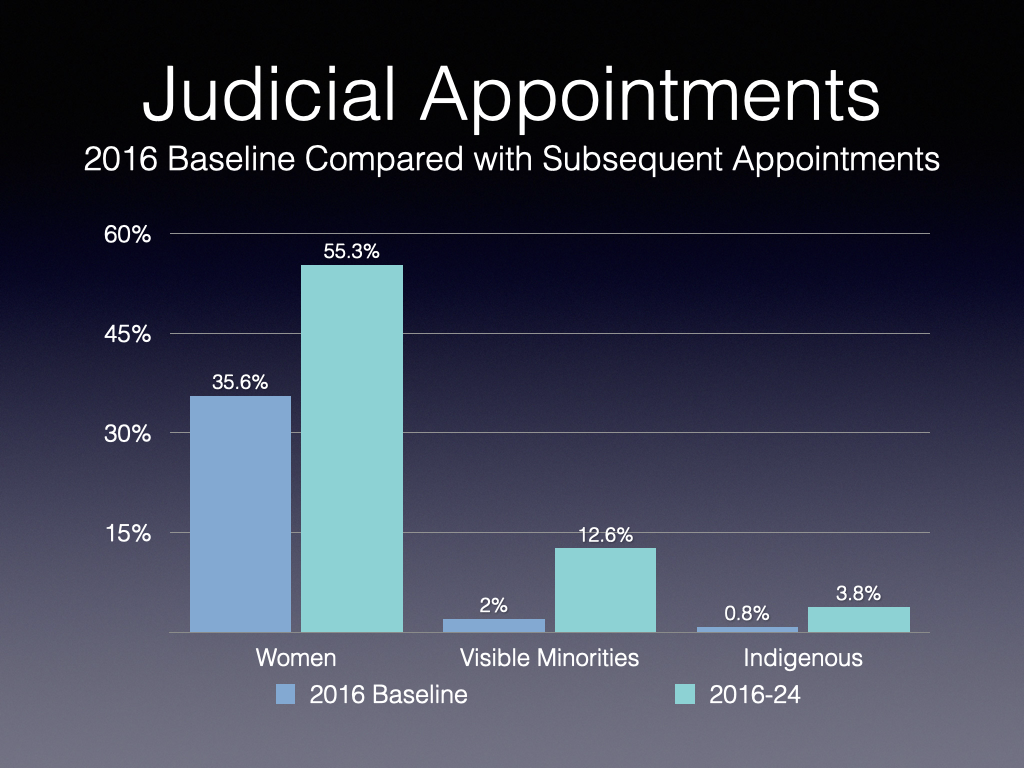
Of note. The most recent stats on diversity can be found at: https://www.fja.gc.ca/appointments-nominations/StatisticsCandidate-StatistiquesCandidat-2024-eng.html. My summary, comparing the Harper government baseline and subsequent appointments is below:

The federal Liberals have cut judicial vacancies on top courts across the country to their lowest level on record, new data show, after allowing the problem to get out of control for several years.

A flurry of 31 appointments in recent weeks leaves only 13 vacancies, as of mid-March, among the 1,000 full-time positions for judges on federally appointed benches, according to government data.

The previous low in vacancies was 14 in mid-2015, based on a review of data going back to 2003.

The latest appointments, made as a federal election is expected soon, further address unusually sharp and public criticism in recent years about unfilled positions on federally appointed benches. Those include the Supreme Court of Canada, provincial appeal and superior courts, and the Federal and Tax courts….

Source: Surge of new judges on top courts cut vacancies to lowest level after years of alarm

What are Canadians’ perceptions on race relations? Here’s what a national survey found

Always useful to have tracking over time. Encouraing:

Canadians are more optimistic about race relations than they were three years ago, despite a world that’s increasingly defined by inter-group conflict and social divisiveness, says a national survey on racism, race relations and discrimination.

The survey shows that those who view race relations as generally good outnumber those who think otherwise by a three-to-one ratio — with many believing that people from different groups get along with one another and have equal opportunity to succeed, said the report by Environics Institute and the Canadian Race Relations Foundation.

The 2024 survey found that most Canadians acknowledge the reality of racism, prejudice and hate, recognizing these issues both from personal experience and through their understanding of broader societal trends.

Keith Neuman, senior associate at Environics and the report’s lead author, said that compared to racialized people surveyed in 2021, the experiences of those surveyed this time didn’t worsen, and their perceptions of race relations improved slightly. “That, I think, is a point of optimism,” he said.

The survey comes at a time when Canada’s immigration policy is at a crossroads, with anti-immigrant sentiment rising, most recently directed at South Asians here as international students and foreign workers, scapegoated for the housing crisis and socioeconomic challenges. The ongoing war between Hamas and Israel has also led to tensions in Canada

This was the third wave of a national survey that started in 2019 to monitor the attitudes, perceptions and experiences of race relations among Canadians. The second survey in 2021 was in the wake of the racial reckoning from the Black Lives Matter Movement and surge of anti-Asian racism amid the pandemic….

Source: What are Canadians’ perceptions on race relations? Here’s what a national survey found

These Words Are Disappearing in the New Trump Administration

Quite a list, including many I would classify as descriptive and objective, and some that merely correct silly language (e.g., breastfeed + people, breastfeed + person, chestfeed + people, chestfeed + person, pregnant people, pregnant person):

As President Trump seeks to purge the federal government of “woke” initiatives, agencies have flagged hundreds of words to limit or avoid, according to a compilation of government documents.

  • accessible
  • activism
  • activists
  • advocacy
  • advocate
  • advocates
  • affirming care
  • all-inclusive
  • allyship
  • anti-racism
  • antiracist
  • assigned at birth
  • assigned female at birth
  • assigned male at birth
  • at risk
  • barrier
  • barriers
  • belong
  • bias
  • biased
  • biased toward
  • biases
  • biases towards
  • biologically female
  • biologically male
  • BIPOC
  • Black
  • breastfeed + people
  • breastfeed + person
  • chestfeed + people
  • chestfeed + person
  • clean energy
  • climate crisis
  • climate science
  • commercial sex worker
  • community diversity
  • community equity
  • confirmation bias
  • cultural competence
  • cultural differences
  • cultural heritage
  • cultural sensitivity
  • culturally appropriate
  • culturally responsive
  • DEI
  • DEIA
  • DEIAB
  • DEIJ
  • disabilities
  • disability
  • discriminated
  • discrimination
  • discriminatory
  • disparity
  • diverse
  • diverse backgrounds
  • diverse communities
  • diverse community
  • diverse group
  • diverse groups
  • diversified
  • diversify
  • diversifying
  • diversity
  • enhance the diversity
  • enhancing diversity
  • environmental quality
  • equal opportunity
  • equality
  • equitable
  • equitableness
  • equity
  • ethnicity
  • excluded
  • exclusion
  • expression
  • female
  • females
  • feminism
  • fostering inclusivity
  • GBV
  • gender
  • gender based
  • gender based violence
  • gender diversity
  • gender identity
  • gender ideology
  • gender-affirming care
  • genders
  • Gulf of Mexico
  • hate speech
  • health disparity
  • health equity
  • hispanic minority
  • historically
  • identity
  • immigrants
  • implicit bias
  • implicit biases
  • inclusion
  • inclusive
  • inclusive leadership
  • inclusiveness
  • inclusivity
  • increase diversity
  • increase the diversity
  • indigenous community
  • inequalities
  • inequality
  • inequitable
  • inequities
  • inequity
  • injustice
  • institutional
  • intersectional
  • intersectionality
  • key groups
  • key people
  • key populations
  • Latinx
  • LGBT
  • LGBTQ
  • marginalize
  • marginalized
  • men who have sex with men
  • mental health
  • minorities
  • minority
  • most risk
  • MSM
  • multicultural
  • Mx
  • Native American
  • non-binary
  • nonbinary
  • oppression
  • oppressive
  • orientation
  • people + uterus
  • people-centered care
  • person-centered
  • person-centered care
  • polarization
  • political
  • pollution
  • pregnant people
  • pregnant person
  • pregnant persons
  • prejudice
  • privilege
  • privileges
  • promote diversity
  • promoting diversity
  • pronoun
  • pronouns
  • prostitute
  • race
  • race and ethnicity
  • racial
  • racial diversity
  • racial identity
  • racial inequality
  • racial justice
  • racially
  • racism
  • segregation
  • sense of belonging
  • sex
  • sexual preferences
  • sexuality
  • social justice
  • sociocultural
  • socioeconomic
  • status
  • stereotype
  • stereotypes
  • systemic
  • systemically
  • they/them
  • trans
  • transgender
  • transsexual
  • trauma
  • traumatic
  • tribal
  • unconscious bias
  • underappreciated
  • underprivileged
  • underrepresentation
  • underrepresented
  • underserved
  • undervalued
  • victim
  • victims
  • vulnerable populations
  • women
  • women and underrepresented

Source: These Words Are Disappearing in the New Trump Administration

Winer: What to Expect When You’re Expecting Catastrophe

Good assessment, drawing from the experience under Hitler, appropriately so:

It’s as if the so-called shock and awe of that unholy duo—Donald Trump and Elon Musk—combined with loyalists like Kash Patel, Stephen Miller, Dan Bongino, Ed Martin, and many others, has rendered us, for the moment at least, unable to react.

Magical thinking is far from new. Adolf Hitler came to power amid similar lies and conspiracy theories. We should know where that leads. And, while MAGA may ignore the mountains of books written on fascism, the rest of us are not in the dark about what comes next.

As we brace for further actions from a cabinet catering to a serial fabulist, it is important to note that the president’s abstruse nonsense is not random. It has a history. A history that takes us in only one direction, to catastrophe.

Here, then, are things to watch for, all warnings from the well-known story of the Third Reich.

  • Daily life will take on a surreal quality and, if we do not take some action or join an organized resistance, our discussions will consist of merely repeating the latest horror.
  • People around you will forget that they once were anti-Trump.
  • The administration will issue absurd denunciations of opponents whose expertise is needed.
  • There will be parades and possibly mandatory public displays of support for the administration.
  • News sources will disappear or be radically altered.
  • MAGA will continue to believe what the leader says up until the very brink of disaster.

**

The debate about whether or not we should bring Hitler or Nazism or fascism into a contemporary political debate is obsolete. Now it is crucial that we take seriously the warnings gathered for us by survivors and writers. When you look at a photo of a Jew about to be arrested or shot and he or she is staring straight into the camera, remember that it is you they are looking at.

Source: Winer: What to Expect When You’re Expecting Catastrophe

Hamas and Feminist Dissonance

Sigh…:

It was predictable that Hamas officials and their radicalised international supporters would deny that sexual violence against Israeli women and men was committed on 7 October 2023. But denials from the academic field of women’s, gender, and sexuality studies are more surprising because they appear to violate two of the field’s salient principles: support for women’s sexual autonomy and insistence that women who lodge charges of sexual violence should be believed. Instead, a number of academic feminists have not only rejected Israeli claims, they have also embraced Hamas, along with all the reactionary patriarchal baggage of radical Islam, thereby abandoning their own stated values.

This subversion of academic feminism has been unambiguously apparent in multiple events organised by women’s and gender studies programs across the US since the 7 October attacks. The most recent of these was held on 11 February, when the Gender and Women’s Studies department at the University of California at Berkeley sponsored a webinar panel discussion titled “Feminist and Queer Solidarities with Palestine.” The original abstract for the event read:

“Some of the more important accomplishments of feminism include the insistence on “believing women” who come forward with accusations of sexual assault, and the awareness of increased sexual violence during militarized conflicts. Yet these achievements are currently being turned against real feminist concerns in Palestine. This talk will look at how Zionism has weaponized feminism, so as to serve Israel’s genocidal intent, by upholding debunked accusations of systematic Hamas mass assault, while ignoring documented reports of Israeli abuses.”

The abstract was taken down after UCB law professor Steven Davidoff Solomon published a critical op-ed in the Wall Street Journal on 3 February. Solomon anticipated that the panelists’ talks would likely “celebrate antisemitic violence” and create “a hostile environment for women” on campus, thereby violating the 1964 Civil Rights Act. Two days later, UC Berkeley’s chancellor Rich Lyons responded to Solomon in a letter to the Journal:…

Source: Hamas and Feminist Dissonance