Californians to vote on racial, gender preference programs

Will be interesting to see how the demographic shifts affect the vote:

A California with vastly different political preferences and demographics is voting on whether to allow affirmative action in public hiring, contracting and college admissions — nearly a quarter century after voters outlawed programs that give preference based on race and gender.

If approved, Proposition 16 would repeal a 1996 initiative that made it unlawful for California’s state and local governments to discriminate against or grant preferential treatment to people based on race, ethnicity, national origin or sex. Then-Gov. Pete Wilson, a Republican, championed the measure as part of his conservative bid for the presidency.

The California of 2020 is less Republican and more diverse than it was 24 years ago, with Latinos making up 39% of the population in a state where no group holds a majority.

Still, the repeal might not have made the ballot if not for the Memorial Day police killing of George Floyd while handcuffed by police in Minneapolis. Voters’ decision will test support for the Black Lives Matter movement.

Assemblywoman Shirley Weber, a San Diego Democrat and chairwoman of the California Legislative Black Caucus, is the lead author of the legislation that put the question to voters, which required two-thirds support in both houses of the state Legislature.

“I think the death of George Floyd made racism very real for people; they could see it. And now what I was asking them to do was to act on it, stop telling me how horrible it is, stop telling me that you really didn’t know that, stop telling me that this is such a revelation for you,” Weber said.

She added: “Now the question becomes, what are you going to do about it?”

Early voting begins Monday for the Nov. 3 election.

The U.S. Supreme Court has long outlawed racial quotas, but it has ruled that universities may use tailored programs to promote diversity.

Last year, a federal judge in Boston rejected claims that Harvard’s admissions policies discriminated against Asian American applicants to keep their numbers artificially low. The plaintiff, the Students for Fair Admissions group, is appealing.

Supporters of Proposition 16 include U.S. Sen. Kamala Harris of California, the Democratic nominee for U.S. , Black Lives Matter movement co-founders, professional sports teams and politically liberal groups of all types. They argue that some programs are needed to help level a systemically racist playing field. The campaign has raised $14 million, far more than the $1 million raised by opponents.

Opponents include Ward Connerly, an African American businessman and former University of California regent who pushed for the 1996 ban.

They say government should never discriminate by race or gender, and the only way to stop discrimination is to end it. Joining Connerly are more recent Chinese immigrants who say the United States shouldn’t play based on skin .

In 2014, activists scuttled an attempt to restore racial preferences in higher education and successfully voted out some Asian American legislators they called traitors to their race.

Assemblyman Evan Low, who is Chinese American, voted in June to put the issue before voters despite emails and phone calls running 37-to-1 against it. He rebuked proponents for failing to reach out to him and the broader Asian American community at a time when all minorities have reason to feel under attack.

“Yes, we have a moral compass, but we must have conversations, difficult ones, even with those communities in opposition, because we’re all in this together, right?” said Low, a Silicon Valley Democrat, in June.

Supporters say minority- and women-owned businesses have missed out on public contracting dollars. Because of the ban, culturally specific programs aimed at improving high school graduation rates for African American boys and Latinas were discontinued, deepening divides.

And while some Asian Americans are admitted to elite universities in large numbers, affirmative action proponents say they too hit a “bamboo ceiling” that prevents them from landing executive-level positions.

On the other side, Tom Campbell, a former dean of the Haas School of Business at the University of California, Berkeley, said the college recruited minority applicants through strong outreach to high school students in nearby Oakland.

The legacy of slavery and Jim Crow segregation laws exists, he said, but, “I just will not engage in this method of correcting that, because it is wrong to the individual kept out because of her or his race.”

Kali Fontanilla teaches English as a second language in Salinas, California and before that, tutored African American students. She identifies as Black and biracial, and said students of don’t need their standards lowered.

“That’s insulting to me to say that there’s certain groups that because of the of your skin you’re not meeting the standard, you can’t meet the standard (so) we’re going to help you, we’re going to give you this crutch to get in,” she said.

Higher education has long been a flash point in the debate and both sides point to admissions statistics at the University of California and its nine undergraduate campuses to make their case.

Opponents of affirmative action say Latinos have made significant progress without preferential treatment, making up 25% of undergraduates last year, double their share two decades ago.

Supporters of affirmative action note that Latinos make up more than half of California’s high school seniors, with a graduation rate above 80 .

The population of California has also changed dramatically since 1996. The numbers of Latino and Asian American residents — and voters — have grown, although likely voters are still disproportionately white. Democrats still make up nearly half of registered voters, but the percentage of Republicans in the state has dropped from 36% to 24%.

Dan Schnur, who teaches political communications at UC Berkeley and the University of Southern California, noted that young white Californians also are much more liberal on issues of immigration, same-sex marriage and equity, having “grown up in much more diverse and multicultural environments than their parents and grandparents.”

But recent polls by the Public Policy Institute of California and the Institute of Governmental Studies at the University of California, Berkeley showed the measure trailing. Last year, voters in Washington narrowly upheld that state’s ban.

Thomas Saenz, president of the Mexican American Legal and Education Fund, said claims that a quarter of college students are Latino are “not something to be celebrated,” given that more than half of all public school students are Latino.

“That’s a disparity that needs to be aggressively addressed, and Proposition 16 would allow us to do that,” he said.

Source: Californians to vote on racial, gender preference programs

‘Overlooked’: Asian American Jobless Rate Surges But Few Take Notice

A reversal from pre-COVID. Canadian data by visible minority group shows some comparable trend with respect to income but less so for most Asian groups:

The coronavirus pandemic is taking a heavy economic toll on Asian Americans.

From Vietnamese nail salons to Cambodian donut shops, Asian-owned businesses have struggled. And Asian American workers have gone from having the lowest unemployment rate in the country to one of the highest.

Jerry Raburn lost his job at a mortgage servicing company in Southern California in March, just six months after he started.

“The business decreased dramatically, and based on seniority, I was let go,” said Raburn, who came to the U.S. from Thailand when he was 8 years old.

He now shares a single room with his mom, brother and sister in another family’s house.

“Everything just went downhill,” Raburn said. “I’m still unemployed, unfortunately, and I’ve been looking.”

David Canlas, who is from the Philippines, also lost his job consulting for software startups when the pandemic struck.

“Right now, nobody has start-up capital,” Canlas said. “Nobody has the budget to go hire a consultant. Nobody even feels comfortable for me to come into their office.”

The spike in Asian American unemployment stands out, even amidst the widespread misery of the pandemic.

A year ago, the jobless rate for Asian Americans was 2.8% — lower than that of whites, Blacks or Latinos. But Asian American unemployment soared to 15% in May, and it was still 10.7% in August — well above the rate of 7.3% for whites and the Latino rate of 10.5%. Only African Americans had a higher jobless rate of 13%.

While disparities in employment among Latinos and African Americans have garnered headlines during the pandemic, Asian American job losses have attracted less notice.

“Asian Americans are absolutely overlooked,” said Marlene Kim, an economist at the University of Massachusetts, Boston. “People have the sense that Asians are fine. That they’re a model minority. That they have good jobs and are doing OK.”

Geography explains some of the newfound challenges. Asian Americans are concentrated in places like New York and California, where the virus has taken a heavy toll.

Occupation also plays a role. Nearly a quarter of the Asian American workforce is employed in industries such as restaurants, retail, and personal services such as nail salons.

“Those industries have been hard hit by the pandemic and they traditionally employ many Asian Americans,” said economist Donald Mar of San Francisco State University.

Asian Americans also worry about discrimination, and say President Trump hasn’t helped with his provocative labeling of what he has repeatedly called the “Chinese virus.”

Paul Ong of UCLA noted that Chinatown in Los Angeles suffered an earlier and deeper drop in foot and vehicle traffic than the city’s other commercial neighborhoods.

“People are avoiding these areas in part because of this myth that somehow Asian Americans are tied in with the spread of the coronavirus,” Ong said. “Certainly that is untrue and unfair. But there’s no question that it gets reflected in the impact on the ethnic economy.”

That can be a real problem for Asian Americans who are new to the country or have limited English skills. In ordinary times, the social and economic networks of an immigrant community can open doors and provide opportunity. But Ong warned over-reliance on those networks can be a trap during a crisis like the pandemic.

“If you’re in an ethnic sector and all the restaurants are facing the same problem of being shut down, your opportunity to find work is minimal if not non-existent.”

Raburn has filed numerous online job applications since he was laid off by the mortgage servicing company, even though he finds the process soul killing.

“You don’t talk to a person,” he said. “It makes me not ever want to look for jobs again. But I have to look for a job.”

Raburn is also attending community college, and said his younger brother recently landed a job at Home Depot. Events have tested but not yet beaten his immigrant family’s hope for a brighter future.

“Life is hard in any country,” Raburn said. “I believe America will get better.”

Source: ‘Overlooked’: Asian American Jobless Rate Surges But Few Take Notice

Racism at Quebec hospital reported long before troubling death of Atikamekw woman

Of note:

From the moment she was admitted to the hospital in Joliette, Que., Joyce Echaquan started filming her interactions with staff.

It was an impulse, friends and family say, driven by long-held concerns about the way Indigenous people are treated at the hospital 70 kilometres north of Montreal.

Ultimately, two days after she walked in with stomach pains, she would broadcast her final pleas for help, capturing insulting and foul language directed at her by attending staff.

Sebastien Moar, Echaquan’s cousin, said she had several health problems, and felt she didn’t receive adequate care at the hospital.

“She always said, at the hospital, they never did anything. They just made sure she wasn’t hurting. She always had appointments and she said the nurses seemed fed up with her,” Moar said.

Echaquan used her phone, Moar said, to make sure her experience was documented.

“She was able to communicate what was happening and what had already happened.”

Her mistrust in the health services provided at the Joliette hospital, the Centre hospitalier de Lanaudière, is widespread in Echaquan’s Atikamekw community of Manawan, 180 kilometres further north.

It was flagged as a problem in the Viens commission, a provincial inquiry into the discrimination faced by Indigenous people.

One year after the Sept. 30, 2019 release of the report, Paul-Émile Ottawa, chief of Conseil des Atikamekw de Manawan, said he has started advising people to seek services elsewhere, for example Trois-Rivières or La Tuque, where signs in the hospitals are translated in Atikamekw.”The racism problems at [the Joliette] hospital did not start yesterday,” he said Wednesday.

“Even during the commission we came to devote a whole week to listen to the testimonies of the people of Manawan who suffered discrimination in this hospital.”

According to the Grand Chief of the Atikamekw First Nation, Constant Awashish, people are hesitant to file complaints because they distrust the system.

With no clear directives coming from the Quebec government following numerous recommendations and reports that have identified systemic racism, including the Viens commision, Awashish wants change.

“We’re in 2020. I think we need the government to step up on this and we need them to work on mitigation,” he said.

Mistrust in Manawan

For Alexia Nequado, who is also from Manawan, the death of her friend Joyce Echaquan was all too familiar.

Like Joyce, Nequado said she was admitted to the Joliette hospital two years ago with stomach pain.

Lying on a hospital gurney, Nequado said a nurse came to check on her. When she explained she was still in pain despite the dilaudid injection she had received, the nurse went to fetch a syringe of morphine.

Nequado, who was wearing a bracelet that indicated she was allergic to the drug, passed out.

“When I came to, the nurse told me I was an idiot for not telling her I was allergic,” Nequado said Wednesday.

“I didn’t feel safe and I felt awful for being treated that way.”Nequado said she filed a complaint to the hospital, but when she followed up later she was told it had not been reported to management.

Alland Flamand, a witness at the Viens commission who is also from Manawan, said he’s avoided going back to the hospital after trying and failing to get treated for an undiagnosed back problem.

Over six months, he said he went five times and each time was told nothing was wrong then given pain medication and told to rest. He was often asked, he recalled, if he was on drugs.

At one point, Flamand said, he saw a white man at the hospital for his own back problem being treated with a degree of respect he had not been given.

“It showed me clearly that there was racism there,” he said Wednesday.

After half a year of hardly being able to stand up, let alone walk, Flamand finally went to the hospital in Trois-Rivieres where he was taken in for emergency surgery for a herniated disc.”I could have been in her place,” Flammand said of Echaquan.

The local health authority, the Centre intégré de santé et de services sociaux de Lanaudière, did not return a request for comment Wednesday about those incidents.

Health authority promises to work with Manawan

Earlier, Daniel Castonguay, the executive director of the health authority, said he was “shocked and disappointed” to hear the language captured on video coming from one of his staff members.

But he denied there is systemic discrimination at the Joliette Hospital against Atikamekw patients.

“We receive complaints from people from all backgrounds, and those complaints are taken very seriously,” Castonguay said.

“But to say that residents from Manawan are systematically treated this way? No, that’s not true.”Castonguay said staff have to follow a cultural awareness training program. He wants to replace that with a working committee in collaboration with Atikamekw communities.

“The goal of that partnership is to ensure people feel safe, no matter where they are from.”

With pressure mounting on provincial authorities, Echaquan’s death is now the subject of three investigations: a coroner’s inquest, an investigation by the local health authority into her treatment and broader investigation by the same organization into practices at the hospital.

One of the nurses involved has been fired.

Sylvie D’Amours, Quebec’s minister responsible for Indigenous Affairs, said that whatever the outcome of the investigation, what was captured on video was “totally unacceptable and must be denounced loud and clear.”

“This shows that, unfortunately, there is still racism in Quebec, in particular against Indigenous communities,” she said Wednesday. She also said that 51 of the 142 recommendations from the Viens report have an action plan.

But she too, like Premier François Legault, has continued to deny systemic racism is a problem in the province.

Source: Racism at Quebec hospital reported long before troubling death of Atikamekw woman

There’s a social pandemic poisoning Europe: hatred of Muslims

Of note:

Rarely does the EU act so swiftly. Less than four months since the killing of George Floyd in police custody and the Black Lives Matter campaign that spilled into Europe and galvanised continent-wide protests, the EU is appointing its first ever anti-racism coordinator.This brilliant idea will make little sense, however, if anti-Muslim hatred is not part of their portfolio. Because instead of building a “truly anti-racist union”, as the president of the European commission, Ursula von der Leyen, would wish, we have so far built an anti-Muslim one.

Prejudice against Muslims exists in every corner of Europe. Not only do we collectively devalue and discriminate against Europeans who follow Islam, but the incidence of violence against Muslims is increasing.

We have known since the refugee and migration crisis of 2015 and the jihadist terrorist attacks in France, Spain and Germany that Muslims suffer from an exceptionally bad reputation in our societies. In 2019, research conducted for the Bertelsmann Stiftung’s Religion Monitor yet again confirmed widespread mistrust towards Muslims across Europe. In Germany and Switzerland, every second respondent said they perceived Islam as a threat. In the UK, two in five share this perception. In Spain and France, about 60% think Islam is incompatible with the “west”. In Austria, one in three doesn’t want to have Muslim neighbours.

Source: There’s a social pandemic poisoning Europe: hatred of Muslims

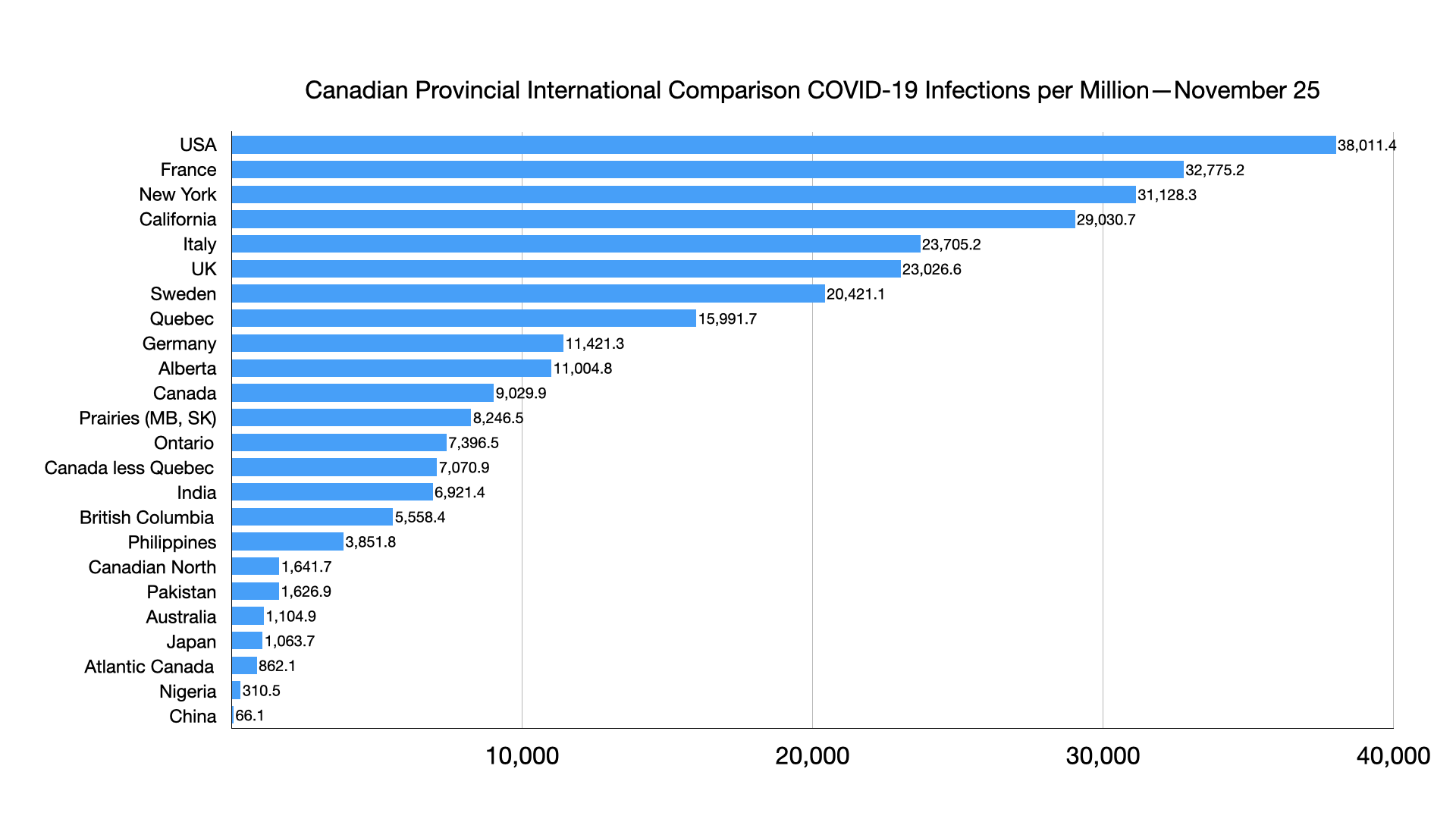
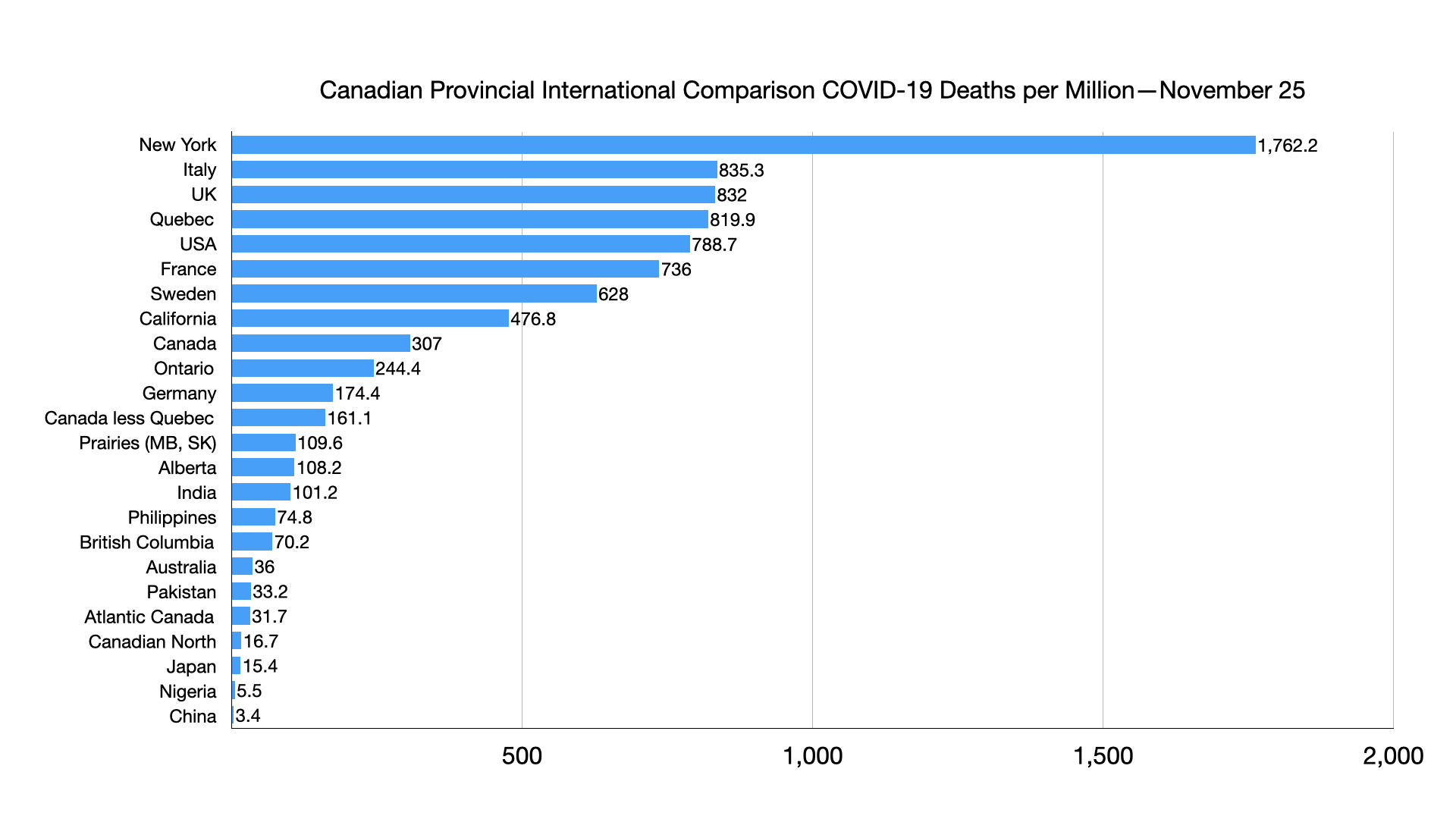
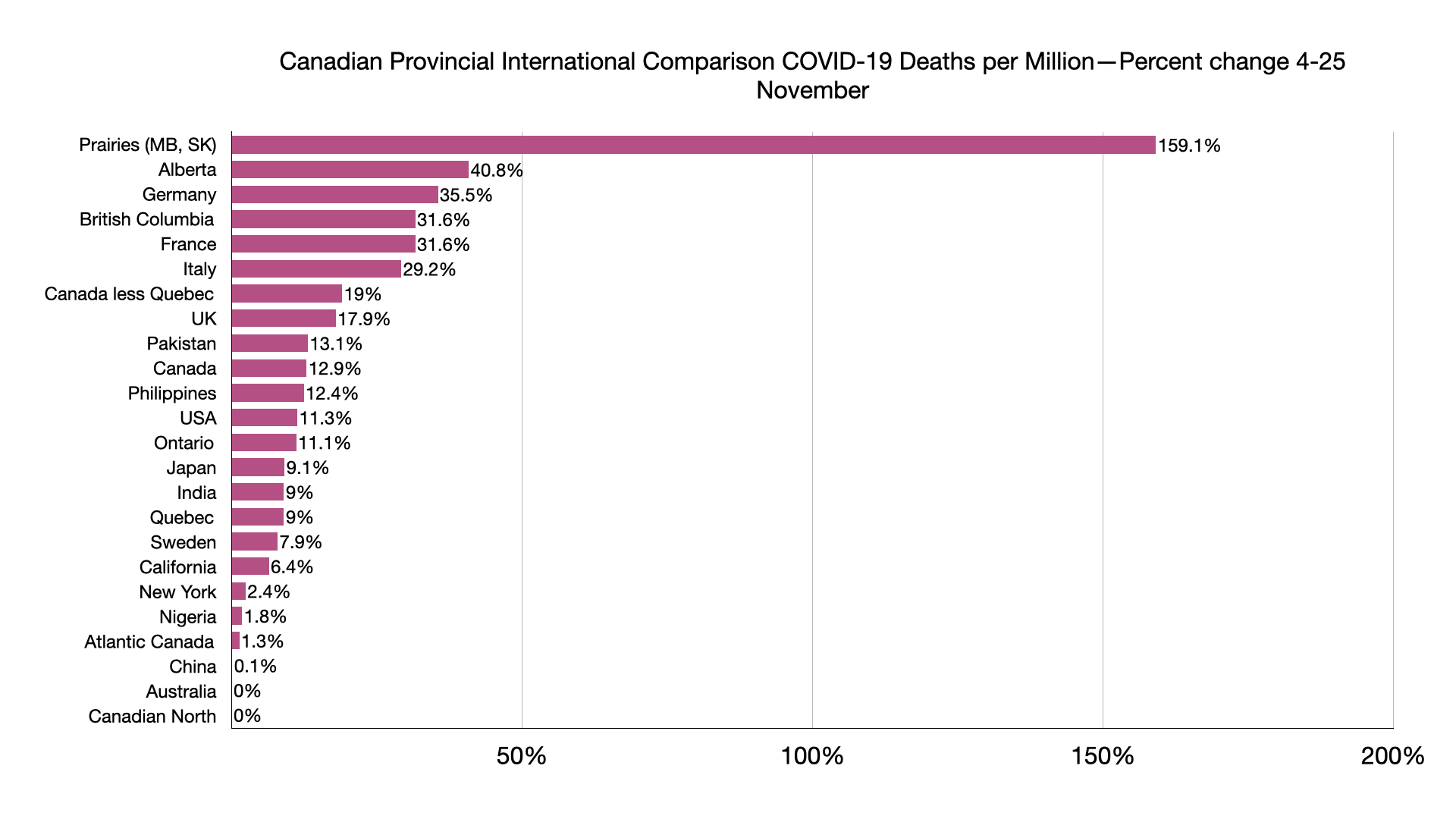
#COVID-19: Comparing provinces with other countries 30 September Update

Highlights:

Deaths per million:Canada less Quebec now ahead of Germany

Infections per million: Ontario now ahead of Germany, Canada less Quebec ahead of Philippines

Weekly:

Monthly Comparison (September 2-30 increase percent):
Infections: British Columbia and Prairies in top 5 jurisdictions with highest increases
Deaths: No provinces in top 5 in terms of increased death rates but British Columbia, Alberta and Prairies in top 10
The Globe has an editorial highly critical of the Ford government:

The German language probably has a word for the state of being surprised by the unsurprising, unprepared for the expected, and caught off guard by the danger you were on guard against. English does not have such a word. But when this pandemic is over, we are going to have to come up with one.

We’ll need it to describe what appears to be happening right now, in Canada.

Governments from coast to coast knew a second wave was coming. It was as predictable as fall. It was as expected as the rising of the sun. It was as surprising as the first snowfall – timing and severity uncertain; occurrence inevitable.

And yet, somehow, many governments have reacted like someone who forgot to set the alarm clock. Leading the parade of those surprised by the unsurprising is Premier Doug Ford’s Ontario government.

On Monday, Ontario reported 700 new cases of COVID-19, a new single-day record. Also on Monday, Ontario casinos reopened their doors to gamblers.

They say timing is everything in comedy and politics. In pandemics, too.

Also on Monday, the Ford government announced that, in response to the second wave, it would be hiring 3,700 more frontline health care workers. It’s a move that should have been made in May or June, not late September.

Still on Monday: Ontario reported processing more than 41,000 tests, but had a backlog of 49,586 waiting to be analyzed. By Tuesday, the backlog was nearly 55,000. The province, like many parts of the country, has recently seen enormous lineups at testing centres; lineups that are – how is this surprising? – driven by the predictable and predicted combination of rising infection rates and people needing to get tested to allow a safe return to school.

Yet again on Monday: The Ottawa Citizen obtained a memo showing that provincial health bureaucrats ordered a reduction in testing in some areas, owing to labs being overwhelmed. It’s another unsurprising result of too little test-processing capacity meeting growing demand for tests.

As of Tuesday afternoon, the pinned tweet at the top of Health Minister Christine Elliott’s Twitter feed still said: “It’s never been more important to get tested for #COVID19.” She’s right. The more people who get tested, the more often, the better. That should include lots of people who have no symptoms. But if everyone takes that advice to heart in the current system, where there are not enough tests or facilities to process them, Grade 3 math points to the inevitability of a surprisingly unsurprising outcome.

For anyone who remembers what Ontario went through last spring, that outcome looks all too familiar. We have lived this movie before.

Yes, Ontario is conducting several times more daily tests than it did back in April. Yes, Ontario has the second-highest provincial testing rate (Alberta is tops). There has been progress. There just hasn’t been enough.

With case numbers rising, as in the spring, and testing not keeping pace, as in the spring, this looks a lot like a sequel. The script has a disturbing amount of consistency. If it were run through plagiarism-detection software, someone would be getting an “F.”

More unsurprisingly surprising findings:

The most recent data from Toronto Public Health, as reported by the CBC, show that most people testing for COVID-19 don’t get results for at least two days. And nearly half of those who test positive are not followed up by contact tracers within 24 hours. Both of those numbers are well below the targets that need to be met for a program of heavy testing and contact tracing – which the province is supposed to have, but doesn’t – to be able to quickly find infected people before they infect others, and even more quickly track down anyone they may have infected.

In an effort to speed things up, the Ford government last week gave the green light for some pharmacies to begin administering tests to some asymptomatic individuals. The province also intends to hire more contact tracers. The mystery is why it didn’t do that months ago.

And last week, the province began rolling out plans for its response to the pandemic’s second wave. But this is like announcing in January that, in response to recent snowfalls, you plan to put out a tender for snowplows. It’s a bit late in the game.

And CBC has an analysis of what went wrong in Quebec:

A little over a month ago, Health Minister Christian Dubé congratulated Quebecers for their hard work at containing the spread of the coronavirus.

It was a Tuesday, Aug. 25, and the province had registered just 94 new cases of COVID-19 in the previous 24 hours.

“We have really succeeded at controlling the transmission of COVID,” Dubé said at a news conference in Montreal.

It was a statement of fact, but the ground had already started to shift. In the weeks that followed, transmission increased. At first it grew slowly, then exponentially.

On Monday, the government implicitly acknowledged it has again lost control of the virus. The province is reimposing lockdown measures on Quebec’s two biggest cities, starting Oct. 1.

Until Oct. 28, Quebecers won’t be able to entertain friends or families at home. Bars, restaurant dining rooms, theatres and cinemas will also be closed.

“The situation has become critical,” Premier François Legault said Monday evening. “If we don’t want our hospitals to be submerged, if we want to limit the number of deaths, we must take strong action.”

The new measures will bring abrupt changes to the lives of millions of Quebecers. They will also prompt questions about how the public health situation could have deteriorated so quickly.

This story tries to trace how Quebec again lost control of the spread of COVID-19.

At first, a stern warning

As Dubé addressed reporters on that Tuesday in late August, public health officials in Quebec City were busy trying to track down patrons of Bar Kirouac, a watering hole in the working-class Saint-Sauveur neighbourhood.

A karaoke night at the bar ultimately led to 72 cases and the activity being banned in the province.

There were also numerous reports by then of young people holding massive house parties and flouting physical distancing recommendations. One of them, in Laval, led to a small outbreak.

On Aug. 31, as Quebec’s daily average of new cases neared 152 cases, Legault delivered a stern warning.

“There has been a general slackening in Quebec,” Legault said. “It’s important to exercise more discipline.”

Legault and his health minister threatened stiffer punishments for those who disobeyed public-health rules, but stopped short of imposing new restrictions.

Private gatherings identified as the culprit

In late August, public health officials were attributing the rise in infections to Quebecers returning home from vacations around the province, as opposed to the start of school.

Though Quebec’s back-to-school plan wasn’t met with widespread criticism, some experts expressed concern about the large class sizes and the lack of physical distancing guidelines for students.

The government also ignored advice that it should make masks mandatory inside the classroom.

But the first weeks of the school year went relatively smoothly. By the start of Labour Day weekend, only 46 out of the province’s 3,100 schools had reported a case of COVID-19. Importantly, there were no major outbreaks.

The problem was elsewhere. Outside schools, in the community at large, cases continued to rise. On Sept. 8, the province was averaging 228 cases per day.

By now public health officials had identified private gatherings as the main culprit behind the increase.Montreal’s regional director of public health, Dr. Mylène Drouin, was among those who urged more caution when hanging out with friends and family.

“Yes, we can have social activities, but we have to reduce contacts to be able to reduce secondary transmission,” Drouin said on Sept. 9.

Warning signs

In an effort to spell out the consequences of the increase in cases, the Quebec government unveiled a series of colour-coded alert levels.

Areas coded green would see few restrictions; yellow zones would see more enforcement of existing rules; orange zones would be the target of added restrictions; and red zones would see more widespread closures of non-essential activities.

When the scheme was announced on Sept. 8, Quebec City was classified yellow. Montreal was classified green.

At this point, though, health experts were already concerned that more was needed to curb the spread of the virus.”It is important to intensify these measures,” Dr. Cécile Tremblay, an infectious disease specialist with the Université de Montréal hospital network, said after the alert levels were announced.

The warning signs were starting to multiply.

Officials in Montreal were investigating 20 outbreaks at workplaces on Sept. 9; a week later that number had risen to 30. Long lines were also forming outside testing centres, filled with anxious parents and their children.

And more stories were circulating of private gatherings where the 10-person limit was ignored, angering the health minister.

He told reporters about a dinner with 17 people at a restaurant in Montérégie, which led to 31 cases. A corn roast in the Lower St. Lawrence, he said, resulted in 30 cases.

“To me, that’s unacceptable,” Dubé said on Sept. 15.”If people won’t understand from these examples then, I’m sorry, but they’ll never understand.”

He moved Montreal, and four other regions, into the yellow zones and banned bars from serving food after midnight. The province was averaging 338 new cases per day.

Second wave arrives

The warnings from the government did not curb the spread of the virus. By mid-September, authorities were reporting more cases in closed settings.

On Sept. 17, Herzliah High School in Montreal became the first school in the province to say it was shutting down for two weeks to deal with an outbreak. At least 400 other schools were also dealing with active cases of COVID-19.

Cases accumulated too in private seniors homes (known as RPAs), a major source of concern for public officials given the vulnerability of the residents to COVID-19.There were only 39 cases in RPAs at the start of the month, and 157 by Sept. 20.

On that day the government announced it was moving Montreal, Quebec City and the Chaudière-Appalaches region into the orange zone, the second-highest alert level. Private gatherings were capped at six people.

The province was by then averaging 501 new cases per day. The second wave had begun, according Quebec’s public health director, Horacio Arruda.

Red zone

Over the last week, Quebec’s health system has shown signs of strain as authorities race to contain the spread of the virus.

Drouin, the Montreal public health director, admitted on Sept. 21 that her contact-tracing teams were swamped by the demand.

Until now, the increase in cases had not been accompanied by a corresponding surge in hospitalizations. Most of the new cases were concentrated in younger people.But the number of hospitalized COVID-19 patients in Quebec has increased by 45 per cent in the last seven days. Hospital staff are starting to get stretched. Several thousand health-care workers are in preventive isolation.

“We’re feeling the second wave,” Dr François Marquis, the head of intensive care at Montreal’s Maisonneuve-Rosemont hospital. “We were apprehensive about it, but now it’s a reality.”

On Monday, Quebec reported 750 new cases of COVID-19. Montreal and Quebec City were classified as red zones later that evening.

Source: How Quebec went from COVID-19 success story to hot spot in 30 days

‘Words alone will not be enough’: Black caucus, community cautiously optimistic about feds’ Throne Speech pledges

Initial reactions (and wait for the budget for initiatives to be concretized or not):

Prime Minister Justin Trudeau’s Throne Speech further elevates the priorities long advocated by the Black community, say MPs, Senators, and advocates, though some say the lack of specificity on certain planks gives the government too much wiggle room to follow through on its commitments.

Mr. Trudeau’s (Papineau, Que.) parliamentary reset last week featured a grab bag of mostly old commitments that are likely to compete with one another for resources against the immediate threat posed by the global pandemic.

It featured a separate section devoted to “addressing systemic racism,” reflecting, in sweeping terms, many of the priorities that the Black Parliamentary Caucus had lobbied for in response to the anti-Black racism rallies that hit many cities around the world over the summer. Some of its commitments include addressing standards on the use of force; implementing a plan to increase representation in public service; and finding new ways to support the “artistic and economic contributions of Black Canadian culture and heritage.”

Liberal MP Greg Fergus (Hull-Aylmer, Que.), chair of the cross-party caucus that includes MPs and Senators, said the attention focused on grappling with racial inequities in the speech is a testament to the caucus’ and the Black community’s drive to prevent the momentum from fading. The caucus’ statement, a document that set out policy prescriptions for achieving racial equity that was released in June, received the endorsement of nearly all cabinet ministers and more than 150 Parliamentarians.

For Mr. Fergus, who is also parliamentary secretary to the Treasury Board president and to minister of digital government, said seeing the caucus’ agenda adopted in the speech means members have a “green light” to keep pressing for reforms. Had the speech not reflected those priorities, Mr. Fergus said, there would be “screaming headlines” registering that omission—and it would have been justified.

“It’s all forward thrusters on in terms of moving on this file, and given that we are in a pandemic, for us to recognize we have to address the real fault lines that exist, and make that a priority in the Speech from the Throne, it means I got a green light for the Black caucus to continue [its work],” he said.

Mr. Fergus pointed to the “down payments” the government has made on the collection of disaggregated race-based data, which started with Statistics Canada’s move to publish, for the first time, a Labour Force Survey tracking job losses by race and ethnicity. Though such data is likely to confirm the existence of longstanding inequities linked to structural forces, having hard figures, advocates say, would help further illustrate the scope of the problems. The speech picks up on that priority advocated by the caucus, in committing to developing an approach across the government around “better collection of disaggregated data.”

Mr. Trudeau, in response to the wave of protests in June, promised action “very quickly” and enlisted his cabinet ministers to develop a “summer work plan.” A request for comment from the Prime Minister’s Office was not returned by deadline.

Independent Senator Rosemary Moodie (Ontario) said when hard data is available, it makes the inequities that have long been apparent, “much more indisputable,” and “easier for us to speak with authority.”

Independent Senator Wanda Thomas Bernard (Nova Scotia) echoed that sentiment, saying that degree of commitment on data collection suggests the government could make a push to apply an “intersectional lens” on policies. Such an approach, she noted, is already happening in the files overseen by Diversity Inclusion Minister Bardish Chagger (Waterloo, Ont.).

“Part of the problem is that, in government, change happens very slowly. Through the pandemic, it’s slowed down even more,” Sen. Bernard, a caucus member, said. “There’s a great need, in this country, for policy development to be more inclusive, and so, bringing the voices of all stakeholders in policy development is something we really haven’t been doing.”

While Sen. Bernard said the speech gave profile to the concerns of Black and Indigenous Canadians, where it didn’t “go far enough” for her was in providing specific and substantive reforms around criminal justice. During the pandemic, Canada has seen the pandemic collide with racial injustices, she said, pointing to several incidents involving police that have led to violent encounters and in some cases, the deaths of Black and Indigenous people such as Chantel Moore and Regis Korchinski-Paquet. Both women died during so-called “wellness checks” carried out by police.

“I often look at the decal on the side of police cars; it says, ‘To serve and protect,’ and there are many Black Canadians and Indigenous Canadians who don’t feel well served or well protected by police and, in fact, feel fear,” she said. “That has to shift; that requires major change, major reform, and the Throne Speech references this a little bit.”

Sen. Bernard said she had hoped the speech would have made specific references to the development of a Black-Canadian justice strategy—an acknowledgement that underscores that the community has been disproportionately affected by the criminal justice system and “state violence.” She noted that Nova Scotia has already moved in that direction. Instead, the speech states a pledge to “take action to address the systemic inequities in all phases of the criminal justice system, from diversion to sentencing, from rehabilitation to records.”

Sen. Moodie agreed that a lack of specifics would make it “harder to hold people accountable.” “I don’t think it lessens our responsibility as Parliamentarian; I don’t think it lessens our mandate to pursue that,” she added.

NDP MP Matthew Green (Hamilton Centre, Ont.) said while pledges in the speech are wrapped up in the “words of equity and the language of racial justice,” the government isn’t responding with the urgency required. He added the government doesn’t have a solid track record of implementing policies it endorses.

“The government has all the power to immediately act on the priorities outlined in the Black caucus’ statement. From procurement to policing, they have failed,” said Mr. Green.

He pointed to the government’s policy requiring that companies with more than 100 employees that are interested in bidding on contracts worth more than $1-million to set diversity targets, saying that, without audits, it’s a toothless measure.

“That is a good policy that the Liberals put forward, but how many audits have actually happened?” he said.

Federal audits of companies were scrapped under the Harper government and have not been brought back, according to The Toronto Star.

“It was not through the goodwill of the government,” he added of the government’s move to adopt priorities pushed for by the caucus and protesters. “It was the tens of thousands of Canadians led by the Black Lives Matter movement, demanding that they move beyond performative actions.”

Mr. Green cited getting rid of mandatory minimums and amnesty for those convicted of recreational marijuana possession as examples of other policies the government can move on without delay.

Even as he expressed frustration over the pace of the government’s response, Mr. Green said the work of the caucus, of which he is a member of, has been meaningful, saying it’s been an “overwhelmingly non-partisan” vehicle for change.

“We are looking at creating a governing structure to institutionalize the work we’ve done to date,” he said. “I stand by that work. My job, in opposition, is to ensure that I continue to point out the uncomfortable truths.”

‘Rare’ for speeches to have hard timelines

Sen. Moodie said the speech, which gave a “prominent place” to the concerns of Black and Indigenous communities, sends a reassuring signal that the government is serious about delivering on its commitments.

“It’s my sense there’s a will and perhaps a plan,” Sen. Moodie said. “We know the prime minister has spoken about it. He will need to follow through, or he risks losing credibility when he speaks on the issue. Words alone will not be enough for the country, for Black and Indigenous Canadians who have heard him.”

Sen. Moodie is feeling upbeat about the prospects for change, a shift from where she was at before the speech was released in late August, when she said, in an email response, “any continued delay” on responding to calls from the Black community could not be “wholly blamed on prorogation.”

Alfred Burgesson, a member of the Prime Minister’s Youth Council and founder of advocacy group Collective Action, said the main “missing piece” from the speech was the lack of “tangible targets” for measuring the pace of progress.

Mr. Fergus noted that Throne-Speech commitments rarely come with timelines.

“It’s cool to see we’re going to make progress on systemic racism, but without tangible targets, then how are we measuring our success?,” he said, speaking for himself, not on behalf of the council. “Are we just striving towards saying we’re doing it, or are we doing it to have an impact across Canada?”

He said the budget or the promised fiscal update in the fall will be indicative of whether the government is “truly putting their money where their mouths are.” Mr. Burgesson said the feds’ launch of the Black Entrepreneurship Strategy, which promises close to $221-million in partnership with banks to help thousands of Black business owners recover from the pandemic, earlier this month was a positive development, but said “that can’t be it.”

At the same time, Mr. Burgesson, who participated in a council meeting that was an hour and half long with Mr. Trudeau on Friday, said he left feeling a “great deal of optimism.”

“He’s not afraid of the criticism. …When others challenged him, he received it very well,” he said, adding that Mr. Trudeau did not respond defensively in the face of criticism about the speed of the government’s response to pressing issues.

Velma Morgan, chair of Operation Black Vote, said the speech was a “good start,” with many of the broad commitments reflecting what the community has been campaigning on for in countless meetings with government officials, but the real work has yet to begin in earnest. (Ms. Morgan is also working on Green Party candidate Annamie Paul’s leadership campaign; the two are personal friends, and Ms. Paul is the only Black candidate running for the Greens.)

“It’s time we move from aspirational to action. We need for that work to be expedited. The time should’ve been last year. There’s a little bit of catchup,” she said. “The government has been really good at speaking to the community. It has been said over and over again, ‘Let’s get it done.’ The ball is in their court.”

Source: ‘Words alone will not be enough’: Black caucus, community cautiously optimistic about feds’ Throne Speech pledges

Scientists combat anti-Semitism with artificial intelligence

Will be interesting to assess the effectiveness of this approach, and whether the definition of antisemitism used in the algorithms takes a narrow or more expansive approach, including how it deals with criticism of Israeli government poliicies.

Additionally, it may provide an approach that could serve as a model for efforts to combat anti-Black, anti-Muslim and other forms of hate:

An international team of scientists said Monday it had joined forces to combat the spread of anti-Semitism online with the help of artificial intelligence.

The project Decoding Anti-Semitism includes discourse analysts, computational linguists and historians who will develop a “highly complex, AI-driven approach to identifying online anti-Semitism,” the Alfred Landecker Foundation, which supports the project, said in a statement Monday.

“In order to prevent more and more users from becoming radicalized on the web, it is important to identify the real dimensions of anti-Semitism — also taking into account the implicit forms that might become more explicit over time,” said Matthias Becker, a linguist and project leader from the Technical University of Berlin.

The team also includes researchers from King’s College in London and other scientific institutions in Europe and Israel.

Computers will help run through vast amounts of data and images that humans wouldn’t be able to assess because of their sheer quantity, the foundation said.

“Studies have also shown that the majority of anti-Semitic defamation is expressed in implicit ways – for example through the use of codes (“juice” instead of “Jews”) and allusions to certain conspiracy narratives or the reproduction of stereotypes, especially through images,” the statement said.

As implicit anti-Semitism is harder to detect, the combination of qualitative and AI-driven approaches will allow for a more comprehensive search, the scientists think.

The problem of anti-Semitism online has increased, as seen by the rise in conspiracy myths accusing Jews of creating and spreading COVID-19, groups tracking anti-Semitism on the internet have found.

The focus of the current project is initially on Germany, France and the U.K., but will later be expanded to cover other countries and languages.

The Alfred Landecker Foundation, which was founded in 2019 in response to rising trends of populism, nationalism and hatred toward minorities, is supporting the project with 3 million euros ($3.5 million), the German news agency dpa reported.

Source: Scientists combat anti-Semitism with artificial intelligence

UK barrister mistaken for defendant calls for compulsory anti-racism training

One would hope that this would not occur in Canada:

The barrister who was mistaken for a defendant three times in one day at court has called for compulsory anti-racism training at every level of the UK legal system.

Alexandra Wilson, who specialises in criminal and family cases, put in a complaint on Wednesday and spoke of her frustration about the incident on Twitter. Her tweets, which quickly went viral, resulted in an apology by the head of the courts service in England and Wales.

Since tweeting about what happened to her, Wilson said she has been flooded by responses from other black and minority ethnic lawyers who have had similar experiences. She added the frequent occurrence of such incidents points to the failure of current training in the legal system that only focuses on unconscious bias or diversity.

Uncertain future for Egypt’s Salafists following Senate election defeat

No great loss (but extremely low voter turnout combined with government restrictions):

The failure of Egypt’s largest Salafi party to win any seats in the recent Senate elections raises questions about the prospects of the party as well as the future of political Islam in the country.

Al-Nour, founded following the 2011 uprising against autocratic President Hosni Mubarak, fielded 12 candidates who ran as independents in nine out of Egypt’s 27 provinces.

Eight candidates lost in the first round of the elections, which took place Aug. 11-12.

Four other candidates secured a place in the election runoff, which was held Sept. 8-9.

However, they lost too, pointing to what some analysts describe as a “drastic” change in voters’ moods.

“There is a noticeable change in the mood of the voters who are no longer ready to accept political parties with religious backgrounds,” Cairo University political scientist Akram Badreddine told Al-Monitor. “Ordinary people view the Salafists as representing the same political brand as the Muslim Brotherhood.”

Egypt’s Salafists have come a long way since the 2011 uprising, demonstrating a high degree of pragmatism.

They stayed away from politics for decades before the uprising, preferring to focus on religion and inviting people for prayer.

They have a strict interpretation of Islam and many have a low view of non-Muslims and see women as being subservient.

The Salafists have a strong following in the Nile Delta. They have their stronghold in the northern coastal city of Alexandria, where they control most mosques.

Come the 2011 uprising, the Salafists found a chance to advance their agenda in the new Egypt that was evolving then, like other Islamists did, including the Muslim Brotherhood, the movement of the late President Mohammed Morsi.

They formed several political parties, including Al-Nour, the political arm of the Salafi Invitation, by far the most important umbrella organization of the nation’s Salafists.

Having organized themselves into political parties, the Salafists had to tailor their strict worldview to realities on the ground.

They had to answer questions on issues taken for granted in developed countries, but still under debate in Egypt, such as the status of women and non-Muslims in society and whether visiting antiquities is a sin. The Salafists were debating whether visiting ancient sites was against the Islamic religion. Some Salafi figures called for covering the faces of ancient statues with wax. Others called for destroying them, considering them deities that date back to pre-Islamic times.

Salafi politicians tried to attune their answers to these questions to what the media in Cairo liked to hear.

Nonetheless, answers to the same questions by some Salafi sheikhs divulged a wide chasm between the new political class and moderates.

In 2012, a Salafi sheikh called for the destruction of the Great Pyramids of Giza. Another said Muslims should not congratulate Christians on Christian religious occasions.

Such views gratified a number of Egyptians, especially conservative ones. And many voters backed the Salafi parties in the elections that followed the 2011 uprising.

The Salafi parties Al-Nour, Construction and Development and Al-Asala won 128 seats in the first post-Mubarak parliamentary polls between November 2011 and January 2012 (112, 13 and 3 respectively) out of a total of 498 seats).

This made the Salafists the second-largest political force in parliament after the Muslim Brotherhood’s Freedom and Justice Party — now outlawed — which won 222 seats.

Al-Nour also won 45 seats in the Senate elections in January 2012, coming in second to the Freedom and Justice Party, which won 105 seats, out of a total of 270 seats.

“The Islamists saw their political heyday after the 2011 revolution because they were the most organized political force then,” Muneer Adeeb, a specialist in political Islam, told Al-Monitor. “The lack of strong secular parties and prevailing security and political conditions made the rise of the Islamists inevitable.”

The Salafists were allied with the Muslim Brotherhood all through the one year of Morsi’s rule.

Adeeb said, however, “This honeymoon ended because the Brotherhood wanted to exclude everybody else in its pursuit for fully dominating the political stage.”

This was why the Salafists welcomed the army-backed popular uprising against the Muslim Brotherhood and Morsi in 2013.

They even backed the post-Muslim Brotherhood authorities and President Abdel Fattah al-Sisi — who formally came to power in mid-2014 — apparently to evade the fate of the Muslim Brotherhood and to secure a continued presence on Egypt’s political stage.

Sisi, who has a hard line against political Islam in general and the Muslim Brotherhood in particular, also courted the Salafists in his bid to discredit Muslim Brotherhood propaganda about his hostility to the Islamic religion, analysts said.

Nonetheless, the Salafists’ courtship of the post-Muslim Brotherhood authorities failed to help the Salafists maintain their popularity, let alone attract new fans.

In the 2015 House of Deputies elections, Al-Nour, the only functional Salafi party, won only 12 seats out of a total of 596.

“This result should have acted as an early warning for the Salafists,” Badreddine said.

The failure of Al-Nour to win any seats in the recent Senate elections appears to be yet one more indicator of the collapse of the Salafists’ popularity.

This does not augur well for the party, especially with the nation’s political parties preparing for the House of Deputies elections in October.

It also gives insights into the looming demise of political Islam as a whole in Egypt, especially with the ongoing crackdown by the authorities on the Muslim Brotherhood, analysts said.

“My belief is that political Islam is on the way out, given the changes happening in this country,” Badreddine said.

The Senate elections were the first for the body to be held in Egypt since 2012. The upper house of the Egyptian parliament was dissolved in November 2013 and then excluded from the 2014 constitution. However, it was reinstituted by a package of constitutional amendments in 2019.

Nonetheless, the Senate elections were untimely for the Salafists. They were held after months of suspension of services at the nation’s mosques, the main sphere of activity for the Salafists, because of the coronavirus.

The Salafists were also negatively affected by hostile propaganda from the Muslim Brotherhood, which is angry about their cooperation with Sisi.

Voter turnout in the Senate elections and the runoff was also very low, 14% and 10.25% respectively, according to the independent elections commission.

“This voter turnout, along with the practices of the other parties participating in the elections, reduced our chances of success,” said Salah Abdel Maaboud, a senior Al-Nour official who ran as an independent in the Senate elections in the Nile Delta province of Menoufia.

Abdel Maaboud and his colleagues said they have started preparing for the House of Deputies elections in October.

He told Al-Monitor that the party has prepared lists of its potential candidates amid hopes of making up for some of the losses in the Senate elections.

“We hope we can achieve positive results in the elections,” Abdel Maaboud said. “This is possible if we communicate better with voters.”

Source: Uncertain future for Egypt’s Salafists following Senate election defeat

Black Microbiologists Push for Visibility Amid a Pandemic

Of note, particularly important given disparities in health and healthcare:

A few days before her fifth-grade science fair, Ariangela Kozik awoke to the overwhelming scent of poultry past its due. It was exactly what the young scientist had been hoping for.

“Whew,” she recalled thinking at the time. “There is definitely something growing in here.’”

She rushed into her kitchen, where a neat stack of glass Petri dishes awaited her, each filled with a gelatinous brown disk made of beef broth and sugar. Atop many of the cow-based concoctions was a smattering of what looked like shiny, cream-colored pimples. Each was a fast-ballooning colony, teeming with millions and millions of bacteria, including several from the swab of raw chicken juice she had dabbed on three days before.

Dr. Kozik, then just 11, had set up an experiment to determine what brand of dish soap was best at killing bacteria. (The answer: Joy dishwashing liquid.) But her results yielded an even bigger reward: a lifelong love of microbes, exquisitely small organisms with an outsize impact on the world.

“It felt like I had just discovered a new form of life,” said Dr. Kozik, who is now a researcher at the University of Michigan, where she studies microbes that live in human lungs. “It was so cool.”

Two decades later, Dr. Kozik still considers her science fair project, for which she won first place, one of her first formal forays into the field of microbiology. In the months after her experiment, she devoured every book she could find on the topic, until she had worn her parents down with endless chatter about infectious disease. About 10 years later, she was on track toward a Ph.D., which she earned in 2018. And on Monday, she kicks off Black in Microbiology Week, the latest in a series of virtual events highlighting Black scientists in a variety of disciplines, as one of its two lead organizers.

Like earlier, similar events, Black in Microbiology Week will be hosted entirely through virtual platforms like Twitter and Zoom. The event will feature seven days of talks, panels and online discussions, spanning a range of topics under the microbiology umbrella, including the coronavirus, and addressing disparities in medicine, education and career advancement. Everything is free and accessible to the public, and will be live-captioned. Registration is required to attend.

“This is really a chance to welcome new voices and amplify those that have not been heard,” said Michael D. L. Johnson, a microbiologist and immunologist at the University of Arizona who will take part in Friday’s Black in Bacteriology panel.