US funds for Canada protests may sway American politics too

Should it be a surprise that Canadians are being used as props for the US right?

The Canadians who have disrupted travel and trade with the U.S. and occupied downtown Ottawa for nearly three weeks have been cheered and funded by American right-wing activists and conservative politicians who also oppose vaccine mandates and the country’s liberal leader.

Yet whatever impact the protests have on Canadian society, and the government of Prime Minister Justin Trudeau, experts say the outside support is really aimed at energizing conservative politics in the U.S. Midterm elections are looming, and some Republicans think standing with the protesters up north will galvanize fund-raising and voter turnout at home, these experts say.

“The kind of narratives that the truckers and the trucker convoy are focusing on are going to be really important issues for the (U.S.) elections coming ahead,” said Samantha Bradshaw, a postdoctoral fellow at the Digital Civil Society Lab at Stanford University. “And so using this protest as an opportunity to galvanize their own supporters and other groups, I think it’s very much an opportunity for them.”

By Wednesday afternoon, all previously blocked border crossings had been re-opened, and police began focusing on pressuring the truckers and other protesters in Ottawa to clear out of the capital city or face arrest, fines and confiscation of their vehicles. 

About 44 percent of the nearly $10 million in contributions to support the protesters originated from U.S. donors, according to an Associated Press analysis of leaked donor files. U.S. Republican elected officials, including Texas Sen. Ted Cruz and Georgia Rep. Marjorie Taylor Greene, have praised the protesters calling them “heroes” and “patriots.”

“What this country is facing is a largely foreign-funded, targeted and coordinated attack on critical infrastructure and our democratic institutions,” Bill Blair, Canada’s minister of public safety and emergency preparedness, said earlier this week. 

Demonstrators in Ottawa have had been regularly supplied with fuel and food, and the area around Parliament Hill has at times resembled a spectacular carnival with bouncy castles, gyms, a playground and a concert stage with DJs. 

GiveSendGo, a website used to collect donations for the Canadian protests, has collected at least $9.58 million dollars, including $4.2 million, or 44%, that originated in the United States, according to a database of donor information posted online by DDoSecrets, a non-profit group.

The Canadian government has been working to block protesters’ access to these funds, however, and it is not clear how much of the money has ultimately gotten through.

Millions of dollars raised through another crowdfunding site, GoFundMe, were blocked after Canadian officials raised objections with the company, which determined that the effort violated its terms of service around unlawful activity.

The GiveSendGo database analyzed by AP showed a tally of more than 109,000 donations through Friday night to campaigns in support of the protests, with a little under 62,000 coming from the U.S. 

The GiveSendGo data listed several Americans as giving thousands or tens of thousands of dollars to the protest, with the largest single donation of $90,000 coming from a person who identified himself as Thomas M. Siebel.

Siebel, the billionaire founder of software company Siebel Systems, did not respond to messages sent to an email associated with a foundation he runs and to his LinkedIn account.

A representative from the Siebel Scholars Foundation, who signed her name only as Jennifer, did not respond to questions about whether he had donated the money. But she said Siebel has a record of supporting several causes, including efforts to “protect individual liberty.”

“These are personal initiatives and have nothing to do with the companies with which he is associated,” she wrote.

Siebel has donated hundreds of thousands of dollars to Republican candidates and organizations over the last 20 years, according to Federal Election Commission records, including a $400,000 contribution in 2019 to a GOP fundraising committee called “Take Back the House 2020.”

The GiveSendGo Freedom Convoy campaign was created on Jan. 27 by Tamara Lich. She previously belonged to the far-right Maverick Party, which calls for western Canada to become independent.

The Canadian government moved earlier this week to cut off funding for the protesters by broadening the scope of the country’s anti-money laundering and terrorist financing rules to cover crowdfunding platforms like GiveSendGo. 

“We are making these changes because we know that these platforms are being used to support illegal blockades and illegal activity, which is damaging the Canadian economy,” said Canadian Finance Minister Chrystia Freeland.

Perhaps more important than the financial support is the cheerleading the Canadian protesters have received from prominent American conservative politicians and pundits, who see kindred spirits in their northern neighbors opposing vaccine mandates.

On the same day Lich created the GiveSendGo campaign, retired Army Lt. Gen. Michael Flynn shared a video of the convoy in a post on the messaging app Telegram.

“These truckers are fighting back against the nonsense and tyranny, especially coming from the Canadian government,” wrote Flynn, the former head of the Defense Intelligence Agency who served briefly as former President Donald Trump’s national security adviser.

A few days later, Flynn urged people to donate to the Canadian protesters. Earlier this week, he twice posted the message “#TrudeauTheCoward” on Telegram, referring to the prime minister who leads Canada’s Liberal Party.

Fox News hosts regularly laud the protests, and Trump weighed in with a broadside at Trudeau, calling him a “far left lunatic” who has “destroyed Canada with insane COVID mandates.” Cruz called the truckers “heroes” and “patriots,” and Greene said she cannot wait to see a convoy protest in Washington.

Sen. Rand Paul, R-Ky., said he hopes truckers come to America and “clog up cities” in an interview last week with the Daily Signal, a news website of the conservative Heritage Foundation.

Far-right and anti-vaccine activists, inspired by the Canadian actions, are now planning American versions of the protests against COVID-19 mandates and restrictions modeled on the Canadian demonstrations.

Source: US funds for Canada protests may sway American politics too

China’s high-tech repression of Uyghurs is more sinister — and lucrative — than it seems, anthropologist says

Keeps on getting worse:

When people started to disappear in China’s northwest province of Xinjiang in 2014, then-PhD student Darren Byler was living there, with a rare, ground-level view of events that would eventually be labelled by some as a modern-day genocide.

The American anthropologist, who learned Chinese and Uyghur languages, witnessed a digital police state rise up around him, as mass detention and surveillance became a feature of life in Xinjiang. He spent years experiencing and gathering testimony on the impact.

“It’s affected all of society,” he told CBC’s Ideas.

Since those early days of Chinese President Xi Jinping’s so-called “People’s War on Terror,”Human Rights Watch says at least one million Uyghur and other Muslims in Xinjiang have been arbitrarily detained in what China calls “re-education” or “vocational training” camps, in prisons or “pre-trial detention” facilities. 

Survivors have recounted being tortured and raped in the camps, scruitinized by the gaze of cameras 24/7, and perhaps most crucially, forced to learn how to be Chinese and unlearn what it is to be Uyghur. 

Countless of their children, says HRW, are forced to do the same in residential boarding schools. 

China — currently in the Olympic spotlight and steering clear of such topics — routinely denies accusations, including from Canada’s House of Commons, that its treatment of Uyghurs amounts to genocide. 

China declared its campaign in 2014 after a series of violent attacks that it blamed on Uyghur extremists or separatists. 

But what all Uyghurs are now facing is more sinister and lucrative than that, said Byler, now an assistant professor of international studies at Simon Fraser University in British Columbia.

It is, he said, a modern-day colonial project that operates at the nexus of state surveillance, mass detention and huge profits, and is enabled by high tech companies using ideas and technology first developed in the West.

Byler calls it “terror capitalism,” a new frontier of global capitalism that is fuelled by the labelling of a people as dangerous, and then using their labour and most private personal data to generate wealth.

“When we’re talking about a frontier of capitalism, you’re talking about turning something that previously was not a commodity into a commodity,” he said. 

“So in this context, it’s Uyghur social life, Uyghur behaviour, Uyghur digital histories that are being extracted and then quantified, measured and assessed and turned into this pattern data that is then made predictable.”

The process Byler describes involves forced harvesting of people’s data and then using it to improve predictive artificial intelligence technology. It also involves using the same population as test subjects for companies developing new tech. In other words, Xinjiang serves as an incubator for new tech.

Also critical is using those populations as unpaid or cheap labour in a resource-rich area considered a strategic corridor for China’s economic ambitions.

“As I started to think more about the technology systems that were being built and understand the money that was flowing into this space, I started to think about it as more of a kind of security industrial complex that was funding technology development and research in the region,” Byler told CBC’s Ideas.

Byler said research shows that tech companies working with Chinese state security tend to flourish and innovate, thanks largely to access to the huge troves of data collected by various levels of government.

David Yang, an assistant professor of economics at Harvard University, conducted such research using thousands of publicly available contracts specifically for facial recognition technology procured by mostly municipal governments all over China. 

A contracted firm with access to government data “steadily increased its product innovation not just for the government, but also for the commercial market,” for the next two years, said Yang. 

‘Health check’

Surveillance is a feature of everyday life in Xinjiang, so the personal data crucial to the profits is constantly being collected.

Central to the harvesting is a biometric ID system introduced there in 2017 requiring citizens to provide fingerprints, facial imagery, iris scans and DNA samples.

There are also turnstiles, checkpoints and cameras everywhere, and citizens are required to carry smartphones with specific apps.

“It’s the technology that really pervades all moments of life,” said Byler. “It’s so intimate. There’s no real outside to it.”

It was in 2017 that Alim (not his real name) returned to Xinjiang from abroad to see his ailing mother. His arrest upon landing in China was the start of what he said was a descent into powerlessness — and the involuntary harvesting of his data. 

Alim, now in his 30s, spoke to IDEAS on condition of anonymity out of fear of reprisals against remaining family in Xinjiang.

At the police station at home, as part of what he was told was a “health check,” Alim had a DNA sample taken and “multiple pictures of my face from different sides … they made me read a passage from a book” to record his voice.

“Right before the voice recording, I had an anxiety attack, realizing that I’m possibly going to be detained for a very long time,” Alim said.

The warrant for Alim’s arrest said he was “under suspicion of disrupting the societal order.” 

In a crowded and airless pre-trial detention facility, he said he was forced to march and chant Communist Party slogans. 

“I was just a student visiting home, but in the eyes of the Chinese government, my sheer identity, being a male Uyghur born after the 1980s, is enough for them to detain me.” 

Once released through the help of a relative, Alim found that his data haunted him wherever he went, setting off police alarms whenever he swiped his ID. 

“I basically realized I was in a form of house arrest. I felt trapped.”

Global connections

While the Xinjiang example is extreme, it is still an extension of surveillance that has become the norm in the West, too, but where consent is at least implicitly given when we shop online or use social media.

And just as the artificial intelligence technology used for surveillance in Xinjiang or elsewhere in China has roots in the computer labs of Silicon Valley and Big Tech companies in the West, new Chinese iterations of such technology are also being exported back into the world, selling in countries like Zimbabwe and the Philippines, said Byler.

China may be the site of “some of the sharpest, most egregious manifestations of tech oppression, but it’s by no means the only place in the world,” said lawyer and anthropologist Petra Molnar, who is associate director with the Refugee Law Lab at  York University in Toronto.

One such place is the modern international border, not only in the U.S. but also in Europe, where Molnar is studying how surveillance technology affects migrant crossings.

Molnar said China’s avid investment in artificial intelligence is creating an “arms race” that carries risks of “normalizing surveillance” in competing countries with stricter human rights laws. 

“How is this going to then impact average individuals who are concerned about the growing role of Big Tech in our society?” she said from Athens.

“It seems like we’ve skipped a few steps in terms of the kind of conversations that we need to have as a public, as a society, and especially including the perspectives of communities and groups who are the ones experiencing this.” 

‘A lot more nuance to this story’

Despite human rights concerns, other countries are loath to condemn China over Xinjiang because it is such an important part of the global economy, said Byler.

But he points out that he focuses on the economics of Xinjiang partly “to destabilize this easy binary of ‘China is bad and the West is good.'”

China’s “People’s War on Terror” should be seen as an extension of the “war on terror” that originated in the U.S. following the 9/11 attacks and is now a global phenomenon, said Byler.

“If we want to criticize China, we also have to criticize the ‘war on terror.’ We have to criticize or think carefully about capitalism and how it exploits people in multiple contexts,” he said. 

“There’s actually a lot more nuance to the story.”

The West’s complicity, he said, begins with “building these kinds of technologies without really thinking about the consequences.” 

Byler’s observations on the ground form the basis of two books he’s authored on the situation in Xinjiang — and of his policy suggestions to lawmakers, including Canadian MPs, about the repression in Xinjiang. 

He’s called on lawmakers to demand China’s leaders immediately abolish the re-education detention system and release all detainees. He’s also called for economic sanctions on Chinese authorities and technology companies that benefit from that process and for expediting asylum for Uyghur and Kazakh Muslims from China.

“I am a scholar at the end of the day,” said the Vancouver-based anthropologist.

“Maybe I can nudge people to think in ways that advocate for change. It takes many, many voices and I’m just trying to do my best with what I know how.”

Source: China’s high-tech repression of Uyghurs is more sinister — and lucrative — than it seems, anthropologist says

Black and Indigenous people’s confidence in police and experiences of discrimination in their daily lives

Of note, even if not particularly surprising:

Black and Indigenous people are twice as likely as others to report that they have little or no confidence in police

The everyday experiences and perceptions of Indigenous and Black people in Canada differ from those of the non-Indigenous, non-visible minority people in many ways. Recently, social movements seeking racial and social equity in response to injustice—both current and historical—have demonstrated the importance of measuring and monitoring the perceptions and experiences of diverse populations. In particular, inequities among First Nations people, Métis, Inuit, and racialized groups regarding public safety measures, victimization, and the criminal justice system have been a key focus.

Two Juristat articles, released today, contain detailed analysis of the perceptions and self-reported experiences of diverse populations in Canada, with a particular focus on Black and Indigenous people: “Perceptions of and experiences with police and the justice system among the Black and Indigenous populations in Canada” and “Experiences of discrimination among the Black and Indigenous populations in Canada, 2019.” 

Black people twice as likely as non-Indigenous, non-visible minority people to report that they have little or no confidence in police

Black people have experienced and continue to experience various forms of racism, discrimination and unfair treatment in Canada, many of which are specific to the criminal justice system. On the whole, Black people living in Canada reported being less confident in police. According to the 2020 General Social Survey (GSS) on Social Identity, one in five (21%) Black people aged 15 and older reported having little or no confidence in police, double the proportion reported by non-Indigenous, non-visible minority people (11%).

Among non-Indigenous, non-visible minority people, 7 in 10 (70%) said that they had either some or a great deal of confidence in the police, compared with approximately half (54%) of Black people.

Chart 1  
Confidence in police, by population group, provinces, 2020

Chart 1: Confidence in police, by population group, provinces, 2020

Black people reported having lower general confidence when it comes to specific elements of police performance. Specifically, close to one in three (30%) Black people said that police were performing poorly in at least one part of their job, a higher proportion than non-Indigenous, non-visible minority people (19%).

Compared with the overall population, Black people had particularly negative perceptions of the police’s ability to treat people fairly and to be approachable and easy to talk to. For instance, 20% of Black people said that they felt that police were doing a poor job treating people fairly, compared with 7% of non-Indigenous, non-visible minority people.

Experiences of discrimination more common in the daily lives of Black people

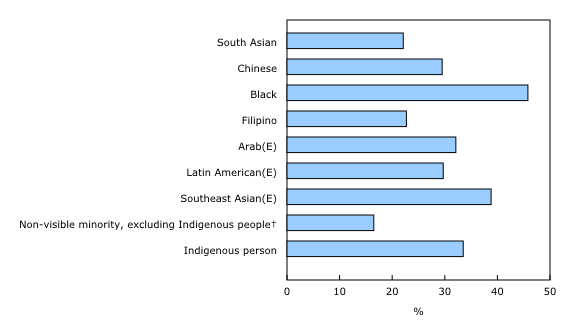
In daily life, Black people were more likely to report experiencing discrimination in a variety of circumstances, including in banks, stores or restaurants, and when dealing with the police. According to the 2019 GSS on Canadians’ Safety (Victimization), nearly half (46%) of Black people reported experiencing discrimination in the past five years—aproportion that was nearly triple that of the non-Indigenous, non-visible minority population (16%).

Chart 2  
Experiences of discrimination in the past five years, by population group, Canada, 2019

Chart 2: Experiences of discrimination in the past five years, by population group, Canada, 2019

Specifically, 4 in 10 (41%) Black people said that they had experienced discrimination based on their race or skin colour.

According to the GSS on Victimization, experiences of discrimination in the five years preceding the survey were more commonly reported in 2019 than in 2014. This was particularly the case among the Black population, with 46% of Black people reporting discrimination in 2019, compared with 28% in 2014.

Indigenous people are significantly more likely than non-Indigenous people to report little or no confidence in the police

Similar to the Black population, Indigenous people reported lower rates of confidence in the police, compared with non-Indigenous, non-visible minority people. Specifically—according to the 2020 GSS on Social Identity—2 in 10 (22%) Indigenous people reported having little or no confidence in the police. This proportion was double that reported by non-Indigenous, non-visible minority people (11%).

Chart 3  
Confidence in police, by Indigenous identity, provinces, 2020

Chart 3: Confidence in police, by Indigenous identity, provinces, 2020

As noted, 7 in 10 (70%) non-Indigenous, non-visible minority people reported having either some or a great deal of confidence in the police. This proportion is much higher than the proportion reported by First Nations people (48%) and Métis (54%). Estimates for Inuit from the 2020 GSS on Social Identity are not releasable because of the sample size.

When looking at indicators of police performance, Indigenous people were more likely than non-Indigenous, non-visible minority people to state police were doing a poor job at the following: enforcing the laws (10% versus 5%), promptly responding to calls (16% versus 7%), providing information on crime prevention (16% versus 9%), ensuring the safety of citizens (11% versus 5%), and treating people fairly (15% versus 7%).

According to the 2019 GSS on Canadians’ Safety (Victimization), one-third (33%) of Indigenous people reported experiencing discrimination in the past five years—a proportion well above that of the non-Indigenous, non-visible minority population (16%). More specifically, experiences of discrimination in the five years preceding the survey were reported by 44% of First Nations people, 24% of Métis, and 29% of Inuit.

Chart 4  
Experiences of discrimination in the past five years, by Indigenous identity, Canada, 2019

Chart 4: Experiences of discrimination in the past five years, by Indigenous identity, Canada, 2019

Often, Indigenous people reported experiencing discrimination based on their ethnicity or culture (15%), or their race or skin colour (14%). These proportions were notably higher than among the non-Indigenous, non-visible minority population (2% and 3%, respectively).

Indigenous people were also more likely than non-Indigenous, non-visible minority people to perceive discrimination or unfair treatment because of their physical appearance (14% versus 5%), physical or mental disability (7% versus 2%), and religion (5% versus 2%).

As was also the case for the Black population, discrimination was more common among Indigenous people in 2019 (33%) than in 2014 (23%). Among the non-Indigenous, non-visible minority population, discrimination also increased, albeit to a lesser extent (from 12% in 2014 to 16% in 2019).

Source: Black and Indigenous people’s confidence in police and experiences of discrimination in their daily lives

Being Black in Mexico: How this country is changing its views

Of interest. Likely a lot of colourism in Mexico as in many countries in Latin America:

Black Mexicans are starting to get widespread public recognition after centuries of being ignored.

Why it matters: Mexico has historically underplayed the roles and contributions of Black people, largely keeping them out of textbooks, too.

  • The country added Afro-Mexicans to the Constitution’s second article, which lauds the nation’s multiculturalism, in 2019.
  • The 2020 Census asked, for the first time, whether people identified as Black, Afro-Mexican or of African descent.

What to know: Two out of 100 Mexicans, or around 2.5 million people, identified as Black in the Census.

  • Black communities are mostly found in Veracruz — where the Spanish disembarked enslaved people from Africa — and the coast of Oaxaca and Guerrero, where Afro-Indigenous traditions from colonial times endure, like the dance of the devils for Day of the Dead.
  • Mascogos, descendants of Black Seminoles and of people who fled U.S. slavery in the 1830s after Mexico outlawed the practice, live in Coahuila state, which borders the U.S.

Between the lines: The Spaniards had a racist caste systemthat considered Blackness the lowest societal status, creating a stigma around identifying as Black.

  • A majority of Mexicans consider themselves mestizos, or mixed race, and many falsely claim that disparities in access to education or jobs are due solely to socioeconomic differences, not skin tone.

What they’re saying: “It was difficult and painful to come out and say ‘soy negra,’ because it’s almost ingrained into you that the term itself is bad, let alone being Black,” Denisse Salinas, who owns a coffeehouse in Oaxaca, told Axios Latino.

  • “But I see many young people doing the same as me, reclaiming the term and identity, and that does give me a glimmer of hope.”

Flashback: Historians believe two key figures in Mexico’s independence were of African descent:

  • José María Morelos y Pavón, who led insurgents to occupy and reclaim the south and southeast parts of Mexico.

  • Vicente Guerrero, who was Morelos’ right-hand man and went on to be the second president of Mexico. Guerrero declared the end of slavery.

Source: Being Black in Mexico: How this country is changing its views

Sears: Warning bells have rung for years over the risk of American money flowing into Canadian politics

Of note, and reinforcing the Marshall Fund analysis:

For decades now, Canadians have been proud at how effectively we have limited the influence of money in politics.

Arguably, there is not another G7 country with as clean a political culture as ours. It has been the hard work of two generations of campaign finance reformers. Those protections are now at serious risk, however, and our record on anti-money-laundering action has been frankly appalling. The issues are linked.

The attacks by small groups of truckers on several Canadian cities have revealed many things. That the Conservatives flirtation with anti-democratic militant groups continues. That our three orders of government are still dreadful at co-ordination. That Canadian intelligence and policing has not kept up with the “clear and present danger” represented by these well-funded groups of angry young men.

The most alarming revelation, though, is the large hole that has been blown in our walls of protection against foreign influence in Canadian political life. Conservative hysteria pre-pandemic about American environmental foundations’ funding of green groups here turned out to simply be that — hysteria.

In Alberta, the Kenney government spent millions of public dollars trying to find the secret bank accounts and found pennies. Conservatives’ reactions to the revelation that the militant truckers have access to millions of American dollars — with the promise of millions more from international neo-fascist allies — will be interesting. This flood of cash is a genuine threat to the sovereignty of Canadian democracy.

A chilling incident unfolded before my eyes this week, as I drove by the truckers’ Ottawa compound. Suddenly, two large black SUVs swept past me and turned into the protest command centre. They had New York state plates. Interestingly, they had no insignia, no flags and no slogans anywhere; they wanted to be invisible. It was an almost cinematic moment, with the bad guys surfacing at the scene of the crime.

We now need to reconsider how we prevent the flow of secret money from the U.S. into the hands of Canadian militants — or worse, from there into the war chests of the People’s Party of Canada, or even Conservative candidates. Our current election finance laws were not written to deal with this type of interference. Neither do we have the investigatory or prosecution expertise to track it being washed through third parties.

For years, experts have demonstrated our record on money laundering is embarrassing. Meanwhile, CSIS has been focused on Islamic terrorism for far too long, and only last year did Public Safety Canada recognize white supremacists as among the top 10 national security risks. Our police and intelligence agencies will need to pivot from their outdated focus to our actual reality: the growing power of these insurrectionists and their political allies.

Source: Warning bells have rung for years over the risk of American money flowing into Canadian politics

Caste has become a university diversity issue in the US

Hard to imagine that this also happens in Canada to some extent given the large number of South Asian students and grateful for information readers may have:

Many international students from disadvantaged groups hope to leave the entrenched social structures and caste discrimination behind and start afresh as they come to the United States or elsewhere. 

But to their consternation and horror, some South Asian students have found that caste discrimination is alive and well overseas, particularly where there is a large South Asia diaspora or foreign students on campus.

Mounting evidence of such discriminatory treatment and harassment led the California State University (CSU) system to add caste to its list of protected groups in January, prohibiting caste-based discrimination, harassment or retaliation. Other universities in the US are examining whether they should do the same. 

The CSU system, with some 485,000 students and about 56,000 faculty and staff, is sending a signal out to the rest of the university sector that caste discrimination exists and that affected students and staff require protection, say inclusivity activists who have campaigned for years to include caste-oppressed students and faculty. They have called the CSU decision an important civil rights win. 

“This is very important because we can now feel safer,” said Prem Pariyar, who recently graduated from CSU’s East Bay campus with a masters degree in social work. He began the campaign for caste protection at East Bay and helped extend it across CSU’s 23 campuses. 

“At least now the university has a policy to recognise our pain and to recognise our issues,” he told University World News. “In the US people are conscious about race and religion and the like but they did not know about caste discrimination.”

“Being a protected category is important as it means people like me [and] other students will feel more comfortable to go and complain. Before adding caste as a protected category, even if students reported to the administration, they would not understand what it is. It is not racial discrimination, but it is the same logic.”

Michael Uhlenkamp, senior director of public affairs in the CSU Chancellors Office, said: “While caste protections were inherently included in previous CSU non-discrimination policies, the decision to specifically name caste in the interim policy reflects the CSU’s commitment to inclusivity and respect, making certain each and every one of our 23 CSU campuses is a place of access, opportunity and equity for all.” 

“The existing processes for reporting instances of discrimination, whether based on caste or any of the categories listed in the policy, still apply,” he added. 

‘Long overdue’

“It’s long overdue. This was a campaign that we were working on for almost two and a half years,” said Thenmozhi Soundararajan, executive director of Equality Labs, a US-based civil rights organisation fighting for the rights of Dalits, a low-caste group formerly known as ‘untouchables’.

Equality Labs has been advising institutions and companies in the US. It carried out the first survey of Dalit discrimination among the South Asian diaspora in the US in 2016. In a sample of 1,500 respondents, “the numbers are high – one in four experience some form of physical or verbal assaults, one in three face discrimination in terms of their education and two out of three face workplace discrimination,” Soundararajan told University World News.

The survey was instrumental in convincing the CSU system to include caste in their policy, along with students like Pariyar, himself a Dalit, who were willing to speak out. 

“The whole process of educating and transforming these institutions towards caste equity has been one of very powerful testimony, and storytelling by really courageous and bold caste-oppressed students and faculty and campus community members. 

“And doing so under very difficult environments where caste bigots were literally intimidating, harassing and doxing them,” said Soundararajan, who is also a visiting scholar at the Center for South Asia, Stanford University. 

Soundararajan points to various types of campus discrimination – including discrimination with housing, work or student groups “openly using caste slurs and other microaggressions as well as more serious cases of gender-based violence like harassment and assault”. 

Equality Labs has been advising a large number of universities and colleges in the US, including providing advice from legal scholars “who have already done some thinking about this – we’ve worked with many institutions, large and small on these issues”.

“In our countries of origin, while there are laws to protect against caste oppression, there is a great deal of impunity and a lack of political will to enforce them. In the United States, however, because of the struggles of black and indigenous and other communities of colour, civil rights laws still have teeth,” Soundararajan explained.

“Increasingly, American institutions that are concerned about their liability related to civil rights and human rights compliance are proactively adding caste and making it explicit,” she noted. “When it’s not explicit, all the things that come from [being] a protected category don’t exist within the campuses’ or institutions’ purview.”

But universities are also key to educating society in general. “In making caste a protected category, institutions of higher learning are positioned to take the critical issue of caste oppression and discrimination seriously and to render it visible,” said Angana Chatterji, cultural anthropologist and scholar at the University of California (UC) Berkeley’s Center for Race and Gender.

“Such commitment is imperative to deepening the study of caste and generative of new knowledge formations attentive to its intersections with gender and race. And to developing support systems, curricula and interventions to dismantle caste oppression and caste privilege within the university,” she added.

Often invisible

Caste harassment can often be invisible to those outside the South Asian community, but that does not mean it does not exist outside Asia. 

“I have been experiencing caste discrimination from my childhood, but I did not imagine that caste discrimination exists in the US, but then I experienced it myself. I was discriminated against within campus and outside campus,” said Pariyar, who is from Nepal. His caste are often not allowed to sit at the same table as higher castes or share food. 

Pariyar, who arrived in the US in 2015, said other South Asians “will ask your name, what does your father do. Their intention is to know my caste identity. In the beginning the conversation is respectful, but after knowing my caste identity that respect is gone,” he said.

“This is happening in California and not just in California but elsewhere in the US,” he added, saying he was left embarrassed, humiliated and depressed by these experiences and preferred not to go to get-togethers, house parties or other parties where there were other South Asian students present. 

Others who face caste discrimination are often reluctant to speak out because, in effect, it means revealing their caste origins. Some of them drop their surname or adopt a caste-neutral surname.  

“Many people do not feel comfortable talking about this type of discrimination and they want to hide their identity because they want to be protected; they don’t want harassment from dominant-caste people,” noted Pariyar, who says he is talking to other campuses about similar protections, including the University of California system – separate from the California State University system – starting with UC Berkeley. 

“We have to take it step by step,” said Pariyar, noting the victories in the CSU system and elsewhere along the way. 

The wording varies in different institutions. Brandeis University added this category in December 2019 that says caste is a recognised and protected characteristic in the school’s anti-discrimination policy. In September 2021, UC Davis added ‘caste or perceived caste’ as a category to its anti-discrimination policy. 

Colby College of Maine revised its non-discrimination policy to add caste to its list of ‘protections for the campus community’. In December 2021 Harvard, the first Ivy League university to do so, “added protections for caste-oppressed students” to its graduate student union contract.

Before CSU included it more broadly, some student and faculty organisations passed resolutions last year calling on the university to add caste to its anti-discrimination policy. These include the California Faculty Association, a CSU labour union, as part of their collective bargaining agreement, and Cal State Student Association, a non-profit representing students across the university, in April 2021.

“The student resolutions really matter because when the voice of the students from all 22 campuses say ‘we need this’, it’s huge. So that began the engagement with the [CSU] Chancellor’s office, and they have their own legal team. So they’re confident about the choices,” said Soundararajan. “But we also connected them with top legal scholars on caste in the United States.”

Periyar says it was an uphill battle. When the CSU-wide resolution came up, the Hindu American Foundation (HAF), a Hindu lobby group, vehemently opposed it. Its website includes a comment by Sunil Kumar, professor of engineering at San Diego State University. 

Rather than redressing discrimination, “it will actually cause discrimination by unconstitutionally singling out and targeting Hindu faculty of Indian and South Asian descent as members of a suspect class because of deeply entrenched, false stereotypes about Indians, Hindus and caste,” he said. 

HAF had been virtually silent until then, perhaps not understanding the significance of student and faculty resolutions. But Pariyar counters: “This policy is not dividing. It is a policy of inclusion. There are marginalised students and they need to be included.”

Berkeley’s Chatterji said: “Hindu nationalist organisations in the diaspora have repeatedly attempted to silence conversations around caste oppression, gender and Islamophobia. If systems of higher education in California determine to make caste a protected category, it will have an impact not just on California, but nationally.”

A ‘caste curriculum’

Becoming more inclusive is also important in the context of broadening diversity of incoming international students. 

“It is already a topic of conversation on campuses on how to diversity the pool of international students, [to know] what are the systemic forms of discrimination that exist over time and how can US institutions make sure they are reaching a broader diversity of South Asian students,” said international education consultant Rajika Bhandari. 

“On-the-ground understanding is definitely required, because if policies are not shaped by individuals who deeply understand the context, it can fall into a kind of neocolonialist framework or a very Americanised view of another countries’ social issues,” she said. 

Social stratification by caste, prevalent in India for centuries, has variations by region and community, even within India and its neighbouring countries, as well as further afield in South Africa, East Africa and Southeast Asia – particularly in Singapore and Malaysia, the Caribbean and elsewhere with communities from South Asia, often since British colonial times. Its complexity is difficult to explain to others. 

Pariyar agrees universities will need to understand caste better in order to be truly inclusive. 

“Adding caste is not enough, application is very important,” he said. “We need a caste equity action plan”. 

“We need training and a curriculum. We need to train all the diversity and inclusion committee members, all the faculty within the CSU system about the gravity of caste discrimination, what it is and how it exists. There is visible discrimination and invisible discrimination and they need to understand that,” Pariyar said, adding that the university system needs to hire experts to train staff and faculty.  

Some of this expertise is provided by Equality Labs which says it helps institutions develop better tools and know the process of how to identify discriminatory behaviour on the basis of caste.

“Institutions need to create real metrics – enrolment metrics, application metrics – to get a sense of what the baseline of crimes or incidents are, then to be able to bring it down. Data is the key – if we don’t begin with a set of really strong KPIs [key performance indicators], we can’t measure progress,” said Soundararajan.

Source: Caste has become a university diversity issue in the US

‘They’re Authoritarians, Dammit!’ Art Spiegelman On the School Board That Cancelled ‘Maus’

Worth noting:

In the four decades since Art Spiegelman began Maus, the graphic novel has sold millions of copies, won a Pulitzer Prize, and secured a place in the Western canon. The book communicates the history of the Holocaust through the history of his family— Polish Jews, who are rendered as mice, sent to death camps by Nazis, who are rendered as cats. Maus is taught in thousands of schools, including, until recently, to eighth-graders in Tennessee’s McMinn County, where the local school board voted 10-0 on Jan. 10 to remove it from the middle school curriculum. With predictable results.

Already alert to a flurry of previous efforts to remove titles deemed inappropriate by state and local politicians—including a Texas state lawmaker’s demand that every school district “investigate” some 850 books dealing with race or sexuality—liberals smelled a rat. Public school curriculums feature prominently in the culture wars that many Republicans are hoping to ride to electoral victory. Progressives may argue for an unvarnished instruction of U.S. history, but in Maus, one member of the McMinn County school board found “it looks like the entire curriculum is developed to normalize sexuality, normalize nudity and normalize vulgar language. If I was trying to indoctrinate somebody’s kids, this is how I would do it.”

“Who’s the snowflake now?” Spiegelman shot back in one interview.

The cartoonist, who turns 74 on Feb. 15, spoke to TIME the morning after headlining a webinar that had attracted an audience of 17,000 before crashing the Facebook page of the Jewish Federation of Greater Chattanooga, which had hosted the conversation along with an array of Tennessee clergy, rabbis, and local activists Spiegelman found so enlightened and reasonable he said he might “have to jettison my caricatured notion of them all as Lil’ Abner-style hillbillies.”

TIME: How much are we dealing with caricatures here?
Art Spiegelman: Well, we’re dealing with everything from vile, racist and antisemitic caricatures to caricatures of what children are. And on the other end of the spectrum, maybe caricatures the way Walt Kelly and Herb Blockapplied them.

Have you ever been to eastern Tennessee?
Never.

You read the minutes of the meeting?
Yes I did. Several times.

What do you think is actually going on?
That’s what left me so filled with flop sweat before the conversation last night, because I kept veering back and forth. Am I just a total Pollyanna naive idiot? Or are these people really idiots? Or are they actually sinister forces that have gathered to, like, kill America for their own profit? Or what are they? I don’t know to what degree they’re genuinely out to destroy America and to what degree they’re actually just like I the metaphor I used last night: If you saw somebody like a psycho killer, strangling a loved one of yours, and you couldn’t reach that person to stop them. And your only response was, “God, did you see the fingernails on that creep’s hands? They’re dirty.”

Do you think it would help to meet the people?
Through bulletproof glass, yeah.

We refer to it as a ban. Is it a ban?
It’s not banned in its broadest meaning, but it is a ban of sorts to use authority to keep people from things. Yes, it’s a ban. And yet it’s not a book burning.

The board later put out a statement that their decision “does not diminish the value of Maus as an impactful and meaningful piece of literature.” Do you take them at their word?

I don’t know. That’s where I started this conversation with you. I don’t know. I don’t know. Did they rewrite their minutes to get rid of all the terrible things actually said to each other in order for us to sanitize the meeting minutes, two or three weeks later? How would I know? My guess is that what they did was the law of the land still is based on the 1982 decision that you can ban things further affect young minds and whatever but you can’t on the basis of content. So they focus on how terrible it was to see what they described as a nude woman—what I saw as the naked corpse of my mother in the bathtub having slashed her wrists in that bathtub. And to call her nude, it made me angry. Naked, which means a kind of vulnerable lack of covering, is enough to get you livid, because look, what do they want me to show, like her upside down in the bathtub? Or wearing a bathrobe splattered with blood in the bathtub? Which didn’t make any sense. They didn’t want to show it. And that was a problem.

I just can’t tell to what degree this carried water for more whacked out people than they are, the ones who really stand to profit from getting more charter schools in the area that teach religion, thereby taking money away from a public education that needs far, far more to do its job well. I don’t know. So we’ll have to see how this plays out. I don’t think I’ve changed and hearts and minds. What this thing last night did show is that caricatures aren’t the way through unless you really know how to use them. It’s like these people that I met last night are wonderful … talking about building bridges rather than blowing bridges up.

Some of the people in the webinar appeared quite pleased. Was that because they have a battle that has been joined?
Yeah. They’re fighting not to burn the book burners or whatever, but really trying to make some kind of bridge—although I think it might be a bridge too far—it’s such an admirable thing to do. They’re better people than I am. I tried to rise to the occasion. But the caricature thing is: caricatures can be used be used to subvert themselves, you know, like the caricature of reducing Nazis and Jews to Cats and Mice. But by showing the caricatures as masks with humans underneath it, and pointing to that more and more as the book goes on, dissolves whatever their caricature is by creating a kind of self-destructing metaphor. But you’re play with dynamite when you’re playing with caricature.

It’s such a personal book. Is the offense personal?

Yes. Because when they’re really most focused on me yelling at my father when he destroyed my mother’s diary and finally confessed to it. I say something like “God damn you, murderer, you murdered her a second time!” The memories that she had managed to preserve for me, because what she said when she was young ,when she died, reoccur, and were destroyed so my cursing is there. And I’m cursing at my mother. I’m calling her a bitch, in the confusion of finding out that my mother had just died that day by killing herself. And there’s a a turmoil, there’s a turmoil of remembering my early childhood, of what the reasons might be, ranging from premenopausal depression to life in the camps damaging her so badly.

That I felt was a little place they had really focused. But why? Because I believe, they were upset that I was breaking the commandment to honor thy father and mother. And that was usurping their authority. They’re all parents. They don’t want their kids talking to them like that, thank you. Authority is what they like the most. They’re authoritarians, dammit.

The board’s attorney said the book could be salvaged if the author approved “extensive edits,” like whiting out “bitch.” Maybe we should just put in “blintz” or “bagel.” Make for a more wholesome Jewish cultural experience.

You have a long history with censorship, right? The Comics Code?
The Comics Code is what made me. Yes, the burning of comic books literally in the 40s and 50s by teachers, clergyman, parents. There were several bonfires across the country. I have a photo of one in Binghamton, N.Y., where I was in college till I got kicked out. That was an important moment because comics had been perceived as being for children, although adults—certainly, GIs, and young women who read true romance magazines were reading romance comics—were probably reading them more than children. But it was focused on the same thing these school board people focused, on we have to protect the children as opposed to educate them, and not let them actually follow their fantasies.

But those comic books that they were burning were pretty far out there and getting more far out as they lead into the more adult audience. You know, the horror comics and some of the very lurid images in many of those comics more and more were among the comics I love the most, because they were kind of on the edge of the forbidden, because they were showing me things to their most exaggerated. And I love those comics, the horror comics. And mainly the horror comics companion from the same publisher:MAD. If there was one of these Citizen Kane biographies about me, like the rosebud at the end would be a copy of MAD comics.

This controversy has boosted sales, hasn’t it?
I think enormously. I haven’t seen it yet. But you know the cynical side of this is like: “Oh man you just got to get your book banned, it’ll really do wonders.” I can envision a future in which there are book galleys going out to people saying publication date, April 5, ban date May 1 .

I didn’t need the uptick in sales. Maus has been really selling steadily since 1986, when the first volume came out, even more so after it won the Pulitzer Prize. I didn’t need to boost my income. It’ll give me more money to donate to things like voter registration.

But the other thing about the forbidden is that it’s it’s it’s always richer if you have to sneak it right? I had to hide MAD magazine from my mom.

As my friend oldest, closest friend, who is now dead, would say, there was a point where he had to hide MAD inside a school book, and a point where he had to hide MAD inside his copy of Playboy.

Which you’ve also worked for, as the school board noted.
Yes, they sure did note it! The roster of authors who have appeared there probably are on their banned list. They include Gabriel Garcia Marquez, Margaret Atwood, Shel Silverstein. It’s an honorable company to be in, even though I understand how Playboy hasn’t aged well in our current moment. Great one to be able to throw at me.

Source: ‘They’re Authoritarians, Dammit!’ Art Spiegelman On the School Board That Cancelled ‘Maus’

Ethnic media provides added perspectives on “Freedom Convoy”

Useful coverage by New Canadian Media and MIREMS:

Over the last week, from Feb 3. to 10, various ethnic media outlets offered a wider range of perspectives on three hot-button issues that have dominated mainstream headlines.

From the so-called Freedom Convoy, to Erin O’Toole’s ousting as leader of the Conservative Party, to the Black History Month, ethnic media provided coverage that went beyond the usual suspects interviewed by the mainstream.

By elevating different cultural perspectives, opinions and narratives, ethnic media was able to provide coverage that offers a fuller understanding of the issues at play. NCM has worked with MIREMS to bring readers these added perspectives.

Polarizing ‘Freedom Convoy’

The top story in both the mainstream and the ethnic media was the ‘Freedom Convoy’ protesting against vaccine mandates and pandemic restrictions in Ottawa and provincial capitals as well as land border crossings to the U.S. The Romanian paper Faptu Divers, for example, supported the convoy in multiple articles and likened Prime Minister Justin Trudeau to former Romanian dictator Nicolae Ceausescu for curtailing people’s freedoms, while the Polish paper Goniec reported that that community provided food for the protesters. The Polish Gazeta, on the other hand, focused on the harassment, racism and misbehaviour of the protesters. 

Both the Russian Vancouverovka and Russian Week highlighted comments by CBC host Nil Köksal suggesting that Russian actors are behind the protests because of Canada’s support for Ukraine.

Multiple features on OMNI TV News Filipino focused on the impact the protests had on members of the Filipino community, who reported being afraid to leave their homes because of the harassment from protesters.  

A feature on OMNI TV Italian focused on the racist messaging at the protests. G98.7 FM online radio featured responses from the Black parliamentary caucus to the public display of hate symbols, including the Confederate flag as a symbol for slavery.

Punjabi media focused on Punjabi truckers, who make up about a quarter of all Canadian truckers, and the hardships of the industry. OMNI News Punjabi featured some Punjabis among the protesters, who emphasized that they are against the mandates, not the vaccine, and object to protesters being silenced and insulted as extremists. 

Several other features on OMNI Punjabi focused on Punjabi truckers who are stuck on the U.S. side of the Canadian border by Coutts, Alberta and by Windsor, Ontario. These truckers had to reportedly live in their trucks for days without access to food or medical supplies and were unable to do their jobs, deliver their goods and attend to personal commitments back home. Several other features highlighted that the Punjabi truckers have other priorities. 

According to ethnic media reports, most Punjabi truckers are vaccinated, as vaccine coverage in the Punjabi community is high. Their priorities are around road safety, snow clearance, road maintenance, as well as working conditions and wage theft. 

In fact, the West Coast Trucking Association organized a separate protest in January to demand better road maintenance on B.C. highways, which has not been mentioned by anyone taking part at the ‘Freedom Convoy.’ One trucker started an online fundraiser to “Support Canada’s real struggling truckers,” which had raised $7,866 as of Feb. 9, according to OMNI Punjabi.

Chinese media on O’Toole’s ousting

Another top story was the Conservative leadership race. 

Coverage reflected the vote to oust Erin O’Toole, the selection of Candice Bergen as interim leader, the candidacy of Pierre Poilievre, and speculations around other potential candidates such as Premier Doug Ford, Mayor Patrick Brown, Peter MacKay and Jean Charest. 

However, the race took a particular spin in the Chinese media, where it was coloured by perceptions of the Conservative party’s hostility towards China. Erin O’Toole was perceived to be extremely anti-China, which may have lost the Conservatives several constituencies with a significant Chinese population in the last election, as Ming Pao Toronto reported on Feb. 3. 

Reports reflect that Chinese media were relieved and delighted at O’Toole’s ousting, because having him as prime minister would, in their view, further increase discrimination and hate against the Chinese diaspora, according to reports from Van People. 

And according to a report on Sing Tao Vancouver, Lin Wen, co-founder of the Canadian Chinese Political Affairs Council, figured that no matter who the new Conservative leader is, the Conservative Party’s China policy will not be changed.

Black History Month beyond the usual

Another topic that has more prominence in the ethnic media than in the mainstream has been Black History Month. 

In the mainstream, Black History Month was covered either from a bird’s-eye view of its significance, sometimes with reference to event listings, or with a focus on statements by political leaders, from the Prime Minister to local mayors. It also looked at ceremonies like flag-raisings and museum exhibits. Some contributions feature a Black author or a celebrity like Lincoln Alexander. 

The ethnic media, on the other hand, were more focused on issues of concern to and activities arising within the Black community. 

The radio station G 98.7 FM and OMNI TV reported in depth on the BE-STEMM 2022 virtual conference organized by the Canadian Black Scientists Network. The network has found that there are few Blacks in the areas of science, technology, engineering and mathematics (STEM) because Black students are not encouraged to pursue these areas in school. The network aims to open doors for Black people in Canada and around the world, as G 98.7 FM and OMNI TV Focus Punjabi reported on Feb. 4.

Another talk show on G 98.7 FM was devoted to a discussion on COVID with members of the Black Scientists’ Task Force on Vaccine Equity. According to the task force, the Black community is over-exposed to COVID because many cannot work from home, have to commute on public transit, work in customer service or care-giving jobs, and have underlying health conditions putting them at greater risk, such as hypertension, diabetes and asthma. 

School disruption was also discussed as something that wreaks more havoc for Black and low-income children’s learning than for other groups. At the same time, Blacks are under-vaccinated because they distrust the authorities, information is not communicated to them appropriately, and they are targets of racialized disinformation using specific triggers from their historical experience.

Ethnic media’s coattails

Often, ethnic media highlights issues of concern to a community that are either not reflected in the mainstream media or which are only picked up by it after they circulate in the ethnic media for a while. 

One such example was a story about the Hindu community in B.C. protesting against a new small business owner who is using an image of Lord Ganesh along with profane language in her logo. 

Community members, including about 40 organizations, are gathering signatures to have her stop using either the image or the wording, have approached local MLAs and MPs, held a protest at the Hindu temple, and are looking into legal action and mounting a PR campaign on social media. 

They feel this is cultural appropriation, Hinduphobia and racism, and they want a new law to protect Hindu culture. MP Sukh Dhaliwal attended the protest and said Canada is a diverse country and that we should celebrate each other’s culture and faith. He was going to approach the Heritage Minister and Prime Minister about this. 

The story broke on the indiansinvancouver.ca blog on Jan. 31 and then on the Desibuzz Canada news website on Feb. 4. It was only then that it was picked up by CBC Vancouver on Feb. 6 as a report about the protest at the temple and by the Punjabi station Zee TV on Feb. 8. 

Source: Ethnic media provides added perspectives on “Freedom Convoy”

Ghayyur: Canada’s realpolitik ignores the plight of Muslims in India

Of note:

Human Rights Watch’s 2022 World Report argued that while there is still hope for the world’s democracies, there remain plenty of threats in the distance. In particular, the report noted that a number of governments around the world are committing atrocities while enjoying the reputational benefits of being a democratic country.

India, the world’s most populous democracy and one that was founded on a secular constitutional order, has become one of the worst offenders among them.

After a 2014 electoral victory for his Bharatiya Janata Party (BJP) – a political wing of the Hindu-nationalist paramilitary group Rashtriya Swayamsevak Sangh (RSS) – Prime Minister Narendra Modi has propelled Hindu nationalism, or Hindutva, into the Indian mainstream. Over the past eight years, the BJP government has adopted policies that discriminate against minority groups, and there has been a surge in violence against those who are not members of the country’s Hindu majority, including attacks on Christian churches and Sikh farmers and abuse of Dalits – all while the government has largely stood idly by.

Muslims have been particularly targeted. In 2019, the Modi government enacted the Citizenship Amendment Act, which allows religious-minority refugees to become citizens unless they are Muslim; it also created a national register of citizens, which threatens to disenfranchise Muslim immigrants or deport others without documentation. High-ranking party officials have vilified Muslims in public remarks. Incidents of mob vigilantism in defence of cows, which are sacred to Hindus, have increased in recent years, with most cases leaving Muslim victims. And in December, a video recording from a conference in northern Indiaattended by party members and religious leaders with ties to the BJP showed militant Hindutva extremists calling for an armed “cleansing” of the country’s more than 200 million Muslims. Mr. Modi has not denounced this incitement of hate and vilification of minority groups, which will only further embolden Hindutva extremists. “We should be crying genocide emergency for India,” declared Dr. Greg Stanton,president of Genocide Watch, a leading human rights watchdog group, at a recent leadership briefing on India.

Even documenting such human rights abuses in Mr. Modi’s India has become dangerous. The BJP and RSS have cracked down on human and civil rights organizations and media in the country. Amnesty International India was forced to shut down its operations in September, 2020, and last year Reporters Without Borders ranked India 142nd on its World Press Freedom Index, which deemed the Indian press less free than Myanmar’s or Uganda’s.

And yet, despite these documented horrific human-rights violations, Canada-India relations continue to improve. Even as India becomes hijacked by an ideology of hatred that aspires to transform the country into an entirely Hindu one, the increasingly authoritarian Modi government continues to hide behind facades of pluralism, democracy and the legacy of Mahatma Gandhi’s non-violence. And Prime Minister Justin Trudeau has chosen realpolitik above holding the Modi administration accountable for human rights violations in the name of Canada’s economic and security interests.

With Canada’s ties to China deteriorating, the Trudeau government has been looking for partners to help it oppose China’s aggressive international stance. As a result, India is attempting to boost bilateral relations. Canada’s International Trade Minister Mary Ng’s recent meeting with her Indian counterpart, Piyush Goyal, “welcomed a re-engagement on negotiations toward a Canada-India comprehensive economic partnership agreement.”

Although India claims to share Canadian values and interests, its normalizing of Islamophobia and human-rights atrocities demonstrates that this is not the case. Canada must declare human rights a priority and a requirement for any economic or security deals with India.

In the 2022 Human Rights Watch report, executive director Kenneth Roth wonders: Will democratic leaders “act consistently, both at home and abroad, with the democratic and human rights principles they claim to defend?”

This is a question Canadians should ask Mr. Trudeau. Protecting human rights across the world must be a top priority for Canada in 2022. It is past time that Ottawa categorically oppose violence against Muslims and attacks on the religious freedoms of Christian, Dalit, Sikh and Indigenous Adivasi in India. Otherwise, by calling Mr. Modi a friend, Canada makes itself complicit on the international stage.

Source: Canada’s realpolitik ignores the plight of Muslims in India

Biden seeking professional diversity in his judicial picks

Significant. In contrast, my analysis of judicial appointments under the Liberal government (close to 500 appointments, 55.7 percent women, 8.5 percent visible minorities, 3.1 percent Indigenous):

President Joe Biden spent a recent flight aboard Air Force One reminiscing with lawmakers and aides about his start as a young lawyer in Delaware working as a public defender in the late 1960s.

The flight from New York to Washington was short, and there wasn’t much time to explore the president’s brief time in the job during the civil rights era. But as Biden considers his first Supreme Court nominee, this lesser-known period in his biography could offer insight into the personal experience he brings to the decision. The account was relayed by a person familiar with the trip who insisted on anonymity to discuss it.

Biden has already made history by nominating more public defenders, civil rights attorneys and nonprofit lawyers to the federal bench during his first year in office than any other president, increasing not just the racial and gender diversity of the federal judiciary but also the range of professional expertise. And it’s possible that theme will continue as he looks to make more history by nominating the first Black woman to the nation’s highest court.

While three of the current justices have experience as prosecutors, none was a criminal defense attorney. The last justice with serious experience in defense was Thurgood Marshall, a civil rights attorney nominated about 55 years ago. He was the first Black person on the court and retired in 1991.

Some of the women on Biden’s list of potential nominees have deep public defense or civil rights backgrounds: Ketanji Brown Jackson, 51, for example, worked as a public defender and served on the U.S. Sentencing Commission before she was nominated to the bench by President Barack Obama. Eunice Lee, 51, whom Biden named to the U.S. Court of Appeals for the 2nd Circuit in August, is the first former federal defender to serve on that court.

Biden’s judicial appointments thus far make clear his interest in professional diversity.

Nearly 30% of Biden’s nominees to the federal bench have been public defenders, 24% have been civil rights lawyers and 8% labor attorneys. By the end of his first year, Biden had won confirmation of 40 judges, the most since President Ronald Reagan. Of those, 80% are women and 53% are people of color, according to the White House.

“It’s so important to have a diversity of perspectives and having the judiciary really reflect the diversity of lived experiences and perspectives of the folks who are coming before them,” said Lisa Cylar Barrett, director of policy at the NAACP Legal Defense & Educational Fund.

The Supreme Court hears only a fraction of federal cases filed each year. Federal judges are hearing most of the cases, with roughly 400,000 cases filed in federal trial courts a year. The high court hears only about 150 of the more than 7,000 cases it is asked to review annually.

Most of the judges appointed to the federal bench have worked as prosecutors, corporate attorneys or both. A survey three years ago found more than 73% of sitting federal judges were men, and more than 80% were white, according to the Center for American Progress.

A diversity of professional expertise makes for a more fair and just bench, advocates say. Judges draw on their personal histories to help them weigh arguments and decide cases, and they also learn from each other. Public defenders often represent the indigent and the marginalized, those who often can’t afford their own attorneys.

“They represent the 80% percent of people in the criminal legal system too low-income to afford a lawyer,” said Emily Galvin-Almanza, a former public defender who founded the nonprofit Partners for Justice. “So when you put a public defender on the bench, you’re putting a person on who listens with a very different ear. You have a person on the bench with an experience of the realities of very, very disempowered people.”

Biden’s brief time as a public defender isn’t widely discussed, and it isn’t listed in his official biography on the White House website. He’s more prone to talk about his 36 years as a senator and his time as head of the Judiciary Committee, where he oversaw six Supreme Court nominations.

But the president has spoken at times about his brief time as a public defender before he became a U.S. senator at the age of 29. It’s informed some of his decisions in office, like directing federal grant money for public defense and expanding other federal efforts on public defense.

“Civil rights, the Vietnam War and President Nixon’s rampant abuse of power were the reasons I entered public life to begin with,” Biden said in a 2019 speech in South Carolina during the presidential campaign. “That’s why I had chosen at that time to leave a prestigious law firm that I had been hired by and become a public defender — because those people who needed the most help couldn’t afford to be defended in those days.”

In a 2007 memoir, he called the job “God’s work.”

The president promised during his campaign for president that he’d nominate a Black woman to the bench, and he spent his first year in office broadening his potential applicant pool through judicial appointments. Most Supreme Court justices have come from federal appeals courts, but it’s not a requirement. Among the current justices, only Justice Elena Kagan wasn’t a federal appeals court judge before joining.

Federal judges are often chosen from state courts, which also lack in diversity. But Biden’s very public push to diversify federal judges could have an impact on how judges in the states look, too.

“Neither state courts nor federal courts reflect the diversity of the communities they serve, or the diversity of the legal profession. Courts across the country are falling short,” said Alicia Bannon, the director of the Judiciary Program at the Brennan Center for Justice at NYU School of Law. “But we’re hoping that is slowly changing.”

Biden has promised a rigorous selection process for his Supreme Court nominee. His team, led by former Democratic Sen. Doug Jones, is reviewing past writings, public remarks and decisions, learning the life stories of the candidates and interviewing them and people who know them. Background checks will be updated and candidates may be asked about their health. After all, it’s a lifetime appointment.

The goal is to provide the president with the utmost confidence in the eventual pick’s judicial philosophy, fitness for the court and preparation for the high-stakes confirmation fight. Interviewing potential candidates comes later, but Biden has already spoken to some of the women who may be under consideration back when they were being appointed to other courts.

Biden will also continue to seek the advice of lawmakers. He was to host Senate Judiciary Committee Democrats on Thursday, a White House official said.

Source: Biden seeking professional diversity in his judicial picks