The Holocaust’s long reach: Trauma is passed on to survivors’ children

Good long piece on the work of Helen Epstein (author of Children of the Holocaust: Conversations with Sons and Daughters of Survivors) and Vivian Rakoff of the ongoing inter-generational trauma faced by children of Holocaust survivors, and the commonality of that experience with other atrocities:

Trauma is trauma, whether it is besetting children of Holocaust survivors or children of families shattered by atom bombs, civil war, terrorism, domestic violence, sexual abuse, addiction, or even illness and disability. The stories keep emerging: in Heather Connell’s Small Voices, a film about the children of survivors of the Khmer Rouge killing fields; in Peter Balakian’s memoir Black Dog of Fate, written as the son of survivors of the Armenian genocide; in Michael Arlen’s Passage to Ararat, also about Armenia. (Memoirs by the children of Rwandan survivors are rarer: They’re just becoming adults.) The details of each oppression make it unique, but the effect of the trauma always follows the same path.

“I don’t feel possessive about my PTSD at all,” Ms. Epstein says. “I think it’s nearly universal.” To which Vivian Rakoff adds, “I think the transmission of trauma has to be admitted to. That when you do something terrible, it has effects. You can have psychic transmission of disorder in the same way you can have microbial transmission of disorder.”

Now we are learning that the horror can be passed along physically, and perhaps even genetically. Efforts are being made to interrupt that fateful flow: At Mount Sinai in New York, Dr. Yehuda has a theory that hydrocortisone might stymie the establishment of PTSD. There are also encouraging therapies and experimental programs, as Judith Shulevitz reported in The Atlantic, in which pregnant women at risk for PTSD receive counselling to help them through the thickets of child rearing.

Trauma and the atrocities that cause it are unavoidable. Parliament’s decision to expand Canada’s war against the Islamic State is, at least arguably, a legitimate and necessary evil. But the children of the soldiers and victims who fall on both sides in that war will feel its trauma regardless, in some place too dark to see. Then will come the hard part. Because once we notice trauma, and inquire after it, we are apologizing for it, and admitting to some sense of responsibility.

Maybe this is why we try so hard not to to notice other people’s pain, why we resist the idea that formative experiences are passed along in physical form as memory, conscious or collective or otherwise. We know we’re connected to one another in ways we can’t see or control, inconvenient as the fact often is. “Much of history is written in blood,” Helen Epstein writes in Children of the Holocaust, “and experiencing some degree of trauma seems to be a part of experiencing life. What that means to me is that it is not ‘other’ but, to various degrees, ‘us’ and that we need to learn to use that insight toward connection rather than separation.” Human pain turns out to be not very private after all.

Judith Herman, the Harvard psychiatrist who in 1993 wrote Trauma and Recovery: The Aftermath of Violence from Domestic Abuse to Political Terror, observed that “the study of psychological trauma has a curious history – one of episodic amnesia.” Why? Because “to study psychological trauma is to come face to face both with human vulnerability in the natural world and with the capacity for evil in human nature.”

We want to remember, and we want to forget. We are who we are. But sometimes we can’t bear to admit it.

The Holocaust’s long reach: Trauma is passed on to survivors’ children – The Globe and Mail.

Teaching The Holocaust: New Approaches For A New Generation

One of the many approaches to Holocaust education and awareness, building on comparisons and parallels for a more universalist message:

In a conference room recently at the main library at Duke University, middle and high school teachers, many from North and South Carolina, watched a video exploring the parallels between Nazi Germany’s anti-Semitic Nuremberg codes and the racist Jim Crow laws in the American south.

“July 1938: Aryan and non-Aryan children cannot play together.”

“In Alabama, all passenger stations shall have separate waiting rooms,” intones the video, “Cause and Effect.” It was created by Centropa with teachers from the U.S. and Europe.

“1938: Jewish children are no longer allowed to attend public schools.”

“In Georgia it shall be unlawful for a white person to marry anyone but another white person.”

The teachers were not suggesting a moral equivalency between dehumanizing and repressive Jim Crow laws and genocide. But they were looking at how the two racist codes might become teaching tools, to explore what dialogue might be sparked with students.

The teachers trade ideas on reaching kids in their world and through their news feeds.

“That’s awesome. I’ve never thought about it that way. It’s like ‘tweet’ is the new telegram,” one teacher says. “That could be the title of the lesson: Tweets Are Telegrams.”

The teachers gathered at Duke were part of a recent seminar run by Centropa, which is dedicated to preserving stories of Jewish life in 20th century Eastern and Central Europe.

Several prominent Holocaust remembrance and education groups have long used survivor interviews and other first-person accounts and pictures to educate about the genocide of European Jewry. The USC Shoah Foundation and its online visual history archive has taken the lead, along with the United Holocaust Memorial Museum, and other organizations in the U.S. and abroad.

Centropa takes a slightly different approach, centering its work on the wider personal family stories, pictures and memories of a lost era, not just the unbelievable darkness of the Nazi years.

“We’re about searching for human values in the darkest times. It is about showing teenagers there is always a true north,” says Director and founder Edward Serotta.

Teaching The Holocaust: New Approaches For A New Generation : NPR Ed : NPR.

France: Teaching the Holocaust

Film worth watching and history of French involvement in Holocaust.

Arun's avatarArun with a View

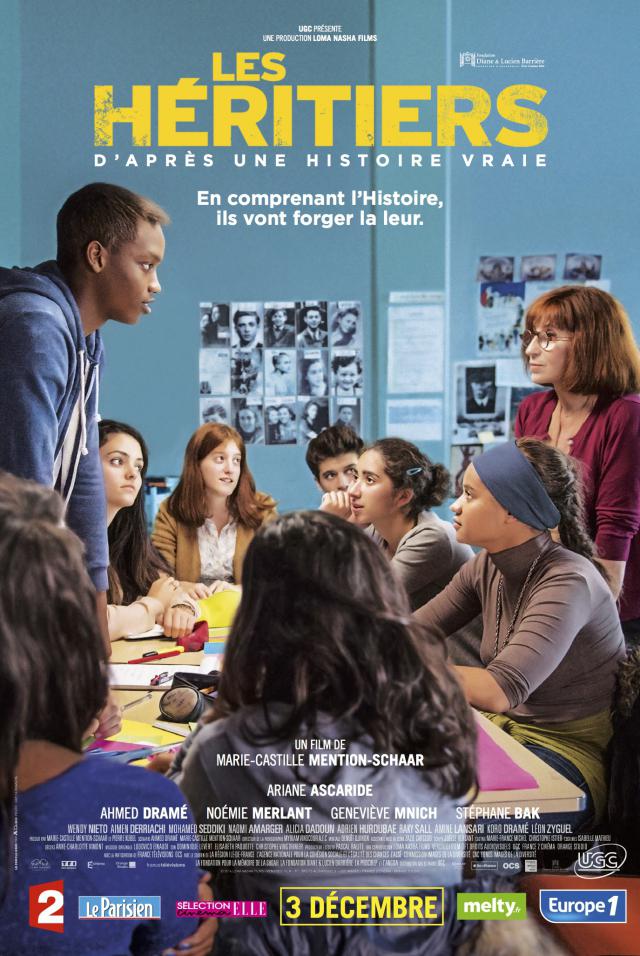
les-heritiers

On the occasion of the 70th anniversary of the liberation of Auschwitz-Birkenau, France 2 broadcast, over one week, an eight-part documentary series—totaling seven-and-a-half hours—on the Nazi extermination of the Jews, “‘Jusqu’au dernier’: La Déstruction des Juifs d’Europe,” by the French filmmakers William Karel and Blanche Finger (English title: Annihilation: The Destruction of Europe’s Jews; English trailer is here). I missed it on TV but managed to see all eight episodes streamed on France 2’s website (before they disappeared, as French television regulations unfortunately only allow the viewing of programs on the web for a week after their broadcast). I’ve seen numerous documentaries on the Holocaust over the decades—and read plenty on the subject—but this one is particularly remarkable. The series, which begins with the 1933 Nazi seizure of power and closes with the memory of the Holocaust over the decades following WWII, is almost entirely composed…

View original post 1,700 more words

FAST launches high school anti-racism curriculum

Good cross-linkages between antisemitism, Holocaust awareness, and all forms of racism, bigotry and hate:

Voices into Action, an interactive site developed in accordance with provincial curriculum standards by a team of teachers, curriculum experts, graduate students, university professors, and consultants, contains five units that focus on issues related to human rights, genocide, prejudice and discrimination.

“It’s divided into five units and the Holocaust is a major feature throughout. It is at least a third of the content,” Miller said.

Although the program addresses racism, bigotry and hate in all forms, there is a special emphasis on anti-Semitism and the Holocaust.

The founders of FAST, Elizabeth Comper, and her husband Tony, a retired Bank of Montreal CEO, were inspired to create the organization after a series of anti-Semitic attacks in Toronto and Montreal, including the 2004 firebombing of Montreal’s United Talmud Torah Jewish day school.

“It was important to address other human rights issues, to put them on a scale, to understand that the Holocaust was as far as you could go with hatred,” Miller said.

“The Holocaust is the first chapter of units 1, 2, 3 and 4, and unit 5 is entirely about the Holocaust and it ends with a conclusion on contemporary anti-Semitism.”

Miller added that most important is the fact that the high school program is curriculum-based and completely free of charge.

FAST launches high school anti-racism curriculum | The Canadian Jewish News.

Sikh MP Tim Uppal says there is ‘so much we can learn’ from the Holocaust

Interesting profile on Uppal’s interest and connection to Holocaust awareness and remembrance, and says something about Canadian multiculturalism to have a Sikh Canadian lead the Canadian delegation:

Holocaust remembrance is not a faith-based cause, Mr. Uppal said.

“I was doing something as a Canadian, this is something that affects us all,” he said.

“It wasn’t because of anything of my own faith, but this is something that I felt was important to us all as Canadians.”

‘This is something that affects us all’

Mr. Uppal has become a fixture on the Jewish community lecture circuit, addressing crowds ranging from the influential American Israel Public Affairs Committee to groups of teens about to depart on March of the Living trips.

He said he hopes to one day expose his own children, now six, four and two, to the story of what happened to the 11 million people who fell victim to the Nazi government’s racist policies.

“It’s so important that we pass on this history to future generations,” he said.

For Mr. Uppal, the issue of racism also hits closer to home.

Sikh MP Tim Uppal says there is ‘so much we can learn’ from the Holocaust

Germany To Fund Anti-Semitism Education for Muslim Youth – Forward.com

Much of the focus of Canadian Holocaust Centres is reaching the diverse communities of Canada, not just Muslims, to increase awareness and understanding of the Holocaust and its lessons:

Felix Klein, Germany’s special representative for relations with Jewish organizations, is in Washington this week to meet with Jewish groups and with Obama administration officials because of American concerns about a spike in anti-Semitism in Germany during the recent Israel-Hamas conflict in the Gaza Strip.

Many of the offenders were Muslims, and many of those were members of Germany’s substantial Turkish minority.

“Sometimes, we hear it is difficult to teach the Holocaust” to Muslim students, Klein told JTA in an interview Wednesday at the German embassy in Washington.

“We would give special tools that would interest young Muslims, that would incorporate the role of Turkey” during World War II, he said.

Klein said there was a “feeling of unease” among Germany’s 100,000 Jews after the spate of anti-Semitic incidents.

Germany To Fund Anti-Semitism Education for Muslim Youth – Forward.com.

Mid-East: The knowledge constituency versus the ignorance lobby

Good piece by Hussein Ibish on the resignation of Prof. Dajani over his leading a visit to Auschwitz:

Even if none of that’s true, knowledge is, nonetheless, power. The constituency for keeping Palestinian students ignorant of certain facts, presumably because they present the truth about Jewish suffering in Europe during the 20th century and that this complicates the understanding of Jewish Israelis simply as oppressors in the occupied Palestinian territories, is a perfect example of the “stupidity lobby.”

And it’s not just restricted to Palestinians and their relationship to Jewish history and the Holocaust. There is a broader conflict throughout Arab culture between those who want to embrace the world, in all its complexity and challenges, versus those who want to crawl inside a warm cocoon of insularity. Relying on nostalgic fantasies about former periods of greatness, the broad Arab ignorance constituency is very powerful.

It includes not only Islamists and other religious dogmatists, including apolitical clerics, but also strident nationalists, leftists, fascists, and chauvinists of every possible variety. Among all of these groupings, as well as the important open-minded and globally-conscious constituencies that are most in favor of engaging the world, there are people who push back against insularity. But for the past century at least, the majority trend in the Arab world has been to try, insofar as possible, to shut out knowledge of and engagement with outsiders, except for commercial purposes.

Many Arabs seem to be suspicious of and hostile towards real knowledge of others as opposed to myths and stereotypes, of course, and even more engagement with them. Too many of us just don’t want to hear it. Those, like Prof. Dajani, who try to break through this curtain of insularity are frequently punished, or at least criticized, for their embrace of broader realities, some of which are uncomfortable and destabilize reassuring mythologies.

Prof. Dajani says he doesn’t regret the turn of events. Why should he? He’s done something noble and constructive, and he will continue to do so without the support of his former university, through many other venues such as his Wasatia movement. But he, and all those like him throughout the region who want to smash the shackles of decades of carefully cultivated ignorance and embrace history and reality in all its troublesome complexity, are pointing the way.

The whole Arab world is at a turning point. If it continues to allow the stupidity and ignorance lobby, in all its myriad forms, to insist on cultural insularity, chauvinism, and deafness to the outside world, it will remain utterly stuck and unable to successfully join and compete in a globalizing world. But if the intelligence and knowledge constituency, as embodied by Prof. Dajani and so many other important leading Arabs, succeed in turning their societies away from decades of enforced parochialism, they will be among the most important groups in building a better future for the Middle East.

The saga of Prof. Dajani, and the whole battle between the Arab ignorance versus knowledge constituencies, is far from over. My money is on the intelligence community ultimately defeating the stupidity brigade, but its going to be an uphill struggle.

The knowledge constituency versus the ignorance lobby.

Jonathan Kay: The politics of genocide

Jonathan Kay on genocides and the related policies and controversies.

The International Holocaust Remembrance Alliance refers to the Holocaust as “unprecedented” in its thoroughness and industrial approach, but that human suffering and killing is universal, whatever the specifics of the genocide or atrocity. Kay is on the same page; Yad Vashem sessions focus on the stories of individual lives, not just the horror of the numbers:

And herein lies the great paradox of memorializing genocides qua genocides: The whole exercise always is cast as one conducted for the victims and their suffering. Yet by agonizing and fighting over the semantics of genocide, we systematically ignore the way these victims actually die: as individuals full of individual grief and pain and love and loss. Everything else is arid semantics.

Jonathan Kay: The politics of genocide | National Post.

Mahmoud Abbas Shifts on Holocaust – NYTimes.com

Some of the background behind Abbas’s statement on the Holocaust. While the article argues the timing is terrible, given yet another Hamas-Fatah reconciliation effort, it is nevertheless significant. And sometimes timing is deliberate to counter other events and decisions, as it is in many countries:

The rabbi who prompted the Holocaust statement, Marc Schneier, is the founder of both the celebrity-studded modern Orthodox Hampton Synagogue and the New York-based Foundation for Ethnic Understanding, a 25-year-old group that fosters relations between Jews and Muslims, blacks and Latinos. Rabbi Schneier said he met with Mr. Abbas at his West Bank headquarters for about 40 minutes last Sunday to enlist his support against European crackdowns on ritual animal slaughter and human circumcision, and for a program that would establish partnerships between Palestinian mosques and Israeli synagogues.

When he suggested that it would be “very significant, very meaningful” for Mr. Abbas to make a statement for Holocaust Remembrance Day, Rabbi Schneier recalled in an interview, the president agreed “before I could finish my statement.”

“It was very heartfelt, very genuine,” Rabbi Schneier said.

“Of course he expressed his frustration on the negotiations, on the peace process — I’ll leave that up to the political leaders,” he added. “I’m a great believer that Muslim-Jewish reconciliation worldwide transcends the Israeli-Palestinian process. We’re working on the spiritual peace process.”

Mahmoud Abbas Shifts on Holocaust – NYTimes.com.

Holocaust Education: Who will tell the story?

Good overview on some of the work the Canadian Holocaust centres are doing on Holocaust eduction given that fewer survivors are available to provide personal testimony:

Eyewitness testimony has played a central role in Holocaust education, says Adara Goldberg, education director of the Vancouver Holocaust Education Centre. The challenge now is to transition to telling their story without them.

For a recent exhibit called Enemy Aliens about Jewish refugees interned in Canada during the war, a curator recorded internees’ experiences, and those voices were the first ones visitors heard upon entering the exhibit. Three of those interviewed died before the exhibition opened, Goldberg says.

The centre, like others across the country, is consulting with survivors on the best ways to use videotaped testimony. “We don’t want to exploit the voices [of survivors]. We want to make sure there is some pedagogical value in what we do.”…

At Toronto’s Holocaust centre, staff are using the 50,000 testimonies, some of them Canadian, recorded by the U.S-based Shoah Foundation. For the generation of digital natives at home with technology, “that’s an automatic point of access,” Phillips says.

The Toronto centre, aided by a grant from Citizenship and Immigration Canada, has begun organizing some of the testimonies into short, searchable sections, and presenting workshops to adult immigrants learning English. Few of the newcomers had much knowledge about Jews or the Holocaust, but they could relate to the stories of persecution and starting over in a new land, and understand what the survivors contributed to Canadian society. “For many of the… students, this was very inspirational,” Phillips says.

Who will tell the story? | The Canadian Jewish News.