Kaufmann: If ‘Woke’ Puritanism Is the Disease, Trump’s Amoral Populism Isn’t the Cure

Funny to see some of the critics of left wokism become woke to the dangers of right-wing populist wokism and the failure of the right wing intelligentcia to counter the inherent destructiveness of Trump and his acolytes and sycophants:

To what extent should a society demand adherence to moral norms? Three months into Donald Trump’s second presidency, it’s a question worth asking. Having rejected the puritanical “woke” moralism of the 2010s and early 2020s, Americans are now enduring the opposite problem: Trump and his chief corporate enabler, Elon Musk, have over-corrected, embracing a morality-free style of governance fuelled entirely by a drive to hoard power and punish their enemies.

…This behaviour isn’t just amoral and anti-democratic. It’s juvenile. Trump and Musk have become America’s trolls-in-chief—as exemplified by the White House’s posting of an AI-generated cartoon depicting an immigrant crying in handcuffs. This type of “shitposting” is the furthest thing from presidential.

What makes this descent into power-drunk nihilism all the more regrettable is that it’s come on the heels of a historic “vibe shift”: Many serious liberals and centrists joined the campaign against woke overreach. The most interesting new ideas on the left have been coming from moderate leftists such as Matthew Yglesias, Noah Smith, and Ezra Klein, who leaven their pro-immigration sympathies with respect for border control.

In light of this, the intellectual right had a chance to broaden its coalition, and fashion what I’ve termed a “rational populist” consensus that marginalises leftist extremism. Such a development could, among other things, dispel the stigmatisation of “whiteness” and manhood pervading progressive discourse—which itself has become a source of populist grievance. More generally, it would also help spark a return to a moral consensus that promotes cultural wealth, personal resilience, and classical liberal values such as free speech and equality among group identities.

Trump could have shown the world a way forward by embracing this challenge. Instead, he’s provided a dark cautionary tale about what happens when a nation’s leader throws off all moral constraints.

Source: If ‘Woke’ Puritanism Is the Disease, Trump’s Amoral Populism Isn’t the Cure

HESA: EDI and the Measurement of Merit

Good primer on EDI/DEI considerations:

…Now it is not obvious (to me at least) that the overall results of such a system are any worse than the overall results of the current system. You gain a little bit of equity in one direction and (perhaps) lose it in another. But there are winners and losers when switching from one system to another and the losers tend to scream louder than the winners.

In an ideal world, of course, one would be able to measure everyone individually by distance travelled, without the use of proxies. That way, “elites” from disadvantaged groups would not be unduly rewarded, and financially disadvantaged whites’ underprivileged position would be recognized. There would still be screaming, of course—people who were in danger of losing their position of privilege would still claim that a context-free, single-point-in-time definition of merit is “better” and “more objective” than a context-dependent one (this is more or less the position taken by the Students for Fair Admissions in the Harvard admissions case decided by the US Supreme Court in 2023). But it would have fewer drawbacks than other schemes which measure disadvantage via proxies.

Why don’t we do that? Well, I would argue it is for two reasons. The first is simply that using proxies to measure disadvantage is a whole heck of a lot cheaper than measuring it at an individual level. With proxies, you can reduce disadvantage to a set of categories that can be indicated by a tick in a box, something that reduces complexity and obviates the need to treat each case individually.

But the second and probably more important reason is that distance travelled is not an entirely straightforward and measurable proposition. It is by no means impossible to create methodologies to look for it: the Loran Scholarships and McGill’s McCall-MacBain scholarships both train assessors to look for precisely this (which is a very good reason why the former is so good at picking future Rhodes Scholars). But the problem is that there is no hard-and-fast algorithm here. You have to put selectors in a position where they can exercise judgment. And frankly, in an increasingly low-trust society, that’s hard to do (Phillip K. Howard’s Everyday Freedom: Designing the Framework for a Flourishing Society is very good on the unfree consequences of depriving administrators of the ability to exercise judgement).

And so here’s the thing: if you don’t want to measure disadvantage individually because you are too cheap to do so, and/or you can’t allow people freedom of judgement in assessing disadvantage for the purpose of measuring distance travelled, then what you’re left with as options are measurement by proxy, or settling for a definition of merit that unabashedly favours the members of the lucky sperm club. There is not really a fourth option.

Source: EDI and the Measurement of Merit

Court denies certification of $2.5-billion Black civil servants class action lawsuit

Successful in raising the profile and issue, but ultimately failed at court. And the plaintiffs assertion that “they deserve real change” discounts the overall improvement among Black public servants in terms of hirings, promotions and separations:

A Federal Court judge on Monday dismissed a motion to certify a proposed class action lawsuit that was launched by Black public servants in 2020 who alleged there was systemic racism within the public service.

In an “order and reasons” document, Justice Jocelyne Gagne said the case did not sufficiently meet the class action requirement that the claims raise common issues.

Gagne also said the scope of the plaintiffs’ claim “simply makes it unfit for a class procedure.”

Filed in 2020, the class action sought $2.5 billion in damages because of lost salaries and promotion.

The Black Class Action Secretariat, a group created as a result of the lawsuit, is seeking long-term solutions to address systemic racism and discrimination in the public service, including compensation and the appointment of a Black equity commission.

Gagne said the court acknowledges the “profoundly sad ongoing history of discrimination suffered by Black Canadians” and that plaintiffs have faced challenges in the public service.

However, she said the plaintiffs didn’t present an adequate litigation plan and that they failed to present a ground for the court to assert jurisdiction over the case.

The document also said there are several class actions against individual federal departments and agencies alleging racial discrimination, which “overlap significantly with the present action.”

Proposed class members, the judge said, “would therefore be included in the class definition of these other class proceedings.”

The Black Class Action Secretariat said in a news release Monday that the ruling was a “major disappointment, but it is not the end of our fight for justice.”

“For five years, this has been a David vs. Goliath battle, and while today’s outcome is frustrating, it only strengthens our resolve,” the organization said.

The news release said systemic anti-Black racism has long been recognized by the federal government and that the plaintiffs will meet with their legal team to “explore next steps.”

In 2023, a grievance ruling by the Treasury Board Secretariat found that the Canadian Human Rights Commission discriminated against its Black and racialized employees. In 2024, an internal report found that public servants working at the Privy Council Office were subject to racial stereotyping, microaggressions and verbal violence.

“For decades, Black public service workers have faced systemic discrimination, and today’s decision does nothing to change that reality,” Thompson said.

A Federal Court hearing took place last fall to help determine whether the class-action lawsuit could proceed.

At the time, the federal government filed a motion to strike, asking the judge to dismiss the case. The government argued that Black public servants could file grievances or human rights complaints.

The government also called to remove Canadian Armed Forces and RCMP members, as well as Department of National Defence and Correctional Service Canada employees as class members because of similar class action lawsuits against those departments.

Thompson says the government used procedural barriers to “avoid addressing the merits of this case, rather than standing on the side of fairness and accountability.” The government has spent around $10 million fighting the class action.

“Black workers deserve more than recognition of past harms — they deserve real change,” he said.

Source: Court denies certification of $2.5-billion Black civil servants class action lawsuit

HESA: The Future of Equity, Diversity, and Inclusion in Canadian Higher Education

Interesting and likely realistic take:

…There are, furthermore, two big differences between Canada and the US with respect to EDI that are worth keeping in mind. The first is that EDI in Canada had very little to do with the composition of the student body; unlike the US, students from racialized backgrounds are substantially over-represented (as compared to the general population) in the student body up here. This is not to say that students from all racialized backgrounds are over-represented, but more are than are not (see back here for more on this). As a result, EDI in Canada tends to be much more about representation at the staff level, and specifically—given the politics of the institution—about academic staff. And to the extent that diversity in hiring, pay and promotion is at the heart of Canadian EDI efforts, current practice in academia is not all that far off the standard in the Canadian private sector, where diversity initiatives have been the norm for quite some time. This is why there aren’t that many Boards of Governors, even in Conservative places like Alberta, that have really blinked at EDI hiring initiatives.

The second is that the prominent presence of Indigenous peoples and the legacy of Truth and Reconciliation add a complicating layer to the whole issue. Indigenous peoples are generally not included in most EDI processes because it is recognized that, for historical and Treaty reasons, they absolutely should not be lumped in with other under-represented groups in terms of process, even if both are deserving of and would benefit from greater efforts at inclusion. Having two separate processes is complicated and can at a superficial level look a bit wasteful and politically complicated, but at the end of the day, that complication works in favour of EDI, institutionally speaking. No one—and I mean no one—is going to try and reverse Indigenization initiatives at Canadian universities. And because at least some of the aims of EDI & Indigenization are parallel (ish), going after one but not the other is hard to justify. 

So, given all of that, what is the future of EDI in Canada? Well, it depends a bit on which part of EDI we are talking about. I don’t think we are going to reverse course on equity in hiring. Cluster hires will probably continue for a little while yet for the simple reason that alternatives simply have not been very effective at moving the needle on racial equity (we’ve been doing that with female profs for about 40 years now, and while we are getting closer to parity, it has taken an unconscionable amount of time to get there). Neither do I think many institutions are going to change tack in terms of trying to create more welcoming environments: in an era of tight budgets, universities and colleges are going to do all they can to be seen as good employers on non-financial stuff.

Where I suspect we will see change will be in the tendency to add staff positions for the specific purpose of addressing issues of Equity, Diversity and Inclusion. This is a place where a larger set of suspicions both in government and the professoriate about “bureaucratization” and “administrative bloat” will be decisive. This won’t necessarily reduce the amount of work to be done, so it probably will mean that more of it is done off the side of someone’s desk. I also suspect that institutions will look less favourably on equity groups’ requests for separate university events (e.g. Lavender Graduation ceremonies). 

Will this result in a tamping down of the (muted) culture wars in Canadian higher education? No. Some people will remain opposed to things like land acknowledgements, and the aging white guy irritation with Canadian history departments being insufficiently “positive” about Canada (meaning, in practice, centering narratives on any groups other than white settlers) isn’t going to go away either. Culture wars never end. Friction will continue.

And so too, broadly, will EDI. Words and tactics might soften or change, and a variety of other institutional challenges (mainly but not exclusively financial) may mean that the issue will never again be quite as central to university policy as it was in 2020 and 2021. But we’re not headed in the same direction as the US.

Source: The Future of Equity, Diversity, and Inclusion in Canadian Higher Education

Surge of new judges on top courts cut vacancies to lowest level after years of alarm

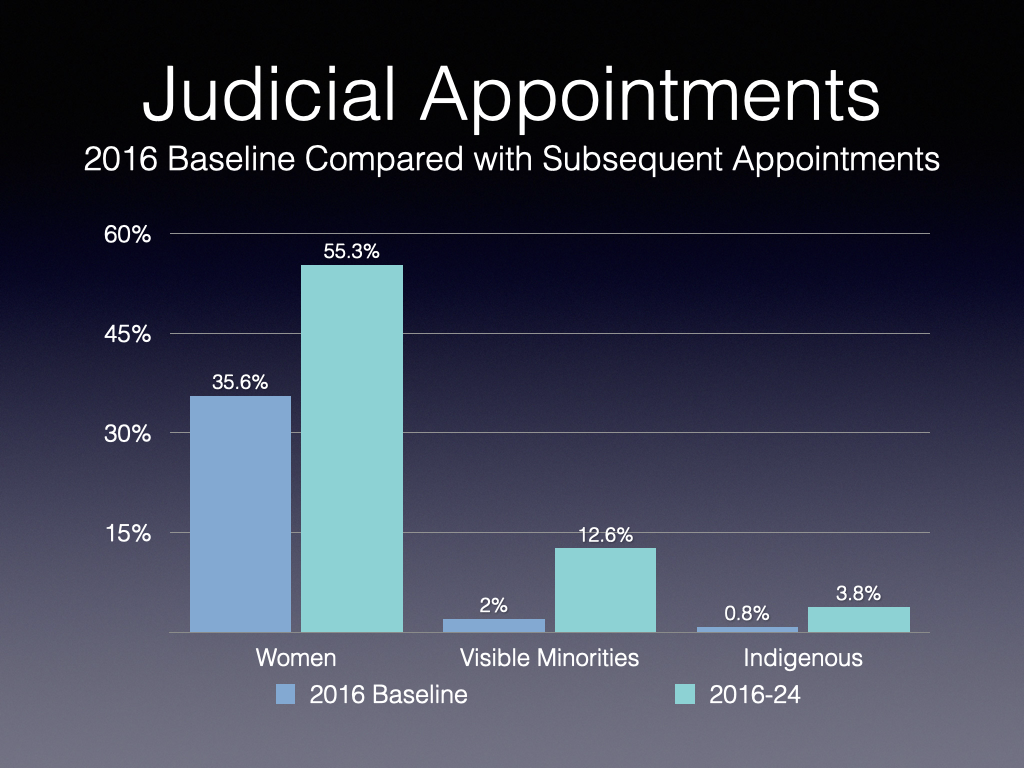
Of note. The most recent stats on diversity can be found at: https://www.fja.gc.ca/appointments-nominations/StatisticsCandidate-StatistiquesCandidat-2024-eng.html. My summary, comparing the Harper government baseline and subsequent appointments is below:

The federal Liberals have cut judicial vacancies on top courts across the country to their lowest level on record, new data show, after allowing the problem to get out of control for several years.

A flurry of 31 appointments in recent weeks leaves only 13 vacancies, as of mid-March, among the 1,000 full-time positions for judges on federally appointed benches, according to government data.

The previous low in vacancies was 14 in mid-2015, based on a review of data going back to 2003.

The latest appointments, made as a federal election is expected soon, further address unusually sharp and public criticism in recent years about unfilled positions on federally appointed benches. Those include the Supreme Court of Canada, provincial appeal and superior courts, and the Federal and Tax courts….

Source: Surge of new judges on top courts cut vacancies to lowest level after years of alarm

Working at Anheuser-Busch, I Saw What Went Wrong With the D.E.I. Movement

Although written by someone connected to anti-DEI republicans, a cautionary note on the need to understand brand values and identity in any DEI initiatives.

But of course, it neglects the risks associated with not broadening values and identity, not to mention the ethnics and morals of just catering to the base:

I still remember the day I realized Anheuser-Busch InBev was no longer the company I thought it was.

I had crunched the numbers and believed the company could make millions of dollars if we agreed to distribute canned coffees made by Black Rifle Coffee Company. I knew Black Rifle’s pro-military and pro-law-enforcement messaging could ruffle some progressive feathers — the company vowed to hire 10,000 veterans after Starbucks announced it would hire 10,000 refugees — but I also knew many of our drinkers shared those values and had grown fed up with the way Starbucks and other coffee companies seemed to cater to coastal, latte-loving elites.

The proposal was rejected. It was early 2022, two years after the George Floyd protests, and I was told that being associated with Black Rifle was too politically provocative, especially in progressive circles.

I should have seen it coming. Many corporations were flexing their credentials in the growing diversity, equity and inclusion movement. But for me, the incident was a particularly telling example of what was going wrong with Anheuser-Busch — and an early sign that too many American corporations had forgotten who their customers were.

To be clear, I believe that an employee base that has a diversity of thought — which is naturally associated with a diversity of ethnicities and backgrounds — is good for business. Different employees can better solve existing problems or identify new opportunities. But the massive corporate embrace of D.E.I. was always destined to fail, in large part because the movement was never well defined to begin with.

In 2019, I learned about the concept of D.E.I. at a meeting in Chicago from Frances Frei, a professor at Harvard Business School. I had no issue with what she described. Anheuser-Busch’s work force had become more diverse over the past decade, and I had watched employees of many backgrounds be given opportunities to grow based on their talents and contributions. If D.E.I. was about continuing this trajectory — being authentic to company culture and mission, listening and responding to customer needs and deploying logical processes — there was nothing to object to.

Unfortunately, the D.E.I. policies that followed at Anheuser-Busch were none of the above. In 2021 the company started using online dashboards that gave managers a breakdown of their employee base by demographic characteristics.

Then the company created annual performance targets linked to the company’s environmental, social and governance strategy, of which D.E.I. was one component, for thousands of employees. It was clear to me that if teams didn’t check the right boxes, managers could be punished. Promotions could be withheld. Bonuses could be lost. That year, senior executives, including me, attended weekly meetings to discuss D.E.I. initiatives. These meetings often distracted from more critical business matters, like the fact that the company risked losing employees as the Great Resignation set in. (Anheuser-Busch declined to comment for this article.)

Anheuser-Busch was hardly alone. At least 70 big companies — from Airbnb to G.E. — had set public targets for gender diversity hiring. Among the worst examples of efforts to accomplish D.E.I. goals was a diversity training course offered to Coca-Cola employees via a third-party platform that urged workers to “be less white,” which the presentation helpfully defined as being “less oppressive,” “less arrogant” and “less ignorant.” A course in Kentucky reportedly told nurses that “implicit bias kills,” that white privilege is a “covert” form of racism and that nurses may contribute to “modern-day lynchings in the workplace.”

I was already considering leaving Anheuser-Busch before the Black Rifle distribution idea was turned down. Once it was, I was certain it was time to go.

I accelerated efforts to start a fund with my high school friend Vivek Ramaswamy (who would become a Republican candidate for president). As many big asset managers were pushing D.E.I. onto the companies they were investing in, we decided to start a fund that would help its companies avoid the mistakes I’d seen at Anheuser-Busch. Raising money from Bill Ackman, Peter Thiel and others, we finalized our seed investment round at the end of February 2022, and I resigned from the company in March.

A year later, Anheuser-Busch became the poster child of what went wrong with the D.E.I. movement. In April 2023, the transgender influencer Dylan Mulvaney promoted Bud Light on social media by dressing up like Audrey Hepburn and drinking from a can of the beer.

While it was a small sponsorship by Bud Light standards, it was still puzzling. Transgender rights were a political lightning rod in many states, especially red ones, where Anheuser-Busch enjoyed high market share. And while Bud Light was in decline at the time and needed new marketing strategies to regain customers, it became America’s biggest beer brand largely by keeping its marketing away from political controversies. It was enjoyed by Democrats and Republicans for precisely that reason.

But what about Black Rifle? That was a distribution deal — trucks that delivered Bud and Bud Light would also carry Black Rifle to retailers like Walmart and 7-Eleven. That is very different from a sponsorship, in which a brand chooses to publicly associate itself with something or someone to burnish itself. Many know that Pepsi sponsored Beyoncé’s Super Bowl performance, but far fewer can probably identify which products its trucks deliver. Black Rifle’s sales have grown since I suggested that deal; loyal fans rewarded its authenticity and dedication to its mission. These days, its products are carried in Dr Pepper trucks.

The Mulvaney promotion generated enormous conservative ire. Commentators called for boycotts that hurt the company’s sales. Yet the company also caught flak from some on the left who felt the company should have been more vocal in its support of Ms. Mulvaney.

Bud Light couldn’t win. The sponsorship never should have happened. Ms. Mulvaney herself said, “For a company to hire a trans person and then not publicly stand by them is worse in my opinion than not hiring a trans person at all.”

I’m not saying that hiring a transgender influencer is wrong. The ice cream maker Ben & Jerry’s, for example, is famously, proudly progressive. Its customers wouldn’t bat an eye at a Mulvaney sponsorship, and the company could have stood by Ms. Mulvaney if conservatives complained, strengthening both its mission and the L.G.B.T.Q. rights movement.

And that’s a good thing. I have no issue with companies having a progressive mission and authentically sticking to it. Capitalism allows, even incentivizes, companies to compete for customers with different tastes.

But the D.E.I. movement demanded that companies pursue the same progressive goals, regardless of their mission and culture. When Anheuser-Busch embraced D.E.I., the partnership felt inauthentic. And that’s why it backfired.

Since he took office, President Trump has wasted no time dismantling D.E.I. policies in the public and private sectors. Many companies, including Tractor Supply Company and Harley-Davidson, began rolling back D.E.I. policies before he was elected. Meta, Target, Goldman Sachs and others have followed suit, and hiring quotas, racial equity audits and exclusionary benefits programs seem to present stronger legal risks to companies still pursuing them.

You can see how performative many companies were in their imposition of D.E.I. policies simply by how quickly they have retreated from those policies. And their demise was well underway before the election. No one wanted to become the next Bud Light.

I believe Mr. Trump is off to a good start. But it is much easier for him to issue an executive order ending D.E.I. programs in government than it is to end them in the private sector. Much of that work will have to come from corporate America.

The principles that built great American companies are simple: Hire the best people, serve your customers well and let merit and financial results determine success. While expanding opportunity and making employees feel welcome are worthy goals, how D.E.I. policies were carried out often strayed from these foundational principles and might have even created other forms of discrimination.

Today companies have an opportunity to demonstrate how true inclusion works: by judging people as individuals, not as members of groups.

Source: Working at Anheuser-Busch, I Saw What Went Wrong With the D.E.I. Movement

Krishnan | DEI was always flawed. It’s being replaced with something much worse

Valid comment:

…Personally, I would welcome a true meritocracy. I was raised mostly on a single income by immigrant parents who grew up extremely poor in Fiji. I went to an unknown college in Vancouver, and still made it to New York, won an Emmy, and currently hold an “extraordinary ability” work visa. I did all of that without the connections and wealth of many others at the top of the dying media industry. 

With the pushback against DEI, however, we’re not getting a meritocracy though, despite the rhetoric insisting we are. Rather it’s an obnoxious and defiant return to the old world order — with the added feature of obscene wealth. Something tells me when the powerful white billionaires now controlling the world run things into the ground they won’t be looking inward. DEI will be long gone, but their failures will still be everyone else’s fault.

Source: Opinion | DEI was always flawed. It’s being replaced with something much worse

Thompson: The name can change, but the work must not: why Canada still needs DEI

Useful long read given current debates. Trump administration’s executive order combined with his many unqualified cabinet and other appointments is perhaps one of the strongest arguments that DEI is compatible with merit considerations:

…At least some of the challenges to DEI at the organizational level can be attributed to leaders (and a fair number of consultants) not doing this work well in the first place. In their 2022 book, Getting to Diversity, sociologists Frank Dobbin and Alexandra Kalev analyze decades of American data to demonstrate which kinds of DEI programs work, and which don’t, under which specific circumstances. For example, mandatory trainings about diversity and sexual harassment that focus on legal compliance can backfire, generating defensiveness on the part of those who need to do better. Cultural inclusion training that seeks to improve collaboration and communication across groups and harassment training that focuses on bystander intervention, however, can be very effective. There is no one-size-fits-all approach to pro-active diversity management, though in nearly all situations, we in Canada require better and more disaggregated and systematically collected data.

The current backlash against DEI is a self-fulfilling prophecy. Corporate commitments that were made because of changing public opinion were always going to be window dressing. For others, the work continues. “Organizations that have sincerely committed to advancing DEI are still committed,” said Nicole Piggott, the president and co-founder of Synclusiv, which guides its clients to create more inclusive workplaces. “The data are clear; the data have not changed. Diverse workplaces perform better in every metric.” However, effective DEI practices must be deliberate, strategic and embedded in the core values of an organization from top to bottom – not relegated to a neglected portfolio in an overworked human resources department….

Source: The name can change, but the work must not: why Canada still needs DEI

To: DEI needs to fix systems, not people

True, but rather vague beyond better data:

…One key takeaway from implicit bias research is that interventions targeting individual biases often provide only temporary results because bias is embedded within systems. 

So, what can organizations do to address systemic bias more effectively?

Let’s look at hiring as an example. 

Instead of requiring hiring managers to participate in diversity training, organizations could implement hiring criteria that minimize the influence of race and gender bias in the hiring process. Some research suggests tailoring job descriptions to appeal to underrepresented groups. For example, HR postings that increase the transparency of qualifications or focus on benefits can attract more women for roles in traditionally male-dominated fields.

Policing is another area where systemic change can mitigate bias. Studies show police officers are more likely to stop, question, arrest or use force against Black people than white people. 

Rather than mandating police officers undergo diversity training to educate them about their biases — something that has only a fleeting effect — a restructuring of the policies and procedures around stops and frisks would reduce bias’s impact. 

For instance, policies to ensure the collection of race-based datain police stop and frisks and to encourage stricter accountability among police officers could go a long way to curb racial profiling. 

As DEI programs face increasing scrutiny and skepticism, and many employees feel frustrated by ineffective and repetitive online training, there is a growing need to reframe DEI as systems-focused work. If diversity, equity and inclusion are truly the goals, the solution lies in rebuilding the systems that shape our society.

Source: DEI needs to fix systems, not people

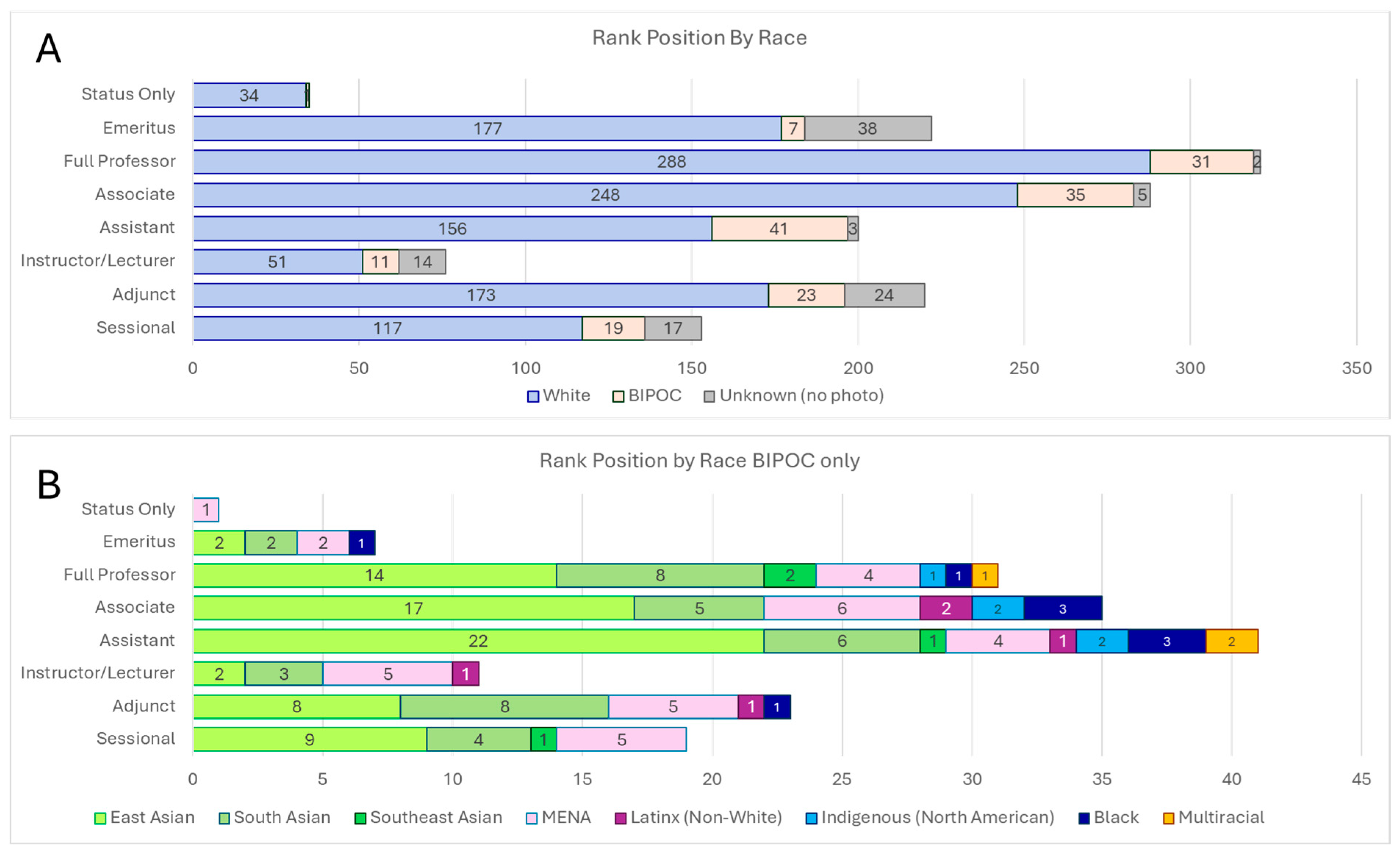
Ivison: DEI screening comes before merit questions in Canadian university hiring

Disappointing that Ivison would cite this tendentious study without background, context, nuance and deeper analysis. And, of course, no real assessment of whether the quality of academics hired has decreased or increased given various inclusion and equity policies. Suspect a mix, as in most hiring:

…But Milke suggested the point is made just as effectively by pre-screening. 

“What they do at the front end is to try and sort through people who they may consider overrepresented, to use an awful word, in a certain profession or faculty.”

He said that merit-based appointments would naturally become more diverse, reflecting the more ethnically diverse country that Canada has become. 

“The problem with diversity, equity, and inclusion, and this attempt to make everything exactly equal at the end and discriminate at the front end to do that, is you’re not looking at merit and qualifications the way that universities claim they are. Instead, you’re basically banning people from the position who don’t fit some irrelevant, non-changeable category.”

Milke said DEI policies entrench the notion that Canada is a systemically racist state. 

“Now, 100 years ago, there was systemic racism. If you were Chinese, for example, you could not get into a white hospital. They had to set up their own hospital. The same with Jewish people in Toronto, which is why Mount Sinai Hospital was set up. But that was 100 years ago. Systemic racism has been outlawed in Canada since the 1950s. You still find individual cases of prejudice, but systemic racism as a policy, as a law, began to be abolished in places like Ontario in the early 1950s.”

Ivison noted that the Trump administration is moving quickly to dismantle DEI in its areas of jurisdiction but that in Canada, the Liberal government has been an enthusiastic cheerleader of the policies, linking DEI hiring to federal funding. 

Milke said he would like to see the federal government reverse direction and admit students and professors based on merit and achievement. 

“The fundamental nature of DEI is flawed and what governments and universities should be doing is saying, ‘look, how can we restructure this? We do want people of all colours, creeds, backgrounds to succeed and help them to do that, but not by focusing on irrelevant characteristics’.

“The more they go down the DEI path, universities are going to capture a segment of the population that believes racism explains all, or mostly all. So, I think a federal government should strongly consider going back to not only Martin Luther King’s vision of equality of the individual (but to) Pierre Trudeau’s vision, in which he believed in the equality of the individual.”

Milke said he believes diversity is a very positive quality and that successful cultures and civilizations need an array of ideas to flourish. 

“These days, we may be admitting too many immigrants at once to have everyone get or provide housing, (but) that’s a separate issue. In the main, cultures that beg, borrow, and steal from each other generally succeed. Diversity is not a bad thing. It can be a very good thing. But not when it’s top down and people look at you and assume because you’re a certain skin colour, you’ve got privilege. I mean, it’s a fallacy.”

Source: Ivison: DEI screening comes before merit questions in Canadian university hiring