Trigger for new immigration powers ‘intentionally not defined’ in border bill: Diab

Not reassuring as some guidelines or principles would be useful:

Immigration Minister Lena Diab says the definition of a “public interest” event that would allow her department to pause or revoke immigration applications is “intentionally not defined” in new legislation.

Diab told the House of Commons immigration committee today the definition was left open-ended in the government’s new border security bill, C-12, to allow Ottawa to respond to unforeseen events.

“It is intentionally not defined in the legislation, as I said, to allow for maximum flexibility for the government to respond in a range of unforeseen circumstances that threaten the public interest,” Diab told the committee. 

Diab was asked repeatedly during the committee hearing when the government would be permitted to use the new powers to pause immigration applications or cancel existing documents.

The minister said they could be deployed in a national security emergency or health crisis, adding the government could have made good use of the power to pause immigration applications during the COVID-19 pandemic.

Tara Lang, Immigration, Refugees and Citizenship Canada director general of integrity policy and programs, told the committee the public interest power also could have been used for a mass extension of healthcare worker visas during the pandemic.

Conservative immigration critic Michelle Rempel Garner repeatedly asked Diab to explain what safeguards exist in the legislation to prevent the power change or revoke immigration documents en masse from being abused. 

“You want Parliament to give the government the ability to kick mass groups of people out, undefined, who they don’t like. That’s what it sounds like to me,” Rempel Garner said. 

“How could I go to ethnic groups in my community and say I could vote for this? This is actually bananas and so anti-Canadian. So what are those specific safeguards?”

Diab replied that these powers would “only be used in exceptional circumstances. She said the use of the powers would have to be Charter compliant and the decision would have to be made in consultation with other ministries and cabinet. 

More than 300 civil society organizations, including civil and migrant rights groups, have called on the government to withdraw this legislation due in part to the proposed power to mass cancel immigration documents. 

Justice department officials at the committee said that it’s their opinion the legislation being put forward is Charter compliant. 

The rationale for using these powers would be published in the Canada Gazette and through a cabinet order, with specific reasoning on why the powers are being used and who is affected.

Lang said that while the powers could be used to revoke an immigration document, they would not remove someone’s legal status in Canada as that is a different process. 

Lang added that if people feel they are “improperly named” in one of these orders there is an opportunity for them to request to the immigration department that they be removed from the order revoking or modifying a document. 

Source: Trigger for new immigration powers ‘intentionally not defined’ in border bill: Diab

Reichhold | Québec doit respecter les droits fondamentaux en immigration permanente et temporaire

Quebec settlement sector perspective:

…Les politiques d’immigration, animées par un esprit utilitariste tant au fédéral qu’au Québec, renforcent ainsi les discriminations systémiques des programmes existants et des processus d’accès à la résidence permanente.

La planification de l’immigration temporaire et permanente doit rompre avec le discours anti-immigrant grandissant dans le monde et à nos portes, qui débouche sur la mise en œuvre de procédures arbitraires et répressives envers toute personne racisée. Québec doit offrir des voies d’accès à la résidence permanente dont les étapes sont lisibles et prévisibles. Cela suppose aussi d’améliorer les moyens pour l’accès à la francisation, avec une responsabilisation des employeurs, ainsi que les subventions pour les organismes travaillant auprès des personnes migrantes et immigrantes. Il faut montrer aussi que le Québec est prêt à intervenir auprès des employeurs abusant de la vulnérabilité des personnes migrantes et immigrantes.

Nous voulons renouer avec l’esprit d’une société qui revendique la justice sociale et une égalité réelle entre ses habitants. C’est pourquoi nous exigeons d’afficher notre volonté d’accueil. Les personnes migrantes et immigrantes ont en effet toujours contribué à la richesse de notre « société distincte ».

Amel Mokhtar et Stephan Reichhold, Le premier est membre du Centre des travailleurs et travailleuses immigrants (CTTI); le second est directeur général de la Table de concertation des organismes au service des personnes réfugiées et immigrantes (TCRI), et la Campagne québécoise pour la régularisation et la justice migrante.*

Source: Idées | Québec doit respecter les droits fondamentaux en immigration permanente et temporaire

Trump caps refugee admissions at record low – with most to be white South Africans

Sick:

The Trump administration will limit the number of refugees admitted to the US to 7,500 over the next year, and give priority to white South Africans.

The move, announced in a notice published on Thursday, marks a dramatic cut from the previous limit of 125,000 set by former President Joe Biden and will bring the cap to a record low.

No reason was given for the cut, but the notice said it was “justified by humanitarian concerns or is otherwise in the national interest”.

In January, Trump signed an executive order suspending the US Refugee Admissions Programme, or USRAP, which he said would allow US authorities to prioritise national security and public safety.

The previous lowest refugee admissions cap was set by the first Trump administration in 2020, when it allocated 15,000 spots for fiscal year 2021.

The notice posted to the website of the Federal Register said the 7,500 admissions would “primarily” be allocated to Afrikaner South Africans and “other victims of illegal or unjust discrimination in their respective homelands”.

In February, the US president announced the suspension of critical aid to South Africa and offered to allow members of the Afrikaner community – who are mostly white descendants of early Dutch and French settlers – to settle in the US as refugees….

Source: Trump caps refugee admissions at record low – with most to be white South Africans

Budget to include millions to help foreign-trained workers get credentials recognized, expand skilled-trades training

Good reality check from WES/Madhany in terms of the need for all the players to work together and ideally harmonize provincial accreditation body standards (the anecdote regarding doctors being Uber drivers needs substantiation regarding the extent):

…The money is welcome news, but won’t solve the issue of underemployed immigrants on its own, said Shamira Madhany, managing director for World Education Services Canada, a non-profit organization that provides credential evaluations for people who have studied outside of Canada.

Even more vital than money, said Madhany, is getting all levels of government — and provincial accreditation bodies — pulling in the same direction.

“You end up with a situation where the federal government says, ‘but this is provincial jurisdiction,’ and the provinces say, ‘but we need more money,’ and then the licensing bodies say, ‘but, you know, we want to have making of standards,’ ” said Madhany. “What I would be looking for is a pan-Canadian approach.”

The federal government recruits skilled immigrants to come to Canada, but then those immigrants see their credentials turned down by individual provinces or regulatory bodies, something Madhany said is a waste at a time when many Canadians are struggling to find a doctor.

“Who’s going to fill our labour shortages? We know it’s immigrants and highly skilled immigrants,” said Madhany. “So if you don’t leverage those skills, you end up with this continuous kind of circling around, and doctors and others in the health professions driving Ubers.” …

Source: Budget to include millions to help foreign-trained workers get credentials recognized, expand skilled-trades training

ICYMI – Bricker and Ibbitson: There are divisions in every part of the country. Is Canada at the breaking point?

Valid critique:

…Both Conservative and Liberal governments contributed to some of the challenges facing Canada today. But it was Mr. Trudeau who oversaw the greatest policy failure of modern times, by letting the immigration system spin entirely out of control.

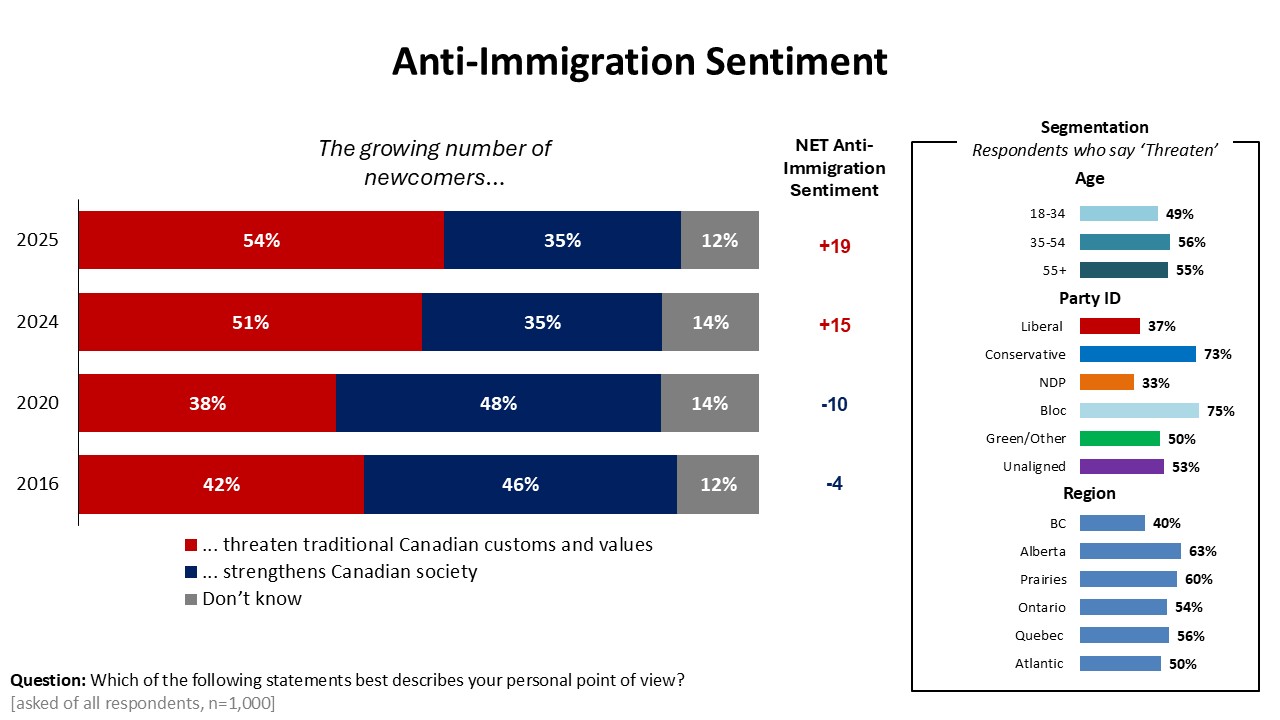
As with so many aspects of the Trudeau legacy, the intentions were honourable: to grow Canada’s population and secure its future through increased immigration. There were arguments for and against the decision to almost double the intake of permanent residents to 500,000 a year. But there was no excuse for letting the number of temporary foreign workers and international students skyrocket, along with the number of people seeking asylum. Suddenly there were three million non-permanent residents in Canada, competing with younger native-born workers for jobs and housing. For the first time in a quarter century, polls showed that most Canadians believed Canada brought in too many immigrants.

Public support for immigration and multiculturalism has been Canada’s great competitive advantage, creating a diverse yet peaceful society of old and new Canadians living and working together in harmony. But by flooding the country with newcomers, the Trudeau government broke the consensus in favour of high levels of immigration and undermined our unique social contract. The damage to the country’s harmony and its future prospects could be incalculable….

Source: There are divisions in every part of the country. Is Canada at the breaking point?

Canada’s overhaul of immigration must include a dedicated program for high-skilled workers 

Dose of reality:

…Some business leaders are dubious that the U.S. overhaul of the H-1B visa program is creating an opportunity for Canada.

“The United States uses immigration and visa policies to strengthen its economic and work-force advantage,” said Jim Balsillie, the former chair and co-chief executive of Research In Motion, which is now known as BlackBerry.

Mr. Balsillie, speaking at The Globe and Mail’s Building Canada’s Workforce event on Wednesday afternoon, noted that Mr. Trump’s “strategic use of visas” includes the TN category for trade professionals and the O-1 tier for individuals with extraordinary abilities and achievements.

“I can make a case that the recent H-1B changes actually hurt Canada because TN and O-1 visas are more attractive for many reasons,” he said.

He argued that America’s H-1B changes could exacerbate Canada’s brain drain if the U.S. looks north to fill the gap by seeking new talent in sectors such as artificial intelligence, life sciences and quantum computing.

Here’s another hard truth. If high-skilled immigrants treat our country as a way station to the U.S., it’s our own fault.

Ottawa has known for years that preferred candidates are getting lost in the immigration queue because they are competing with international students for a limited number of permanent-resident spots, said Stephen Green, managing partner at immigration law firm Green and Spiegel LLP.

As he points out, those foreign students have a Canadian education but minimal work experience. Trouble is, our immigration system skews heavily toward younger people….

Source: Canada’s overhaul of immigration must include a dedicated program for high-skilled workers

Century Initiative: Canada’s Growth Engine is Stalling

Continuing to pivot to a more realistic and comprehensive approach, rather than simplistically arguing for more immigration.

Of the 40 scorecard measures, 11 are leading or are on track, while 29 need attention or falling behind, notably among economic indicators:

Key Takeaways

Build for today—plan for 2050: With growth stalling and the median age rising, Canada needs a smart population plan that balances housing and services now while sustaining a skilled workforce, a resilient tax base, and competitiveness anchored in cross-government collaboration and real-time data.
 
Turning strengths into results: Canada’s talent and startup energy aren’t translating into growth. We lag peers on R&D, productivity, and scaling firms, eroding GDP per capita. The next five years must focus on incentives for R&D and competition, support for scale-ups, and tighter links between education/training and high-value jobs.
 
Compete to win talent: Canada can seize a global opening if immigration policy is stable, predictable, and competitive. A rules-based system that fuels workforce growth and innovation is essential to long-term fiscal resilience.
 
Affordability, competitiveness, and resilience—one agenda: Affordability isn’t just a pocketbook issue; it underpins productivity, social cohesion, and trust. A comprehensive plan on housing supply, household debt, wages, and inequality is critical to economic durability.
 
National security starts with the economy: Economic, demographic, and military security are inseparable. Meeting global commitments requires defence investment alongside modern data systems, deeper cybersecurity talent, and more diversified trade.

Source: Canada’s Growth Engine is Stalling, National Scorecard on Canada’s Growth and Prosperity

Le microcrédit, un outil pour favoriser l’intégration des nouveaux arrivants

Of note:

Microcrédit Montréal, qui fête cette année ses 35 ans d’existence, accorde chaque année ce genre de prêts à une quarantaine de professionnels récemment arrivés au Québec qui désirent travailler dans leur domaine : ingénieurs, architectes, médecins, infirmières, pharmaciens, dentistes…

La somme octroyée, qui peut aller de 500 $ à 10 000 $, peut servir à payer des cours de mises à niveau, l’adhésion à un ordre professionnel, des cours de français ou tout simplement à assurer sa subsistance.

Faire reconnaître ses compétences, « c’est un parcours qui prend de l’investissement en temps et en argent, choses que ces gens-là, souvent, n’ont pas », fait observer Larissa Matveeva, directrice générale de Microcrédit Montréal.

« La plupart des gens vont remettre ça à plus tard parce que leur priorité est de nourrir la famille ou de survivre eux-mêmes s’ils arrivent ici seuls. Et puis, plus tard, souvent, ça ne se fait pas parce que la routine prend le dessus, tout simplement. »

L’organisme sans but lucratif vient faciliter ce parcours en prêtant à faible taux (4 %) à des gens à qui les banques institutionnelles ne prêteraient pas normalement, faute d’historique de crédit au pays.

« Nous, on prend le risque là où les banques ne peuvent pas en prendre », résume Mme Matveeva.

« On permet à ces personnes d’investir dans leur avenir ici, dès le départ, au bénéfice de tous : la personne gagne parce qu’elle a accès à des revenus confortables, puis la société québécoise gagne aussi, parce que cette personne va payer les impôts et va contribuer pleinement à l’économie. »…

Source: Le microcrédit, un outil pour favoriser l’intégration des nouveaux arrivants

Microcredit Montréal, which celebrates its 35th anniversary this year, grants this type of loans every year to about forty professionals recently arrived in Quebec who wish to work in their field: engineers, architects, doctors, nurses, pharmacists, dentists…

The amount granted, which can range from $500 to $10,000, can be used to pay for refresher courses, membership in a professional order, French courses or simply to support your livelihood.

To have your skills recognized, “it is a path that takes investment in time and money, things that these people often do not have,” observes Larissa Matveeva, CEO of Microcredit Montreal.

“Most people will put it off because their priority is to feed the family or survive themselves if they get here alone. And then, later, often, it is not done because the routine takes over, quite simply. ”

The non-profit organization facilitates this journey by lending at low rates (4%) to people to whom institutional banks would not normally lend, for lack of credit history in the country.

“We take the risk where banks cannot take it,” summarizes Ms. Matveeva.

“We allow these people to invest in their future here, from the start, for the benefit of all: the person earns because he has access to comfortable income, then Quebec society also wins, because this person will pay taxes and will fully contribute to the economy. “…

50-year immigration wait stuns lawyers and families, but IRCC says it’s no mistake

Highlights immigration policy and program management failures and the impact of people’s lives on government trying to correct for these failures:

Processing times for Canadian immigration applications have reached unprecedented lengths — up to 50 years under some permanent residency programs — stunning applicants and lawyers who say the system has become unviable.

“We were shocked,” said Olha Kushko, whose family fled Kyiv and settled in Ottawa in 2023 under the Canada-Ukraine Authorization for Emergency Travel (CUAET), a special measure introduced after Russia’s full-scale invasion.

“It doesn’t have any sense. I don’t know how it’s possible, so I can’t believe it,” Kushko said.

Families who recently applied for permanent residence (PR) under Canada’s humanitarian and compassionate stream face waits of 12 to 600 months, according to the new immigration minister’s May 2025 “transition binder”.

Other economic immigration programs list similar waits: 

Up to 108 months (nine years) for the caregivers pathway.

Up to 228 months (19 years) for the agri-food stream.

Up to 420 months (35 years) for entrepreneurs under the startup visa stream. 

Lawyers say these skyrocketing processing times published by Immigration, Refugees and Citizenship Canada (IRCC) are unheard of, and some fear mass cancellation of applications if the Liberal government passes its strong borders bills, which would grant the minister sweeping new powers.

Source: 50-year immigration wait stuns lawyers and families, but IRCC says it’s no mistake

Canada pays highly educated immigrants less money than the U.S., study finds

Highlighting retention issues, relative wage gaps between visible minorities and not visible minority remain a concern:

Canada is “relatively successful” at attracting highly educated immigrants, but their counterparts in the United States earn more and have access to better opportunities, a new study says.

The neighbouring countries that have been largely at odds since the Trump administration took over are not only competing when it comes to industries, like the steel and auto sectors. They are also competing for skilled and educated people, especially those in the science, technology, engineering and math (STEM) fields.

Researchers noted that now is the time for Canada to push for the “best and the brightest” to come to the country, as the U.S. adopts “a far less welcoming immigration policy.”

The study from the Fraser Institute published on Thursday is shedding light on how certain Canadian immigrants are not reaping as many benefits as their U.S. counterparts who “perform better in terms of both employment status and earnings.” Those two factors are compared to native-born Canadians and Americans, respectively, as benchmarks.

In Canada, highly educated immigrants earned 16 per cent less than native Canadians. In the U.S., immigrants had a higher employment rate (1.2 per cent) and higher compensation (8 per cent) than Americans born in the country.

In 2020, visible minority immigrants in Canada with a bachelor’s degree or higher earned a median of $57,200, whereas native Canadians with a bachelor’s degree earned $68,300 on average.

“The differences were even greater when focusing on cohorts with advanced degrees,” said researchers. “Specifically, the median income of visible minority immigrants with a master’s degree was $65,500. For those with an earned doctorate, it was $84,000.” Canadians born in the country with a master’s earned an average of $84,400, while those with a doctorate earned $100,000.

The wage gap was likely due to “difficulties around the recognition of foreign credentials (and perhaps non-Canadian work experience) for newcomers seeking opportunities in the Canadian labour market,” researchers noted.

In the United States, data from 2022 showed that highly educated American immigrants earned US$122,000, while those born in the U.S. in with the same qualifications earned US$113,000. Researchers said that immigrants out-earning their American counterparts could be due to their “superior performance.”…

Source: Canada pays highly educated immigrants less money than the U.S., study finds