Kerr: Moving into uncharted waters: How Canada could benefit from a clearly defined population policy 

Seeing more articles advocating for a population policy, which of course would become the base for immigration levels, permanent and temporary. Of course, the experience of most countries that have tried to increase birth rates has been mixed at best, with few successful efforts:

…How quickly should Canada be growing?

Historically, annual immigration targets were set by cabinet based largely on a political judgment. After consulting with others, including the provinces, this was meant to be a sort of prudential assessment of what Canada can accommodate and what Canadians might accept. Up until recently, this assessment appears to have performed reasonably well. Yet in light of recent events, it might be prudent to return to my basic point—that the Canadian government should set out to establish a well-defined population policy—and perhaps in so doing, be somewhat more formulaic in its approach to immigration.

The first order of business would be to decide upon how quickly we want our population to grow, or whether or not we need an upper and lower limit. In reviewing our historical experience, it would be reasonable to propose a relatively wide range, of say, 0.5 to 1 percent annually. For comparative purposes, the average population growth rate across the current 38 members of the OECD in 2023 was 0.5 percent, whereas across G7 nations (excluding Canada) the corresponding average was 0.3 percent. An upper limit of 1 percent might seem somewhat high to some, but such a target is not far from the rate at which our population has grown over the last half-century. Over the extended period 1971-2015, Canada’s population grew at an average rate of about 1 percent annually.

The basic idea here is that our society works with a predictable rate of population growth, from year to year, that avoids all of the disruptions that could be associated with very rapid growth or for that matter, stagnation or population decline. In doing so, our economy and social institutions would have an easier time accommodating our rate of population growth—avoiding the disastrous situation observed over the last couple of years.

Success in reducing the NPR population translates into higher immigration targets

In setting future targets on permanent immigration, our success in reducing the number of NPRs, put simply, should be considered key in setting future targets on permanent immigration. The basic idea here is that to the extent that we reduce the number of NPRs, we can correspondingly increase the number of landed immigrants without having an impact on population size. In promoting permanent immigration, we can restore best practices in terms of carefully selecting immigrants based on economic immigration, family reunification, and humanitarian considerations. This involves returning to the Canadian tradition whereby newcomers are given the promise in settling in this country that they could eventually obtain the rights of full citizenship.

The earlier projection showed future growth with little change in the number of NPRs, remaining indefinitely at 5 percent of the population total from 2027 onward. In the projection, landed immigrant targets were set to gradually climb from about 365,000 to a figure approaching 400,000 over the next decade or so. Yet if the target on NPRs were reduced further, down for example to about 3.5 percent, this could allow for hundreds of thousands of additional landed immigrants without having an impact on our rate of population growth. Of course, many of the NPRs currently living in Canada will not be leaving the country, but alternatively could be selected for landed immigrant status through our normal immigration streams.

On this front, in planning future immigration targets, it makes sense to further reduce the NPR share of Canada’s population well below the 2027 target of 5 percent. Considerable caution would be advised as to how to achieve this target, with the difficult balance here in meeting shorter-term labour force needs, promoting the best in our international student programs while continuing with our long history of meeting humanitarian commitments with asylum seekers.

Flexibility in our targeted growth

It is very difficult to come up with a simple formula for setting immigration targets—such that a well-informed population policy would continue to closely monitor the impact of population growth and the successful integration of newcomers. A targeted range of 0.5 to 1 percent annual population growth is meant to allow for some flexibility in responding to many of the pressing economic and social challenges that we currently face. In recently announcing its revised immigration plan, the federal government indicated that its new plan would allow for “[c]ontinued GDP growth, enable GDP per capita growth to accelerate throughout 2025 to 2027, as well as improve housing affordability and lower the unemployment rate.” As GDP per capita has been stagnant for several years now, this might be considered a tall order. On this front, there are obviously many factors beyond demography that will impact their relative success. Yet this announcement is consistent with the idea that if our unemployment rate rises or if Canada fails with its current housing plan, it is reasonable to reduce immigration targets accordingly.

In light of the many problems in Canada that were aggravated by the most recent surge in population (six years of growth in two), from housing affordability to access to health care, it would seem justifiable to set a population growth rate closer to the lower part of this range. And in light of the projections shared previously, this would imply lower immigration targets than in the current Liberal plan—unless the federal government has more success than expected in reducing the number of NPRs.

Time for a broader population policy

One of the most widely misunderstood impressions with regard to immigration is that it serves as a panacea to population aging. Yet one of the lessons that we can gain from this most recent surge in immigration is that Canada’s population will continue to age for some time regardless of immigration targets. In July of 2020, the median age in Canada was 40.8. By July of 2024, this median had fallen slightly to 40.3. This is after a population surge of over 3.3 million in merely four years. While international migrants are younger than the average Canadian, an unsustainable number would be required over the longer term to meaningfully slow and reverse this aging trend. Canada’s population will inevitably age over the next several decades, and a well-thought-out population policy should certainly prepare for this basic fact.

Although our population is younger today than it would be without international migration, the primary factor responsible for population aging has been the continued decline in our birth rate. Statistics Canada has in fact projected the impact of a continued decline, such that we could experience a negative natural increase within only a few years. With this in mind, the instinct to further reduce immigration over the longer term without a rebounding of our birth rate might be somewhat shortsighted. Canada seems set to become even more reliant on international migration in maintaining population and labour force levels, such that we will eventually need to raise immigration targets substantially even to meet a lower limit of 0.5 percent annual growth.

A broader population policy could shift our attention to our birth rate, rather than merely a reflex action to increase immigration. The basic fact that birth outcomes in Canada continue to be lower than birth intentions, is in itself worthy of policy intervention. Without a rebounding in our birth rate, population aging in Canada will accelerate. Canada will become even more reliant on immigration in maintaining population and labour force—unless, of course, Canadians decide that slow growth and/or population decline is preferable. Yet while rapid population growth has its challenges, so too does a shrinking population. One merely needs to turn to the Japanese example to fully appreciate this fact. A well-informed population policy could attempt to avoid both scenarios.

Source: DeepDive: Moving into uncharted waters: How Canada could benefit from a clearly defined population policy

Legal Pathways and Enforcement: What the U.S. Safe Mobility Strategy Can Teach Europe about Migration Management

Usual solid analysis from MPI, with approach and results undercover by media and not discussed by Harris campaign:

As the Biden administration comes to an end on January 20, so does one of the most ambitious migration management policy agendas in recent memory. Over the last four years, the administration initiated an innovative strategy mixing increased regional cooperation on immigration enforcement and a more orderly system for border arrivals with a significant expansion of lawful pathways and efforts to push humanitarian protection decisions away from the border. Based on the notion of “safe mobility,” this strategy eventually saw irregular migration to the U.S.-Mexico border drop to its lowest level in almost five years after a period of record arrivals. But it took a long time to implement the various elements—a period during which the U.S. public became increasingly restive over perceived chaos at the border and large numbers of irregular arrivals. Even as some key aspects of the strategy have yet to be fully implemented, the incoming Trump administration will assert its own, differing vision for migration management at U.S. borders and relations with neighboring countries.

Still, the Biden-era innovations have been watched with interest across the Atlantic, where many European governments are struggling to find an effective answer to similar mixed movements of asylum seekers and irregular migrants. While some of the U.S. measures were more developed than others, together they provide the seeds of an approach that ensures greater border control while advancing pathways for humanitarian protection.

The Biden experience makes clear, though, that sequencing matters. Many of the elements promoting protection pathways preceded the efforts for greater regional enforcement and heightened U.S. requirements to seek asylum at borders. It was not until June 2024 that many enforcement measures, including greater cooperation with the Mexican and Panamanian governments and narrowing of asylum eligibility at borders, were fully implemented, with irregular arrivals then dropping precipitously. As a result, the administration will likely be remembered more for the several million migrants who were allowed across the U.S.-Mexico border, rather than the combination of measures that finally brought irregular migration under control.

The incoming Trump administration will undoubtedly pursue a strategy based primarily on enforcement, not lawful pathways, and further reduce access to humanitarian protection. That does not mean, however, that a balanced approach that includes robust enforcement and lawful pathways is dead. Instead, for countries that want to pursue this, it points to the need for a more pragmatic approach that achieves early reductions in arrivals while also preserving pathways for protection, not delaying the enforcement-focused elements of the strategy….

Finally, the Biden administration initiatives offer a crucial lesson about managing public trust and messaging. First, it has become almost gospel that the orderliness of migration (in a planned, legal way) matters almost as much or more than the absolute numbers arriving. The CHNV and SMO programs would seem to have fulfilled this criteria—migrants arrived with authorization at airports and with a sponsor or local agency ready to receive them and support their initial reception costs. Yet there was little messaging to U.S. publics by the government about either program, leaving the door open for critics to exploit the narrative, accusing the administration of paying to fly in future voters. It also seems that numbers may, in fact, matter after all. While more than 860,000 migrants came in through CBP One appointments and another 800,000-plus through the CHNV process and similar parole processes for Ukrainians and Afghans, nearly 4.2 million other migrants were allowed in after crossing a border without authorization, in addition to others who managed to cross the border undetected. For many local communities and service providers, who received minimal support from the federal government for the costs incurred in addressing the needs of these new arrivals, the pace of change and demands placed upon them were great….

Source: Legal Pathways and Enforcement: What the U.S. Safe Mobility Strategy Can Teach Europe about Migration Management


Globe editorial: The twin crises of housing and immigration 

Indeed:

…In its most recent plan, the government uses five criteria – with the final one being Canada’s capacity to settle, integrate and retain newcomers. That is too faint a nod toward a critical shortage of housing in major urban centres.

The new federal targets aim to reduce immigration levels (from record highs) over the next three years. But those reductions won’t fix chronic, countrywide challenges around housing and health care. Canada needs to ensure that its immigration targets match our ability to provide the fundamentals in communities that are stretched by high numbers of new arrivals.

The federal Conservatives want Canada to set immigration targets based on this country’s capacity to absorb newcomers, based on the availability of housing, jobs and health care. The Tories are on the right track. Capacity – most easily measured by the state of the housing market – should be the yardstick for the federal government’s targets for economic migrants, in addition to its humanitarian commitments.

The reduced targets are overdue. Unchecked growth has soured Canadians’ support for immigration, as gaps in housing supply, access to health care and other social services have grown….

The lesson for the federal Liberals, who will face voters next year, is that immigration and housing are intertwined crises – and should be dealt with as such.

Source: On the Brink: The twin crises of housing and immigration

Globe editorial: Wanted – More enforcement in immigration 

Latest in the series:

…Right now, Canada relies on a system of incentives for people to follow the law. People ordered to leave must confirm their departure with the CBSA at a port of exit or risk being put under an exclusion order that would prevent any future return to Canada.

But leaving it to people to decide what is in their best interests leads to a situation where the CBSA cannot speak with absolute certainty as to the whereabouts of 19,729 people whose claims for refugee status were denied by Canada in 2011 or earlier. They might have left and simply not informed the CBSA. Or they may still be here.

There are a range of potential solutions. First, the problem needs to stop where it starts: limiting the number of refugee cases by reducing the incentive for fatuous claims, as this space argued on Thursday. Ottawa could also explore issuing automatic exclusion orders once permits expire.

At the same time, the government needs to provide the CBSA with the tools and staffing to ensure that the people deported actually leave the country. In this new, harder world, stricter monitoring of whether people leave the country when they’re supposed to is inevitable.

Canada can no longer give people the option to fade into the woodwork.

Source: On the Brink: Wanted – More enforcement in immigration

Canadian Immigration Tracker – October 2024 Update

Year to date highlights:

  • Permanent residents admissions: Increase January-October from 404,000 in 2023 to 413,000 in 2024 or 2.3 percent.   
  • TR2PR (Those already in Canada): Increase January-October from 212,000 in 2023 to 219,000 in 2024 or 3.3 percent. 
  • TRs-IMP: Decrease January-October from 757,000 in 2023 to 648,000 in 2024 or -14.5 percent.
  • TRs-TFWP: Decrease January-October from 172,000 in 2023 to 165,000 in 2024 or -4.0 percent.
  • Students: Decrease January-October from 570,000 in 2023 to 461,000 in 2024 or -19.2 percent. Post-secondary only: Decline from 431,000 to 328,000 or 23.9 percent.
  • Asylum Claimants: Increase January-October from 117,000 in 2023 to 149,000 in 2024 or 27.3 percent.
  • Citizenship: Increase January-October from 317,000 in 2023 to 329,000 in 2024 or 3.7 percent.
  • Visitor Visas: Decrease January-October from 1,567,000 in 2023 to 1,290,000 in 2024 or -17.7 percent.

https://www.slideshare.net/slideshow/canadian-immigration-tracker-october-2024-pdf/274022459

Alicia Planincic: The provinces are losing ground to federal priorities in immigration 

Useful observation and analysis. It would benefit, however, from further analysis comparing PNP and federal economic outcomes:

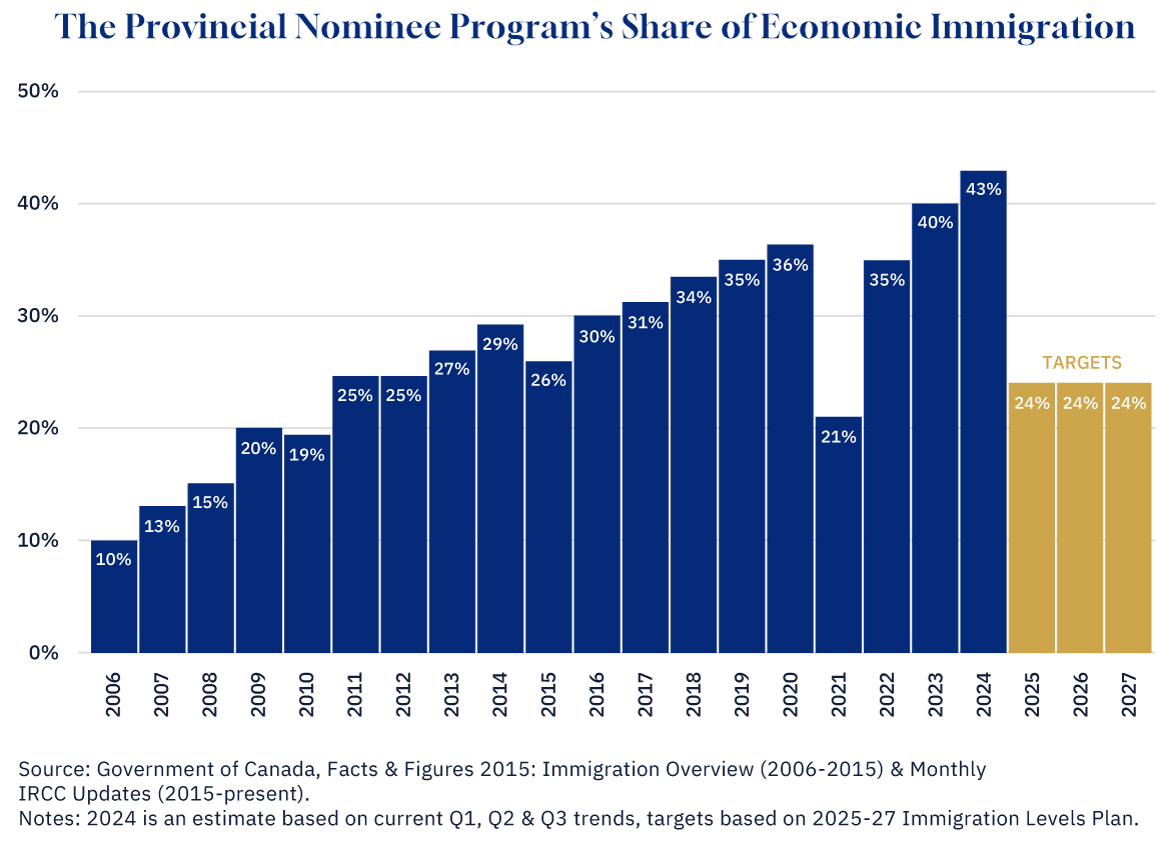
A couple of months ago, the federal government made a big announcement that they were decreasing targets for immigration pretty substantially. Though there was a lot of talk about the topline numbers and what it means for the economy, what was overlooked at that time was that cuts to immigration came primarily at the expense of a single program: the Provincial Nominee Program (the “PNP”)—what represents the provinces’ role in selecting economic immigrants.

What’s important about the PNP is that it’s designed to distribute immigrants more widely across Canada (especially beyond the country’s biggest cities) and give the provinces the ability to meet local labour market needs. And, though it’s not perfect, it’s pretty effective at both.

Just how big of a hit did the program take? Pretty big.

Graphic credit: Janice Nelson. 

While total immigration was reduced by around 100,000 new permanent residents (annually), the PNP was reduced by 65,000. To put this into perspective, the PNP is just a single program within the broader “class” of economic immigration but cuts to the PNP dwarfed cuts made to the other two main classes of immigration combined (i.e., family-related immigration and refugees).

At the same time, federally-focused economic programs did not see any major cuts. In fact, their numbers grew slightly. The result of all this is that the province’s role in economic immigration, which had been steadily growing for years, is set to collapse from over 40 percent of total economic immigration down to just 24 percent.

It’s worth noting that the PNP is also losing ground to another federal priority: French-speaking immigration outside of Quebec. In fact, French language proficiency has become a key factor in selecting economic immigrants federally. Though the target for French-speaking immigration was cut marginally this year, numbers have nearly doubled over the last couple of years, with the latest target at 30,000 (compared to 55,000 for the PNP).

In other words, the current plan to decrease immigration is not just an across-the-board cut that will hit all parts of Canada equally. It comes with regional consequences, as provincial priorities lose out to federal ones.

Source: Alicia Planincic: The provinces are losing ground to federal priorities in immigration 


Thousands of pro-Assad Syrians flee to Lebanon to escape reprisals as interim government takes shape 

Suggesting need for strong vetting for any new Syrian origin asylum seekers to ensure that few, if any, former senior officials and others complicit with the regime are rejected:

…Lebanon is watching one set of Syrian refugees head home only to see another set arrive within its borders in the aftermath of the toppling on Sunday of Syria’s autocratic president Bashar al-Assad.

Since then, thousands of Syrians, most of them believed to be Alawites – members of the same Islamic sect that included the Assad family – have crossed into Lebanon illegally to avoid retribution from the Islamic rebel alliance, led by Hayat Tahrir al-Sham, that has set up a transitional government.

Michel Constantin, the regional director for Lebanon, Syria and Egypt for the Catholic Near East Welfare Association, a papal charity established almost a century ago, said that some 50,000 Syrians have entered Lebanon since the fall of the Assad regime.

“Villages in the north Bekaa Valley are full of families coming from Syria,” he told The Globe and Mail, referring to the 120-kilometre valley in eastern Lebanon that runs roughly parallel to the Syrian frontier. “If they continue to come, it could turn into a crisis for Lebanon.”

The arrivals figure was difficult to verify, though a France 24 news channel report from the Syrian-Lebanese border said there were many more cars lined up to leave Syria than to enter it.

Marc Saad, a spokesperson for the Lebanese Forces, a Christian party that is the largest in the country’s parliament, said, “There is an influx of Syrians fleeing into Lebanon. We cannot bear any more arrivals here.”

Source: Thousands of pro-Assad Syrians flee to Lebanon to escape reprisals as interim government takes shape

Globe editorial: The refugee crisis needs a new approach, not just more money 

Nice shout out to Rob Vineberg and his recommendation:

….Part of that new thinking must be abandoning the rigid rule that cases are heard in the order in which they are filed. That first-in-first-out approach combined with the soaring volumes creates the incentive for false claims. Much better, then, to hear new claims first and reduce that incentive.

Similarly, the conceit that the IRB must hear all refugee claims needs to end. Claims cannot be ignored, of course. But Robert Vineberg, a former director general of Citizenship and Immigration Canada, has made the eminently sensible suggestion that the Department of Immigration, Refugees and Citizenship should first examine cases, approving those claims that are clearly genuine. Only those that were borderline or headed for rejection would proceed on to the IRB.

That would fulfill the obligations laid down in the Singh judgment, since any rejected claimant would have the benefit of an oral hearing. And no claimant would protest about an expedited approval.

Ottawa must act to reduce the claims backlog before today’s crisis becomes tomorrow’s collapse. Otherwise, a future government may find its only option is the even more radical step of using the notwithstanding clause to suspend the effects of the Singh ruling. That would be a stunning epitaph for the Liberals’ mismanagement of the immigration system.

Source: On the Brink: The refugee crisis needs a new approach, not just more money

CBSA lost track of nearly 30,000 people wanted for deportation orders

Sigh….

Nearly 30,000 individuals wanted for deportation are currently at large in Canada, newly-released documents suggest.

In a response to an order paper question filed by Fort McMurray-Cold Lake MP Laila Goodridge on deportation cases currently before the Canada Border Services Agency (CBSA), 29,731 people are listed as “wanted” by immigration authorities — described as those who failed to appear for deportation proceedings, including those with immigration warrants issued against them.

The vast majority — 21,325 — went missing from Ontario, the largest cohort of immigration absconders in the country.

As Canada’s affordability crisis, plus threats of punitive tariffs from U.S. President-elect Donald Trump, has the federal government rethinking Canada’s problematic and ineffective border policy, the Trudeau Liberals’ plans on slowing Canada’s record population growth and tightening our immigration space involves relying on the voluntary departure of nearly 2.4 million people over the next two years.

In October, Prime Minister Justin Trudeau announced plans to cut the number of permanent residents coming into Canada from current targets of 500,000 — down to 395,000 next year and 380,000 by 2026.

According to the newly-released data, there are 457,646 people in various stages of being deported from Canada as of Oct. 21 — 27,675 people are listed in the “working” category, or those in the final stages of the removal process; 378,320 people being “monitored,” or those awaiting refugee status decisions, pending permanent status resident or facing “unenforceable” removal orders; 20,921 people granted a stay from removal proceedings; and 29,730 who were ordered removed but their location isn’t known.

After Ontario, Quebec saw the most people wanted by the CBSA with 6,109, followed by 1,390 in British Columbia, 705 for Alberta, and between 0 and 100 for other provinces and territories.

Of those who have already been successfully deported,  Mexicans represent the largest number, with 7,622 people.

That’s followed by 3,955 Indians, 1,785 Americans, 1,516 people from China, 864 from Pakistan, 858 Nigerians and 794 Colombians.

Source: CBSA lost track of nearly 30,000 people wanted for deportation orders

Tasha Kheiriddin: Marc Miller ignores potential threat from Syrian refugees

Does not appear that Kheiriddin has read the government evaluation (Syrian Outcomes Report) that shows, by and large, that Syrian refugees have integrated reasonably well. Certainly, seeing the happy Syrians celebrating the fall of the Assad regime reinforces that assessment.

However, she is right to worry about former supporters and officials from the Assad regime finding their way to Canada, as we have seen with some Iranian refugees who are former members of the Iranian regime:

..And then there’s Canada. On Tuesday, Immigration Minister Marc Miller said that Ottawa will continue to process Syrian refugee claims but will “monitor” the situation. “We don’t face that flow in Canada, I don’t know what rank they (Syrian refugees) occupy in terms of source countries for asylum seekers, but it’s pretty low,” Miller said. Canada has just shy of 1,600 pending refugee claims from Syria as of Sept. 30, while Germany has over 47,000.

The government’s response is predictable — and misguided. Canada took in 45,000 Syrian refugees between 2015 and 2020. The influx was highly politicized: in the 2015 election campaign, the image of Syrian refugee child Aylan Kurdi dead on a Turkish beach broke the internet and the hearts of Canadian voters. The Liberals accused Conservative prime minister Stephen Harper of dragging his feet on additional refugee admissions and promised to bring in 25,000. Following his election, Prime Minister Justin Trudeau made a great show of greeting Syrian refugees at airports — and spending a lot of money to support them.

To date, Canada has spent $1 billion on humanitarian support for Syria, on top of the supports we provided government-sponsored refugees in Canada. Private Canadian sponsors also opened their hearts and homes to the newcomers, raising funds to give 18,000 a new life here, which wasn’t easy. Syrians had a tougher time than other communities: many spoke neither English or French and had difficulty finding housing for large families.

In short, we’ve done a lot. But Canada should now follow the lead of our European counterparts and end refugee applications from Syria. It’s not just about people who are already here, but there is concern that supporters of the Assad regime, including “terrorist fighters,” could now seek to escape. And while Syria’s transitional government, Hayat Tahrir al-Sham, promises to treat minorities humanely, it could provoke another wave of refugees — at a time where Canada is already bracing for a tsunami of illegal migrants from the U.S., and our government is already preparing to spend a billion dollars to secure our borders.

Canada is a humanitarian country, but we must ask ourselves hard questions — and make some hard decisions — about our refugee policy. We must ensure that we act humanely, but also respect the interests of our own citizens, and our ability to provide social services for both newcomers and citizens alike. And we also need to avoid politicizing the issue, as this government has done in the past — and as Canada cannot afford to do in the future.

Source: Tasha Kheiriddin: Marc Miller ignores potential threat from Syrian refugees