Qian: Canada halts new parent immigration sponsorships, keeping families apart

A useful reminder. Also check out the detailed analysis in the 2012 Canadian Ethnic Studies paper that provides a more nuanced portrait of P&Gs than in the media (time for updating but unlikely to have changed significantly):

…A frequent argument against parent and grandparent immigration is that they will prove to be a burden on Canada’s welfare and health-care system. 

But research has demonstrated that older immigrants are not burdens on Canadian society as commonly assumed. Rather, according to an article in Canadian Ethnic Studies, “sponsored parents and/or grandparents make significant economic contributions to Canadian society as well as other non-economic ones that are often overlooked.

For example, given the shortage of affordable child care in Canada, many immigrant families rely on grandparents to care for young children, so that their parents, especially women, can continue to work outside the home. Many elderly immigrantsalso contribute to Canada’s economy by working paid jobs and enrich Canada’s communities through their diverse volunteer services.

Canada is competing against other countries for talented workers. Allowing immigrants to reunite with their parents (and grandparents) is not only the right humanitarian choice; it is also one that will help Canadian families in their day to day lives, not to mention boost Canada’s efforts to retain much-needed talent.

Source: Canada halts new parent immigration sponsorships, keeping families apart

Housefather and Baker: What Liberals must do to regain Canadians’ support [Immigration]

Reasonable approach:

…• Restoring integrity to our immigration system: Our immigration and visitor levels and mix must be regularly adjusted by taking into account not only economic benefits and costs, but Canada’s capacity to welcome newcomers by considering our housing supply and our ability to deliver critical services like health care. We must also work closely with the U.S. to share information and use the most modern technology to better screen applicants to protect our continent from bad actors and those with links to terrorist organizations, detect fraud and strengthen the system’s integrity. Finally, we need to strengthen our ability to ensure anyone moving to Canada will respect the values we hold as Canadians and will not import hatred to this country….

Source: Opinion: What Liberals must do to regain Canadians’ support

Survey shows more newcomers choose immigration consultants over lawyers — and that can be risky, experts say

General rule of thumb. When something or some offer appears to good to be true, it generally is. As always, the “bad apples” undermine trust in all:

The legal challenge comes as more newcomers are choosing the services of immigration consultants over lawyers, according to a new survey commissioned by CBC News.

The survey, conducted by market research firm Pollara in November, asked 1,507 people who arrived in Canada in the past 10 years about their immigration experiences and found 33 per cent used consultants, while 16 per cent used lawyers. A national survey of that size would normally have a margin of error of +/- 2.5 per cent.

Immigration experts say newcomers may prefer consultants because they’re convenient and affordable. But they also say the College of Immigration and Citizenship Consultants (CICC) hasn’t done enough to punish bad actors in the industry.

They also say victims need better recourse, including a compensation fund promised years ago that has yet to come to fruition.

“I’ve worked with excellent immigration consultants, but the problem is that there are bad actors that are unscrupulous,” said Vancouver immigration lawyer Jae-Yeon Lim, who also teaches immigration law at Queen’s University to those seeking to become consultants. She clarified that she was speaking about her own experiences with clients and not on behalf of her employers….

Overhaul of regulatory body

In 2019, the federal government announced an overhaul to the regulatory body for immigration consultants and the creation of the CICC, which opened about two years later.

Since 2004, two other bodies were not able to effectively regulate consultants because they lacked legislative authorities, the federal government said in briefing notes obtained by CBC News.

CICC was given powers to investigate complaints made against consultants and to publish the names of those being investigated on the college’s website.

It has undertaken more than 70 disciplinary actions against consultants, ranging from fines and suspensions to revocations of licences, according to IRCC.

The college has issued about $300,000 in fines and ordered a total of about $365,000 in restitution to be awarded to clients.

But lawyers Logan and Lim have concerns about the length of time the college takes to discipline consultants.

For example, CICC suspended Lucion about 30 months after the college received complaints about her, during which she was able to continue practising.

“The rules on paper are good. There’s a very good code of conduct. But the actual enforcement of these rules has been lacking,” Logan said.

In another case, a consultant was disciplined in 2023 relating to complaints from 2016. (The regulator transitioned into the CICC for part of that period).

Another consultant was suspended in 2024 in relation to complaints made in 2019 and 2020.

“The impact is that they’re re-traumatizing the victims through these lengthy processes … for something that should have been done in a more expedient manner,” Lim said, adding that victims may lose their legal status in Canada and have to leave before the issue is resolved.

CICC declined interview requests from CBC News. In a statement, it said its goal is to handle complaints in a fair and efficient manner….
Source: Survey shows more newcomers choose immigration consultants over lawyers — and that can be risky, experts say

HESA: Credulous Nonsense on Colleges from the CBC

Good analysis and critique. Shameful that the CBC declined to interview Usher as part of their reporting:

…So why did the CBC react as if it did?

This was the question I asked them when a CBC producer tried to get me to comment on the story on December 27th. Why would you do a story on so little evidence? I said I didn’t think the evidence merited a story but agreed to speak to them if they wanted someone to explain exactly why the evidence was so thin. You will no doubt be shocked to learn that CBC then declined to interview me.

Upon reading the story, it’s not hard to understand why. With zero evidence, they got a bunch of experts to repeat talking points about the awfulness of student visas that they’ve been repeating for months now.

Raj Sharma, a Calgary-based immigration lawyer, told said “If the allegations are true, it reveals shocking gaps in our integrity protocols.… This is deeply, deeply concerning and problematic,” adding that the allegations suggest “wide-scale human smuggling.”

(The “if” in that sentence is doing a hell of a lot of work – AU)

Kelly Sundberg, a former Canada Border Services Agency officer who is a professor of criminology at Mount Royal University, said the system has no oversight and is “being exploited” by transnational criminals. “This type of fraud, of gaming our immigration system has been going on for quite some time actually,” he said, noting that the volume of those potentially involved “is staggering.”

Ken Zaifman, a Winnipeg-based immigration lawyer, says that from his experience, the responsibility of oversight should lie with the educational institutions, but that they did not do so because “they were addicted to international students to fund their programs.”

Ok, so, these comments about fraud and oversight are worth examining. I’m trying to imagine how either the government of Canada or an educational institution could legitimately “prevent fraud” or “exercise oversight” in a case like this one. Are colleges and universities supposed to be like the pre-cogs in the movie Minority Report, able to spot criminals before they commit a crime? I mean, there is a case to be made that in the past Canada made such cross-border runs more tempting by allowing students’ entire families to join them in Canada while studying (as was the case in the Dingucha affair), but that loophole was largely closed ten months ago when the feds basically stopped giving open work permits to partners of students unless they were enrolled in a graduate degree.

Anyways, this is where we are now: our national broadcaster sees no problem running evidence-free stories simply as a platform to beat up on public colleges because that’s a great way to get clicks. Crappy journalism? Sure. But it’s also evidence of the disdain with which Canadian PSE institutions are now viewed by the broader public: CBC wouldn’t run such a thin story unless it thought the target was “soft.” And there’s no solution to our funding woes until this gets sorted out.

Source: HESA: Credulous Nonsense on Colleges from the CBC

Human rights tribunal chair showed unconscious bias in dismissing immigration complaint: Federal Court

Of note:

The former head of Canada’s human rights watchdog demonstrated an “apprehension of unconscious bias” and lost “the necessary objectivity” in dismissing a complaint against the Immigration Department for discrimination, a court has ruled.

In criticizing the decision by David Thomas, the former chair of the Canadian Human Rights Tribunal, the Federal Court concluded the adjudicator breached the duty of procedural fairness by failing to properly address the allegation of bias levelled against him during the human rights complaint proceedings.

Instead, the court said, Thomas erroneously made his own findings on the accusation in an “unexpected addendum” in rejecting the complaint by Amir Attaran that Ottawa discriminated against parents and grandparents by delaying the processing of their permanent residence applications based on age, race, family status and national/ethnic origin.

“The panel did not give the Applicants an opportunity to know the case against them and to fully and fairly respond,” wrote Justice Henry Brown in a rulingon Friday to send the case back to the tribunal for redetermination.

“The panel lost its necessary objectivity by engaging personally and subjectively in the assessment of the bias allegation against him.”

Thomas, in his analysis, denied having unconscious bias against people of Persian background such as the complainant because “some of my closest friends are from Iran.” 

The court decision has added another side note to the already lengthy legal battle by Attaran, a University of Ottawa law professor and American-born Iranian, who filed his complaint to the rights tribunal in 2010 over the Immigration Department’s processing delays for parent/grandparent sponsorships.

At the time of the complaint, it was taking immigration officials 42 days to screen the sponsors of spouses and children — but 37 months for those who wanted to bring their parents and grandparents to Canada.

After some legal wrangling and delays caused by COVID-19, Attaran’s complaint was heard in 2021 by Thomas, who left the tribunal later that year but continued to preside over the case….

In a written statement, Charlotte-Anne Malischewski, the human rights watchdog’s interim chief commissioner, said the decision was important in the evolving jurisprudence in cases involving racial discrimination.

“It clarifies that the legal test for reasonable apprehension of bias is not about the actual state of mind of the adjudicator, but rather whether a reasonable observer would believe them to be biased,” she said.

“If left unchallenged, the (tribunal) decision could be used to make it harder for people to prove discrimination.”

Source: Human rights tribunal chair showed unconscious bias in dismissing immigration complaint: Federal Court

Newcomers feel Canada accepts ‘too many immigrants’ without proper planning, CBC survey finds

Good long detailed article with a mix of data and testimonies. Not surprising that immigrants have many of the same concerns as non-immigrants regarding lack of planning with respect to housing, infrastructure etc among other issues raised in a fairly comprehensive survey:

More than 80 per cent of newcomers to Canada feel the country is bringing in too many people through its immigration system without proper planning, a poll commissioned by CBC News has found.

The survey conducted by market research firm Pollara Strategic Insights in November asked 1,507 people about their experiences coming to Canada. Among its findings was that four in five newcomers believe the Canadian government has accepted “too many immigrants and international students with no planning for adequate housing, infrastructure or having sufficient job opportunities.”

Shabnoor Abdullateef, a physician who immigrated to Canada from Iran in 2022, says she agrees with this statement.

“There was absolutely no thinking behind this,” said Abdullateef, who graduated from the health-care administration management program at Fanshawe College in London, Ont., last spring….

Source: Newcomers feel Canada accepts ‘too many immigrants’ without proper planning, CBC survey finds

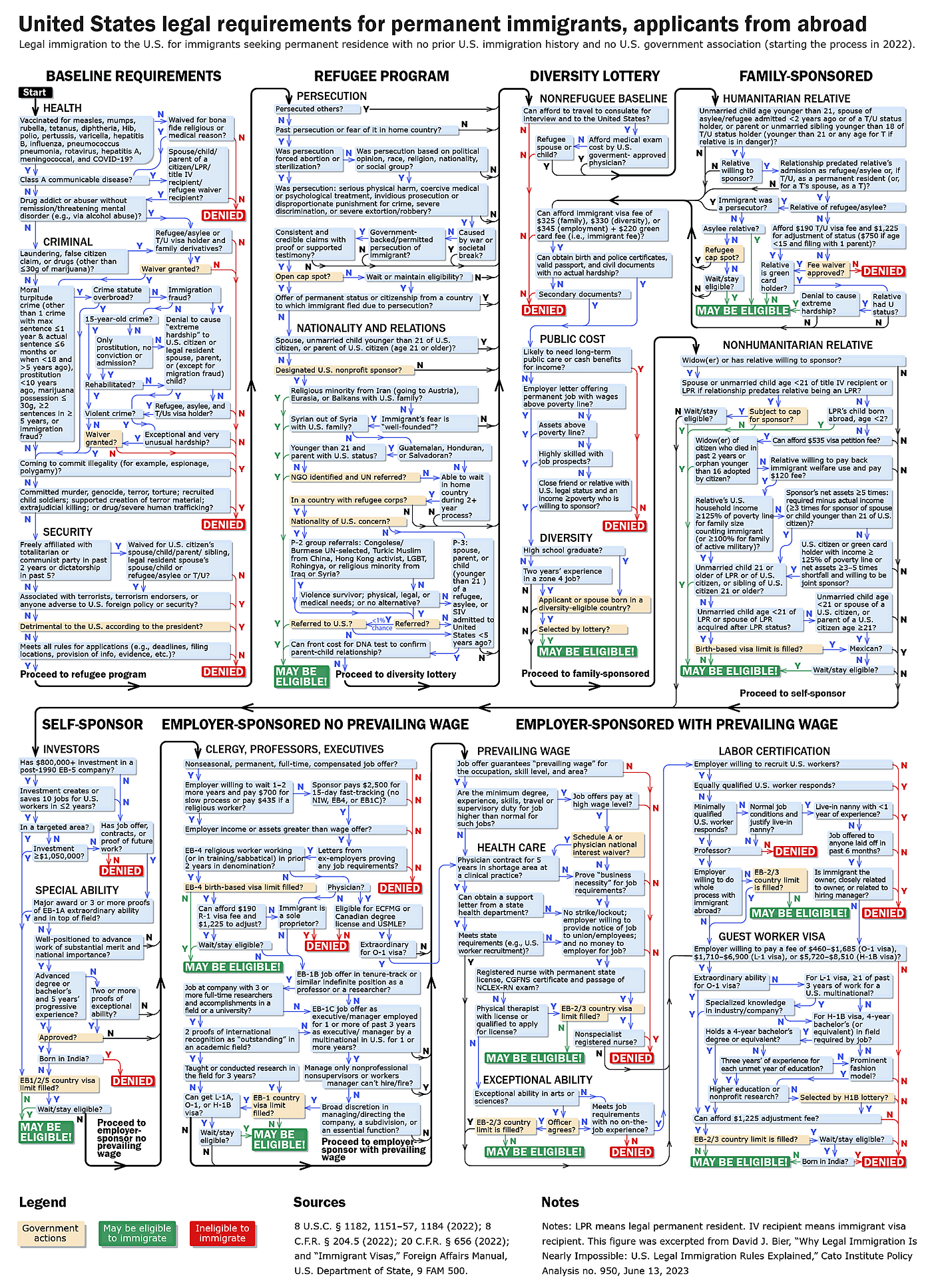
Why Legal Immigration Is Impossible for Nearly Everyone

Wonderful graphic illustrating the complexity of immigration to the USA. Canadian system if anything is more complex, given Provincial Nominee Program and the various “boutique” or targeted programs. Would be nice if IRCC could prepare such a chart as part of the briefing package for the expected incoming Conservative government as a basis for streamlining, simplification and automation:

My latest policy analysis published today explains why it is impossible for nearly all immigrants seeking to come permanently to the United States to do so legally. The report is a uniquely comprehensive and jargon-free (to the extent possible) explanation of U.S. legal immigration. Contrary to public perception, immigrants cannot simply wait and get a green card (permanent residence) after a few years. Legal immigration is less like waiting in line and more like winning the lottery: it happens, but it is so rare that it is irrational to expect it in any individual case.

The figure below shows the U.S. legal immigration system for people who are abroad who presently intend to immigrate permanently to the United States. Below I briefly describe the main problems and choke points in this labyrinth.

Flow chart of the entire legal immigration system

Guilty Until Proven Innocent

Until the Immigration Act of 1924, everyone in the world was eligible to immigrate to the United States unless the government proved they fell into an ineligible category. In other words, innocent until proven guilty. Since then, the foundational principle of U.S. immigration law is that everyone in the world is ineligible to immigrate unless they prove to the government they fit into an eligible category. The result is that over 99 percent of all those wanting to immigrate to the United States cannot do so legally.

Source: Why Legal Immigration Is Impossible for Nearly Everyone

Todd: Can Ottawa solve the problem of millions of expiring Canadian visas?

More commentary on immigration policy and program failures:

…How did we get to this muddled state, where the government admits the numbers are out of control — and that it can’t even track, let alone control, the movement of hundreds of thousands, if not millions, of the country’s guest workers and foreign students?

In 2019 I wrote an optimistic column about how the Canada Border Services Agency was going to bring in “exit controls” to help fix our infamously leaky borders.

The upshot was that proper exit controls would increase the likelihood officials catch homegrown terrorists, individuals who illicitly take advantage of taxpayer-funded health care and, particularly, people who overstay their visas.

The plan was to better track when people leave the country by land, sea or air — using techniques long in place in Australia, the U.S. and the European Union. But even though upgraded exit controls were instituted in 2019, they have not made an obvious difference in compelling people to follow the rules regarding how long they can stay in the country.

To add to the disorder, 2024 had a drastic rise in the volume of temporary residents — 130,000 — trying to overstay their work and study visas by applying for refugee status. That’s up from 10,000 less than a decade ago. The asylum claims process can take several years.

In response to questions from Postmedia, the CBSA said it does what it can to monitor and penalize people who overstay. Specifically, officials said that for various reasons it issued more than 3,700 “removal orders” in 2024, compared to 1,517 in 2020.

Sam Hyman, a retired Vancouver immigration lawyer, said Canada, unlike many countries, doesn’t have exit immigration controls that require all travellers who leave to be examined and their departure confirmed. But, he said, there is a certain degree of border-crossing monitoring.

Vancouver lawyer Richard Kurland, publisher of a monthly migration newsletter called Lexbase, says more rigorous entry and exit controls, while useful, won’t solve Canada’s border crisis alone.

He’s more concerned the government is trying a number of strategies to avoid taking blame for the migration turmoil, first by “denying” it, then by “distracting” from it and now by “repackaging” it, while making new promises.

After Trudeau spent years accusing critics of his high migration policies of being xenophobic or racist, Kurland said he and Miller last year “did a 180 (degree turn) and offered a mea culpa,” admitting to overshooting.

However, they then compounded their blundering, Kurland said, by promising temporary residents who overstay their visas a general amnesty.

“But when you have immigration amnesties, why obey rules, when all you have to do is to hide and wait for the next amnesty?” Kurland said. After the public rose up in criticism, Kurland said the Liberals had to pull back their scheme.

“We are left with the chicken in the python,” Kurland said, “which will be a ticking immigration time bomb for whoever replaces the Trudeau government.”

Source: Can Ottawa solve the problem of millions of expiring Canadian visas?

Thousands of caregivers’ status at risk as immigration programs stall 

Another example of poor management:

Thousands of caregivers from overseas may need to leave the country or risk staying here illegally as Ottawa delays the rollout of a new pathway to permanent residency for nannies and home support workers.

Since 2019, the Home Child Care Provider and the Home Support Worker pilot programs have brought caregivers and support workers to Canada from overseas on temporary work permits, allowing them the ability to apply for permanent residency.

But those programs ended in June, when the federal government announced it would introduce new pilot programs that have yet to be launched.

In a statement to The Globe and Mail, Immigration, Refugees and Citizenship Canada said the department needed time to reduce the number of existing permanent residence applications through the old pilot programs before launching the new ones. The statement from early December also said that full eligibility criteria and details on how to apply for the programs will be available in the “coming months.”…

Source: Thousands of caregivers’ status at risk as immigration programs stall 


NP View: Canada’s welfare state crumbles under the strain of irresponsible immigration

Forgets that Canada was able to manage relatively high levels of immigration until the Liberals were seduced by Barton, the Century Initiative and others, along with provincial government, business and education pressures for more….:

…In Canada, 2024 may eventually be remembered as the year of Milton Friedman’s revenge. Late in his life, the American sage of free markets said on a couple of different occasions that immigration was good, and the mass immigration to the New World of the early 20th century was especially good, but that radically open borders are incompatible with large contemporary welfare states. This may strike many as an uncontroversial claim, but Friedman has never been totally forgiven by radical open-borders libertarians who otherwise venerate him.

As a result, it is rather hard to find any discussion of the Friedman dilemma that isn’t sharply critical. Bryan Caplan, a great admirer of Friedman and an important libertarian economist, for example, attributes Friedman’s warnings to senile “paranoia” and bad math.

We Canadians have all lived through a year in which the carrying capacity of a model welfare state was tested to its political limit, and beyond, by poorly controlled immigration. For a half-century, very high immigration levels, levels without much parallel anywhere else in the world, were a distinguishing core part of the Canadian political philosophy. We thought of ourselves as filling in a vast empty map and pursuing diversity as an end in itself, while being administratively careful to choose the most promising immigrants.

This has all transformed very suddenly, and is a major factor in the crisis now devouring the Liberal Party of Canada. In 2024, the public began to hear warnings from labour and bank economists that governments had lost control of fundamental immigration parameters, and the state lost the ability even to count resident non-citizens accurately in real time. Under pressure from the COVID pandemic, Liberals had opened the door to an unprecedented (even for Canada) flood of low-wage guest workers, asylum seekers and international students who were hypothetically supposed to be self-supporting.

These choices have had obvious first-order effects on semi-official safety-valve parts of our welfare state, like emergency shelters and food banks. They have put crazy pressure on housing construction, which remains constipated by heavy regulation, and have increased demand for health care, which is shielded from ever-suspicious “market forces” and thus cannot react to population growth in the way that shoe stores do.

They have also coincided with a period of stagnant labour productivity, disconcerting urban decay and grotesque reversals in per capita GDP — something that open-border advocates wouldn’t predict, didn’t predict and can’t really explain. We have behaved in the 2020s exactly like a welfare state that was determined to test Friedman’s principle, and we found it to be true.

Of course, if we could put a Friedman clone in charge of our country, or for that matter Bryan Caplan, we would be sure to end up with a more nimble and adaptable economy with less of a necessity for limiting newcomers. Canada is a country that tries to combine plenty of economic nationalism with sky-high immigration. This was always a curious and expensive mixture of ideals. After a decade of a Liberal government proclaiming our “post-national” character, and being openly hostile to cultural nationalism and historical traditions, it is beginning to seem like plain madness.

Source: NP View: Canada’s welfare state crumbles under the strain of irresponsible immigration