Emblemic of the “undercounting” is that the Immigration Levels Plan does not include temporary residents (workers and students), an oversight that many are noticing given the rapid rise in their number over the past 20 years.
Housing availability and affordability is the most obvious Achilles Heel of the government’s approach but there healthcare and infrastructure are also significant:
Canada’s explosive population growth from immigration is causing rents to surge in its biggest cities. And there’s another problem: The country isn’t even properly counting the number of people who need homes.
Prime Minister Justin Trudeau’s government plans to welcome 465,000 new permanent residents this year, and increase the annual target to half a million by 2025. But those often-cited numbers understate the pressure on the country’s limited supply of housing —because they don’t include a wave of foreign students, temporary workers and others with non-permanent visas.
The country actually had close to 1 million international arrivals last year, according to an analysis by Canadian Imperial Bank of Commerce that’s based on other data, including visas. It will probably accept a similar number this year, said Benjamin Tal, the bank’s deputy chief economist.
Apartment Rents Are Soaring in Canada’s Cities
Rent increases for two-bedroom apartments, year-over-year
As a result, Canada is experiencing its fastest population growth since the 1970s, and apartments have become extremely hard to find. The vacancy rate on rental buildings is below 2%, the lowest since 2001. In Vancouver, it’s less than 1%. The situation is made worse by rising interest rates that have made buying a home unaffordable for many people, pushing them into the market for rental properties.
“We’re underestimating how many people are here and how many people are requiring real estate,” Tal said in an interview. “If you don’t have official numbers showing the demand accurately, municipalities making allocation for housing based on those are missing the magnitude of the need.”
The consequences of that undercounting can already be seen, Tal said. Rent inflation was nearly 6% in the last two months of 2022, accelerating from 3.1% early last year.
International Migration to Canada Spikes
Landlords in many provinces face legal restrictions on how much they can increase rents on existing tenants. But when a two-bedroom apartment is vacated, the average increase for the next tenant is 18.2%, according to Canada’s national housing agency.
Local government red tape is one reason more apartments aren’t being built, Kenney said, which means housing policy is out of alignment with Trudeau’s approach to immigration.
“Canada was at a point for many, many years where we had housing affordability and you could have open immigration policy. There were ample homes for all,” Kenney said. “The combination of turning up the volume on the immigration front, and turning down the volume on development, has put us in really bad shape.”
Housing costs are causing some to uproot from the priciest cities in search of cheaper locations. Toronto gained people from international migration but also saw a net outflow of nearly 100,000 residents to other parts of Canada in the 12 months ended July 1.
Toronto Sees Growing Outflows Amid Housing Crunch
Some are landing in Calgary and Edmonton, the largest cities in Alberta, which saw a significant increase in migration from other parts of Canada. “It’s rare to be able to find an empty apartment now, unless it’s new,” said Sam Kolias, CEO of Calgary-based Boardwalk Real Estate Investment Trust. “There’s lots of jobs here.”
A spokesperson for Immigration Minister Sean Fraser said the government takes housing into account when it sets immigration policy, and it’s a factor in who it allows in.
“In order to meet housing demands for those who have newly entered Canada, and the nation’s housing needs in general, we have taken great care to ensure our immigration plan selects individuals with the skills to build homes in Canada, and encourage them to settle in parts of the country that have housing capacity,” Bahoz Dara Aziz, Fraser’s press secretary, said in an emailed statement.
‘Get the Numbers Right’
CIBC’s Tal said it’s “misleading” to focus on the number of new permanent residents when calculating housing needs. And there are other quirks of Canada’s statistics-gathering process that may result in underestimating demand for places to live, he added.
It all suggests that “existing policy tools will easily fall short of addressing the current and future increase in housing demand,” Tal said in a report to investors. If there’s no change in how migration data are captured and debated, Canada may find it harder to absorb its rising number of immigrants, he said.
“The official numbers don’t tell you the story. When we think about the housing policy, a precondition is to get the numbers right.”
Realpolitik, no incentive for USA and off-loading some of their “problems” makes meaningful and successful negotiations unlikely, although Michael Barutciski argues that it can be done (Is a diplomatic solution possible for Roxham Road?:
On the day that Quebec Immigration Minister Christine Fréchette celebrated the mass relocation of Roxham Road migrants to Ontario, her boss, Premier François Legault, told reporters he couldn’t understand why the U.S. wasn’t willing to take border-crossers back.
He met U.S. Ambassador David Cohen on Tuesday, and then said he doesn’t know why the U.S. won’t change a border agreement so people who enter Canada at Roxham Road, an unofficial crossing between Quebec and New York State, can be returned to the U.S.
“I said to him, I don’t understand why it is taking so long to settle with the United States.”
Mr. Legault is an intelligent politician, so he must be deliberately playing dumb.
He knows the relief that government leaders feel when their intractable problem becomes someone else’s. Ms. Fréchette said the Quebec government was “very happy” that 372 of the 380 people who crossed into Canada at Roxham Road since Saturday had been relocated outside Quebec.
Surely Mr. Legault must have a clue as to why the U.S. government isn’t rushing to solve Canada’s Roxham Road issue.
The U.S. position is not an accident. It has for decades resisted doing what Canada wants it to do on this file.
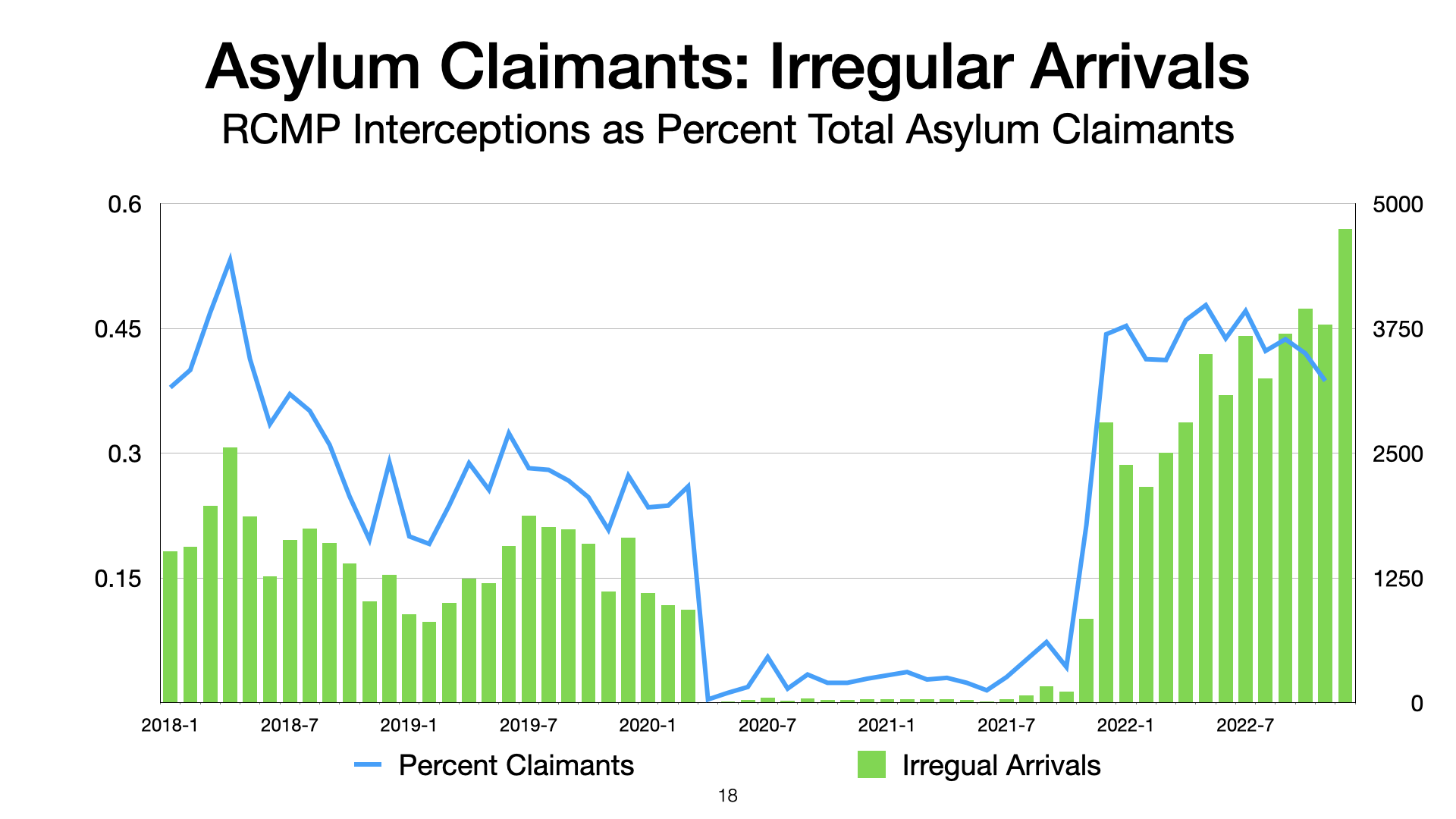
To be clear, Quebec is right to want some of the migrants, many of whom will seek asylum, to be relocated. The RCMP intercepted 39,171 people entering Canada at Roxham Road in 2022, and the province, and especially Montreal, complained their capacity to settle people was strained. The border is Canada’s responsibility, not just Montreal’s, or Quebec’s.
And certainly, it would be easier on all levels of government in Canadaif the United States just took all those people back. But it has resisted.
Politicians shouldn’t act as though getting the U.S. to change should be a snap. Justin Trudeau’s government has hinted a deal might be coming, but we might want to see it before we believe it. You’d have to think there would be some serious quid pro quo. It isn’t the Americans’ border problem.
There was a period in the pandemic when the U.S. did accept people back, in theory temporarily, when both countries closed their borders. Not many people tried to cross at Roxham Road. But the U.S. ended that arrangement in November, 2021. People started crossing there again.
There was a long history before that. At one time, asylum-seekers could simply show up at any official border crossing and claim refugee status in Canada. But as the numbers grew in the 1990s, Ottawa tried and fail to make a deal. The U.S. declined. It was only after the 9/11 attacks, in a broad border pact, that the U.S. accepted a Safe Third Country Agreement that allowed Canada to return asylum-seekers who arrived via the U.S. to make their claim there.
But it only applied at official border posts, and for a pretty simple reason: The United States wanted it that way. It didn’t want the trouble of accepting people who might show up anywhere along the long border with Canada.
The agreement was always opposed by refugee advocates, but from the start there was also a concern that it would encourage people to cross the border in illicit places. Jason Kenney has said he tried to convince the U.S. to change it when he was immigration minister in Stephen Harper’s Conservative government, to no avail.
Fast forward to now, when Roxham Road has become a well-travelled route, and the U.S. still isn’t itching to change it. And we shouldn’t be surprised, when the hottest political issue in the U.S. is illegal entries across the Mexican border, that the U.S. is not racing to stop 40,000 people from leaving.
If the U.S. did apply the Safe Third Country Agreement outside official border crossings, it would shut down Roxham Road, but more people would cross at the many other locations along the boundary.
Taking them all back would require more work and more patrols along the Canadian border when the U.S. devotes its resources to the Mexican boundary. The U.S. Border Patrol has 2,073 agents along the northern boundary, compared to 16,070 agents at the southern border – whose patrols logged more than a million “encounters” with border crossers in 2022.
And U.S. President Joe Biden couldn’t expect to be celebrated for making a deal with Canada that prevents tens of thousands of asylum-seekers from leaving the U.S. New York City Mayor Eric Adams, a Democrat like Mr. Biden, has been giving asylum-seekers bus tickets to get to Roxham Road. No one should be surprised the U.S. isn’t jumping to “solve” this Canadian problem.
Of concern, accelerating trend that I started identifying a number of years ago:
StatCan numbers reveal the percentage of permanent residents who become Canadians has plummeted over the past 20 years.
The Institute for Canadian Citizenship says Statistics Canada data points to a 40 per cent decline in citizenship uptake since 2001.
The group’s CEO, Daniel Bernhard, calls the drop alarming and says it should serve as a “wake up call” to improving the experience newcomers have in Canada.
In 2021, nearly 45.7 per cent of permanent residents who’d been in Canada for less than 10 years became citizens.
That’s down from 60 per cent in 2016, and 75.1 per cent in 2001.
The StatCan data did not identify reasons for the drop, but Bernhard suggests Canada’s cost of living and job prospects are likely factors.
He says the institute is investigating root causes.
“There are a myriad of issues,” said Bernhard.
“But ultimately, what’s changing is that people have decided that they’re less interested in being `Team Canada.”’
Bernhard said the decline affects Canada’s long-term economic and social outlook.
“This is a problem for all of us who care about Canada’s future prosperity and dynamism,” he said. “We need to solve this for the future of our country.”
The federal government has said it wants to boost immigration by adding 1.45 million permanent residents over the next three years, starting with 465,000 in 2023 and increasing to 500,000 in 2025.
As Canada ratchets up immigration to the highest levels in its history, surprising new figures from Statistics Canada are showing that nearly half of all recent immigrants are no longer bothering to seek Canadian citizenship.
The numbers were publicized this week by the Institute for Canadian Citizenship. And according to the group’s CEO Daniel Bernhard, they may be a sign that the Canadian dream is no longer working out for newcomers.
“What’s changing is that people have decided that they’re less interested in being ‘Team Canada,’” Bernhard said in a statement, adding that the figures are a “wake up” call to the Canadian immigrant experience is treating new arrivals.
In 2021, of the permanent residents who had come to Canada within the last 10 years, just 45.7 per cent had become citizens. In 2001, that figure was 75.1 per cent.
It’s not the first time that evidence has emerged to show that new immigrants are not as enthralled with Canada as in prior decades.
A March Leger survey — also commissioned by the Institute for Canadian Citizenship — found that more than one fifth of recent immigrants were already making plans to leave. Among under-34 immigrants, in particular, 30 per cent said they were “likely” to leave Canada within the next two years.
As to why, newcomers are citing the same concerns with the country as native-born Canadians: Skyrocketing housing costs and diminishing access to government services such as health care.
In the Leger poll, even among immigrants who wanted to stay, their number one reservation was “high cost of living.”
In a bid to boost GDP, the Trudeau government has already raised Canada’s immigration intake to the highest levels in Canadian history, and is on track to bring in 500,000 newcomers annually by 2025. Absent any dramatic policy changes, this influx will likely worsen many of the issues that are already beginning to scare away new Canadians.
On Tuesday, CIBC CEO Victor Dodig warned that if Canada continued packing in immigrants without a viable plan to absorb them, it could spur an unprecedented “social crisis.”
“New Canadians want to establish a life here, they need a roof over their heads. We need to get that policy right and not wave the flag saying isn’t it great that everyone wants to come to Canada,” Dodig said at an event hosted by Canadian Club Toronto.
One other factor potentially driving down rates of immigrants seeking citizenship is that Canada’s immigrant stream is increasingly coming from countries that do not tolerate dual citizenship, thus prompting many newcomers to remain permanent residents in perpetuity.
The chief examples are India and China. Indian nationals are required to surrender their Indian passport the moment they become Canadian citizens. Chinese prohibitions on dual citizenship were illustrated most glaringly in 2021, when the Beijing government tightened its control on Hong Kong by forcing 300,000 residents with joint Canadian citizenship to either leave or tear up their Canadian passport.
Both countries now represent a significant share of Canada’s current immigrant influx. As per 2021 figures, 18.6 per cent of recent Canadian immigrants reported India as their birthplace, while 8.9 per cent reported being born in China.
For context, just three per cent of recent immigrants were born in the United States.
In 2022, Canada officially welcomed 431,645 immigrants. Notably, the last time in Canadian history that immigration levels were this high — during the settling of the prairies in the years preceding the First World War – it was also paired with surging levels of outmigration as many newcomers swiftly abandoned their new Canadian homesteads.
“A lot of people left; outmigration was as high as in-migration for a very, very long time,” Adele Perry, a researcher of Western Canadian history, told the National Post in 2012.
The federal government transported almost all of the migrants entering the country through Roxham Road to other provinces over the weekend, said Quebec Minister of Immigration Christine Fréchette on Tuesday, calling the wave of relocations a “new approach” from Ottawa.
Three hundred seventy-two of the 380 migrants who arrived in Quebec by that route on Saturday and Sunday were relocated, largely to Ontario, the minister said in a scrum in Quebec City on Tuesday.
She saluted Ottawa for fulfilling the province’s demand for help with the recent influx of asylum seekers through the irregular border crossing south of Montreal and called on Justin Trudeau’s government to continue.
“We are starting to see results,” said Ms. Fréchette. “We’re very happy with that.”
The federal government has been relocating Roxham Road migrants regularly because of capacity constraints in Quebec since last summer, and would not confirm whether the spike in relocations was a new policy or a blip. Since June, more than 5,300 migrants have been relocated from the province, including some 500 to Windsor, Ont., and roughly 2,700 to Niagara Falls, Ont.
A federal source said this is part of a long-standing initiative, paid for by Ottawa, but did not clarify whether the number of people being relocated outside Quebec have been expanded. The source added that people who do not want to relocate can stay in Quebec.
The Globe and Mail is not naming the source because they were not authorized to speak about the matter.
Ms. Fréchette called on the federal government to maintain the recent heightened rate of removals, repeating her government’s position that Quebec’s “welcoming capacity” has been surpassed. Roughly 60,000 asylum seekers arrived in Quebec last year, double the annual number from before the pandemic, the minister has said.
That has sparked a fierce political debate in the province about how to manage the situation, with the opposition Parti Québécois tabling a motion in the National Assembly recently calling on the government to “close” the border crossing.
Federal opposition parties have also repeatedly called for a review of the Safe Third Country Agreement with the United States, a long-standing pact that requires border agents from each country to turn away asylum seekers from the other if they present themselves at official land border crossings.
Roxham Road, along the border between New York State and Quebec’s Eastern Townships, has become the primary route for irregular entries into Canada in recent years. The RCMP intercepted 34,478 asylum seekers who did not use official ports of entry to enter Quebec between January and November of 2022, according to Immigration, Refugees and Citizenship Canada data, compared with just 316 in the rest of the country.
On Tuesday, Ms. Fréchette called the weekend’s mass relocations a “first step” that could potentially come to involve other provinces receiving asylum seekers from Roxham Road. She said the federal government recently booked 500 hotel rooms to house migrants in Ontario as a sign of seriousness.
“I don’t have information about what happened on Monday, but we are expecting that this new approach persists,” she said.
In the future, she added, her government is asking that the share of asylum seekers who stay in Quebec be kept around 22 or 23 per cent, in keeping with the province’s demographic weight within Canada.
Roxham Road has become one of the stickiest issues in Quebec politics as Premier François Legault’s nationalist Coalition Avenir Québec government has sought to manage public unease with the increase in irregular migration.
On Tuesday, Mr. Legault met with U.S. ambassador to Canada David Cohen to ask for a speedy renegotiation of the agreement governing asylum seekers between the countries.
“I said to him, ‘I don’t understand why it’s taking this long to settle with the United States.’ What we’re asking is that the Safe Third Country Agreement be applied to all ports of entry, including Roxham.”
La ministre de l’Immigration, de la Francisation et de l’Intégration, Christine Fréchette, s’est réjouie mardi du fait que presque la totalité des demandeurs d’asile ayant traversé la frontière par le chemin Roxham la fin de semaine dernière ont été envoyés en Ontario.
Parmi les personnes qui ont emprunté cette voie de passage irrégulier samedi et dimanche, seules 8 sur 380 sont restées au Québec, a affirmé Mme Fréchette en mêlée de presse. « On est très contents de ça et on espère que ça va se maintenir dans le temps », a-t-elle dit.
Récemment, « 500 chambres additionnelles » ont été réservées par Ottawa en Ontario afin d’accueillir des demandeurs d’asile, a-t-elle affirmé.
La ministre Fréchette soutient que « la capacité d’accueil du Québec a été dépassée ». « On demande à ce que la proportion des demandeurs d’asile qui restent au Québec équiva[ille] au poids politique du Québec à l’intérieur du Canada, a-t-elle ajouté. Donc on parle de 22 à 23 %. Là, on serait dans des eaux acceptables. »
Christine Fréchette admet toutefois que le dossier sera « réellement réglé » par une renégociation de l’entente entre le Canada et les États-Unis sur les tiers pays sûrs. Le chemin Roxham, situé au sud de Montréal, n’est pas soumis à l’accord, car il s’agit d’une voie de passage irrégulier. Un total de 39 171 demandeurs d’asile y ont été interceptés l’an dernier.
En juillet dernier, Jean Boulet, qui était alors le ministre québécois de l’Immigration, avait salué la décision du gouvernement fédéral de rediriger en Ontario une centaine de demandeurs d’asile entrés de façon irrégulière au Québec.
Le bureau du ministre fédéral de l’Immigration, des Réfugiés et de la Citoyenneté, Sean Fraser, dit s’adapter depuis l’été dernier en fonction de la capacité du Québec et de ses besoins. « On reconnaît qu’au Québec, c’est un gros fardeau », a dit au Devoir Émilie Simard, porte-parole du ministre.
Legault et l’ambassadeur américain
Plus tôt mardi, le premier ministre québécois, François Legault, a dit qu’il continuerait à faire pression sur son homologue canadien, Justin Trudeau, afin qu’il « accélère » les négociations avec les États-Unis concernant l’accord sur les tiers pays sûrs.
Il a d’ailleurs profité de sa rencontre le jour même avec l’ambassadeur américain au Canada, David L. Cohen, pour déplorer le fait que le chemin Roxham n’est pas inclus dans l’entente.
Sur Twitter, M. Cohen s’est réjoui d’avoir pu discuter des « objectifs des États-Unis et du Canada en matière d’énergie propre, de commerce et de nos frontières communes ».
This is a somewhat silly header. After all, would cutting immigration erase racism?
More substantially, Khan’s commentary lacks historical perspectives, as there has been progress since the elimination of racial preferences in the 1960s. International comparisons with other OECD members provide a more balanced assessment, where Canada is one of the stronger countries in its integration outcomes. Public opinion research, particularly that of immigrant and minority populations, tends to portray that most are reasonably satisfied with their life in Canada, with relative few differences with the non-minority groups.
Of course, Canada far from perfect but to only focus on the shortcomings without acknowledging progress or comparing Canada with other countries reads more like a rant than measured analysis. To use an Australian term, this narrative is that of a “black armband” where everything is negative.
Of for a Canadian term, this is a woke version of Polievre’s “everything is broken.”
That being said, immigration should not just be a numbers game “the more the merrier” as I have and continue to argue:
In its latest immigration plan, the federal government says it hopes to welcome almost 1.5 million new permanent residents between 2023 and 2025, up from approximately one million in the immigration targets for 2020-22. The economic benefits of increased immigration aside, there remains a major elephant in the room that Canada is still not ready to address – racism and discrimination against “visible minorities” – code for non-white immigrants.
While recent surveys claim that public opinion in Canada is more in favour of immigration than ever, recent practices suggest otherwise. Examples include heightened surveillance of select immigrant populations, intense scrutiny of some of their financial resources and discrimination against migrant workers. There have also been incidences of hate crimes against members of immigrant groups. The government must address the issue of racism in immigration policy with a series of broad measures. Otherwise, if left unaddressed, these incidences have the potential to work against Canada’s intentions to continually increase immigration levels and grow its economy.
This is the key failing of the government’s plans on immigration, past and present. Although the latest plan does discuss anti-racism measures much more than previous versions, it is strictly in the context of Immigration, Refugees and Citizenship Canada’s own organizational strategy. Unfortunately, it does not address the real issue – that racism is not just organizational, it is endemic in Canadian society.
A national immigration plan cannot succeed in the long term if it does not acknowledge or address racism and discrimination in society. This is important because eight out of the top 10 source countries for immigrants to Canada, accounting for almost 70 per cent of annual intake, are non-white countries from the Global South.
This disconnect is becoming blatantly obvious in many ways. For instance, it is impossible to view the increase in immigration numbers without looking at the impact of regressive laws and policies such as Bill 96 in Quebec on new immigrants.
Racism affects not only our social connections with immigrants, but also our economic dependence on them. Canada’s approach to immigration has been to view migrants as a source of labour. That approach is bound to create tensions in the long term.
Immigrants may help with Canada’s labour shortages and aging demographics. But if the environment toward them is socially hostile, the chances of them gaining economic ground decrease substantially. In that case, Canada will no longer be a desired destination for people wanting to migrate. Or they will leave because the living conditions are toxic.
This hostility is on display in how Canada refers to immigrants in an official capacity. Immigrants are numerical “targets” to achieve in a given timeframe. International students are deemed the “ideal immigrants,” a common racist stereotype. Canada should not attract students based on how much labour or revenue they can provide in the long term – or because many students themselves use this as an opportunity to gain Canadian permanent residency – but rather how education can enrich their futures. Immigration levels are about “breaking records,” as numbers are increased based on labour shortages rather than the capacity to absorb new people from different parts of the world.
Phrases used by the government to justify rising numbers, such as “filling labour shortages, creating jobs, and driving economic growth,” perpetuate stereotypes of immigrants. The term “visible minority,” or the politically correct “racialized newcomers,” indicates a continued “othering” of immigrants. Semantics hide the racist notion that immigrants are only as useful as their revenue-generating skills. Everything else is their own problem.
This approach to reducing immigrants to labels and economic tools completely ignores the existence and reality of racism as a social and economic hurdle for immigrants. Canada sees new immigrants as a way to fill labour shortages, but the statistics tell a different story. New immigrants are far behind their Canadian-born counterparts in finding employment. Yet, the push to increase immigration levels to record highs continues without anyone talking to employers about immigrants’ inability to find work. This may only increase unemployment rates amongst racialized groups.
Racism also applies to our policies toward refugees and asylum seekers. Recent cases have shown how authorities continue to treat refugees from Afghanistan differently compared with those from Ukraine. If Canada is choosing to discriminate among seriously at-risk populations such as refugees fleeing war and death based on – it can be assumed – their race or religion, this itself proves the point that racism is more than just an organizational issue. It is endemic in our society.
For instance, Canada’s recent appointment of a representative to combat the rise in Islamophobia in this country reflects the federal government’s concern that violence and racism toward racialized communities is becoming normalized. But it ignores longstanding racism against the original inhabitants of this country.
Indigenous communities continue to be oppressed, and the arrival of immigrants, many of them unaware of Canada’s dark colonial past, only adds to Indigenous communities’ distrust of settlers.
Among racialized communities in Canada, Black and Asian Canadians also continue to experience some of the highest levels of discrimination.
If Canada truly wants its millions of new immigrants to be able to contribute to the country, it must address racism and discrimination as broad societal issues. We need a holistic policy approach, not one that is piecemeal.
To do this, the thinking around immigration needs to evolve and specifically address the following in policy and practice:
First, there is a need to change the language around immigration to Canada. This starts with changing how Ottawa frames immigration and immigrants as a labour supply issue. Immigration is a human right and not a numbers game. It must work for both the migrant and the host country.
Second, immigration is never purely economic. Regular immigrants also attempt to escape conflict, discrimination and political instability in their home countries. This is important to remember when assessing admissibility and the potential of each immigrant beyond just their economic capabilities.
Third, anti-racism efforts must be incorporated into the philosophy of services provided to immigrants including settlement services, employment, housing, education and health. This will require different federal, provincial and territorial departments to work in tandem with each other, not in silos.
Last, any immigration plan must also come with a strategy that socially protects the rising number of immigrants rather than just economically compensates them. Addressing racism and race relations must be important elements when designing immigration policy in a country that calls itself multicultural.
Immigration cannot just be about achieving targets and numbers. It is not an assembly line opportunity. Ultimately, we are dealing with individuals and families who also have hopes and expectations of Canada. Undermining these expectations through racial discrimination is the last thing anyone seeking to start a new life in a new country needs.
Yet another study highlighting some of the implications and impacts of Canada’s high level of immigration:
Canada needs to ramp up home building by 50 per cent just to keep pace with immigration, according to a new report.
The country is on track to break ground on about 210,000 housing units this year, according to Desjardins Securities. But the Desjardins report says about 100,000 additional housing starts are needed this year and next, as Canada gets ready to admit a record number of immigrants.
Many economists and real estate industry experts believe there is a severe shortage of housing in the country – and it will only get worse. Canada has increased immigration levels to make up for the shortfall during the first year of the pandemic and to help fill jobs in construction, health care and other areas.
With the federal government planning to admit 1.45 million new permanent residents over the next three years, the report says, housing starts must become a priority, in part because of the time it takes to complete a housing unit.
“We have to dig out of a hole and move higher ultimately,” said Randall Bartlett, Desjardins’ senior director of Canadian economics.
A large share of new immigrants end up in Ontario and B.C., two provinces where home prices have historically risen faster than in the rest of the country.
Although the typical home price across Canada dropped 13 per cent from the peak last February by December, the average price in the most popular destinations – Toronto and Vancouver – still tops $1-million.
“If these newcomers to Canada continue the recent trend of moving to Ontario and British Columbia, affordability there and nationally will erode further,” says the report, authored by Mr. Bartlett and Marc Desormeaux, the bank’s principal economist.
Desjardins’s call for more home construction echoes statements from the national housing agency, Canada Mortgage and Housing Corp., which has repeatedly said the country needs to increase its supply of homes.
Needed reminder and useful counterpart to the self-serving nature of many of those complaining about labour shortages:
Busy people often lament, “I wish there were more hours in the day!” They struggle to get all their tasks completed. An extra hour or two each day would surely ease the pressure.
While this frustration is understandable, no-one seriously believes our days are too short — nor that time pressures would be solved by stretching the day to 25 hours. Almost certainly, our to-do lists would just get longer, and we’d quickly face the same time crunch again.
This same flawed logic infects the chorus of complaints these days about a so-called ‘labour shortage.’ Employers moan they can’t find enough workers. They preferred it when unemployed workers abounded, and simple job ads could elicit dozens of applications.
Tiff Macklem, Governor of the Bank of Canada, also cites employers’ complaints as justification for painful interest rate hikes. He aims to ‘solve’ the labour shortage by deliberately raising unemployment.
The federal government, too, is catering to employers by increasing immigration targets to all-time highs. Properly planned and supported immigration is good for the economy and for society. But importing masses of workers just to make life easier for employers is the wrong way to do it (especially using exploitative temporary migrant programs).
At any rate, just increasing the number of people in the country doesn’t magically fix the labour market. Yes, there are more people to work, but now there is more work to do (since the population requiring housing and subsistence also grows). It’s like lengthening the day to 25 hours, while adding more tasks to your list.
All these policies would make it harder for Canadians to find and keep good work — which should be our central economic goal. Pushing more workers into the labour market, while reducing job opportunities, will certainly make like easier for HR managers. But it will undermine life chances for most Canadians.
Statistics prove that Canada is not anywhere near ‘running out’ of workers. There are more than a million officially unemployed. Another million or more are underemployed, working short hours or in menial jobs that don’t fully utilize their abilities. And at least a million more potential workers (including hundreds of thousands of female parents, and hundreds of thousands of nonemployed who aren’t counted as officially ‘unemployed’) sit on the sidelines of the labour force.
Fully employing these Canadians would expand national output by 15 per cent. It would reduce poverty and exclusion. And it would allow us to undertake vital priorities: like strengthening health care, expanding green energy, and building affordable housing. Instead, the economy is being deliberately held back to maintain an ample buffer of idle workers, ready anytime employers need them.
To be sure, employing every available worker (and achieving genuine full employment) would require careful planning and supports. We’d need stronger vocational training pipelines to train and retrain workers, and connect them with relevant jobs. We’d need better child care, flexible hours, and public transit to support healthier work-life balance. And we’d need different ways of setting wages: through industry-wide negotiations that lift real wages steadily and sustainably (alongside productivity), rather than using unemployment as a weapon to keep wages in line.
Ultimately, the terminology of ‘labour shortage’ propagates an employer-centric vision. It portrays the economy as a machine — and human beings as just another input to that machine (like energy, raw materials, or widgets).
In fact, the economy is there to serve us, not the other way around. The economy is the place where we use our energy and skills to produce the goods and services we need for a good life. If workers are fully occupied, that means we’re doing a good job supporting ourselves.
We shouldn’t complain about that, or try to prevent it. We should celebrate it.
Have to admire the entrepreneurial spirit of those helping irregular arrivals:
Moments after a Greyhound bus from New York City pulls into a gas station bus stop in Plattsburgh, N.Y., Friday at 5:25 a.m., several minivan taxis swarm the vehicle.
About a dozen passengers descend from the bus — mostly single men, but also several couples and a family with three young daughters. They are greeted by four pushy taxi drivers.
The drivers begin to shout: “Frontera!” — the Spanish word for border — “Roxham Road! 60 dollars! Come! Come!”
As the passengers unload luggage from under the bus, the taxi drivers are relentless, beckoning them into their cars for the 30-minute drive to Roxham Road, the wooded route into Canada that has become an unofficial border crossing for tens of thousands of asylum seekers over the past several years.
Most of the bus passengers approached by The Canadian Press refused to talk; some shielded their faces. Many weren’t dressed for winter: they wore T-shirts, thin jackets, sneakers. One couple, however, were prepared, wearing warm winter jackets, tuques, gloves and boots.
One single man hopped into a cab. Asked where he was from, he said, “Haiti.”
Anxiously waiting for the taxi to depart, the man said his bus ticket was “purchased by a friend.”
Last week, reports said officials from New York City were providing free bus tickets to migrants heading north to claim asylum in Canada. New York City Mayor Eric Adams told Fox 5 his administration helps in the “re-ticketing process” for people who arrive in the city but want to go elsewhere.
In December, a total of 4,689 migrants entered the country through Quebec’s Roxham Road — more than all would-be refugees who arrived in Canada in 2021. Crossing the irregular border allows them to take advantage of a loophole in a deal between the United States and Canada.
The Canada-U.S. Safe Third Country Agreement requires that asylum seekers make a refugee claim in the first “safe” country they reach. In practice, it means that border officials in Canada turn back would-be asylum seekers who show up at official checkpoints from the U.S. But they are not required to turn back asylum seekers who cross irregularly at places such as Roxham Road.
On average, about 100 migrants arrive daily at the Greyhound bus stop on their way to Roxham Road, according to Chad Provost, who runs his own shuttle service for migrants. On his business card is written “Roxham Road Border,” his WhatsApp number, and “24 hour service to and from the Canadian border. Asylum seekers and refugee safe transportation.”
Provost, standing at the bus station outside his minivan with three passengers inside, said he sometimes provides asylum seekers with free rides.
“A lot of them come from mess-up places. A lot of them just want a better life,” Provost said.
“There are some people I have driven for free. A lot of them don’t have any money. Some of these other drivers will just leave them here to freeze …. The gas station is closed at night.”
He says he doesn’t need to wrestle with the other taxi drivers to fill up his van — he gets his customers through word of mouth.
“My customers call me in advance to set up pickups from the bus stop to Roxham Road.”
For months, Quebec has been calling for the federal government — which controls Canada’s borders — to stop the flow or migrants, or at least ensure they are more equally distributed across the country after they arrive. The vast majority of people who enter irregularly into Canada cross into Quebec, putting a strain on the province’s social services.
The opposition Parti Québécois, meanwhile, has called for the provincial police to shut down Roxham Road entirely — but the party hasn’t said what it thinks should be done if asylum seekers choose another of the many forested routes into the country.
The province recently announced $3.5 million in aid for community organizations that have been struggling to provide food, clothing and housing for rising numbers of asylum seekers.
On Thursday evening, along the muddy trail leading up the border, a sign says “road closed.” A second sign a few metres away says, “Stop” in French. To the left, blue barrels act as pillars at the front of a makeshift entryway where asylum seekers line up and are met by RCMP agents.
One of those migrants is David Jesus Binto, 17, who arrived to Roxham Road in a taxi with another young man. Jesus Binto, wearing sneakers, jeans and an old-looking windbreaker over a T-shirt, says he and his friend are from Venezuela.
“We heard about (Roxham Road) through word of mouth. We left Venezuela for economic reasons,” he said in Spanish.
When asked if he had acquired the bus tickets for free, he replied that they had purchased the tickets themselves.
RCMP agents tell the migrants that if they cross the blue bins into Canada, they will be placed under arrest.
Jesus Binto, his friend and several others walk in single file toward the agents and into Canada.
Would be nice if we actually had published data on the number of visa overstays to inform policy and monitor extent of issue (USA reports on overstays). Some progress in recognizing impact of immigration on housing…:
Prime Minister Justin Trudeau says he’s pushing Canada’s immigration system to soften its approach to processing visa applications and put less focus on the risk of visitors overstaying their short-term visas.
“We’re also trying to do a better job around temporary visas,” Trudeau said Friday.
“The system — I’ll be honest — is still based around, ‘Prove to me that you won’t stay if you come,’ right?” he said, arguing that it is easier for applicants to “convince” immigration officials to grant them visas if they have “a good job and a home and a house and a good status back home.”
On the other hand, people who are strongly motivated to be in Canada for family reasons could be seen by officials as more likely to overstay, he suggested: “If your mom talks about how much she loves you and just wants to be there (in Canada), and you’re there all alone, that’s scary.”
Trudeau made the remarks Friday during an hour-long meeting with about 25 Algonquin College nursing students in Ottawa. Many of them told him they are international students, and a handful mentioned visa issues.
During a question-and-answer session, one international student recounted being hospitalized for seven months and feeling isolated. She told the prime minister her mother had tried twice to get a visa to come visit her, but both applications were rejected.
Trudeau responded that it is vital for Canadians to have faith in the integrity of their immigration system. But he also suggested that he had asked Immigration, Refugees and Citizenship Canada to take a less defensive posture when issuing visas.
“We have to stop saying ‘Well, it would be a bad people, a bad thing, if these people were to choose to stay,'” Trudeau said. “Our immigration minister, Sean Fraser, is working very, very hard on trying to shift the way we look at immigration and make sure that we’re bringing people in.”
The prime minister told the student that the Immigration Department made the wrong call in deciding not to admit her mother.
“It would seem unfair to Canadians and to all sorts of people if there was a back door. These are all the things we’re trying to balance,” Trudeau said. “But I absolutely hear you. Your mom should have been able to come and see you.”
Trudeau added that the federal immigration system is challenged by Canada’s need to fill labour gaps and by numerous crises abroad that are causing people to flee their homes.
Trudeau also said Ottawa has to do a better job helping immigrants thrive. Otherwise, he said, Canadians’ warm feelings toward immigration could chill.
“An anti-immigration party would have a hard time succeeding in Canada, because so many Canadians understand how important that is,” Trudeau said. “We need to protect the fact that Canadians are pro-immigration.”
For example, he said there must be enough housing stock for newcomer families to establish themselves without breeding resentment among the Canadian-born population. But he suggested immigration could also help solve that problem.
“There’s a labour shortage in the construction industry and building houses. So as we bring in more people who can build houses, we will solve some of the housing shortage,” said Trudeau.
“There are solutions in this. Part of it is shifting the attitudes. Part of it is also just improving our ability to process (applications) using proper digital means and computer means.”
Fraser’s office confirmed that work is underway to look at how Ottawa issues visas for relatives of people already in Canada.
“Reuniting families is a pillar of Canada’s immigration system,” the minister’s spokeswoman, Bahoz Dara Aziz, said in a statement. “We continue to be guided by principles of fairness and compassion, and work to explore all avenues possible in bringing people together with their loved ones.”
Canada’s visa denials and processing delays have made global headlines in the past year, with citizens of developing countries finding themselves unable to attend global conferences hosted in Canadian cities.
This week, the International Studies Association went public with its struggles to get visas for hundreds of people set to attend a Montreal conference next month.
Despite presenting plane tickets, income data and evidence of funding they received to attend the conference, many attendees, including panelists, have been denied on the grounds that they can’t demonstrate a likelihood of returning home when the event is over.
The issues follow an uproar last year over the denial of visas for multiple African delegates to the International AIDS Conference, also held in Montreal, which had some accusing Canada of racism.
Data updated Tuesday show that visa applications take an average of 217 days to process for people based in Britain. It’s 212 days for people in France.
While citizens of those countries don’t need visitor visas to come to Canada, academics from many developing countries who are based in Paris or London do need a visa to attend a conference Canada.
The Immigration Department did not respond to the concerns until after The Canadian Press published an article Wednesday.
“IRCC works collaboratively with organizers of international events taking place in Canada to help co-ordinate processing of temporary resident visa applications for delegates or participants to Canada,” spokesman Jeffrey MacDonald said in an email.
“We are committed to the fair and non-discriminatory application of immigration procedures. We take this responsibility seriously, and officers are trained to assess applications equally against the same criteria.”
The department said the complexity and accuracy of information in a visa application can influence how quickly IRCC processes it, in addition to the staffing and resources of offices that handle the requests.
But the department also noted that the processing times it posts online are often not “reflective of reality.”
That’s because the estimate is based on how long it took officials to process 80 per cent of applications in the previous six to eight weeks. Those include long-backlogged cases.
“Processing times can be skewed by outliers, in particular applications from our older inventory that were previously on hold for a long period of time and are now being processed,” MacDonald wrote.
“Once this backlog of applications is cleared, we will start to see processing times more reflective of reality.”
Hard not to see how this story, and the higher numbers, will not encourage the government to act (not just pretend to act?):
U.S. Customs and Border Protection (CBP) is investigating reports that some of its border patrol agents are driving Quebec-bound asylum seekers to the irregular border crossing on Roxham Road in exchange for money, picking up groups of people in nearby Plattsburgh, N.Y., while off duty.
Sources have told Radio-Canada the practice “has been known for a few months,” adding that several agents are involved, but the exact number is unknown.
The CBP’s Office of Professional Responsibility (OPR) said Friday it “is in receipt of these allegations and is conducting an investigation” but “the commencement of an OPR investigation is not indicative of wrongdoing or the substantiation of alleged misconduct.”
This situation has been reported to Canadian authorities, according to Radio-Canada sources.
Many people looking to cross into Canada use a regular bus line to get to Plattsburgh,which is about 30 minutes away from Roxham Road.
From there, they walk through a wooded passage, enter Canada and seek asylum.
CBSA says it’s ‘aware of situation
When first contacted by Radio-Canada, the Canada Border Services Agency (CBSA) confirmed twice in writing that it was aware of the transportation situation involving U.S. border patrol agents and migrants.
“We are aware of the information you are reporting,” said spokesperson Jacqueline Roby. She added that the CBSA “is in contact with the United States regarding irregular migration issues.”
In another written exchange, the CBSA repeated the same message while instructing Radio-Canada to contact its American counterparts, the CBP.
Subsequently, a member of the CBSA contacted Radio-Canada by phone to find out its sources — which it did not disclose. The member also said the CBP had called the CBSA about the situation following Radio-Canada’s inquiries.
The CBSA then sent a new written statement, which said it had “no comment regarding [these] allegations.”
However, a source familiar with the matter later confirmed that the CBSA is in fact aware of the situation.
‘Violation of the spirit of the law,’ lawyer says
According to Canada’s Immigration and Refugee Protection Act, it is forbidden for anyone to organize the entry of one or more persons into the country or to incite, assist or encourage them to enter the country.
Immigration lawyer Stéphane Handfield says the law could also apply to American agents.
“Driving someone knowing they are going to cross the border is clearly a violation of the spirit of the law,” said Handfield.
He also said he’s not surprised by the situation. Before the pandemic, he said, people of Haitian origin, whom he had represented, had told him similar stories about how they made it to the border.
“They were looking for Roxham Road to get to Canada. Instead of arresting them and detaining them because they were undocumented in the United States, [border agents] put them in their car and drove them to Roxham,” he said.
Questioned about these reports, Canadian officials have remained tight-lipped. The Royal Canadian Mounted Police (RCMP) would “not confirm or deny such information.”
“For reasons of protecting our ongoing criminal investigations, we cannot comment on this type of situation,” said RCMP spokesperson Charles Poirier.
For its part, the CBP said it takes “all allegations of misconduct very seriously” and stresses that a “thorough investigation” is underway.
Nearly 100,000 people have come to Canada to claim asylum since the start of last year, either through Roxham Road or by air.
The majority of them have settled in the greater Montreal area, where organizations say they are overwhelmed and lack the resources to care for them properly.
Many asylum seekers are also forced to work illegally, as revealed by a Radio-Canada investigation, due to work permits that take months to be issued.
Earlier this week, the office of the mayor of New York City said the city was funding the transportation of migrants who want to go elsewhere. Some are heading to Canada and Plattsburgh, thanks to free bus tickets
This prompted Alexis Brunelle Duceppe, a Bloc Québécois MP to say “the Americans are ridiculing the federal government” in the House of Commons.
Quebec Immigration Minister Christine Fréchette also criticized New York’s move, and said the situation “demonstrates above all else the importance of addressing the Roxham Road issue and the [Safe Third Country Agreement]” between Canada and the United States.
The agreement forces asylum seekers to make a refugee claim in the first “safe” country they reach. This means that border officials in Canada turn back would-be asylum seekers who show up at official checkpoints from the U.S.
The agreement does not apply to irregular border crossings, however, such as the one on Roxham Road.