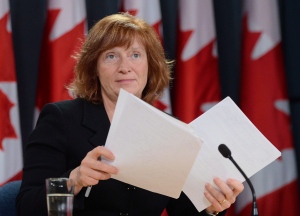
Public service about to feel the heat of public scrutiny

Nothing like some sunshine to improve accountability. But the challenge is real as public service-cited evidence will be more open to scrutiny and questioning:

The work Canada’s public service undertakes to support federal cabinet decisions could be thrown into the public spotlight in a way never seen before, according to the instructions Prime Minister Justin Trudeau has given Treasury Board President Scott Brison.

In what is referred to as a “mandate letter,” Trudeau has told Brison to make sure departments use the “best available information” and evidence when shaping policy and decisions — and be prepared to make that information public.

The mandate letters, sent to the 30 cabinet ministers and made public late last week, are built on the key promises of the Liberal election campaign. Brison’s marching orders for open and transparent government include specific instructions to create a culture of “measurement, evaluation and innovation” in the way programs and policies are designed and services delivered to Canadians.

In a big change from the past, those orders also include publicly releasing key supporting information used for making decisions, such as background and analysis, that has been shrouded in cabinet secrecy.

Trudeau also directed Brison to ensure departments set aside money for innovation. The letter asked that a “a fixed percentage” of program funds be reserved “to experiment with new approaches to existing problems and measuring the impact of their programs.”

Sahir Khan, the former assistant parliamentary budget officer who is now a senior visiting fellow at the University of Ottawa, said the government seems to be taking a page from New Zealand’s cabinet disclosure policy, in which a significant amount of the information submitted in memorandums to cabinet is made public.

“This is a level of transparency that we have never seen laid out so clearly,” said Khan, who led the PBO’s work on the analysis of the government’s proposed expenditures. “This represents a fundamental cultural transformation for the public service.”

During its almost 10 years in power, the more secretive Conservative government didn’t seek much public service advice or ask for evidence to back up policy-making.

The big question is whether the public service can now generate sturdy evidence-based decision that will not only be seen by cabinet but will also withstand the scrutiny of Parliament and the public.

Making more of the information around cabinet decisions public will also ramp up the accountability of both ministers and the public service.

“The public service can respond to the challenge, but it has not been asked to flex those muscles in a very long time,” said Khan. “The question is not whether they can respond but how many years for the public service to make such a substantive cultural change for a new way of doing business.”

Source: Public service about to feel the heat of public scrutiny | Ottawa Citizen

Highest ever number of Muslim Canadian MPs elected in new House | hilltimes.com

Good range of interviews on the large number of Muslim Canadian MPs elected:

In interviews last week, MPs, political insiders, and academics said the newly-elected legislators from diverse cultural and religious backgrounds will bring unique perspectives, community feedback and different life experiences to the table which will prove to be valuable in the overall legislation and policy-making process at the highest level of government. They also pointed out that these MPs are not just token representatives of their respective communities but people who have solid credentials in a variety of professions including law, medicine, and business.

“Every Member of Parliament will bring their values to the debates and values are shaped by religion, by experience, by the community that they come from. So, it will shape their values and values will shape what they have to say and their positions, no question,” said Prof. Donald Savoie, the Canada Research Chair in public administration and governance at the Université de Moncton and one of Canada’s leading experts on public administration, in an interview with The Hill Times.

He said Muslim MPs and MPs from other religious backgrounds will have important input in Parliamentary debates in the new Parliament.

“They will have very important points of view that need to be heard,” said Prof. Savoie, adding that Muslim MPs should also not be stereotyped.

“Let them come and debate the issue and let’s hear what they have to say. What they will have to say is as important, as relevant, and ought to be listened to, as much as a white MP from Newfoundland, or from British Columbia.”

Meanwhile, pollster Greg Lyle of Innovative Research said that MPs from different cultural and religious backgrounds will offer valuable input in legislative debates on social and economic issues that affect all Canadians.

“When you are in the room, you don’t have to wait for someone to think about you. You’re right there to bring your concerns front and centre,” Mr. Lyle said.

He said that newly elected MPs from a variety of demographic groups won their ridings because they were the best candidates. Using the example of Justice Minister Jody Wilson-Raybould (Vancouver Granville, B.C.), Mr. Lyle said she is an indigenous woman who ran in a riding that has almost negligible presence of aboriginal people, but won by a margin of about 9,000 votes.

 “In a lot of cases, people are just nominating the best person for this job and they happen to come from different backgrounds,” Mr. Lyle said.

“When you look at their resumés, they’re not getting appointed as tokens. These are people who have really impressive stories to tell,” Mr. Lyle said.

Muslim MPs interviewed for this article said that the previous government’s Anti-Terrorism Bill C-51, the so-called Strengthening Canadian Citizenship Act Bill C-24, the niqab debate, and the barbaric cultural practices snitch line affected the Muslim community directly and motivated it to get engaged a lot more actively than in past elections.

“The community is reaching a new level of maturity, overall. The Muslim community in Canada tends to be a newer community. It’s going through various levels of growth and sophistication, maturity as a newer Canadian community,” said Mr. Alghabra who represented the riding of Mississauga-Erindale, Ont., from 2006 to 2008, lost the two subsequent elections and was elected again on Oct. 19.

“This was a new milestone in that growth process. There’s a greater level of sophistication, greater level of awareness about the importance of getting involved. It was demonstrated through various groups and organizations and individuals,” said Mr. Alghabra.

Ms. Ratansi, who represented the riding of Don Valley East from 2004 to 2011, lost the 2011 election but was re-elected last month, also reiterated that the divisive issues that the Conservatives pushed in the campaign made the Muslim community get involved more actively.

“People got a little concerned about the negativity against Islam. A lot of intelligent people who are lawyers, [legal scholars] who teach law in universities, who are accountants, businesspeople like me, got a little fed up with this constant badgering of Muslims as if we were a homogenous group and we all work the same way. We don’t,” said Ms. Ratansi, adding that unlike the impression portrayed by some in the last government and some news organizations, the Muslim community, overall, is a peaceful hardworking community trying to make the world a better place.

Carleton University Prof. Howard Duncan, who has conducted extensive research on immigration integration theory, multiculturalism theory, globalization, and migration, in an interview, predicted that the election of MPs from different religious and cultural backgrounds will encourage those who did not participate in this election to get engaged in the political process.

“What you’re going to find as time goes by is that immigrants from other countries and other religious and ethnic backgrounds are also going to participate more in politics,” said Prof. Duncan.

Andrew Cardozo, president of Pearson Centre for Progressive Policy, told The Hill Timesthat in the current international political scenario, a number of political conflicts are religion based. He said he hoped that the newly-elected MPs from different religions will prove they can all work together.

“If you think of it in global terms, the biggest division that’s taking place amongst people in the world is around religion. It’s good when you have a country that’s religiously diverse. It’s good to have so many religions represented. With many of them in the same caucus, there should be room for discussion and accommodation when there are differences,” said Mr. Cardozo.

Source: Highest ever number of Muslim Canadian MPs elected in new House | hilltimes.com

Ministerial Mandate Letters: Mainstreaming diversity and inclusion, and point of interest from a citizenship and multiculturalism perspective

With the Mandate letters now public, two good pieces by Susan Delacourt (You’ll be judged by how you treat others, Trudeau cabinet warned) and Paul Wells (Justin Trudeau repeats himself) on the template used to guide  Ministers on the government-wide priorities and the expected and broad code of conduct.

Delacourt notes:

Working well with others — including people in the media — is now officially part of the job description for Canadian cabinet ministers.

The “mandate letters” given to every minister are setting a new bar for co-operation in Justin Trudeau’s government, according to one letter obtained in advance of the expected public release.

In fact, if the sheer word volume in these letters is any indication, co-operation seems to be the top item on the to-do list of Trudeau’s team.

Ministers are being warned that they will be judged by how well they treat a whole raft of people — everyone from business to labour, stakeholders and citizens, and yes, the opposition and the media too.

“Members of the Parliamentary Press Gallery, indeed all journalists in Canada and abroad, are professionals who, by asking necessary questions, contribute in an important way to the democratic process. Your professionalism and engagement with them is essential,” the letter states.

….One group of people is singled out as well in the mandate letters for special treatment from government. “No relationship is more important to me and to Canada than the one with Indigenous Peoples,” the letter states.

 The notable feature of these mandate letters, as mentioned, is the amount of words devoted to culture change of the kinder, gentler sort. “Open by default” is an operating principle.
 Wells analyses further:

Possible explanations for this outbreak of boilerplate include (a) a particularly wonky form of Tourette’s; (b) a desire to put most of the country to sleep before we get to the good stuff; (c) the PM and his advisers actually think the repetitive stuff is worth repeating. I’m going to go with (c). So while many colleagues will focus on what changes from letter to letter, let’s pause here to look at what doesn’t. 

  • “Real change—in both what we do and how we do it.” … Now, these letters come from Trudeau and his staff and appear over his signature, but it’s nearly a deadlock certainty that public servants were involved in the process, and one of them will have said: Prime Minister, if you evoke “a personal commitment” to this stuff and then tell ministers they “will be held accountable for our commitment,” you’re elevating it way beyond the realm of pious nostrum. You’re making it sound like you mean it. Repeating it 30 times in letters to 30 ministers is like tracing a line in the sand, then scraping it a yard deep.
  • “Track and report on the progress of our commitments.” …., idealism and political self-interest become nearly synonymous: Trudeau wants to be able to meet voters in, probably, 2019, with a bunch of check marks next to his 2015 promises. And again, by publicly repeating that goal, he is offering up a jumbo hostage to fortune if any promise proves impossible to keep.
  • “No relationship is more important to me and to Canada than the one with”— Actually, it’s interesting here to try to guess how this sentence ends. Important relationships. Hmm. The one with . . . the United States? The United Nations? Hard-working families? Nope. Again in every letter, Trudeau elevates the relationship with “Indigenous Peoples” above every other in his personal hierarchy of priorities…..
  • “Observe the highest ethical standards in everything you do.” …“As noted in the Guidelines, you must uphold the highest standards of honesty and impartiality, and both the performance of your official duties and the arrangement of your private affairs should bear the closest public scrutiny. This is an obligation that is not fully discharged by simply acting within the law.”Expect opposition members to quote that last sentence back to Trudeau and his ministers any time one of them lands in hot water. “It’s legal” is not, in Justin Trudeau’s own judgment, a sufficient defence for poor conduct.

Diversity and Inclusion commitments:

Turning from the general to the specific with respect to citizenship and multiculturalism, what is striking are the two paragraphs, again to all ministers, mainstreaming the Government’s diversity and inclusion agenda with a commitment to end divisive politics and practices and renewed emphasis on employment equity for women, indigenous Canadians and minority groups in political appointments:
Canadians expect us, in our work, to reflect the values we all embrace: inclusion, honesty, hard work, fiscal prudence, and generosity of spirit. We will be a government that governs for all Canadians, and I expect you, in your work, to bring Canadians together.
You are expected to do your part to fulfill our government’s commitment to transparent, merit-based appointments, to help ensure gender parity and that Indigenous Canadians and minority groups are better reflected in positions of leadership.

The specific commitments for each Minister will, of course, be reflected in the performance management agreements of Deputy Ministers, which in turn will cascade down to all levels of management. Hence, these are the ones that will be met given their priority.

Immigration, Refugees and Citizenship Minister

The specific commitments track the party platform commitments in immigration and refugees. On citizenship, the mandate letter expands on the platform by including repealing the revocation provisions of the C-24 Citizenship Act and the ‘intent to reside’ provision.

In other words, very surgical changes rather than more sweeping changes. For example, no mention of reversing the expansion of knowledge and language requirements from 18-54 to 14-64 year olds, nor reversing the sharp increase in citizenship fees (from $100 to $530), nor improvements in due process (oral hearings in cases of misrepresentation).

While not in the list of commitments, presumably the Minister will revise and rebrand the citizenship study guide, Discover Canada, with more inclusive substance and language, given the overall priority mentioned above.

The specific commitments are below:

As Minister of Immigration, Refugees and Citizenship, your overarching goal will be to reopen Canada’s doors to welcome those who want to contribute to our country’s success. Canadians are open, accepting, and generous – qualities that should be reflected in Canada’s immigration policies and in our approach to welcoming those seeking refuge from conflict and war. Our communities are strengthened when we come together to welcome newcomers who want to build a better Canada and to help those in need.
In particular, I will expect you to work with your colleagues and through established legislative, regulatory, and Cabinet processes to deliver on your top priorities:

  1. Lead government-wide efforts to resettle 25,000 refugees from Syria in the coming months.

  2. As part of the Annual Immigration Levels Plan for 2016, bring forward a proposal to double the number of entry applications for parents and grandparents of immigrants to 10,000 a year.

  3. Give additional points under the Entry Express system to provide more opportunities for applicants who have Canadian siblings.

  4. Increase the maximum age for dependents to 22, from 19, to allow more Canadians to bring their children to Canada.

  5. Bring forward a proposal regarding permanent residency for new spouses entering Canada.

  6. Develop a plan to reduce application processing times for sponsorship, citizenship and other visas.

  7. Fully restore the Interim Federal Health Program that provides limited and temporary health benefits to refugees and refugee claimants.

  8. Establish an expert human rights panel to help you determine designated countries of origin, and provide a right to appeal refugee decisions for citizens from these countries.

  9. Modify the temporary foreign workers program to eliminate the $1,000 Labour Market Impact Assessment fee to hire caregivers and work with provinces and territories to develop a system of regulated companies to hire caregivers on behalf of families.

  10. Lead efforts to facilitate the temporary entry of low risk travelers, including business visitors, and lift the visa requirement for Mexico.

  11. Work with the Minister of Justice and the Minister of Public Safety and Emergency Preparedness to repeal provisions in the Citizenship Act that give the government the right to strip citizenship from dual nationals.

  12. Eliminate regulations that remove the credit given to international students for half of the time that they spend in Canada and regulations that require new citizens to sign a declaration that they intend to reside in Canada.

Canadian Heritage Minister

Noteworthy for what is not in the letter: any mention of multiculturalism following its transfer back to Canadian Heritage after some eight years at the former CIC.

This will give the bureaucracy time to implement the machinery changes (time-consuming at the best of times) and re-integrate and rebuild policy and related capacity that was dispersed and weakened at CIC.

For better and worse, it will give officials a freer hand in this reintegration process and the more important policy reflections on how multiculturalism can better reflect the diversity and inclusion agenda, lost somewhat at CIC under then Minister Kenney.

This would start with a review of the priorities enunciated in 2010, where language (e.g., inclusion) and substance (e.g., employment equity, racism and discrimination):

  • build an integrated, socially cohesive society;
  • help federal and public institutions respond to the needs of a diverse society; and
  • engage in international discussions on multiculturalism.

The first opportunity to reflect this change will be the February tabling of the Annual Report on the Operation of the Canadian Multiculturalism Act, with the Ministerial message and overview (the report will cover the 2014-15 fiscal year period and thus report on the previous government’s initiatives).

However, there is a risk that the lack of political direction (and ‘supporting minister’) will undermine the ability for the multiculturalism program to play an effective policy role in the government’s overall diversity and inclusion agenda.

The overarching  commitment in the mandate letter:

As Minister of Canadian Heritage, your overarching goal will be to implement our government’s plan to strengthen our cultural and creative industries. Our cultural sector is an enormous source of strength to the Canadian economy. Canada’s stories, shaped by our immense diversity, deserve to be celebrated and shared with the world. Our plan will protect our important national institutions, safeguard our official languages, promote the industries that reflect our unique identity as Canadians, and provide jobs and economic opportunities in our cultural and creative sectors.

The one commitment related to, but much broader than multiculturalism, is with respect to reinstating the court challenges program (it provided funds to groups that need funding to contest specific policies):

  1. Work with the Minister of Justice to update and reinstate a Court Challenges Program.

Roles of Other Ministers

The Minister of Justice is expected to:

  1. Review our litigation strategy. This should include early decisions to end appeals or positions that are not consistent with our commitments, the Charter or our values. [e.g., the citizenship niqab case, cuts to refugee healthcare]

  2. Support the Minister of Canadian Heritage to restore a modern Court Challenges Program.

  3. Work with the President of the Treasury Board to enhance the openness of government, including supporting his review of the Access to Information Act to ensure that Canadians have easier access to their own personal information, that the Information Commissioner is empowered to order government information to be released and that the Act applies appropriately to the Prime Minister’s and Ministers’ Offices, as well as administrative institutions that support Parliament and the courts.

The Minister of Public Safety and Emergency Preparedness has no commitment with respect to softer approaches to countering violent extremism (e.g., research, working with communities, deradicalization) although this can be implied from the overall inclusion messaging.

Link to all mandate letters:

ministerial mandate letters

Trudeau’s diverse cabinet not a true Canadian portrait – Gagnon

While true, commentators sometimes miss the forest for the trees.

Compared to previous federal cabinets, the Trudeau cabinet represents progress. For example, the previous Conservative cabinet was only 30 percent women and the three visible minority members were only in junior positions (multiculturalism, sport, seniors).

I suspect that some of the gaps pointed out will be addressed when parliamentary secretaries appointed.

And Gagnon is also factually wrong: Jim Carr, Minister of Natural Resources is Jewish.

It would be interesting, rather than just carping on the sidelines, to come up with an alternate cabinet that would balance regional, gender, ethnic origin, and experience – not as easy as it sounds:

“A cabinet that looks like Canada!” Prime Minister Justin Trudeau exclaimed as he introduced his ministers. But this was false on several counts.

A cabinet that includes no one of Italian or Chinese origin, a cabinet without Jews or Arabs, a cabinet without a single black person – while Sikhs (who comprise about 1.4 per cent of the Canadian population) hold four cabinet posts – is not a true portrait of Canada. Not that I mind. The last thing a modern government needs is a cabinet that would reflect the exact ethnic makeup of the population. That’s because it’s impossible to achieve: Ministers are chosen from a caucus that results from the vagaries of politics and doesn’t correspond to demographic reality. For example, the Liberals have only a handful of black MPs, two MPs of Chinese descent – and 16 Sikhs, reflecting the active interest of Sikhs in politics and of a pattern of block voting in ridings with a significant Sikh minority.

Mr. Trudeau also prides himself on having formed the first federal cabinet with gender parity. False again. It is actually built on gender inequity. The Liberal caucus counts 134 men and 50 women, meaning that at the outset, every female MP had roughly three chances more than her male colleagues to be appointed to cabinet. Shouldn’t gender equity apply to men as well?

Those who want the proportion of female cabinet ministers to reflect the female population should insist that the political parties present many more women in “good” ridings – ridings where they have a real chance of being elected. Then a prime minister would have a larger pool of qualified female MPs to choose from when forming the cabinet.

Source: Trudeau’s diverse cabinet not a true Canadian portrait – The Globe and Mail

Here’s a thought, what if governments weren’t so secret? MacDonald

Relevant article by Neil MacDonald given the comments by Alex Himelfarb, former Clerk of the Privy Council and Head of the Public Service:

He [Himefarb] says secrecy is essential and, at the same time, greatly overused.

Ministers and officials, he says, need to be able to speak frankly.

HARPER-SWEARING-IN TOPIX

Former Clerk of the Privy Council Alex Himelfarb, right, administers the oath of office to new Prime Minister Stephen Harper in 2006 as then governor general Michaelle Jean looks on. (Tom Hanson/Canadian Press)

Around the cabinet table, he says, it may be that somebody wants to talk back to the prime minister.

“It may be that somebody there wants to say ‘I hate what you’re doing. This is terribly, terribly wrong.’ You want people to be free to say to the PM ‘that’s a pile of garbage’ and know that the opinion will not be leaked and used against the government later,” he says.

“It is important to have zones in which courageous advice can be given freely.”

That said, he acknowledges “we have inappropriately expanded the need for legitimate zones to a massive extent. They now include message control and avoidance of personal responsibility.”

No one actually owns up to that, he says. It’s a deeper, unacknowledged reality, down in the marrow of the culture.

Moreover, he says, the holders of the deepest secrets often become “absolutely convinced that they are not only working for the people, but that they are the best people to judge whether something should be secret.”

Generational shift?

Perhaps surprisingly, though, Himelfarb believes all of that is changing, and government must accommodate and manage what’s coming, or be overwhelmed.

WikiLeaks, social media, the advent of bloggers and citizen journalists determined to root out information, and a relentless 24-hour mass media are now arrayed against the old forces of mutton-chopped secrecy.

Bureaucracies at first react by shifting defences; they respond to WikiLeaks and access-to-information laws by ensuring less is written down, or by becoming even more controlling.

But Himelfarb, for one, believes we are in the midst of a generational attitude shift. Younger people expect — demand, in fact — to be included in the process of government between elections.

Many of Trudeau’s new ministers may well be inclined to grant that, given that so many are unschooled in governing. Their lack of experience is also a lack of baggage.

Some have worked outside government, Himelfarb observes, and may have even been victimized by government.

But ultimately, it’s the prime minister who gets to decide what those oaths taken at Rideau Hall will mean in reality.

If bureaucrats sense that loosening the flow of information to the public is not just OK but actually career enhancing, and that government’s boss of bosses wants more open government, open government will be more likely.

The trick, says Himelfarb, is to ensure that only those secrets that must truly remain secret for the proper functioning of government are shielded.

Perhaps. But again, the journalist’s view: Information is power. Politics is the exercise of power. Secrecy allows information, and therefore power, to be hoarded and preserved.

Source: Here’s a thought, what if governments weren’t so secret? – Politics – CBC News

Les fonctionnaires saluent le gouvernement Trudeau

More on the public service public (and private) reaction to the change in government and approach to the public service:

Mel Cappe, un ancien greffier du Conseil privé (sorte de grand patron de la fonction publique fédérale), accueille lui aussi favorablement la nouvelle, tout en apportant un bémol. Il rappelle que les fonctionnaires ont le devoir de servir leurs maîtres politiques du jour. Si les scientifiques devraient avoir le droit de parler de leurs recherches, cela ne leur donne pas pour autant le droit de critiquer publiquement les choix politiques du gouvernement.

Fonctionnaires partisans ?

Cette annonce vendredi n’est pas le seul événement à avoir ébranlé la bulle fédérale. En après-midi, le ministre des Affaires étrangères, Stéphane Dion, a donné à son ministère un point de presse au cours duquel plusieurs fonctionnaires présents l’ont applaudi à trois reprises : lorsqu’il a parlé de la valeur de tous les fonctionnaires, d’évaluations environnementales et de lutte contre les changements climatiques.

Les critiques ont fusé sur les réseaux sociaux, de nombreux commentateurs y voyant la preuve que la fonction publique fédérale est « rouge » dans l’âme et que Stephen Harper avait raison de s’en méfier.

Debi Daviau y voit plutôt une « réaction complètement naturelle et humaine après neuf ans d’abus complet et absolu »« Notre fonction publique vit une lune de miel du fait qu’elle peut, après neuf ans, être autorisée à faire son travail correctement. On ne doit pas s’inquiéter que notre fonctionpublique célèbre cela. »

Tom Flanagan, professeur de sciences politiques de Calgary et ancien collaborateur de Stephen Harper, trouve ces applaudissements problématiques. Ils trahissent non pas un biais pro-libéral, mais un biais en faveur d’une vision interventionniste de l’État.« Les fonctionnaires ont intérêt à ce que l’État soit gros. C’est leur industrie. Plus l’État est gros, plus il y a d’emplois, d’occasions de promotions et meilleur est le salaire. C’est pour cela qu’ils sont toujours suspicieux des gouvernements qui prônent la retenue. » Les visions politiques libertariennes véhiculées par les partis politiques de l’Ouest sont donc perçues comme étant étrangères.

« Je vais utiliser cet exemple dans mes cours pour démontrer la dominance du courant de pensée laurentien [du Canada central] à Ottawa et comment l’Ouest est encore perçu comme un outsider ! » reconnaît-il.

Mel Cappe lui donne en partie raison. Les applaudissements soulignaient, à son avis, « la revitalisation et la renaissance du rôle du Canada sur la scène internationale ». En ce sens, dit-il, les fonctionnaires avaient beaucoup aimé le gouvernement de Brian Mulroney, preuve que ce n’est pas la « partisanerie » qui anime les fonctionnaires, mais une certaine vision de l’État.

Source: Les fonctionnaires saluent le gouvernement Trudeau | Le Devoir

Formerly secret federal mandate letters to be open

Good for both an accountability and communications perspectives. While deputy ministers always saw these letters, and briefed downwards as appropriate, making them public makes it easier for all.

I am particularly interested in seeing Minister McCallum’s mandate with respect to citizenship issues, and Minister Joly’s mandate with respect to multiculturalism:

Prime Minister Justin Trudeau will be the first to make public the traditionally secret mandate letters for ministers, another step in his government’s promise to be more open, transparent, accountable and committed to results.

The Liberals are following the lead of many provinces that already publicly release mandate letters – including British Columbia, Alberta, Saskatchewan and New Brunswick. Ontario Premier Kathleen Wynne released mandate letters for her entire cabinet for the first time last October.

Liberal spokesman Dan Lauzon confirmed letters will be released shortly.

Mandate letters typically begin with a generic introduction outlining the overall approach and style of the new government and its priorities. They are tailored for each minister, listing roles, responsibilities, expectations — even timelines in some cases — for their portfolio.

Many say Trudeau’s letters will include messages that ministers should work with their cabinet colleagues and rely on public servants for advice and bring them back into the policy-making process.

This is a critical signal for a public service emerging from a decade under the previous Conservative government, which didn’t seek their advice and left many feeling marginalized.

Lauzon said open letters are a step to counter public perceptions about the secrecy of government and reducing the growing power concentrated in the Prime Minister’s Office. Making them public will ensure “clear direction, increased transparency and a higher degree of accountability for each minister,” he said.

The letters are expected to bring “clarity” and sharpen the ambiguity of past letters that weren’t made public.

They will make clear who is responsible for what and what policies have to be managed across departments — which is especially critical when departments and functions have been reconfigured in the new cabinet.

Tony Dean, a professor at the University of Toronto’s School of Public Policy and the former top bureaucrat in Ontario, said open mandate letters increase the accountability of ministers and public servants both externally and internally.

“When public servants are guessing about their goals and governments aren’t clear about their priorities … then the public service isn’t being optimized. When they are guessing at what the priorities are and what they should be working on, then the mandate letters really help. Everyone focuses on what is important to the prime minister,” said Dean.

Source: Formerly secret federal mandate letters to be open | Ottawa Citizen

A perfect cabinet? Some Italian Liberals disagree. Also Black Canadians

The challenges in meeting the expectations of all groups in Canada, starting with Steve Paiken with respect to Italian Canadians:

But now that the dust is settling and Ottawa is beginning to get back to business, some observers — even Liberals — are allowing themselves to be a bit more critical.

Having spoken Thursday night to two prominent members of the Italian-Canadian community — both of whom are Liberals — they are more than a little miffed that there’s not a single member of their community in the new cabinet.

In some respects, it is a bit shocking. The Italian-Canadian community has always demonstrated overwhelming support for the Liberal Party of Canada.

“We’re not going to make a stink about this because the reaction to the new cabinet has been so positive,” one well-connected member of the Italian community told me. “But four ‎Sikhs and no Italians? I don’t know about that.”

Let’s remember, putting a cabinet together is almost by definition an impossible undertaking. There are so many boxes to check off: gender balance, regional balance, ethnic balance, generational balance, and the list goes on. Satisfying every constituency is a hopeless task.

Nevertheless, the absence of any Italian presence in a Liberal cabinet is noteworthy.

Another Liberal with whom I spoke last night — not an Italian — had less patience for the criticism. This source admitted, yes, Italians are under-represented in this cabinet, but added they’ve been over-represented in previous cabinets.

When Paul Martin took over the prime minister’s office in 2004, his cabinets would feature more ministers of Italian heritage than perhaps numbers warranted (Albina Guarnieri, Tony Valeri, Joe Volpe, Joe Fontana, Tony Ianno, Judy Sgro, and Joe Comuzzi).

“No one complained we had too many Italians back then,” this source said.

It’s not like Prime Minister Trudeau didn’t have enough Italian-Canadian MPs from which to choose. Liberal MPs with Italian backgrounds include former cabinet minister Judy Sgro; Joe Peschisolido, who has previous experience as a parliamentary secretary; Marco Mendicino, whose resume includes defeating floor-crossing MP Eve Adams for the Liberal nomination, then Conservative Finance Minister Joe Oliver for the seat in Eglinton-Lawrence;  Francis Scarpaleggia, an MP since 2004; Anthony Rota, first elected in 2004, sidelined for the last four years after losing in 2011, but back in now; and rookie MPs Francesco Sorbara, Mike Bossio, Angelo Iacono, David Lametti, and Nicola Di Iorio, among others.

When our first prime minister, Sir John A. Macdonald, once checked into a hotel, he was asked on the registration form what his occupation was. He wrote: “cabinet maker.”

Our first PM was a clever guy. He also understood that every time he made a decision to put someone in cabinet, it required a concurrent decision to keep several others out. High profile victorious candidates such as former Toronto police chief Bill Blair, former broadcaster Seamus O’Regan, downtown Toronto’s Adam Vaughan, and former general Andrew Leslie are among the many Liberal MPs who have learned this the hard way.

And so, apparently, are many Italian-Canadian MPs, who for the first time in three-and-a-half decades find themselves outside the Liberal inner circle. As we are learning, it is a curious and uncomfortable place for them to be.

Source: A perfect cabinet? Some Italian Liberals disagree | TVO.org

And Cecil Foster reflects on Black discontent:

It is as if there is no black in Canada. Maybe despite all its diversity Canada in 2015 is still a white man’s country, where as in time of old all eligible and desirable non-whites and males have been co-opted into whiteness. Just like the Italians, Greeks, Ukrainians, Afghans, etc. that are now all white Canadians. Diversity through assimilation. And as has always been the case, the one unassimilable group – primary because of the colour of skin and the historic outsider status – is blacks. And this is at a time when south of the border there is a black president. Maybe it is true that Canadian and U.S. cultures and politics are fundamentally different.

It is unbelievable that at this moment when diversity is the language and imagery of Canada, yet again we have been told in the jargon of street that if you are black, stand back. If there has been two groups that have been the measure of exclusion and marginalization in the Canada of old they were First Nations people and blacks. It is a moment of pride when we can see First Nations representation in the Canadian government, especially for me a First Nations Justice Minister and Attorney-General.

But whether it was as the original Loyalists that withdrew into what would become Canada, blacks were always part of this country and we have always been the moral conscience of this country. Indeed how can anyone begin a conversation on power, citizenship, multiculturalism, equity, a Charter of Rights and Freedoms, criminality, discrimination and police carding without starting that conversation about historically what has been the role and positioning of blacks generally in this hemisphere and specifically in Canada?

So why are there no blacks in the cabinet? Perhaps because the cabinet was chosen on merit and no black was good enough. Perhaps no one ethnic or racialized group should be signalled out for special attention. Perhaps affirmative action should not be a factor. …

As the Prime Minister stated, the year is 2015. All these questions can be posed about any visible-minority group that is using the pictures of members of their community who are federal government ministers to tell their young see you, too, can become a government minister. For it to be really true, as our Prime Minister implied, that Canada has come a long way when any argument against the inclusion of any ethnic, racial, gendered or sexed group is so absurd that no real explanation is needed. Unless this inclusion is about other minorities, not blacks.

Unfortunately, there is the sense that the blacks in Canada have been slighted. And ironically this is one of the ethnic groups that have resolutely remained faithful politically to the Liberal Party of Canada in good and bad times, even when other ethnic groups with less of a legacy in Canada flirted with and even shifted support to other parties. Most enthusiastically support multiculturalism. Many in the black communities across Canada still revere Pierre Trudeau. What more needs to be said about loyalty or blacks and Liberals.

About two decades ago, I published a book titled A Place Called Heaven: The Meaning of Being Black in Canada. Back then. I was writing about an ethno-racial group that is as old as Canada itself, that for want of a better phrase should be considered as much “old stock” as the English or French. Back then, this was a group still feeling marginalized and dreaming of a day when Canada would make young black boys and girls feel confident enough to believe that they can grow up to become members of the highest echelons of their society.

Source: Canada’s blacks: Still waiting for their moment of ‘real change’ – The Globe and Mail

Justin Trudeau joyfully mobbed by federal civil servants

PM Trudeau at the rebranded Global Affairs department. Unprofessional but understandable:

Suddenly there was a buzz and the crowd moved forward.

Trudeau appeared and began to make his way out of the building. He was swarmed. Many took photos and even selfies along the way.

Liberal Cabinet 20151106

Trudeau was mobbed as he tried to leave the Lester B. Pearson building Friday. He told the crowd his government would need the civil service’s absolute best. (Sean Kilpatrick/Canadian Press)

The prime minister was hugged. Cheers erupted. He smiled, waved and stopped by the door.

He thanked the crowd for supporting the members of his cabinet, who had just left.

Then he continued: “We’re going to need every single one of you to give us, as you always do, your absolute best.”

They applauded and cheered some more. Some yelled back: “You’ve got it.”

One longtime staffer nearby said he’d never seen anything like it. Not in all of his years.

And it might not be the only instance of a crowd forming to welcome a minister Friday.

On Facebook, a photo circulated of civil servants at another location waiting to greet Sajjan.

Source: Justin Trudeau joyfully mobbed by federal civil servants – Politics – CBC News

And Donald Savoie puts it into context:

Donald Savoie, a public administration expert at the University of Moncton, said public servants are gripped by “the euphoria” of working for a government that promises renewed respect.

He said many hope they are returning to their “days in the sun” when public servants worked on policy and were listened to. He likened it to when Pope John XXIII opened the Vatican and liberalized the Catholic Church.

As a result, bureaucrats’ heckling and cheering, and unions revelling in their political campaigns, may not be appropriate but isn’t unexpected.

“Don’t try to make sense of this. School’s out and people are beside themselves with joy,” Savoie said. “Stay tuned, it’s too fresh. Wait until things calm down in a few months.

“I wouldn’t get too worked up because what happened today doesn’t define the public service and its non-partisanship.”

Public servants shed cloak of impartiality – at least for the day

#Multiculturalism Transferred Back to Canadian Heritage: Impact

CM_Table_12_Transfer_to_CICThe Order in Council announcing the reversal of the 2008 transfer to CIC as part of then Minister Kenney’s Package:

His Excellency the Governor General in Council, on the recommendation of the Prime Minister, pursuant to paragraph 2(a) of the Public Service Rearrangement and Transfer of Duties Act, transfers, effective November 4, 2015,

(a) from the Department of Citizenship and Immigration to the Department of Canadian Heritage the control and supervision of those portions of the federal public administration in the Citizenship and Multiculturalism Branch within the Department of Citizenship and Immigration that relate to multiculturalism; and

(b) to the Minister of Canadian Heritage the powers, duties and functions of the Minister of Citizenship and Immigration relating to multiculturalism.

The PCO press release indicates that responsibility for the Canadian Race Relations Foundation is also transferred but makes no reference to either the Global Centre for Pluralism or the International Holocaust Remembrance Alliance (the previous government gave the head of the Office for Religious Freedom the lead responsibility).

Personally  interesting,  given that I managed the transfer to CIC in 2008, and have consistently written that multiculturalism was atrophying at CIC given its more operational focus on citizenship and immigration.

As I wrote two years ago in my conclusion to Policy Arrogance or Innocent Bias: Resetting Citizenship and Multiculturalism on the longer-term impact of CIC’s departmental structure and culture on the multiculturalism program:

A functional model like CIC has advantages in creating greater clarity between the policy and operational functions, but tends to reinforce the centre of gravity and allocate resources accordingly. A business line model like PCH provides more focused policy and program integration at the business line or program level, but increases rigidity and coordination issues between business lines. While the PAA structure acts as a counterweight, over time the centre of gravity will dominate. Arguably, for integration, citizenship and multiculturalism, the lines between pure policy and pure operations (e.g., citizenship ceremony design, G&C management) are less clear than for admissibility and immigration selection. Additionally, one of the legacies of the Cullen-Couture agreement transferring immigration selection and integration funding to Quebec meant CIC was largely uninterested in using the levers in citizenship and multiculturalism to highlight federal presence in Quebec. A sharp contrast to PCH which had, and viewed itself as having, a strong role in Quebec.

In many ways, the collective impact for multiculturalism will, over time, become closer to the original Reform Party objective of 1996-97 of abolishing multiculturalism and strengthening a strong, common narrative of citizenship. The Cabinet shuffle of July 2013 and the separation of the political function, which remained under Minister Kenney, from the departmental function, under Minister Alexander, is significant in that context. While political, community-based outreach is central to electoral strategies (the “fourth sister”), as evidenced by Minister Kenney’s ongoing responsibility for this critical outreach, the substantive policy and program focus on long-term integration issues will continue to decline. This is a legitimate policy choice but it is striking just how little debate this change has provoked.

The Liberal government’s decision to reverse the transfer and restore the broader Canadian Heritage identity mandate (and no longer have the file ‘travel’ with a minister), with a strong diversity and inclusion emphasis, will reinvigorate multiculturalism, both within the department and across government more generally.

However, given the dispersal of and reductions to multiculturalism resources at CIC (now IRC), considerable rebuilding will be required.

The above table highlights the FTEs and Operations and Maintennance resources transferred in 2008 (about $12 million in Grants & Contributions funding was also transferred).

Chapter 6 of my book describes the process, resource transfers and impact (available at Lulu.com, direct link My Author Spotlight).

Source: Orders in Council – Search – Privy Council Office