White Women Should Check Their Privilege After Women’s March | Lauren Sandler

A reminder of white ‘privilege’:

We unravel the powerful statements of intersectionality that we heard from that stage when we congratulate ourselves for the safety of the march. That safety is a privilege, among many privileges. We must consider the racial and economic factors behind the fact that there’s a different state system for women with skin privilege — and economic privilege. Failing to do so reinforces the oppression so many of us said we were marching to dismantle. The absence of an intimidating law-enforcement presence at the Washington march, in contrast with the policing of gatherings and communities of color, is part of a story we must tell if we are to speak the truth of this march. Not every woman there was a woman of privilege, whether it be due to the color of their skin or their financial comfort.

“I spent a fortune to come here,” one woman told me, who had flown in from Colorado and stayed at the Renaissance hotel where rooms were more than $800 a night. “Didn’t we all?” I’m glad that she came. I’m glad I had the funds to share an AirBnb with my friend who drove us down there ($150 per night for each of us). I’m glad I brought my 8-year-old daughter; I’m glad she brought her son. My mother flew down from Boston on JetBlue, with a ticket she bought the morning President Trump gave his acceptance speech, and Hillary Clinton gave her concession. I’m glad she had that privilege.

On my mother’s plane, flight attendants wore pink cat-ear hats, took pictures with the women who filled every seat to protest and cheered the marchers over the P.A. I’m glad for that too. But would they have taken pictures and cheered if the flight had been filled with people flying down to march against a Muslim registry? Would my mother have traveled as swiftly from the tarmac to the entrance to the metro? Would the flight attendants have donned hats in solidarity with those marchers? There’s a beautiful picture of a white cop in uniform wearing one of those pink hats, smiling alongside the march route in Portland. It’s hard to imagine him in a Black Lives Matter armband alongside a march for racial justice or wearing a button in support of immigrant rights.

Another photo has been circulating of three white women in pink hats smiling into their own phones near a black woman holding a sign reminding us that many white women voted for Trump. The image has been divisive. But that sign does not state an alternative fact — nor should we ignore that 94% of black women voted against Trump. These things are simply true. Just as our march was given the benefit of the doubt by law enforcement. (And surely no one in public relations was a fan of the optics of men in uniform roughing up a mass of white ladies.)

If we want a true women’s movement, our joyous, contagious celebrations must beware of self-congratulation. There is much to cheer in this historic, women-led moment that united so many of us. But we can’t fail to be clear-eyed about existing injustice as we fight against gender inequality. If we want a true women’s movement, that means not just marching on behalf of our own lady-parts but against injustice for all. It means loudly and affirmatively answering another sign that went viral after the march, the one that says, “I’LL SEE YOU NICE WHITE LADIES AT THE NEXT #BLACKLIVESMATTER MARCH, RIGHT?”

I felt optimism and hope and pride in our stunning numbers — in Washington, around the country and around the world. But I have to confess: I don’t think I’ve quite felt the magic like so many millions of other protesters did on Saturday and in the aftermath of our historic march. There is much to cheer, but instead of congratulating ourselves for showing up peacefully when it was our privilege to do so, let’s fight until everyone’s civil liberties are equally protected. Let’s listen to each other as well as chant. It’s not always going to be pretty or selfie-ready in a pink hat. But if we want to build a movement, we must march forward together, even if we blister along the way.
Correctional Service flip-flops on transgender inmate placement policy – Politics – CBC News

That was a fast reversal. Town halls may prove more substantive in terms of policy development:

Canada’s prison service has abruptly reversed course on its new policy for transgender inmates, one day after Prime Minister Justin Trudeau promised to promote equality for all trans Canadians, including those behind bars.

Correctional Service Canada spokesman Jean-Paul Surette said trans inmates will now be considered for placement in prisons based on their gender identity rather than their genitalia.

“We are currently assessing — on a case-by-case basis — individual inmates’ placement and accommodation requests to ensure the most appropriate measures are taken to respect the dignity, rights and security of all inmates under our custody,” he told CBC News in an email.

That is a sharp departure from CSC’s revised policy directive on trans inmates that was released on Monday, which confirmed a previous rule that based placement on birth sex rather than gender identity.

“Pre-operative male to female offenders with gender dysphoria will be held in men’s institutions and pre-operative female to male offenders with gender dysphoria will be held in women’s institutions,” the Jan. 9 policy reads.

The change in course comes after Trudeau, during a town hall meeting in Kingston, Ont., made an off-the-cuff promise to ensure transgender inmates can serve their sentences in institutions based on their gender identity.

The pledge came in response to a question from a transgender woman and advocate who described Canada’s current placement policy as “torture.”

Trudeau said the issue hadn’t been on his radar, but would act now that it is.

“I will make sure we look at it and we address it and we do right in recognizing that trans rights are human rights and we need to make sure we are defending everyone’s dignity and rights in every way we can,” he said.

Source: Correctional Service flip-flops on transgender inmate placement policy – Politics – CBC News

Talking to In-laws Can Be Hard. In Some Languages, It’s Impossible. – The New York Times

Learn something new every day about the interplay between family relationships and language:

In-laws may be universally intimidating, but in some cultures, the deference paid them rises to a whole new level, at least linguistically.

A geographically widespread practice known as avoidance speech, or “mother-in-law languages,” imposes strict rules on how one speaks — or doesn’t — to the parents of a spouse, with daughters-in-law typically bearing the brunt of such limits.

In parts of Africa, Australia and India, some societies restrict the words a person can say after marriage. Some cultures have even barred all direct communication with parents-in-law.

Some married women who speak the Kambaata language of Ethiopia follow ballishsha, a rule that forbids them from using words that begin with the same syllable as the name of their father-in-law or mother-in-law.

This rule can complicate a conversation, but there are workarounds. Certain basic words in the vocabulary come in synonymous pairs. “One is the normal term, used by everybody; one is the term used by women who are not allowed to say that word,” said Yvonne Treis, a linguist at a French research institute, Languages and Cultures of Sub-Saharan Africa.

Euphemisms are another frequent solution: If the word “ox” is taboo for a wife to say, she may refer to “the one that plows” instead. The Kambaata language also has a word akin to “whatchamacallit” in English, useful in a pinch as either a noun or verb when no other alternative is available.

Avoidance speech is also practiced by speakers of some of the Bantu languages of southern Africa, including Xhosa and Zulu. Married women are forbidden from using their father-in-law’s name, or any word that has the same root or similar sound.

Bantu speakers often get around this restriction by borrowing synonyms from other languages spoken nearby. Some linguists think that is how click consonants found their way into Bantu speech: in words borrowed from Khoisan languages, which use clicks extensively.

In parts of India, a daughter-in-law is not allowed to use words that begin with the same letters as her in-laws’ names, requiring her to use a parallel vocabulary.

Avoidance speech was a common feature of many aboriginal languages in Australia. The custom has largely faded in some areas, but it is still widely practiced in the Western Desert region and Arnhem Land, according to Claire Bowern, a professor of linguistics at Yale.

Avoidance speech can be more of a two-way street in Australia, with restrictions applying across genders and generations. There are aboriginal cultures where a man and his mother-in-law are forbidden to directly address each other.

Marissa Mayer and the Failure of Trickle-Down Empowerment – The Daily Beast

Valid commentary by Erin Gloria Ryan on how the focus on those at the top, their successes and failures, often overshadows the overall context, realities, and class:

Mayer may not have identified as a feminist, but men who hate women sure celebrated her stumbles as though she was. A curious amount of schadenfreude followed any announcement of a problem at Yahoo. It seems her existence rubbed some observers the wrong way. And some who would have legitimate reasons to critique her work seemingly shied away, out of fear of being roped in with those who would howl about a woman being happy and successful no matter what her job, or how good she was at it.

This combination of voices—idiotic critique from those who would hate something no matter what, combined with reticence on the part of the thoughtful to offer useful critique from a place of good faith—is something that seems uniquely zeitgeisty, especially when it comes to powerful women. And, in that sense, Mayer’s rise and fall stands out as something that makes more sense than most things that have happened in the last 12 months.

In recent years, there’s been an upswell in corporate feel-good feminism. The type of feminism that means well but tends to focus on fighting the battles and celebrating the victories of only the most privileged among women, whether or not those women believe in those principles. The type of feminism that envisions that the collective action of all feminists will push women up the ladder one at a time, and that she, upon reaching the top, will reach down and pull more women up behind her.

It seems feminists want so strongly for a woman to be a visionary CEO, a tech genius, a president that they’re able to overlook glaring flaws, that they’re unwilling to critique or to be tolerant of honest critique from others. We want superheroes; we’ve got plain old human beings.

It can be tough to tease out legitimate skepticism of the work of women like Marissa Mayer from misogyny; misogyny has been practicing blending in for years. But it’s also silly to pretend that trickle-down feminism, that which trusts those at the top will somehow benefit those at the bottom in any tangible way, is a tenable focus for advocates of gender equality. Nobody can lift that many bootstraps on her own. Even with Alibaba money.

Canadian politics are sexist. What are men going to do about it? 

Worth reflecting and acting upon:

A 2016 survey of 55 female parliamentarians from 39 countries found that 44.4 per cent had received threats of death, rape, beatings or abduction, and 65.5 per cent said they had “often” been subjected to humiliating sexist remarks from male colleagues. And, of course, we all know what happened toHillary.

Good ideas have been floated to address this hostility towards female politicians: last week, the Alberta Council of Women’s Shelters created the Lift Her Upcampaign to challenge sexist bullying; and Notley believes we should be encouraging more women to enter politics. In the U.S., women are already responding to the 2016 presidential election by pursuing their own runs for office: since November, more than 4,500 of them have signed up for She Should Run, a new organization that trains women for public life. 

But a quick and simple solution is unlikely. The threats and harassment are bound to get worse before they get better. And what’s more: This isn’t women’s problem to fix. This one is up to men. Because men—and it is almost entirely men who’ve been targeting female politicians—are reacting to a very real change. As Don Braid wrote in the Calgary Herald, “Alberta has become a kind of social laboratory, unique in North America, to test whether a near-majority of women in a government caucus makes a change in style and substance. The verdict is already in—they do, as shown both by Notley’s conciliatory style and the NDP’s advancement of women and minorities.”

There are some men who find this progress very, very threatening. For them, the advancement of women, people of colour and LGBT people in politics and other arenas feels like a personal attack. It feels like what has been rightfully and unquestionably theirs for so long is now being stolen away.

American author and academic Michael Kimmel calls this “aggrieved entitlement.” In his book, Angry White Men, which came out in 2013 but seems even more relevant now, Kimmel surveys the growing rage among neo-Nazis, gamers, right wing talk radio hosts and men’s rights activists who define their masculinity and manhood in terms of dominance and power and who believe in their “God-given right” to rule the world.

Female politicians from the right, left and middle have been attacked. Those who identify as feminists have been harassed as well as those who don’t. Their haters simply don’t like that these women are smarter, more powerful and more successful than they are. Given the narrow way they define their manhood, it’s emasculating.

To put it in terms those guys will understand, what they really don’t like is that these women have bigger balls than they do. (Because whether or not you agree with the politics of these women, you have to recognize the guts and perseverance and hard work it takes to run for office.)

Men who believe in equality need to champion the idea of women in power and, more significantly, they need to model for other men that they are respectful of and comfortable with female leaders and female bosses. Michael Kimmel suggests we might start to address white male rage by creating a new definition of masculinity doesn’t depend upon male supremacy, but instead embraces egalitarianism and a true meritocracy.

It turns out that inclusion and social equality are good for white guys, too. Men in marriages where the responsibility for domestic chores and financial support are more evenly shared report higher levels of happiness and less depression. And societies that care for the rights and well-being of all their citizens tend to be the ones that provide a social safety net to protect those, including white men, who have lost jobs or feel disempowered.

Over the last several decades, women have redefined their roles, moving into fields that were previously off-limits, like politics. Now it’s up to men—white, straight men in particular—to redefine theirs. What does it mean to be a man when it’s no longer just a man’s world?

House more diverse, but still has a long way to go – The Hill Times Editorial

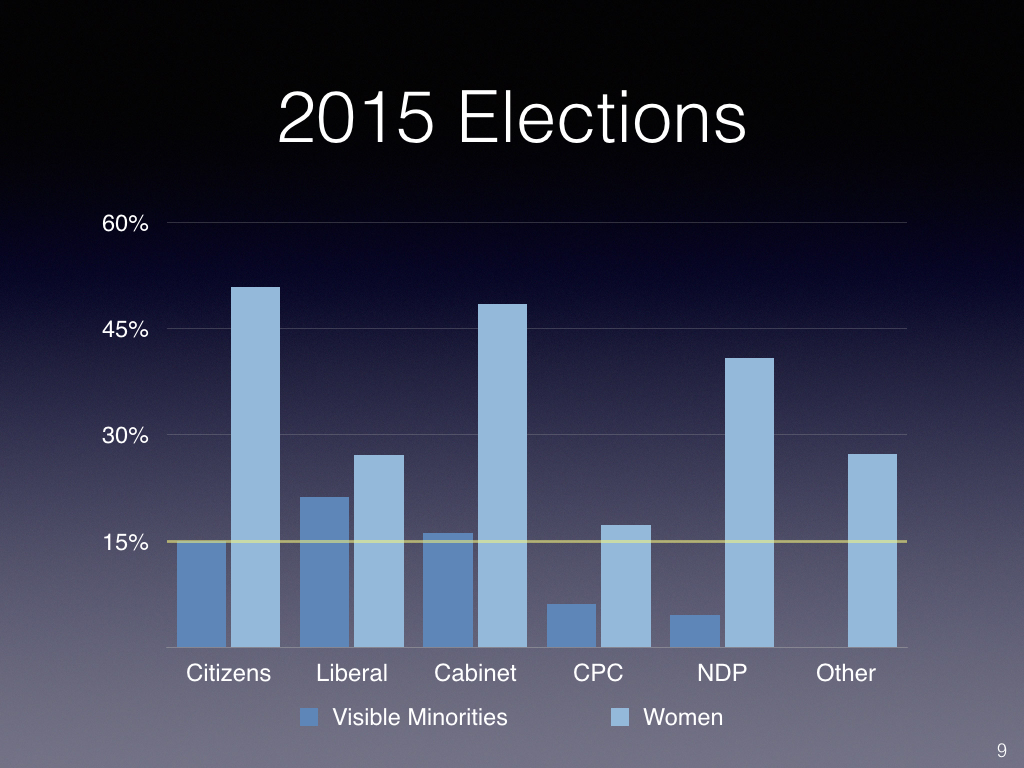
While hard to disagree with the overall tenor of this editorial, the more interesting aspects of Kai Chan’s in-depth work is less with traditional diversity – women, visible minorities, foreign-born, Indigenous peoples – is with respect to the lack of occupational, age, education etc where some of the differences between parties are striking.

Election 2015 - VisMin and Foreign-Born MPs.002

Note: Baseline for visible minorities is 15 percent, those who are Canadian citizens

The Hill Times conclusion only focuses on the former and is silent on the latter:

As The Hill Times reports in this week’s issue, this is one of the most diverse House of Commons in Canadian history, but it still has a long way to go to reflect Canada’s diverse population. More work must be done to elect more women, more indigenous peoples, more visible minorities, and more people with diverse educational and professional backgrounds. The House is still too white, too male, and too English.

According to research by Canadian expatriate economist Kai Chan, who has a PhD in economics from New Jersey’s Princeton University and is a self-described “data-junkie,”of 338 MPs elected in the last general election, the average group in the House is 50-59; the most common professional background is law; and the most studied subject is politics. Some 104 MPs, or 30 per cent of MPs, are bilingual; 47 MPs, or 13 per cent, were born outside Canada; and there are 88 female MPs, or 26 per cent of the House. Of the 47, or 14 per cent of MPs who were born outside Canada, 11 were born in India, six in the U.K., and four in Lebanon. Out of the 291 MPs, or 86 per cent of the House, born in Canada, 28 MPs were born in Montreal, 25 in Toronto, and 12 in Winnipeg.

According to the 2011 National Household Survey, of Canada’s 32.8 million total population, 6.2 million, or 19 per cent, are visible minority Canadians, including 1.5 million South Asians, 1.3 million Chinese Canadians and about 945,665 black Canadians. The Filipino population numbers 619,310, Latin American 381,280, Arab 380,620, Southeast Asian 312,080 and West Asian 206,840. And the total aboriginal population is 1.4-million.

“Canada is such a diverse country, it’s good to get all different voices,” Mr. Chan told The Hill Times. “It’s especially good because we live in a globalized world, and for Canada to really capitalize on its demographic dividend, we really should have all those people at the table.”

Canadians elected 60 lawyers, 47 consultants, 43 professors, 42 business people, and 41 executives. Some 63 MPs studied politics, 60 studied law, 27 studied business and 27 studied economics. Some 199 prefer English and 35 prefer French only.

In the education category, a total 136, or 40 per cent of MPs, have bachelor’s degrees; 75 MPs, or 22 per cent, have master’s degrees; and 30 MPs, or eight per cent, have PhDs. And 81 MPs have secondary or lower levels of education. The Liberals lead the pack with 22 MPs who have doctorates, followed by the Conservatives with five MPs who have doctorates, the NDP two and Bloc one MP. Of the MPs who have secondary or lower education, the Conservatives have the highest with 42 MPs, followed by the Liberals with 27, the NDP eight and the Bloc four MPs. The Liberals are far ahead of other parties when it comes to MPs who have master’s or bachelor’s degrees with 47 and 82, respectively. In the Conservative caucus, 14 MPs hold their master’s and 31 their bachelor’s. On the NDP side, 12 MPs have their master’s and 19 MPs have their bachelor’s degrees. Some 32 MPs attended the University of Toronto, 22 McGill University in Montreal, and 16 went to Queen’s University in Kingston.

Hopefully, all political parties will make a much stronger effort to recruit more candidates who are underrepresented in the House right now, including more visible minorities, more women, more indigenous peoples to run in the next election. Canada is a diverse country. It’s time that diversity was better reflected in the House.

Source: House more diverse, but still has a long way to go – The Hill Times – The Hill Times

Glass ceiling still in place for British Columbia public sector employees

Unfortunately (or fortunately, depending on the perspective), there is no equivalent federal ‘sunshine list’ on all public sector salaries.

british-columbia-public-service-2011

However, we do have data on federal Deputy and Assistant Deputy Ministers (for women, 2016 baseline 37.6 percent women and 4.7 percent visible minorities for deputies, 40.8 and 7.2 percent for ADMs). DM appointments by the current government are close to gender parity at 46.9 percent women.

My analysis of GiC appointments showed less representation of women and visible minorities, and a similar gap to British Columbia between senior and junior appointments for crown corporations and administrative tribunals:

GiC Baseline 2016.014

Prime Minister Justin Trudeau may have introduced a gender-balanced cabinet “because it’s 2015,” but that equality does not extend to public servants in B.C., where the vast majority of the highest-paid employees are men.

An analysis of The Sun’s exclusive public sector salary database reveals that of the 200 highest-paid public employees in B.C., during 2014 or the 2014-15 fiscal year, 70 per cent were men and 30 per cent were women. That increases to 77 per cent male when the field is narrowed to the top 100 (By contrast, 94 of the 100 highest-paid corporate executives in 2015 were men, according to Business in Vancouver.)

“There’s an old saying: the higher, the fewer, with respect to women,” said Barbara Arneil, head of the University of B.C.’s political science department. “We have what I think are structural, systemic reasons why women are not reaching the top of their profession, whether that is in the university, whether that’s in government, whether that’s in the private sector. And we’re wasting very good resources.”

Search The Sun’s exclusive public sector salary database.

The Sun analyzed the top 200 public-sector earners in this year’s database, which contains salary information for nearly 77,000 employees, and the top 50 earners in six of the seven sectors: B.C. government, Crown corporations, health authorities, local government, school districts, and colleges and universities. The Sun did not include municipal police in this analysis because forces generally withhold many names to protect undercover officers. The Sun relied on first names for this gender analysis, checking Internet profiles in cases where only a first initial was provided or the name was ambiguous.

The gender divide is most pronounced at colleges and universities, where men represented 41 of the top 50 earners, or 82 per cent, in the 2014-15 fiscal year. But because the University of B.C. accounts for 45 of the top 50 highest-paid employees in the sector in the province, these findings really only reflect that institution. At the University of Victoria, for example, five of the 10 highest-paid employees are women.

Pay equity is an issue UBC takes seriously, university spokeswoman Susan Danard said in an emailed statement.

“Compensation is affected by several factors, including the depth of experience and accomplishment that a faculty or staff member brings with them when they are first hired, and the length of employment with UBC, with people paid more as they progress in their careers,” she said. Faculty and area of specialization are also factors that affect pay equity, she said, noting specialists and top doctors in the faculty of medicine are often the highest paid given the demands and complexity of their jobs.

Source: Glass ceiling still in place for public sector employees | Vancouver Sun

Daphne Bramham picks up on issue:

Canada’s failure is in providing women the opportunities to fully participate in the economy. Not only does Canada lag the Nordic countries, it trails countries like the United States, Namibia, Mongolia, Belarus, Thailand and Burundi.

It’s because women don’t have equal opportunities, Canada’s overall gender ranking dropped to 30th in 2015, down 11 places from 2014.

Among the more troubling findings in the Sun’s gender analysis of B.C. public-sector wages is that the 25 universities and colleges have the fewest women in top-paid positions — only nine among the top 50. Of those, five work at the University of British Columbia.

The excuses/reasons are the usual ones. Prime career-building years coincide with the prime reproductive years and Canadian mothers continue to bear the largest share of the caregiving for both children and aging parents.

Even though 58 per cent of these institutions’ graduates are women, missing are the supports for those young women to succeed in academe. It’s all the more disappointing because post-secondary institutions are supposed to be places of innovation and change, not laggards.

What’s not surprising is that the health services authorities account for the most women on the top-earners’ list with 59; 35 of whom are at the Provincial Health Services Authority.

For more than a decade, the majority of medical school graduates have been women. Among the professionals in the B.C. government, women account for nearly 90 per cent of the nurses and nutritionists and three-quarters of the social workers and counsellors.

But that may be change for the worse because catching up wage-wise isn’t as simple as more women working in traditionally male jobs. When women do that, the pay scale drops. That’s what sociologist Paula England at New York University concluded after analyzing U.S. census data from 1950 to 2000.

When biologists went from being predominately men to women, England found that wages fell 18 percentage points (even accounting for changed value of the dollar over time). When workers in parks and camps went from mostly men to mostly women, the median hourly wages dropped 57 percentage points.

It’s because when women do the work, England told the New York Times, “It just doesn’t look like it’s as important to the bottom line or requires as much skill.”

Daphne Bramham: Few women in B.C. public sector’s top ranks, …

Apple says it has investigated recent allegations of sexism on campus and ‘actions have been taken’ – Recode

Parts of interview with Apple HR head on sexism and diversity challenges at Apple and in tech more generally:

Young Smith said Apple is committed to diversity in its many forms, noting it is an issue long important to Apple and one that CEO Tim Cook has made a priority.

Without a wide range of perspectives, she said “we cannot continue to be the great innovator we constantly strive to be.”

Cook himself came out rather famously in a column he wrote and has since been vocal with regards to LGBTQ issues, including the need for a national employment non-discrimination act.

But even companies like Apple and Intel, which have been more vocal advocates on the need for diversity, remain largely white and male. Women only make up 32 percent of Apple’s workforce, for example. That’s up two percentage points from two years ago and roughly on par with Google and Facebook, but still far short of having a truly representative workforce.

This has consequences — in hiring and recruitment as well as when it comes to creating an inclusive culture. Most of Apple’s engineering teams are dominated by men and it is not uncommon for women in tech to experience sexism in different forms.

In another incident described in the Mic article, a female employee recalled hearing one male co-worker tell another that he sounded like he was on his “man period.”

Asked how she would respond if she heard such talk, Young Smith noted that people tend not to say such things around her, but added that if she did hear that kind of talk, she hoped she would have the courage to call “time out.” Other employees, she said, might prefer to address things afterward, but Young Smith said she wants a company where people do call one another out.

“I don’t think people are too shy about doing it,” Young Smith said, “but I am also very cognizant that we are still 70/30 in our very hard-core engineering team. We have to be cognizant that someone may not feel that their voice is heard or valued.”

Deciding just what to do to change that is trickier, Young Smith said.

The company is looking at ways to improve the training it gives its managers as well as some of the courses in Apple University, but Young Smith said she is skeptical of top-down corporate lectures.

Nor does she see creating a giant diversity team as the answer. Rather, she said she wants 140,000 people who all feel it is their personal responsibility to make Apple more inclusive.

As for the articles, Young Smith said she is most concerned that Apple employees, especially women and people of color, will now feel like they can’t safely speak up if they experience discrimination.

“The unfortunate consequence of this is that we may have lost the trust of others,” she said.

Young Smith is particularly concerned about preserving the women-at-Apple mailing list that was the source of the emails leaked to Mic. The list has more than 1,000 participants and is an important place for people to talk about their experiences, good and bad, Young Smith said.

“We cannot risk losing that,” she said. “We have to have a safe place for people to do that.”

At the same time, Young Smith says the company may need to also find new places for people to share their concerns. “I think we need to constantly reevaluate the tools we have and think about what could be more effective.”

As we talked on Friday, Young Smith said she was finalizing an email she planned to send to the group talking about the issues raised in the articles and her personal commitment to making sure women at Apple are supported.

“As a woman (and a) leader, I think I have an even greater responsibility that I am listening to all the women, all the people of color, who may not feel as heard,” she said.

Addressing the impact of the articles, in addition to the specific incidents described, quickly became a top priority this week, not just for Young Smith, but also for Cook.

“In the midst of all this, he was deep down with all of us to understand what has transpired and what can we learn,” Young Smith said. And that came in a week where Cook was taking part in a board meeting and overseeing a major product launch.

“I think what that says is this is every bit as important as our products,” Young Smith said.

‘Feminist’ Trudeau under attack for attending gender-segregated event at Ottawa mosque

Awkward. Valid to raise questions about appropriateness.

While in general, always better to engage and be present, PMO needs to think more about the guidelines when accepting such invitations or choosing locations. Respect should be mutual, while I can understand women MPs covering their hair as a sign of respect, the mosque should have allowed the women MPs to enter by the front door, not the side door, equally as a sign of respect.

And that would allow the PM to support those within Muslim communities who wish for more egalitarian mosques:

Canada’s self-styled feminist prime minister was praised Tuesday by one of the world’s most powerful women for his commitment to gender equality even as he was taking it on the chin from other women for appearing at a gender-segregated event the previous day.

International Monetary Fund managing director Christine Lagarde told reporters at a Parliament Hill news conference she was “appreciative” of Trudeau’s commitment to a government that was “gender-equal.” Trudeau had just told Lagarde the next Canadian representative to the IMF would be a woman, a first for the country.

Yet, Trudeau’s appearance Monday morning at a gender-segregated mosque in Ottawa brought criticism from some of the same women who had admired his work toward gender equality.

 “Right now we have these political leaders — ironically, politically liberal leaders — who are just putting blinders on their eyes about their values,” Asra Nomani said in a telephone interview from Washington, D.C. Nomani, a former Wall Street Journal reporter who describes herself as a liberal, is the author of Standing Alone: An American Woman’s Struggle for the Soul of Islam.

“That’s the big differential for liberals, they fancy themselves as honouring the women’s body and yet the segregation by its very definition hyper-sexualizes women’s bodies. That’s the great irony.”

 Trudeau was at the mosque Monday to mark Eid al-Adha, considered the holiest of feast days for the world’s Muslims. Three female MPs accompanied Trudeau during his brief remarks, though they had to arrive by a side door and stand with their heads covered. They did not address the mosque.

Worshippers at the mosque are separated by gender. Men were on the main floor where Trudeau spoke. Women and girls were in a balcony or in other parts of the mosque. Nomani said that recent surveys indicate about two of every three mosques separate men from women, but that is up from a decade ago when only about half did.

“I will meet with Canadians regardless of where they are in Canada,” Trudeau told reporters Monday afternoon. “I will speak to inclusive growth, help for the middle class. I will talk about gender equality. I will talk about the rights of the LGBT community. We will continue to promote the values which bring us together.”

Source: ‘Feminist’ Trudeau under attack for attending gender-segregated event at Ottawa mosque | National Post

Status of Women list: Modern, minority Canadians unjustly left off

While the criticism of the list is valid as well as noted the mixed record of many of the names, Stephen Hume forgets, in his suggestions, that usually naming of buildings is reserved for the dead:

Our federal government has compiled a list of 29 women it thinks deserve buildings named in their honour but, as a Canadian Press report points out, very little has been done with it.

Read through the list compiled by Status of Women Canada for then-Conservative public works minister Rona Ambrose and one can see why.

The list is overwhelmingly white, privileged and a roster of the establishment.

Emily Murphy may have been the first woman in the British Empire appointed magistrate and one of the “Famous Five” who successfully battled to have women recognized as “persons” rather than the chattels of fathers or husbands.

But in the 21st century should we name a public building for a woman who surreptitiously wrote fear-mongering racist tracts about Asians, blacks, Jews and Ukrainians?

 …Then there’s Nellie McClung, widely celebrated as a witty, eloquent suffragette, adept with the rejoinder in her debates with the Colonel Blimps determined that women should stay out of politics and in the nursery.

When one yelled that the prime minister would quit if ever a woman were elected, McClung retorted, “what a purifying effect women would have on politics.”

On the other hand, McClung advocated removing people with disabilities from the gene pool. The pristine bloodlines of Canada’s sturdy, Anglo-Saxon, Protestant stock, our natural overclass, was not to be muddied by the genes of feeble-minded degenerates.

McClung was for routine sterilization for “young simple-minded girls.” Her arguments helped fashion the Alberta Sexual Sterilization Act. It gave provincial bureaucrats power to order sexual sterilization of undesirable individuals.

….There are folks who will argue that our reactions should be tempered by the times that shaped and defined people. That argument doesn’t cut ice with the Canadian Jewish Congress. It has objected to honours for long-time Ottawa mayor Charlotte Whitton — another on the federal list — as an unapologetic anti-Semite who helped deliberately block the entry into Canada of Jewish orphans fleeing the Nazi Holocaust. Fair point. Would we tolerate naming buildings after a Nazi like Albert Speer because his anti-Semitism happened to be a product of his times but he remained a refined, cultured and artistic man who did public service?

Source: Status of Women list: Modern, minority Canadians unjustly left off | Vancouver Sun