Bureaucrats assess impacts of policies on women — but results kept secret

Indeed. There should be a way to shed some light on the gender-based analysis involved without violating Cabinet confidentiality:

Canada committed to using gender-based analysis in 1995, as part of ratifying the UN Beijing Declaration and Platform for Action, but the auditor general concluded last year that relatively few departments and agencies were using it, or that they were doing so in an incomplete and inconsistent way.

That is changing. Prime Minister Justin Trudeau is said to have pushed for more rigorous gender-based analysis around the cabinet table. Finance Minister Bill Morneau pledged to put the 2017 federal budget through the same process and publish the results.

The finance department plays a special role in gender-based analysis.

It puts many of its own policies through the process, but it also reviews the gender-based analysis done by other departments on any budget proposals before they can go to Morneau.

Treasury Board and the Privy Council Office, the other two central agencies, perform a similar “challenge function.” A template for the new due diligence document that must now be submitted with every memorandum to cabinet shows proposals must include a summary of findings from a gender-based analysis.

This is where the newly declassified memo comes in.

The report from the status of women committee had recommended all three central agencies “produce annual reports on the challenge function they play in promoting the application of (gender-based analysis).” It also recommended they share these reports with a commissioner for gender equality — another recommendation from the report.

This is what the part of the memo regarding the limits of transparency — contained in a heavily redacted section titled “considerations” — was responding to.

New Democrat MP Sheila Malcolmson, vice-chair of the status of women committee, said people need to know what questions the government is asking itself.

“We heard a lot of evidence that there is no transparency on the challenge function and nobody was able to really point to any examples of where legislation or a funding decision had been turned back at the cabinet level because they hadn’t done the (gender-based analysis) test,” Malcolmson said.

It is especially important for the finance department to find a way to shed more light on their decisions, said Conservative MP Marilyn Gladu, who chairs the committee.

“They are the ones putting money to programs that may adversely affect women if not done well,” she said.

There is a sign the finance department is looking for a better way.

The government’s official response to the committee report, tabled in the House last October, included this line: “All central agencies will explore ways to better communicate publicly the role and value-added of their challenge function with respect to (gender-based analysis.)”

Jack Aubry, a spokesman for the finance department, referred to this line when asked about the memo, but said he could not give any more details.

Isabella Bakker, a political scientist at York University who has done research on gender budgeting, said the finance department should be able to find some balance. “They could develop some kind of internal measure that would get around the issue of secrecy, but would at least give a broad indication of what they were doing.”
Add women, change budgets? Underused gender policy tool finds new fans in Trudeau’s cabinet

In contrast to the bleak assessment posted earlier (Ottawa’s gender-based analysis was predestined to fail : Lynda Gullason), there does appear to be some progress on GBA (requirement in MCs and TB submissions).

This not only sends a key signal but equally important requires background analysis in order to be mentioned in cabinet documents. We will only know how effective this requirement has been following the next OAG audit:

There’s a T-shirt for sale on the Liberal Party’s website that features the slogan “Add women… change politics.”

You can’t say self-described “feminist” Justin Trudeau isn’t trying.

First, he picked a half-female cabinet. Four of the five Liberal candidates in the by-elections now underway are women — including those in three ridings Liberals won in 2015 and look to win again.

But changing politics — or its politicians — is one thing. Changing policy is another.

That’s one of the reasons March 22’s federal budget will be worth watching.

The finance department will include something that’s never been offered before: a gender-based analysis for budget measures.

It’s the latest way Liberals are trying to walk the talk they campaigned on in the last election.

“We will consider the gender impacts of the decisions we make,” the Liberal platform promised. “Public policies affect women and men in different ways.”

Finance Minister Bill Morneau’s fall economic statement promised “more rigorous analysis” to “deliver real and meaningful change.”

But what does that mean?

Social Development Minister Jean-Yves Duclos offered reporters a preview last Friday. One of highest-profile things his government introduced so far is a good example of more gender-sensitive policy, he said.

The Canada Child Benefit (CCB) is helping lift about 200,000 parents out of poverty, and about 70 per cent of those are mothers, he said.

“Almost half of the children that are being lifted out of poverty because of the CCB are in single-parent families. And 90 per cent of these single-parent families are headed by women,” the minister said.

Not just about women

Trudeau’s team didn’t invent gender-based analysis.

Canada made a commitment at the 1995 United Nations conference on women to “ensure that before policy decisions are taken, an analysis of their impact on women and men, respectively, is carried out.”

But progress in the 22 years since has been slow.

The auditor general has scolded the government twice for its tepid embrace of gender analysis, most recently after an audit completed in the final year of the former Conservative government.

Among over 100 federal departments and agencies, only 30 had committed to it by early 2015, and six of those hadn’t fully implemented it.

Four departments that were doing gender analyses were examined by the auditor general, who in 2015 found incomplete work that lacked enough evidence for decision-makers.

The Liberal platform promised to do better. “We will also ensure that federal departments are conducting the gender-based impact analyses that have been required of them for the past 20 years,” it said.

It’s not only about advocating for women. Status of Women Canada says the government’s current requirements go beyond gender-based analysis: analyzing not just gender, but also age, education, language, geography, culture and income to find ways some aren’t equal to others.

“Have you or someone you know taken parental leave, been treated for heart disease or recently immigrated to Canada?” its website says, offering examples of policy shaped by studying inequalities.

Equality equals economic growth?

Officials admit things aren’t fully in place across every department this spring. But starting from the top and trickling down, it’s clear this way of thinking is the new intended normal.

The privy council office is asking for gender analysis when policy proposals are prepared for cabinet.

Duclos said gender parity among ministers making those decisions has already had “tremendous value.”

“It’s been extremely satisfying to see both the level of actions and the attitudes, how that changes,” he said.

Asked for examples of policy from his shop now shaped by gender analysis, Duclos names two areas: housing and child care.

The budget will offer more details, he said, following recent work with the provinces.

Duclos, an economist before entering politics, is on a pre-budget tour this week, putting down markers for how Morneau’s budget will promote economic growth.

He laid out three things Liberals are focusing on — innovation, public and private capital, and labour, or human capital.

Making it easier to start or return to work — offering training or child care, for example — improves labour force participation rates and in turn, overall productivity. And more people working improves economic growth.

“We’re sensitive to both economic inclusion and social inclusion,” he said. “It involves all characteristics beyond income that make it difficult sometimes for Canadians to feel included in our society. And gender is one.”

Spending proposals submitted to the Treasury Board now must include proof that gender was considered.

A form available online that civil servants use for Treasury Board submissions asks for evidence and data sources, as well as a plan for monitoring what happens after a program starts.

That fits with the Trudeau government’s affection for “deliverology” — measuring results, not just the initial splash of an announcement.

Widespread compliance with bureaucratic processes isn’t the end goal. Equal opportunities are.

Source: Add women, change budgets? Underused gender policy tool finds new fans in Trudeau’s cabinet – Politics – CBC News

More men moving into women-dominated fields of work: U.S. study

Important study that helps explain some of the political currents. Not sure if there has been equivalent research in Canada:

Even as women moved into men’s jobs, in fields like medicine, law and business, men did not flock to the lower-status jobs that women mostly did.

That’s changing. Over the past 15 years, according to a new study in the United States, men have been as likely to move into predominantly female jobs as the other way around – but not all men. It’s those who are already disadvantaged in the labor market: black, Hispanic, less educated, poor and immigrant men. While work done by women continues to be valued less, the study demonstrates, job opportunities divide not just along gender lines but also by race and class.

At the same time, the women who have continued to make inroads into more prestigious male-dominated professions in that period are likely to be white, educated, native-born and married, according to the research, which is not yet published.

“More privileged men can resist entry into predominantly female occupations more readily than their less privileged counterparts,” said Patricia A. Roos, a sociologist at Rutgers, who did the study with Lindsay M. Stevens, a sociology doctoral student there.

The gender composition of jobs matters for reasons of equality – fields with a majority of men pay 21 per cent more than those with mostly women. Also, the fastest-growing jobs are dominated by women, while the fastest-shrinking ones are predominantly male.

The jobs that have become more female are generally professional or managerial ones, the study found. Some examples of high-paying, high-status jobs done mostly by men in 2000 that had an increased share of women by 2014: supervisors of scientists, which had 19 per cent more women, podiatrists with 8 per cent more and chief executives with 5 per cent more.

Jobs that were mostly female in 2000 and have become more masculine are lower-status jobs. The share of women who work in stores selling products and answering customer questions fell 10 per cent; the share for crossing guards and counter clerks each fell 7 per cent, and for textile workers it fell 5 per cent.

Men are much less likely to have moved into the higher-status professions that are majority women, like nursing and high school teaching (they became more male by about 2 per cent between 2000 and 2014.) The share of women grew slightly in two female-dominated professions, social worker and librarian.

Race, ethnicity and gender have always contributed to who does what work. Women have typically entered occupations when men find better ones, and immigrants have filled the ones women left behind. In the 1800s, according to previous research by Roos and Barbara Reskin of the University of Washington, Irish men replaced native-born white women in textile mills. The women moved to middle-class jobs like teaching – which native-born white men were leaving.

The current patterns reflect widening inequality as a whole, said Leslie McCall, associate director of the Stone Center on Socioeconomic Inequality at CUNY, who was not involved in the new research but said it was consistent with past findings. She said it shows that policymakers who want to improve jobs should focus not on gender or race, but on general working conditions at the bottom of the income ladder.

“People are focusing too much on the white, male working class,” she said, “but if you look at the working class more broadly, the issues are quite similar across all groups: wages, economic security, employment support, training.”

The Rutgers researchers used census data to track 448 occupations. Occupations were considered male or female if they had more than 60 per cent of one sex in 2000, and they were considered to have masculinized or feminized if the percentage of men or women changed by at least 4 per cent by 2014. This happened in 27 per cent of occupations.

Health care showed some of the most striking changes: Every health care job except one is more female than in 2000. (The exception is radiation therapists: from 72 per cent female to 65 per cent.) The share of female dentists, optometrists and veterinarians each increased by more than 10 per cent. The majority of doctors are still men, but women have become the majority in some health care specialties, including pharmacists and veterinarians.

Men’s movement into low-skilled women’s jobs since 2000 is partly a result of the hollowing out of middle-skill jobs in fields like clerical and manufacturing work, which was described by economist David Autor. Women were hit harder – female employment in those jobs fell 16 per cent from 1979 to 2007, compared with 7 per cent for men. But women almost uniformly moved into high-skill jobs, while men were more likely to move into low-skill, low-paying jobs.

Other research has found that men resist so-called pink-collar work, and those who end up in the lowest-status of those jobs, like nurses’ aides who bathe patients and change bedding, are already disadvantaged in the labor market because of race and class.

Sociologists have described the phenomenon as a trap door; these men drop into less desirable jobs. At all levels of work, it seems, white Americans have more choices.

Source: More men moving into women-dominated fields of work: U.S. study – The Globe and Mail

The Order of Canada and diversity

My latest, in Policy Options:

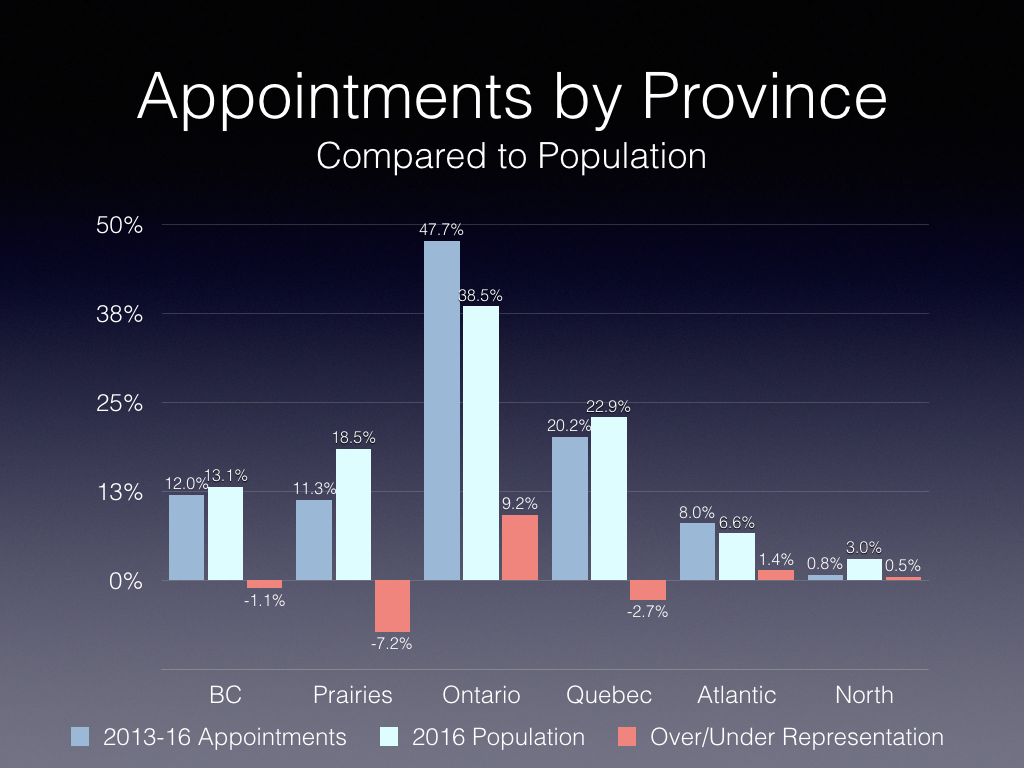
In Budget 2015, the then Conservative government announced additional funding of $13.4 million over five years and $2.8 million in ongoing funding for the Canadian Honours System. This aimed to “bring [honours] closer to all Canadians” by increasing the number of Order of Canada nominations from “under-represented sectors” (e.g. business) and regions (i.e. the West).

This was prompted by an Ottawa Citizen analysis that showed only 26 percent of recipients since the Order’s creation in 1967 came from the West, compared to the region’s 31 percent share of the population. In contrast, Atlantic Canada had 11 percent of recipients, about twice its share of the population. Moreover, the study showed an increasing percentage of awards had gone to those active in the arts while the share going to business people had declined.

Source: The Order of Canada and diversity (for complete article)

Ottawa’s gender-based analysis was predestined to fail : Lynda Gullason

Hard hitting assessment (less of an issue with respect to employment equity in the public service, where regular tracking and data indicate overall progress, and more of an issue with policy and program design, where GBA – and broader diversity analysis – is rarely practiced):

But the gender-based analysis initiative is predestined – perhaps even predesigned – to fail.

Intended to assess the potential gender-specific impacts of policies, programs, legislation and services on women and men, its critical shortcomings severely limit its utility.

To start, there are no mandatory requirements for federal departments and agencies to conduct such analysis. Only 30 out of 110 departments are even signed on to the gender-based analysis action plan – 22 years after it was initially adopted.

There is no monitoring or evaluation or reporting of the implementation and outcomes by Status of Women Canada or by the departments and agencies themselves, although SWC was required to do so after the 2009 audit.

In fact, Status of Women Canada has no authority to enforce the application of gender-based analysis and there are no consequences for departments and agencies which do not conduct it.

There is no measurement of gender equity: no data collection to analyze and correct unfair practices and policies; no baselines or targets and no performance indicators to track progress.

Departments conducting gender-based analyses are required to, but do not, propose measures to address gender inequities. The Canadian Armed Forces, for example, which has set an employment target for women of 25 per cent, has developed no employment equity strategy to achieve that target, and its actual number remains unchanged at 14 per cent.

And so it follows, there are no consequences for departments and agencies which fail to ensure gender equity.

Auditor-General Michael Ferguson has expressed frustration with the federal government’s inability to address gender discrimination, which persists despite decades of audits. Fully half of the gender-based analyses conducted by the audited departments in his 2015 report were incomplete. Yet for the incomplete analyses, these departments “nevertheless concluded” that there were no gender-specific impacts, “and they provided these conclusions to decision-makers.” This is serious: because the conclusions were not supported by evidence, there is the question of “whether Cabinet had been adequately informed about existing and potential gender considerations.”

In response, Status of Women Canada has plans to “explore the development of gender equality indicators,” according to its statement to the Standing Committee on Status of Women last spring. “This is work that is just beginning in terms of how we are going to define success and how we are going to attract progress as we continue to monitor and report,” says Meena Ballantyne, the head of the agency, in her 2016 presentation to the Public Accounts Committee. Except that the agency neither monitors nor reports, and the work should not be “just beginning” some 20 years after the principle of gender-based analysis was first accepted.

When asked at a Status of Women committee meeting how gender-based analysis is measured and how we know whether it is actually implemented, the response of the agency’s gender-based analysis manager, Vaughn Charlton, was, astonishingly, “That is the million-dollar question.” Status of Women Canada, she said in a written reply to the same questions, “simply does not collect this type of information.”

Moreover, the agency’s plan to develop an evaluation strategy will actually measure and report on the agency’s progress in implementing gender-based analysis, rather than the progress made in correcting gender discrimination. And that evaluation of its own performance won’t even be completed until 2020, 25 years after such analysis was introduced.

The fundamental goal of gender-based analysis must actually be gender equity. And that is only achieved when discriminatory policies and practices are corrected.

Thirty-four years after Justice Rosalie Abella wrote in her 1984 Report of the Commission on Equality in Employment that, “Equality in employment will not happen unless we make it happen”; 22 years after gender-based analysis was first adopted by the Canadian government; eight years after the previous negative audit, and 18 months after the most recent one, there is, as the Auditor-General notes in his 2016 Fall Reports “no mandatory requirement subjecting policy, legislation and program decisions to gender-based analysis.”

A more ill-conceived approach to correcting gender discrimination is hard to imagine. No analysis, no monitoring, no evaluation, no enforcement, and no consequences: no surprise, really, that gender inequity will continue under the federal government’s gender-based analysis implementation plan.

Source: Ottawa’s gender-based analysis was predestined to fail – The Globe and Mail

Diversity in GiC appointments – 2016 Update

My latest in IRPP Policy Options:

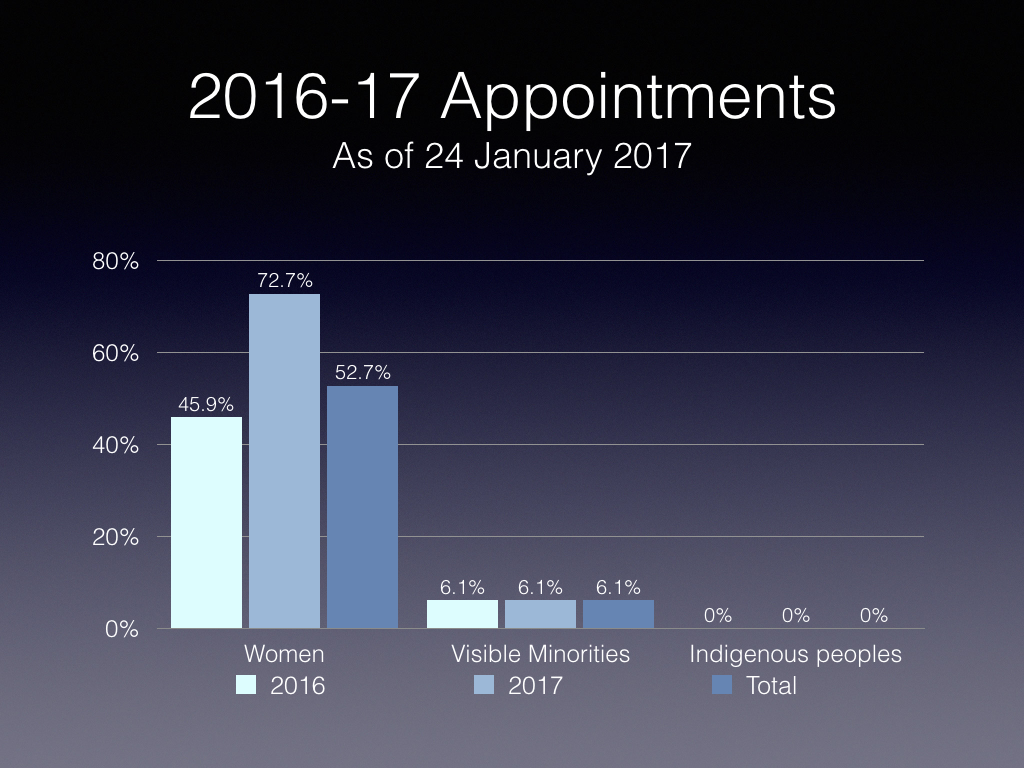
election-2015-and-beyond-implementation-diversity-and-inclusion-062Following my 2016 baseline study of the diversity of Governor in Council (GiC) appointments (Governor in Council Appointments – 2016 Baseline), I have analyzed 2016 and early 2017 appointments using the GiC appointments index. There has been a strong push towards gender parity but no clear trend with respect to visible minorities and Indigenous peoples.

Baseline data below:

GiC Baseline 2016.010

Source: Diversity in GiC appointments

Terry Glavin: Sorry, Canada, when it comes to political leadership it turns out you’re not uniquely feminist

Interesting study by Environics Institute, underlying the importance of data and analysis in challenging assumptions:

Sorry to disappoint you, Canada, but it turns out you’re nowhere near as uniquely feminist in your ideas about political leadership as you seem to think you are. With Prime Minister Justin Trudeau’s inaugural gender-parity cabinet, and his Jan. 10 shuffle which the majority of cabinet posts to women, Canada is better than the average, sure.

But when asked whether women are just as qualified to lead their country as men, Canadians are less likely to agree than respondents in such stereotypically macho countries as Spain, Portugal, Italy and Venezuela. Going strictly by the numbers, Canadians are less likely to agree with the proposition than Kenyans.

That’s just one of the surprising findings in a groundbreaking international survey undertaken late last year by the Toronto-based Environics Institute, made available exclusively to the National Post. Involving 62,918 respondents in 60 countries, the Environics survey is the most ambitious of its kind that the institute has ever undertaken.

Here’s another one of its surprises: age and education levels play no clear role in whether people will agree that women are as qualified as men to serve in political leadership positions. In some countries, the older and less educated you are, the more likely you’ll be content with women holding political power.

The Swedes, whose government boasts that it’s “the first feminist government in the world,” are not statistically different than Chileans or Mexicans, or Canadians for that matter. And the rigidly theocratic Saudis, who are notorious for requiring women to cover themselves from head to toe in niqabs and won’t even allow women to drive, come in only slightly below the thoroughly democratic Japanese, who are only barely likely to agree that women are as capable as men in political leadership.

In most countries, there’s not much difference between what women and men say on the subject, either. Here’s a shocker: people who are most emphatic that women are as capable in national leadership positions as men are more likely to cleave simultaneously to the “patriarchal” notion that a man should be the head of the family.

Of the United Nations’ 193 member states, only 19 heads of state or heads of government are women. If this isn’t mainly because of institutional barriers or differences in political systems, and if it doesn’t simply reflect what men want, or what old people want, or what people without much schooling want, then what’s going on?

“It looks like it’s mainly culture,” says Keith Neuman, the Environics Institute’s executive director. Another lesson from the study is that the assumptions Canadians tend to make about certain cultures, and the implications for the status of women, might also be more than just a bit wonky.

“Nobody’s ever asked these questions of all these countries so we didn’t have clear expectations, but what surprised me I guess was the level of support in a number of patriarchal societies. I was surprised by the level of support, for instance, in Latin America,” Neuman told me. “Part of me assumed that it would be the western progressive feminist countries, the countries with the strongest feminist leanings, that would be the counties where people would be be inclined to say, yes, absolutely, women of course are just as qualified as men. That didn’t come out the way I’d expected.”

Globally, nearly eight in ten people are pretty much like Canadians, at least mildly agreeing with the statement: “Women are just as qualified as men to lead our country.” Respondents were given a ‘totally agree’ or ‘totally disagree’ option, to identify responses that were emphatic and not merely indications of a ‘Yeah, sure, whatever’ attitude. Latin America comes in with a higher “totally agree” score than any region in the world, at 85 per cent, exceeding even Western Europe’s 77 per cent average.

But in that same “totally agree” category, Canada comes in at 62 per cent, below Spain (72 per cent), Portugal (71 per cent), Italy (65 per cent), and Kenya (66 per cent).

Cold comfort: at least Canadians score higher than Americans. Only 43 per cent of American respondents “totally” agree. Canada gets to rub it in, too: the United States scores lower than Pakistan, where 48 per cent of respondents “totally” agree.

Unsurprisingly, the Arab countries come in low in the total-agreement category, at 38 per cent of Syrians, for instance, 22 per cent of Algerians, and 24 per cent of the Saudis — roughly half of whom, surprisingly, at least basically agree that women are as qualified to lead as men. Respondents in the East Asian countries came in generally low in “total agreement” with the idea that women are as qualified in politics as men. But the Japanese come in close to the Saudis. While 63 per cent at least agree, only 27 per cent totally agree.

Undertaken in collaboration with Environics Communications and Environics Analytics — two commercial firms in the Environics group — roughly 1,000 people were surveyed in each of the 60 countries in the study. The surveys relied on technology pioneered by Toronto’s RIWI Corp., which gets around the usual recruited online panels by teasing out random samples of country populations through cellular phones and laptop computers. (RIWI has racked up quite a few predictive bullseyes lately, pinpointing the tipping point in Egypt’s popular uprising against dictator Hosni Mubarak in 2011 and correctly forecasting Donald Trump’s electoral college win despite Hillary Clinton’s popular-vote lead in the U.S. presidential elections. RIWI also called the margin of defeat in Italy’s constitutional referendum within a single percentage point last December.)

Source: Terry Glavin: Sorry, Canada, when it comes to political leadership it turns out you’re not uniquely feminist | National Post

Diversity in the Senate – My latest in Policy Options

My latest, analyzing the diversity of Senators. Intro teaser below:

With the large number of Senate appointments made by Prime Minister Justin Trudeau and a more independent role for individual senators, a look at the current level of diversity in the Upper Chamber is timely.

In essence, the Trudeau appointments have made the Senate more diverse in terms of gender, visible minorities, and Indigenous peoples and thus more representative of the people it serves.

However, when viewed from the perspective of education and occupation, there is less diversity: more senators with higher degrees, and more senators with an activist background and less with a business background.

Given the increased independence of senators, the increased ethnic and gender diversity and decreased educational and occupational diversity    may play a role in terms of how the Senate responds to legislation and plays its sober second thought role.

This analysis contrasts the various aspects of diversity between the 43 non-affiliated senators (33 form the Independent Senators Group, of whom 28 were appointed by Prime Minister Trudeau),  and the 41 Conservative and 21 Liberal senators (December 2016).

Source: Diversity in the Senate – Policy Options

Feminists watching closely for gender-based analysis in Budget 2017

Indeed, something to watch for.

Whether this will be done seriously for key budget initiatives or more generally will indicate the degree to which the government is serious and the public service able to deliver an informative and meaningful assessment of the budget’s impact on women (and which sub-groups of women).

And of course, GBA is only part of the required diversity analysis required for all employment equity and other groups:

When Finance Minister Bill Morneau delivered his fall economic statement, much of the fanfare focused on the deficit, the infrastructure bank and efforts to attract foreign investment.

Something else caught the attention of a select group of people — mainly women — that Morneau never mentioned in his speech.

“To ensure that the government continues to deliver real and meaningful change for all Canadians, it will submit Budget 2017, and all future budgets, to more rigorous analysis by completing and publishing a gender-based analysis of budgetary measures,” said the statement released Nov. 1.

That one sentence, virtually ignored by the rest of the country, caused a flurry of excitement for those whose work touches on issues affecting women and girls.

They are now anxiously awaiting the results of the commitment, and there are some signs of movement.

“It’s historic and it’s important, but there is a lot of work to be done,” said Kathleen Lahey, a professor of tax law at Queen’s University.

The idea behind gender-based analysis is to think about how a certain policy might affect men and women, or boys and girls, in different ways, along with taking age, income, culture, ethnicity and other intersecting factors into account.

If the analysis — ideally done early on in the process — reveals one gender would experience disproportionately negative impacts then policy-makers have the opportunity to reshape things or otherwise mitigate those effects.

Conservative leadership candidate Maxime Bernier reacted strongly to the idea Monday.

“More identity politics nonsense from those who want bigger and more interventionist government pandering to every subgroup of Canadians,” Quebec MP posted to Twitter.

‘Good for the economy’

Isabella Bakker, a political scientist at York University who has done research on gender budgeting, said the process is actually good for the economy.

“There’s a lot of economic good sense to doing a gender-based analysis of budgets, because basically what you’re doing is targeting your policies more effectively,” she said.

“So, you’re asking who is using these services and how are we meeting the needs of the most marginalized?”

There are many different models around the world, but one example of what might be included would be a look at how a tax measure — be it a cut, a hike or a credit — could impact men and women differently based on the fact that a higher percentage of women do not earn taxable income.

It could also involve viewing infrastructure spending through a gendered lens, both in terms of how men are more likely to benefit from the creation of construction jobs and how women are more likely to be the ones to use the infrastructure once it is built.

And then there is the matter of including things specifically aimed at reducing gender inequality, be they relatively inexpensive initiatives aimed at reducing gender-based violence or massive programs aimed at increasing participation in the workforce, such as child care.

An ambitious, overdue goal

Armine Yalnizyan, senior economist at the Canadian Centre for Policy Alternatives, said a federal budget that is truly gender-responsive needs to take this holistic approach to reducing gender inequality.

“They have to watch what kind of narrative they develop around growth, or else it is going to sound tone-deaf,” she said.

“‘We need you to work because we need more money.’ I’m sorry, that’s not gender-responsive. That’s gender-exploitive.”

Prime Minister Justin Trudeau, who has proudly declared himself to be a feminist, is said to have pushed for more rigorous gender-based analysis around the cabinet table — helped along, several senior sources have said, by Labour Minister Patty Hajdu, who was until last month the minister responsible for status of women.

They have a lot of catching up to do. Ottawa committed to using gender-based analysis in 1995, as part of ratifying the UN Beijing Declaration and Platform for Action, but the auditor general revealed last year that relatively few departments and agencies were using it to its full potential — or at all.

The commitment to incorporate gender-based analysis into the federal budget could be seen as the next natural step in that process. But no Canadian finance minister has ever agreed to do it before and experts describe it as an ambitious — even if long overdue — goal.

Source: Feminists watching closely for gender-based analysis in Budget 2017 – Politics – CBC News

Is your gender really necessary on a passport? | Toronto Star

Interesting to see where the government ends up on this but encouraging that the MP responsible for advising the PM, Randy Boissonault, on the issue recognizes the balance: “Any policy changes have to also ensure good policy making in the future … we want to make sure that we’re being respectful and inclusive, and yet not erasing what knowledge we have.”

There is also a need for federal-provincial consultation and likely coordination to avoid situations such as when Ontario removed gender from health cards, making it more difficult for some to get a passport (New gender-neutral Ontario health cards make it harder to get a … – CBC):

In what transgender rights activists are calling a “landmark” development, the Canadian government has settled a human rights case that could pave the way for gender markers to be scrubbed from passports, birth certificates and other identity documents.

Ottawa is also undertaking a government-wide review to assess how it collects and uses sex and gender information — a move that advocates for transgender rights are hailing as a major victory in the fight to remove “male” and “female” markers from identity documents.

“To my knowledge, this would be like a world first, for a government to proceed to review all of its gendering practices,” said barbara findlay, a lawyer and member of the Gender-Free ID Coalition, an advocacy group calling for gender-neutral identity documents.

“It’s a seismic shift in the way that we understand what gender means and how we should be using it.”

Wednesday’s announcement caps a five-year battle launched by findlay’s client, 32-year-old Torontonian Christin Milloy, who was repeatedly denied in her attempts to update the gender information associated with her social insurance number.

In January 2012, the transgender activist and web developer filed a human rights complaint against Employment and Social Development Canada (then known as Human Resources and Skills Development Canada), which oversees the SIN register.

A settlement was only reached last week, however. While its terms are confidential, an exception was made for some details to be publicized.

“As a government, we feel that this settlement is a step in the right direction,” said Jean-Yves Duclos, Minister of Families, Children and Social Development, in a statement posted online.

“My department is committed to reviewing its data collection to determine when it is justifiable to ask an individual for their gender as a condition of receiving a government service or for other legitimate purposes.”

In the settlement, ESDC acknowledged that personally-identifiable sex and gender information can only be collected from Canadians if there are “legitimate purposes” for doing so. It remains unclear how “legitimate purposes” will be defined, but Milloy believes the acknowledgement is “revolutionary.”

“Now the onus is on government to prove why they need the data,” she said.

Since Milloy filed her complaint, the ESDC has stopped requesting supporting documentation from people looking to change their gender associated with their SIN.

The government department is also changing its procedures to let people opt out of responding to sex or gender questions. It will further provide at least three options — male, female, and a third option — when the question is asked.

“We are encouraged by this change, and we hope that all governments in Canada are inspired to remove gender markers (“male or female”) on documents wherever possible, and make any remaining markers more gender inclusive,” Marie-Claude Landry, chief commissioner of the Canadian Human Rights Commission, said in a written statement.

“What it comes down to is the ability for people to choose how they define themselves and under what circumstances. There is nothing more unique or personal than our identity and gender.”

Gender markers can be fraught for people who are transgender, gender fluid or have a non-binary gender identity.

The wrong gender on a driver’s license can “out” someone as transgender — making them vulnerable to discrimination or transphobic violence — and the letters “m” and “f” fail to accurately represent people who identify as both or neither.

Current processes to change gender information can also be onerous, expensive or invasive.

While some have proposed adding an “X” option to identity documents, the Gender-Free ID Coalition argues that “in our transphobic society, a third option puts a target on the forehead” of people who are gender diverse. Furthermore, they don’t see how a government can verify someone’s sex (not only are some people intersex, biological sex is now understood to comprise a variety of factors, like chromosomes, genitalia and secondary sex characteristics) or gender identity (which can be fluid and reflects how someone feels inside).

They prefer a different solution: eliminating gender markers altogether.

“You wouldn’t be entitled to ask somebody’s race, sexual orientation or religion — and gender is exactly the same,” said findlay.

She said the routine practice of asking for gender information hearkens back to a time when “men and women had utterly different rights” — for example, when women were prohibited from owning property, voting, or marrying other women.

“But those legalized inequalities are gone,” she said. “There is no longer a reason to maintain that information.”

Transgender rights activists don’t oppose the collection of de-personalized gender information for census surveys and demographic research. Lawyer Nicole Nussbaum says the goal is to push for “deliberate and purposeful collection of information.”

The government-wide review is aimed at achieving just that, according to Edmonton Centre MP Randy Boissonnault, special advisor to the prime minister on LGBTQ2 issues.

He said that the review will try to understand how sex and gender data is collected and used, and where it might be necessary for informing policy and funding decisions. He said that Canadians with gender-diverse identities are also poorly represented in datasets, something he hopes to see fixed.

“If we’re going to, as a government, get to the point where we can have respectful gender markers on official documents, then we also need to know how we collect that information as a government,” he said.

“Any policy changes have to also ensure good policy making in the future … we want to make sure that we’re being respectful and inclusive, and yet not erasing what knowledge we have.”

Boissonnault doesn’t have a timeline yet for how long the government review process will take. But Milloy’s case is sure to have an immediate impact in courtrooms and tribunals across the country, where other battles over gender markers are still playing out.

Source: Is your gender really necessary on a passport? | Toronto Star