Despite ministerial parity, women still underrepresented as senior cabinet, PMO staff

Nice to see this analysis being done by The Hill Times. Now they need to expand this to include visible minorities and Indigenous peoples:

Even though the Liberal cabinet was designed with gender parity in mind, women only represent 40 per cent of the senior staff supporting those ministers’ offices.

Those positions—made up of chiefs of staff and their deputies, directors of policy, communications, parliamentary affairs and senior advisers—are the gateways to ministers and the people who help shape political decisions, observers said.

“That’s where the primary influence is,” said Rachel Curran, former policy director to prime minister Stephen Harper. “Those are the people helping set the agenda in conjunction with the minister.”

While the Liberal government seems to have made more of an effort staffing women in political circles, Ms. Curran said having 60 per cent men in senior positions is “indicative that there is a problem there.”

Men held 98 of 162 positions, according to a Hill Times analysis using an October list exported from the government’s electronic directory services (GEDS) of all staff working for cabinet ministers and the Prime Minister’s Office, marked each by perceived gender, job title and cross-referenced with our records. While the public service annually reports staff numbers by gender, which is almost at parity at the executive level, no such data exists for political staff.

This is the second of a two-part series looking at women at senior political staff levels.

“Women still have a long way to go to be considered equal,” said Michele Austin, who was chief of staff to former Conservative minister Rona Ambrose, after reviewing The Hill Times’ staff lists. “Progress has been made, but certainly not in the senior staff rank.”

via Despite ministerial parity, women still underrepresented as senior cabinet, PMO staff – The Hill Times – The Hill Times

Poll: Majority of LGBTQ Americans Report Harassment, Violence Based On Identity : NPR

Not too surprising:Poll__Majority_of_LGBTQ_Americans_Report_Harassment__Violence_Based_On_Identity___NPR

More than half of lesbian, gay, bisexual, transgender and queer Americans say they have experienced violence, threats or harassment because of their sexuality or gender identity, according to new poll results being released Tuesday by NPR, the Robert Wood Johnson Foundation and the Harvard T.H. Chan School of Public Health.

“There are very few nationally representative polls of LGBTQ people, and even fewer that ask about LGBTQ people’s personal experiences of discrimination,” says Logan Casey, deputy director of the survey and research associate in public opinion at the Harvard Chan School. “This report confirms the extraordinarily high levels of violence and harassment in LGBTQ people’s lives.”

Majorities also say they have personally experienced slurs or insensitive or offensive comments or negative assumptions about their sexual orientation. And 34 percent say they or an LGBTQ friend or family member has been verbally harassed in the bathroom when entering or while using a bathroom — or has been told or asked if they were using the wrong bathroom.

The poll, conducted earlier this year, looked not only at violence and harassment but also at a wide range of discrimination experiences. We asked about discrimination in employment, education, in their interactions with police and the courts and in their everyday lives in their own neighborhoods. We’re breaking out the results by race, ethnicity and identity. You can find what we’ve released so far on our series page “You, Me and Them: Experiencing Discrimination in America.”

via Poll: Majority of LGBTQ Americans Report Harassment, Violence Based On Identity : NPR

Jordan Peterson and the big mistake of university censors: Maher

One of the better commentaries:

Unfortunately, it is time for people outside the academy to stand up for the free speech rights of Jordan Peterson, the irritating University of Toronto psychology professor who has become a star by producing tedious YouTube videos complaining about people trying to silence him.

Peterson, who is wrong about almost everything, is right when he says, over and over again, that he has a fundamental right to speak. The well-meaning people who try to silence him are making a big mistake, and need to listen to people outside the ivory tower.

On Nov. 1, Lindsay Shepherd, a teaching assistant at Wilfrid Laurier University in Waterloo, showed first year Communications Studies students a video clip from TVO’s Agenda, in which Peterson debated the use of non-gender-binary pronouns with another professor.

The classroom discussion must have upset a student, because Shepherd was censured by faculty and diversity and equity officials, who said she was “transphobic” and had created “a toxic climate.”

Shepherd is afraid that the university may fire her.

“Universities are no longer places where one can engage with controversial ideas,” she told the Waterloo Record. “They are echo chambers for left-wing ideology.”

Shepherd is right and the scolds at the university need to stop their censorious ways, not least because they are playing Peterson’s game.

Peterson, who makes tens of thousands of dollars a month fund-raising online, became famous in basements around the world when he spoke out against a University of Toronto policy requiring professors to use non-traditional pronouns like “ze” to address non-gender-binary students.

He argues that the university shouldn’t force him to use language he doesn’t like—misusing the plural, for goodness sake—and that his academic freedom is imperiled by the social justice warriors running the universities.

I think he’s wrong. Professors should do what they can for students who fall outside traditional gender categories, who have a much tougher life than powerful straight white men like Peterson. If that means that professors need to spend a little effort wrapping their tongues around new words, too bad.

I think it’s difficult for many straight, cisgendered people to deal with trans people because thinking about gender identity threatens their own identity in some way, and it’s lazy and selfish for them to refuse to deal with their own issues. Because gender is so emotional, young trans people face huge challenges being accepted, which is a matter of survival.

Peterson is the very picture of white straight male privilege, griping about being told what to do by people that were once subordinate to people like him, ignoring the pressing needs of people who need to be accepted if they are to survive.

For that reason, though, he is performing a valuable function. When society changes, as it is changing now, thankfully, in the way it treats trans people, we need to have a debate about it. To have a debate, someone has to be right and someone else—Peterson, in this case—has to be wrong.

What is worrying is that universities are trying to stop the debate from taking place.

Activists, who are right to demand that society treat trans people with respect, are wrong to think that that respect should extend to silencing those who disagree with them.

This seems to be half the point of a lot of left wing campus activism in the 21st century: trying to prevent people you disagree with from speaking. It is mistake, because it plays into the hands of the troll army of hateful troglodytes who lose every argument so long as you don’t try to force them into silence.

I get it when the people you disagree with are actual Nazis, like Richard Spencer, and I can see why exuberant young people aren’t always scrupulous about the distinction between showing up to oppose a speaker they dislike, which is healthy, and trying to stop that person from speaking, which is not.

But there is something sick-making about the growing bureaucratization of safe spaces, the culture of human resources departments imposing itself on campus, the idea that the universities must protect students from being confronted by uncomfortable ideas.

You can’t learn to think without debating. Learning to think doesn’t mean having your head stuffed full of whatever orthodoxy the profs have settled on this week, because you can be sure that will change, and then what will you do? Go back to school for re-education?

Learning to think means learning to entertain opposing ideas, defend your views and discard the ones you can’t defend.

There is no room for compromise on this, and that means there’s going to have to be a nasty fight with well-meaning but mistaken censors.

Campus activists have weaponized fragility, imposing the safety culture of the elementary school where it does not belong.

An earlier generation of activists made gains by forcing society to confront their reality. They said Black is Beautiful, or We’re here! We’re Queer! Get used to it! Today’s activists seem to invest a lot of energy in prosecuting micro-aggressions, preventing offence, imposing orthodoxy.

There’s something disturbing about this, beyond its implications for free speech. As a society, we are becoming increasingly risk-averse, embracing safety as the highest value, wrapping our children in bubble wrap, helmets securely strapped to their chins, safe from sexism, transphobia, bullying and peanuts.

It’s hard to speak out against any of it. Helmets are a good idea. Transphobia is bad. Peanuts are life-threatening for some kids.

But the world is not an elementary school, and we’re not doing students any favours by pretending that they can go through their lives without ever having their feelings hurt.

via Jordan Peterson and the big mistake of university censors – Macleans.ca

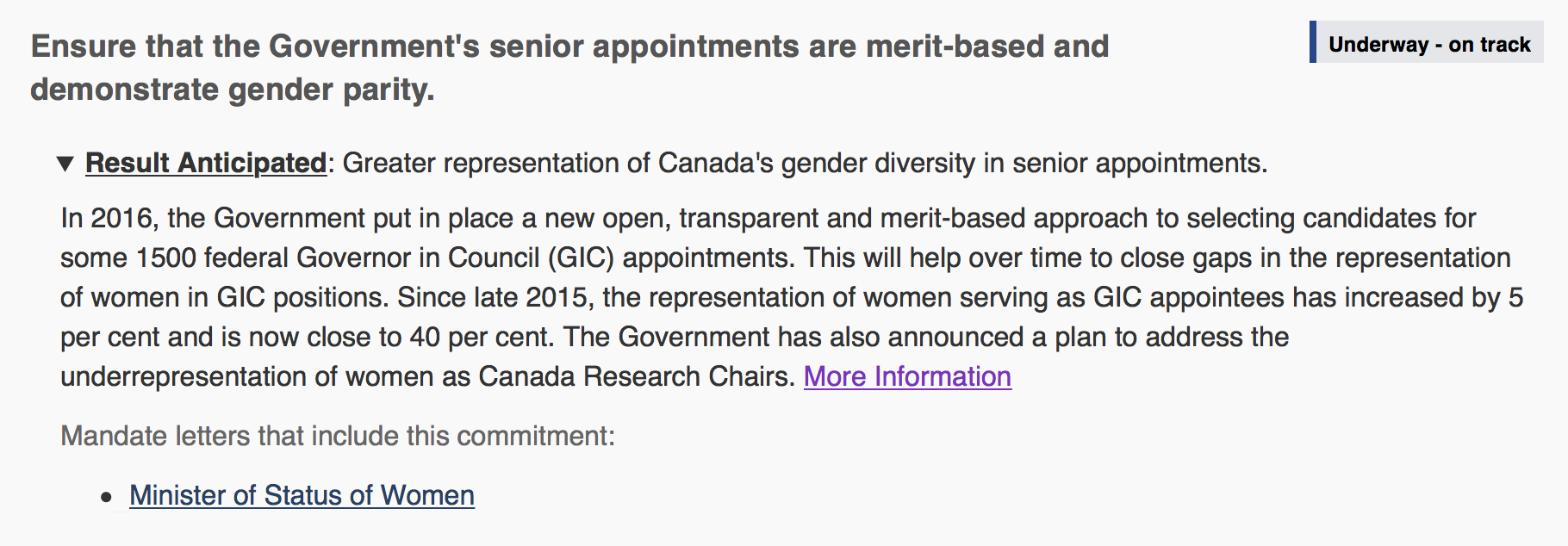
Mandate Letter Tracker: Delivering results for Canadians [diversity of appointments and lack of detail]

There has been justified critical commentary regarding the government’s mandate letter tracker. I was curious to see how the commitment to increased diversity in appointments was covered.

Surprisingly, the 2016-17 PCO Departmental Performance Report does not provide any data table to substantiate that claim, merely noting:

  • Almost 12,000 applications processed and 429 Governor in Council appointments made in 2016-17”

Strikingly, the focus appears only to be with respect to women, not the other employment equity groups (visible minorities, Indigenous peoples, and persons with disabilities). PCO should be providing such data (as Justice does for judicial appointments).

That being said, given HoM and judicial appointments to date, I think this one can be said to be on track.

via Mandate Letter Tracker: Delivering results for Canadians – Canada.ca

Donald Trump Has Nominated 480 People So Far in His Presidency. 80% of Them Are Men.

Says it all:

And if there is one trend that has defined this current president’s staffing decisions, it has been his proclivity to turn to men when filling out key posts.

Since he assumed office, Donald Trump has sent 480 nominations to the U.S. Senate for positions in the judicial branch and executive branches. Of those, The Daily Beast found, 387 were men—constituting just over 80 of all of Trump’s nominees.

The trend goes across government, though it is truly accentuated in certain fields. For example, Trump has nominated 282 men for high-ranking cabinet positions compared to 77 women. He has nominated 55 men for tax, armed forces, veterans claims, district, appellate, and supreme court judgeships compared to 13 women. And he has nominated 50 men to U.S. attorney posts compared to just three women.

Numerous executive branch departments have not had a single woman nominated to their ranks. Though some of them have only a handle of confirmable positions, others like the  Department of Agriculture and the Department of Energy have had seven nominees respectively to date. All of those nominees were men.

via Donald Trump Has Nominated 480 People So Far in His Presidency. 80% of Them Are Men.

Differences of Opinion: How Canadian and US business leaders think about gender diversity

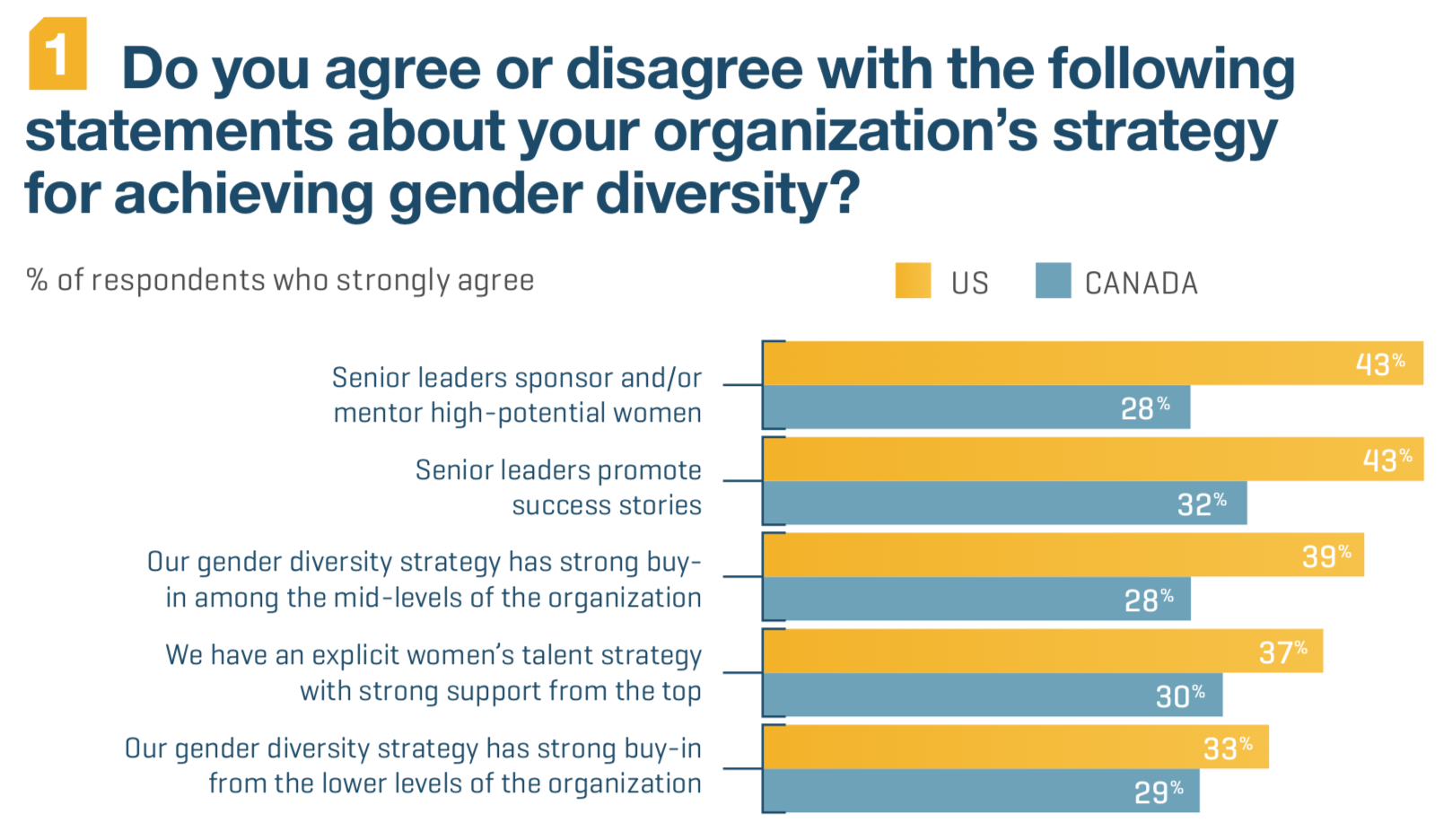
RBC continues to do interesting research and reports on diversity issues. This Canada-United States comparison being the most recent example (and it challenges Canadian smugness about our diversity policies in the corporate sector). These two charts are particularly revealing, report recommendations follow:

1. Be aware that diversity mandates can backfire.

Surprisingly, mandatory diversity training can often have the opposite effect, increasing bias rather than eliminating it. Research over several decades has shown that corporate leaders and managers are less motivated to increase diversity if they are forced to do so. In one study, Harvard Business Review researchers who analyzed data from hundreds of US firms found that “companies get better results when they ease up on the control tactics.”

Similarly, national policies that promote gender parity, diversity, and gay rights may be viewed as controlling or policing people’s personal opinions and actions. Equal opportunity or pro-diversity legislation may make organizations “check the boxes” to advertise their compliance with the requirements, but may also make them less likely to make practical efforts to reduce gender or other types of discrimination. Rather, engaging leaders and managers to become advocates for change is more effective. Voluntary training to raise awareness, along with mentoring and coaching efforts, participation in task forces or councils, or leadership of affinity groups, works best.

2. Try more innovative solutions.

The most appropriate measures vary across industries and firms, and a decision not to adopt any specific approach cannot be interpreted as a failure. Still, our study shows that companies in both the US and Canada are using only a subset of all the potential strategies. Canadian companies tend to take fewer risks and are less likely to try innovative solutions than their US counterparts. Solutions that have been adopted less frequently in Canada than in the US may provide ideas for further action by Canadian firms. They include:

  • Job auctions or trial hiring (37% vs 43%)
  • On-the-job development activities that provide opportunities to generate business impacts (38% vs 44%)
  • Support for working parents (34% vs 43%)
  • Flex time (48% vs 52%), part-time (31% vs 35%) and childcare subsidies (27% vs 31%)
  • Assessing performance relative to gender diversity targets (37% vs 44%)

3. Build a strong business case for women in senior management.

“Fundamentally, having a workforce and a senior management team that represents the clients and communities an organization serves is both an asset and a competitive advantage,” says Jennifer Tory, Chief Administrative Officer at RBC. “Diversity of gender, thought, and background creates inclusive teams that generate better ideas and solutions. Inclusive teams are strong teams, and strong teams make better business decisions.”

4. Invest in retraining and reintegrating women into the workplace.

One of the biggest challenges in both the US and Canada is the issue of parental leave and how it affects women’s careers. The two countries differ markedly with respect to national policies. In the US, women who take maternity leave do not receive guaranteed payments from the federal government. The Family and Medical Leave Act protects their job for up to 12 weeks; some individual companies and states may offer more generous policies or a short-term disability policy that pays women during their leave of absence. By contrast, Canada is far more generous; its mandated 12-month parental leave is expected to stretch to 18 months in 2018.

In a way, that could “create unintended consequences” for women’s advancement in Canada, says the University of Toronto’s Dart. She notes that although both parents can share the leave, men are often reluctant to take time off. “In many Scandinavian countries paternity and maternity leave are mandatory. Both men and women leave the workplace for a time when they have children, so there is less of an opportunity for gender bias. It has to be mandatory. You have to make it an equal playing field.”

In Canada and other countries where equal parental leave is not mandated, being away from the job for so long could be detrimental to women’s careers, she adds. “Women step out, often because of family pressure, and find it very difficult if they want to come back later on. They have lost their professional networks and they don’t know if their skills are up-to-date. Many companies don’t actively work on bringing women back to work; it is easier to advance the women who have stuck it out.”

5. Make a concerted effort to change societal perceptions.

Here’s where male role models, influencers, pressure groups, and governments play a big part. “With regard to progressing in their career, women are working really hard, but they need networks and sponsorship much earlier in their career,” says Jennifer Reynolds, CEO of the Toronto Financial Services Alliance (TFSA), a public-private partnership that supports the financial services industry. “We need to actively challenge senior management on that, and we have to have men in this dialogue.”

Dart advocates going even further. “There is a very large gap in the middle part of the pipeline,” she says. “There’s always more commitment that we need to see in senior leaders. We need more CEOs and board chairs to advance their support of women. But this battle is not lost at the corporate front. This battle is lost at the home front. The expectations of women, the roles they are supposed to play, are different in different cultures. That’s where we need to start: changing role expectations.”

Source: Download Here

Big Oil Has A Diversity Problem : NPR

Good profile of US oil patch and diversity. Assume similar in Canada but I welcome Canadian oil patch reader comment and insight:

Oil industry leaders say they want be more welcoming to women and minorities. Both groups are underrepresented across much of the oil industry, compared with the U.S. workforce as a whole.

One example is the category “oil and gas extraction,” where Bureau of Labor Statistics numbers show only 20.2 percent of workers are women, compared with 46.8 percent in the overall workforce. African-Americans make up only 6.2 percent in the same category, compared with 11.9 percent overall.

At oil companies, “for both women and for African-Americans, they tend to be among the worst performing in terms of both pay gaps and employment representation,” says sociologist Don Tomaskovic-Devey. He directs the Center for Employment Equity at the University of Massachusetts, Amherst and wrote a report about these federal labor statistics.

Tomaskovic-Devey says some firms probably do a better job than others. He says it’s difficult to know because those numbers aren’t available. “The key thing to understand is when diversity is a managerial priority, it happens,” he says.

The great crew change

A few people at the top of the oil business do want to make diversity a priority. One reason is something the industry calls “The Great Crew Change.” After the oil bust in the 1980s, a lot of companies stopped hiring. That has left the industry with an aging workforce that includes many who are headed toward retirement.

Winkel co-authored a 2016 American Petroleum Institute research report detailing how many women and minorities work in the oil and gas business now and how that could change in the future. It projects the industry needs to attract 1.9 million new workers by 2035 to make up for retirements and growth in the oil business.

“We know from the Census Bureau that we will be a majority-minority country by 2044 … Those changing demographics demand that we pay more attention to diversity than, perhaps, we have in the past,” says Winkel.

You can see evidence of the industry’s desire to at least appear as if it’s changing in advertisements for big oil companies. One from ExxonMobil shows a string of mostly women and minority workers wearing hard hats and holding signs that tout the benefits of the industry.

This ExxonMobil advertisement features a string of female and minority workers that are much more diverse than the oil industry’s actual workforce.
ExxonMobil YouTube
Chevron’s Twitter posts highlight the company’s commitment to diversity in its suppliers.

The company has made diversity and inclusion one of the core principles highlighted in its mission statement called “The Chevron Way.”

“Staffing our workforce for the future is a priority and we actually start focusing on our talent pipeline with kids as young as 5 years old,” says Rhonda Morris, vice president of human resources at Chevron.

Big oil companies like Chevron and ExxonMobil spend millions promoting science and math to children around the world — in part hoping that it will lead to a more diverse workforce. At colleges, those companies recruit women and minorities and then offer them mentors. And for existing employees, there are programs such as unconscious bias training.

Ray Dempsey, the chief diversity officer at BP America, says this is good for business. “There’s data that you can find from many, many sources that talk about how much difference a more diverse and a more inclusive workforce can make on your fundamental business outcomes.”

Dempsey says executives already embrace diversity. The focus these days is on middle managers where the hiring and firing happens.

But he says there are other things about the oil industry that are difficult to change, like where the oil or gas is located. Dempsey says it’s often in remote places, “versus the urban centers where minorities — communities of color — tend to be and, frankly, where people from those communities tend to want to live and to work.”

Dempsey says the industry needs to do more to make rural places welcoming to women and minorities.

via Big Oil Has A Diversity Problem : NPR

Liberal government not always appointing top recommended judges

Good analysis by Sean Fine. Greater transparency leads to more questions, but commendable that the government is releasing this data. Will do more analysis once I have reviewed the report but relieved that I will no longer have to review judicial announcements and compile my own data:

The Liberal government is not always appointing judges from a pool of “highly recommended” candidates, raising questions about whether partisan political considerations or diversity concerns are trumping merit.

Under a ranking system brought back last October by the Liberals – who said it would “highlight truly outstanding candidates” – advisory committees identify the best as “highly recommended.” Second best are “recommended.” A third group is “unable to recommend.” The Conservatives had dropped the “highly recommended” category in 2007, drawing criticism from the legal community.

But the Liberals have appointed a number of judges from the “recommended” list, according to a federal agency that supports the appointment process. Justice Minister Jody Wilson-Raybould would not reveal how many when contacted by The Globe and Mail. Neither would the Office of the Commissioner for Federal Judicial Affairs, which collects data on the process.

New statistics released as part of Ms. Wilson-Raybould’s stated effort toward transparency and diversity show a large surplus of the truly outstanding: 129 highly recommended candidates, for just 74 appointments made since last October. The rankings come from 17 non-partisan advisory committees across the country, who review the candidates’ applications and check each individual out with lawyers they know in the community.

Ms. Wilson-Raybould, who had instructed the judicial affairs commissioner to collect and publish the statistics, says it is her prerogative to appoint from the recommended list.

“I take care to consider a number of factors, such as each candidate’s expertise, the needs of the court, and the strength of their application,” she said in an e-mail to The Globe. “Whether someone is recommended or highly recommended is one factor that I take into account, among many important considerations, in exercising my prerogative to appoint the best candidates to the judiciary.”

The highly recommended category is the key to a merit system of appointments, says Peter Russell, a political science professor emeritus at the University of Toronto. “If you just appoint people who are merely qualified, that is not looking for the best-qualified people for the positions.”

In an interview, he questioned whether some appointed from the recommended group were chosen for their affiliation with the Liberals. “I think we should know – is it politics?”

The return of the “highly recommended” category was part of the Liberals’ new appointments process in which candidates are now asked to self-declare their sexual orientation, ethnicity and other background factors. That information is kept private.

On Friday, for the first time in Canadian history, the judicial affairs commissioner published data on the diversity of candidates and appointments.

Commissioner Marc Giroux’s office said revealing the number of appointees from the “recommended” list could be damaging to the legal process.

“We have considered whether providing a further breakdown regarding appointees and the ‘rating’ of recommended or highly recommended should be provided,” spokeswoman Caroline Masse said. “However, if such were disclosed, litigants or others could determine whether or not a particular judge was recommended or highly recommended by simply referring to their biography and comparing it to these statistics.

“This prevents our office from distinguishing between the number of appointees that were highly recommended vs. recommended,” Ms. Masse said in her e-mail.

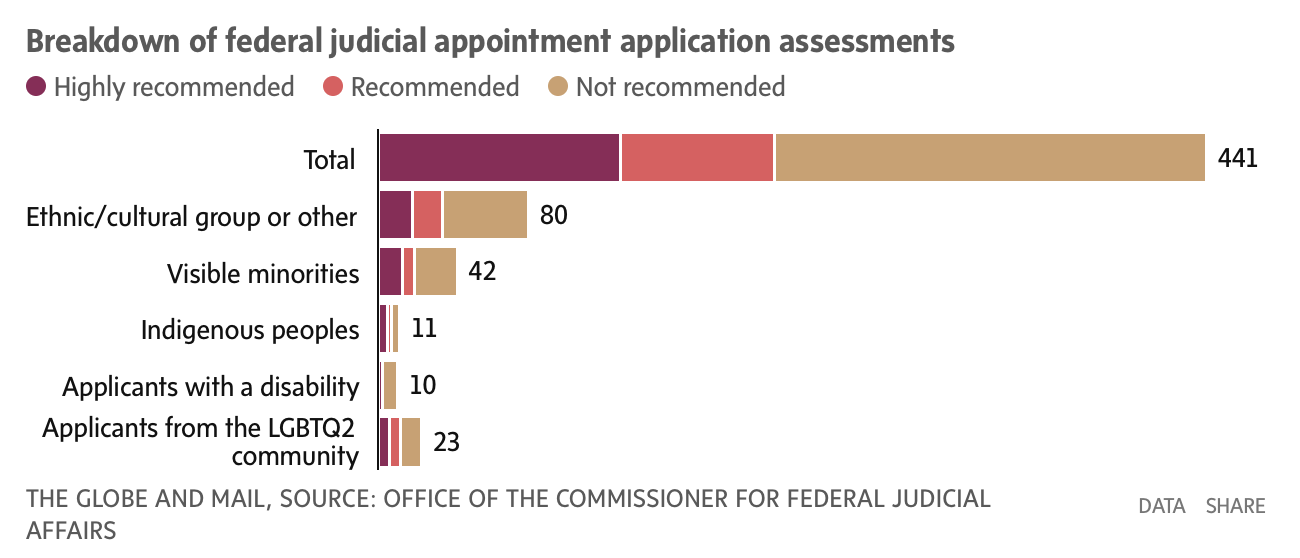
Just short of 1,000 applications have been received since last October, of which the committees got around to assessing 441. Of those 441, 129 candidates were highly recommended, 82 were recommended and 230 were not recommended.

The data also show that, of the 74 appointments under the new process, 37 were men and 37 were women. (An additional 12 were of judges who moved from trial courts to appeal courts; of these, five were men and seven women.) Men, however, made up a much larger proportion of assessed and highly recommended candidates; there were 75 highly recommended men compared with 54 highly recommended women.

For years, the federal government had been urged by lawyers’ groups to collect data on applications and appointments by race. The new data show that, in the “visible minority” category, 97 applied (or roughly 10 per cent of all applicants) and 42 were assessed. Thirteen were highly recommended, six recommended and 23 not recommended. The government appointed nine visible minority judges.

Toronto lawyer Ranjan Agarwal, past president of the South Asian Bar Association, said the numbers show that there is more work to be done in mentoring and encouraging visible minority lawyers to apply. “Maybe there’s just not enough candidates applying from minority communities, which I think was the point of having the data – we could then focus in on the problem areas.”

There were 36 Indigenous candidates who applied and 11 who were assessed. Five of the 11 were ranked highly recommended, two were recommended and four not recommended. Three Indigenous judges were appointed.

f those lawyers who described themselves as belonging to an “ethnic/cultural group or other,” there were 190 applications, and 80 assessed; of those, 18 were highly recommended, 16 recommended and 46 not recommended. Fifteen were appointed.

There was one person with a disability appointed out of 10 assessed candidates (two highly recommended and eight not recommended). There were four judges appointed from the LGBTQ2 community, out of 23 candidates assessed. Six were highly recommended.

There were more “highly recommended” candidates in every category of diversity (women, ethnic minorities, LGBTQ, Indigenous and disabled) than judges appointed from each group.

Source: Liberal government not always appointing top recommended judges – The Globe and Mail

Islamic school’s gender segregation is unlawful, court of appeal rules | The Guardian

Sound, although same rationale could be applied to single sex schools:

Schools in Britain will no longer be able to substantially segregate boys and girls, after the court of appeal ruled that a co-educational faith school in Birminghamhad caused unlawful discrimination by separating the two sexes.

The court overturned a ruling by the high court last year involving Al-Hijrah school, a voluntary-aided mixed-sex state school that had been strongly criticised by Ofsted school inspectors for failing to uphold British values.

On appeal, Ofsted argued that the school had breached the 2010 Equalities Act by strictly segregating pupils from the age of nine, teaching them in different classrooms and making them use separate corridors and play areas. The segregation policy was also applied to clubs and school trips.

About 25 other mixed schools in England have similar rules and they now face having to overhaul their policies in the wake of the ruling by Sir Terence Etherton, the master of rolls, Lady Justice Gloster and Lord Justice Beatson.

Ofsted said it would now look closely at the other schools with similar policies, which includes several Orthodox Jewish and Christian faith schools.

“Ofsted’s job is to make sure that all schools properly prepare children for life in modern Britain,” said Amanda Spielman, Ofsted’s chief inspector, after the ruling was announced. “Educational institutions should never treat pupils less favourably because of their sex, or for any other reason.

“This case involves issues of real public interest and has significant implications for gender equality, Ofsted, government, and the wider education sector. We will be considering the ruling carefully to understand how this will affect future inspections.”

Rebecca Hilsenrath, the chief executive of the Equality and Human Rights Commission, said: “We welcome today’s confirmation by the court of appeal that it is unlawful for a mixed school to segregate girls and boys completely. Socialisation is a core part of a good quality education, just as much as formal learning and, without it, we’re harming children’s life chances right from the start.”

The appeal court judges said segregation had been tacitly approved by the Department for Education and Ofsted in the past, so the schools involved should be treated sympathetically and given time to adjust their policies.

“The relevant central government authorities should not pivot in the way they have gone about this without recognising the real difficulties those affected will face as a consequence,” the judges said in their ruling.

The ruling applies only to co-educational schools. Single-sex schools are given a specific exemption from discrimination claims related to admissions under the Equalities Act, although it is unclear if the provisions would extend to arguments that both sexes suffer from the absence of the other.

In ruling that Al-Hijrah had unlawfully discriminated against its pupils, the court stated: “An individual girl pupil cannot socialise and intermix with a boy pupil because, and only because, of her sex; and an individual boy pupil cannot socialise and intermix with a girl pupil because, and only because, of his sex. Each is, therefore, treated less favourably than would be the case if their sex was different.”

Source: Islamic school’s gender segregation is unlawful, court of appeal rules | Education | The Guardian

Ryerson study highlights severe lack of visible minorities on corporate boards

Important study.

The approach of the Employment Equity Act to require federal public sector and regulated companies to publicly report on designated group representation has shown the benefits of transparency and regular reporting:

Visible minorities make up more than half of Toronto’s population, but only 3.3 per cent of corporate boards and 9.2 per cent of the private sector’s senior management, a new study finds.

While the percentage of women on large corporate boards has steadily grown, from 14.8 per cent in 2012 to 23.6 per cent in 2017, the representation of visible minorities in leadership has stalled, inching up from 2.8 per cent to 3.3 per cent over the five years, said the study by Ryerson University’s Diversity Institute, released Wednesday.

“Diversity is more than gender,” said Wendy Cukier, the institute’s founder and professor at the Ted Rogers School of Management, at a forum on advancing diversity and inclusion in Canadian Business. “If you look at the minority representation on boards, it is not a pretty picture.”

The six-year study, funded by the Social Sciences and Humanities Research Council, analyzed data on senior leaders from the largest organizations in Greater Montreal and the GTA in six sectors — elected, public, private, volunteer, education and agencies/boards/commissions.

Although the representation of women has improved, the gains are primarily made by white women, said Cukier.

“While equally represented in the workforce, white women outnumber racialized women 16 to 1 on corporate senior management teams,” noted Cukier.

In Toronto, 24 per cent of companies have more than 30 per cent women on their boards while 28 per cent have none. By contrast, only 3 per cent of firms have 20 per cent visible minorities on their boards and 90 per cent have none.

In Montreal, where minorities make up more than 20 per cent of the population, almost 10 per cent of corporate boards actually had more than 40 per cent women, while 25 per cent had none. Only 3 of 60 of the largest companies there had any racial minorities on their boards.

“We have a problem,” said Cukier, adding that the research findings underline the significance of moving forward two government bills currently before the Parliament and Queen’s Park — that aim at tracking racial diversity data in organizations.

Navdeep Bains, federal minister of innovation, science and economic development, said Bill C-25, which is now before the Senate, requires publicly traded corporation to report on diversity data and policies.

“Diversity is not just the right thing to do. It has a strong economic case,” Bains told the Toronto forum attended by business leaders, diversity and industry experts. “Canadian competitiveness and strength and resourcefulness come from our people and diversity.”

Michael Coteau, Ontario’s children and youth services minister and minister responsible for anti-racism, said Bill 114 will extend reporting requirements on race, gender and other demographic characteristics to provincially-funded agencies.

“Eliminating systemic racism and advancing racial equity is integral to our plan to create jobs, grow our economy and help people in their everyday life,” said Coteau, who was also on the panel. “We believe that data is the foundation of an effective strategy to advance inclusion.

Tiffany Gooch, a public affairs consultant in Toronto, said she was not surprised by the little progress made by visible minorities as the hope was that changes would trickle down from gender diversity to other aspects of diversity representation.

“You need a critical mass for any conversation to take on,” said Gooch, who believes both proposed government bills can help build a good foundation for meaningful conversations about organizational diversity.

Andi Shi, executive director of the Chinese Professionals Association of Canada, was disappointed by the poor minority representation in leadership roles despite Canada’s celebrated pride in multiculturalism.

“There is still the unconscious assumption that racial minorities are not good enough, and the fear that we are not going to perform as good as a white person,” said Shi. “We need quotas to force organizations to make changes.”

Overall in 2017, women are faring well in taking senior leadership positions in all sectors in Toronto compared to private companies, representing 42 per cent in agencies, boards and commissions, 40.1 per cent in education, 42.5 per cent in the volunteer sector, 44.4 per cent in the public sector, and 41.5 per cent among elected officials.

However, visible minority representation is still dismal in 2017 in all areas, accounting for just 17.2 per cent in agencies/boards/commission, 23.1 per cent in education, 12.3 per cent in the volunteer sector, 9 per cent in the public sector, and 29.8 per cent among elected officials.

Source: Ryerson study highlights severe lack of visible minorities on corporate boards | Toronto Star