Order of Canada Appointments Update

For those that are interested, with the December 2017 Order announcements, I was able to update a number of  the key charts from my earlier The Order of Canada and diversity.

The first charts looks at the overall diversity of 953 appointments, broken down by year, for the last five years. The most notable change is the large jump in the number of Indigenous peoples appointed to the order in 2017 (particularly the December appointments).

Source: Order of Canada announcements

The second chart shows the provincial breakdown compared to the population shares, showing the historic pattern of over-representation of Ontario.

The third chart breaks down appointments by rank and group, showing slight relative over-representation at the officer level for visible minorities and Indigenous peoples compared to the ‘feeder’ group member level.

Source: Order of Canada announcements

While as noted in the article, there are a number of factors that make Order of Canada appointments an imperfect indicator for diversity and inclusion (i.e., nomination driven process, regional balance considerations etc) it nevertheless provides a sense of how the contributions of three employment equity groups are publicly recognized.

ICYMI: How the federal government is slowly becoming as diverse as Canada

Good overview article by Aaron Wherry of CBC on diversity in government, both public service and political appointments. Some of my analysis quoted and used:

Campaigning in 2015, Justin Trudeau’s Liberals promised to “build a government as diverse as Canada.”

That job might’ve seemed nearly done on Day One. Of the 31 ministers sworn in on Nov. 4, 2015, 15 were, famously, women. Five ministers were visible minorities and two others were Indigenous.

A cabinet ratio of 48.3 per cent women, 16.1 per cent visible minorities and 6.5 per cent Indigenous comes close to matching a Canadian population that was 50.9 per cent women, 22.3 per cent visible minorities and 4.9 per cent Indigenous.

But a prime minister and his government are responsible for far more than a few dozen cabinet positions. The cabinet oversees more than 1,500 appointments, including chairs and members of boards, tribunals and Crown corporations, deputy ministers, heads of foreign missions, judges and senators.

On that much larger scale, progress has been made, but the ideal of a government that looks like Canada is still a ways off.

A new appointment process

When the government was sworn in, just 34 per cent of federal appointees were women, 4.5 per cent were visible minorities and 3.9 per cent were Indigenous.

Two years later, according to data from the Privy Council Office, 42.8 per cent of appointees are women, 5.6 per cent are visible minorities and 5.8 per cent are Indigenous.

In February 2016, the Liberal government announced a new appointment process for boards, agencies, tribunals, officers of Parliament and Crown corporations. It specified diversity as a goal and opened applications to the public.

According to the Privy Council Office, 429 appointments were made via that process through Dec. 5, 2017. Of those, 56.6 per cent were women, 11.2 per cent were visible minorities and 9.6 per cent were Indigenous.

A total of 579 appointments — including deputy ministers, heads of mission and appointments for which requirements are specified in law — were made through existing processes. Of those, 43.7 per cent were women, 3.8 per cent were visible minorities and 5.2 per cent were Indigenous.

“Mr. Trudeau has been more intentional on these issues than his predecessors and has made great progress in opening up the process. He has also clearly made great strides on gender,” says Wendy Cukier, director of Ryerson University’s Diversity Institute.

But, says Cukier, the government’s efforts toward transparency and equal opportunity need to be accompanied by “proactive outreach and recruitment as well as retention strategies” in order to “address some of the barriers historically disadvantaged groups have faced.”

Eleanore Catenaro, press secretary for the prime minister, says, “Our aim is to identify high-quality candidates who will help to achieve gender parity and truly reflect Canada’s diversity.”

She says, “We know there is more work to do to achieve these goals, and we continue to do outreach to potential qualified and diverse candidates to encourage them to apply.”

Rigorous reporting of demographic data across federal appointments could presumably drive change — or at least give the  government something to answer for — but most of these numbers have not been made public.

“It is crucial that the government tracks, measures and reports on diversity in all areas,” says Sen. Ratna Omidvar, the founding director of Ryerson’s Global Diversity Exchange. “By doing so, we are able to see where we are making progress and where we need to improve.”

Beneath those top-line numbers, there are a few other points of reference.

According to Global Affairs Canada, the government made 87 heads-of-mission appointments — ambassadors, consul generals and official representatives — in 2016 and 2017. Forty-eight per cent were women and 13.8 per cent were visible minorities. There were no Indigenous appointees.

Senate and court appointments

Andrew Griffith, a former official at the department of citizenship and immigration who has been tracking diversity in federal appointments, has counted 18 women, six visible minorities and three Indigenous Canadians among Trudeau’s 31 Senate appointments.

As a result of an initiative to track judicial appointees, the Office of the Commissioner for Federal Judicial Affairs has published a tally of court appointments from Oct. 21, 2016 through Oct. 27, 2017. Between those dates, 74 judicial appointments were made, of whom 50 per cent were women, 12.1 per cent were visible minorities and four per cent were Indigenous.

But that data also suggested the pool of candidates was limited: of the 997 applications received, just 97 applicants identified as a visible minority and 36 were Indigenous.​

At some point, it might be charged that diversity is being inappropriately prioritized ahead of merit or competency — as Kevin O’Leary once alleged of Trudeau’s cabinet. But such suggestions assume that achieving diversity must come at the expense of merit.

Ideally, diversity would also amount to more than a numerical value.

3 benefits of diversity

Griffith, for instance, suggests three potential benefits of diversity in appointments: that it allows Canadians to see themselves represented in government institutions, that it brings a range of experience and perspectives to government policies and operations and that it reduces the risk of inappropriate policies (for example, an RCMP interview guide that asked asylum-seekers about their religious practices).

“It has been proven over and over that more diversity in the workplace leads to better outcomes,” says Omidvar, who is also pushing to tighten the standards included in a proposed government bill that would require corporate boards to report on diversity.

But the most profound impact could conceivably relate to Griffith’s first potential benefit. A nation that values diversity and pluralism might want its institutions to reflect those principles — and institutions that reflect those principles might advance the building of a multicultural society.

“It normalizes diversity,” Omidvar said of public appointments. “At this point, diversity is still sort of not the norm, which is why we focus on it.”

via How the federal government is slowly becoming as diverse as Canada – Politics – CBC News

American Bar Association is ‘greatly concerned’ about low percentage of female and minority US attorney candidates

Consistent with the lack of diversity among Cabinet and other appointees:

ABA President Hilarie Bass has sent a letter to Attorney General Jeff Sessions that asks him to urge senators proposing U.S. attorney candidates to take diversity into account.

The letter (PDF) is dated Nov. 30, nearly two weeks after President Donald Trump announced a ninth wave of U.S. attorney nominations. Of the 57 U.S. attorney candidates announced so far by the Trump administration, one was black and three were women, Newsweek reported.

The letter acknowledges that senators representing states in which U.S. attorneys are to serve have long had the prerogative to make recommendations for appointments. But the attorney general who will oversee the U.S. attorneys “also has influence over the process,” the letter says.

“We are greatly concerned that a lower percentage of women and people of color have been appointed to these positions in the past year than in previous administrations—both Democrat and Republican,” the letter says. “That is why I am writing you to ask that you take an active role to help ensure that the cadre of U.S. attorneys appointed in this administration is more reflective of the legal profession and our society.”

The letter says equal numbers of men and women are graduating from law school, but the profession is 65 percent male and 85 percent white. Progress in achieving diversity “has been uneven, slow, and concentrated in low- and mid-level legal jobs,” Bass writes. “Racial and ethnic groups, sexual and gender minorities, and lawyers with disabilities continue to be underrepresented and face hurdles to advancement throughout the profession.”

“Our failure to achieve a diverse justice system despite the ever-increasing multiculturalism of our nation invites a crisis in public confidence,” the letter says. “A justice system that is not representative of the diverse community it serves risks losing its legitimacy in the eyes of those who come before it.”

via ABA is ‘greatly concerned’ about low percentage of female and minority US attorney candidates

Poll: Discrimination Against Women Is Common Across Races, Ethnicities, Identities : NPR

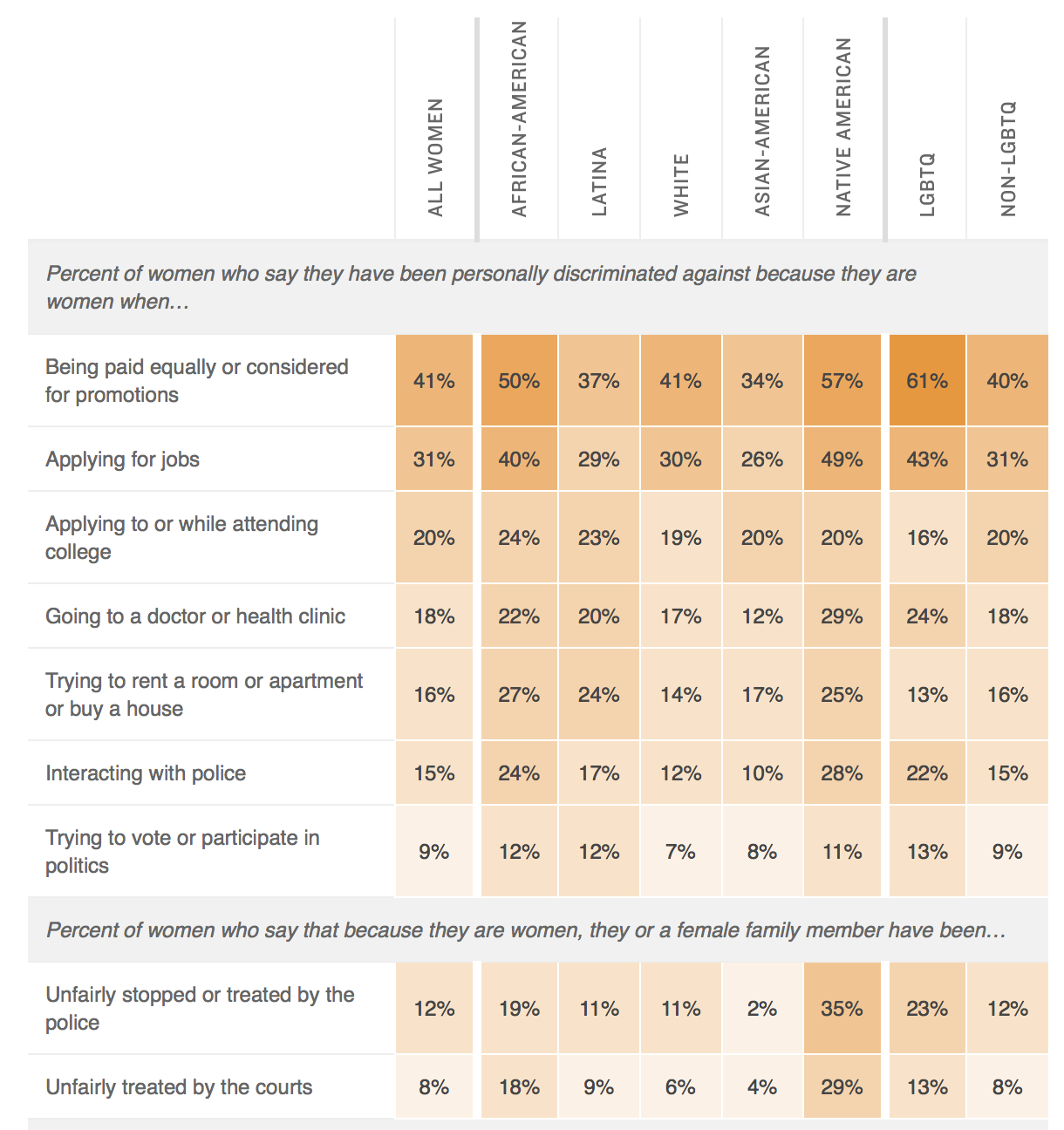
Another in the series of NPR polls on discrimination, with the usual richness of data including the “intersectionality” between race and gender:

Discrimination in the form of sexual harassment has been in the headlines for weeks now, but new poll results being released by NPR show that other forms of discrimination against women are also pervasive in American society. The poll is a collaboration with the Robert Wood Johnson Foundation and the Harvard T.H. Chan School of Public Health.

For example, a majority (56 percent) of women believe that where they live, women are paid less than men for equal work. And roughly a third (31 percent) say they’ve been discriminated against when applying for jobs because they are women.

Overall, 68 percent of women believe that there is discrimination against women in America today.

The chart below shows that the experience of gender discrimination is not monolithic — women in each racial, ethnic and identity group have particular problems in employment, education, housing and interactions with law enforcement, the courts and government. Several groups of women also avoid seeking health care out of concern they will face discrimination.

On nearly every measure, Native American women had the highest levels of discrimination based on gender. In our series, “You, Me and Them: Experiencing Discrimination in America,” we have highlighted several of these situations, including unfair treatment by the courts in majority-Native areas.

NPR will livestream an expert panel discussion on Native American issues at noon ET on Tuesday.

One of the patterns that emerged from the poll and our subsequent reporting is a gulf between high- and low-income areas when it comes to experiences of discrimination. This gap is also apparent in the gender data crunched by our Harvard team. The graph below illustrates the stark differences based on income when it comes to several everyday experiences people have in their own neighborhoods.

A snapshot in time

Our poll — which was fielded from late January to early April — before this fall’s intense news coverage of sexual harassment — also captures what women were feeling and experiencing before the recent scandals.

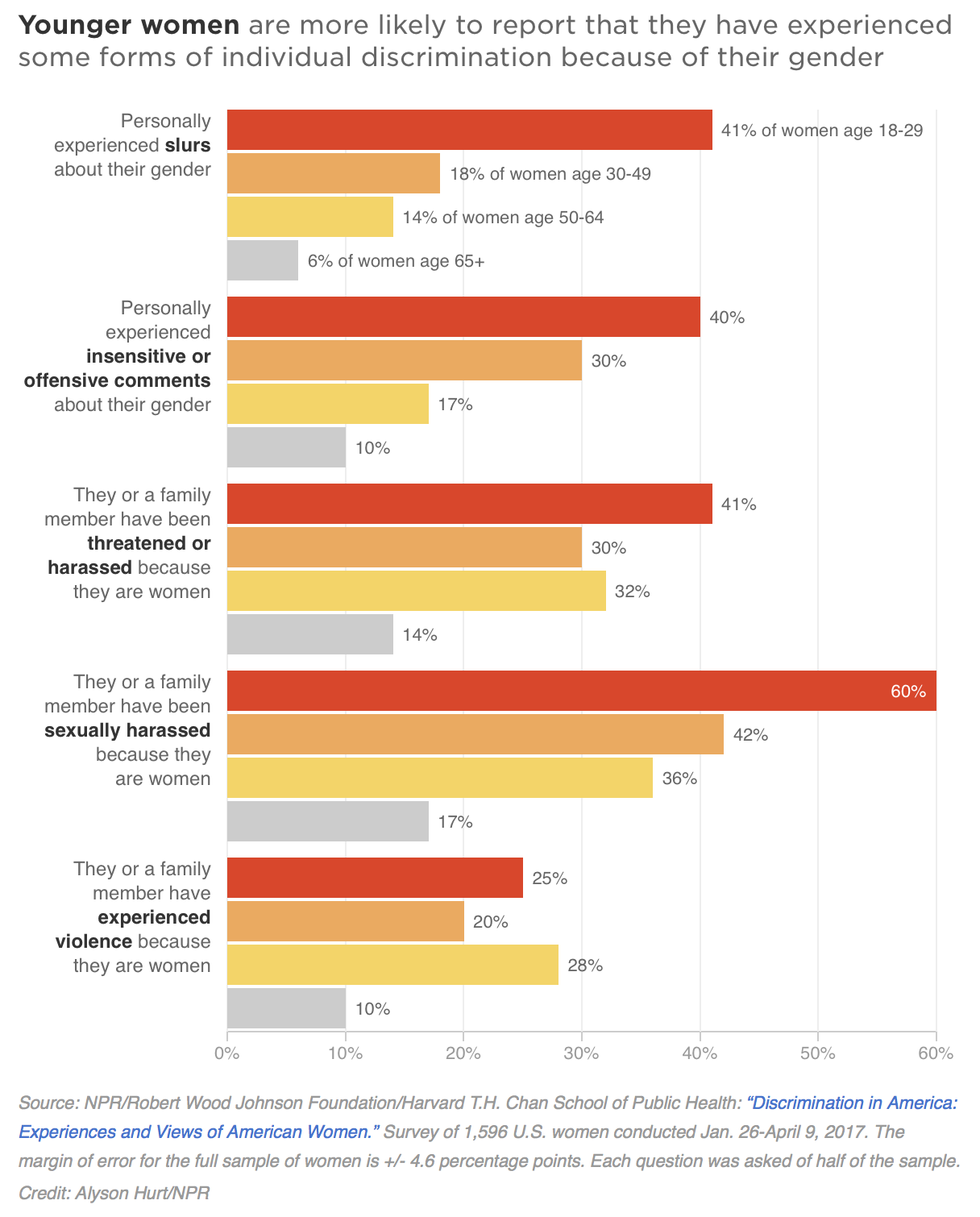
We found that 37 percent women overall reported they or a female family member had been sexually harassed because they are women at some point in their lives. But there was a wide range of responses based on age, with 60 percent of those 18 to 29 years old saying they or a female family member had been sexually harassed because they are women, versus 17 percent of women 65 and over.

“Our survey highlights the extraordinary level of personal experiences of harassment facing women today, as reflected in the news,” says Robert Blendon, co-director of the poll and professor of health policy and political analysis at the Harvard Chan School. “These national conversations may have affected how people viewed or responded to their own experiences in our survey, or their willingness to disclose these experiences.”

Indeed, a poll released last week by Quinnipiac University, asking specifically about sexual assault, suggests women may be more comfortable reporting such experiences now that more women are coming forward and revealing past abuse. (Our poll differs from Quinnipiac in that we asked a broader question: “Do you believe that you or someone in your family who is also a female has experience sexual harassment because you or they are female?”)

The survey from NPR, the Robert Wood Johnson Foundation and the Harvard Chan School was conducted from Jan. 26 to April 9, 2017 among a nationally representative probability-based telephone (cell and landline) sample of 1,596 women. The margin of error for total female respondents is 4.6 percentage points at the 95 percent confidence interval. Complete methodological information is in the full poll report.

via Poll: Discrimination Against Women Is Common Across Races, Ethnicities, Identities : NPR

Facebook COO warns women that male executives may stop hiring them because of sexual harassment scandals

Header misleading – Sandberg’s comments quite different:

The chief operating officer of Facebook, has warned of a potential backlash against women in the workplace following recent high-profile sexual harassment scandals. Sheryl Sandberg, one of the most powerful businesswomen in the world, said she had already heard “rumblings” that male leaders of companies may be increasingly reluctant to hire female employees because they feared their firms becoming involved in disputes.

Sandberg urged companies to put policies in place on how to handle allegations. Writing on Facebook, she said: “I have already heard the rumblings of a backlash: ‘This is why you shouldn’t hire women.’ Actually, this is why you should.” She added: “The percentage of men who will be afraid to be alone with a female colleague has to be sky high right now.

“So much good is happening to fix workplaces right now. Let’s make sure it does not have the unintended consequence of holding women back.”

Outlining her own experiences Sandberg, 48, said she had suffered sexual harassment in the past, and continued to do so despite the power she now wields. On one occasion, early in her career, a man at a conference came to her hotel room late at night and banged on her door until she had to call security. She said: “Like almost every woman – and some men – I know, I have experienced sexual harassment in the form of unwanted sexual advances in the course of doing my job.

“A hand on my leg under the table at a meeting. Married men – all decades older than I – offering ‘career advice’ and then suggesting that they could share it with me alone late at night.”

She made clear that none of the harassment was by men she had worked for, and all of her male bosses during her career had been “not just respectful, but deeply supportive”. But in each case the harasser had more “power” than her.

A hand on my leg under the table at a meeting. Married men – all decades older than I – offering ‘career advice’ and then suggesting that they could share it with me alone late at night

She said: “That’s not a coincidence. It’s why they felt free to cross that line.

“As I’ve become more senior, and gained more power, these moments have occurred less and less frequently. But they still happen every so often.”

Sandberg said the current movement against sexual harassment was a “watershed moment” and an “opportunity that must not be lost.”

via Facebook COO warns women that male executives may stop hiring them because of sexual harassment scandals | National Post

Sensitivity framing is crucial in the classroom

Sensible suggestion on greater awareness and appropriate framing by Mitu Sengupta of Ryerson University. But students also need to learn how to speak up; if not in the class, then after with the instructor, prior to filing a complaint:

The panel convened to respond to this complaint shouldn’t have rebuked Ms. Shepherd for failing to voice disagreement with Jordan Peterson, the professor in the controversial video. She was under no obligation to do so. What the panel might have done was to simply advise her to show more regard in the future for students who might feel distressed by any aspect of a difficult class discussion. This might involve nothing more than uttering a few short sentences at the start of the session, such as, “For some of you, our discussion today might feel very personal. If you feel upset by the conversation, please come speak to me after class.”

I do this quite often, taking my cue from the eminent Canadian philosopher, Charles Taylor, who was my favourite undergraduate professor at McGill University more than 20 years ago. I remember we were discussing colonialism, and Prof. Taylor read out the following excerpt from British historian Thomas Macaulay’s Minute on Indian Education: “A single shelf of a good European library [is] worth the whole native literature of India.” Prior to doing so, however, Mr. Taylor went red in the face and said, “This is embarrassing and a horrible thing to repeat.”

I was the only Indian in the room. I remember feeling acknowledged, grateful. It wasn’t much, but Prof. Taylor had given me relief from the weight of Macaulay’s scathing, racist remarks. I felt better able to listen and more willing to engage.

We are taught to have the highest regard for free speech, the cornerstone of our liberal democracy. We receive less instruction, however, in understanding that free speech is still an ideal, not a reality.

We should recognize speech is usually more “free” for some people than for others. This may not be due to any tangible constraint, and may even occur despite our best efforts. In my classes, for example, I try to provide a supportive environment for everyone, but find that men consistently speak up more often than women. This is unsurprising. People who command social power – derived from their class, race or gender – tend to have more confidence while speaking, and are better at getting themselves heard. While I’m not recommending that anyone be shut down, we do need to be wary of how the ideal of free speech plays out in practice, in our very non-ideal world that is rife with deeply rooted inequalities.

We have a problem when the ideal of free speech imposes a heavier burden on some more than others – women, people of colour, sexual minorities – who constantly find themselves on the defensive in discussions about class, race and gender. This can be an extraordinarily taxing, alienating experience, and sometimes the safest option for the person involved is to mentally exit the conversation. This, of course, is terrible for the “debate” in progress, not least because you do not, in fact, get to hear “the other side.”

To me, the power and privilege of being an educator comes with the special responsibility of keeping an eye on the well-being of students who are likely to find certain conversations especially stressful, and taking a few extra steps to ensure that they feel recognized and included. Far from snuffing out debate, doing so enriches the conversations that follow.

I think that our younger generations actually have a better grasp of the complexities and challenges surrounding free speech than do our older generations. I remain astounded by the compassion with which my students treat each other. They are creating a kinder and more open learning environment than the one that was thrust upon me during my undergraduate years. And, if students are pushing back against any perceived insensitivity on part of their instructors, I applaud them for taking ownership of their education, and for having the courage to actively protect their self-esteem.

via Sensitivity framing is crucial in the classroom – The Globe and Mail

Women need to play a role in ‘restoring’ Saudi Islam: Sheema Khan

Sheema Khan challenges the patriarchy (and the Friedman puff piece on MBS):

In a wide-ranging interview with Thomas Friedman of the New York Times, Saudi Arabia’s Prince Mohammed bin Salman (a.k.a. “MBS”) discussed, among other topics, the recent anti-corruption drive and liberalization of Saudi society. Call it a kinder, gentler form of authoritarianism – with a progressive touch. Notably, MBS refused to address his country’s interference in Lebanese politics or its unconscionable scorched-earth policy in Yemen.

Nonetheless, Mr. Friedman was effusive of MBS’s plans to veer Saudi Islam to a “moderate, balanced Islam that is open to the world and to all religions and all traditions and peoples.” The Prince calls it a “restoration” of the faith to its origins – namely the Prophetic period in the early 7th century. This has the potential to reverse the puritanical strain (Wahhabism) currently at the heart of Saudi society, where, for example, a woman is under male guardianship from cradle to grave.

The late Sunni scholar Abdul Halim Abu Shaqqa chronicled in his comprehensive study of the Koran and authentic traditions of Prophet Muhammad, Muslim women were far more engaged in society during the Prophetic era. They had more rights and opportunities to build a vibrant society, in partnership with men, than many contemporary Muslim cultures (including Saudi Arabia).

Mr. Friedman believes this “restoration” project “would drive moderation across the Muslim world.” In fact, most of the Muslim world has soundly rejected Wahhabism. Yet, the deeply entrenched patriarchy of Saudi society finds parallels in many Muslim countries.

While MBS has promised to grant Saudi women more liberty, his top-down approach towards “restoration” of Islam raises a number of questions.

Will the man who allowed women to drive, allow them a place to drive the “restoration” as well? Or will it be a vehicle steered exclusively by men, with women seated as passengers, while men alone navigate women’s role in society?

Women’s voices and perspectives will be essential if there is to be any meaningful reform of contemporary Muslim cultural practices.

In her groundbreaking book “Domestic Violence and the Islamic Tradition,” UBC Professor Ayesha Chaudhry makes it abundantly clear that the “Islamic tradition” – beginning a few centuries after the Prophetic era to the precolonial era – reflected worldwide patriarchy of the times. The hierarchical paradigm was unambiguous: God (or Allah) at the top, followed by men below, then by women subordinate to men and finally slaves below women. This view shaped pretty much all religious discourse – from Koranic exegesis to Islamic jurisprudence.

Ismail ibn Kathir, a 14th-century Sunni scholar whose works still carry great influence, was unequivocal. “The man is better than the woman,” he wrote in his authoritative commentary of the Quran. By no means was he alone. Prof. Chaudry’s meticulous research shows how devastating this paradigm was in relation to domestic violence. All Sunni scholars and jurists advocated beating a “recalcitrant” wife – specifying when, how often, where on her body, with either one’s fists or a sturdy object, and so on. The Hanafi school of jurisprudence was the harshest, allowing a husband the leeway to beat his wife as he saw fit, so long as he didn’t kill her. The book is a painful read, but should be read by those interested in reform.

The problem is that much of this patriarchal Islamic tradition – developed by male medieval scholars – is still taught uncritically in many Muslim seminaries and reflected in a number of Muslim cultures, where male privilege reigns.

Muslims must take a critical look at this tradition in light of contemporary norms. Like Abo Shaqqa, Prof. Chaudhry points out the obvious: Domestic violence advocates were/are unable to reconcile the fact that the model for all Muslims, Prophet Muhammad, never once raised his hand. He rebuked those who did.

The postcolonial period had ushered in a more egalitarian view, in which men and women are on the same moral plane before God. However, this approach has had uneven acceptance. Very rarely will men give up their privileged position to be on equal footing with women.

Yet Muslim women still insist on gender justice. Contemporary female Muslim scholars, such as Prof. Chaudhry, Amina Wadud, Asma Barlas, Ziba Mir-Hosseini and Asma Lamrabet, have challenged patriarchal interpretations of the Koran, thereby providing women with exegetical tools to confront male privilege rooted in theology.

Elsewhere, Muslim women in India are challenging the patriarchy entrenched in Muslim institutions, through education and legal reform. There are now female judges to solemnize marriages and adjudicate divorces, thereby restoring balance to proceedings which were exclusively presided by men.

If MBS really wants to return to a “moderate, balanced” Islam, he must include the perspectives of women on equal footing.

Anything less will be a whitewash.

via Women need to play a role in ‘restoring’ Saudi Islam – The Globe and Mail

The Jobs You’re Most Likely to Inherit From Your Mother and Father – The New York Times

Interesting analysis:

When children choose what to be when they grow up, they often follow in their fathers’ footsteps. But mothers are powerful, too.

Working sons of working fathers are, on average, 2.7 times as likely as the rest of the population to have the same job but only two times as likely to have the same job as their working mothers, according to an analysis by The New York Times, one of the first to look at mothers and daughters in addition to fathers and sons. Daughters are 1.8 times as likely to have the same job as their mothers and 1.7 times as likely to have the same job as their fathers.

How often a man has the same job as his:
Father 2.7× as likely
Mother 2.0× as likely
How often a woman has the same job as her:
Father 1.7× as likely
Mother 1.8× as likely

Try these jobs to start: Bartenders, cashiers, elementary and middle school teachers, lawyers, doctors and structural iron and steel workers. Some jobs are not available due to low sample size.

The estimates, drawn from General Social Survey data between 1994 and 2016, show that mothers, despite working in lower numbers, are still influential in inspiring their children’s career choices. And the passing down of occupation and other measures of socioeconomic status seems to affect boys more than girls.

Some of the jobs most likely to be passed down include steelworker, legislator, baker, lawyer and doctor. Children are less likely to follow their parents’ careers if they are middle managers or clerical or service workers. These findings broadly align with previous research.

“It’s not just a matter of education or what your parents can buy — there’s something about the occupations themselves,” said Kim Weeden, chairwoman of the sociology department at Cornell University, who is researching the topic with April Sutton, also a sociologist.

It’s another example of the powerful role family circumstances play in shaping children’s lives. Children with unemployed parents were more likely to say they didn’t know what they wanted to do for work, they found. “There’s an inheritance of advantage but also disadvantage when you talk about occupational plans,” Ms. Weeden said.

A big factor in passing down occupations — and advantage or disadvantage — is the connections parents offer children. Children who pursue the same job as their parents often start ahead, whether through inheriting a family business, getting an internship at a parent’s company or having a parent put in a good word with a colleague.

“If people lack financial capital, they likely lack these other types of capital as well,” said Claudia Goldin, an economist at Harvard. “For all of these reasons, the world is not a very fair place for some kids.”

Some fields are particularly dynastic, like Hollywood acting or politics.

…Children often pursue their parents’ jobs because of the breakfast-table effect: Family conversations influence them. They fuel interests or teach children what less commonly understood careers entail (probably one reason textile spinning and shoemaking are high on the list of jobs disproportionately passed on to children). In interviews, people who followed their parents’ career paths described it as speaking the same language.

Certain aptitudes may be inherited. Families also have their own cultures, reflected in how they value spending time — whether making things by hand, achieving academically or filling the home with art and music. People described flirtations with other careers as teenage rebellions before settling into a parent’s occupation.

How Frequently Do Daughters Share an Occupation With Their Parents?

Father

Fishers 362x as likely
Textile machine operator 159
Medical and laboratory techs 126
Aircraft mechanics 118
Librarians 106
Printing press operators 91
Packaging machine operators 39
Electrical, electronics and electromechanical assemblers 28
Lawyers 27
Doctors 19

Mother

Military officer 281x as likely
Shoemakers 135
Metal and plastic workers 105
Dishwashers 91
Human resources managers 78
Textile machine operator 75
Textile workers 65
Textile winding and twisting machine operators 60
Factory workers, food preparation 49
Travel agents 48

…Though research has focused more on fathers, mothers have always influenced their children’s career paths, social scientists say. “What we’re learning is that both parents are quite important, and quite important for both boys and girls,” Ms. Weeden said.

In our analysis, sons are 20 times as likely to be a scientist if their mother is one. Gil Rabinovici is the son of Sarah Bacus, a cancer scientist, and Eliezer Rabinovici, a theoretical physicist. After giving up the idea of becoming the next Steven Spielberg or playing third base for the Chicago Cubs, he became a neurologist, studying memory disorders at the University of California, San Francisco.

How Frequently Do Sons Share an Occupation With Their Parents?

Father

Textile machine operator 415x as likely
Boilermakers 275
Fishers 275
Drywall installers 136
Structural iron and steel workers 135
Door-to-door sales workers 130
Cabinetmakers 127
Prepress technicians and workers 116
Textile workers 105
Railroad conductors 94

Mother

Paralegals and legal assistants 191x as likely
Bakers 66
Credit counselors and loan officers 58
Postal service clerks 43
Clinical laboratory techs 38
Bartenders 36
Hairdressers 26
Butchers 24
Packaging machine operators 18
Child care workers 16

“I think seeing work for them growing up as a passion rather than a chore is something I’m sure had an influence on me,” he said.

The effect of his mother’s science career has been intergenerational, he said: His 9-year-old daughter spends time drawing neurons and brain schematics. “It definitely influenced how I view gender, and probably having a strong role model as a scientist influenced her,” he said.

…Yet over all, parents have less of an effect on daughters than on sons, in career and socioeconomic status more broadly, according to research.

One explanation is that previous generations of mothers had fewer job options than their daughters, so their daughters consider a broader range of jobs. Men, meanwhile, are unlikely to take jobs that haven’t typically been done by men.

Because daughters are less likely to work or earn as much, parents might invest more in sons’ careers. But more likely, researchers said, parents invest equally, and women make more career compromises because of family obligations. Especially with young children, some women “can’t do the jobs that they wanted or were trained to do by their parents,” said Melinda Morrill, an economist at North Carolina State University.

The General Social Survey analysis is not conclusive. For instance, because of the small sample size, we could not control for age, which matters when considering how women’s careers are affected by motherhood. The survey may also misclassify the dominant career of the parent. Survey respondents were asked only what their parents’ latest occupation was, so if the parent was a steelworker in the prime of his career, but now is a greeter at Walmart, the survey would classify him as a greeter. The same is true if the parent is now retired.

Also, it is impossible to isolate the influences of parents. But we know that children inherit economic standards of living from their parents, and the occupations of parents are one determinant of the American dream — whether children are better off than they were.

via The Jobs You’re Most Likely to Inherit From Your Mother and Father – The New York Times

Can white male CEOs bring diversity to corporate Canada? Interview with Frank Vettese, CEO Deloitte Canada

Worth reading:

Q: How long have you been Deloitte’s “chief inclusion officer”? 

A: Almost two years. I’ve been CEO since 2012, prior to that going back to 2006 I co-founded our “women’s initiative.” I have been heavily involved in all things diversity-related at Deloitte. I was executing the CEO role and at same time looking to make deliberate shifts in the organization—from an emphasis on diversity to an emphasis on inclusion. Inclusion really is about creating the conditions for success within the organization within the widest scale. I needed to be the individual setting the tone and the execution plan and linking it to our strategy. Hence, it was an incremental role I took on.

Q: For decades we’ve been hearing white men in powerful positions discuss the value of diversity—and more recently “inclusion.” And yet business remains dominated by white men. The link to Deloitte Canada’s leadership team on your website is broken. But from what I can see, the top three positions are held by white men and only one of six regional managers is a woman. What has Deloitte done, or is it doing, to establish greater diversity/inclusion?

A: In terms of looking at those rolesCEO or chairyou’re correct, they’re men. We’ve got between 20 and 30 per cent of our leadership team as women and 30 and 40 per cent of board as women; I would concur with your point that what we’ve been dealing with, certainly in our organization, and it’s no different than corporate Canada, is a significant under-representation of women and visible minorities and other forms of diversity. We’ve recently appointed our CFO, which you could argue is the third most significant position in the organization, as a female. And when you look at broader leadership team, our vice-chairgroup, we have a number of women within that group.

We’ve had a long track record of hiring at the Canadian representation of our population at the entry levelwomen, visible minorities, all forms of diverse communities. The challenge has been at the most senior levels and one step back, entry into partnership. To me, this has been the real telling tale of whether the firm is getting this right. In the first few years we were struggling with getting representation  in partnership ranks at Canadian population levels. I’m proud of the last two admission years have approximated the Canadian populationlast year 45 percent of new partners were women. We’re still not where we need to be.

Q: Deloitte’s report talks in terms of the need for revolutionary change. Yet as Thomas Kuhn wrote in in The Structure of Scientific Revolutions, paradigm shifts rarely happens from within. You are ensconced in corporate Canada. What makes you confident you can create radical change from within?

A: The thing that gives me great confidence is that there is a clear mandate for this. The whole notion about inclusion for our firm is entirely embedded in the strategy of the firm….Go back less than 10 years, and we’d talk about the most significant issue, the topic of inclusion was something that might have come up episodically. Today it is very rare when I go and exchange at the external marketplace that this isn’t at the forefront at least around awareness and recognition of the business case and the moral imperative. I subscribe that there’s a big difference between that and the “how” and “What do we do to get it done?” As we’ve transformed, we’ve engaged our people, our Millennials, Gen X, they have informed what it is we’re doing. We’ve removed hierarchy…They are the ones telling us this is needed for success. I’m confident this has moved from conversation into real action.

Q: On the point of removing hierarchy, you’ve talked about having no formal offices at Deloitte.  So you don’t have an office?

A: I have no office whatsoever; today I’ve probably operated on six or seven floors.

Q: Yet hierarchy is measured in lots of ways in a corporation, mostly by compensation. What are you doing to flatten that out? 

A: A few things. We used to put more of an emphasis on roles, management jobs that had a value assigned to them. Today the measure is very simple: contribution and impact. It’s determined one person at a time; there’s goal-setting. I think that has dramatically changed the way we share the financial rewards and benefits of the firm. We’re working hard at reviewing our compensation policies and approaches to make sure that we’re removing bias, certainly around gender parity but it goes beyond that to ensuring that what people do, functions they perform, impact they drive is being measured in as an objective way as possible. We’re even looking at introducing things like artificial intelligence into our processes to remove bias.

Q: In  your Globe and Mail op-ed you admitted you were guilty in the past of hiring people who looked like you. The report refers to “deep underlying cultural sources of exclusion.” Is that one of them?

A: At time I was launching women’s initiative in 2006, I put in place measures to address the concern, “How do we assure having top talent female managers invited into our partnership?” We saw good progress I stood back after a couple of years and looked at the overall numbers and they moved, but didn’t move as much as I thought. When I went to assess the root cause, we were providing support and tailored development to the people we had. But looking to build the business and fill gaps, I was disproportionately hiring people who had similar attributes to me. It was an unconscious bias I did not identify at the time. And once we  identified it, we could put measures in place. So instead of going to the usual suspects and going to the regular places, how do we change practices to widen the aperture to ensure we look at all qualified candidates?

Q: The report refers to the “diversity industry” which began in the 1960s, noting that diversity training in corporations doesn’t improve diversity. Why not?

A: A lot of the training I made reference to was diversity training—it was awareness of differences, it was spotlighting and putting an emphasis on differences. To some extent, a lot of that training was around representation; the measure of success was the numbers, the fact we were looking at measures of diversity as the outcome. And although diversity is important, and I would say that inclusion without diversity is hollow, the flip is true: diversity in itself does not mean the organization is inclusive. If we’re having certain numbers you’re counting doesn’t mean you are creating a workplace where people can bring their whole selves to work; where there is that flexibility, tailoring to how people operate to thrive and succeed on their own basis. A lot of diversity training has failed because it’s still focused on the need to hit certain targets, as opposed to that underlying culture.

Q: The last of the report’s five “action” recommendations is “Own inclusion inside and outside the office”—meaning to call out inequalities and bias when you see them.  You sit on the Dean’s Advisory Council at the Schulich School of Business, which is 56 men and 15 women. And you sit on the advisory board of Catalyst Canada [a non-profit that promotes advancement of women in the workplace];  it’s composed of 11 men and seven women. Last September, CIBC chief executive Victor Dodig, a white man, replaced Bill Downe, a white man, as the board chair at Catalyst. Don’t you have a responsibility to speak out about inequities on corporate boards? Or do you agree that the board of an organization devoted to promotion of women in business should be headed by white guys?

A: First of all, the CEO of Catalyst is a woman. Victor is someone who at the core represents the ideals and what we’re trying to accomplish. I look at it as “Who is in the best position and most qualified at that time to advance what is core to the strategic objectives of the organization?” I do believe it’s important that we don’t get caught up in the notion that in any way starts to approach tokenismrather that we look at each unique person and how they align against the needs of the role. Having said that, I’m not trying to dispel the underlying point that you’re making which is, “Are there some things we have to deliberately do and deliberately make to ensure our boards represent the broader constituent group and actually execute against the ideals we espouse?” So our Deloitte Canadian board, for example, when we first set up, it was making sure we could sign up for 30 per cent representation by this year. We’re past that number.

Q: Why a 30 per cent target? Why not 50 per cent?

A: There’s no question that what we hope to achieve in our organization is that we get to the [statistical equivalent of female representation in the] Canadian population in the partner group and in our most senior roles. But in a board situation we don’t simply get, with the stroke of a pen, to construct a board. With our bylaws, we have to have partners who vote. We work through a deliberate process to determine we could achieve 30 per cent. We’re continuing to push boundaries. In our global [Deloitte] board, we had a real deficit in female representation and some of the larger countries had two board seats, one for their sitting chair and one for the CEO. So myself and four other stepped out of our seats years ago and put a top female leaders. Where we have the latitude we’re looking for creative ways to do that. The discourse and effectiveness of our global board has moved up a clear notch.

via Can white male CEOs bring diversity to corporate Canada? – Macleans.ca

Diverse workforce expected by new recruits, drives performance | Business Insurance

Insurance industry perspective:

Insurance industry companies seeking to attract young professionals to the sector need to create work environments that welcome diversity or risk losing talent to competitors, a panel of experts said.

In addition, companies that actively promote diversity may perform better financially, they said.

There is a “dawning reality” that corporate culture has fundamentally changed, said Dominic Christian, CEO of Aon U.K. Ltd., a unit of Aon P.L.C. in London.

Young people entering the workforce assume that multiculturalism and gender equality are part of corporate culture, he said, and most executives’ approach to management encourages diversity, he said during a panel session at Business Insurance’s 2017 Women to Watch EMEA Awards and Leadership Conference in London last week.

“The leaders of companies today in corporate life, for the most part, are intensely consensual, they are very open, and openness and receptivity are at the heart of diversity,” Mr. Christian said.

Those companies that don’t promote diversity will lose coveted young employees to rivals, said Harsha V. Agadi, president and CEO of Crawford & Co. in Atlanta.

“These young executives will learn to jump, and there will always be a net,” he said.

To improve diversity in senior positions, companies should focus on their talent “pipelines” to ensure that diversity efforts are sustainable, said Romaney O’Malley, head of U.K. regions and industrials and commercials in Europe for American International Group Inc. in London, and one of Business Insurance’s 2017 Women to Watch.

AIG in Europe has committed to having a pipeline that is composed of 50% women within the next two years, she said.

“That’s really getting at succession planning — and succession planning at all levels,” she said.

FM Global is seeking to increase gender diversity in its talent pipeline, which targets graduate engineers, but in the U.K. only 15% of graduates with degrees in engineering are women, said Angela Kelly, vice president of diversity and international human resources for FM Global in Windsor, England.

To try to improve gender diversity, the insurer established a program with 20 women around the globe appointed as “engineering ambassadors,” with responsibility for working with their business leaders to address the challenge of attracting and developing women engineers. The program, which included networking, mentoring and presenting to senior management, has been in place for two years, and 50% of the women have been promoted into higher-level positions, Ms. Kelly said.

In addition, while historically only 20% to 25% of FM Global’s engineering recruits have been women, last year 50% of the recruits were women, she said.

“I’ve got to think that by putting these formal programs in place, putting some rigor behind it, getting that executive support and buy-in, that’s got to have contributed,” Ms. Kelly said.

As they promote more women to senior positions, companies may need to look outside of their own organizations for mentors for women executives, said Mr. Agadi of Crawford.

“You can promote women, you can have them on the executive committee, but guess what — when they get to the top, you might not be the best mentor for them,” he said.

At another company, Mr. Agadi said he asked the female CEO of another company to mentor an Iranian female executive who was promoted to a senior position based in the southern United States rather than one of her six male colleagues in the U.S.

“If I had her being mentored internally, it would have been a big, big miss,” he said.

Swiss Re Ltd. has a structured program for increasing diversity within the organization, including an active female sponsorship program, with every line manager held accountable for meeting diversity targets, said Frank O’Neill, CEO of U.K. and Ireland for Swiss Re in London.

The benefits of diversity initiatives can sometimes be seen in financial results, he said.

Prior to his current position, Mr. O’Neill ran Swiss Re’s Africa and Middle East business and was based in Cape Town, South Africa. When he took the job in 2012, the executive team was made up exclusively of white males and the business was performing badly. In the next year and a half, he rebuilt the team so it was 60% female, and 60% of those women were women of color, he said. When he left the position last year, revenue had increased 100% and earnings had increased 120%.

“If you build the right team with great talent, you can really drive the business forward,” Mr. O’Neill said.

via Diverse workforce expected by new recruits, drives performance | Business Insurance