Emergency debate on ISIL draws only handful of MPs | “Root Causes” and Government Stupidity

Interesting to see Conservatives invoking the Liberals R2P (Responsibility to Protect) initiative, which many conservative commentators have panned if memory serves me correctly:

Employment Minister Jason Kenney invoked the “responsibility to protect” doctrine to fight “genocide” against religious minorities in a sparsely attended yet spirited late-night debate Tuesday over Canada’s response to the Islamic State threat.

… In an extensive speech about the violence minorities face, Kenney took aim at “moral relativism” and cynicism, saying that supporting an existing military presence was the only effective response to the urgent situation.

“There are hundreds of thousands of girls who are facing serial gang rape in this circumstance in Iraq. There are children who have been beheaded,” he said, adding that persecuted families “don’t have time for ‘root causes” — a dig at a previous comment by Trudeau.

Kenney added that stopping ISIL from harming more people takes “hard power,” and couldn’t be done “with pleasant speeches, tents or humanitarian supplies.”

While I share his abhorrence of ISIS and similar groups, blindness or ignoring root causes leads to history repeating itself, and not calibrating the degree of intervention appropriately (admittedly hard to do, both substantively and politically).

Emergency debate on ISIL draws only handful of MPs | Ottawa Citizen.

Ottawa Citizen editorial demolishes the PM and Government’s logic in this regard (“We know (terrorists’) ideology is not the result of ‘social exclusion’ or other so-called ‘root causes.’ It is evil, vile and must be unambiguously opposed.”).

Have highlighted the money quote:

Are the Conservatives really arguing that terrorism, as an expression of pure evil, just springs up without explanation, like demonic possession? That any one of us might wake up tomorrow possessed of an urge to become a terrorist for no reason whatsoever? Surely there are reasons why one person takes up arms in an evil cause and another does not. To try to understand those reasons, and reduce their effect, is not to shrug at violence. It is in fact a moral duty.

Setting up these two perspectives in opposition – that terrorism has causes, and that terrorism is evil and must be opposed – might be time-honoured political strategy. But it’s wrong and dangerous rhetoric. One way to oppose terrorism is to understand it. The Conservative talking point implies that anyone who tries to figure out how to stop a kid from suburban Ontario from becoming a jihadi is, somehow, a terrorist sympathizer. It implies that any analyst who tries to understand the ebb and flow of propaganda within a territory is excusing violence. To sneer at any attempt to understand terrorism is a stupid approach to one of the world’s most insidious problems, and the Conservatives ought to know better. They do know better, but they’re trying to score points.

Canada can and must unambiguously oppose terrorism while trying to improve its understanding of how it operates and how its adherents recruit.

Editorial: Yes, terrorism has causes

Baird’s ‘one voice’ in Iraq with Liberals and NDP a notable non-partisan change in tone for the Tories

Welcome change in tone and not overly playing to diaspora politics.

Let’s see if applied consistently or partisan temptations too great:

The face of Baird that Iraqis saw just before he left Iraq was not the one politicians and the public are used to seeing in Canada.

Off the top of his closing press conference in Irbil, Baird said a round of thank yous.“I’m also very pleased to be joined by representatives of both the other political parties in Canada,” the minister added.

“I think we speak with one voice: we abhor the barbaric terrorist activity we see in the region and we really want to come and personally stand with you and the people of this great country.”

Baird’s ‘one voice’ in Iraq with Liberals and NDP a notable non-partisan change in tone for the Tories

Canadian religious freedom ambassador Andrew Bennett says religious freedom violated in China

Not easy for this Government, as all governments, to balance economic interests with human rights concerns.

For the Conservative government, particularly challenging given their support, now muted, to Tibetans, their legitimate focus on issues relating to religious freedom and their overall anti-Communist regime framework:

“In China, unlike other parts of the world, religious freedom is being violated almost solely as a result of government restrictions.”​

“And that’s certainly a concern and an issue that we seek to raise with the Chinese,” Bennett told host Evan Solomon on Wednesday.

Under Canada’s long-standing “one China” policy, the Canadian government takes no position with regard to specific autonomy claims. But with religious freedom now a central tenet of Canada’s foreign policy, Bennett said it will take a stance when governments choose to discriminate on the basis of religion.

“In China right now, were seeing increasing state persecution of a variety of religious communities and this has been escalating over the last year or more.”

“For example, the case of China’s officials prohibiting Uighur Muslims from fasting during Ramadan. You know, this is completely unacceptable,” Bennett said.

“Now were seeing reports that the Chinese government wants to nationalize Christianity.”

Having Bennett do some early messaging will likely be followed by more discrete raising of the issues during the PM trip.

Interests are simply too serious to allow for “huff and puff” diplomacy.

Canadian ambassador Andrew Bennett says religious freedom violated in China – Politics – CBC News.

Sponsored travel helping Israel win over Canadian MPs

Good piece in iPolitics on the influence of sponsored travel, focussing on Israel but not unique (i.e., Taiwan):

Independent MP Brent Rathgeber says he enthusiastically accepted the chance to visit Israel when he was invited in 2010.

“It was a fascinating trip. It was a great trip. I learned a great deal on all aspects of it. I grew up in a Christian home and it was fascinating to visit the holy sites.”

Rathgeber says the trips deliver value for the CIJA and could be having an effect on the reaction of Canada’s MPs to the current conflict.

“The sponsors of these trips, although in fairness they try to provide some balance on the conflict, obviously have a goal in mind in the education that they provide by taking you there. So, I am not surprised that all of the major parties seem to have a certain perspective with respect to this ongoing conflict in Gaza.”

Norman Spector, a former Canadian ambassador to Israel, is among those who have met with MPs on trips sponsored at the time by the Canada Israel Committee.

Spector said he also set up meetings and tours for MPs when he was ambassador but his tours included elements he suspects the CIJA tours are lacking – like a wide range of Palestinian views including members of Hamas before it was declared a terrorist organization and some of the far right voices in Israel.

“I doubt that many MPs have been taken on these missions to a refugee camp in Nablus or if any has seen raw sewage flowing at Jabalya camp in Gaza.”

Sponsored travel helping Israel win over Canadian MPs. (pay wall)

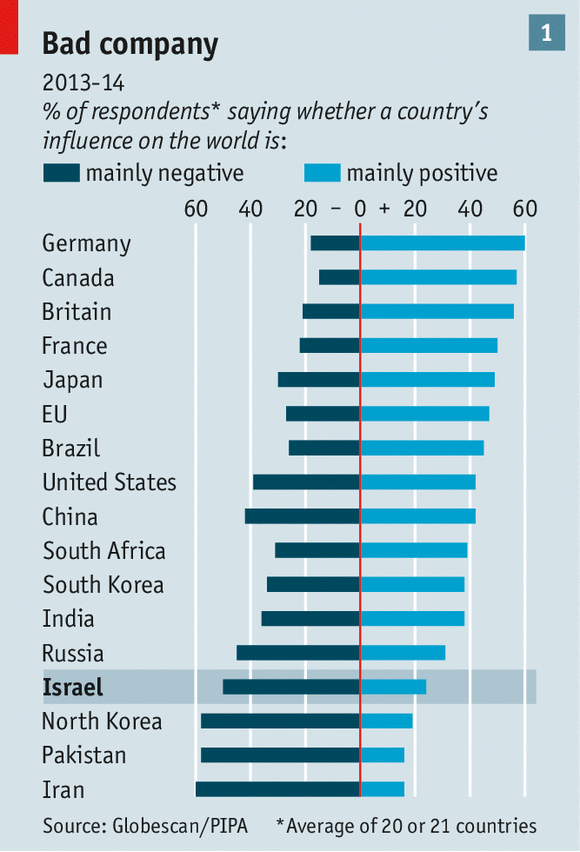
Israel and the world: Us and them | The Economist

Israel in World
Not encouraging:

Daphna Kaufman of Reut wonders whether Israel is also moving away from Europe. The secular and social-democratic leanings of Israel’s early decades dovetailed with western Europe’s. But the 1m migrants from the former Soviet Union, who arrived in the 1990s, have scant democratic tradition; many seek salvation in a strongman, a Jewish Putin, to rescue Israel from its enemies.

A similar number of national-religious Jews, heavily represented in government, see Israel as part of the divine plan for the Messiah’s coming, and worry that democracy might get in the way. More often now, Israel finds it easier to deal with non-democratic regimes, in the region or in the Asia-Pacific, where politics intrudes less on business. All of that bodes ill for co-operation with the country’s European critics and perhaps its American ones too.

Some hope that the common threat of a jihadist menace will yet induce Europe to treat Israel as its frontline bulwark and to overlook the plight of the Palestinians. “Ours is the fight of the free world,” says Mr Steinitz. But others see only greater divergence ahead. “Within 50 years, Europe’s lingua franca will be Arabic, and Britain will have a Muslim majority,” Moshe Feiglin, a hardline member of Mr Netanyahu’s party, Likud, tells a nodding audience in Bet Shemesh, a commuter town between Jerusalem and Tel Aviv. His listeners see a future in which Israel is increasingly forced to rely on its own devices—and its own might.

Haven’t seen any recent Canadian polling on attitudes with respect to Israel and Palestine.

Israel and the world: Us and them | The Economist.

I hate the hatred | Coren Toronto Sun

Michael Coren, whose writings I generally disagree with, nevertheless is worth reading in general for a different perspective, and particularly this piece on Israel and Gaza:

I hate the way some on the right and in Zionist circles refuse to listen to the Palestinian experience and believe Israel can do no wrong. I hate the way some evangelical Christians think the ghastly battle over Israel and Palestine is some sort of Biblical combat and modern Armageddon to be fought vicariously by Jews and Arabs. I hate the hatred.

I hate it when North African thugs in Paris attack synagogues in the name of Palestine, beat up Jews in the street and then scream about human rights. I hate it that kids from Pakistan will say not a word about their home country’s blasphemy laws and murder of Christians but roar their hatred of Israel when they probably couldn’t even find it on a map. I hate the hatred.

I hate the singling out of Israel for condemnation but the ignoring of the murderous regimes that surround it. I hate the fact that Iran can hang young gay men, Syria can murder tens of thousands and Turkey can occupy two countries and deny the Armenian genocide but there are no demonstrations. I hate the hatred.

I hate it that when supporters of Israel, like myself, argue that there has to be another way, that Palestine has to exist and that the settlements are wrong, we are mocked as compromisers – I actually wear that badge with pride. I hate it when the same people who welcomed Soviet diplomats, sportsmen and artists and now welcome diplomats, sportsmen and artists from repugnant Arab dictatorships, boycott Israeli kids who can kick a ball or play an instrument. I hate the hatred.

I don’t have a solution, I don’t even have much hope — and for someone who has spent so long in the Middle East, read so much, met so many people, listened to so many stories, I am I suppose a terrible disappointment. I’m obviously not as clever as those on both sides who know exactly how all of this can be settled. But I do know that I hate the damned hatred.

I hate the hatred | Coren | Columnists | Opinion | Toronto Sun.

Serving in foreign militaries

Serving in the IDF or other foreign militaries raises sensitive issues related to dual loyalty (see my earlier article Which Country Would You Die For?).

Serving in a foreign military implies a greater loyalty to that country, given the risk of ultimate sacrifice.

But serving in a foreign military, with its own discipline, regulations and codes, is distinct from extremist irregular forces without such developed frameworks (even if there are some common elements).

In the former in democratic societies the broad frameworks and values are largely similar. Needless to say, the same could not be said for those fighting for ISIS or equivalents:

Two Americans serving as lone soldiers were among 13 Israeli soldiers and scores of Palestinians over the weekend who died during the first major ground battle in two weeks of fighting between Israel and Hamas. Max Steinberg, a 24-year-old sharpshooter in the Golani Brigade, was killed as well as Nissim Sean Carmeli, 21, from South Padre Island, Texas.

There were about 5,500 lone soldiers serving in the military in 2012, according to the Israel Defence Forces. Groups for families of lone soldiers, like the support group in Toronto, have recently started in Los Angeles and other cities, providing a support network as the fighting intensifies.

“Lone soldiers are a kind of star in Israel,” Jewish Journal reported. “For Israeli kids, army service is a rite of passage. But because it is a choice for the young members of the Diaspora who re-direct their own life paths to protect Israel, those enlistees are given a hero’s welcome — and a lifetime of Shabbat dinner invitations from their fellow soldiers, who become their surrogate families.”

‘I just want her to get through this in one piece’: Canadians serving with Israeli military amid Gaza conflict, parents say

And in LaPresse, a fairly critical look at Canadian Ambassador Vivian Bercovici’s one-sided perspective as seen through her tweets.

To be fair, she is simply expressing the Government’s policy on Israel and Palestine but given that she formally is the Ambassador to both Israel and the Palestinian Authority, she does seem to be even more one-sided than necessary:

Norman Spector, qui a été ambassadeur du Canada en Israël de 1992 à 1995 et chef de cabinet du l’ancien premier ministre Brian Mulroney, s’est dit surpris du «parti pris» de ces déclarations. «Cela me surprend de lire ses tweets et retweets», a-t-il affirmé.

«Par contre, à mon époque, l’ambassadeur était responsable pour les relations avec Israël et pour les relations avec les Palestiniens, ce qui n’est pas le cas aujourd’hui, si je ne me trompe pas», a-t-il ajouté.

Le bureau du ministre des Affaires étrangères, John Baird, a confirmé que cette dernière responsabilité incombe au Bureau de représentation du Canada auprès de l’Autorité palestinienne.

Le ministre John Baird n’a pas bronché lorsque La Presse lui a demandé de réagir. «Elle est là pour représenter les intérêts canadiens, les valeurs et la position canadienne, et elle le fait très bien», a déclaré un porte-parole par courriel. «Elle a tout notre appui.»

Des experts n’ont pas été particulièrement surpris en lisant ces propos. «Elle a été choisie au départ parce qu’elle avait ces convictions», a souligné Rex Brynen, professeur de sciences politiques à l’Université McGill.

«Je ne crois pas que cette distinction [entre diplomatie et activisme politique] existe réellement, a quant à lui noté le professeur Roland Paris, de l’Université d’Ottawa. Les diplomates ont plusieurs fonctions, et l’une d’elles est d’être un défenseur des positions de leur gouvernement.»

http://www.lapresse.ca/actualites/politique/politique-canadienne/201407/22/01-4785985-israel-les-tweets-de-lambassadrice-du-canada-font-jaser.php

ICYMI: For Israelis and Palestinians, Separation Is Dehumanizing – NYTimes.com

Interesting commentary on how Israelis and Palestinians have moved further apart by Ethan Bronner of the NYTimes:

Israelis — especially in the heartland around Tel Aviv, where two-thirds of the country lives — can now go weeks without laying eyes on a Palestinian or ever having to think about one. In Gaza, Israelis do not exist except in a kind of collective nightmare. In the West Bank, the Israelis are mostly settlers and soldiers. Apart from a few pockets of industry and shopping where Palestinians are employed, interaction is highly limited.

At the height of the peace efforts, in the 1990s, Israeli and Palestinian leaders, locked in rooms negotiating with one another, built a poignant bond and developed a form of trust that they then sought to spread — not always successfully — to their peoples.

Yossi Beilin, then an Israeli official, and Mahmoud Abbas, who went on to become the president of the Palestinian Authority, wrote a peace plan together. In the early 2000s, Sari Nusseibeh, a Palestinian official and intellectual, joined with Ami Ayalon, a former head of the Israeli Shin Bet security services, and gathered hundreds of thousands of Palestinian and Israeli signatures for a two-state solution. They traveled together for months. They got along famously.

The relationship between Prime Minister Benjamin Netanyahu and Mr. Abbas is one of mutual loathing, according to Martin S. Indyk, who resigned last month as American envoy for peace negotiations after nine months of futile efforts. The two sides and their leaders have become total strangers. Each vilifies the other and imagines its own people to be morally superior, forced to defend itself against the cruel predations of the other.

A generation ago, there were plenty of causes for tension and concern. But Palestinians building what they hoped would become their state, and Israelis working with them, had an often moving sense of shared purpose. Some discovered that they liked one another and looked forward to working together. Today, those feelings are virtually dead. And while mixing the populations in those years was no panacea, divorcing them has only made things worse.

For Israelis and Palestinians, Separation Is Dehumanizing – NYTimes.com.

Convert, pay tax, or die, Islamic State warns Christians

Depressing – and another legacy of the Gulf War of 2003:

In the statement, Isis said Christians who wanted to remain in the “caliphate” declared earlier this month in parts of Iraq and Syria must agree to abide by terms of a “dhimma” contract – a historic practice under which non-Muslims were protected in Muslim lands in return for a special levy known as “jizya”. “We offer them three choices: Islam; the dhimma contract – involving payment of jizya; if they refuse this they will have nothing but the sword,” the announcement said.

….Mosul, once home to diverse faiths, had a Christian population of around 100,000 a decade ago, but waves of attacks on Christians since the 2003 US-led invasion to topple Saddam Hussein have seen those numbers collapse.

The Mosul residents who saw the Islamic State announcement estimated the city’s Christian population before last months militant takeover at around 5,000. The vast bulk of those have since fled, leaving perhaps only 200 in the city.

Convert, pay tax, or die, Islamic State warns Christians | World news | theguardian.com.

‘Shopping for Votes:’ Baird gets tetchy with CBC reporter over Middle East Twitter gambit

A rather amusing exchange between Minister Baird and Valerie Boyer of the CBC:

Boyer: “Why has the Conservative Party decided to use this conflict in advertising to gain supporters?

Baird takes a drink of water: “I haven’t seen that.”

Boyer: “There’s been a few tweets out there saying, ‘You know we’re on ….’”

Baird interrupts: “So, is it the position of the CBC that a tweet is advertising?”

Boyer: “Well, I mean it’s a form of getting out to supporters though.”

Baird: “I just don’t … If the CBC calls tweets advertising, it doesn’t …”

Inaudible – Baird and Boyer try to talk over each other

Boyer: “It’s a form of getting out to people.”

Baird: “In fairness, you’re a member of our national broadcaster. We deserve better questions than that.”

While the Government’s full-throated support of Israel is deeper than diaspora political calculations, this exchange allowed Baird to reiterate support to Canadian Jews (not all share the Government’s position) while attacking the CBC, and playing to the Conservative base.

Neat trick, but the obvious retort to “We deserve better questions than that.” is “We deserve better answers.”

Baird gets tetchy with CBC reporter over Middle East Twitter gambit (pay wall)