Hong Kong democracy advocates angry after Ottawa-funded group buys ad backing China’s side

Understandably so:

A Chinese Canadian group that has received more than $130,000 in federal funding published a newspaper advertisement that condemned democracy protesters in Hong Kong and closely mirrored Beijing’s stance on unrest in the city.

Critics of the regime say they’re appalled that Canadian taxpayers are backing an organization that would pay to intervene on China’s side in the Hong Kong turmoil, likely at the behest of Chinese officials.

But it’s not the only recent example of federal funding linked to activities that support Beijing, as the two countries remain locked in a tense diplomatic standoff.

The ad placed by the “non-political” Council of Newcomer Organizations appeared weeks before a festival co-organized by China’s consulate general in Toronto, designed in part to celebrate the 70 th anniversary of the founding of the People’s Republic.

Our government is using taxpayers’ money to enable CCP influence and infiltration into our society and politics

Heritage Canada gave a multiculturalism grant of $62,000 to last month’s “Dragon Festival” through the event’s other organizer, the Canadian Association of Chinese Performing Arts.

Meanwhile, the Chinese government invited the heads of both the newcomer council — which was founded by Liberal MP Geng Tan — and the performing arts group to attend this week’s anniversary celebrations in Beijing.

Council executive chairman Zhu Jiang was quoted as saying he wept as he witnessed the military parade through Tiananmen Square Tuesday, realizing how much he “loved the motherland.”

“Our taxpayers’ money should have never been used to fund such organizations and activities,” said Ivy Li, a spokeswoman for the group Canadian Friends of Hong Kong. “By doing so, our government is using taxpayers’ money to enable CCP (Chinese Communist Party) influence and infiltration into our society and politics. This is a total betrayal of Canadian voters.”

It is “very troubling” that Ottawa helped pay for an event — the Dragon Festival — that marked a totalitarian state’s anniversary, added Cheuk Kwan of the Toronto Association for Democracy in China. The consulate “should be funding the whole thing, and then they can make whatever speech they want,” he said.

Heritage Canada, the main funder of the newcomer council, was unable to comment by deadline.

Neither the newcomer council nor Dragon Festival organizers could be reached for comment.

Critics say the incidents are just the latest examples of China’s long soft-power reach into Canadian society, with the added wrinkle of financial support from Ottawa.

Beijing has reportedly poured increasing resources into such efforts in recent years, the influence campaigns spearheaded by a party branch called the United Front Work Department (which reportedly invited Zhu to the anniversary gala). Its actions have come under newfound scrutiny in Canada as the feud with China unfolds.

The arrest in January of Huawei Technologies executive Meng Wanzhou under an extradition treaty with the U.S. touched off an angry response from Beijing. China imprisoned two Canadians on ill-defined espionage charges, abruptly increased a Canadian’s drug-trafficking sentence to death from 15 years in jail, and imposed trade barriers on billions in Canadian agricultural imports.

The Council of Newcomer Organizations placed its ad in the Chinese Canadian Times — a free, Chinese-language newspaper that claims a “vast distribution network across Ontario” — in early August.

At that point, the Hong Kong demonstrations had been mostly peaceful, bringing a million or more people to the streets some days to oppose a now-defunct extradition law, decry alleged police brutality and call for more democracy.

The council’s ad dismissed the protests as a foreign-incited assault on the city’s stability, much as the strife has been characterized by China itself.

“Recently, certain self-serving political actors who do not hesitate to collude with foreign anti-Chinese powers, luring young extremist activists to be their cannon fodder, have continuously violated the peace of Hong Kong,” it said in part.

Heritage Canada said it has funded the council to the tune of $99,760 over the past several years. Employment and Social Development Canada granted it $38,000 in 2016.

The council’s own website — which describes the group as non-political — suggests an orientation toward China.

Much of the site is devoted to sports events, essay contests and other activities for local young people. But one of five sections in the English version – headed “legislation” – lists summaries of several Chinese laws, including one outlining restrictions on religious activities by foreigners. And there are several articles about “roots-seeking” trips for youth to China, organized by Beijing’s Overseas Chinese Affairs Office, part of the United Front.

Last month’s Dragon Festival outside Toronto’s City Hall involved booths and performances highlighting Chinese arts, food and culture.

But at its launch, one master of ceremonies said in Mandarin it was also an early celebration of “the 70th birthday of our motherland.” In his speech, Consul General Han Tao said the festival should help increase understanding and friendship between peoples, and then referenced the 70 th anniversary on Oct. 1 and China’s rise from a “poor and weak” nation to the world’s second-largest economy.

A consulate press release on the festival said in Chinese it would include events to “celebrate the (ancestral) homeland” on the occasion of the anniversary.

Source: Hong Kong democracy advocates angry after Ottawa-funded group buys ad backing China’s side
Terry Glavin: Apparently blind spots extend to supporters of Syrian mass murderers

Full credit to Terry for having provided Syrian Canadians with a voice that forced government to reverse its decision:

Well, that’s done then.

That creepy fella who’s been driving around the streets of Montreal in a gigantic bright red Humvee with a 1Syria custom licence plate and a portrait of Syrian mass murderer Bashar al-Assad on a side window has finally fallen out of favour with the Liberal Party of Canada.

Waseem Ramli is now expunged from the party’s digital fundraising rolodexes. Banned from further photo opportunities with the dashing Justin Trudeau, and struck from the first-class invitation lists maintained by the embarrassed staffers who toil for Marc Miller, Liberal MP for Ville-Marie—Le Sud-Ouest—Île-des-Sœurs.

And thanks to the exasperated last-minute interventions of Foreign Affairs Minister Chrystia Freeland — who is ordinarily smart enough not to get caught up in this kind of thing — the Baathist fanboy proprietor of the Cocktail Hawaii restaurant over on Rue Maisonneuve will not be entrusted, after all, with the delicate and confidential consular affairs of tens of thousands of Syrian immigrants and refugees who have fled Assad’s bloody nightmare state and ended up refugees, something like 60,000 of them, in Canada.

Waseem Ramli is now expunged from the party’s digital fundraising rolodexes

Blindsided badly by the Office of Protocol in her own Global Affairs bureaucracy, Freeland was furious with the revelation (yes that was me, I confess) in Maclean’s magazine on Monday that the colourful Mr. Ramli, Montreal’s notorious advocate of the world’s most thoroughly blood-soaked pariah state, had been greenlighted, duly authorized and credentialed by her own department to serve as honorary consul of the Syrian Arab Republic in Montreal.

Might it have been the poster-style photograph of Ramli and Trudeau that had been making the rounds after first appearing on Ramli’s Facebook page a few weeks ago? Was it the photograph of Ramli with Marc Miller from that same June 17 Liberal party “armchair conversation” fundraising event in Montreal? Is it not just possible that the Global Affairs’ authorization of Ramli was the result of a certain poor schmuck in the Office of Protocol who thought, “hey, he must be a good guy, a made guy, right?” Or maybe, “hey, I better just stamp this guy’s papers, because if I don’t, I’ll have the Prime Minister’s Office breathing down my neck, right?”

Everybody makes mistakes. I make mistakes. Sometimes I file so late past my deadline I wonder why my editors still put up with me. I’ve never put on a woolly black wig and painted my face and hands and arms and legs black and jumped around with my tongue wagging out of my head, mind you. But to be fair to Trudeau, there is one explanation he’s offered for the serial blackface and brownface spectacle he’s made of himself over the years, which we are only now learning about, that makes some sense, in this particular context.

It’s this one: “I have always acknowledged that I come from a place of privilege, but I now need to acknowledge that comes with a massive blind spot,” he said.

Maybe he’s got some sort of blind spot, which similarly afflicts his old friend and fellow Montrealer Marc Miller, when it comes to people whose faces are vaguely brown. Maybe that would explain why Miller has had several friendly encounters with the generous Waseem Ramli over the years and yet somehow remained blissfully unaware of the eccentric restaurateur’s unseemly affiliations and the dread he instilled in Montreal’s Syrian refugee community.

Ramli tells me he’s not a Liberal party member. He was content to shell out several hundred dollars to attend that June 17 fundraiser and photo session with Trudeau, and he declined to tell me how much he’s contributed to the Liberal party, or to Miller’s war chest, over the years. As is his perfect right. And maybe it doesn’t have a damn thing to do with money. Marc Miller is not a bad man. He’s a genuinely decent guy. Maybe it’s just about votes, and the blind spot here is the thing some politicians imagine about votes coming in distinct colours. There certainly is a pattern, anyway. Sometimes it’s like déjà vu.

In the lead-up to the past federal election, some strange sort of blind spot afflicting the soft-palmed and the posh, or people with “privilege” as they now classify themselves, may well have been at work in the way nobody in the Liberal party noticed anything untoward about the affiliations of the party’s own national director of outreach, who went on to become a greenlighted contender for the Liberal candidacy in Nepean.

Foreign Minister Chrystia Freeland… has overturned the approval of Montreal businessman Waseem Ramli, a supporter of Syrian President Bashar al-Assad, as Syria’s honorary consul in Montreal. Sebastien St.-Jean/AFP/Getty Images

Nour El Kadri, it turned out, was so intimately associated with the Syrian Social Nationalist Party that the SSNP’s cadre and literature had consistently and invariably described Kadri as one of the SSNP’s central leaders in Canada. And the SSNP, it fell to me to point out back then, was at the time a component of Bashar Assad’s ruling coalition, and its death squads were terrorizing the city of Homs and the suburbs of Damascus. You’d think a party with its own stylized swastika and an anthem sung to the tune of Deutschland, Deutschland Uber Alles might have been a giveaway.

But there’s that blind spot again.

And so those poor, banished children of Eve, the Syrians trudging the roads of the world in their millions, among whom some paltry few thousand have been permitted to settle in Canada, and it is their place to tell us how lovely we are for allowing them in, and this is the sort of thing they see. A Humvee, of exactly the kind that the Shabiha drive around Damascus, at night, and the horror stories of kids who never made it through their checkpoints, and now here in Canada a bright red one, with a portrait of Bashar on the side, in the streets of Montreal. And it becomes unbearable, and they make a telephone call to some journalist they know. And they ask whether something might be done about their dread, and they fear they would be seen as insufficiently appreciative of the handsome and dashing prime minister who built his reputation on being so kind to them, the man who so generously allowed them to come, if they complained too loudly. And they ask, please, don’t use my name, because they are afraid of the man in the Humvee.

Hell of a blind spot to fail to see the shame and the disgrace in that.

Source: Terry Glavin: Apparently blind spots extend to supporters of Syrian mass murderers

Former Canadian ambassador suggests registry to help identify foreign agents

Hard to disagree:

A veteran of Canada’s diplomatic corps is urging the creation of a federal registry, modelled on one in Australia, to shed light on the work Canadians, including former senior public officials, are doing on behalf of foreign governments.

David Mulroney, who worked for 32 years in the Canadian foreign service, including as Canada’s ambassador to China, said there’s an increasing risk today that foreign governments are using Canadians to mould public opinion and lawmaking here.

“It is not being alarmist to suggest that foreign countries continue to seek influence in Canada and that some are even willing to interfere covertly in Canadian affairs. If anything, the threat is growing,” Mr. Mulroney said in an interview.

What he’s proposing is that Canadians paid to lobby or communicate political messages on behalf of foreign states or enterprises owned by a foreign government would be required to disclose their activities in a federal registry. He said his proposal goes far beyond the scope of the existing federal lobbyists registry, which he says has loopholes that do not capture all activity he believes should be brought to light.

Mr. Mulroney said the rise of China as an economic and geopolitical power has added urgency to the question of foreign interference and influence. “China’s Communist Party has well-developed mechanisms for influencing political opinion in foreign countries,” he said.

He said he was unwilling to comment on individual cases, but stated that, under his proposal, virtually any work undertaken by former Canadian officials for China’s state-owned corporations would need to be disclosed in a registry.

New foreign-influence transparency laws took effect recently in Australia. The rules came in response to concerns about Chinese government influence in Australian politics.

Under Mr. Mulroney’s proposal, former cabinet ministers would be required to register almost all work – not just lobbying – that they are doing for foreign governments or related entities. Mr. Mulroney argues that international work promoting Canadian values and interests – such as humanitarian work – would remain exempt, but all other employment in which a foreign state is seeking to benefit from the knowledge, experience or contacts a former minister gained while serving Canada would need to be reported. The obligation would last their lifetime.

Former senior public servants, including deputy ministers, assistant deputy ministers and ambassadors, would face the same high bar for registration, but only for 15 years.

Mr. Mulroney is publishing his proposal in a paper through the Macdonald-Laurier Institute, an Ottawa-based think tank.

Ward Elcock, a former director of the Canadian Security Intelligence Service and former deputy minister of National Defence, said he supports Mr. Mulroney’s proposed registry.

“There are foreign governments who did have an interest in influencing Canadian public policy in one way or another and, yes, I think transparency is required,” he said.

However, Mr. Elcock said a registry won’t help if former politicians or senior bureaucrats attempt to hide their affiliation with foreign governments or state-owned enterprises.

Richard Fadden, another former director of CSIS, said he broadly supports Mr. Mulroney’s proposal.

Mr. Fadden, who was also national security adviser to prime ministers Stephen Harper and Justin Trudeau, said he thinks however that China is “far from the only country for us to worry about” and would like to see the registration requirements also apply to Canadian military ranks down to the Canadian Armed Forces equivalent of an assistant deputy minister.

Mr. Mulroney is proposing two extra measures on top of what Australia has done.

Any Canadians serving on federal government boards, agencies, foundations or councils in Canada would be prohibited from working for foreign governments or related entities for the duration of their appointment. It would also require Canadians to relinquish membership in what is called the Queen’s Privy Council, which is a lifetime designation granted to prime ministers, cabinet ministers and chief justices of Canada.

Mr. Fadden doesn’t support requiring Canadians in the Queen’s Privy Council to relinquish membership if they work for a foreign government.

He said if a former senior public official is, for instance, working for Britain to help promote a bilateral trade deal with Canada they shouldn’t be forced to give up the P.C. designation.

Stockwell Day, a former Conservative cabinet minister and vice-chair of the Canada China Business Council, a lobby group, said the proposed registry is not needed given existing rules against lobbying that remain in place for half a decade after leaving office.

Mr. Day said he could see the registry becoming a “nightmarish bureaucratic overburden trying to report working arrangements of individuals 15 years after they have been in office” and predicted the law would almost certainly also be challenged in court “as an unconstitutional restriction on the right to work.”

Mr. Mulroney said however that existing lobbying registry rules do not cover the sort of disclosure he’s proposing. “Think about the possibility of a former, or even a current politician taking talking points from a foreign government. … If you are speaking or disseminating information on behalf of a foreign entity, you need to be clear about your sources. Otherwise you mislead Canadians.”

Source:   Politics Former Canadian ambassador suggests registry to help identify foreign agents Subscriber content Steven Chase September 23    

Canadian officials honour Nazi collaborators in Ukraine, angering Jewish groups

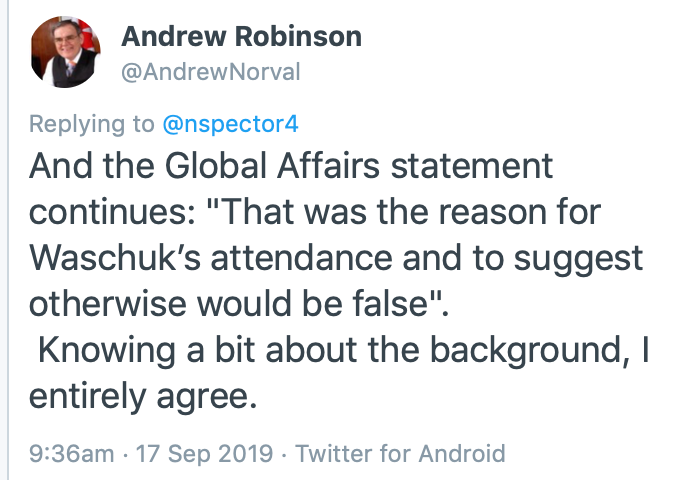
Not quite as simple as portrayed: see tweet from former Canadian Ambassador to Ukraine, Andrew Robinson:

The Canadian Forces and Global Affairs Canada are facing criticism after honouring members of Ukrainian organizations that helped the Nazis in the Second World War.

Canada’s Ambassador to Ukraine Roman Waschuk spoke at an Aug. 21 ceremony that unveiled a monument in Sambir to honour members of the Organization of Ukrainian Nationalists (OUN) and the Ukrainian Insurgent Army (UPA), two groups that are linked to the killing of tens of thousands of Jews and Poles.

The event has been condemned by the Simon Wiesenthal Centre and the Ukrainian Jewish Committee who warn the memorial whitewashes the role of Ukrainian collaborators in the Holocaust.

“All Jews of Sambir were murdered by Nazis and their collaborators from OUN and UPA,” Eduard Dolinsky, director-general of the Ukrainian Jewish Committee based in Kiev, told Postmedia.

The monument, which is at the edge of a cemetery holding the remains of more than 1,200 Jews murdered by the Nazis and Ukrainian collaborators, is a desecration and “double murder of the Jewish victims,” Dolinsky said. “It’s like putting a monument to killers on the top of the graves of their victims.”

Global Affairs Canada said the Sambir event was intended to assist efforts by the Jewish community in Canada and Ukraine to build public support to create an eventual memorial for the Jewish cemetery in the town. That was the reason for Waschuk’s attendance and to suggest otherwise would be false, the department said.

The memorial is to 17 members of the OUN who the Ukrainians say were killed by the Nazis. Waschuk, in his speech at the ceremony, paid tribute to the murdered Jews, Ukrainians who tried to help them and “those Ukrainians who fought against the Nazi regime as members of OUN-UPA.”

Members of the OUN-UPA supported the Nazis and helped round up and execute Jews after the Germans invaded Ukraine, according to Holocaust historians. At one point, they broke away from their support of the Nazis, but later joined forces again with Germany. In 1943 the UPA started massacring Polish civilians, killing an estimated 100,000 men, women and children, according to historians.

The Canadian Forces said in a statement that military personnel were requested by the Canadian embassy in Ukraine to attend. The attendance was “part of a whole government effort to champion tolerance in a democratic Ukraine and reiterate that totalitarian regimes (in both past and contemporary times, and under all guises) have done injustices to Ukrainians,” the statement said.

Jewish organizations have been trying for years to erect a memorial at the Jewish cemetery. But Sambir locals have resisted that, removing the Star of David at the site and instead erecting three large Christian crosses on the Jewish cemetery. A compromise was eventually reached; in exchange for removing the crosses, a memorial to the dead OUN-UPA would be erected.

Waschuk called the memorial “a monument of love to one’s motherland. And a motherland must know how to defend itself so that it does not suffer again from waves of inhuman totalitarian terror as happened during World War 2.”

It’s not the first time that Canadian actions in Ukraine have raised concerns.

In June 2018 the Canadian government and military officials in Ukraine met with members of the ultranationalist Azov Battalion, which earlier that year had been banned by the U.S. Congress from receiving American arms because of its links to Neo-Nazis

The Canadians were photographed with Azov battalion members, images which were shared on the battalion’s social media site.

In a statement to Postmedia the Canadian Forces noted the meeting was planned by Ukrainian authorities and Canadian representatives had no prior knowledge of those who would be invited. The Azov battalion has been connected to war crimes by the United Nations.

Various Jewish groups have warned about efforts to whitewash Nazi collaborators in eastern European countries, portraying them as heroes instead of those who aided in the Holocaust. Earlier this year, the Canadian government added its voice to those condemning an annual parade in Latvia’s capital honouring members of the Nazi SS, saying it opposes any such event glorifying Adolf Hitler’s regime.

Around 1,000 people marched in the parade in Riga on March 16 in honour of the Latvian SS divisions which fought for the Nazis in the Second World War. Some in the parade wore swastikas and other Nazi insignias.

Source: Canadian officials honour Nazi collaborators in Ukraine, angering Jewish groups

Former Ontario minister sides with Beijing, pins Hong Kong protests on ‘outside’ forces

Chan has also been writing a number of op-eds in Chinese media and his rebuttal to a National Post article on his activities in relation to pro-Hong Kong demonstrations was also published in Chinese Canadian media (Dawa Business News, 6 September):

A former Ontario cabinet minister, who held the province’s immigration and international trade portfolios under two Liberal premiers, has denounced acts of violence during the pro-democracy protests in Hong Kong as the work of foreign actors intent on undermining the state of China.

Former MPP Michael Chan, in a recent interview with Chinanews, a Chinese state-backed news site, condemned the city’s anti-government protesters and applauded Hong Kong police for showing restraint in the crisis.

His assertions echo the statements by Chinese officials as the protest movement in Hong Kong gathered steam. China has blamed “foreign forces” for manipulating the protests and interfering in Hong Kong affairs.

“I have been thinking, why are these young people so radical, so passionate [and] committed to do these things? And why so many people?” Mr. Chan said in an interview with Chinanews that was published earlier this month.

“If there is no deeply hidden organization in this, or deeply hidden push from the outside, there is no way that such large-scale turmoil would happen in Hong Kong in a few months.”

Mr. Chan served in various portfolios for the Ontario Liberals, including as immigration minister, during his tenure in office between 2007 and 2018.

Last week, in an article posted on Mr. Chan’s public WeChat social-media account, he is quoted as suggesting demonstrators have been trying to enlist the Japanese for help with their cause. The article is titled “Exclusive interview with Michael Chan: Guerrilla actions.”

He said in the article that Japanese media reported an interview with a Hong Kong protest leader who travelled to Japan and mused that “Japan could send a self-defence force on the grounds that they could protect the overseas Japanese.” Mr. Chan went on to say the report was strongly condemned by Hong Kong residents and added that the protest leader has denied ever saying such things.

The protester Mr. Chan referred to, Agnes Chow Ting, stated on her social-media accounts on Sept. 5 that she made no such claims and demanded the Japanese media delete the report.

Any reference to a Japanese military presence in Hong Kong is especially inflammatory among the Chinese community, because of Japan’s brutal treatment of Chinese citizens during the Second World War.

“That protest leader is actually taking the initiative to ask the Japanese army to occupy Hong Kong again in order to guard … ‘freedom and democracy.’ This is incomprehensible,” the article on Mr. Chan’s WeChat page said.

This article was also published under Mr. Chan’s byline at 51.ca, a prominent Chinese-language online publication in Canada.

Efforts to reach Mr. Chan through his public WeChat account were not successful.

Repeated calls and e-mails to Mr. Chan’s lawyers and workplace were not returned to The Globe and Mail. According to the Seneca College website, Mr. Chan sits on the board of governors.

In 2010, Mr. Chan was considered so close to the Chinese consulate in Toronto that Canada’s intelligence agency feared he was at risk of being unduly influenced by foreign officials. A senior intelligence official later met the province’s top bureaucrat to formally caution the province about the minister’s conduct and the risk of foreign influence.

Dalton McGuinty, who was then premier, dismissed the Canadian Security Intelligence Service’s concerns as baseless and kept Mr. Chan in cabinet. His successor, Kathleen Wynne, similarly dismissed the concerns and said the federal spy agency’s suspicions lacked substance.

CSIS’s concerns about Mr. Chan were never disclosed publicly at the time, nor was Mr. Chan named as the subject of the CSIS briefing. They were revealed in a 2015 report by The Globe.

When asked earlier this September about Mr. Chan’s interview with Chinanews, Ms. Wynne said she hadn’t spoken to Mr. Chan “for months.”

“We are no longer part of a caucus; I haven’t spoken to him for some time. He is a trusted colleague, but I have not had a conversation with him about the issues in Hong Kong, in China.”

After the Globe article appeared in 2015, Mr. Chan said CSIS’s concerns were “ludicrous” and “totally false” and he brought a legal action against The Globe.

“There is a persistent theme that there is a perceived risk that I am under undue influence and that I am an unwitting dupe of a foreign government,” he wrote in an open letter. “This is offensive and totally false.”

When he left politics last year, Mr. Chan joined the law firm Miller Thomson. A spokesperson for the firm said earlier this month that Mr. Chan no longer worked there.

In the Chinanews article, Mr. Chan said the violence in the movement in Hong Kong has been severe, and if there were similar unrest in Western countries, police would have “already fired bullets toward crowds.”

Protesters have accused Hong Kong police of excessive use of force, but Mr. Chan disagreed.

“It’s the opposite,” he stated. He said the restraint and courage of Hong Kong police should be praised, according to the article.

The months of unrest in the Chinese-governed, semi-autonomous city were prompted by a bill that would have allowed people in Hong Kong to be extradited to mainland China for trial. Many saw the extradition bill as an erosion of rights promised under a “one country, two systems” framework when the former British colony returned to Chinese rule in 1997. The bill was first suspended, but after the tensions in the city kept escalating, Hong Kong’s leader, Carrie Lam, announced on Sept. 4 that the government would withdraw the bill.

Hong Kong protesters have said the bill’s withdrawal was too little, too late.

In other remarks in the Chinanews interview, Mr. Chan noted about 300,000 Canadians are living in Hong Kong.

“If the system in Hong Kong is really that unfree, undemocratic, feeble, and bad, then why do these 300,000 (Canadians) live there?

“One country, two systems will not change. If whoever says Hong Kong wants to be independent and separated, then there is no discussion needed. Hong Kong belongs to China. This is unnegotiable.”

Some Chinese Canadians, especially those who have ties to Hong Kong, found Mr. Chan’s remarks appalling.

Gloria Fung, president of Canada-Hong Kong Link, said Mr. Chan’s remarks sound like the Chinese regime’s propaganda.

“It’s very clear that he is not using Canadian values nor the universal values of Western democracies in making all these comments. Rather, he abides by the values of the Chinese Communist Party,” Ms. Fung said. “That is troublesome.”

It was not the first time Mr. Chan publicly supported China’s stand on the Hong Kong issue. Last month, Mr. Chan spoke at a rally in Markham, Ont., expressing support for Hong Kong police, the government and Beijing.

Ms. Fung, who also lives in the Toronto area, said although Mr. Chan has stepped down from the political arena, he is still actively engaged in pro-China events.

The rally, organized by the Confederation of Toronto Chinese Canadian Organizations, attracted a few hundred attendees from the Chinese community. Online pictures and videos show leaflets resembling the Liberal Party’s old paid membership forms were distributed at the event.

Braeden Caley, spokesman for the Liberal Party of Canada, said the party had no involvement at the event. He said Mr. Chan has no formal role in the federal party.

The area that Mr. Chan once represented provincially is now held federally by Small Business Minister Mary Ng. A spokeswoman for Ms. Ng said the minister was aware of the rally, but declined to comment on whether Mr. Chan’s views are shared by many of Ms. Ng’s constituents.

Ms. Ng said in a statement that it is important that the situation in Hong Kong be de-escalated, and there is a diversity of views among Chinese Canadians as to how this can happen.

Source: Former Ontario minister sides with Beijing, pins Hong Kong protests on ‘outside’ forces

Daphne Bramham: China’s long reach laid bare by Hong Kong protests

Expect we will continue to see many articles like this:

Beijing’s long reach into the Chinese diaspora and beyond has rarely been as evident as it is now.

On Monday, Twitter suspended 936 accounts, which it described as “the most active” of 200,000 accounts representing “a larger, spammy network.” The accounts originating in China were “deliberately and specifically attempting to sow political discord in Hong Kong, including undermining the legitimacy and political positions of the protest movement on the ground.”

Based on “intensive investigations, Twitter said it has “reliable evidence to support that this is a coordinated state-backed operation. Specifically, we identified large clusters of accounts behaving in a coordinated manner to amplify messages related to the Hong Kong protests.”

Based on Twitter’s findings, Facebook also shut down seven pages, three groups and seven accounts.

Fortunately, this weekend’s march by an estimated 1.7 million Hong Kongers was peaceful after several weeks of violence and alleged police brutality.

But there were rising tensions in several Canadian cities as well as Paris, London, New York City and Sydney where pro-Beijing counter-protests were hastily arranged at sites of rallies held in support of Hong Kong’s protest movement.

The counter-protests were strikingly similar with denunciations of the Hong Kong “rioters” and “traitors” and false accusations of Hong Kongers demanding independence from China. They sang the Chinese national anthem under seemingly fresh-from-the-package Chinese flags and scores of identical placards.

With their own citizens protesting in the streets — many of them of Chinese ancestry — Canada’s Foreign Affairs Minister Crystia Freeland and the European Union’s foreign affairs chief Federica Mogherini were told to mind their own business by China. They had issued a joint statement urging restraint and condemning the “rising number of unacceptable violent incidents” in Hong Kong that might lead to “risks of further violence and instability.”

In Vancouver, Calgary and Toronto, police were busy keeping protesters and counter-protesters separated and safe.

On Saturday, social media chatter among Vancouver-based China’s supporters included boasts about bringing bricks, rocks and knives to hastily organized counter-protests that resulted in a more obvious police presence than at previous events. Whether the threats were legitimate, it’s up to the police to investigate.

Later, scores of counter-protesters gathered outside Nordstrom’s, video posted on Facebook shows one young man marching past the red flags with his arm raised in a pseudo-Nazi salute with Chinese singing in the background. The show of forced convinced the organizers of a nearby pro-Hong Kong event to cancel.

On Sunday, a convoy of flag-draped cars and some landscaping trucks that had blocked the street outside the Chinese consul general’s house on Granville Street during a rally drove to a nearby church.

There, about 80 worshippers met to pray for peace, freedom, human rights and democracy in the former British colony. Police kept the 100 or so flag-waving and red-clad demonstrators away from the church and helped escort the worshippers though the crowd when the prayers ended.

Chris Chiu, one of the prayer meeting’s organizers, called it an assault on religious freedom, freedom of assembly and freedom of expression — something protected in Canada, but absent in China.

“We definitely felt intimidated,” he said. “As far as I know this doesn’t even happen in Hong Kong. Some churches there have opened their space during protests so that people can have a rest, get first aid or some water. They’re like shelters.

“It was definitely outrageous and shocking. It makes me feel very angry and unsafe even in Canada.”

Chiu said members of Vancouver Christians for Love, Peace and Justice will be meeting later this week to talk about their future.

“Are we going to hold any prayer meeting for Hong Kong or any other causes that China doesn’t like? Do we have to think about safety? About contacting police or hiring security guards? We don’t know the answers.”

Bizarrely, there were also by noisy drive-bys of flag-draped luxury cars at protests sites in Vancouver and Toronto.

Ferraris, McLarens, Aston Martins and Porsches revved their engines and honking is intimidation on a whole different scale in cities that have been roiled by a different kind of social unrest from residents who have been priced out of the housing market and who have been rocked by a multi-billion-dollar, money-laundering scandal that’s been linked to China.

The revving of cars that cost more than many people’s homes was another ostentatious reminder of China’s economic power.

Canada and Canadians are already suffering the economic consequences of China’s retribution for cleaving to our own values and upholding the rule of law with regard to Huawei executive Meng Wanzhou.

She’s under house arrest in her multi-million Vancouver home, awaiting an extradition trial, while two Canadians — Michael Spavor and Michael Kovrig — have been jailed without trial in China and two others jailed in China have been condemned to death.

People in Hong Kong are in a life-and-death struggle to retain the vestiges of freedom that have made the city-state so vibrant. They are struggling to retain their own culture and customs and even the Cantonese language, which is increasingly being replaced by Mandarin.

As the Chinese government exerts ever increasing influence over other countries in Asia, Africa and in Canada, Hong Kongers are not alone in thinking that they may just be the canary in the coal mine.

Source: Daphne Bramham: China’s long reach laid bare by Hong Kong protests

Gurski: Why Canada should not be in a hurry to re-embrace Saudi Arabia

Good piece by Gurski:

I never worked in foreign affairs or for Foreign Affairs (or Global Affairs Canada, as it is now known, having once been designated External Affairs and many other names), but I know a little about the subject. After all, you cannot work in intelligence for three decades without picking up a thing or two on how nations manage their relations with other states.

I do know that at times a country has to hold its nose when engaging with a foreign partner whose actions are seen as, at a minimum, distasteful or, at a maximum, grotesque. In this light, I cannot imagine how the current crew at the Lester B. Pearson Building in Ottawa are handling Canada-U.S. ties, given the present occupant of the White House.

There are also those who maintain that some level of relationship is better than none. A complete cut in ties removes any form of influence or dialogue, although there are other fora (the UN for example) where national representatives can grab a coffee and chitchat about all things statecraft.

On the other hand, there are times and circumstances where a government has little choice but to close doors. Sometimes a state will engage in activities that are truly heinous and no country should allow such to go unpunished.

Saudi Arabia is now in that club. Canada has chosen, at least under Prime Minister Justin Trudeau, to criticize the kingdom over a variety of incidents; ranging from its treatment of women activists, to its disastrous war in Yemen, which is directly causing a massive humanitarian crisis. The event that overshadows everything, however, is last year’s murder and dismemberment of a Saudi dissident, Jamal Kashoggi, at the Saudi consulate in Istanbul. Everyone knows that he was killed on orders from the very top of the Saudi royal family, their incredulous denials, notwithstanding. In return, the Saudis have suspended relations, booted our ambassador in Riyadh out and recalled their own man from Ottawa. There has not been a lot of movement on this file in some time although Foreign Affairs Minister Chrystia Freeland and her Saudi counterpart have been “discussing ideas to de-escalate.”

Into this mix comes the Conservative Party, whose foreign affairs critic, Conservative MP Erin O’Toole, has said that a government led by Andrew Scheer will try to “win some trust” with the Saudis by focusing on improving business links. O’Toole acknowledges that for some Canadians re-establishing ties with Saudi Arabia will be a “tough sell.”

Ya think?

I fail to see why so many states are still fawning over Saudi Arabia, and especially over the king-in-waiting and international star Muhammad bin Salman (or MBS as he is called: some say the acronym stands for “Mister Bone Saw,” a reference to how Kashoggi was cut up). Yes, yes, it is all about oil and MBS’ plans to modernize his nation and the need to have a stalwart ally against the real menace: Iran.

Except that the crown prince’s words are probably just that: words. Saudi Arabia remains a heavily conservative Wahhabi Muslim state that has exported its hateful strain of Islam worldwide for decades and crushes any internal dissent forcefully. True, there has been some crackdown on the more egregious religious hate-mongers, but this leopard is highly unlikely to change its spots any time soon.

I find it hard to believe that many governments, including the U.S., have been giving the kingdom a pass in the post 9/11 period. Recall that 15 of the 19 hijackers that fateful day on Sept. 11, 2001, were Saudis, bred on Saudi Wahhabi Islam. And for all the noises about a mellowing of Islam in the desert kingdom, there is ample evidence that Saudi-trained imams are continuing to spread Wahhabi poison around the world. And this is what an ally does?

I realize that money trumps values a lot of the time. In this regard, there is a lot of money to be made by having a robust relationship with Saudi Arabia, particularly in the defence sector. But what is more important: trade or the values Canada stands for?

So O’Toole, if your party indeed gains power in October, have a re-think over going cap in hand to the Saudis. We really don’t need them. Their actions are antithetical to who we are. I’d like to suggest that you be a little more Canadian yourself and ditch this idea.

Source: Why Canada should not be in a hurry to re-embrace Saudi Arabia

Egyptian minister’s laughing vow in Canada to ‘slice up’ anyone who criticizes her country alarms immigrant groups

Even if the expression was made only in jest, unacceptable:

Egyptian-Canadians are incensed over an Egyptian cabinet minister’s promise to “slice up” critics of her country, saying what might have been meant as a joke struck them as a serious threat from a repressive regime.

Those of both Coptic-Christian and Muslim backgrounds — who rarely see eye to eye otherwise — condemned Wednesday the comments made by Immigration Minister Nabila Makram on a visit to Mississauga, Ont.

They cite Cairo’s record of arbitrary detentions, violence against political opponents and other human-rights abuses since President Abdel Fattah al-Sisi seized power six years ago.

Some have complained to police, and the Peel Regional force in Mississauga says it is investigating the matter.

“No one in his or her right mind should take this — although it might be said in a joking manner — as a joke,” said Ehab Lotayef of the Egyptian Canadian Coalition for Democracy. “It really represents the mindset of the current Egyptian government and is totally unacceptable by a minister in a country that respects itself.”

Lotayef urged Global Affairs Canada to make its displeasure known for what he said was at least a diplomatic affront.

Makram was near the end of a short speech to an Egyptian heritage dinner Sunday when she said in Arabic that anyone who criticized Egypt would be “sliced up,” accompanying the remark with a slashing motion across her throat.

She said it with a smile, after talking about Egyptians’ passion for their country, and earned laughter and applause from the audience.

But Egyptian ex-patriates cite evidence that critics of the Sisi government in Canada are already under watch, and note that a visiting Egyptian-Canadian businessman has been imprisoned in Cairo without charge for months.

Canadian-based “dissidents” have been mentioned in government-aligned Egyptian media in negative terms, said Lotayef.

“We are surely being followed and monitored,” he said.

Egypt’s ambassador to Canada routinely makes the trip from Ottawa to attend major events at Mississauga’s main Coptic-Christian church, said Maher Rizkalla, president of Canadian Coptic Association.

“The Egyptian government is always involved and keeps an eye on the churches in Canada,” he said. “I would be concerned to visit Egypt. I know they’re watching us, and they know who is active and inactive outside the country.”

Sisi’s government has been widely criticized for its abuses, with Human Rights Watch writing that “his security forces have escalated a campaign of intimidation, violence, and arrests against political opponents, civil society activists and many others who have simply voiced mild criticism of the government.”

Makram is on a Canadian tour organized in part by the Egyptian embassy.

“Our country is very grand and deserves that all of us work for it and fight for it, because we just have one county – Egypt,” she told the dinner audience. “This country is always inside us, inside our hearts. We cannot accept any word about it. Anyone who says a (bad) word about our country – what will happen to him? Will be sliced up.”

Not everyone interpreted the remarks in a completely negative fashion.

One audience member, who asked not to be named for fear of landing in the midst of a political fight, said the slicing-up expression is a common and usually genial one in Egyptian Arabic, not meant literally.

“Parents say that to their kids all the time,” the person said. “Usually … people say it as an endearing gesture.”

Still, the audience member said the comment was definitely inappropriate in the circumstances.

The Egyptian embassy in Ottawa did not respond to a request for comment.

In response to a complaint from Rizkalla, Peel Regional Police are investigating the matter, and liaising with the department’s “equity and inclusion bureau,” said Const. Lori Murphy, a spokeswoman.

Tung Chan: Dialogue with Chinese consul at reception can promote Canada’s case

Valid argument. The test, however, will be how many municipal politicians will raise their concerns and how forcefully or not they do so. And dialogue requires a willingness on the Chinese side, not very much in evidence these days:

I read with amazement about the debate over whether municipal politicians should attend the reception to be hosted by the Consulate of the People’s Republic of China at the 2019 Union of B.C. Municipalities Convention, to be held Sept. 23-27 at the Vancouver Convention Centre.

The central arguments against attending can be summed up in two points.

The first is that as a result of China acting in a hostile way toward our country, we should not have any contacts with its officials. The second is that if our politicians attend the reception, they will end up under the influence of the Chinese officials.

There is no doubt that China is acting in a heavy-handed way toward Canada. But this is precisely the time that more dialogue between our two countries is needed. Even Prime Minister Justin Trudeau tried to talk to Chinese President Xi Jinping at the recent G20 meeting in Japan. The reception at the upcoming UBCM will give our municipal politicians the opportunity to talk to Chinese officials.   

As to the second point about being afraid that our municipal politicians would be influenced, as a former Vancouver city councillor and former president of the Non-Partisan Association, I have full confidence that our elected mayors and councillors would not be so easily influenced by a cocktail or two. To suggest otherwise is an insult to their intelligence and integrity.

If we truly believe that our politicians can so easily become “under the general influence” of the cocktail host and then “all of a sudden, decisions aren’t taken on the basis of the public good, but on the basis of” the preoccupations of the cocktail party’s host (to paraphrase a statement by Richard Fadden, former head of CSIS), then we should, on principle, also ban commercial sponsorship at all gatherings of our politicians. Otherwise they will all be making decisions on the basis of those commercial enterprises and not on the basis of the public good. 

The fact is influence can go both ways. Why is it that those who suggest boycotting the reception have so little confidence in themselves or other politicians who want to participate of their own power of influence?  Why won’t they consider using the interaction to impress, to the extent possible, to the hosts of the reception in question that Canada is acting the way we are because we are a country that believes in the rule of law?

The points of view of the Chinese consular officials may not be changed but at least there would be constructive dialogue and our local politicians would reinforce the message of our prime minister and the foreign affairs minister. 

I believe, with the best interest of our country in heart, we need to open up more channels of dialogue between Canada and China.

Common sense tells us that problems can only be solved through dialogue, not through avoiding contact. It is time for our local politicians to join in the effort to tell China via the Chinese consuls face-to-face the feelings of the people they represent about the actions of the Chinese government. Our local politicians cannot leave that job to our prime minister and the minister of foreign affairs alone.

Tung Chan is a former Vancouver city councillor and former president of the Non-Partisan Association.

Source: Tung Chan: Dialogue with Chinese consul at reception can promote Canada’s case

John Ivison: Prioritizing romanticism over realism: Where Trudeau went wrong in Canada’s foreign policy – Anonymous former diplomats

While I agree with many of the criticisms (e.g., oversized role of diaspora politics), some less so (e.g., overly focussed on the US, the main Canadian national interest), a good survey of former ambassador assessments.

But what I find hard to understand is why former ambassadors refuse to make these statements on the record, hiding behind anonymity.

Being retired gives one the freedom to express one’s opinions publicly. There are good examples: Paul Heinbecker, David Mulroney, Dennis Horak, Ferry de Kerckhove and Mike Malloy have all played, and continue to play, an important role in public discussion on foreign policy.

Making anonymous comments, whether on social media or in interviews, has less impact and, I would argue, less credibility.

So to my former colleagues at DFAIT/GAC, if you have something to say, say it but with the personal and professional accountability that comes with being named.

Welcome any contrary opinions, of course:

Rhetoric is no substitute for reality, as the American social theorist Thomas Sowell said. It is the besetting sin of the Trudeau government that it has not lived up to its promises in so many fields of endeavour.

In foreign affairs, this week gave us another reminder of the gap between what Justin Trudeau said he would do — a “new era of Canadian international engagement” — and the state of affairs in the real world.

The Hindustan Times reported that India has informed Canada that there is little prospect of warming the frosty bilateral relationship unless Ottawa takes action on the burgeoning activities of groups seeking an independent Sikh homeland in the Punjab region.

The relationship with India has cooled since Trudeau’s disastrous visit last year, largely because the Indians believe the Liberal government is taking a position that is deliberately ambiguous for domestic political reasons (the Sikh population being a particularly coveted voting bloc at the next election).

The problem is not specifically Trudeau’s lack of credibility with Narendra Modi’s government, though India is an important Commonwealth partner.

The larger issue is that it is just one example of Canada’s continuing evisceration of its foreign service, its subjugation of relations with regional powers to domestic politics and of the millenarian belief that Canada should be regarded as a moral superpower.

Policy has been diaspora-driven in the case of the Sikhs, Tamils and Ukrainians. “We are trying to win votes in Surrey, B.C. That’s not adult. It’s not G7 behaviour,” said one former ambassador.

Another senior diplomat, with two decades of experience in Asia, said the Liberals seems to believe that foreign governments will buy their progressive talking points just as its political base does.

“I spent decades working with these highly educated and sophisticated people and I would be embarrassed to be defending current policies. We have never before had strained relations with all three of the world’s strongest powers,” he said.

The Post spoke with a handful of former senior diplomats, all of whom lamented the current state of Canada’s foreign relations.

They talked about a missed opportunity after the Harper years, when the Conservative government turned away from multilateralism and refused to “go along just to get along.” Trudeau tried to rebrand Canada as a more sympathetic, co-operative country, and said he wanted to share a “positive Canadian vision.”

When he visited the renamed Global Affairs Department in Ottawa’s Lester B. Pearson building he was greeted like a rock star by staff who were open in their jubilation at the demise of the Conservative government.

“Harper made no secret of his open disdain for the bureaucracy, which he thought was staffed by a bunch of Liberals,” said one former ambassador. “That wasn’t true — people had served previous Conservative governments loyally.”

There were high hopes that Trudeau would revive the foreign service but by all accounts, that has not happened.

“For a government that evinced such appreciation of bureaucrats at the beginning — which was embarrassingly reciprocated — Trudeau’s government has shown little appreciation for the actual institution of Canada foreign policy. Was this because the institution didn’t deliver, after the years of Harper starvation; because the Harper model was there and was so easy to fall back on; because of the press of crises; or because of personality?” asked another former ambassador.

The answer is probably a combination of the above. But what can be said with confidence is that allowing the foreign service to atrophy further has had real world consequences.

Naiveté, myopia and bad advice contributed to the debacle in Beijing in late 2017, when Trudeau arrived in China expecting to launch talks on a free trade deal and left empty-handed. Old Foreign Affairs hands shake their heads at the expectation that China would change its labour laws to accommodate Canada’s progressive trade agenda, blaming former ambassador John McCallum (one of a number of political appointees in key embassies) for not warning the visiting prime minister. “The Liberal establishment is in bed with the Chinese and they were slow to see that Xi is different and the romantic vision of China is no longer true,” said a former ambassador.

The consensus on Trudeau’s trip to India is that foreign service advice was either ignored or overruled. The logic appears to have been that dressing up in flamboyant costumes for pictures that would appear in constituency mail-outs at election time should take precedence over fostering more harmonious relations with the world’s largest democracy.

On relations with the U.S., there is a sense that Trudeau has performed more adroitly. “I’m careful not to carp about the swimming stroke of a guy caught in a white water cascade,” said one former ambassador, referring to the problem for any Canadian government dealing with Donald Trump.

The main criticism was that the renegotiation of the North American Free Trade Agreement has dominated the agenda, leaving little time for the rest of the world.

Chrystia Freeland, the global affairs minister, is given credit by foreign policy veterans for getting the free trade deal with the European Union across the finish line.

She is also commended for backing the Lima Group, a collection of 12 countries intent on creating a peaceful solution to the crisis in Venezuela. “It’s one of the best initiatives to come out of this government,” said a former ambassador with experience in Latin America. “It’s flexible, not the usual suspects and pragmatic.”

But Freeland and Trudeau are given more failing marks than passes for prioritizing romanticism over realism in Canada’s foreign policy.

The Trudeau government’s idealistic crusade to promote democracy and reduce inequities has blinded it to the realpolitik that puts national interest ahead of all other considerations.

An example would be the tweet by Freeland calling for the release of two women’s rights activists, including Samar Badawi, sister of imprisoned writer Raif Badawi, which provoked an angry response from the peevish Saudi Arabian crown prince, Mohammed bin Salman. The prince called the intervention “blatant interference in the Kingdom’s domestic affairs,” expelled the Canadian ambassador, froze bilateral trade, and dumped Canadian assets. For their part, the Trudeau Liberals were able to engage in their particular brand of pulpit diplomacy. But it came at a cost and Canada’s former Saudi envoy, Dennis Horak, was quoted as saying Freeland’s tweet was a “serious overreaction” and “went too far.”

One of the former ambassadors interviewed concurred. “If we confine relations to like-minded countries, we’ll have ever fewer relations,” he said.

Freeland could claim to being on the side of the angels when the Saudis murdered journalist Jamal Khashoggi in their consulate in Turkey in October 2018. But Samar Badawi is still in detention and is less likely to be released after Canada’s involvement than she was before. The incident revealed that Canada is impotent when it comes to transforming the behaviour of other states, yet retains an unrealistic sense of utopianism that offers the mirage of power and influence.

Meanwhile, Canada’s foreign affairs department continues to disintegrate — quite literally. There has been no ambassador in Moscow for over a year and the roof of the embassy is falling in, such that staff are set to move into the basement and backrooms of the British embassy.

Canada promised to be “back” but the re-emergence on the multilateral stage has fizzled. On arms control, aid, peacekeeping and security, the Trudeau government has disappointed. The government took a long time to commit to a year-long engagement in Mali and the eight helicopters and 250 personnel are due to come home at the end of this month — nearly three months before their Romanian replacements are in theatre.

None of this bodes well for Canada’s attempt to win a seat on the UN Security Council next year, against strong opposition from Ireland and Norway.

Failure would bring uncomfortable comparisons with the prime minister’s father, who was in power when Canada held a non-permanent security council seat in 1977.

“Justin has a domestic focus to his foreign policy, compared to his father, who was a factor on the world stage,” said one eminent former ambassador, who spent 35 years working on four continents.

I asked him if he thought Trudeau, who travelled extensively with his father as a boy, was a student of geo-politics. “I don’t think so. When engaging with world leaders, he’s not talking about Middle East peace or Iran, I’d suggest he is engaging on issues like income inequality, women in leadership roles and the environment,” he said.

The consequence of these skewed priorities, according to my informal panel of ambassadors, is that in many areas of foreign policy, not only is Canada not back, it is positively AWOL.