Ex-immigration minister Jason Kenney ‘dictated’ niqab ban at citizenship ceremony, court told

I’m with the Government and Kenney on this one.

Not for the stated reason that this allows the citizenship judge and officials to ascertain that the oath is being said (one can mouth the words or move one’s lips with different meanings, and impossible, unless blatant, to closely monitor each and every individual in a ceremony with typically 50 people).

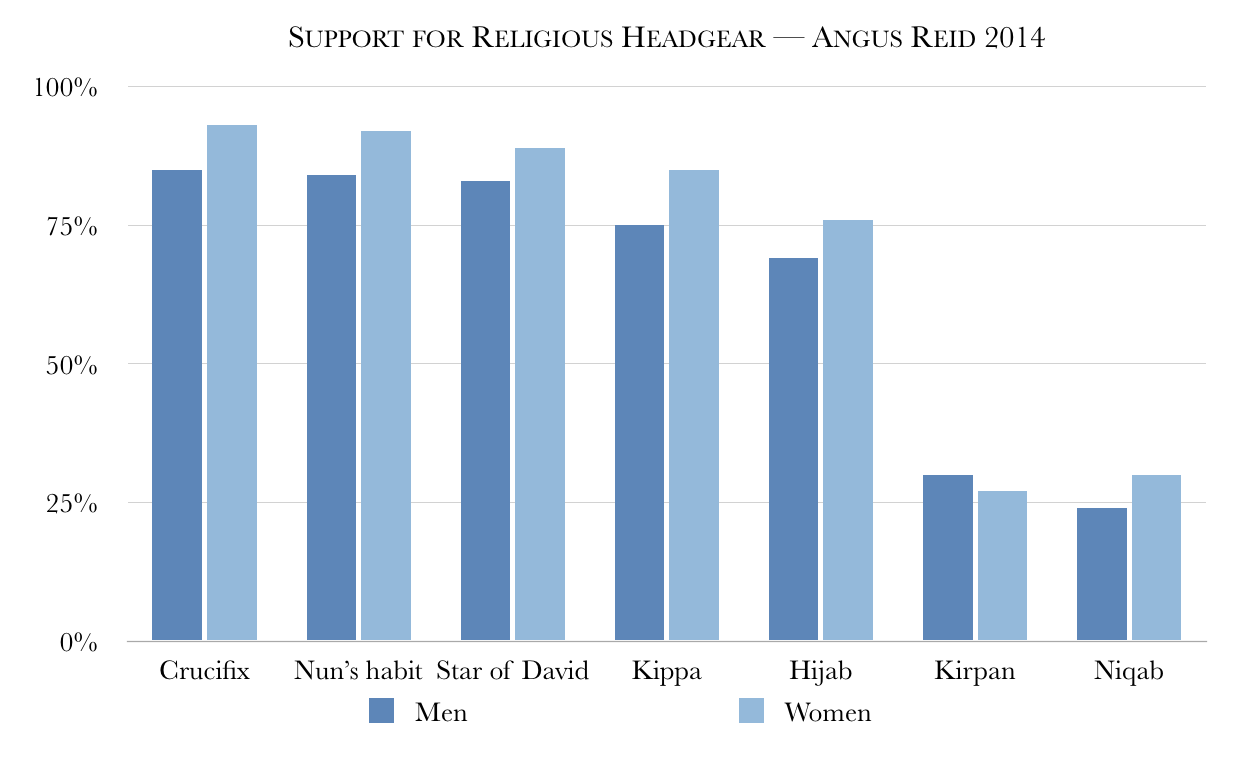
But rather, that becoming a citizen means becoming part of the Canadian society and community, and the niqab is essentially a symbol of rejection of broader participation in the community.

Accommodation requires flexibility on both parties and Ishaq was given the opportunity to be seated in a less visible location:

Government lawyer Negar Hashemi said the case is about finding the “right balance” between respecting differences and maintaining Canadian core democratic values.

The niqab ban, she said, is part of a larger scheme to ensure everyone vows loyalty to Canada. Other non-veil-wearing candidates caught not doing so, such as elderly people with language difficulties, can also have their citizenship certificates withheld.

“There is no hidden agenda in this case,” she said.

Hashemi said Ishaq did not seek accommodation prior to her scheduled citizenship ceremony and declined the offer to take her oath at the front or the back of the citizenship court after the legal action was initiated.

She noted that the applicant unveiled herself to have her driver’s licence photo taken, and the brief unveiling at a citizenship ceremony would be no different.

“She had a choice of becoming a citizen or adhering to her religion,” said Hashemi. “Becoming a citizen is a privilege, not a right.”

Lorne Waldman, a co-counsel for Ishaq, said the Citizenship Act does not stipulate that a candidate must be seen or heard taking the oath — something witnesses for the immigration department agreed is hard to enforce and ensure.

“This policy was dictated by the immigration minister Kenney that there had to be a change, and there’s no willingness to provide any accommodation,” said Waldman, adding that officials confirmed there are fewer than 100 cases a year across Canada where someone wears a niqab to the ceremony.

Ex-immigration minister Jason Kenney ‘dictated’ niqab ban at citizenship ceremony, court told | Toronto Star.

Citizenship Week Celebrated with New Canadian – First Fast-Track from Armed Forces

The first fast-tracked applicant for an applicant in the Canadian Armed Forces:

The new measures improve the Citizenship Act in four ways, according to [Kelowna Lake Country MP Ron] Cannan.

“Firstly to reinforce the value of citizenship, secondly to strengthen the integrity of the system and counter fraudulent attempts to gain citizenship,” explains Cannan. “Third is to improve the process by which new comers become Canadian citizens and help applicants get their citizenship sooner and lastly, we honour those who helped serve our country and the Canadian Armed Forces and fast track their citizenship.”

On September 12th, 2014 McGinty became the first person in Kelowna to become a Canadian citizen under the new measures. McGinty, originally from the United Kingdom, said the decision to bring his family to Canada was an easy one.

“Much of the reason I brought my family to Canada is because of Canada’s global reputation as a nation that not just recognizes but perpetuates those values of citizenship,” said McGinty. “Not only at home but overseas, I am extremely grateful to the government and people of Canada for having offered this fast track of citizenship for those of us who were not citizens but nevertheless served with the Canadian Armed Forces and have been recognized for having stood on guard for Canada.”

Citizenship Week Celebrated with New Canadian.

Former Governor-General Clarkson says Canada has redefined citizenship

Globe immigration/citizenship reporter Joe Friesen’s interview with Adrienne Clarkson on citizenship:

You say citizenship is an act of imagination. What does that mean?

It means we imagine ourselves as part of a democratic structure, as equal, as able to get on with our lives without having to worry about our rights. We behave “As if” people who come here will be able to take their place in society and by doing that they are able to do so. [Northrop] Frye said that our imagination gives us our vision of what our society is and what it could be. Rather than having a grid imposed on us, we have become part of each other’s wishes, part of each other’s dreams and in the process we’re creating a new kind of society.

Situates citizenship (and multiculturalism) within that context, unlike many critics who forget, intentionally or not, that the Canadian approach, while allowing considerable flexibility and accommodation, happens within that context.

Former Governor-General Clarkson says Canada has redefined citizenship – The Globe and Mail.

Bank of Canada still not committed to women on currency, petition says

A bit disingenuous for the Bank of Canada to cite public opinion research when the Government generally does not release such information, or when it does (i.e., CIC annual tracking survey) releases it in a pdf format from which one cannot extract and analyze the data tables:

The disappearance of women figures prompted scattered protests, including from Calgary city council. But Forsters campaign kicked into high gear last year after she was inspired by a British lobbying effort that was successful in getting an image of Jane Austen included on the next 10-pound notes, set for release after 2016 in the United Kingdom.

Ironically, the commitment to include the Austen image came from Mark Carney, the new Bank of England governor who years earlier in Canada had overseen the removal of images of women on Canada’s redesigned currency.

Forster began an online petition that now includes about 44,000 names, including author Margaret Atwood and actor Kim Cattrall. Some 12,000 signatures were added in the last few days, after the banks announcement.

Forster has already been rebuffed once before, after writing repeatedly to the central bank. Last year, Poloz wrote to her saying it would be premature for the Bank of Canada to commit to including images of women on any new currency issues.

“It’s clearly discrimination against women,” Forster said in an interview. “It perpetuates the myth that women are not nation builders.”

The Bank of Canada, on the other hand, says it wants to wait for the consultation process before making any commitment. The bank says previous public opinion research showed Canadians want to celebrate collective achievements, rather than individuals, and so the current series features themes such as medical advances rather than historic figures.

“These notes depict Canada’s exploits and accomplishments, endeavours in which Canadian women and men have contributed,” said spokesman Alexandre Deslongchamps.

Deslongchamps added that the current banknotes, introduced between 2011 and 2013, are expected to last for at least eight years before needing replacement so there is no immediate requirement for new designs.

Forster said she plans to continue her campaign, noting the British campaign included a threat of legal action. A court challenge in Canada might draw on Section 15 of the Charter of Rights and Freedoms, which forbids sex discrimination, she said.

She also noted that Australia, to whom the Bank of Canada looked for advice on its new plastic bills, features historic women on most denominations.

Bank of Canada still not committed to women on currency, petition says – Politics – CBC News.

B.C.: Funding Dries up for Successful Citizenship Exam Program

While I don’t know the details for this particular decision, we do know from CIC data that some groups have poorer success rates than others, largely related to education levels and language, correlated in many cases with ethnic origin.

This type of training was a means to help such groups become citizens without diluting the integrity of language and knowledge testing:

This year’s Citizenship Week marks a sad occasion for the staff at the Victoria Immigration and Refugee Centre. That’s when the centre will end its highly successful citizenship training course, a government program to help permanent residents pass Canada’s citizenship exam.

Citizenship and Immigration Canada began funding the two-year pilot program at several agencies in January 2013. But VIRC’s funding dried up in July this year, so the centre invested $100,000 of its own money to cover the costs and keep the program going.

However, VIRC’s executive director David Lau says that can no longer continue and the program will end on Oct. 17, a date that falls during Citizenship Week.

“It’s heartbreaking,” says Lau, noting that the staff and volunteers put a lot of effort into the program. “We had to shut down the program before the end of our contract,” he adds. “We’ve been trying to reach Citizenship and Immigration Canada for months, but they’re not returning our calls.”

VIRC offered its Citizenship 101 course once a week for 10 weeks. The program ran five times and graduated 140 permanent residents. “We had really good dialogue [with CIC]. We sent in regular reports on the program and it met or exceeded all our milestones,” Lau says. “We had a 100 percent success rate.

”Word about the pilot’s success spread and Lau and his team began training people to teach the course for use in other agencies. Twelve non-profits were involved—ten in B.C. and the other two in Winnipeg and New Brunswick.

Funding Dries up for Successful Citizenship Exam Program – The Epoch Times.

FATCA Paris Meeting: Lee and Bopp: A Chance to Turn the Tide

Victoria Ferauge’s reporting on a FATCA meeting with American expatriates in Paris this week:

Bright and early Monday morning, Senator Mike Lee and superlawyer James Bopp, Jr. addressed a full house of frustrated and forlorn US citizens over at Reid Hall in Paris.  Some came in suits, some in jeans. There was a very young woman with blue streaks in her hair and men whose touches of gray were a testimonial to a lot of living.  There were lawyers, stay at home mothers, IT workers and artists.  A diverse group that was far more representative of the true face of Americans abroad than the usual caricatures of champagne-sipping yacht-owners living it up in Gay Paree.  It was coffee and croissants and a frank discussion that at times was fraught with emotion.

Senator Lee spoke first and he began with some anecdotes from the time when he was first elected to the Senate.  He’s a young man with a quiet and modest demeanour.  He recounted how in the very beginning he had moments where because of his youth and appearance he was taken for something other than a member of that august body, the US Senate, and how he finally had to quietly but firmly assert himself as the elected-by-the-people junior Senator from Utah.  He invited us to laugh with him and we did. But the funny stories took a very serious turn when he shared the lesson he drew from that experience: “We must assert what is rightfully ours,” he said, “if it is to have any meaning.”

US citizens wherever they live, he said, have constitutional rights that cannot be taken away by anyone.

The Franco-American Flophouse: Lee and Bopp: A Chance to Turn the Tide.

Should the Canadian government revoke the citizenship of dual-nationals who fight for ISIS?

Good CBC Radio interview with Raj Sharma, an immigration lawyer, who was scheduled to testify during the parliamentary hearings on Bill C-24 revisions to the Citizenship Act and revocation.

One of the better plain language explanations of the shortcomings of the Government’s approach:

Should the Canadian government revoke the citizenship of dual-nationals who fight for ISIS? – The 180 – CBC Player. (about 6 minutes)

Winnipeg man could be test case for Canada’s latest tool in fight against terrorism: revoking citizenship

A likely test case given Hiva Mohammad Alizadeh, a dual Iranian-Canadian national, pleaded guilty in Canadian courts (Hiva Alizadeh — arrested in Project Samosa — pleads guilty to terror plot):

Both the NDP and Liberals oppose the legislation, known as C-24. In a June 25 letter to Prime Minister Stephen Harper, NDP leader Thomas Mulcair wrote that the case of Mohamed Fahmy, a Canadian-Egyptian Al Jazeera journalist imprisoned in Egypt, illustrated the dangers of the law’s reliance on the decisions of foreign courts.

John McCallum, the Liberal immigration critic, said he was also concerned that the judgments of foreign courts could influence Canada’s decision to revoke citizenship, arguing the term terrorism was used “extremely loosely” against government opponents in countries like Sri Lanka.

The safeguards built into the law are also weak, he said, and it creates two classes of Canadians — those who hold dual nationality and those who don’t. “We think a Canadian is a Canadian and we should not have two classes of Canadians, some of whom could be deported and have their citizenship taken away.”

Neither was he convinced that deporting terrorists was a sound national security strategy. “If you’re serious about stopping them from killing people, you want to put them in jail, you don’t want to deport them to a place where they could go on killing.”

In a recent interview, Chris Alexander, the Minister of Citizenship and Immigration, said the law “sends a very clear message already to those who have grown up here or immigrated here who think it’s just natural that they should be able to go as Canadian citizens with their Canadian passport off to a theatre of war like Syria and join a barbaric group like Daesh,” another name for ISIS.

“No one, however misguided, can be in any doubt now about whether that kind of move should be taken lightly. It shouldn’t be. It’s a serious crime,” he said. “Where there is a conviction and it’s a dual national, you will lose your citizenship.”

He would not comment on which or how many cases were under consideration, saying it was “early days” and procedures were still being put into place. “I hope there’s early action under this provision, but I can’t give you firm timelines,” he said.

But during a meeting Tuesday with U.S. Homeland Security Secretary Jeh Johnson, Public Safety Minister Stephen Blaney “highlighted the Government of Canada’s determination to revoke citizenship from dual nationals found guilty of terrorism,” according to the Prime Minister’s Office.

Winnipeg man could be test case for Canada’s latest tool in fight against terrorism: revoking citizenship  

Mo3 and the risky idealism of youth: Salutin | Toronto Star

Rick Salutin on the one-sided language and focus on revocation and similar measures, rather than helping families and communities on prevention:

But ensuring decent options isn’t a task that parents can take on alone. It’s for all of society, especially its leaders. And believe me, pious denunciations of evil at the UN, by leaders with their own hideous, ongoing records to be ashamed of, won’t cut it with the young. I have that on vivid recall.

This week an Alberta leader of Somali Canadians asked the Harper government to expand outreach programs for youth. Their only response was a promise to protect “law-abiding Canadian families” by stripping citizenship under their new law for “dual-nationals who engage in terrorism.”

Well, these are law-abiding Canadian families whose kids are at risk and any criminal acts, including treason, can be dealt with already. All revoking citizenship does is dehumanize its targets, since citizenship is a human right. Do we really want Stephen Harper or Chris Alexander to decide who counts as human and who to exclude as monsters? This is sheer incitement of more anger and alienation. I’m against revoking anyone’s citizenship but if you were going to do it for encouraging radical, violent behaviour, you’d start with these official, elected provocateurs.

Mo3 and the risky idealism of youth: Salutin | Toronto Star.

Adrienne Clarkson on the anguish of not belonging

Adrienne Clarkson on citizenship in her Massey Lectures this fall. Worth reading and reflecting upon:

It was in attending public school that I truly felt a sense of place in this country. Still today I believe that a public education is the single most valuable institution that our society provides to help people belong. If we are going to continue to accommodate newcomers into society, we must continue to have well-funded public education—education paid for by the state, free for all citizens. This has been key to our success ever since our humble beginnings. Without public education, we cannot have a cohesive society, a society with shared values. Without public education, we cannot continue to fulfill the public good—that is, the internationalization and the continuation of our key notions and values from one generation to the next. We can do all of this only in a democratic structure, where all children are treated as equal, regardless of income. That is how people really learn to belong. That is what public education does. We want people who will take their place in our society, but that means we must make sure there are no barriers to inclusion for people who come here.

So belonging is essential to us in Canada. We select our immigrants with the idea that they will become citizens. Immigrants are future citizens, and we recognize them as citizens in the making. As Aristotle said in Physics, “With respect to what is eternal, there is no difference between being possible and being.” New citizens take on the same responsibilities as existing citizens: obeying laws, paying taxes, voting. And once a new citizen is adopted into the family of fellow citizens, he must accept the good with the bad, both past and present, in order to contribute to and help shape the future. Canada is the land of our ancestors, as it says in our national anthem, and we are each and every one of us adopted by those ancestors. Newcomers are not invited to this country to spend a few years working, only to depart like migrants. Migrant is a very ugly word, and it should have no place in the Canadian vocabulary. Immigrant is the Canadian word. And citizenship is central to our immigration policy.

I truly believe that you can find a place to belong, as long as there is a negligible amount of force against you. I was lucky to come to this country, where we operate in an atmosphere of benevolent neglect: We are left alone to get on with our lives. This is where perseverance and generosity come in. Canadians are generous, even when they don’t know it. To me, this flexibility is the generosity that leads to gross national happiness, because it allows people to persevere through hard times and come out on the other side.

Refreshing recognition and advocacy of the efficacy and value of the more flexible, accommodative approach than the desire for more narrow and prescriptive Cartesian clarity.

Adrienne Clarkson on the anguish of not belonging.