As Popularity Of Citizenship-By-Investment Grows, Tighter Vetting By Some Countries Should Be Recognized | The Daily Caller

More on citizenship-by-investment programs, by Lanny Davis, who consults with countries to ensure appropriate due diligence in reviewing applications. Ironic that he also cites Dominica as a good example the same day that this other story came out where the process failed (Dominica says ‘due diligence followed’ before granting citizenship to arrested Iranian national):

Recent U.S. media reports, however, have focused on these “bad apples” or atypical anecdotal stories of abuses.  These reports fail to report the examples of nations who have raised, not lowered, their standards of vetting and oversight, so that Americans can gain the advantage of a passport that doesn’t put a potential “death” target on their backs when they seek to travel on business or for family vacation reasons.

For example, take the government of St. Kitts and Nevis (SKN), twin islands in the Caribbean 1,200 miles southeast of Miami. In the SKN citizenship-by-investment program’s infancy, a handful of wrongdoers obtained St. Kitts and Nevis passports. Rather than ignore their shortcomings to remain competitive in the contest of attracting potential investors, government leaders acknowledged the deficiencies and overhauled their program. I should know—I was hired to conduct an independent review of the country’s revamped program.

On December 4, 2015, I was retained by Prime Minister, the Honorable Timothy Harris, Head of the Government of the Federation of Saint Kitts and Nevis. We were asked to conduct an independent review of the increased efforts of the St. Kits and Nevis Government to enhance and strengthen its vetting and background checking procedures under its CBI.

With a staff that has nearly doubled in size, led by Mr. Les Kahn, an internationally respected former consultant to IPSA International, the unit has added many additional layers of vetting. Each layer requires a written report to explain why a specific recommendation was made, and that report stays in the file as it moves upstream. In addition to conducting internal investigations, unit officials collaborate at length with international partners (including the U.S. government) through established law enforcement channels. Under Mr. Khan’s leadership, the Unit has willingly revoked previously issued problematic passports. St. Kitts and Nevis now operates one of the most stringent CBIs in the world. In addition to conducting internal investigations, Unit officials collaborate at length with international partners (including the U.S. government) before deciding to issue the passport.

Another example is the nation of Dominica, another beautiful island nation in the Caribbean, Prime Minister, Dr. the Honorable Roosevelt Skerrit, with whom I have met twice and who is a most impressive leader of his small island, has been steadfast in his commitment to a rigorous vetting process that involves criminal, character and ethics checks by international law enforcement agencies for all citizenship applicants. For PM Skerrit, having a legitimate and transparent CBI is about more than reputation—it has massive implications for his small nation’s economy. In 2016, the CBI accounted for 39.2% of the country’s total revenue. These resources are critical to rebuild the country and its economy in the wake of tropical storm Erika.

No matter a country’s size and stature, in an age of terrorism and increased need in the global economy for Americans to travel without fear, the citizenship-by-investment programs of small democracies that need such investments ought to be available with appropriate high-level vetting standards.   International media should take the time to investigate and differentiate between those nations who are” selling” passports without regard to the “bad actors” buying them vs. those governments who have put a high level of regulation and oversight into place and continue to raise their standards before issuing passports, knowing they will depress revenues from such bad actors.

Source: As Popularity Of Citizenship-By-Investment Grows, Tighter Vetting By Some Countries Should Be Recognized | The Daily Caller

C-6: My brief to the Senate on the declining naturalization rate

For those interested, my full brief to the Senate’s Social Affairs, Science and Technology (SOCI) that will be reviewing Bill C-6 changes to the Citizenship Act can be found here: C-6 Senate Hearings: Expected Impact on the Naturalization Rate.

The summary is below:

  • Bill C-6 appropriately maintains and strengthens the existing integrity and business process measures introduced in the 2014 major rewrite of the Citizenship Act (C-24).
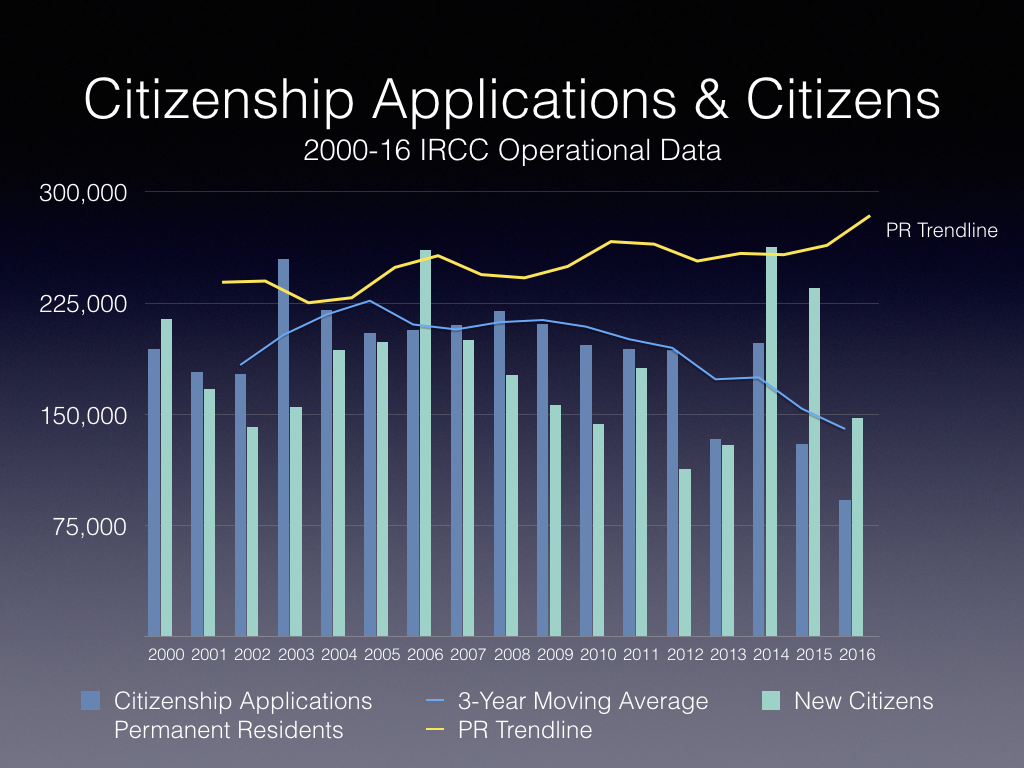
  • Beyond the specific changes proposed in Bill C-6, there is a broader issue of fewer immigrants applying for citizenship, primarily a result of the steep increase in the processing fee (from $100 to $530 in 2014-15).
  • Five non-legislative recommendations are proposed to ensure that all immigrants have a more equitable opportunity to become citizens. One legislative recommendation is proposed to ensure a clear and transparent process for future citizenship fee changes:
  • Non-Legistlative
  1. Reduce the current citizenship processing fee of $530 to $300, abolish the right of citizenship fee of $100, with consideration for a partial waiver for refugees and low income immigrants;
  2. Review the impact of the additional cost of language competency pre-assessment (about $200) and develop lower-cost alternatives;
  3. Ensure that any revisions to the citizenship study guide, Discover Canada, and related materials are written in plain language as close to the level required (CLB-4), and preferably focus-group tested;
  4. Consider dedicated citizenship preparation classes targeted towards those groups that appear to be having difficulty passing the test; and,
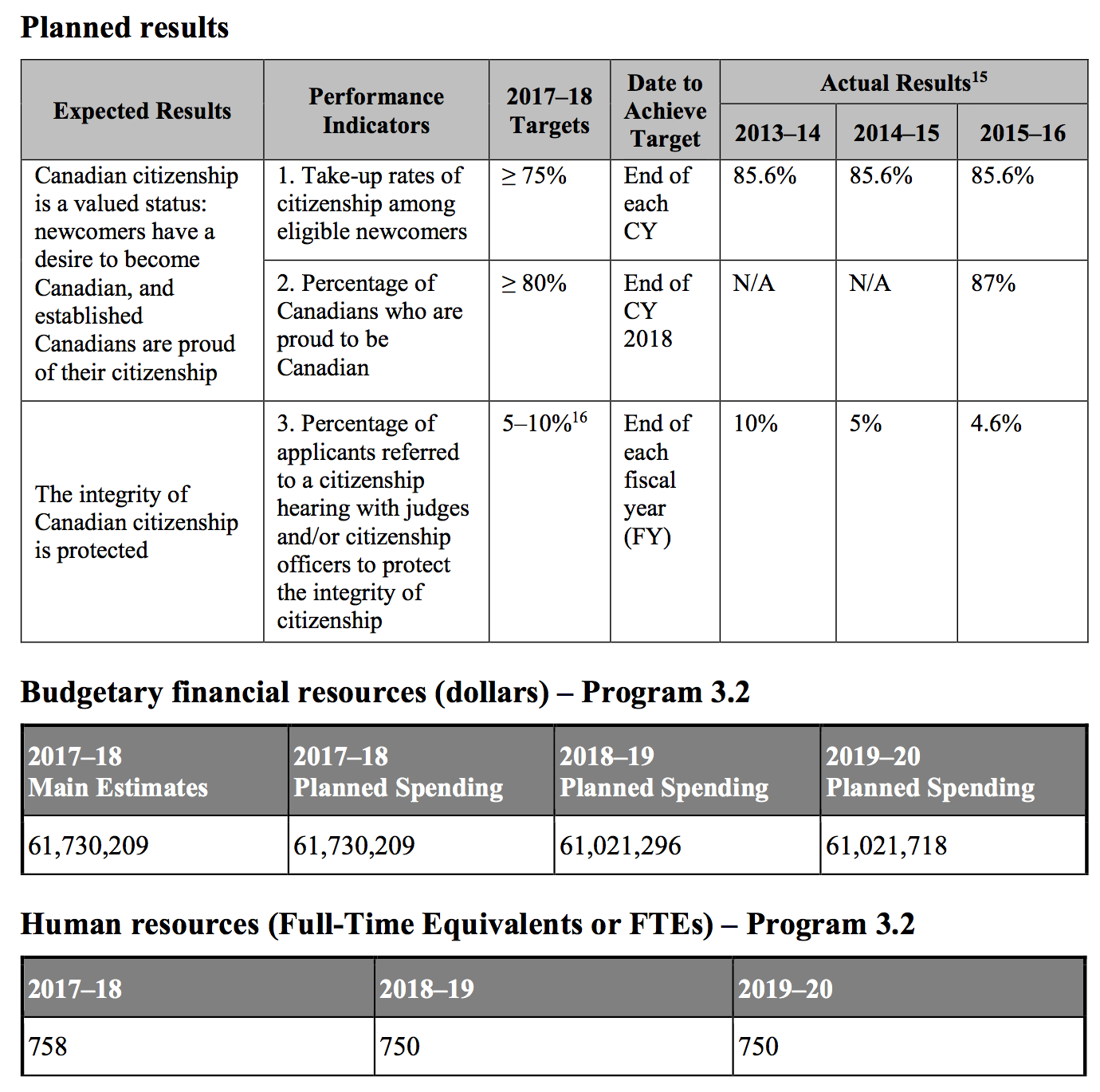
  5. Set a meaningful naturalization benchmark rate that 75 percent of immigrants will take up citizenship within a six- to eight-year period.
  • Legislative
  1. Repeal the exemption to the User Fees Act with respect to the setting of citizenship fees to ensure full public review and consultation for future changes.

Ahmed Hussen, my kind of Muslim | Tarek Fatah

Interesting to see the various sources of praise for the new Minister for Immigration, Refugees and Citizenship on both sides of the political spectrum (Candace Malcolm, former Conservative communications assistant and Sun columnist tweeted her support and subsequently wrote a column Ahmed Hussen has shown courage and conviction).

Will be interesting to see how long this lasts as he makes policy decisions or implements existing one’s (i.e., C-6 repealing of the revocation and other provisions  of the previous government’s C-24):

On Jan. 10, Prime Minister Justin Trudeau made a decision that made ripples throughout the world.

From Singapore to India, to the BBC and beyond, the only news from Canada that made headlines was about Ahmed Hussen, a Somali-born refugee who arrived on our shores in 1993 and rose to become our Minister of Immigration, Refugees and Citizenship.

For spotting talent and lifting a backbencher into the Privy Council, I tip my hat to Trudeau.

For hundreds of thousands of African-Canadian boys and girls, Ahmed Hussen’s story is a beacon of hope.

(Readers should know Hussen is a close friend, though we disagree on much.)

He first came to my attention at the height of Ontario’s historic (and successful) fight rejecting the use of Sharia law in family law arbitration matters in 2004-2005.

On one side was the mosque establishment and many Islamic clerics who had set up quasi courts and appointed “Qazis” to invoke Islamic Sharia in settling family disputes.

Opposing them was a much smaller group of secular and liberal Muslims – including yours truly – for whom this was a do-or-die moment.

We knew how the UK had let this happen many years before, only to discover, too late, the Muslim community of Britain being held hostage by Islamic clerics.

At the time, Hussen was a Liberal staffer with ties to then Ontario cabinet minister George Smitherman.

Along with another Muslim staffer, Hussen helped us connect with Smitherman, where we made our case to ban Sharia courts in Ontario.

While Hussen supported our goals, he never crossed the line to help us more than what was appropriate, transparent and above board.

That same year, the Toronto Star listed Hussen as a “Person to Watch”.

People were already noticing the lanky lad from Regent Park, but I am not sure Hussen knew that at the time.

When asked by the Star if he had political ambitions, the future immigration minister said, “I don’t think I could handle the life of a politician . . . I don’t want to be front and centre.”

A community organizer in Regent Park, when the Toronto District School Board (TDSB) tried to pigeonhole Canadian-born kids of Somali ancestry as “Somali kids” in 2014, Hussen led the fight against this paternalistic orientalism, denouncing attempts by the board to segregate in the name of integration.

He told the TDSB: “Do you need to stigmatize and marginalize people to help them? … In the name of ‘help’ you can actually do a lot of damage if you don’t do it the right way.”

Canadians concerned about the global and Canadian rise of Islamism and jihad should be reassured they have an ally in Hussen.

Here is what he told the U.S. Committee on Homeland Security hearings in Washington in July 2007, in criticizing the idea of treating terrorism only as a criminal offence:

“The strategy of Canadian officials as they confront this phenomenon in my community has been to view this serious matter only through the prism of law enforcement … There has not been a parallel attempt to counter the toxic, anti-Western narrative that creates a culture of victimhood in the minds of members of our community.”

Hussen is already showing his mettle. On Monday, he told CBC News he was committed to bringing non-Muslim Yazidi refugees, victims of ISIS, to Canada, a group that has been largely excluded so far.

Source: Ahmed Hussen, my kind of Muslim | Fatah | Columnists | Opinion | Toronto Sun

Turkey begins process to give citizenship to eligible Syrian refugees | TRT World

Skills-based naturalization policy:

Turkey has begun the process of giving citizenship to some of the 3 million Syrian refugees living on its soil.

European countries are attracting Syrians with expertise and those with skills and capital.

It’s all part of a move announced by Turkish President Recep Tayyip Erdogan to give some of Turkey’s 3 million Syrian refugees citizenship.

Those who choose to be naturalised have to offer a skill set that’s valuable to Turkey.

Syrians in Turkey work in all kinds of fields.

And some of the most successful ones are able to employ others, both Syrians and Turks, in different workplaces.

The idea is for these successful people to be given the opportunity to apply for Turkish citizenship, at least in the first phase.

If the first phase is successful, more skilled Syrians may be invited to apply.

Those who have refugee status and are not eligible for citizeship, will retain their current status.

Source: Turkey begins process to give citizenship to eligible Syrian refugees | TRT World

Turkey a late entry in lucrative economic citizenship bandwagon – Daily Sabah

citizenship-investmentOne of the latest countries to embrace the trend, without the pretence that this will help the economy beyond real estate:

The increasing phenomenon of citizenship-by-investment – economic citizenship – has come to occupy the Turkish agenda with Thursday’s amendment of a citizenship law that offers citizenship to foreigners via four types of investment choices, including a real-estate investment of $1 million. In particular, the real-estate option is expected to boost Turkey’s real estate market and increase the ratio of real estate purchased by foreign investors.

Granting citizenship to foreigners in return for a determined amount of investment is a global phenomenon applied in many developed and developing countries, such as the U.S., Canada, the U.K., France, Australia, Dominica and Bulgaria. The growing phenomenon of “buying citizenship” is defined as “economic citizenship” by the International Monetary Fund (IMF).

Economic citizenship is offered by a number of small states and advanced economies, some of which, such as Canada, the U.K. and U.S., have had immigrant investor programs since the late 1980s or early 1990s, offering a route to citizenship in exchange for specific investment conditions with significant residency requirements. The rapid growth of private wealth, especially in emerging market economies, has increased the interest of wealthy people in greater global mobility and fewer travel obstacles posed by visa restrictions.

Source: Turkey a late entry in lucrative economic citizenship bandwagon – Daily Sabah

We can’t let Canada’s politicians divide us with populist labels: Goldy Hyder

While I agree with Hyder on the risk of playing to divisions, ignoring class and other differences also entails risk of denial and addressing issues.

Generally those who decry ‘class warfare’ do so from a position of privilege. What is needed, hard to do so in politics, is more nuanced debate about difference, barriers, and ways to overcome them:

Prime Minister Justin Trudeau’s decision to cancel his plans to attend the World Economic Forum in Davos so he can undertake a cross-country tour and engage directly with Canadians is a symptom of a much larger and more troubling trend where it has become increasingly fashionable for political leaders to frame public-policy decisions in terms of their potential impact on “ordinary,” “real” or “average” Canadians.

These terms, which are now at the heart of debates about everything from health-care funding to the benefits of globalization, have come to be used almost interchangeably with the equally popular “middle class.” To the extent that many Canadians consider themselves, rightly or wrongly, to be part of the middle class, these labels are intended to convey a sense of inclusiveness.

Yet the opposite is true. As we have seen in the United States and Britain, when these types of generic terms are used to describe large groups, they are generally defined on the basis of who they exclude: the so-called elites.

These terms are, in fact, inherently divisive. Just as few of us would self-identify as being “abnormal,” our characteristic Canadian modesty prevents us from thinking we are particularly exceptional. If we are not among those frequently maligned “elites,” we must therefore, be part of some “middle-class” majority. (Even the math holds up, as we’re told “elites” are only the top 1 per cent.)

The problem with vague terms like these is that they invite people to fill in the blanks with their own biases about who fits into each group – and we’ve seen the consequences that has had in other countries. Canadians should not be urged to divide themselves on the basis of income, education, ethnicity, religion or region. To do so would be to unravel our rich multicultural tapestry by pulling on loose threads.

We don’t want Canadians to be inherently distrustful of experts, to presume that a person is less ethical because they have a higher or lower net worth, or to believe that those with global outlooks aren’t patriotic. Any proliferation of populist labels risks creating an “us versus them” conflict within the country, something that can be exploited by those looking for an easy way to galvanize and mobilize a political base.

Some may suggest I am being alarmist, but I have spent the better part of my career in the field of communications, and in my professional experience our choice of language matters a great deal. It has also been my personal experience. As an immigrant and a Muslim, I have witnessed firsthand how quickly the word “different” becomes “foreign,” and how easily “foreign” can become “un-Canadian.”

At a certain point, assigning some meaning to arbitrary or artificial terms inevitably becomes a question of defining values. That is where things get complicated and where the real fissures can emerge. Canada’s 150-year story has many chapters in which divisions between people defined the politics of an era. Some of our worst mistakes have been made by governments in attempts to satisfy one group over another.

Without question, governments must consider the very different realities in which Canadians live when they develop policy res-ponses to pressing issues – but that is about technical implementation. What governments must avoid doing is using the levers of policy to divide Canadians on the basis of their different circumstances, as opposed to building a broad consensus based on shared values and interests.

Moreover, governments must avoid making decisions – such as whether to attend a global conference with the world’s most powerful economic stakeholders – based solely on the perceived optics of those decisions.

In these uncertain times, we cannot afford to make mistakes or miss opportunities. We need to seize every advantage we have, and that means ignoring those who call for us to marginalize or vilify others. Instead of targeting a particular class of Canadian – whether upper, lower or middle – let’s avoid entirely the temptation to engage in any type of class distinctions or, worse still, to inflame class warfare.

When the Fathers of Confederation created our country 150 years ago, they sought to unite us in common cause. Let us invoke that same spirit in this anniversary year by uniting Canadians, not dividing them.

Source: We can’t let Canada’s politicians divide us with populist labels – The Globe and Mail

Countries that forget history become easy prey for demagogues – The Globe and Mail

I agree with Paris’s assertion of the need for greater emphasis on critical thinking skills, incorporated into school curriculums, and it is alarming that Ontario is considering ending its mandatory grade 10 civics course (Civics classes may disappear in Ontario. That’s a mistake. – Maclean’s) – Correction Ontario’s education minister subsequently announced no plans to do so.

However, I am not sure that the Global Centre for Pluralism and the Institute for Canadian Citizenship have the needed reach to make much of a difference.

The liberal triumphalism of the 1990s after the fall of the Soviet Union may partly account for our inattention, but there may be a more pertinent cause. Few in the world today were reasoning adults when the Second World War ended in 1945. We matured in the postwar era, as the international community created a multitude of protective institutions such as the United Nations. Hope underscored the trials of war criminals in Nuremberg and Tokyo, the birth of the International Criminal Court and the creation of the European Union.

The postwar liberal order was a rational global response to the events of the early 20th century. And if we assumed the 70-year status quo would endure, it is because we collectively forgot that irrationality is a core human attribute. In addition, few among us were trained to recognize warning signs. In Canada, the study of contemporary world history has not been mandatory on most high school curricula, a lacuna that has lessened our aptitude for awareness.

Which brings me back to Tom Lehrer and his pithy advice. Be prepared.

Economic well-being is a central indicator of social peace, and since Canada’s economy is dep-endent on trade with the United States, the government of Justin Trudeau has wisely attempted to position itself with the incoming administration in positive ways. The Prime Minister also shuffled his cabinet for similar reasons.

But there are other ways to be vigilant. It is worrisome that Conservative Party leadership hopeful Kellie Leitch opportunistically admires Mr. Trump and thinks his “exciting message” needs to be delivered in Canada. Stephen Harper thankfully failed to ins-pire voters with his anti-Muslim provocations, but the Conservatives haven’t yet chosen their new leader, and those tea leaves, with their capacity to threaten our core acceptance of multiculturalism – the driver of Canadian social peace – remain unread.

As for long-term preparations, I hope ministries of education across Canada will create mandatory courses in critical thinking and human rights studies at the secondary level, possibly assembling elements of current social studies and history programs with a new focus. Such courses should have both historical and contemporary content. Young Canadians need to understand how, and why, pluralist societies have failed in the past in order to be vigilant about preserving their own. As “fake news” threatens the media, young people will need the tools of critical thinking in order to differentiate sources of credible information from propaganda.

Organizations such as the Global Centre for Pluralism, based in Ottawa, might consider making public preparedness for what lies ahead a priority. So might the Institute for Canadian Citizenship, an entity dedicated to the basic principles of belonging and diversity.

Without these defences, we will become easy prey for demagogues. An unpredictable historical juncture is upon us, and we must pay attention.

Source: Countries that forget history become easy prey for demagogues – The Globe and Mail

Supreme Court to rule in immigrant’s revoked US citizenship – The Washington Post

Will be interesting to watch in the context of a Trump presidency. Similar issue as with respect to Minister Monsef’s country of  birth controversy: was it material to her family being accepted as refugees and later as citizens?:

The Supreme Court says it will hear an appeal from an immigrant who was stripped of U.S. citizenship for lying about the circumstances that brought her to this country.

The justices said Friday they will review lower court decisions that upheld a criminal conviction against Divna Maslenjak of Ohio. The conviction automatically revoked her citizenship.

The issue for the justices is how important her false statements were to her application to become an American citizen. Lower courts have disagreed about the standard.

Maslenjak is an ethnic Serb from Bosnia. She and her family were granted refugee status in 1999 and settled near Akron in 2000. She became a citizen in 2007.

She initially told immigration officials her husband had not served in the Bosnian Serb military.

Swiss Locals Deny Citizenship to ‘Annoying’ Vegan

Couldn’t resist sharing this – another example of identity issues (and having lived in Switzerland, cowbells are part of their identity if not a reason to reject an application for citizenship):

A community in Switzerland recently turned down a vegan’s request for Swiss citizenship because she “annoys” local residents and does not respect their traditions.

Nancy Holten, 42, applied for citizenship in Switzerland and faced no formal objections from municipal and cantonal authorities, but a local committee of residents, from the community of Gipf-Oberfrick in the canton of Aargau, has twice denied her application, according to the Local, a Swiss English-language news site.

In Switzerland, local communities often have a larger say in citizenship applications than the federal government.

Holten moved from her native Netherlands to Switzerland when she was eight years old and has children who hold Swiss citizenship. She is an outspoken vegan who regularly campaigns against cowbells, the noise from church bells, piglet racing, and other Swiss traditions, drawing the ire of locals.

Holten regularly does interviews with the press about her activism and views.

Much of the annoyance with Holten is not that she speaks her mind, but that she does so in such a public manner and draws negative attention to the local community.

One of Holten’s biggest targets are cowbells. She complains that the weight of the bell and the strap holding it hurts cows’ necks.

Source: Swiss Locals Deny Citizenship to ‘Annoying’ Vegan

St Lucia opposition describes new citizenship rules as ‘desecration’ | Caribbean News Now

Inevitable, that a program designed to encourage investment through citizenship, should lead to minimal conditions or requirements?

The Saint Lucia parliament later approved the legislation establishing the CIP with every member expressing support for the programme, including all opposition members.

In establishing the CIP, the SLP was very clear on its objectives, Pierre said:

1. It was a tool aimed primarily at attracting foreign direct investment in high end hotel and real estate products and employment generating business enterprises

2. Accountability and transparency was not an option. An annual report would have to be submitted to Parliament indicating the individuals who were granted Saint Lucian citizenship, how much income was collected and how was that revenue utilised

3. That Saint Lucia’s programme would not be positioned just as selling passports. “We were introducing global citizenship as a lifestyle and creating incentives to make the island a choice destination for investment. In this regard, we placed Saint Lucia on the higher end of the scale of options. We did not see Saint Lucia as being offered as the cheapest option,” Pierre noted.

4. That the due diligence process would be very robust and was expanded the due diligence process to include legally enforceable assessments.

5. That Saint Lucia would be offered as an option for selected high worth individuals with a propensity to invest, therefore the number of applications was limited to 500 annually, and required a minimum net worth of US$3 million.

However, apparently abandoning its initial up-market approach to its citizenship programme, namely, Prime Minister Allen Chastanet, last month issued an amendment to the citizenship by investment regulations, removing the cap on annual applications, reducing the amount of qualifying contributions and dispensing with the requirement of financial resources of a minimum of US$3 million.

“The announcement that the UWP administration has changed the regulations effective January 1, 2017, has effectively damaged the reputation and image of the CIP. The intention of the UWP government is to turn the CIP into a cash cow with little regard for the consequences to Saint Lucia or the programme. The unrealistic election promises must now be funded by whatever means necessary,” Pierre said.

The SLP said it is opposed to the changes being made and will seek a debate in the Parliament to ensure that the changes and their possible consequences are fully explained to the people of Saint Lucia.

Source: St Lucia opposition describes new citizenship rules as ‘desecration’ | Caribbean News Now