Commentary: Competition for benefits of second citizenship is global | Caribbean News Now

Rationalization of Caribbean citizenship investment programs by pointing to comparable programs among developed countries. These programs will always be at risk for abuse and minimal benefits:

The point is: there is a demand in the global market for second citizenships. It is a demand worth billions of dollars, and many governments, including some who criticise the Caribbean for its CIPs, are very much involved in it.

The world’s top destination for millionaires seeking another citizenship is Australia. The second is the United States. And, neither of them has been a passive recipient of millionaires and their money. Both have active programmes, designed to lure millionaires to their shores. These programmes are cast as schemes for permanent residence leading to citizenship; they differ only in the length of the process, not in the purpose of them.

In 2012, Australia introduced a ‘golden ticket’ investor visa for US$3.8 million that has attracted more than 1,300 millionaires. It also has a cheaper programme at $770,000 that allows temporary residence and takes longer to get a permanent visa.

For 27 years, the United States has been operating what is called an ‘EB-5’ programme. It requires a $500,000 investment for a two-year visa, which can be turned into permanent residence and eventually citizenship. Since 2012, the programme has generated at least $8.7 billion for the US economy. While, originally, it was meant to help finance projects in low-income areas, it has been used to attract Chinese millionaires to invest in high-end real estate projects.

Until three years ago, Canada was the third highest beneficiary of visa-investment programmes. Canada scrapped the programme in 2014, but two months ago, Quebec announced that, on the May 29, it will launch the Quebec Immigrant Investor Programme. For CAN$800,000 that programme provides permanent residence leading to citizenship in Canada. Not surprisingly, the programme, while open for 1,900 applicants, is providing for 1,330 applicants from the Peoples Republic of China.

In the Australia programme, nearly 90 percent of the 1,300 who signed-up were from China.

The point is many of the governments that express concern about Caribbean CIPs, run such programmes themselves earning billions of dollars and targeting the same millionaire communities as do the Caribbean jurisdictions.

The Caribbean has a right to a share of the feast on the global table, and not just to the crumbs that remain after others have fed themselves. Those, who continuously condemn the CIPs, also fail to acknowledge that all the governments, including those in industrialised nations that operate these programmes – by whatever name they are called – do so as a means of bringing revenues and investment into their countries. Small Caribbean countries have the same motivation; they have adopted these programmes out of economic necessity.

But, having said all that, Caribbean countries with CIPs should be aware that the critics hang their disapproval of CIPs on the peg of money laundering, tax evasion and terrorism. They claim that CIPs can be used for these purposes, even though they have failed to explain how or to produce evidence of instances where it has occurred.

That is why what is crucial to the success of these programmes and their acceptability, is vigorous, intense and transparent scrutiny of the applicants for citizenship. For the programmes to be successful, they certainly need applicants of high worth – and, in this regard, Caribbean jurisdictions must create new and exciting reasons why their citizenship is competitive and desirable – but they also require great comfort by the governments of countries to which the successful applicants will travel.

Source: Commentary: Competition for benefits of second citizenship is global | Caribbean News Now

The Benefits of Citizenship in Nicaragua for High-Net-Worth Individuals

Nicaragua must have one of the cheapest programs – USD 100,000:

Are you a high-net-worth individual that travels internationally? Are you frustrated by lack of access to countries on your current passport? Open up your destination options with the power of citizenship by investment.

Citizenship by investment allows wealthy individuals the opportunity to gain a second passport that enables them a high level of access to many first-world nations. Your second passport will give you the freedom to effortlessly travel the world.

Save time and eliminate the hassle of travel with a second passport. By directly investing in the Nicaraguan economy, you qualify for nationality and the benefits that come from being a Nicaraguan passport holder.

The Benefits of Nicaraguan Citizenship for Investors

Freedom of travel is vital for any investor. Time spent in transit, or applying for visas in person can feel frustrating, especially when you have more pressing business issues to attend to.

There are many different citizenship by investment programs available from a variety of countries. However, Nicaragua offers very good value for money when you consider the advantages.

  • Affordable cost of living and fantastic real estate prices.
  • Stable government and economic conditions.
  • Good schooling and favorable tax laws.
  • Friendly locals and good public services.

Nicaragua does not require you to reside in the country for any specific period of time to keep your citizenship. You have complete freedom of movement to live anywhere in the world that you desire and still reap the advantages of a Nicaraguan passport holder. Here’s what you can expect from your second passport;

  • No restrictions on travel to 112 countries, no visa required.
  • Live & work in any of the 26 countries in the Schengen zone.
  • Pension & medical programs.
  • 5-year, renewable passport with drivers license and national ID card.
  • 60 day processing period.

With all of the advantages available to you, it’s easy to understand why Nicaraguan passport is ranked among the top 50 in the world to hold.
The Process – How CBI Programs Work

By directly investing in the Nicaraguan economy, you are entitled to nationality and a second passport. This direct investment is offered in two different formats for the investor to choose from.

  • Purchasing real estate in Nicaragua, to the value of US$100,000 or more.
  • Making an investment of US$100,000 into the Nicaraguan “Sociedad Anónima” corporation, refundable after the investment term has expired.

Receive Your Second Passport by working with CBI Professionals

Source: The Benefits of Citizenship in Nicaragua for High-Net-Worth Individuals

The pendulum swing on government service fees: C-44 Service Fees Act proposal

The recommendations from my  brief to the House and Senate Finance Committees and the related article in Policy Options, based in part of how the previous government was able to increase fees twice within a year with minimal scrutiny:

While it is unlikely that the Commons and Senate finance committees will undertake a serious review of the proposed “Service Fees Act,” the following suggestions would reduce the possibility for potential government abuse of fee setting:

  • Insert a provision that explicitly allows for public interest considerations, rather than just cost recovery, to be applied when fees are set. The Treasury Board included public interest considerations in its guidelines for the User Fees Act. But as a fundamental principle, this should be written into the Act itself, rather than relying on subsequent regulations or guidelines.
  • Require that any proposed increases that are twice the annual consumer price index adjustment, and that directly impact the public (e.g., passport fees, park fees), be referred to the relevant Parliamentary committee for review in advance.
  • Ensure that Treasury Board Secretariat regulations and guidelines reflect these two points as good practices, even if the government chooses not to amend the Act.

While there may have been a need to streamline the consultation process for fee increases, the proposed “Service Fees Act” makes it too easy for government to raise fees without any meaningful public consultation and debate. The government needs to ensure a reasonable balance between efficiency and consultation, particularly for those fees that affect the general public.

Source: The pendulum swing on government service fees

House/Senate Brief: Bill C-44 Division 21: Risks and Implications of the Service Fees Act

Myanmar’s ‘national races’ trump citizenship | East Asia Forum

Interesting article and explanation by Nick Cheesman regarding the status of the Rohingas in Burma:

Taingyintha, or ‘national races’, is among the most important political ideas in Myanmar today. Although the term is not well recognised or readily translated in English-language scholarship on Myanmar, it lies at the heart of the country’s contemporary politics. It also helps to explain the so-called ‘Rohingya problem’ on which so much has been written in recent times. So how did the idea of taingyintha become politically salient? And what is its relationship to state formation and national identity?

Rohingya refugee workers carry bags of salt as they work in processing yard in Cox's Bazar, Bangladesh, 12 April 2017. (Photo: Reuters/Mohammad Ponir Hossain).

To answer these questions requires a little bit of digging into the recent past. As a term, taingyintha has neither a long nor glorious history. It was not a significant idea in colonial-era politics, where it seems to have been a signifier of ‘native’ identity. At the end of World War II, taingyintha featured in negotiations on the country’s draft constitution, which was ratified in 1947, but it got only two modest references in the chapter on citizenship, where it is translated as ‘indigenous races’. It wasn’t mentioned in the 1947 Panglong Agreement, which is mythologised as laying the foundations for national unity, and it remained peripheral to politics in the country prior to a military coup in 1962.

But on 12 February 1964, taingyintha went from having limited political salience to becoming a centrepiece in the project for military-dominated statehood. The junta leader, General Ne Win, used the Union Day address to urge ‘national races’ to come together for the good of the nation. In so doing, he inaugurated a new programme of action based on a state-sponsored conception of taingyintha as political community. Within the same year, the government had set up an Academy for the Development of National Races. The following year, staff from universities around the country began state-directed fieldwork to document and publish authoritative studies on national races’ culture.

Although Ne Win’s one-party state collapsed under the weight of nationwide protests in 1988, the idea of national races not only prevailed, but also emerged stronger than ever. A newly comprised military junta that seized control of government announced that ‘non-disintegration of national [taingyintha] solidarity’ was the second of its three main causes. For want of any other unifying motif, national races were invoked on every broadcast and publication, and at every major event.

The new military junta used the term to mean different things. On the one hand, ‘national races’ was used to describe the members of a single political community, united in struggle against common enemies inside and out. On the other, it was used to denote people living in remote parts of the country who had failed to progress due to civil war and ignorance. Between them, these usages worked to justify relentless military campaigns against armed groups operating under the banners of multitudinous national races.

Today, Myanmar’s 2008 constitution cements national races in the country’s formal institutions. It establishes a conceptual relation between taingyintha and citizenship, such that the former is irreducible to the latter. Legally and by definition, national races trump citizenship. To talk of the political community ‘Myanmar’ is to talk of taingyintha, and to talk to that community is above all to address its members not as citizens but as national races.

Because taingyintha identity had trumped citizenship, the place of people belonging to groups not recognised as national races, like people identifying or identified as Rohingya, is precarious. The only means available for the Rohingya and other excluded groups to achieve any political recognition within Myanmar is to submit to the politics of domination and insist that they too are taingyintha.

This means that Rohingya advocates must also engage with and support the idea of national races. That is, they must reproduce the idea in order to make a claim for political identity and membership. They must give assurances that if included in the schema of national races, they would be committed to the idea of taingyintha; that, ironically, they would be the most vociferous defenders of ‘national race’ identity.

Myanmar’s problem is not a ‘Rohingya problem’, but a ‘national races’ problem. The idea of taingyintha obligates groups wanting political recognition — like the Rohingya — to acquiesce to its terms as the price demanded for admission to the ‘Myanmar’ political community, only to expose them to the ire of the members of other groups already recognised as national races.

Source: Myanmar’s ‘national races’ trump citizenship | East Asia Forum

Activist judge puts stop to citizenship revocation | Candice Malcolm

The usual rant against “unelected”  and “activist” judges (all judges are unelected and “activist” is used when government over-reach is ruled against).

The value of Canadian citizenship was undermined by the “streamlined” revocation process for those guilty of misrepresentation by not providing the basic right to a hearing.

As legal experts testified during hearings on C-24 and C-6, those given a parking ticket had greater procedural protections than those whose citizenship was in question.

The court ruling recognized that, as did the Senate in passing an amendment to C-6 to ensure procedural protections.

As government legal opinions are protected under ATIP (for valid reasons), we will never know the degree to which government lawyers cautioned the previous government on the risks of their approach to revocation (I suspect they did):

An unelected judge has made a ruling that will significantly weaken the value of Canadian citizenship.

The landmark decision delivered by the Federal Court this week drastically restricts the government’s ability to revoke citizenship from people who gained it through fraud or misrepresentation.

The previous Conservative government introduced a streamlined process for stripping citizenship from fraudsters, liars and terrorists. Canada has long revoked citizenship from those who become Canadians on false pretenses – a policy that even Justin Trudeau defended in 2015.

Despite Trudeau’s big talk that “a Canadian is a Canadian is a Canadian,” his government stripped more citizenships in its first year in office than the previous Conservative government had in seven years.

But now, thanks to judicial activism pushing a big government agenda, the streamlined process will be dismantled.

Individuals found to have lied or cheated to become a citizen will be afforded more tax-payer funded resources to plead their case and appeal decisions they don’t like.

Justice Jocelyne Gagné determined that while the rules do not violate the Charter of Rights and Freedoms, they do infringe upon Canada’s Bill of Rights. Gagné ruled that those facing citizenship revocation “should be afforded an oral hearing before a court.”

This will all but end the practice of stripping citizenship. It will become too costly, too resource-intensive and too time-consuming.

The previous Conservative government spent years carefully crafting legislation to protect the integrity of Canadian citizenship. They held consultations, worked with non-partisan civil servants and cautiously introduced new rules to crack down on fraud and abuse in Canada’s immigration system.

Now, in a single day and without a coherent alternative, an activist judge has undone it with the slap of a gavel.

One unelected judge has overruled years of legislative accomplishments from Canada’s elected officials.

In our system of government, the judicial branch is designed to be a check on executive power. There is no practical check, however, on the unelected judges who lord over the Federal Court.

Canada’s judges have become super-legislators. They’ve given themselves the power to strike down laws they disagree with, and mask their dogmatic ideology with legalese.

Absurd decisions have become commonplace by activists on the bench.

In 2014, one judge struck down a policy to cut off additional welfare benefits to failed asylum seekers who were awaiting deportation from Canada.

The judge said it was “cruel and unusual” to deny bogus refugees – people already rejected by a Canadian immigration judge – from receiving healthcare benefits above and beyond what Canadian citizens receive.

You can’t make this stuff up.

In another case, legal obstacles thrown in front of immigration officials led to a lengthy delay in deporting career criminal Clinton Gayle. In the meantime, this thug was able to stay in Canada, commit crime after crime, and eventually murder a Toronto police officer.

When it comes to protecting the rights of foreign criminals, judges are steadfast. But when it comes to protecting Canadians – our safety, security and the value of our citizenship – these activist judges are nowhere to be found.

The decisions made by activist judges on the Federal Court have real consequences. Justice Gagné’s decision will no doubt make it much more difficult to strip citizenship and deport convicted fraudsters, gangsters, terrorists and war criminals.

The rights and freedoms of foreign criminals are judiciously protected by activist judges on the Federal Court. As for law-abiding Canadians? The jury is still out.

Source: Activist judge puts stop to citizenship revocation | MALCOLM | Columnists | Opin

Canada can’t strip your citizenship without a trial, court rules – VICE News

Good ruling. Senate review of C-6 included restoration of procedural protections in case of revocation for fraud or misrepresentation (along with two other amendments) and still no sign from the government whether they intend to accept the one or more of the amendments:

A landmark ruling from the Federal Court means that Ottawa will no longer be able to strip Canadians of their

A landmark ruling from the Federal Court means that Ottawa will no longer be able to strip Canadians of their citizenship without a hearing.

In ruling on the case of a group of dual citizens who had their citizenship nullified because the Canadian government believed they obtained it through fraudulent means, the court found the government’s revocation powers unconstitutional.

Under the Citizenship Act, thanks to changes brought in by the previous government, the minister of immigration could revoke the Canadian citizenship of any dual resident who, they believe, obtained it through fraud or misrepresentation, or who has been convicted of a terrorist offence.

It was at the government’s discretion whether or not there would be a trial on the matter. Thanks to those streamlined rules, revocation could take place after merely sending a letter to the person affected.

Today, the court ruled that such a process ran afoul of the Bill of Rights, a rarely-used piece of the constitution and a precursor to the more widely-known Charter of Rights and Freedoms.

Those facing citizenship revocation “should be afforded an oral hearing before a court,” Justice Jocelyne Gagné wrote, adding that they deserve to be afforded “an opportunity to have their special circumstances considered when such circumstances exist.”

Today’s ruling means that all current citizenship revocation cases will be put on hold.

In some ways, these changes were inevitable.

Justin Trudeau’s Liberal government pushed forward legislation in early 2016 to make similar changes to the Citizenship Act, removing the government’s ability to strip the citizenship of terrorists, and to afford the right to a trial to all those facing revocation. That legislation has been making its way through Parliament for more than a year, and was most recently amended by the Senate earlier this month — meaning it now heads back to the House of Commons for another vote.

Despite that, the Canadian government has nevertheless pushed forward to strip the citizenship of an array of people across the country. The current Liberal government, who campaigned on repealing Harper’s changes, has revoked more citizenships in a year than the previous government did in seven years.

Previously, under both the Trudeau and Harper governments, the government has moved to take away citizenship from Canadians who obtained their citizenship as children.

Joel Sandaluk, a Toronto immigration lawyer, represents a client who got notice that Ottawa was moving to take away his citizenship as recently as last month.

“It’s always been kind of a mystery as to why the government was still pursuing revocation,” Sandaluk says, noting that the government was pursuing legislation to make that very change, and it knew that this case was to be decided imminently.

“It’s either very canny politics or it just kind of feels a little bit manipulative,” he says.

It’s quite possible that the Liberals will need to go back to their own legislation, which is currently making its way through the Senate, to make sure it complies with today’s ruling, Sandaluk says. That means Ottawa likely won’t bother appealing the decision.

Source: Canada can’t strip your citizenship without a trial, court rules – VICE News

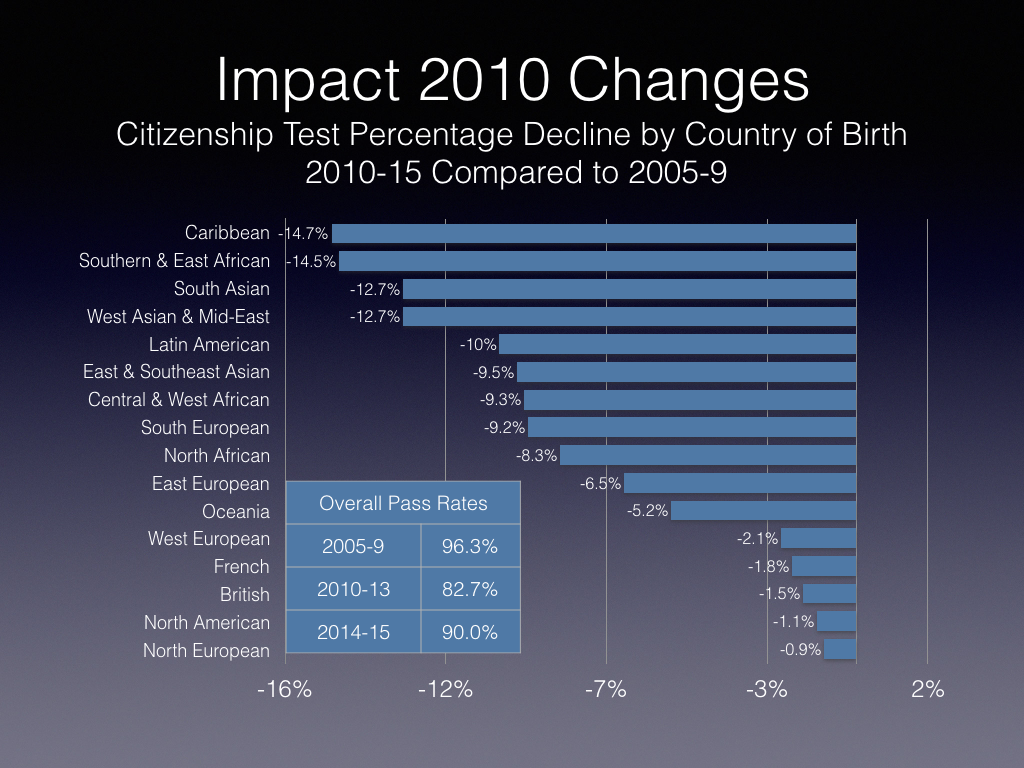
Conference Board Immigration Summit: My Citizenship Presentation

For those interested, this is the latest version of my citizenship deck, being delivered later today at the Conference Board Immigration Summit. A mix of 2016 and 2015 data as some of the specialized datasets have not yet been updated by IRCC.

Minister Hussen on citizenship #Immigration150 conference

Interesting insight at yesterday’s Conference Board of Canada Immigration Summit during the session with IRCC Minister Hussen.

In response to a broad question regarding multiculturalism from the moderator, CBoC Senior VP Craig Alexander, the Minister responded that the world has two choices: give into fear or make a “deliberate choice” to be open to people, skills and talent. This was not only “morally right” but also beneficial to economic development.

The Minister noted that when questioned in other countries about diversity, he replied that Canadian citizenship is based upon shared values, not on ethnicity, cultural origin or religion as in many other countries.

Canada’s ability to welcome all, whatever their origins, and integrate them well, is key to our success.

He noted that as Canadians, “we all assume that when people come as immigrants, they will become citizens” and that was not the case in many other countries.

He went on to emphasized that not becoming a citizen affects the ability to integrate and never becoming part of society and never able to contribute to their full potential. Canada does not that problem. Again, we assume that all immigrants will become Canadian.

Canada is unique in the regard. We take this for granted. It is our history of immigration that makes us open to immigration. By welcoming and including everyone, Canada can realize the potential of all and use the full resources of its population.

Powerful words, eloquently stated.

However, someone at IRCC should point out to him the recent data that show a dramatic drop citizenship applications – from 198,000 in 2014 to 92,000 in 2016 – and the increasing gap between new permanent residents and new citizens (296,000 compared to 148,000 in 2016, following the elimination of the backlog in 2014-15).

The key chart captures the trends.

So rather than assuming the immigrant-to-citizen path, we need to recognize the impact of previous changes and take steps to address this decline, starting with reviewing the steep fees as I have noted previously (and repeatedly).


Liberal government to debate Senate amendments to long-delayed citizenship bill

It will be interesting to see whether the Liberal government accepts all three amendments and how quickly the House will deal with C-6.

I suspect that the government may accept the procedural protections amendment in the case of revocation for fraud and right of minors to apply independently of their parents or guardians, while rejecting the exemption for testing change to 60 from 55.

Personally, I favour accepting all three in the interests of getting C-6 implemented quickly. The age exemption issue – a difference of five years – has been largely an “evidence-free” zone:

While I expect the Liberal government to reject The Liberals’ long-delayed citizenship bill is finally moving ahead almost a year after the House of Commons passed it, but it’s not law yet.

The Senate voted Wednesday in favour of the bill that will revoke a Conservative policy to remove Canadian citizenship from dual citizens convicted of serious crimes such as terrorism and treason.

Three amendments were introduced, however, which means the bill gets sent back to the House of Commons, where Liberals will decide whether to accept the changes or not. If they don’t, it goes back to the Senate again. Government House leader Bardish Chagger’s office said Wednesday amendments will be brought to the floor for debate “in due course.”

The new law will also require prospective citizens to be in the country for three out of five years before their application, a change from the four out of six years that are currently required. Applicants will no longer need to declare an intent to reside in Canada.

Bill C-6, which fulfills a major election promise to repeal elements of Conservative legislation, has trudged slowly through the upper chamber since last June. After a spurt of opposition delay tactics, senators had made a backroom deal to have a final vote by Wednesday.

The bill’s sponsor, independent Sen. Ratna Omidvar, championed in particular an amendment, introduced by independent Sen. Elaine McCoy, that improves due process for people who are facing revocation of their citizenship due to fraud or misrepresentation.

After the Conservatives’ Bill C-24, revocation processes were streamlined such that people weren’t automatically granted a right to defend themselves if their citizenship was about to be taken away. The Liberal Bill C-6 didn’t reverse this change.

“Without this amendment,” said a statement from Omidvar’s office, “Canadians face an unjust administrative process and fewer safeguards than anyone wishing to challenge a parking ticket.”

Previous immigration minister John McCallum had told senators Liberals would “welcome” an amendment addressing this, but new minister Ahmed Hussen has not indicated support one way or the other.

Two other amendments were adopted. For older applicants, the law currently requires language proficiency in English or French up to the age of 64. The Liberal law proposed lowering this to 55, but senators decided to adopt Conservative Sen. Diane Griffin’s suggestion of a middle ground, setting it at age 60 instead. Another amendment, from Conservative Sen. Victor Oh, seeks to ensure minors can apply for citizenship separate from parents or guardians.

With physician-assisted dying legislation last summer, the House of Commons addressed Senate amendments right away (with the government rejecting most of them). On the other hand, the Senate is still waiting for the House of Commons to accept or reject an amendment on the RCMP union bill, C-7, which it adopted last June.

Source: Liberal government to debate Senate amendments to long-delayed citizenship bill | National Post

Trudeau devalues citizenship: Gordon Chong

Over the top criticism and fear-mongering by Gordon Chong:

When Paul Martin Sr. introduced the bill in the House of Commons that became the Canadian Citizenship Act on Jan. 1, 1947, he said: “For the national unity of Canada and for the future and greatness of the country, it is felt to be of the utmost importance that all of us, new Canadians or old, … have a consciousness of a common purpose and common interests as Canadians, that all of us are able to say with pride and with meaning ‘I am a Canadian citizen.’”

Despite new acts in 1977 and 2002, as well as more recent legislation, those foundational words should be forever etched in our minds.

Subsequent revisions have vacillated between weakening and strengthening the requirements for granting citizenship.

The Harper Conservatives strengthened the value of Canadian citizenship in 2014 by increasing residency and language requirements with Bill C-24, the Strengthening Canadian Citizenship Act.

Applicants aged 14 to 64 were required to meet language and knowledge tests.

Permanent residents also had to have lived in Canada for four out of the six previous years prior to applying for citizenship.

The Liberals’ Bill C-6, an Act to Amend the Citizenship Act, proposes to reduce knowledge and language requirements (they only affect applicants aged 18 to 54) and reduce residency requirements to three of the previous five years.

Bill C-6 also proposes to repeal the right to revoke Canadian citizenship of criminals such as those convicted of terrorism.

As a citizenship court judge for several years in the ’90s, I can assure doubters that acquiring citizenship was relatively easy, especially for seniors over 65 with a translator.

Skilled professional translators have difficulty capturing the nuances between languages. It is not uncommon, for example, to see significant errors and omissions in the Chinese-language media when reporters rush to meet deadlines.

Obviously, without a comprehensive grasp of English, it is impossible to meaningfully participate in Canadian life.

Meanwhile, our federal government is frivolously throwing open our doors to potential terrorists and providing fertile conditions for the cultivation of home-grown terrorists by indirectly subsidizing the self-segregation and ghettoization of newcomers, further balkanizing Canada.

The cavalier Trudeau Liberals, peddling their snake oil political potions, are nothing more than pale, itinerant imitations of the Liberal giants of Canada’s past, shamefully repudiating their predecessors for immediate, short-term gratification.

These privileged high-flying Liberal salesmen with colossal carbon footprints should be summarily fired, solely for seriously devaluing Canadian citizenship!

Source: Trudeau devalues citizenship | CHONG | Columnists | Opinion | Toronto Sun