Former Canadian flag, the Red Ensign, gets new, darker life as far-right symbol | National Post

Sigh …:

When five members of the anti-immigration, alt-right Proud Boys strode into a Halifax park on Canada Day to confront Indigenous protesters, the Canadian flag they carried was more than 50 years out of date.

With a Union Jack in the corner and a coat of arms on a red background, the Canadian Red Ensign held aloft by one member has largely disappeared from public view since it was replaced in 1965 by the Maple Leaf.

But the Red Ensign, a variation of which Canadian troops fought under in both world wars, has recently taken on a darker symbolism, adopted as Canada’s equivalent of the Confederate flag by some extremists here.

The perversion of the Red Ensign was first observed among white supremacists, who saw it as a throwback to a time when Canadians were overwhelmingly white and of European extraction.

Anti-immigrant protests by the Aryan Guard in Calgary featured the Red Ensign as far back as 2008, and photos showed group members decorated their apartments with the flag alongside a Nazi flag and a Confederate flag.

When John Beattie, who founded the Canadian Nazi Party in the 1960s and remains a white supremacist, ran for municipal office in 2014, a reporter noted that he flew the Red Ensign flag at his home.

 Notorious white nationalist Paul Fromm has campaigned to have the Red Ensign returned as Canada’s flag, calling it “the flag of the true Canada, the European Canada before the treasonous European replacement schemes brought in by the 1965 immigration policies.”

Northern Dawn, a Canadian alt-right website launched last year to defend Western heritage against “chaos,” has used the Red Ensign as its Facebook cover photo. In a July 1 essay on the site, Gerry Neal decried the 1965 replacement of the Red Ensign with the current flag as evidence of a Liberal revision of national symbolism “to eliminate reference to our British heritage.”

Anti-Racist Canada has been tracking the growing popularity of the Red Ensign among extremist groups for years. A spokesperson, who for safety reasons asked to be identified only as Chris, said racists have adopted the Red Ensign “to represent a time when Canada was a ‘white man’s country.’ They view the flag that flies in Canada today as an abomination representing multiculturalism and diversity.

“If you attend any far-right rally or march in Canada, there is a very good chance that, along with ‘white pride,’ Nazi, and Confederate flags, you will also see the Red Ensign being flown rather than the Maple Leaf.”

For the Royal Canadian Legion, which flies the Red Ensign outside its headquarters and includes the flag in its official colour party, the idea that it has been adopted by extremists is hard to stomach.

“There is significant and genuine affection for the Red Ensign in the veterans’ community of Canada for the reason that wars were fought and lives were lost under that flag,” Bill Maxwell, secretary of the Legion’s Poppy and Remembrance Committee, said.

“Canadians fought for the freedoms we enjoy today. I don’t think they fought to have the Red Ensign denigrated in such a manner, quite frankly.”

Caitlin Bailey, executive director of the Canadian Centre for the Great War, in Montreal, said the Red Ensign was a symbol of unity as a young nation went to war. It was the flag that flew over Vimy Ridge to signal its 1917 capture by Canadian troops.

“It’s unfortunate that it has turned into a white nationalist symbol,” she said. “It’s not right, and it flies in the face of what the Red Ensign means.”

C.P. Champion, editor of the history journal the Dorchester Review, recently wrote in support of greater prominence for the Canadian Red Ensign, arguing it should fly permanently at the National War Memorial in Ottawa.

He said in an interview that he was disappointed when the self-described traditionalists of the Proud Boys were captured on video provoking Indigenous protesters with the flag.

“It looked like it was trivializing, or treating as a kind of talisman of defiance, a flag that has a much more venerable and mainstream role,” Champion said. “I’ve always thought it’s important not to let traditional symbols be appropriated by fringe elements.”

Source: Former Canadian flag, the Red Ensign, gets new, darker life as far-right symbol | National Post

What is the difference between nationality and citizenship? The Economist

Useful clarification of the nuance although less applicable in the Canadian context compared to the UK and USA (where we do not have distinct categories of citizenship – with the major difference being voting rights for non-residents):

IN OCTOBER, when Theresa May’s political future still looked bright, the British prime minister chastised her opponents: “If you believe you’re a citizen of the world, you’re a citizen of nowhere. You don’t understand what the very word ‘citizenship’ means.” In their defence, the concept of citizenship is complex, especially when compared with the similarly complicated idea of nationality. What is the difference between the two?

In general, to be a national is to be a member of a state. Nationality is acquired by birth or adoption, marriage, or descent (the specifics vary from country to country). Having a nationality is crucial for receiving full recognition under international law. Indeed, Article 15 of the Universal Declaration of Human Rights declares that “Everyone has the right to a nationality” and “No one shall be arbitrarily deprived of his nationality nor denied the right to change his nationality” but is silent on citizenship. Citizenship is a narrower concept: it is a specific legal relationship between a state and a person. It gives that person certain rights and responsibilities. It does not have to accompany nationality. In some Latin American countries, for example, such as Mexico, a person acquires nationality at birth but receives citizenship only upon turning 18: Mexican children, therefore, are nationals but not citizens.

Similarly, not all American nationals are also American citizens. People born in the “outlying possessions of the United States” can get an American passport and live and work in the United States, but cannot vote or hold elected office. In the past, these “outlying possessions” included Guam, Puerto Rico and the U.S. Virgin Islands, but in the 20th century Congress gradually extended citizenship to their inhabitants. Today, only American Samoa and Swains Island stand apart: the latter is a tiny atoll in the Pacific ocean, barely more than five meters above sea level, which, in 2010, had a population of just 17.

In Britain, thanks to the legacy of colonialism, the situation is even more complicated. There are six types of British nationality: British citizens, British subjects, British overseas citizens, British overseas territories citizens, British overseas nationals, or British protected persons. Sometimes it is possible to switch categories: for instance, before the British handed Hong Kong over to the Chinese on 1st July 1997, some British overseas territories citizens registered as British overseas nationals. These overseas nationals hold British passports and can receive protection from British diplomats, but they do not have the automatic right to live or work in Britain. So in Britain, there are several types of citizenship and some nationals who are not citizens at all. The targets of Mrs May’s ire are likely to have good company in not fully grasping the meaning of the word “citizenship”.

Source: What is the difference between nationality and citizenship?

Bahrain is stripping dissidents of their citizenship, and the U.S. is silent – The Washington Post

Another example of revocation being used to political ends:

The tiny island kingdom of Bahrain is increasingly turning to a particularly draconian tool of repression: stripping dissidents of their citizenship.

Rights activists say authorities have revoked the citizenship of 103 people so far this year, already more than in 2016. All were convicted of terrorism-related crimes in trials that rights activists say lacked due process and transparency.

The pace of citizenship revocations has increased amid an intensifying crackdown on opposition. And activists charge that the silence of the West, particularly the United States and Britain, has emboldened authorities to press ahead with more repressive measures than the kingdom has employed since the response to mass protests in 2011.

“There’s absolutely zero pressure for them to reform or do anything that’s less than repressive,” said Sayed Ahmed Alwadaei, director of advocacy at the Bahrain Institute for Rights and Democracy and one of those deprived of his citizenship. That attitude was clear, he said, when President Trump reassured the king of Bahrain at a meeting in May that there would be no “strain” in their relationship.

“This was an indicator that human rights is absolutely not part of the U.S. interests,” Alwadaei said.

An official at the Bahraini Embassy in Britain said authorities revoke citizenship “in the aim of preserving security and stability while countering threats of terrorism.”

“Revoking citizenship is only done in accordance with the provisions of the law, in cases where the person involved were engaged in activities that has caused damage to the interest of the Kingdom and its national security,” the official said in an email, responding to questions on the condition of anonymity.

Bahrain, an archipelago in the Persian Gulf that is home to the U.S. Navy’s 5th Fleet, has a majority-Shiite population but is governed by a Sunni monarchy. In 2011, thousands of protesters demanding democratic reforms were met with a brutal crackdown and mass arrests. International pressure led to an inquiry that documented allegations of torture and violations by security forces, and recommended reforms.

But that pressure has largely evaporated, and the government has recently taken the crackdown to new lengths, dissolving political groups and the kingdom’s last independent newspaper. Many activists and opposition figures have been jailed, and security forces killed five protesters in a raid on a demonstration in May.

Source: Bahrain is stripping dissidents of their citizenship, and the U.S. is silent – The Washington Post

Applicants for US Citizenship Surge; Mexicans Least Likely to Apply

Different trend in Canada. Country of origin differences interesting – expect that one reason for lower take-up rates for Mexican immigrants is related to the high cost of US citizenship (about CAD 1,000):

The number of legal immigrants applying for U.S. citizenship has surged by more than 20 percent since 2015, according to a recent Pew Research study – with Mexicans the least likely to apply.

Applications for citizenship were up by 21 percent in the first half of this year at 525,000, compared to the same period in 2016 when 435,000 applied, the report found.

The total number of applications in 2016 was 972,000, 24 percent higher than the approximately 800,000 who applied in 2015.

According to the report, in 2015 there were 45 million immigrants living in the U.S., of whom 11.9 million were “lawful permanent residents holding green cards.”

Among those green card holders, 9.3 million were eligible to apply for citizenship.

Of the 9.3 million, 37 percent or 3.4 million were of Mexican origin, but they were the least likely of all immigrant groups to seek naturalization.

In 2015, 67 percent of all lawful immigrants living in the U.S. and eligible for citizenship had applied – but for Mexicans the rate was considerably lower – 42 percent. That rate hasn’t changed much since then, the report found.

In comparison to the 42 percent of eligible Mexicans applying, 83 percent of those from the Middle East applied and 74 percent of those from Africa.

Middle Eastern immigrants had the highest naturalization rate among all immigrant origin groups, while African immigrants accounted for the largest increase in naturalization rate in the last decade, according to the report.

The report’s research is based on U.S. census data, a year-round survey of 3.5 million households, and a monthly survey of 55,000 households.

Source: Report: Applicants for US Citizenship Surge; Mexicans Least Likely to Apply

ICYMI – the Duck: The maple leaf flag embodies Canada’s national amnesia | C.P. Champion

Historian and former CPC staffer Champion on the current and former flags (under former Minister Jason Kenney, the Red Ensign was displayed at some citizenship ceremonies if memory serves me correct but the Conservative government declined to provide it more official status as Champion recommends):

There is much to celebrate on Canada’s 150th, and there will be no shortage of Canadian flags fluttering about. But the maple leaf flag is also the perfect embodiment of our national amnesia.

Unlike Canada’s original flag—the Canadian Red Ensign—the maple leaf tells no story of our country. The Red Ensign, by comparison, vividly embodies Canada’s rich history, inclusive of First Nations, the fleur-de-lis, and the diversity represented by Scottish, English and Irish symbols.

This history dates back much further than 1867. Canada’s traditions were shaped by the first colonists, the Conquest of 1759, the policies of Lord Dorchester, the resilience of His Majesty’s new French Catholic subjects, generations of American and British immigrants, and First Nations who prospered in the pre-Industrial era and understood themselves as proud, though cautious, allies of the King.

Jon Fogg, Saint James Marine operator, left, and his daughter-in-law Wendy Fogg, unfurl the original Canadian Red Ensign flag that flew over the S.S. Keewatin. Darren Calabrese/National Post

When these old colonies were reimagined and set on a new footing in the 1860s, four distinct Provincial shields were combined on the Red Ensign, which was flown by Sir John A. Macdonald. Lord Stanley, the governor-general, and Henri Bourassa, a French Canadian nationalist, both recognized the Red Ensign as a distinctive Canadian flag. After 1921, the flag bore the shield from Canada’s new coat of arms.

When Canadian soldiers took Juno Beach on June 6, 1944 (D-Day) they carried this Canadian flag ashore. Through Normandy and the Netherlands, between the Maas and the Rhine, under the Klever Tor at Xanten, in liberated Nijmegen, Arnhem, and Groningen: as the Reich flag was lowered across Western Europe, the Canadian flag was unfurled among the banners of victory. In 1945, there could be no doubt that “Canada had a flag,” as John Diefenbaker later said, “a flag ennobled by heroes’ blood.”

The Red Ensign was replaced by the red maple leaf in 1964, recommended in the sixth report of a parliamentary committee, voted for by 178 MPs in a discordant House of Commons, and implemented by a minority government led by a jittery Lester Pearson. Why the jitters? Because the old flag was so popular. As Senator Marcel Prud’homme, an M.P. in 1964, told me in 2007: “You see, we had to kill the Red Ensign” — so that the fledgling maple would have no rival.

Many celebrated the new dawn. The late Lt. Gen. Charles Belzile, who witnessed the maple’s raising for the first time while serving as a young soldier in Cyprus in 1965, told me: “It sure looked pretty good against those green hills!”

But the new flag also had its critics. Historian Marcel Trudel warned in 1964 that Canada’s new flag had “no historic significance” and was “a lamentable failure.” “I am convinced, for my part,” he said, “that any flag, if it is to be truly significant, must contain or represent the symbols of the nation or nations which contributed to establishing the country.”

First Nations leaders were strongly attached to the old flag. James Gladstone, a Blood (Kainai) appointed to the Senate in 1958 said: “Personally I do not want to see any other flag flying but the Red Ensign.” Many chiefs had received a Union Jack as a ceremonial seal on treaties: “Under these symbols of justice, we feel safe. Take them away from us and it will be another sign that we are not safe.”

While the national flag is obviously here to stay, Ottawa should accord the old flag official status as “The Canadian Red Ensign.” It should fly permanently alongside the Canadian flag at the National War Memorial — after all, it’s the flag our soldiers actually fought under. It should fly at war memorials everywhere, and at obvious locations such as the Canadian War Museum grounds. And finally, a Red Ensign should wave permanently above the East Block of Parliament as a symbol of our heritage of freedom.

Source: Beyond the Duck: The maple leaf flag embodies Canada’s national amnesia | National Post

High number of women failing citizenship test reflects barriers they face, advocates say

Some good analysis of the effects on gender from some of the earlier policy and program changes to the citizenship program.

Not surprising but now data and evidence-based (disclosure: I have shared my citizenship data and talked with Neighbourhood Legal Services). IRCC does not publish a gender breakdown for citizenship unlike other programs:

According to data obtained under a freedom of information request, far more women than men have their citizenship applications rejected because they are unable to meet the knowledge or language requirements.

Although the Liberal government passed a bill this month to relax some of the more stringent citizenship requirements imposed by its Conservative predecessor, critics say the changes fail to address the barriers faced by immigrant women hoping to acquire Canadian citizenship.

Between 2007 and March 2017, more than 56,000 people had their citizenship applications refused, the majority of them for failing the language and knowledge requirements, said Jennifer Stone of the Neighbourhood Legal Services, who requested the data after spotting a rising number of women coming to her office for help with their applications.

“Women and refugees are disproportionately affected by the language and knowledge requirements. Now we have data that could bear that out,” Stone said. “For them, it’s not a matter of won’t. It’s a matter of can’t.”

Stone said that in recent years the number citizenship cases received by her clinic has skyrocketed and the majority of clients having difficulty obtaining citizenship are refugee women or sponsored spouses.

A gender breakdown of the refusals showed that 24,286 or 60 per cent of the 41,071 who failed the citizenship knowledge test were women. Of the 14,779 who failed the language requirement, 66 per cent or 9,754 of them were female, according to the data.

Refugees appear to be disproportionally affected by the tightened citizenship requirements introduced by the former Conservative government: raising the passing mark for the citizenship exam, demanding proof of language proficiency and drastically increasing the non-refundable citizenship application fee to $530 from $100.

The number refugees who obtained their citizenship dropped by 25 per cent to 20,059 between 2010 and 2015 from 26,725 between 2005 and 2009.

By comparison, the citizenship conversion rate for those who came under family reunification declined by 19.6 per cent while the number of new citizens who immigrated under the economic class went up by 0.9 per cent.

Tenzin Tekan, a community legal worker with Parkdale legal clinic, said she was not surprised by the statistics.

“For someone with no formal education, it’s hard,” Tekan said. “We welcome the news about the changes (by the Liberals), but it’s not going to help everyone.”

Although there is a provision in the Citizenship Act that waives the knowledge requirement based on medical opinions that applicants will “never” pass the exam, it’s a long, tedious process.

Source: High number of women failing citizenship test reflects barriers they face, advocates say | Toronto Star

Happy Canada Day: Inside Ken Dryden’s hockey rink citizenship ceremony 

To mark Canada Day, former hockey icon, writer and politician Ken Dryden remarks to new citizens of note:

I wasn’t sure but I thought I had heard that someone who has received an Order of Canada is able to preside at a citizenship ceremony. I emailed the citizenship office, and asked them, and told them about Jacques. About a month later, the office confirmed a date and a place.

The ceremony was held June 26 at the Senators’ home arena. Our daughter, continuing her work with refugees, was in Botswana with her family. Until the moment I was introduced by the Clerk of the Ceremony, Jacques and his family had no idea I would be there, in part, representing Sarah. And at that moment, my wife Lynda, who had been watching Jacques, snapped a picture of him with his mouth open.

It being Canada’s 150th birthday, 150 people received their citizenship that day. As the presiding official, I spoke briefly to them and to their families. This is what I said:

“I am very happy to be here. Happy to be here with some people I know—Jacques and Sarah, Daniela, Ivan, Naomi, Steve, and Pamela, the Bwira family, whom I met first in Uganda 14 years ago through our daughter. And happy to be here with all of you, to be part of, and to share with you, this special Canada-moment.

You are quite a sight.

You are from 49 countries. 49. Almost one quarter of all the nations on Earth! Here. Together. All of us Canadians.

Citizenship ceremony, presided over by Ken Dryden, at the Canadian Tire Centre in Ottawa June 26, 2017. 150 new Canadians were celebrated. Photograph by Blair Gable

I grew up in a very different Canada. In Etobicoke, a suburb of Toronto, and the kids I went to school with, their families had come to Canada usually many generations before, and almost all of them from Europe. Mine had come from Scotland, in 1834. Then as I got older, about 20 years ago, I went back to high school for a year to write a book about education. The school was just west of Etobicoke, in Mississauga, and by this time—1995—the classrooms were like this arena—filled with people from everywhere.

One of the big questions for me in writing the book was: how could a school like this work? All the different languages, the different cultures, in many cases students whose ancestors had fought one another, sometimes for centuries. Now all in one place, inside the same four walls. In the lunch room, you could see the divisions—the students sitting in clusters, the Chinese kids here, the Jamaican kids there, the Sri Lankan kids and others somewhere else—all of them separate and apart. But in classrooms, they had to sit next to each other—not quite comfortably at first, but then not thinking about it, then just doing it, then, often without realizing it, getting to know each other a little, then, over time, even learning from each other. It was remarkable to watch and see.

Other countries have people from lots of places too—like you, I’ve been to many of those countries—but they have more divisions. More tensions. Why is it different here? Maybe because our history is shorter, maybe because we have so much space and didn’t have to live on top of each other. Maybe because we’ve always had to live with division—our many different Indigenous peoples, later our French and English settlers—we had to learn to be tolerant, accepting, patient, to “live and let live.” But maybe too because as Canadians we have never seen Canada as something already fully formed, something that long-standing Canadians created, that new Canadians could only adapt to. Where some people feel fully Canadian, and others don’t. Instead, we’ve always been willing to put Canada on the table in front of all of us, for all of us to share, so that Canada can be, and is, our focus, not what our life was and used to be.

To me, this isn’t a multicultural society we are creating in Canada. It’s a “multiculture,” something that all of us are building, and building every day. That is different all the time. A place that changes us, but that we—all of us, old and new Canadians—change too. A place, and a future, we can all feel a part of.

And something else too—it’s our message to ourselves as Canadians and to each other, an understanding we share—that in Canada, we get along. That seems pretty simple, but it’s crucial in an increasingly global world. We get along here. We ask this of each other. We expect it. And need for it to be. This understanding and way of life is now part of your legacy, your new life, your obligation to the future.

I know that as you sit here you are grateful to Canada for opening its doors to you. For giving you this gift. I know too, you are proud to be Canadian. But you also need to know that we are grateful to you. I just got back from Kazakhstan, Tajikistan and Kyrgyzstan—countries of the old Silk Road—that connected China and Mongolia through Central Asia, to the Middle East, to the Mediterranean—and eventually to North and South America. It was not just a connection of silk and other goods, but when goods move, people move, learning moves, technologies move, philosophies and religions move, ideas and cultures move. We are grateful to you because when you came here from your original home countries, you brought with you your cultures, your ideas, your learnings. You are helping to make Canada a modern Silk Road country. You are helping to make Canada a more compelling, dynamic, creative, and interesting place. And this act of creation, this is what all of us—new and old Canadians—are doing together. So that whatever Canada has been in the past, we will be so much more in the future. And what that Canada will be, what we, all of us, will be in that future, I have no idea. And that is the best part.

So congratulations! Good luck to all of you. Good luck to all of us.”

After my talk, I asked these soon-to-be Canadians to take the Oath of Citizenship, reading out one line at a time for them to repeat, giving the entire oath in English, then in French. Most of the 150 said the oath in both languages. Then these new Canadians came up on stage to receive their certificates, one by one, families coming together.

One hundred and fifty of them: 17 from the Philippines, 11 (including the Bwiras) from Congo, 10 from Haiti and the U.S., eight from Colombia and the U.K., six from Morocco and Pakistan, five from Senegal and Sri Lanka, four from China and India. There were 125 adults and 25 children, 78 males, 72 females, 102 primarily English-speakers, 48 French. Two men came up a ramp in wheelchairs, one wore a wide, bright, red-and-white Canada tie. Another man wore a Sydney 2000 Olympics tie. His son, Simon Whitfield, had won a gold medal in the triathlon and was Canada’s flag-bearer in the closing ceremonies. Originally from Australia, the father wanted to share his Canada-moment with his son. The oldest recipient was 75, the two youngest were four. There were 23 families, of two or more; three families of five. The Bwiras, with six, were the largest family present. Almost everyone came up those stairs with a smile and a look of pride. Almost everyone was dressed up in their best, whatever their best was. Each arrived at that moment in that place with their own special story, just like the Bwiras.

Photograph by Blair Gable

The formal part of the ceremony was over. Now it was time to get informal. This was a day of solemnity, and celebration. I said to these 150 new Canadians:

“As you know, this is a hockey arena, the home of the Ottawa Senators. And in this new home of yours, Canada, there is a tradition, that when a team wins a championship, they all gather together on the ice for a team photo. Well, today, in receiving your Canadian citizenship, I think you’ve all won the championship. So let’s everybody come up here near the stage for your team picture—Team Citizenship Canada 2017.

They jammed into the open space between the stage and the seats, the kids at the front, others stood in the rows behind them. And because this was a championship photo, some of the kids lay on their sides on the concrete floor and others kneeled around them, their “We’re Number 1” fingers raised, waving small Canadian flags.

It was time to close the ceremony. I went back up on the stage, everyone was still standing, and said, “I began this morning by saying you are an amazing sight. Why don’t you all take a moment—all of you—and look around, take your time, look at each other, look at this amazing sight you have created. And never forget what you see.”

Our 150th birthday offers Canadians a chance to pause, to see where we were and where we are, and imagine what we might be. A new immigrant’s eyes are even more acute. Immigrants have lived somewhere else, they are here each for their own very good reasons, they see Canada with fresh, deep clarity. For them, receiving their citizenship represents a great new beginning. They are here, finally. They have found solid ground. They are able, now, step by step, to build a future that is absolutely possible, for themselves, for their children, for generations of their families ahead. For me, it was a chance to see Canada, Canada at 150, through their eyes.

Source: Inside Ken Dryden’s hockey rink citizenship ceremony – Macleans.ca


New Zealand gave Peter Thiel citizenship after he spent just 12 days there | The Guardian

Pretty scandalous on many accounts. Revocation on grounds of fraud or misrepresentation?

Peter Thiel, the billionaire co-founder of Paypal, was granted New Zealandcitizenship despite spending only 12 days in the country, new documents have revealed.

The government ombudsmen has forced New Zealand authorities to release further details of Thiel’s highly unusual citizenship process because it was deemed in the public interest.

On Thursday, Nathan Guy – who oversaw Thiel’s citizenship application as minister of internal affairs in 2011 – said Theil had been “a great ambassador for New Zealand, a great salesperson”. “He is a fine individual, good character, he has invested a lot in New Zealand, he’s got great reach into the US and I am very comfortable with the decision that I made.”

The billionaire entrepreneur who is a close adviser to Donald Trump, was granted New Zealand citizenship in June 2011, after taking four brief trips to the country. He made it clear he had no immediate plans to settle in the country.

The usual route to citizenship requires applicants to be in New Zealand as a permanent resident for at least 1,350 days in the five years preceding an application.

The New Zealand government granted Thiel citizenship due to his “exceptional circumstances”, and because it was understood he would promote New Zealand on the global stage, and provide introductions and contacts for New Zealand start-ups in Silicon Valley.

Official information documents stated Thiel’s “exceptional circumstances” related to “his skills as an entrepreneur and his philanthropy”, which were deemed to be of potential benefit to New Zealanders and the country. The formal citizenship process took place in a private ceremony in Santa Monica in 2011.

In his application for citizenship Thiel stated that although he had no plans to reside in New Zealand, and did not work for a New Zealand business overseas, he intended to “represent the country on the international stage”. He also donated NZ$1m to the Christchurch earthquake relief fund, and bought prime land and luxury homes in New Zealand.

Despite this intention Thiel never appeared to mention his New Zealand citizenship in any public capacity – it was revealed by New Zealand media this year.

Labour’s immigration spokesman Iain Lees-Galloway told Radio NZ that Thiel was not promoting New Zealand internationally as he’d stated in his application, as no one knew about his citizenship or ties to New Zealand for six years.

“If Peter Thiel was an amazing ambassador and salesperson for New Zealand we would have found out he was a citizen of New Zealand because he would have told the world that he was a citizen of New Zealand,” Lees-Galloway said. “He kept it under wraps. He hasn’t gone around telling the world that he’s a citizen of New Zealand and that he’s proud of New Zealand.”

Source: New Zealand gave Peter Thiel citizenship after he spent just 12 days there | World news | The Guardian

Trump win produces only tiny bump in numbers of Americans applying for Canadian #citizenship

Not surprising:

The number of Americans applying for Canadian citizenship jumped slightly after Donald Trump’s election, but numbers are still only half what they were five years ago.

New statistics from Immigration, Refugees and Citizenship Canada obtained by the National Post show an average of 400 U.S. citizens put in their applications in each the first four months of this year, compared to an average of 264 per month in 2016 — including a spike in applications in November, the month Trump was elected.

But overall — despite reports of the immigration website crashing on election night, and earnest tourism campaigns sprouting in Cape Breton, N.S. — the trend line has gone down in the past couple of years.

In the decade since 2007, applications peaked in 2011, with an average of 564 Americans per month applying to become Canadians.

A batch of data to the end of 2016 was obtained through the access-to-information system and newer numbers were provided by Immigration spokesman Rémi Larivière. The numbers do not include Americans who may have moved to Canada recently to become permanent residents, or who already live here — just those who are applying for citizenship to seal the deal.

The website for Immigration, Refugees and Citizenship Canada crashed Nov. 8 while Americans were voting in their presidential election.

In the lead-up to the election, the idea of moving to Canada became a popular tongue-in-cheek reaction to the prospect of either electoral outcome — with Americans deeply divided between supporting Donald Trump or Hillary Clinton, and many apparently voting against one or the other rather than for them. It appeared some were taking it more seriously when the immigration website crashed.

All of the traffic was not necessarily election-related, however. The first day of a new system requiring visa-free travellers to apply for Electronic Travel Authorizations was Nov. 10, and had visitors heading to the site to fill out forms and pay $7 fees.

Source: Trump win produces only tiny bump in numbers of Americans applying for Canadian citizenship | National Post

Federal government passes law to end ‘second-class citizenship’

My take (and familiar refrain on fees):

Andrew Griffith, retired director general of the Immigration Department, said the changes are long overdue and should have been passed last year if the opposition parties had not dragged the debate on.

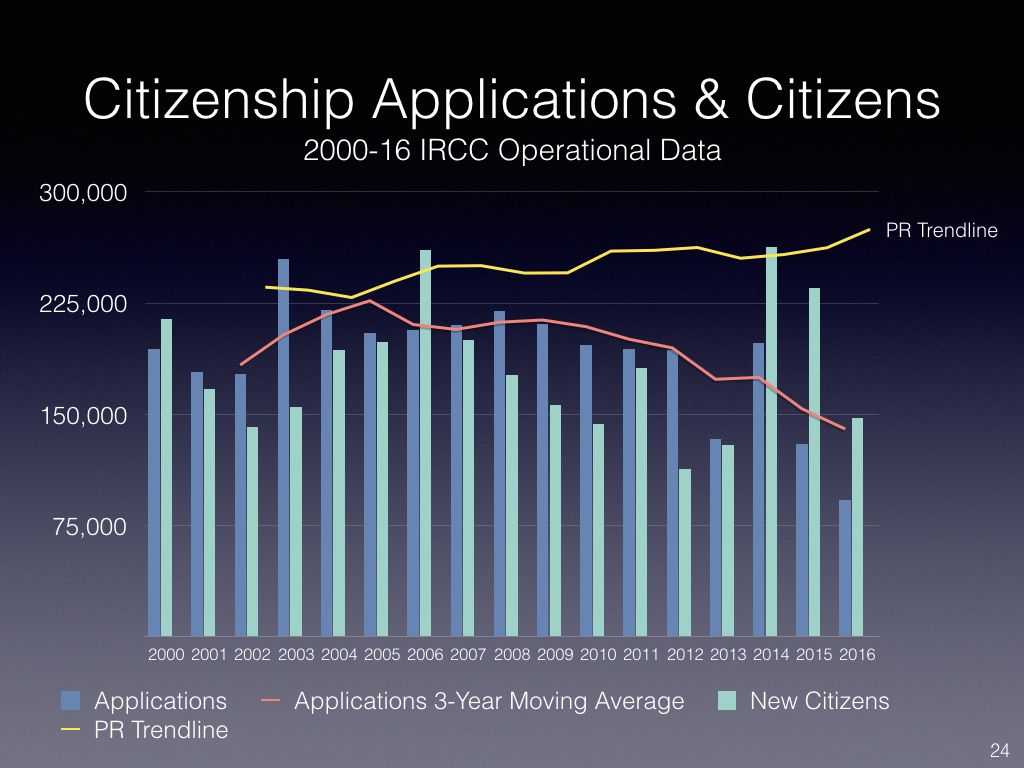
“It’s good that the bill is through,” Griffith told the Star. “It delivered the Liberal government’s campaign commitment to facilitate citizenship, that a Canadian is a Canadian is a Canadian. It has shifted the overall balance somewhat to facilitate (access to) citizenship.”

However, Griffith was disappointed that Ottawa has chosen not to deal with the exorbitant citizenship application fees — $630 for adults [$530 administration processing and $100 right of citizenship fee] and $100 for minors [plus $100 right of citizenship] — that some said have prevented eligible applicants, especially refugees, from becoming full-fledged Canadians.

“The issue that remains for me is the fee,” said Griffith. “If the government really believed in diversity and inclusion, they should ensure it is not an insurmountable financial barrier for people to become citizens.”

Source: Federal government passes law to end ‘second-class citizenship’ | Toronto Star