Australia: Citizenship Minister Alan Tudge wants new English language test for migrants

Unclear exactly who this will apply to beyond economic immigrants who most likely largely meet this requirement already given their version of express entry (which Canada largely was inspired by). Dependents of economic immigrants? Refugees?

But a shift from international tests to testing for conversational English has merit. But as always, the devil is in the details:

MIGRANTS could face a primary school level conversational English test as a requirement to becoming permanent Australian residents and citizens.

Prime Minister Malcolm Turnbull said speaking English was the key to integrating in society and engaging with the economy and education.

“Everyone should recognise we all have a vested interest in being able to converse and engage in the national language,” Mr Turnbull told reporters in Hobart on Thursday.

He said the initial goal of primary school-level English was reasonable, saying it was an obvious measure to help migrants achieve in Australia.

“It is plainly in everybody’s interest that everyone, ideally, should have English language skills,” Mr Turnbull said.

Citizenship Minister Alan Tudge said Australia could move to a locally designed test focusing on conversational English, rather than using international exams.

“If you have a lot of people not speaking the language then you start to get social fragmentation and we don’t want to see that happen,” Mr Tudge told Sky News.

He said the government was considering extending the test to make it a requirement for permanent residency.

“We’re looking at whether or not we can have a reasonable, basic conversational English language requirement at that stage,” Mr Tudge said.

“We want people to be able to interact with one another, work together, play together and continue to contribute to Australian society.”

Australia is approaching a million non-English speakers and the increase is concerning, Mr Tudge said.

He wants to avoid “parallel communities” developing, which he said were an issue in some European countries.

“The secret to our success is we’ve largely had integrated communities where people have blended together regardless of where they’ve come from,” he said.

It’s not the first time Mr Tudge has flagged the importance of English for migrants.

In March he suggested migrants must demonstrate they’ve made an effort to integrate before becoming citizens, steps which could include joining a Rotary Club or a soccer team.

Any changes would need to pass parliament, but that is by no means guaranteed.

Previous changes to citizenship laws were blocked in the Senate last year and fresh talks with cross bench senators would be needed.

Source: Citizenship Minister Alan Tudge wants new English language test for migrants

US launches campaign to strip immigration cheaters of citizenship, once a rare process

No issue with cracking down on fraud and misrepresentation, unlike some of the other Trump administration policies, although legitimate concern over how it may be done:

The US government agency that oversees immigration applications is launching an office that will focus on identifying Americans who are suspected of cheating to get their citizenship and seek to strip them of it.

US Citizenship and Immigration Services Director L. Francis Cissna said his agency is hiring several dozen lawyers and immigration officers to review cases of immigrants who were ordered deported and are suspected of using fake identities to later get green cards and citizenship through naturalisation.

Cissna said the cases would be referred to the Department of Justice, whose attorneys could then seek to remove the immigrants’ citizenship in civil court proceedings. In some cases, government attorneys could bring criminal charges related to fraud.

Until now, the agency has pursued cases as they arose but not through a coordinated effort, Cissna said. He said he hopes the agency’s new office in Los Angeles will be running by next year but added that investigating and referring cases for prosecution will likely take longer.

“We finally have a process in place to get to the bottom of all these bad cases and start denaturalising people who should not have been naturalised in the first place,” Cissna said. “What we’re looking at, when you boil it all down, is potentially a few thousand cases.”

He declined to say how much the effort would cost but said it would be covered by the agency’s existing budget, which is funded by immigration application fees.

The push comes as the Trump administration has been cracking down on illegal immigration and taking steps to reduce legal immigration to the US.

Denaturalisation – the process of removing citizenship – is very rare.

The US government began looking at potentially fraudulent naturalisation cases a decade ago when a border officer detected about 200 people had used different identities to get green cards and citizenship after they were previously issued deportation orders.

In September 2016, an internal watchdog reported that 315,000 old fingerprint records for immigrants who had been deported or had criminal convictions had not been uploaded to a Department of Homeland Security database that is used to check immigrants’ identities. The same report found more than 800 immigrants had been ordered deported under one identity but became US citizens under another.

Since then, the government has been uploading these older fingerprint records dating back to the 1990s and investigators have been evaluating cases for denaturalisation.

Earlier this year, a judge revoked the citizenship of an Indian-born New Jersey man named Baljinder Singh after federal authorities accused him of using an alias to avoid deportation.

Authorities said Singh used a different name when he arrived in the United States in 1991. He was ordered deported the next year and a month later applied for asylum using the name Baljinder Singh before marrying an American, getting a green card and naturalising.

Authorities said Singh did not mention his earlier deportation order when he applied for citizenship.

For many years, most US efforts to strip immigrants of their citizenship focused largely on suspected war criminals who lied on their immigration paperwork, most notably former Nazis.

Toward the end of the Obama administration, officials began reviewing cases stemming from the fingerprints probe but prioritised those of naturalised citizens who had obtained security clearances, for example, to work at the Transportation Security Administration, said Muzaffar Chishti, director of the Migration Policy Institute’s office at New York University law school.

The Trump administration has made these investigations a bigger priority, he said. He said he expects cases will focus on deliberate fraud but some naturalised Americans may feel uneasy with the change.

“It is clearly true that we have entered a new chapter when a much larger number of people could feel vulnerable that their naturalisation could be reopened,” Chishti said.

Since 1990, the Department of Justice has filed 305 civil denaturalisation cases, according to statistics obtained by an immigration attorney in Kansas who has defended immigrants in these cases.

The attorney, Matthew Hoppock, agrees that deportees who lied to get citizenship should face consequences but worries other immigrants who might have made mistakes on their paperwork could get targeted and might not have the money to fight back in court.

Cissna said there are valid reasons why immigrants might be listed under multiple names, noting many Latin American immigrants have more than one surname. He said the US government is not interested in that kind of minor discrepancy but wants to target people who deliberately changed their identities to dupe officials into granting immigration benefits.

“The people who are going to be targeted by this – they know full well who they are because they were ordered removed under a different identity and they intentionally lied about it when they applied for citizenship later on,” Cissna said. “It may be some time before we get to their case, but we’ll get to them.”

Source: US launches campaign to strip immigration cheaters of citizenship, once a rare process

Australia: Citizenship discount for migrant pensioners, widows scrapped

Migrant pensioners, veterans and widows who receive Centrelink payments will soon have to pay full price when applying for Australian citizenship after Home Affairs minister Peter Dutton removed a regulation that offered them a discounted price.

Most people pay a $285 fee when they apply for citizenship, but disadvantaged pensioners and widows have long been granted a concession rate of $20 or $40.

Mr Dutton lodged a legislative instrument on Thursday last week that removes the concession, effective from July 1. The Greens have already promised to attempt to overturn the regulation when parliament sits next week.

The change mostly affects those who hold a pensioner concession card and receive certain welfare payments, including Newstart, the aged pension, the disability support pension or parenting payments.

The Federation of Ethnic Communities, which represents migrant groups in Australia, is calling for the change to be reversed.

“This is a needless imposition,” chair Mary Patetsos told SBS News.

“It puzzles me why you would want to create a hurdle that makes a resident who is entitled to claim for citizenship choose between paying their bills and applying for citizenship,” she said.

Veterans with pensioner cards who receive income support payments – including payments for aged service, invalidity service or partner service – will also lose their discount, as will some widows who hold health care cards.

The changes will also capture those applying for citizenship a second time, who will now have to pay the full fare with each application.

SBS News asked Mr Dutton to comment on the matter but was referred to the Department of Home Affairs.

A spokesperson for the department said only three per cent of people who applied for citizenship via the entrance test – as opposed to those who became citizens by descent or adoption – paid a concession fee in the past 12 months.

“Australia’s citizenship application fees remain internationally competitive and among the lowest in OECD nations,” the spokesperson wrote.

“The Department is committed to ensuring that application fees remain compliant with the Australian Government Cost Recovery Guidelines.”

Greens move to overturn changes

The changes were introduced via a legislative instrument that amends the Australian Citizenship Regulation, meaning they did not require legislation to pass the parliament.

But the Senate can still move to disallow the motion and overturn it. Last month, the government backflipped on controversial changes to parent visa sponsorship rules after it became clear a disallowance motion was about to pass.

Greens senator Nick McKim said he would move a disallowance motion when parliament sits again next week and called on Labor and the crossbench to support him.

“It’s an incredibly small-minded and vindictive move by this government,” Senator McKim told SBS News on the phone from Hobart.

The senator questioned why the government would close the concessions when only a small number of applicants applied for a discount.

“If it’s correct that this only applies to about three per cent of applicants in the recent past, it begs the obvious question as to why in fact the government is moving forward.”

Ms Patetsos said the change was inconsistent with Australia’s approach to encourage migrants to join the broader community and would impact the most vulnerable applicants.

“We’ve always encouraged new arrivals and migrants to apply for citizenship as soon as they’re eligible and that encouragement shouldn’t be dependent on a capacity to pay,” she said.

Source: Citizenship discount for migrant pensioners, widows scrapped

USA: Documents Show Political Lobbying in Census Question About Citizenship

Not surprising. Echoes of the Conservative government’s approach to the 2011 Census/National Household Survey:

Documents released in a lawsuit attempting to block the inclusion of a question about citizenship in the 2020 census show lobbying by anti-immigration hard-liners for the question’s inclusion, and resistance on the part of some census officials to asking it.

The Kansas secretary of state, Kris W. Kobach, who has taken a strong position against illegal immigration and was appointed by President Trump to a now-defunct panel on voter fraud, had advocated the question directly with the secretary of commerce, Wilbur Ross, according to the documents. In a July 2017 email to an aide to Mr. Ross, Mr. Kobach said that he had reached out to the secretary a few months earlier “on the direction of Steve Bannon,” then the White House chief strategist.

In an email to Mr. Ross, Mr. Kobach urged the addition of the question, saying that including undocumented immigrants in the decennial count of the United States population would, among other things, lead to the problem “that aliens who do not actually ‘reside’ in the United States are still counted for congressional apportionment purposes.”

The documents were released by the Justice Department late Friday night in response to a federal lawsuit from the attorneys general of 18 states aimed at blocking the inclusion of the question, which was added to the census questionnaire in March.

The 1,332 pages released by the Commerce Department show a chorus of warnings from scientists, immigrant groups and lawmakers. They also includes letters of support from others who endorse the question, including Representative Bob Goodlatte, Republican of Virginia.

Mr. Ross defended the addition of the question, pointing to the documents released. “I am confident that after months of review and consideration, this administrative record proves that the return of the citizenship question to the Decennial Census is the right move that will allow our country to have the most complete and accurate census information available,” he said.

The Commerce Department added in a statement that “the notion that Secretary Ross decided to reinstate the citizenship question in response to a single email” is disproved by the fact that Mr. Kobach’s note is but one of the more than 500 pages of records produced.

Many of the letters in the documents released support the legal justification for the inclusion of the question. Mr. Goodlatte, the chairman of the House Judiciary Committee, said it was necessary to uphold Section 2 of the Voting Rights Act, which prohibits United States citizens from being denied the right to vote because of race.

“In order to best enforce this prohibition, an accurate enumeration of the number of citizens in America should be conducted, and the most accurate such enumeration would be one in which a question regarding citizenship were reinstated starting with the 2020 census,” Mr. Goodlatte wrote.

Arthur Gary, the general counsel in the Justice Department’s justice management division, also invoked the enforcement of that Act as reason to include the question, according to the documents.

But there were also detailed scientific arguments opposing it, according to an analysis conducted by John M. Abowd, the chief scientist and associate director for research and methodology at the United States Census Bureau, that was included in the documents. The impact of asking about citizenship would be “major potential quality and cost disruptions,” it asserted.

The research also showed that the cost of adding this question, Mr. Abowd said, would be at least an additional $27.5 million, which would cover Census Bureau personnel having to track down households that did not respond.

“We believe that $27.5 million is a conservative estimate because the other evidence cited in this report suggests that the differences between citizen and noncitizen response rates and data quality will be amplified during the 2020 census compared to historical levels,” Mr. Abowd wrote in a Jan. 19 memo.

The Census Scientific Advisory Committee, a group of academics and scientists mandated to review the census by the Congress, also strongly disagreed with the inclusion of the question. “We hold the strong opinion that including citizenship in the 2020 census would be a serious mistake which would result in a substantial lowering of the response rate,” the committee said.

“These documents make clear what we already knew — career staff at the Census Bureau warned the political leadership at the Commerce Department that the inclusion of a citizenship question would depress census response rates, increase costs and diminish the quality of census data,” said Vanita Gupta, chief executive of the Leadership Conference on Civil and Human Rights.

Ms. Gupta said that the release showed political meddling by Mr. Kobach and Mr. Bannon in the census process.

The office of Mr. Kobach did not immediately respond to a request for comment. Nor did Mr. Bannon immediately respond.

In response to the release of the documents, Representative Elijah Cummings, the ranking member of the House Oversight Committee, asked Trey Gowdy, the committee chairman, to subpoena the Commerce and Justice Departments. He said the Justice Department omitted “entire categories of requested documents.”

This spring Mr. Cummings and other committee members asked both departments for any and all conversations, analyses and documentation related to the citizenship question, including the impact it could have on census response rates and costs. They wanted to know who worked on the issue and whether anyone expressed concerns, inside or outside of government. They specifically asked the Justice Department for all communications related to how the question would help enforce the Voting Rights Act.

The Justice Department is reviewing the document requests it received this spring from the House, but the information it produced Friday night was for the lawsuit and unrelated to the Oversight Committee’s efforts to obtain information.

A Justice Department spokesman declined to comment on Mr. Cummings’s statement.

Republican committee members have said they support production of the documents and would vote to subpoena for more information if necessary.

The citizenship question has not been on a decennial census since 1950. It has been on the annual American Community Survey, however, since 2005, but that goes to fewer households, rather than the entire country.

The lawsuit filed in April by 18 attorneys general, six cities and the United States Conference of Mayors — led by New York — argued that the question would result in an undercount, which would not only “fatally undermine the accuracy of the 2020 census, but will jeopardize critical federal funding needed by states and localities to provide services and support for millions of residents.”

“Further,” the suit continued, “it will deprive historically marginalized immigrant communities of critical public and private resources over the next 10 years.”

A subsequent lawsuit was filed last week by the American Civil Liberties Union and other immigrant rights groups, charging that asking the citizenship question thwarts the constitutional mandate to accurately count the United States population.

IRCC Departmental Plan 2018-19: Citizenship

The new framing of citizenship places citizenship outside of integration in the 2018-19 Departmental plan, viewing citizenship as more operational in nature rather than key to integration.

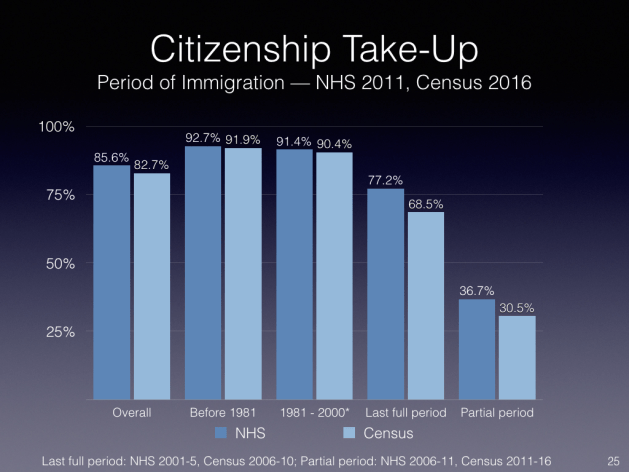
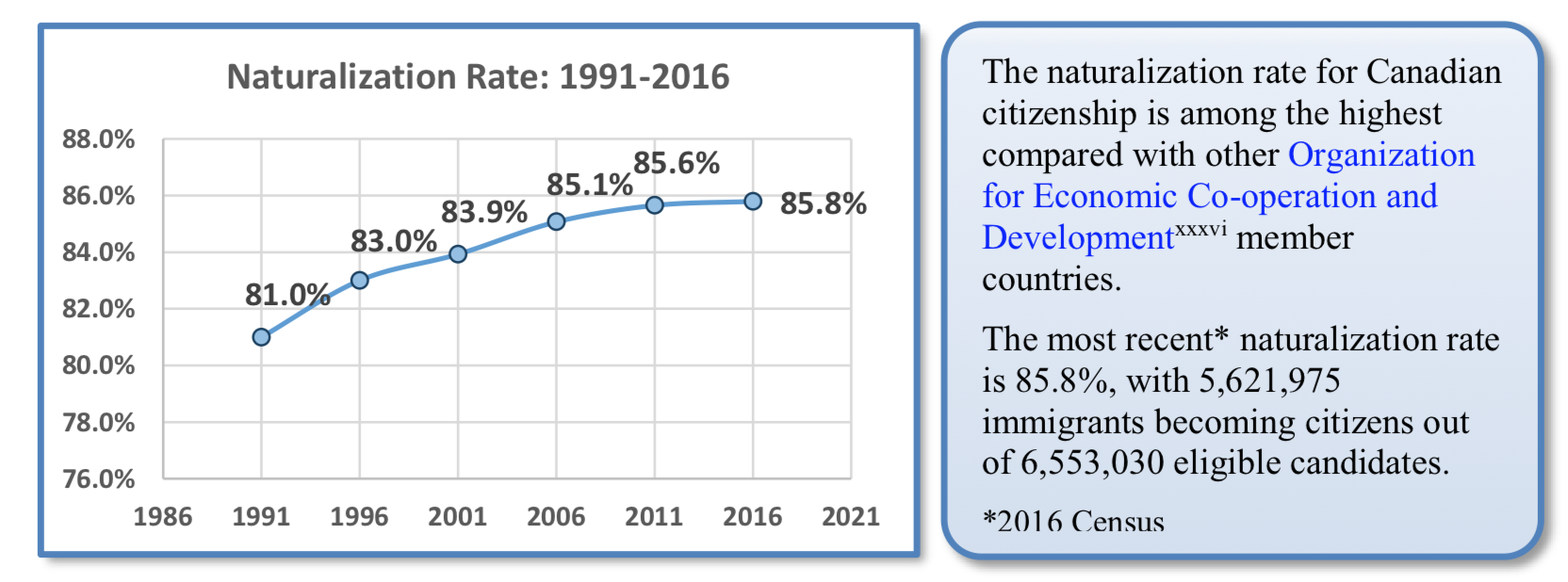
Moreover, the plan includes an incorrect naturalization rate of 85.8 percent for the 2016 Census rather than a more accurate rate of 30.5 percent, given their methodology using the four-year residency requirement for the full 2011-16 period without accounting for the fact that the three-year residency requirement was in effect  until May 28, 2015 (my detailed analysis in my article, What the census tells us about citizenship).

This will likely come back to haunt IRCC and StatsCan in 2021 as using the same methodology would mean assuming a three-year residency period for the entire 2016-20 period, despite the four-year period being in effect for 649 days, or about 35 percent of the time.

And of course by overstating naturalization rate now, and understating in 2021 (assuming they are consistent in their methodology), the decline will appear larger.

I look forward to doing the analysis then!

Summary chart below:

Metropolis 2018 - Citizenship.025.png

Core Responsibility 3: Citizenship and Passports

IRCC promotes the rights and responsibilities of Canadian citizenship, and issues secure and internationally recognized Canadian citizenship and travel documents so that Canadians can participate fully in civic society and so that travel is facilitated across borders while contributing to international and domestic security.

 The Department is consulting with Indigenous organizations and Crown-Indigenous Relations and Northern Affairs Canada to update in 2018–2019, through a legislative amendment, the Oath of Citizenship to include reference to respecting treaties with Canada’s Indigenouspeoples. This is also in response to the Truth and Reconciliation Commission’s Calls to Action.

To improve the client experience, the Department is also working in collaboration with the Canadian Digital Service to improve flexibility in accessing citizenship tests and ceremonies. Furthermore, the Department is considering additional enhancements in 2018–2019 which could allow more electronic accessibility options.

Planned result: Eligible permanent residents become Canadian citizens

Departmental Result Indicators

Targets

Date to achieve targets

2014–15 Actual results

2015–16 Actual results

2016–17 Actual results

Percentage of permanent residents who become Canadian citizens

≥ 85%

2021 (every five years)

85.6% (2011)

85.6% (2011)

85.8% (2016)

Percentage of citizenship applications that are processed within service standards18

≥ 80%

End of each FY

N/A

N/A

90%

Percentage of citizenship applicants who report they were satisfied overall with the services they received19

≥ 90%

page23image2913264

End of each CY

page23image2908672

Changes to UK law may provide more dual citizenship drama – ABC News (Australian Broadcasting Corporation)

The never-ending saga of dual citizenship and the Australian Constitution:

As the apocryphal Chinese idiom goes, we live in interesting times. We can give qualified agreement to Prime Minister Turnbull’s assertion that there has never been a more exciting time to be an Australian constitutional law expert.

So far, 15 members and senators have resigned or been ruled ineligible by reason of section 44(i) of the Australian constitution. That section provides:

Any person who: “is under any acknowledgement of allegiance, obedience, or adherence to a foreign power, or is a subject or a citizen or entitled to the rights or privileges of a subject or a citizen of a foreign power; shall be incapable of being chosen or of sitting as a senator or a member of the House of Representatives.”

All the disqualifications under s44(i) so far have related to the first part of the clause. These involved MPs who were “citizens” of a foreign power at the time they nominated for Parliament.

However, s44 does not only disqualify “citizens”. It also disqualifies anyone: “entitled to the rights or privileges of a subject or a citizen of a foreign power.”

The High Court has not yet ruled definitively on how this provision works. However, in light of the decision in the Katy Gallagher case, it appears the dual citizenship saga may not yet have run its course.

Entitled to the rights or privileges

Citizenship is a little like herpes: you might not even know you have it. One can contract the “rights and privileges” of citizenship without showing any outward symptoms.

What are the symptoms of being “entitled to the rights or privileges of a subject or a citizen”? In Nick Xenophon’s case, the High Court had to consider whether being a British overseas citizen disqualified a person under s44(i). It held it did not.

The then senator remained eligible to sit in Parliament because British overseas citizens were, essentially, only “second-class” citizens. The High Court found: “… a BOC [British Overseas Citizen] does not have the right of abode in the United Kingdom. The right of abode includes the right to enter and to reside in the country of nationality.”

As Mr Fransman observes, the right of abode is one of the main characteristics of a national under international law.

Someone without a right of abode will not be considered a citizen for the purposes of s44(i). Of course, this implies its opposite. Anyone who has a “right of abode” might fall foul of the second part of s44(i). Despite technically not being a citizen, they may be found to be “entitled to the rights and privileges of a subject or citizen”.

What is a right of abode?

Since 1983, the only way to obtain a right of abode in the UK has been to become a British citizen. People with a right of abode in the UK are exempt from customs control. They may work, live, own property and register to vote in the UK. In a deeply ironic twist, they may also stand for office.

One does not need to do anything to obtain the right of abode. The UK Home Office explains: “The right of abode is a statutory right which a person either has or does not have…”

And as we learned in the Canavan decision, when it comes to s44, ignorance is no excuse.

Contracting a right of abode

Prior to 1983, British citizenship was patrilineal; a fancy way of saying deeply sexist. Only your father could pass it on. It took a change to the law in the British Nationality Act, which came into force in 1983, for women to be able pass British citizenship to their children.

Section 44 casualties

This is where it gets complicated — and interesting. The operation of section 37 of the British Nationality Act and section 2 of the Immigration Act together mean that anyone born in a Commonwealth country before 1983 to a parent who is a UK citizen is granted a “right of abode” in the UK. Australia, of course, is a Commonwealth country.

If your father was a British citizen, or you were born after 1983, nothing changes. You would have been a British citizen by descent anyway, which means you already had a right of abode in the UK.

However, if your mother was a British citizen, and you were born prior to 1983, the British Nationality Act operates retrospectively to grant you a right of abode in the UK.

For many people, this newly discovered right will come as a welcome surprise. MPs born before 1983, who believed that they were not caught by s44(i) because only their mother was a British citizen, may find the surprise far less welcome.

Another round of section 44 cases?

One of the few things Mr Turnbull and Opposition Leader Bill Shorten will agree on is that predicting how the High Court will rule is a mug’s game.

We will not know whether those who possess a “right of abode” in the UK will be excluded by operation of s44(i) until the High Court explicitly considers the matter. Even then, each case turns on its own facts.

However, in light of the High Court’s fairly blunt ruling in Katy Gallagher’s case, some MPs who may have inherited more than just an inexplicable love of Coronation Street from their mother might have good reason to be nervous.

via Changes to UK law may provide more dual citizenship drama – ABC News (Australian Broadcasting Corporation)

Gov’t obliges Dutch schools to give good ‘citizenship’ lessons | NL Times

Basic civics appears to be the focus (“freedom of speech, equality, understanding others, tolerance, autonomy, rejecting intolerance and rejecting discrimination”):

All Dutch primary- and secondary schools are obliged to give good “citizenship” lessons focused on the “basic values of the democratic constitutional state” in a new legislative proposal by Minister Arie Slob for Primary and Secondary Education, NOS reports.

“After all, children are not born with a ‘democratic gene’,” the Minister wrote in the explanation of his legislative proposal. “Therefore schools have an important task in educating our children to know their rights and respect the rights of others.” The new law applies to all schools, including private schools. The Education Inspectorate can intervene if schools do not provide enough citizenship education. Now the inspectorate can only intervene if no citizenship lessons are given at all.

Schools have been obliged to give separate lessons on citizenship for the past ten years, though how and when they did so were left up to them. “Some do it perfectly and have citizenship in the DNA of the school”, Slob said, according to the broadcaster. “With others, citizenship is done with one lesson per year.” The Minister wants to put an end to this non-commitment. According to him, the “government aims to oblige the entire school community to make an effort to put into practice the clearer concept of citizenship.”

Under the new law schools must include their approach to citizenship in the school guide and teachers must be a good example for their pupils. There is no detailed curriculum in the law, because schools have the freedom to chose their teaching methods and materials themselves. The law does state that schools must focus on freedom of speech, equality, understanding others, tolerance, autonomy, rejecting intolerance and rejecting discrimination. Things like Liberation Day, the Wilhelmus, the National Remembrance of Dutch Slavery and the Keti Koti Festival can be used to reflect on “historical development and the meaning of living together in the Netherlands”, Slob recommends.

The Dutch government considers the separate lessons on citizenship, in addition to other lessons, to be very important given the “current situation of increasing tensions and declining ties”. It is important for pupils to come into contact with cultures other than their own during school time, and to learn to embrace the democratic constitutional state, according to the government.

The internet consultation of the new law starts on Tuesday. Anyone can comment on the law. If the Tweede Kamer and Eerste Kamer, the lower house of Dutch parliament and the Dutch Senate, passes the law, it will be implemented in the next school year.

via Gov’t obliges Dutch schools to give good ‘citizenship’ lessons | NL Times

Brit denied Swiss citizenship after ‘failing raclette question’ – The Local

Amusing but absurd (except for Lewis). Illustration of the perils of having local communities conduct interviews:

A British citizen has been denied the Swiss passport because he incorrectly answered several questions at a citizenship interview – including one about the origins of the cheese dish raclette.

In mid-March, Lewis, a 43-year-old British citizen, attended a citizenship interview at his local town hall in Freienbach in the canton of Schwyz, where he has lived since 2011.

Read also: Swiss passport named fifth ‘most powerful’ in the world

Lewis had been told in advance that the meeting would be “relaxed talk”. He had already completed the mountain of paperwork necessary for his citizenship application and had passed a demanding written test in early 2017, achieving a score of over 80 percent.

The Brit also grew up in Switzerland. He attended a local school in the French-speaking canton of Vaud, speaks fluent French and German, and understands Swiss German. Until recently he even worked in that most Swiss of all industries: finance.

“I feel Swiss – very much so. This is my home,” he told The Local on Monday.

But the interview in March proved to be a gruelling experience as he and his six-year-old son George – whose mother is Russian – were interrogated for an hour by around eight people from the local citizenship committee.

“My son passed with flying colours, but I got some questions about politics wrong and one about where raclette [a cheese dish from the canton of Valais] comes from,” said Lewis.

Among the political questions Lewis didn’t answer correctly was one about direct democracy and another about Switzerland’s system of part-time politicians. He also failed to identify the ingredients of capuns, a dish from the canton of Graubünden made with chard, dried meat and noodle dough.

These incorrect answers were enough to see both his and his son’s citizenship applications rejected and his outlay of 3,200 francs forfeited.

“The irony is they gave my son a present at the end of the interview – a fridge magnet with the commune’s coat of arms,” Lewis noted wryly.

Lewis admits he was probably distracted during the interview because he had just opened his new coffee shop in Zurich the day before. But he also expressed his frustration about the citizenship process.

“I had already passed the written test and shown I understand the Swiss political system and society so I don’t know why they were testing me again at the interview,” he said.

“From day one, when I went to pick up the forms, there was a great degree of animosity, with the woman at the town hall speaking to me very loudly and very quickly in Swiss German. You are dealing with people who want to make things difficult for you,” the banker-turned barista said to The Local of the citizenship application process.

“The fact that I had my six-year-old son next to me during the interview is also indicative of the degree of interrogation,” he added.

Lewis was keen to stress he respects how things are done in Switzerland and lives by the rule of ‘when in Rome’. But he also said that the process had affected him at an emotional level.

“I respect the laws of this country. I am a business person living in Switzerland. I pay taxes here and now I employ Swiss people. But it all seems a little bit arbitrary. I think they are looking for signs of non-integration,” he explained.

“Now I find myself thinking: ‘What do I say to my son? And what am I to this country?”

Lewis also believes there is a broader issue at stake: “This affects a lot of people and is a reflection on society. Do you want people to integrate or do you want to make it too painstaking and expensive for them?” he asked.

“I didn’t want to go public but I am not an isolated case. There must be lots of other people who were just as shocked as I am when they failed the test but we don’t know their stories,” Lewis told The Local.

via Brit denied Swiss citizenship after ‘failing raclette question’ – The Local

Citizenship for sale: how tycoons can go shopping for a new passport | The Guardian

Best overview and analysis I have seen to date:

It’s the must-have accessory for every self-respecting 21st-century oligarch, and a good many mere multimillionaires: a second – and sometimes a third or even a fourth – passport.

Israel, which helped Russian billionaire Roman Abramovich out of a spot of bother this week by granting him citizenship after delays in renewing his expired UK visa, offers free nationality to any Jewish person wishing to move there.

But there are as many as two dozen other countries, including several in the EU, where someone with the financial resources of the Chelsea football club owner could acquire a new nationality for a price: the global market in citizenship-by-investment programmes – or CIPs as they are commonly known – is booming.

The ‘golden visa’ deal: ‘We have in effect been selling off British citizenship to the rich’
Read more
The schemes’ specifics – and costs, ranging from as little as $100,000 (£74,900) to as much as €2.5m (£2.19m) – may vary, but not the principle: in essence, wealthy people invest money in property or businesses, buy government bonds or simply donate cash directly, in exchange for citizenship and a passport.

Some do not offer citizenship for sale outright, but run schemes usually known as “golden visas” that reward investors with residence permits that can eventually lead – typically after a period of five years – to citizenship.

The programmes are not new, but are growing exponentially, driven by wealthy private investors from emerging market economies including China, Russia, India, Vietnam, Mexico and Brazil, as well as the Middle East and more recently Turkey.

The first launched in 1984, a year after young, cash-strapped St Kitts and Nevis won independence from the UK. Slow to take off, it accelerated fast after 2009 when passport-holders from the Caribbean island nation were granted visa-free travel to the 26-nation Schengen zone.

For poorer countries, such schemes can be a boon, lifting them out of debt and even becoming their biggest export: the International Monetary Fund reckons St Kitts and Nevis earned 14% of its GDP from its CIP in 2014, and other estimates put the figure as high as 30% of state revenue.

Wealthier countries such as Canada, the UK and New Zealand have also seen the potential of CIPs (the US EB-5 programme is worth about $4bn a year to the economy) but sell their schemes more around the attractions of a stable economy and safe investment environment than on freedom of movement.

Experts from the many companies, such as Henley and Partners, CS Global and Apex, now specialising in CIPs and advertising their services online and in inflight magazines, say that unlike Abramovich, relatively few of their clients buy citizenship in order to move immediately to the country concerned.

For most, the acquisition represents an insurance policy: with nationalism, protectionism, isolationism and fears of financial instability on the rise around the world, the state of the industry serves as an effective barometer of global political and economic uncertainty.

But CIPs are not without their critics. Malta, for example, has come under sustained fire from Brussels and other EU capitals for its programme, run by Henley and Partners, which according to the IMF saw more than 800 wealthy individuals gain citizenship in the three years following its launch in 2014.

Critics said the scheme was undermining the concept of EU citizenship, posing potential major security risks, and providing a possible route for wealthy individuals – for example from Russia – with opaque income streams to dodge sanctions in their own countries.

Several other CIPs have come under investigation for fraud, while equality campaigners increasingly argue the moral case that it is simply wrong to grant automatic citizenship to ultra-high net worth individuals when the less privileged must wait their turn – and, in many cases, be rejected.

The Caribbean

The best-known – and cheapest – CIP schemes are in the Caribbean, where the warm climate, low investment requirements and undemanding residency obligations have long proved popular. Five countries currently offer CIPs, often giving visa-free travel to the EU, and have recently cut their prices to attract investors as they seek funds to help them rebuild after last year’s hurricanes. In St Kitts and Nevis a passport can now be had for a $150,000 donation to the hurricane relief fund, while Antigua, Barbuda and Granada have cut their fees to $100,000, the same level as St Lucia and Dominica.

Europe

Almost half of the EU’s member states offer some kind of investment residency or citizenship programme leading to a highly prized EU passport, which typically allows visa-free travel to between 150 and 170 countries. Malta’s citizenship-for-sale scheme requires a €675,000 donation to the national development fund and a €350,000 property purchase. In Cyprus the cost is a €2m investment in real estate, stocks, government bonds or Cypriot businesses (although the number of new passports is to be capped at 700 a year following criticism). In Bulgaria, €500,000 gets you residency, and about €1m over two years plus a year’s residency gets you fast-track citizenship. Investors can get residency rights leading longer term to citizenship – usually after five years, and subject to passing relevant language and other tests – for €65,000 in Latvia (equities), €250,000 in Greece (property), €350,000 or €500,000 (property or a small business investment fund) or €500,000 in Spain (property, and you have to wait 10 years to apply for citizenship).

Rest of the world

Thailand offers several “elite residency” packages costing $3,000-$4,000 a year for up to 20 years residency, some including health checkups, spa treatments and VIP handling from government agencies. The EB-5 US visa, particularly popular with Chinese investors, costs between €500,000 and $1m depending on the type of investment and gives green card residency that can eventually lead to a passport. Canada closed its CA$800,000 (£460,000) federal investment immigration programme in 2014 but now has a similar residency scheme, costing just over CA$1m, for “innovative start-ups”, as well as regional schemes in, for example, Quebec. Australia requires an investment of AU$1.5m (£850,000) and a net worth of AU$2.5m for residency that could, eventually, lead to citizenship, and New Zealand – popular with Silicon Valley types – an investment of up to NZ$10m (£5.2m).
via Citizenship for sale: how tycoons can go shopping for a new passport | World news | The Guardian

Uproar in Lebanon over ‘naturalization’ granting hundreds citizenship – Al Arabiya English

Speaks for itself:

A controversial decree granting citizenship to 375 foreigners has sent ripples across Lebanon in the last 48 hours after news emerged that President Michel Aoun signed the resolution along with Prime Minister designate Saad al-Hariri and caretaker Interior Minister Nouhad Mashnouq.

While government officials kept silent, civil societies and activists took to social media to vent their anger and criticism.

The decree, which was riddled with accusations of bribery, grants Lebanese citizenship to affluent applicants including Syrians, Palestinians, Iraqis and Iranian nationals.

While MP Nadim Gemayel from Kataeb party was the first to announce the list of the names of those included in the presidential decree of naturalization, there was conflicting information as to whether the decree had already been signed.

In an interview with Al Arabiya news channel, MP Gemayel confirmed the signing of the decree according to sources close to the presidential palace.

Aoun’s office has yet to comment on the matter, with sources telling Annahar newspaper that the decree might have been drafted before the May 6 elections while the Cabinet was still fully operational. Both Hariri and Mashnouq have also refrained from commenting up to this point.

But the caretaker Justice minister Salim Jreissati confirmed in a statement Friday the signing of the decree which sent waves of shocks to a lot of Lebanese citizens especially Lebanese women married to foreigners who cannot grant citizenship to their children due to religious considerations and others related to the issue of settling the Palestinians.

These development draws a lot of questions whether if the law grants the Minister of the Interior, the President of the Republic with the approval of a majority of ministers, a naturalization decree.

The question now is about the “category” that has been naturalized, especially if it is true that they are rumored to be financiers who have paid about $ 200,000. If that is true the Lebanese are asking on social media: “Where did all that money go and in whose pocket it ended up?”

via Uproar in Lebanon over ‘naturalization’ granting hundreds citizenship – Al Arabiya English