‘A lot of these women had no idea what they got into’: inside the world of birth tourism – The Guardian

Looking forward to seeing the doc.

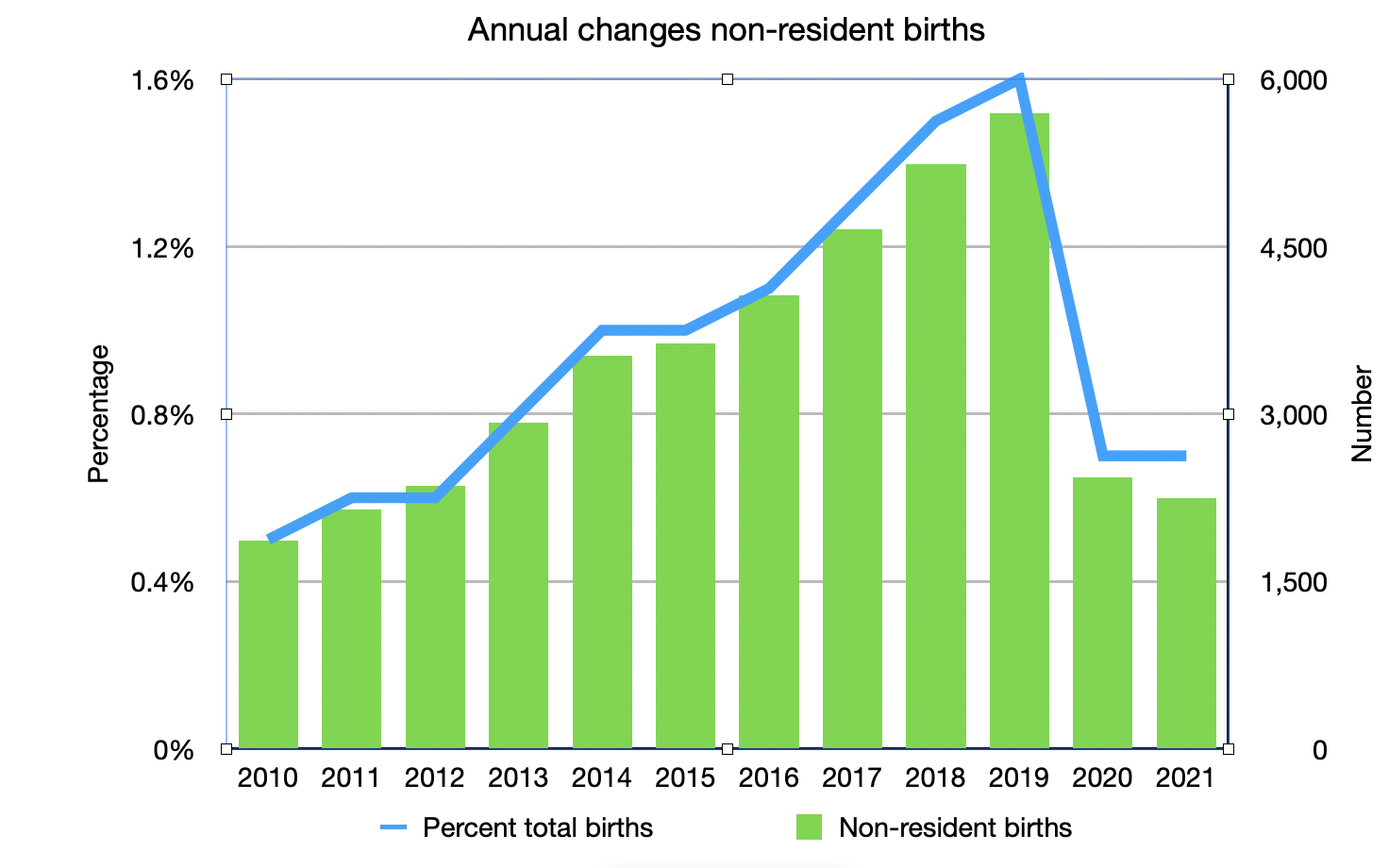
Of note that birth tourism to the USA appears to have dried up given the impact of Trump and COVID travel restrictions along with anti-Chinese and American sentiment in both directions (my latest analysis of Canadian numbers, out shortly, will confirm a similar decrease with respect to Chinese birth tourism to Canada):

It started a decade ago, when Leslie Tai, who lives outside San Francisco, heard from a woman she’d met in Beijing and who told her that she was staying for a few months in Los Angeles. Tai’s friend was evasive about the purpose of her visit, until the pair finally had a video call and Tai watched her friend oil a round belly on camera. “She said, ‘I have a surprise for you,’” Tai recalled. “‘I’m having an American baby.’” Tai, who knew that her friend came from a poor family and was dating a wealthy older artist in China, asked if he had friends in southern California. “And she was like, ‘No, honey, you don’t need friends to do what I’m doing.’”

She was part of the birth tourism industry, which boomed during the Obama years, when scores of pregnant Chinese women of means invested in package deals that cost anywhere from $30,000 to $100,000 and granted buyers the ability to fly across the world and stay for three months at a facility that catered to expectant mothers looking to score US citizenships for their children or skirt the one-child policy that was the law in China until 2015.

Tai, a Chinese American documentary film-maker, wasted no time embedding in the group home where her friend was waiting out the final days of her pregnancy, alongside a handful of other expectant mothers. “I got kind of obsessed with this idea of how on the outside, it’s just nondescript suburban tract housing, with palm trees everywhere, but then behind closed doors there’s this whole world with multiple families living in close quarters and all in this crazy intense situation of waiting to have a baby,” she said.

Securing subjects’ permission was not easy for Tai. “I started asking my aunties and uncles like, do you know anybody who is involved in this industry? They were all like, yeah, actually, my cleaner, or our nanny from when our kids were children ended up working in one of these maternity hotels,” she recalled. Tracking down subjects and winning over their trust took an enormous amount of care and strategy. “Even though what they were doing was not illegal, they had reservations, so it was not like I came in like guns blazing.” Tai’s English fluency proved a valuable resource as she pursued mothers-to-be, nannies, drivers and cooks to grant entry to their private world and anchor the vignettes in her film. “I made myself of service because actually, when they saw me, they were like, ‘Oh my God, you speak English. Can you help me call PG&E?’” She had given similar help to her friend, who did not speak English, in the delivery room.

Nearly 10 years in the making, Tai’s entrancing and heartrending film How to Have an American Baby provides viewers insider access to a phenomenon that took place behind closed doors and on Chinese websites where brokers offered pregnant women package deals as if they were cruise holidays. Money-hungry operators offered help obtaining visas and lining up rooms at specialized facilities. There were enormous industrial maternity hotels, as well as private Beverly Hills homes and boutique group homes where up to five women at a time waited out their births and holed up for the 30-day postpartum quarantine that is a Chinese tradition. Then, more often than not, they returned to China.

“By and large, the majority of the women that were coming were simply coming to evade the one-child policy,” Tai said. Some, though, were mistresses, as Chinese law did not allow unmarried mothers to give birth in public hospitals until earlier this year. Sales agents knew how to tap into maternal anxieties, playing up the supposed advantages of US citizenship. “There’s a lot of misinformation that the customers are receiving,” Tai said. “They think that there’s universal healthcare. They think that there’s universal education. It’s sold as a really good investment, but they’ve been lied to.” Babies born in the US have the right to declare their American citizenship at age 18, and apply for green cards for their families when they turn 21. “There was a sentiment of: who knows what the world is going to look like in 18 years? If China goes to hell, what if America goes to hell, whatever, they have two passports.”

Tai’s film is less concerned with policy than offering a textured portrait of the day-to-day, minute-to-minute experience that the mothers went through. The exteriors are mostly shot at night on suburban streets of southern California and the interiors sit with women bathing their babies or microwaving cups of tea while they wait to go into labor. A meditative quality pervades the work, which weaves several vignettes together into a broader portrait of women navigating a terrifying life phase in a strange land. “A lot of these women had no idea what they got into,” Tai said. “It’s almost like they were sold on the pretty pictures of this vacation and then when they come here, they realize: ‘My family’s not here, and I’m having a baby. Oh, my God, I’m sequestered with a bunch of pregnant women. Plus there’s all the drama living in the suburbs. It’s like Real Housewives from hell.”

While many of the visitors enjoyed daily meal deliveries and shopping excursions, they were surrounded by people who saw them as financial marks. The doctors in the film offer all-cash birthing options (vaginal for $3,000 or caesarean for $5,000) with the tenderness of night market vendors hawking ripoff handbags. Tai captured a maternity hotel worker saying about the residents: “If you become too friendly they will use you. The more you give them, the more they complain.”

The birth tourism world underwent major upheaval over the course of filming and editing, to the point where Tai said her film was “like a time capsule”. With the rise of Trump and the travel restrictions around Covid, and anti-Chinese and anti-American sentiment flying in both directions, the phenomenon has come to a standstill.

Tai had her own changes as well, namely, the birth of a baby this past January, a few weeks before the world premiere of her film at a festival. “I definitely took a lot of lessons from watching all these births, like making sure I was set up with the right support,” she said.

And now she is in what she called “double postpartum mode”, watching both her baby and film find their footing in the world. While the film has a jaw-dropping concept at its core, the bulk of the footage focuses on the mundanity and emotion that color the days leading up to and following childbirth, as well as the terror and ecstasy of labor itself. (There is a birthing scene more honest and beautifully gruesome than any video they’ll show you at birth class.) Tai’s ambition for her movie is strikingly tender. “I want to fight for the moving image that allows you to really sink into the humanity of the people, regardless, and even in spite of, how controversial the situation is,” she said.

Source: ‘A lot of these women had no idea what they got into’: inside the world of birth tourism – The Guardian

What the [USA] Birthright-Citizenship Debate Is Really About

More on political posturing by DeSantis and Trump with relevant background:

When my Google Alerts sounded this past week, I knew that birthright citizenship was again lighting up in the news. My interest in debates over birthright is professional and abiding: I’m a historian who in 2018 published a book, Birthright Citizens, that traced this approach to national belonging from its origins in debates among Black Americans at the start of the 19th century to 1868, when the ratification of the Fourteenth Amendment established that, with a few exceptions, anyone born on U.S. soil is a citizen.

On Monday, Florida Governor Ron DeSantis, looking to advance his presidential campaign, promised to reverse more than a century and a half of law and policy and, as he put it in a statement, “end the idea that children of illegal aliens are entitled to birthright citizenship if they are born in the United States.” A few days later, a spokesperson for another GOP presidential candidate, Nikki Haley, said she “opposes birthright citizenship for those who enter the country illegally,” and the entrepreneur Vivek Ramaswamy’s campaign said he would reform birthright by adding new citizenship requirements. Having lived through more than one such outburst in recent years—the first in 2018, when then-President Donald Trump proposed to do away with birthright—I know that any promise to transform our citizenship scheme is sure to set off a debate.

But what, we should ask, is that debate really about? Why does it keep coming up? When we talk about birthright citizenship, we are talking about democracy—its fundamental component that grants equal status to every person born in this country and affords them all the same rights of citizenship.

Let’s briefly review. Although the 1787 Constitution did not bar Black Americans from citizenship, it also did not plainly state what made any person a citizen. The result was that Black Americans received profoundly uneven treatment before the law; most authorities leaned toward the view that color, with its implied links to slave status, disqualified Black Americans from citizenship. Black activists waged a long campaign arguing that, on the face of the Constitution and as a matter of natural rights, Black people were citizens by virtue of their birth on U.S. soil.

Notoriously, the U.S. Supreme Court, in the 1857 case Dred Scott v. Sandford, concluded that citizenship was beyond the reach of Black Americans; their race disqualified them. During the Civil War and Reconstruction, lawmakers remedied this circumstance: first in an 1862 opinion from Attorney General Edward Bates, then in the Civil Rights Act of 1866, and finally in the first clause of the Fourteenth Amendment, which installed birthright in the Constitution, guaranteeing that Black people and all those born in the United States were citizens.

Calls today to do away with birthright citizenship are, in large part, political theater, often a way to project a tough stance on immigration. DeSantis outlined only a very loose strategy, saying he would “force the courts and Congress to finally address this failed policy.” Trump, too, was light on specifics. For all the noise that his administration generated around doing away with birthright citizenship, which he threatened to do multiple times as president, nothing came of it. The meaning of the Fourteenth Amendment as we knew it before the Trump era remains unchanged.

Campaign pledges to end birthright citizenship might get people’s attention, but lawmakers have kept this objective alive in other quarters. Less well known, for example, is how in every session of Congress from 2007 to 2021, a Republican representative introduced something called the Birthright Citizenship Act. The legislation would have redefined the meaning of a minor clause in the Fourteenth Amendment—one that limits birthright status to persons “subject to the jurisdiction” of the United States. In 1868, this exception excluded the children of visiting diplomats and those of Native American sovereign nations. Today, some lawmakers propose to newly expand the meaning of this clause by defining children as subject to U.S. jurisdiction, and thus birthright citizens, only when they have one parent who is a U.S. citizen or national, a permanent resident residing in the United States, or an alien on active duty in the Armed Forces. In Congress, opposition to birthright simmers on the back burner, but it demands our vigilance lest it boil over.

When politicians dispute birthright, they also open up legal questions about where the power to interpret the Fourteenth Amendment resides. Trump suggested that with his authority, as exercised through an executive order, he could reinterpret who is subject to the jurisdiction of the United States and thus a birthright citizen. Members of Congress similarly have taken the view that that body can legislate the amendment’s meaning. Many legal commentators rightly argue that the U.S. Supreme Court has the final say when it comes to the meaning of the Constitution. Our recently constituted Court has not been tested on the issue of birthright, and we must allow for the possibility that it might defer to Congress or the president when it comes to interpreting its meaning.

When Trump first promised to undo birthright, I was primarily concerned about how immigrants and their U.S.-born children would be harmed by such a change. Today, this worry still figures importantly in my mind, but my concerns have grown broader. Calls to undo birthright, though couched in terms of immigration reform, ultimately aim to undo a key precept of our democracy: equitable access to citizenship. Birthright sets an even bar when it comes to being a citizen—all those born here are subject to the same threshold test, no matter whom they descended from. It ensures that, for those born in the United States, citizenship will not be conferred depending on their politics, race, faith, culture, gender, or sexuality. Birthright safeguards those born here from political leaders who would mete out citizenship as a reward or withhold it as a punishment.

The wielding of citizenship as a weapon is precisely what the Fourteenth Amendment was designed to prevent. In 1868, birthright undid the Dred Scott decision. It ensured that the right of Black Americans to belong to this nation was neither open to debate nor susceptible to shifting political whims. Since its ratification, the Fourteenth Amendment has guaranteed the belonging of some of the most vulnerable among us, including generations of children born to immigrant parents. It has protected marginalized, despised, and unpopular people who, when born here, do not need to fear exile or banishment. Birthright citizenship has always been a solution rather than a problem, and our democracy depends on it remaining just that.

Martha S. Jones is the Society of Black Alumni Presidential Professor, a professor of history, and a Stavros Niarchos Foundation Agora Institute professor at Johns Hopkins University.

Source: What the Birthright-Citizenship Debate Is Really About

Influx of Russians prompts Argentina to set restrictions on immigration

Of note, applying to temporary residents, equivalent of extended visitor visa in my reading. Original story from Clarin: “Enojo ruso” en Argentina: qué condición cambió para que puedan residir en el país.

Will be interesting to see how effective is implementation and how effective this financial requirement is.

Having a child born in Argentina gives its parents the right to legal residence, and entitles them to a passport two years after the offspring’s birth. The Argentinian government has adopted a decree restricting the mass influx of Russian citizens into the country, especially pregnant women.

As the Argentine newspaper “Clarin” explained, the decree does not apply directly to Russians, but to all foreigners, but the amendment serves to stop the mass influx of Russian citizens to Argentina initiated in March 2022.

The main change to the legislation approved at the initiative of the National Migration Authority (DNM) is that temporary residents are required to have annual receipts of USD 24,000 per person in an account established in Argentina.

The new legislation also obliges the precise source of the sums deposited in the bank, which, as envisaged by the amendment, cannot come from the earnings of freelancers, as is commonly practised by Russians in Argentina.

Since the beginning of the war in Ukraine, several thousand Russian children have been born in Argentina, which the authorities in Buenos Aires consider suspicious. According to them, there is an allegation of an attempt to extort an Argentine passport, which allows visa-free travel to 171 countries worldwide.

Source: Influx of Russians prompts Argentina to set restrictions on immigration

FIRST READING: Canada’s massive (and easily fixed) birth tourism problem

Second article in the National Post in a week. Hopper forgot to mention that the Conservative government did make a push to end birth tourism in 2012 (see my What the previous government learned about birth tourism):

Last week, Macleans’ published an interview with Simrit Brar, a Calgary OB-GYN who is one of Canada’s few medical researchers to actually look into the issue of birth tourism.

It’s something that’s long been an accepted fact within Canadian birthing hospitals: Hundreds of non-resident women each year are coming to Canada in the final weeks of pregnancy, having their baby in a Canadian hospital and then immediately returning home. The purpose of the excursion being to ensure that the child has Canadian citizenship by virtue of the country’s jus soli laws.

There are companies openly advertising their services as “birth hotels.” Online forums include questions as to the “cheapest” Canadian hospital for a non-resident to give birth. In the last full year before the COVID-19 pandemic, a single hospital in Richmond, B.C. had 502 non-resident births — nearly one quarter of total babies born.

Figures from the Canadian Institute for Health Information show that Canada hosted a record 4,400 foreign births in 2019 — up from 1,354 just nine years prior.

Vancouver’s first baby of 2023, in fact, was born to a birth tourist: Mother Salma Gasser had only recently arrived from Cairo, Egypt, on her first-ever trip to Canada, and told local reporters she did it to secure a Canadian passport for her baby girl.

There’s nothing illegal about birth tourism and birth tourists are all paying handsomely for the service (it costs between $6,000 and $10,000 for an uninsured non-resident to give birth at a Canadian hospital). But for a Canadian health-care system that is constantly on the verge of crisis, the phenomenon is having an impact.

In a two-tier system like Australia, the U.K. or the U.S., an influx of non-residents seeking health-care beds could safely exist on the sidelines without affecting overall health-care access: The system could simply grow organically to accommodate the increased demand.

But Canada rations its supply of doctors and health-care workers, meaning that any extra patient is going to be adding to wait times.

“So even if a birth tourist does pay their bill, if we allow people who have the opportunity to pay to preferentially access beds … that displaces people here,” Brar told Maclean’s.

She added that birth tourism is a “social structure issue.” Ultimately, wealthy people from abroad are able to supplant scarce Canadian health-care resources, with negative results for “disadvantaged” Canadians.

“The system is too strained for us to ignore these questions,” she said.

Brar’s research examined 102 cases of birth tourists who had their babies in Calgary between July 2019 and November 2020. A plurality (24.5 per cent) were Nigerian and all told, the 102 paid $694,000 to Alberta Health Services in hospital fees.

Notably, most of Canada’s birth tourists are coming from countries that do not offer birthright citizenship. Almost all of North and South America grants automatic citizenship based on birthplace — a principle known as “jus soli,” or “right of the soil.”

In most of the rest of the world, citizenship is determined based on the nationality of one’s parents — known as “jus sanguinis,” or “right of the blood.” If a visiting tourist gave birth in Nigeria, for instance, that child would not be considered Nigerian unless they had a Nigerian parent or grandparent.

It would be remarkably easy for Canada to ban birth tourism, or at least make it less easy.

Provincial health-care systems could dramatically raise fees on “other country” birth services in order to discourage patients not insured under the Canadian system.

Some minor tweaks to the Citizenship Act could nullify instant citizenship if a baby is born to a parent temporarily visiting Canada on a tourist visa.

Refugees, asylum-seekers and other newcomers would still have guaranteed full, automatic citizenship for their Canadian-born children.

Or, Canada could simply begin denying visas to foreign nationals booking short trips to Canada at the tail end of a pregnancy. This is what the United States did in order to curb its own rising rates of birth tourism.

In early 2020, the U.S. Department of State issued an order to deny certain classes of recreational visas to foreign nationals if a consular official believed they were doing it just to give birth.

“The Department does not believe that visiting the United States for the primary purpose of obtaining U.S. citizenship for a child, by giving birth in the United States — an activity commonly referred to as “birth tourism” — is a legitimate activity for pleasure or of a recreational nature,” reads a statement from the time.

U.S. officials have also prosecuted California-based “birthing houses” for counselling foreign nationals to misrepresent their intentions on visa forms in order to enter the U.S. for the purpose of giving birth. Similar charges are feasibly possible in Canada, given that it is illegal under Canadian law to misrepresent one’s intentions for visiting.

Although birth tourism is not addressed or even acknowledged at the federal level, it’s long been deeply controversial in the immigrant-heavy Vancouver communities where it’s most visible.

Jas Johal, MLA for Richmond, has repeatedly denounced birth tourism for turning local hospitals into “passport mills.” Longtime Richmond city councillor Chak Au has often gone on record saying that his constituency — the most Chinese-Canadian in Canada — supports a legislated end to birth tourism.

In 2018, Richmond’s Liberal MP Joe Peschisolido tabled a petition in the House of Commons calling birth tourism an “abuse of Canada’s immigration and citizenship system.”

“The government should say birth tourism is bad. Let’s quantify it and let’s fix it,” he said at the time.

As recently as 2016, Vancouver-area Conservative MPs Alice Wong and Kenny Chiu even led a drive to overturn Canada’s system of birthright citizenship altogether in order to combat birth tourism — although both had reversed course by 2019, when the Conservatives prepared for that year’s election with a platform that mostly side-stepped immigration policy.

Source: FIRST READING: Canada’s massive (and easily fixed) birth tourism problem

Trump vows to end birthright citizenship for children of unauthorized immigrants if he wins in 2024

Usual floating to get media attention. Will be interesting to see if CPC picks up on change to Canadian birthright citizenship (former Minister Kenney tried in 2012):

Former President Donald Trump on Tuesday pledged to challenge a long-standing interpretation of the U.S. Constitution in an attempt to end birthright citizenship for children of unauthorized immigrants if he defeats President Biden in the 2024 election.

If he secures a second presidential term, Trump said he would issue an executive order during his first day back at the White House in January 2025 instructing the federal government to deny citizenship to children with parents who are not American citizens or legal permanent residents.

Under a decades-long interpretation of the Constitution, children born on U.S. soil are automatically bestowed American citizenship, even if their parents are not themselves citizens or legally present in the country. Some immigration hardliners have long criticized the policy, saying it encourages parents to come to the U.S. illegally. While he was in the White House, Trump repeatedly floated the idea of challenging the interpretation, but never took action.

In his announcement Tuesday, Trump portrayed the move as part of a broader crackdown on unauthorized immigrants and asylum-seekers that he has promised if he returns to the White House. He has also vowed to launch the largest immigration roundup and deportation operation in U.S. history.

“My policy will choke off a major incentive for continued illegal immigration, deter more migrants from coming and encourage many of the aliens Joe Biden has unlawfully let into our country to go back to their home countries. They must go back,” Trump said in a video message on Tuesday.

If Trump wins the 2024 presidential election and follows through on his promise, the move to end birthright citizenship for children of immigrants living in the U.S. without legal permission is all but certain to face significant legal challenges.

Is birthright citizenship in the Constitution?

The 14th Amendment of the Constitution, adopted following the Civil War, declares that all “persons born or naturalized in the United States” are “citizens of the United States and of the State wherein they reside.”

“Any executive action that a president might try to end birthright citizenship would be challenged in court and would be likely struck down as unconstitutional,” said Stephen Yale-Loehr, an immigration law professor at Cornell University.

While the move would likely not pass legal muster, Yale-Loehr added, it could be a beneficial campaign tactic for Trump, especially during the Republican primary.

“I think it’s pretty clear that, for political purposes, he thinks that this kind of announcement will appeal to his base. It shows that he has anti-immigration credentials. And most of his voters don’t know or don’t care about whether such an executive order would be legal,” Yale-Loehr said.

Ron DeSantis’ immigration policies

Florida Gov. Ron DeSantis, the 2024 Republican presidential candidate currently Trump’s closest challenger in the polls, has also sought to make immigration a top issue of his campaign.

A measure championed by DeSantis that was recently passed by the Florida legislature will be among the strictest state immigration laws in American history. Among other things, it will invalidate driver’s licenses other states provide to unauthorized immigrants, require hospitals to document whether patients are in the country legally, fund efforts to relocate migrants to “sanctuary jurisdictions” and impose fines for employers who don’t verify the immigration status of workers.

In addition to sharply criticizing the Biden administration’s handling of the record number of migrant crossings reported along the southern border in recent years, Trump and DeSantis have feuded over which candidate has the toughest immigration platform.

DeSantis recently accused Trump of supporting “amnesty” by endorsing a bipartisan proposal that would have traded border barrier and security funds in exchange for the legalization of some unauthorized immigrants, including those brought to the U.S. as children.

Source: Trump vows to end birthright citizenship for children of unauthorized immigrants if he wins in 2024

A No-Nonsense View of Birth Tourism

National Post picks up on this useful Alberta study:

Last week, Maclean’s magazine published an interesting little one-interview piece featuring Simrit Brar, an OB-GYN physician at Calgary’s Foothills Hospital. Author Liza Agrba had caught wind of an interesting and overlooked study, published in January 2022, on the contentious topic of “birth tourism” — i.e., pregnant foreigners who visit Canada for the purpose of having their babies be born with Canadian citizenship. Past attempts to count birth tourists required some statistical inference, but Dr. Brar led a groundbreaking local effort to enumerate them directly and learn whatever could be discovered about their health outcomes and their effects on Calgary hospital capacity. 

This opportunity was provided through what the economists might call a “natural experiment.” In July 2019, the Calgary health region, which was not quite sure how much birth tourism the region was actually seeing, created a “Central Triage” office designed to capture all prenatal referrals for uninsured maternity patients. 

As Brar et al. describe it, this administrative creature was instituted with a number of goals. It allowed hospitals to distinguish situationally uninsured patients — refugees, persons with expired visas and undocumented residents — from intentional tourists. It established a process for getting full consent from the uninsured, who might have had a nebulous legal status otherwise, and it allowed Alberta Health Services to impose some order on chaotic physician-service pricing. And patients placed in the “birth tourist” category were given pamphlets explaining, basically, “We don’t want you here, although we can’t chase you away,” and were required to hand over a refundable deposit of $15,000. 

The study describes the traffic experienced by this unique Central Triage (CT) system. Of 227 pregnant patients sent to CT without Canadian health insurance over a period of 15½ months, 102 were labelled tourists and 125 were uninsured residents. A few of the birth tourists were lost to follow-up for various reasons (a few went home or gave birth outside Calgary, perhaps as a way of evading the cash deposit), but 83 were treated in Calgary hospitals. About a quarter of the tourists were from Nigeria, 18 per cent were from the Middle East and 11 per cent were from China. 

Calgary has about 15,000 childbirths in a typical year, so those 83 patients represent an added burden on maternity services of about half a percentage point — all other things being equal. But the first thing to note is that the study period ran up to Nov. 1, 2020. About two-thirds of it thus coincided with the COVID pandemic, and doctors did observe a decline in tourism visits when world air travel basically shut down. 

Moreover, Calgary was the only place in Canada where birth tourists were, and are, being discouraged by means of a deposit. (Dr. Brar told Maclean’sshe is concerned that the Central Triage system may be diverting tourism patients to suburban and rural hospitals that are even more overmatched than the city’s.) 

Most of the birth tourists ended up using less than the $15,000 deposit and received refunds, but the study reveals that even in a city determined to address birth tourism consciously, it might create external problems. Birth tourists often arrive in Canada late in pregnancy, when air travel is risky, and some arrive with health problems from the Third World. One tourist was diagnosed with HIV in Calgary and three needed to have cervical cerclagesremoved. Since uninsured patients are on the meter while in an Alberta hospital, they may leave against medical advice. Nine birth-tourist babies required time in the neonatal intensive care unit, including a pair of twins who were in the NICU for 50 and 63 days at the worst conceivable time. 

The kicker is that collecting hospital fees from birth tourists can be tricky if the cost of their care goes over the deposit. During the 15½ months of the study, the tourists ran up about $700,000 in Alberta health bills that are still unpaid. Brar takes a surprisingly unsentimental view of the birth-tourism phenomenon in her Maclean’s interview, emphasizing the “finite” nature of Canadian health care and the affluent nature of the tourists. Her team’s paper suggests making the Central Triage setup province-wide, and perhaps it ought to be imitated even more widely.

Source: A No-Nonsense View of Birth Tourism

Canadian doctors say birth tourism is on the rise. It could hurt the health care system. [Alberta study]

Interesting Alberta study that broadens awareness of the issue with some qualitative analysis (Alberta has some of the most active medical academics working on birth tourism and I haven’t seen much from the other large provinces). Medical professionals are much more realistic than some social scientists and lawyers on the issues and implications:

Every few years, the phrase “birth tourism” seems to re-emerge in the news cycle. It refers to non-residents giving birth outside of their home country to gain citizenship and, occasionally, health care for their newborns. Birth tourism isn’t illegal in Canada, but it’s a fraught issue that tends to kick up discussions about who deserves access to the country’s health care system, especially in times of low bandwidth. Like now.

Simrit Brar, an OB-GYN at Calgary’s Foothills Medical Centre, is one of many Canadian doctors who claim to have noticed a recent spike in the number of birth tourists arriving out west. But because that data isn’t routinely collected by hospitals, it’s been impossible to understand the real scope of the issue. Last year, Brar was part of a research team that conducted the country’s first in-depth study on birth tourism in Alberta, and this year—for the first time—the Society of Obstetricians and Gynecologists of Canada is forming a working group to study its impact country-wide. Here, Brar reveals what we know so far.

What prompted you to study birth tourism?

Anecdotally, my colleagues and I noticed an increase in the number of cases we were seeing in Calgary hospitals over the past decade or so, but it’s been difficult to draw any real conclusions about the motivations, health outcomes or financial situations of birth tourists. We know they don’t have Canadian health coverage, but sometimes they have their own private insurance plans that reimburse their care costs. Canadian doctors were struggling to provide timely care for our baseline population even before the pandemic. Birth tourism is far from the only factor straining the health care system, but we knew it was an additional cost, and that we didn’t have the data to understand it. We saw an opportunity.

So how do birth tourists differ from other uninsured pre-natal patients in Canada?

Based on our research, birth tourists are typically middle to upper-middle class, with the means to support themselves while in Canada. The people we looked at weren’t necessarily disadvantaged. I want to be clear: refugees, asylum seekers, undocumented migrants and those in similarly precarious situations—like patients whose provincial health insurance has lapsed, for whatever reason—are not birth tourists. A birth tourist makes the conscious decision to travel and give birth here, and generally they have no intention to stay. Piling everyone under the same umbrella misses those crucial nuances and prevents us from making informed decisions, both at the policy level and in day-to-day care.

If you’re right that there’s been an uptick in birth tourism, what do you think is causing it?

It’s hard to say. We saw it slow a bit during the pandemic, given travel restrictions, and now it seems to be picking up again. I think the availability of information via social media is one factor; that spreads awareness that this is even an option. There are also companies that specialize in facilitating the birth-tourism process. They seem to market themselves online and through word-of-mouth.

What did your study reveal about why birth tourists are coming to Alberta? And where are they typically coming from?

About a quarter came from Nigeria, probably because there’s an established Nigerian community in the Calgary region. Birth tourists tend to go where they have friends or family. Smaller portions came from the Middle East, China, India and Mexico. The vast majority arrived with tourist visas, and based on our interviews, they weren’t facing particularly precarious situations back home. Again, I can only speak to the population we studied, but in general, these are women with resources.

What were they seeking?

That majority said their goal was to get Canadian citizenship for their newborns. Many saw it as an easier route to citizenship for their kids than applying through the typical process. Others either wouldn’t tell us their motivations or said they wanted to somehow benefit from quality Canadian health care.

When birth tourists get off their flights, what is the extent of their health needs?

Many travel here late in their pregnancies and arrive close to 38 weeks, which can lead to complications. I’ve seen patients with pre-existing high blood pressure get off a plane with numbers that are through the roof. Often, they’ll show up at a family doctor’s office, who sends an urgent hospital referral. I’ve also seen patients with pre-term twins literally get off a plane and go straight to an emergency room to deliver. Even somebody who might be otherwise low risk but shows up with no medical imaging or other records of pre-natal testing can have adverse birth outcomes, like unchecked pre-eclampsia and gestational diabetes. These aren’t isolated incidents, either.

When you crunched the numbers, what was the total cost incurred by the province to take care of these people?

For the 102 people we studied, the total amount owed to Alberta’s health care system was $649,000. That may not sound like a lot, but this is just one small study. If you were to add up the costs across Canada, you would end up with a significant amount. I also want to emphasize that this is not just about money. Canada’s health care system isn’t like the States’, which is not only fee-for-service but has a much larger population—and accordingly a larger number of health care providers. Our public system has a finite number of doctors, nurses, and anesthetists. Every province has a lengthy surgical waitlist, and we’re struggling to care for insured patients. So even if a birth tourist does pay their bill, if we allow people who have the opportunity to pay to preferentially access beds (and finite human resources), that displaces people here.

Have any solutions been proposed? If birth tourism isn’t illegal, but it is draining resources, how do we move forward?

We’ve discussed developing a standard charge and different systems for collecting it. In Calgary, we’ve established a central triage system, where patients identified as birth tourists are charged an upfront deposit of $15,000 to cover physicians’ fees. They’re refunded whatever part of that doesn’t end up being used. It’s the only measure of its kind in Canada. Transparently, that number is meant to be a deterrent.

Conversations on this topic occasionally lean toward a xenophobic—and even racist—lens, particularly in the States. Media coverage can sometimes paint pregnant women of colour as a national security threat. What are the biggest misconceptions about this issue?

I say this as a woman of colour: in my opinion, this is not a race issue. It’s a social-structure issue. It’s about access to care. When you have money and you have the ability to get on a plane and choose where to go, your options are different. The issue here is the use of a limited public health care resource. It’s about what it means for patients in disadvantaged communities here. Birth tourists have the ability to choose where they want to go, whereas somebody in a marginalized community may not have that ability. If we open the floodgates, we are further limiting people with very limited options.

Birth tourism highlights some really interesting philosophical tension around the Canadian health care system, the spirit of which is to make sure everyone is taken care of. Here, we see the limits of that thinking. Has studying birth tourism changed your perspective?

You hit the nail on the head. I would love nothing more than to have unlimited resources and help anyone and everyone. That would be dreamland. I would love to not have to fight to get things done. And to be clear, I would never deny care to a patient. But the reality is that we operate within a finite system, and even though the conversations around the allocation of those resources are difficult and complex, we have to have them. I would identify wanting to help as many people as possible, and in the best way possible, as a fundamentally Canadian value. But the system is too strained for us to ignore these questions.
Source: Canadian doctors say birth tourism is on the rise. It could hurt the health care system.

Pregnant Russians flock to Argentina, seeking passports — and options — for their kids

More detailed account than elsewhere. In contrast to some earlier reports, appears many are fairly afflluent. And not all are birth tourists with some settling in Argentina:

Shortly after Vladimir Putin ordered the invasion of Ukraine, Alla Prigolovkina and her husband, Andrei Ushakov, decided they had to flee their Sochi, Russia, home.

Ushakov had been detained for holding up a sign that read “Peace,” and Prigolovkina, a pregnant ski instructor, feared he would soon be drafted and potentially killed, leaving their baby fatherless.

The original plan was to stay in Europe, but anti-Russian sentiment discouraged them.

“We chose Argentina because it has everything we needed: Fantastic nature, a large country, beautiful mountains,” Prigolovkina, 34, told The Associated Press inside the home her family is renting in Argentina’s western Mendoza province. “We felt it would be ideal for us.”

They were hardly alone.

Over the past year, Argentine immigration authorities have noticed flights packed with dozens of pregnant Russians. But whereas Prigolovkina said her family intends to build a life here at the foot of the Andes mountains, local officials believe many of the other recent Russian visitors are singularly focused on receiving one of Argentina’s passports.

All children born in Argentina automatically receive citizenship and having an Argentine child speeds up the process for the parents to obtain residency permits and, after a couple of years, their own passports.

Crucially, the navy blue booklets allow entry to 171 countries without a visa, a backup plan that Russians believe could come in handy in the ever-uncertain future. Due to sanctions, Russians have also had trouble opening bank accounts in foreign countries, something an Argentine passport could solve.

According to official figures, some 22,200 Russians entered Argentina over the last year, including 10,777 women — many of whom were in the advanced stages of pregnancy. In January, 4,523 Russians entered Argentina, more than four times the 1,037 that arrived in the same month last year.

After an investigation, Argentine officials concluded that Russian women, generally from affluent backgrounds, were entering the country as tourists with the plan to give birth, obtain their documentation and leave. More than half of the Russians who entered the country in the last year, 13,134, already left, including 6,400 women.

“We detected that they don’t come to do tourism, they come to have children,” Florencia Carignano, the national director for migration, said during a meeting with international media.

Although Argentina generally has a relatively permissive immigration process, the recent arrest of two alleged Russian spies who had Argentine passports in Slovenia raised alarms in the South American country, where officials reinforced immigration controls.

“We canceled residencies of Russians who spent more time outside than in,” Carignano said, expressing concern the Argentine “passport will cease to have the trust it enjoys in all countries.”

Immigration authorities have also called on the justice system to investigate agencies that allegedly offer assistance to Russian women who want to give birth in Argentina.

It’s unclear how many women have left Russia to give birth in the last year, but the issue is big enough that lawmakers in Moscow this month raised the question of whether those who choose to give birth abroad should be stripped of the so-called maternity fund that all Russian mothers receive — a financial benefit of almost $8,000 for the first child and about $10,500 for the second.

There is no discussion on whether to cut off access to the maternity fund for Russian mothers who give birth abroad, Kremlin spokesperson Dmitry Peskov said.

The phenomenon also is not entirely new. Prior to the Russia-Ukraine war, Russian women were part of a wave of “birth tourists” in the U.S. and many paid brokers tens of thousands of dollars to arrange their travel documents, accommodations and hospital stays, often in Florida.

Embarking on a long journey during an advanced pregnancy can be particularly perilous, and Russians in Argentina insist that their decision to leave their homes goes beyond a new passport. Despite the government’s claims, some at least seem eager to make Argentina their new home.

In spite of the language barrier and the unfamiliar, stifling summer heat, Prigolovkina and Ushakov have quickly adopted Argentine customs since their July move. Prigolovkina said they especially enjoy spending time in the park with their dogs. And while the family may not have been interested in soccer in Russia, they happily cheered when their newly adopted country won the World Cup late last year.

Still, she also concedes that obtaining a passport for their newborn son, Lev Andrés, was a motivating factor for the move: “We wanted our baby to have the chance to not just be Russian and have a single passport.”

Some experts say a country in which migrants once made up as much as 30% of the population should be particularly sensitive to the plight of Russians trying to start a new life. The South American country was transformed in the late 19th and early 20th century by the influx of millions of European migrants, including many from Italy and Spain.

“Given our history of migration, a country like ours should empathize more with the humanitarian dimension” of these recent immigrants, Natalia Debandi, a social scientist and migrations expert who is a researcher at the publicly funded CONICET institute, said. “They are not terrorists, they are people.”

A study by immigration agents based on interviews with 350 newly arrived Russians concluded that most are married and largely well-off professionals who have remote jobs in finance and digital design or live off savings.

Days before giving birth to a boy named Leo, 30-year-old Russian psychologist Ekaterina Gordienko lauded her experience in Argentina, saying “the health care system is very good, and people are very kind. My only problem is Spanish. If the doctor doesn’t speak English, I use the (Google) translator.”

Gordienko arrived in the nation’s capital of Buenos Aires in December with her 38-year-old husband, Maxim Levoshin. “The first thing we want is for Leo to live in a safe country, without a war in his future,” Levoshin said.

In Mendoza, Prigolovkina is excited for her family’s new life in Argentina and optimistic they will be able to give back to the country that has welcomed them.

“We have left everything behind to live in peace. I hope that Argentines understand that Russians can be very useful in different areas of life, in business, the economy, in science,” she said. “They can help make Argentina better.”

Source: Pregnant Russians flock to Argentina, seeking passports — and options — for their kids

Soucy: Cohérence médicale pour les migrantes enceintes

Soucy makes a valuable distinction between birth tourists and vulnerable and precarious migrant women, some 2,000 according to RAMQ. Will be interesting to see whether Quebec provides a waiver to the non-resident medical surcharge or not:

Les enfants ne naissent pas d’une fleur : la santé de la mère est intimement liée à celle de l’enfant. La jolie formule utilisée par Médecins du monde résume bien l’incohérence de refuser aux mères ce qu’on a bien voulu accorder à leurs petits à venir, soit une couverture de santé bétonnée par un accès sans condition (sinon celle d’être présents sur le territoire plus de six mois) aux régimes d’assurance maladie et d’assurance médicaments, peu importe leur lieu de naissance ou le statut migratoire de leurs parents.

Il n’est pas inutile de rappeler que le projet de loi 83, qui a permis cette avancée, a été adopté à l’unanimité à l’Assemblée nationale en juin 2021. Guidés par des objectifs « d’équité et de solidarité », les partis n’avaient alors pas manqué de réclamer la même chose pour les mères en devenir. Il est bien documenté que l’absence de suivi de grossesse vient avec des risques accrus notamment de fausse couche et de césarienne, mais aussi de prématurité, de détresse foetale et de petits poids chez les nouveau-nés.

Outre leurs effets délétères sur les humains concernés, ces éléments pèsent lourd sur notre système de santé engorgé, en plus de nous coûter collectivement plus cher à long terme. Sensible à tous ces arguments tant éthiques et sanitaires qu’économiques, le ministre de la Santé, Christian Dubé, avait immédiatement mandaté la Régie de l’assurance maladie du Québec (RAMQ) afin qu’elle évalue les options qui s’offrent pour combler cette brèche.

Déposé en juin dernier, son rapport présente quatre solutions, dont le statu quo, qui va contre la volonté parlementaire. Au vu et au su des cas déchirants rapportés par les médias ces derniers mois, et dont le nombre grandit à vue d’oeil, il est clair que cette option n’en est pas une. Au Québec, un accouchement sans complications après un suivi de grossesse normal aura coûté entre un peu moins de 10 000 $ et jusqu’à près de 20 000 $ à qui n’a pas d’assurance maladie. Pour nombre de femmes enceintes à statut précaire, une facture de cette ampleur agit non seulement comme un frein, mais aussi comme un accélérateur de paupérisation terrible.

Ceux qui agitent l’épouvantail du tourisme médical dans ce dossier n’ont pas complètement tort. Ce phénomène existe bel et bien au Canada, nourri notamment par ce qu’on pourrait appeler une double citoyenneté de complaisance. Le Québec n’y échappe pas, lui qui a un fructueux historique en matière de tourisme obstétrique, rappelle la RAMQ. Mais ce n’est pas de cela qu’il s’agit ici.

Ce dont il est question, c’est d’une couverture d’assurance maladie pour les soins de santé sexuelle et reproductive accessible à toutes les femmes qui vivent au Québec (et non pas celles qui y transitent pour en soutirer le meilleur avant de repartir avec leur petit bonheur sous le bras), indépendamment de leur statut migratoire. Plusieurs pays offrent déjà ce genre de formules, comme la France, la Belgique, l’Allemagne et même quelques États du voisin américain, pourtant peu réputé pour sa générosité en matière de soins de santé.

Le Québec peut en faire autant pour les quelque 2000 femmes concernées par année, selon l’évaluation de la RAMQ. Celle-ci a retenu trois formules qui pourraient avoir des bienfaits notables dans la trajectoire de ces femmes et de leurs enfants à naître. Cela va de l’élimination de la surcharge de 200 % des coûts engagés imposée actuellement à la gratuité pour toutes, en passant par la gratuité pour les femmes migrantes qui répondent à des critères de vulnérabilité (comme la pauvreté et la sous-scolarisation).

Le ministre Dubé dit attendre les conclusions du groupe de travail censé soupeser ces options et en évaluer la faisabilité pour trancher. L’affaire n’est pas simple : il faudra être équitable tout en empêchant tous les abus possibles afin de garder une saine gestion du régime. Souhaitons, surtout, qu’il ne tarde pas.

À force de se déchirer sur le chemin Roxham, on a fini par perdre de vue une valeur cardinale chère aux Québécois, celle de prendre soin de notre monde. Indépendamment du nombre d’immigrants que le Québec veut ou peut accueillir — et qu’il faudra bien définir un jour —, des femmes sans statut vivent leur grossesse ici, maintenant. C’est fâcheux, mais une grossesse ne se met pas sur la glace.

Source: Cohérence médicale pour les migrantes enceintes

Argentina says mafia groups are spurring Russian birth tourism

Appears that there may be a similar cottage industry to that of Richmond but possibly with criminal elements rather than businesses. But articles have been conflicting whether the women have resources to pay for these services or are relatively destitute:

Argentine officials have blamed organized “mafias” for promoting birth tourism to the South American country by Russian mothers-to-be amid a boom in numbers traveling there since the invasion of Ukraine looking to get their children citizenship.

Thousands of expectant Russian mothers have arrived in Argentina over the last year, including 33 on a single flight last week, which threw a spotlight on the trend. Some were detained and officials launched a crackdown on the practice.

Florencia Carignano, head of Argentina’s immigration office, wrote on Twitter on Sunday that “mafia organizations were profiting by offering packages to obtain our passport to people who do not actually want to reside in our country.”

Russians can travel to Argentina without a visa, where all newborns are granted citizenship automatically, making it an attractive destination for so-called birth tourism.

“We detected a significant increase in the entry of Russian citizens in recent months. That is why we decided to investigate and we interviewed 350 of them who were in advanced pregnancy,” Carignano said.

“In the interviews we discovered that this organization offers people, in exchange for a large sum of money, a birth tourism package with the Argentine passport as the main reason for the trip.”

Carignano said that the immigration office had passed data related to the case to the country’s judiciary with the aim of defending the integrity of Argentina’s passport issuance.

Source: Argentina says mafia groups are spurring Russian birth tourism