Interesting read and analysis on shift from jus soli to jussanguinis:
Citizens of India’s north-eastern states have been protesting vigorouslyagainst a proposed new citizenship regime that they claim will “destroy their culture” in the region. The protests have been diverse and dramatic – petitions, hunger strikes, effigy-burning, a rebel militant group threatening to end talks with the Indian state.
The source of their anger is the Citizenship Amendment Bill, first tabled in the lower house of the Indian Parliament in 2016. It is set to change the Citizenship Act of 1955, which has formed the basis of India’s citizenship regime since it gained independence from the British Empire in 1947. The amendment seeks to allow select “persecuted minorities” (Hindus, Christians, Parsis, Sikhs, Buddhist and Jains) from the neighbouring countries of Bangladesh, Pakistan and Afghanistan citizenship status in India after six years of residency. Other groups must wait 11 years to become naturalised citizens.
In the north-eastern states, the fear is that this amendment would legitimise migration of Hindus from neighbouring Bangladesh in particular, potentially affecting the demographic make-up of the region.
When the bill’s parliamentary committee began touring the north-east in May, protests grew steadily larger, stronger and more widespread. As almost 99% of their boundaries are international borders, the citizens of these states have been quick to point out that they would be the first “victims” of the new amendment if it makes it easier for minority immigrants to travel across the border, settle in and become full citizens. The complaints are loudest in the state of Assam, which has waged a four decade struggle against the Indian state to prevent what some there call“unchecked infiltration” from neighbouring Bangladesh.
The committee’s decision to visit the north-east – and the media coverage of the protests – have framed this as a north-eastern issue, not a national concern. But in fact, the Citizenship Amendment Bill will change the character of citizenship not just for this region, but for India as a whole.
Birthright and blood
When India achieved independence, its citizenship regime was established on the basis of jus soli (birth within a territory), meaning that people were members of the political community regardless of their religion or ethnicity. While mistrust of Muslims has persisted into present-day India, particularly in recent years with growing Hindu right-wing populism, the law has so far upheld the secular, non-religious character of the Indian state. The Citizenship Amendment Bill would fundamentally alter this basic tenet, shifting the basis of citizenship towards jus sanguinis (by right of blood).
But, as historians such as Joya Chatterjiand Ornit Shani have documented, there have been frequent challenges to the principle of citizenship by birth – especially in the period immediately after the partition of India and Pakistan in 1947.
In contrast to Muslims, Hindus were from the start considered “natural citizens” of India. Muslim citizens of pre-independence India were ostensibly given a choice between the two countries, but in practice they were subjected to arbitrary processes to “prove” their loyalty to the Indian state. Similar demands were not made of Hindu citizens crossing the border from the newly-formed Pakistan back into India.
Regardless of which states or regions would be most affected by a sizeable influx of migrants, the bill changes the character of Indian citizenship and the basis on which it is granted, moving from secular to overtly favouring specific groups – particularly Hindus. It opens the door for the creation of second-class citizenship for non-Hindus and most of all Muslims – not just in the extra-legal practices of discrimination and violence that exist today, but in the law.
Slipping away
Given that India repeatedly fails its own minorities, perhaps it’s not surprising that it is only prepared to offer refuge and asylum on the basis of ethnicity, not humanitarian need. It’s no coincidence that this amendment was introduced by the ruling Bhartiya Janta Party (BJP), led by the prime minister, Narendra Modi, which has an abysmal track record in protecting India’s minorities, whether they are Muslims, Christians or Dalits. Nor has it shown any inclination to help rehabilitate South Asia’s largest persecuted minority, the Rohingya.
Furthermore, the bill also leaves out Muslim minorities in Pakistan, such as Shias and Ahmadis. There is also speculation about whether the bill is a means to appease India’s Hindu diaspora abroad – an important funding base for the ruling party.
Even the relatively hardline BJP is not immune to public resistance. The protests in the north-east prompted India’s government to backtrack and table discussions to address what it euphemistically referred to as “people’s concerns”. But by framing the amendment as a regional issue, the government has managed to confine public opposition to the people of the north-east. Because the region is already marginalised in Indian politics, the rest of the country is often apathetic about its concerns, which rarely become pan-Indian ones.
Still, that the citizens of the north-east are protesting so vehemently – whatever their precise grievances – is currently the only sign of dissent. Unless it feels the heat of visible and vocal public outrage, the Indian state is likely to continue its slide towards becoming a very different, less inclusive, and increasingly more unjust country.
Liberal MP Joe Peschisolido is optimistic that he can persuade federal ministers to curb so-called birth tourism, as pressure for action mounts in B.C.
“We are reaching a tipping point,” he said. “Nurses have told me that this is displacing folks from giving birth in Richmond.”
The number of babies born to foreign nationals at Richmond Hospital rose to 384 last year from just 18 in 2010 and now accounts for about 20 per cent of all deliveries, according to Vancouver Coastal Health. Under Canadian law, babies born here get Canadian citizenship regardless of their parents’ citizenship.
An entire industry of citizenship brokers and maternity tourism businesses are profiting from this “illegitimate business model,” said Peschisolido, who represents Steveston-Richmond East. “A whole slew of folks are complicit in this.”
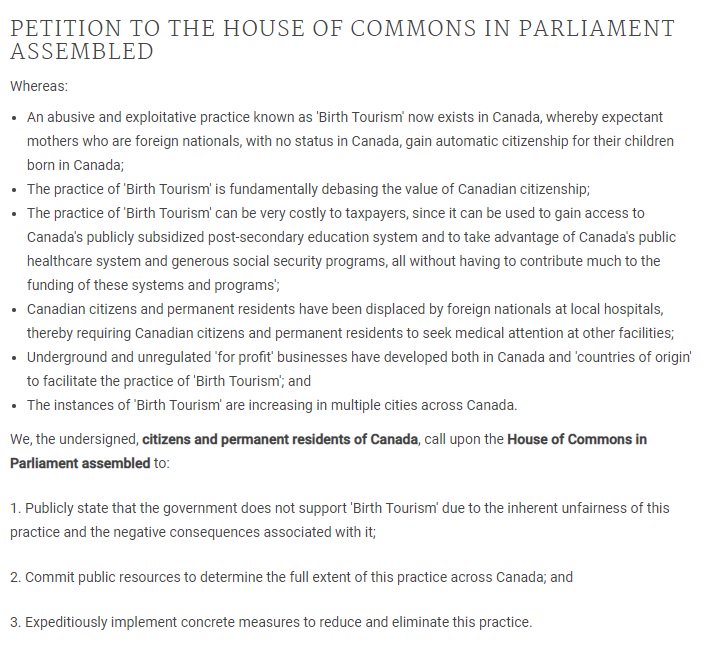
Peschisolido plans to present a parliamentary e-petition — which calls for an end to this “abusive and exploitative practice” and “concrete measures” to eliminate the birth tourism — to federal Immigration Minister Ahmed Hussen and Public Safety Minister Ralph Goodale.
In response to birth tourism, Australia and New Zealand changed their laws, granting citizenship to babies only when at least one parent is a citizen or a legal resident.
“Birth tourism is wrong and it undermines our immigration system and our health care system,” said Peschisolido. “The reason there are more than 8,000 signatures is that it violates people’s sense of fairness.”
Non-resident births account for two per cent of the 44,000 babies born in B.C. each year.
Non-residents are required to pay the costs associated with their care and the vast majority of these patients pay these fees without issue, said Laura Heinze, who speaks for the B.C. Health Ministry.
“The ministry in no way endorses or supports the marketing of maternity tourism,” she said. “Matters relating to immigration are the responsibility of the federal government.”
Pregnant women who come to Canada specifically to have a child with Canadian citizenship are not breaking the law, but they could be misleading immigration officials about their reasons for visiting Canada.
“If a person, including an expectant mother travelling to Canada, provides false information or documents, IRCC will refuse their application and that person could also be inadmissible to Canada for five years,” according to the federal Immigration, Refugees and Citizenship department.
This is the second time that the petition’s author, Kerry Starchuk, has tried to get the attention of the federal authorities. Her first petition launched in 2016 also gathered more than 8,000 signatures.
A report by Canadian immigration officials recommended changes to citizenship law to then-immigration minister Jason Kenney in 2014.
No action was taken by that Conservative government, but the number of foreign citizens coming to B.C. to give birth in order to secure Canadian citizenship for their child has risen dramatically since then.
People have until July 17 to sign the current petition.
Starchuk became concerned about growth of birth tourism after trying to greet new neighbours with cookies and came to realize the house was being used as accommodation for women from abroad who were about to give birth.
“I’ve done my part being a good neighbour, but this is exploiting the system,” she said. “They are not here to be my neighbours and I’m not OK with that.”
A Vancouver Sun investigation in 2016 found more than two dozen so-called baby houses were providing services and accommodation to birth tourists in B.C.
“These people are jumping the queue when people are waiting to immigrate,” she said. “I don’t see how being born here like this justifies citizenship.”
Petition supporter Gary Liu said the practice of birth tourism is generally “despised” in the immigrant community.
“People who have worked hard to learn the language and raise their families — and everyone has their own struggles and stories — they feel like this is a quick pass for some people,” said Liu, who has lived in Canada for more than 20 years.
Liu believes more rigorous application of existing rules by Canada Border Services Agency and enforcement of zoning bylaws against baby houses would minimize the practice.
Canada and the United States are the only G-7 nations that grant automatic citizenship for babies born in-country to foreign nationals. Critics complain that so-called “anchor babies” become a legal foothold in Canada to gain immigration access for the rest of their families.
Although the overall number of birth tourists is low compared to the total number of births in Canada (see What happened to Kenney’s cracking down on birth tourism? Feds couldn’t do it alone | hilltimes.com), appropriate to ensure that any unpaid bills are collected. “Birth houses” at a minimum need to be regulated if not banned given this is clearly an abuse, even if relatively small, of our immigration and health systems:
Record numbers of so-called birth tourists, mainly from China, are expected at Richmond Hospital this year. Yet the Vancouver Coastal Health Authority has no plans to deter women from having their babies at the hospital to give them Canadian citizenship, despite suing a woman for nonpayment of $313,000 for her delivery.
The lawsuit filed in April relates to a birth in 2012 that involved complications and kept the lawsuit defendant, Yan Xia, and her infant, in the hospital for an extended time. Xia has not yet filed a statement of defence.
Although the hospital reserves the right to add interest charges of two per cent a month to unpaid bills, a spokeswoman said that is not the plan at this point. If such interest were to be added, the bill would exceed $1 million.
There has been a steady increase in the number of babies born to non-resident mothers at Richmond Hospital, to 384 in 2016-17 from 18 in 2010. Halfway through the 2017-18 fiscal year, there were 189 non-resident births, according to VCH spokeswoman Carrie Stefanson.
While all pregnant women are asked to register well in advance of giving birth so that hospital resources can be planned, there have been no measures taken by the hospital to deter birth tourism, which now accounts for 20 per cent of its deliveries. That is believed to be the highest proportion in the province, if not Canada. B.C. Women’s Hospital discourages birth tourism through various policies and practices. At times, Richmond Hospital has to send local women in labour to other hospitals when it is too busy.
The birth tourism phenomenon is tied to several factors, including Richmond’s demographics, a preponderance of “birth houses” for pregnant Chinese women in the city, the large number of doctors and nurses who speak Cantonese or Mandarin, and an industry fuelled by brokers who charge high fees to make the arrangements for women wanting to have so-called “anchor” babies in Canada.
Stefanson said she believes the Xia case is the only maternity lawsuit over $100,000 so far. Typically, the health authority uses other means to collect unpaid bills.
“VCH has invoiced non-residents for approximately $43 million in (all kinds of medical) services in the past year, and has collected about 80 per cent of that amount,” she said.
In the Xia case, such efforts have been unsuccessful, and with a six-year deadline for legal action approaching, the health authority decided it was time to take that action. Xia’s whereabouts are unknown.
Stefanson said the hospital exists to provide health care and will never deny urgent hospital care to anyone based on their ability to pay or where they are from.
She said the health authority expects foreigners will have travel insurance or some other means of paying. Non-resident pregnant women who go to any hospital in B.C. are expected to pay a deposit of $8,200 for a vaginal birth and $13,300 for a caesarean delivery. If they stay in the hospital for at least a night, there may be additional charges. In the past year, VCH has invoiced non-resident maternity clients $6.2 million, and 82 per cent of that amount has been recovered.
An article posted on the “Hongcouver” blog in the South China Morning Post says Richmond is at the centre of the birth tourism phenomenon. It highlighted one “birth house” called the Baoma Inn and its Instagram account showing photos of smiling expectant or post-delivery Chinese mothers enjoying touristy outings around Vancouver. Also pictured are newborns asleep, next to their new Canadian passports. In addition to pre- and post-partum accommodation, the inn is said to be able to arrange birth certificate and passport services plus getting newborns enrolled in the B.C. Medical Services Plan so they can receive publicly funded health care after they’ve resided in the province for three months.
The Baoma Inn is one of the dozens of so-called birth houses in Richmond. It is not known what birth house the defendant in the VCH case used, or even if she stayed in one.
The South China Morning Post article pointed out that Canada is one of a few countries (including the U.S.) that offers citizenship to babies born in the country, regardless of the nationality of parents. By contrast, in China, nationality is acquired upon birth only if one parent is a Chinese national, similar to policies in Australia and Britain.
David Georgetti, the Mandarin-speaking lawyer retained by VCH to litigate the case, could not be reached for comment.
A petition by a group of Metro Vancouver residents is demanding Ottawa crack down on birth tourism in Canada.
Richmond resident Kerry Starchuk started the electronic petition. She has been campaigning on this issue for the last two years since discovering a neighbouring house was a so-called “birth house,” which caters to pregnant women who come to Canada to give birth so their child is automatically granted Canadian citizenship.
“It’s wrong. It’s jumping the queue,” said Starchuk of the practice, an increasing trend in Richmond where the majority of birth tourists hail from China.
In 2016-2017, 384 babies were born to non-residents at Richmond Hospital, said Vancouver Coastal Health — a significant jump from 18 cases in 2010. Between 2014 and 2017, 1,020 newborns were born to non-residents.
The rise in birth tourism has spawned an underground economy with unregulated agencies and brokers offering services to pregnant clients, including airport pickups, room and board, and assistance with obtaining documents such as a Canadian passport for the infant.
For Starchuk, birth tourism undermines the value of Canadian citizenship by essentially buying a lifetime’s privilege for the price of a hospital procedure, housing costs, and a return plane ticket.
“It’s not truthful, it’s deceitful and it’s short-sighted,” she said. “We don’t know what the consequences are going to be in 18 years. Are we prepared for it?”
The petition, identified as E-1527 in the House of Commons, is sponsored by Liberal Richmond MP Joe Peschisolido. It calls on the federal government to denounce birth tourism; determine the extent of the practice in Canada; and implement measures to reduce and eliminate it. It has received more than 620 signatures as of Tuesday.
Gary Liu, whose family immigrated to Taiwan when he was a teen, said most immigrants are also against birth tourism.
“Almost all of them despise this kind of practice,” said Liu, a Burnaby resident. “This is a very unfair practice to all immigrants.”
The petition is Starchuk’s second attempt to get the federal government to take action.
Her first petition in 2016, sponsored by Conservative MP Alice Wong, urged the government to end jus soli, or automatic birthright citizenship.
It received more than 8,800 signatures and was presented to the House of Commons, but went nowhere because the government felt revoking birthright citizenship would require a major overhaul of how Canadian citizenship is granted.
Liu said the rejection of that petition in 2016 was seen by some as an endorsement by the federal government of birth tourism. He hopes this second petition will gain more traction.
Starchuk said birth tourism happens across Canada, but are most prevalent in Richmond and Toronto, where the women are usually from Russia or Nigeria.
In 2016, the B.C. government said it was aware of 26 birth houses in the province.
Starchuk said more data is needed to get a grip on the extent of the practice in Canada.
“We’re hoping to have Canada-wide statistics,” she said. “We don’t know if it could be happening in West Vancouver or Langley.”
Vancouver Coastal Health spokeswoman Carrie Stefanson said figures for babies born to non-residents in other hospitals in the region are not immediately available, but said those numbers would be small.
The health authority “does not endorse or support marketing of maternity tourism and we are concerned about the impact it is having on our ability to provide quality services to every resident maternity patients,” Stefanson said.
Women who intend to use Richmond hospital to give birth are asked to pre-register six to eight weeks before their due date in order to enable to hospital to plan ahead.
Stefanson said Vancouver Coastal Health is committed to collecting payment from non-residents who use medical services, but wouldn’t deny urgent care based on a person’s ability to pay.
Peschisolido, who is in Ottawa, denounced birth tourism in a statement issued to media on Tuesday.
“Birth tourism is wrong,” he said. “Women are being exploited by organized efforts to take advantage of the system.”
The federal government’s rationale for trying to deny Canadian citizenship to the Toronto-born son of Russian spies leads down an “absurd and purposeless” path, the young man’s lawyers argue.
They’re asking the Supreme Court of Canada to dismiss the government’s application for a hearing of the legal issues at the heart of the strange espionage saga that has left Alexander Vavilov, 23, in limbo.
Accepting the federal position “would result in uncertainty about an individual’s fundamental right to citizenship,” Vavilov’s counsel say in a brief filed with the high court.
The Supreme Court will announce in coming weeks whether it’s going to hear the case, though no date has been set for the decision.
The government is appealing a ruling that returned Canadian citizenship to Vavilov after it was revoked by Ottawa.
Vavilov, 23, was born in 1994 as Alexander Philip Anthony Foley to Donald Heathfield and Tracey Ann Foley. The following year the family — including an older boy, Timothy — left Canada for France, where they spent four years before moving to the United States.
The FBI turned up at the family’s Boston-area home eight years ago. In all, 11 people — four of whom claimed to be Canadian — were indicted on charges of conspiring to act as secret agents on behalf of the SVR, the Russian Federation’s successor to the notorious KGB.
Heathfield and Foley admitted to being Andrey Bezrukov and Elena Vavilova.
The FBI said Bezrukov had based his cover identity on the birth record of a baby with the surname Heathfield who died in Montreal at the age of six weeks in early 1963.
Bezrukov and Vavilova were among those sent back to Moscow — part of a swap for prisoners in Russia.
Alexander finished high school in Russia, studying in English.
He changed his surname to Vavilov on the advice of Canadian officials in a bid to obtain a Canadian passport. But he ran into trouble at the passport office and in August 2014 the citizenship registrar informed Vavilov the government no longer recognized him as a citizen of Canada.
The registrar said his parents were employees of a foreign government at the time of his birth, making him ineligible for citizenship. The Federal Court upheld the decision two years ago.
Last June the Federal Court of Appeal set aside the ruling and threw out the registrar’s decision. It said the provisions of the Citizenship Act cited by the registrar shouldn’t apply because Vavilov’s parents did not have diplomatic privileges or immunities while in Canada.
In its application to the Supreme Court, the federal government says the registrar’s original decision was “rational and defensible.”
The appeal court’s interpretation, on the other hand, means the legislative provisions in question deny citizenship to children of foreign intelligence agents posted to an embassy and benefiting from diplomatic privileges, while allowing citizenship for children of undercover intelligence agents engaged in surreptitious espionage.
In their filing with the Supreme Court, Vavilov’s lawyers say the government’s view of the Citizenship Act is unreasonable and would lead to absurd outcomes.
Aside from diplomatic or consular officers, many foreign governments employ people in Canada through a wide range of state-owned enterprises including banks, airlines, energy companies and other national ventures, they point out. The government’s stance would expand the exception to citizenship by birth to encompass all children born to parents working for such employers.
“This would mean, for example, that children born to employees of foreign private oil companies operating in Alberta would be Canadian, while those born to employees of state-owned oil companies would not,” the submission reads.
“Similarly, children born to employees of foreign private airlines working at Canadian airports would be Canadian, while children born to employees of state-owned airlines working in those same airports would not.
“These results are absurd and purposeless.”
Limiting the exception to citizenship to children born to foreign officials or employees who enjoy diplomatic immunities and privileges provides far greater certainty, Vavilov’s lawyers conclude.
In a reply, the government characterizes the examples as “hypothetical scenarios” that “would undoubtedly be more complex and benefit from this court’s guidance in the present case.”
Timothy Vavilov, 27, also went to Federal Court after being stripped of Canadian citizenship, and the outcome of his case could ultimately hinge on the result of his brother’s proceedings.
I agree with the government on this one. And the brothers have lived abroad most of their lives with the main connection to Canada being their passport:
A judge has ordered the Trudeau government to issue citizenship documents—and a passport—to the Toronto-born son of elite Russian spies, ruling that the 23-year-old should be allowed to return to Canada even though the Supreme Court is still pondering whether to hear one last appeal in his controversial case.
Alexander Vavilov was stripped of his Canadian citizenship “through no fault of his own,” the judge ruled, and after winning it back last summer at the Federal Court of Appeal, he should not be forced to wait in limbo while Ottawa tries to convince the country’s top court to overturn that decision. Instead, the Liberals should reinstate Vavilov’s revoked citizenship—and allow him to come home—pending any potential ruling from the Supreme Court.
“It is difficult to accept that issuing these documents to this one person will cause significant and irreparable harm to the public interest,” wrote Justice Wyman Webb of the Federal Court of Appeal, in his Jan. 19 decision. “There is no allegation that Mr. Vavilov did anything wrong.”
Ottawa has fought for years to keep Vavilov from re-entering his country of birth, and despite this latest ruling the government is still doing all it can to keep him out. Instead of conceding defeat, Justice Department lawyers filed yet another motion last week, asking the Federal Court of Appeal to reconsider. The feds remain adamant that nothing should happen on the contentious file until the Supreme Court decides, once and for all, whether Vavilov is indeed a Canadian.
The high court has yet to announce whether it will weigh in on the matter, and is under no deadline to do so.
Vavilov was born in Toronto in 1994 as Alexander Philip Anthony Foley, the second son of a husband-and-wife team of deep-cover KGB agents who slipped into Canada during the Cold War and stole the identities of two dead babies from Montreal: Donald Howard Heathfield and Tracey Lee Ann Foley. Alex and his older brother, Timothy, spent their childhood oblivious to the fact that their parents’ real names were Andrey Bezrukov and Elena Vavilova, or that their mom and dad were prized assets of Russia’s foreign intelligence service. The boys were still young when the family moved to France, then Massachusetts—where, in 2010, the couple was arrested in a high-profile FBI raid that later inspired the hit TV series The Americans. Tim was 20 when his parents were exposed; Alex was 16.
After the bust made headlines around the world, immigration officials in Ottawa concluded that both brothers were never Canadian to begin with, despite being born here, because their parents were “employees in Canada of a foreign government,” a rare exception to the birthright rule under the Citizenship Act. Now Russian citizens who changed their last name to Vavilov, Alex and Tim have been battling in court to regain their Canadian status, arguing, among many other things, that they should not be punished for their parents’ espionage.
Though they lived abroad most of their lives, the brothers always travelled with Canadian passports and identified themselves as Canadians. “It is an integral part of my identity, the way others recognize me and is a recognition of certain values,” Alex told Maclean’slast year. “It is unacceptable that that the government may strip me of my rights just because it wants to.”
The feds appear especially eager to keep Tim, the eldest brother, from coming back. According to a report prepared by a senior immigration official, the Canadian Security Intelligence Service (CSIS) has told the government that Tim not only knew the truth about his parents’ double lives, but had pledged to join them—having been “sworn in” by the SVR, the KGB’s post-Soviet successor, before his mother and father were arrested.
Specific evidence to support that claim has never been revealed, and Tim, now 27, denies the accusation. “I am aware that there have been some media reports that my parents were ‘grooming’ me for espionage,” he wrote in one sworn affidavit. “These allegations are not true. It has been stated by the FBI that for over 10 years my home was bugged, however no evidence of my involvement has ever been presented.”…
As in the case of similar debates in Canada, the conversation largely occurs based on anecdotal evidence rather than hard data (see my analysis of the push by the Conservative government against birthright citizenship and the relatively small numbers involved What happened to Kenney’s cracking down on birth tourism? Feds couldn’t do it alone).
The estimated annual numbers – 36,000 according to The Center for Immigration Studies which wants stricter limits on immigration – is small compared to the overall number of births of about four million (2015), or about 0.9 percent:
Lured by the charm of little Havana or the glamour of South Beach, some 15 million tourists visit Miami every year.
But for a growing number of Russian women, the draw isn’t sunny beaches or pulsing nightclubs. It’s U.S. citizenship for their newborn children.
In Moscow, it’s a status symbol to have a Miami-born baby, and social media is full of Russian women boasting of their little americantsy.
“It’s really common,” said Ekaterina Kuznetsova, 29. “When I was taking the plane to come here, it was not only me. It was four or five women flying here.”
Ekaterina was one of dozens of Russian birth tourists NBC News spoke to over the past four months about a round-trip journey that costs tens of thousands of dollars and takes them away from home for weeks or months.
Why do they come?
“American passport is a big plus for the baby. Why not?” Olesia Reshetova, 31, told NBC News.
“And the doctors, the level of education,” Kuznetsova added.
The weather doesn’t hurt, either.
“It’s a very comfortable place for staying in wintertime,” Oleysa Suhareva said.
It’s not just the Russians who are coming. Chinese moms-to-be have been flocking to Southern California to give birth for years.
What they are doing is completely legal, as long as they don’t lie on any immigration or insurance paperwork. In fact, it’s protected by the 14th amendment to the U.S. Constitution, which says anyone born on American soil is automatically a citizen.
The child gets a lifelong right to live and work and collect benefits in the U.S. And when they turn 21 they can sponsor their parents’ application for an American green card.
As president, Donald Trump has indicated he is opposed to so-called chain migration, which gives U.S. citizens the right to sponsor relatives, because of recent terror attacks. And as a candidate, he called for an end to birthright citizenship, declaring it in one of his first policy papers the “biggest magnet for illegal immigration.”
“You have to get rid of it,” he said on “Meet the Press” on NBC. “They’re having a baby and all of a sudden — nobody knows — the baby is here. You have no choice.”
In a twist, as the Daily Beast first reported, condo buildings that bear the Trump name are the most popular for the out-of-town obstetric patients, although the units are subleased from the individual owners and it’s not clear if building management is aware.
There is no indication that Trump or the Trump Organization is profiting directly from birth tourism; the company and the White House did not respond to requests for comment.
Roman Bokeria, the state director of the Florida Association of Realtors told NBC News that Trump- branded buildings in the Sunny Isles Beach area north of Miami are particularly popular with the Russian birth tourists and Russian immigrants.
“Sunny Isles beach has a nickname — Little Russia — because people who are moving from Russian-speaking countries to America, they want … a familiar environment.”
“They go across the street, they have Russian market, Russian doctor, Russian lawyer,” he added. “It’s very comfortable for them.”
Reshetova came to Miami to have her first child, hiring an agency to help arrange her trip. The services — which can include finding apartments and doctors and obtaining visas — don’t come cheap. She expects to pay close to $50,000, and some packages run as high as $100,000. Bokeria says some landlords ask for six months rent up front.
One firm, Miami Mama, says it brings about 100 Russian and Russian-speaking clients to the U.S. per year, 30 percent of them repeat clients. The owners are Irina and Konstantin Lubnevskiy, who bought Miami Mama after using the firm to have two American children themselves.
The couple says they counsel clients to be completely transparent with U.S. immigration officials that they’re expecting.
“We tell every client, ‘You have the documents, you have to tell the truth. This is America. They like the truth here,'” Konstantin said.
“I would like the American people to understand they don’t have to worry,” he added. “Those who come here want to become part of the American people.”
But Miami Mami has drawn scrutiny from law enforcement. In June, it was raided by the FBI, and an employee was convicted of making false statements on passport applications. The owners say they knew nothing about it, fired the worker and their business license was renewed.
Federal prosecutors declined to comment on the case, and the FBI said it could not discuss “an active investigation.”
There is no official data on birth tourism in the United States. The Center for Immigration Studies, which wants stricter limits on immigration, estimates there are 36,000 babies born in the U.S. to foreign nationals a year, though the numbers could be substantially lower. Florida says births in the state by all foreign nationals who live outside the United States have jumped 200 percent since 2000.
Customs and Border Protection says there are no laws governing whether pregnant foreign nationals can enter the country or give birth here.
“However, if a pregnant woman or anyone else uses fraud or deception to obtain a visa or gain admission to the United States, that would constitute a criminal act,” the agency said.
When federal agents raided California “maternity hotels” catering to Chinese clients in 2015, authorities said in court papers that some of the families falsely claimed they were indigent and got reduced hospital rates.
In Miami, the Jackson Health System said 72 percent of international maternity patients — who represented 8 percent of all patients giving birth last year — pay with insurance or through a pre-arranged package.
While in the United States, the concept that the Vatican might influence public policy is outrageous, in Italy, the relationship between politics and the Catholic Church is like a well-made cappuccino: The espresso and milk foam may seem separated at first, but once you drink it, they blend into one.
Popes theoretically handed in their temporal power almost 150 years ago, but their voice and opinions still hold considerable weight in public discourse, which, in Italy as well as in many parts of the world these days, is centered around the immigrant crisis.
In the past, Pope Francis has been hesitant, if not downright opposed, to using his hefty popularity to intervene directly in matters of Italian public policy. But while the pope remained quiet as Italy’s parliament passed a law on de facto-couples, which critics say opened the road towards gay marriage, he was vocal on a recently proposed law concerning citizenship to the children of long-term immigrants.
The legislation is based on the concept of ius soli, which establishes citizenship depending on where you are born and not ius sanguinis, requiring a blood lineage, and would offer citizenship to the children of immigrants born in Italy who have completed at least five years in the Italian school system.
Under Italy’s current ius sanguinis system, it’s difficult and somewhat rare for the children of immigrants to the country to acquire citizenship. Under a ius soli standard, it would become much easier.
The country’s senate is currently at a standstill on the law, with opposing parties entrenched in a battle where no political blows are spared.
At the weekly general audience Sep. 27, Francis extended his arms wide toward St. Peter’s square and called faithful to welcome migrants and refugees.
“Just like this,” the pope said, “arms wide open, ready for a sincere, affectionate, enveloping embrace.” He then praised the work done by the civil organizations involved in collecting signatures in order to push the ius soli legislation forward.
This wasn’t the first, nor most adamant time the pope publicly expressed his support for the legislation, causing distress and outrage on the part of those who strongly oppose it. Matteo Salvini, leader of the populist right-wing party Northern League tweeted that if the pope “wishes to apply the law in his State, the Vatican, he can go ahead. But as a Catholic, I don’t believe Italy can welcome and sustain the entire world. To God what is of God and to Caesar what is of Caesar. Amen,” to which he added his staple hashtag ‘stoptheinvasion.’
The pope had used the same quote from the Gospel in an interview with sociologist Dominique Wolton, where he stressed how “the lay state is a healthy thing,” but Francis’s recent statements on the ius soli show that when the topic is close to his heart, he is not willing to back down.
…A chorus of priests, bishops and cardinals joined in their support of the ius soli legislation, with Bishop Nunzio Galantino, secretary general of the Italian Bishop’s Conference (CEI), saying that if a way was found to accelerate things with regards to the rights of same-sex couples, “the same attention should be given to the rights of Italians left without citizenship.”
“The Vatican doesn’t vote,” the bishop clarified, “but the Church is bound to call out the heart of the matter.”
On Sep. 25 the president of CEI, Cardinal Gualtiero Bassetti, also joined the ranks in favor of the controversial law, adding that while welcoming immigrants is an important first step, “there is another responsibility, promulgated over time, that has to be tackled with prudence, intelligence and realism.”
Many reporters spotted a difference of expression between Francis’s “open arms” approach and CEI’s call to caution, but Vatican Secretary of State, Cardinal Pietro Parolin, quickly shot them down.
“You can welcome people with open arms, but also with prudence,” Parolin told reporters Sep. 27, before taking part in Rome’s Lateran University’s conference sponsored by the pontifical organization Aid to the Church in Need on the situation facing Christians in Iraq’s Nineveh Plains area.
“The fundamental thing is welcome, because they are our brothers and sisters,” Parolin said. The prelate said that in the context of this “very intense Italian political debate,” it’s best if the Vatican sticks with “recalling principles.”
“What’s important is that these people not just be welcome but integrated, so that they can be inserted in a positive way into the fabric of our society,” Parolin said.
Good piece by David Graham of The Atlantic on one of the Republican obsessions.And an obsession, of course, that the Conservative government pursued with respect to citizenship revocation for terror or treason (in the process of repeal by the current government) and birthright citizenship, where they tried to end the practice but gave up provincial opposition due to the high cost compared to the small numbers involved:
Depriving someone of their citizenship is one of the harshest sanctions a government can levy—not as lastingly grave as execution or life imprisonment, perhaps, but still very serious, especially for someone who is not a dual citizen and would therefore be left stateless. (It’s a situation that Edward Everett Hale dramatized in his famous short story “The Man Without a Country,” published in The Atlantic in December 1863.)
Yet recent years have seen a vogue among Republicans for proposing to strip citizenship as a punishment for various crimes. In 2014, Senator Ted Cruz, a Trump frenemy-turned-enemy-turned-supporter-turned-rumored-appointee, proposed stripping citizenship from any American, native-born or naturalized, who declared allegiance to a foreign terrorist organization, became a member of such an organization, or provided training or material assistance. Senator Rand Paul floated a similar proposal around the same time. Earlier this year, Newt Gingrich, a close Trump adviser, called for stripping citizenship from and deporting any Muslim who believes in sharia law, a proposal that is impractical, nonsensical, and virtually guaranteed to be unconstitutional. Somewhat more perplexingly, Ben Carson called in a 2014 column for non-citizens who vote fraudulently to be stripped of the citizenship they don’t possess.
A different but related current is the occasional call, usually from Republicans, for an end to birthright citizenship, which grants American citizenship to anyone born in the United States—most notably to the children of immigrants, whether authorized or not. Ending birthright citizenship was one of the earliest policies that Trump rolled out in the summer of 2015, saying, “This remains the biggest magnet for illegal immigration.” Several of his rivals for the Republican nomination announced that they agreed with him.The frequent proposals from conservatives and Republicans to strip citizenship as a punishment for a range of crimes—or in the case of birthright citizenship, for the crimes of one’s parents—illustrates a partisan difference in how citizenship is viewed. Progressives tend to think about citizenship as a right that, if acquired legally, cannot be taken away, even for heinous crimes. It is nearly absolute. Conservatives, however, tend to view it as a privilege, and while it might be the default, it can still be withdrawn, as in the case of Americans who join terrorist groups. The right tends to view the left’s version as insufficiently patriotic, but it’s simply a different view of patriotism, and perhaps one that is more constitutionally grounded.
(In a separate and controversial move, President Obama decided he could kill American citizens fighting for terrorist groups overseas, such as the radical cleric Anwar al-Awlaki, without trial—thus depriving Awlaki of another of his rights—a decision that was decried by civil libertarians.)
Birthright citizenship is one of those areas in which the United States is unusual—even exceptional. Just 33 countries around the world offer it. The legal matter has been more or less settled since 1898, when the Supreme Court ruled that children of foreigners who are born in the United States are, according to the 14th Amendment, citizens, though some scholars have argued that does not cover unauthorized immigrants.Stripping citizenship is another area in which the United States has taken an exceptional stance. Governments from oppressive Middle Eastern police states to Western European countries have used the tactic as a punishment for various crimes. Libertarian journalist Matt Welch suggested in late 2015 that there’s a global trend toward it. In 2014, the United Kingdom established the maneuver for terror suspects, and Australia did the same a year later. French President Francois Hollande this year dropped a similar proposal, brought up after terror attacks in 2015, in the face of opposition.
Doing the same in the United States would likely be impossible. The Supreme Court ruled in Afroyim v. Ruskin 1967 that American citizens could not be stripped of their citizenship involuntarily. Wikipedia has a useful though incomplete list of those who have had their citizenship stripped. Generally, those cases in recent decades fall into a three clear, sometimes overlapping, groups: spies, former Nazis, and those who acquired their citizenship fraudulently, i.e., by lying during the naturalization process. Even Emma Goldman, the famed anarchist leader, was stripped of her citizenship not explicitly for being an anarchist, but on a technicality: She had obtained citizenship through marriage to a man who was a naturalized citizen, and the government determined that the ex-husband had fraudulently obtained his citizenship, thus invalidating hers as well.
Throughout the 1950s, as Atossa Araxia Abrahamian wrote in Dissent in 2013, there were plenty of cases of Americans, both naturalized and native-born, who were stripped of their citizenship for having various foreign ties. But the Supreme Court eventually stamped that practice out in Afroyim. Some conservative legal scholars have argued for a new legal regime in which citizenship could be stripped in certain circumstances. Richard Epstein, a law professor at the University of Chicago, frames the conservative case for citizenship as a privilege this way:
“Think of the United States as a quasi-partnership, which has to set its rules for the admission and exclusion of its member citizens. I know of no private association that states that an individual can lose his place in the firm only if he voluntarily resigns. Virtually every well-drafted agreement understands that these relationships depend upon trust, and thus allows a forcible removal for cause.”
Epstein reasons, “The same for-cause rule applies to common carriers who have to take all customers on reasonable and nondiscriminatory terms. Even they can exclude rowdy or drunken individuals.” Whether something as fundamental as citizenship should be treated similarly to the right of an unruly, besotted patron to get one more nightcap is a matter on which people are likely to disagree.
In any case, adopting Epstein’s point of view would require a Supreme Court decision overruling the Afroyim precedent and returning the United States to the system more as it was in the 1950s and 1960s. Trump is likely to have a chance to make some at least one Supreme Court appointment; perhaps this is the America to which his campaign slogan suggested returning.
Another take on “anchor babies” from the perspective of the children and their families:
“Anytime you eat at a Chinese restaurant in Chinatown, it’s likely that somebody in that restaurant has a child who is in China at the moment,” says Cindy Liu, a psychologist at Harvard University. She points out that no one knows exactly how many Chinese immigrant families send their babies to be raised by family in China.
That’s partly why she helped start a research project focusing on Chinese immigrants in the Boston area who are raising what some psychologists call “satellite babies.” Like satellites in space, these children leave from and return to the same spot.
You can find similar arrangements among immigrant communities from South Asia, Africa and the Caribbean, researchers say. The satellite babies of Chinese immigrants usually come back to the U.S. in time for school.
When Satellite Babies Go To School
For their study, Liu and her colleagues interviewed adults who were once satellite babies to try to track the long-term impacts of the experience. Researchers say there are benefits from spending your early years in another country, away from your birth parents. Many satellite babies are exposed to their immigrant parents’ mother tongues and often develop strong ties with their grandparents and other extended relatives.
While Liu says that separation between satellite babies and their biological parents does not necessarily harm their relationship, some teachers and principals in New York City, where researchers also see this phenomenon, say these children can sometimes show subtle signs of trauma.
“They’re always looking around to see who’s there with them,” says Principal Elizabeth Culkin of P.S. 176 in Brooklyn. “And they always need that sense of knowing where they are and who’s there to protect them.”
Five-year-old Vivien Huang reads a book in her kindergarten classroom. After being raised in China, her teacher says she’s eagerly learning English from picture books.
Jennifer Hsu/WNYC
Members of Culkin’s staff say sometimes these children may act out by pushing or shoving other students to get attention. There are, of course, language difficulties, and some children show signs of attachment disorders.