Hospital birth data suggests increase in birth tourism, says immigration expert

Globe coverage of my policy options article:

Births in Canada to foreign visitors and other non-residents have risen in the past year, an expert in immigration statistics has found after analyzing hospital data. 

The research, published in a report on Wednesday, shows a small increase in births at Canadian hospitals to temporary residents, such as international students and people here on work permits.

The proportion of births to people who are not settled in Canada is small compared with births in the country overall, but the number of temporary residents in Canada has been dropping as the federal government has reduced immigration.

According to the report, authored by Andrew Griffith, a former director-general at the federal immigration department, the data suggest an uptick in births to women here on visitor visas, otherwise known as birth tourism. …

Source: Hospital birth data suggests increase in birth tourism, says immigration expert, Policy Options Birthright citizenship and the politics of “birth tourism”

Korea: Court denies dual citizenship application, citing ‘birth tourism’

Of note:
A Seoul court has supported the rejection of an application for dual US-South Korean citizenship because their parent’s residence in the US was for the purpose of their child gaining US citizenship.The Seoul Administrative Court said Monday that it had ruled in favor of the Seoul Southern Immigration Office, which rejected the plaintiff’s February 2024 application to retain the citizenships of both countries.

South Korea’s Nationality Act states that a child of a citizen obtains citizenship at birth, and the Fourteenth Amendment of the US Constitution grants citizenship to anyone born inside its territories. This means that someone born in the US to parents who are Korean citizens — as in case of the plaintiff — is granted dual citizenships at birth.

Dual citizens at birth are usually allowed to retain the nationality of South Korea and another country by pledging to the government not to exercise the rights of foreign citizenship before the age of 22, or within two years of completing their mandatary military service in the case of men. This is to prevent dual citizens from dodging duties mandated for South Koreans, such military service.

But the immigration office refused to allow dual citizenship to the plaintiff, saying that the plaintiff’s mother is thought to have lived in the US only for the explicit purpose of obtaining US citizenship for her child — sometimes referred to as “birth tourism.” The Nationality Act states that in cases where the parent is “deemed to have resided in a foreign country for the purpose of having the person acquire the nationality of the foreign country,” the child can retain his or her South Korean citizenship only after renouncing the other nationality.

The plaintiff’s mother went to the US in 2003 just before giving birth to the plaintiff, staying in the country for a month and a half. She went back to the US in 2011 and lived for four months since then.

“There are substantial grounds to believe (that the plaintiff’s mother) gave birth in a foreign country, with the intent to have the child gain the citizenship there,” the court said in its verdict.

The plaintiff denied that the mother’s stay in the US was for the purpose of ensuring her child had US citizenship, saying that she lived for four years in the country overall.

The Article 17-3 of the Enforcement Decree of the Nationality Act does state that a person who lived for two or more years in a country and gave birth there cannot be considered as having conducted birth tourism. But the court said this clause applies to parents who stayed for two consecutive years at the time of the birth of the child.

“The Nationality Act of this country had applied strict single nationality principle, and has only allowed dual citizenship on a limited number of cases since 2010. If the court interprets the article (Article 17-3) as the plaintiff claims, we cannot achieve the act’s goal of preventing birth tourism,” the court went on to say.

Source: Court denies dual citizenship application, citing ‘birth tourism’

LoP – Canadian Citizenship: Practice and Policy

Good comprehensive review by the Library of Parliament of legislative and policy issues along with related history. Lots of familiar references to declining rates of citizenship, “lost Canadians” and birth tourism. Executive Summary below:

Canadian citizenship can be obtained through birth on Canadian soil, by descent through birth or adoption outside of Canada to a Canadian citizen, or through naturalization (the process by which citizenship is obtained by a foreign national). Requirements related to citizenship are laid out in the Citizenship Act, as well as in the Citizenship Regulations and Citizenship Regulations, No. 2.

Responsibility for implementing the Citizenship Act lies with the Minister of Immigration, Refugees and Citizenship, who is supported by Immigration, Refugees and Citizenship Canada (IRCC) in managing the citizenship application process. The Citizenship Commission – an administrative body under IRCC that is made up of citizenship judges – also plays an important role, with duties including assessing citizenship applications to ensure they meet certain requirements under the Act and administering the Oath or Affirmation of Citizenship.

To become a Canadian citizen through naturalization, an individual must first obtain permanent residency in Canada and then apply for citizenship after meeting residency and other requirements. Applicants between 18 and 54 years of age must also complete a written test based on the official citizenship study guide (Discover Canada: The Rights and Responsibilities of Citizenship) and attend an interview to test their abilities in English or French and to discuss their application. Successful applicants attend a citizenship ceremony and take the Oath or Affirmation of Citizenship, through which they swear or affirm their allegiance to the King of Canada.

Loss of citizenship can occur if it is revoked (for example, due to citizenship being acquired or retained through false representation) or it can be renounced voluntarily (for example, if an individual chooses to become a citizen of a country that does not allow dual citizenship).

Several issues are currently at the forefront of discourse on citizenship policy. For example, census data show that the rate of citizenship among recent immigrants to Canada declined between 2006 and 2021. The citizenship rate varies for different groups, with contributing factors including income level, education level and country of origin.

Another key issue is that of “lost Canadians,” which refers to individuals who were born before the 1977 Citizenship Act came into force and who should have been Canadian citizens under that Act but were deprived of Canadian citizenship because of outdated or obsolete provisions in the Canadian Citizenship Act of 1947. Many of the problems associated with “lost Canadians” have been addressed through amendments made to the Citizenship Act since 1977. Those whose cases are not covered by legislative amendments may be granted citizenship on a case-by-case basis at the minister’s discretion. Following a December 2023 Ontario court ruling, the federal government introduced Bill C‑71, An Act to amend the Citizenship Act, to address “lost Canadians” issues that remain following previous legislative amendments. This bill died on the Order Paper on 6 January 2025 when the 1st session of the 44th Parliament was prorogued, but the Court’s order is scheduled to come into effect on 19 March 2025.

Finally, the concept of birth tourism refers to the practice by foreign nationals of coming to Canada to give birth for the sole purpose of securing Canadian citizenship for their child. While data suggest an increase in non-resident births in the past two decades, it is difficult to determine how many non-resident births are cases of birth tourism. A federal initiative linking health and immigration data has shed further light on the topic….

Source: Canadian Citizenship: Practice and Policy

As birth tourism rises again, will Trump’s citizenship moves send more Canada’s way?

Some good reporting on the local birth tourism “industry” and their expectations regarding possible increased business resulting from Trump threats (my analysis referenced, would be nice to see some reporting from the GTA, given the number of hospitals with significant portions of non-resident self-pay births).

For those who worry that any measures might affect the vulnerable, the cost for birth tourism “packages” for Chinese nationals is, according the operators cited, in the order of $100,000:

Vancouver-based birth tourism operator Liga Lin says her phone has been buzzing with inquiries from expectant mothers since U.S. President Donald Trump moved to end American birthright citizenship.

Lin’s business, New Joy Postpartum Care, arranges accommodation and services for non-resident women — mostly from mainland China, Taiwan and Hong Kong — who want to give birth in Canada, granting their children automatic citizenship rights.

The industry also exists in the U.S., but Trump’s executive order seeking to end the right to citizenship at birth on American soil has thrown it into disarray, even as the measure was blocked by a U.S. district court judge who called it “blatantly unconstitutional.”

Chinese social media platform Xiaohongshu, known in English as RedNote, has numerous discussions among people in China about whether they should stick to their plan to give birth in the U.S. or switch to other countries with birthright citizenship, such as Canada.

Lin — whose packages can cost up to about $100,000 including housing, a nanny, a housekeeper and massages, recalled a phone call from a Chinese woman already in a U.S. “birth house,” panicking over Trump’s announcement.

“She is very worried, and she asked me if there is any similar move going on in Canada. She wanted to come to Canada instead,” Lin said in an interview in Mandarin.

Birth tourism in Canada slumped during the COVID-19 pandemic, but Lin and other British Columbia operators say inquiries from potential birth tourists are spiking since Trump’s election last year, and his recent executive order.

You Wu has run a “maternity care agency” in the Metro Vancouver city of Richmond, B.C., since 2013.

“My company has experienced an increase in consultation requests after Trump came into power. The most noticeable change is many clients deciding to switch from the U.S. to Vancouver,” Wu said in Mandarin.

She said there was a sense of urgency, compared with other times when potential clients would question her closely and hesitate to sign contracts.

“It’s fantastic news for people who work in this industry in Vancouver,” Wu said of the shift. 

Andrew Griffith is a former director-general of the Department Citizenship and Immigration, who has tracked the ups and downs of the birth tourism industry in Canada.

He said Trump’s executive order would require a constitutional amendment to stand, but it had already created uncertainty and panic among would-be U.S. birth tourists. 

“It’ll make it eventually to the Supreme Court, but in the meantime, there’ll be lots of chaos, lots of worries,” said Griffith.

He has released data showing the number of birth tourists to Canada “declined dramatically” during COVID-19 due to travel restrictions, dropping by 50 per cent. 

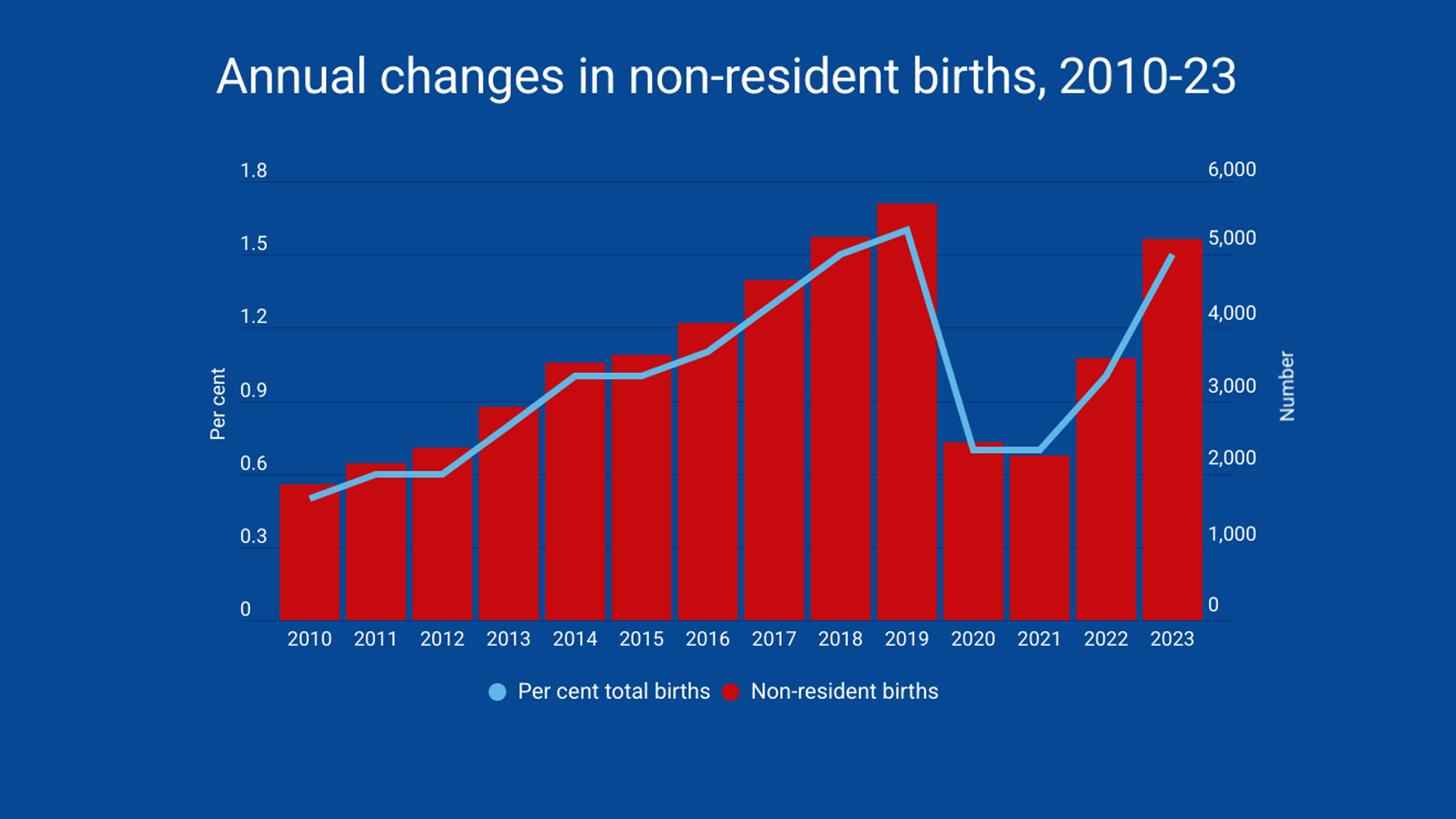
But he said births to non-residents are now back near pre-pandemic levels, jumping last year by 46 per cent to an estimated 5,219. 

That is only about 1.5 per cent of all births in Canada, although critics of birth tourism point to the potential burden on hospitals where the practice is most common.

“The number of births is quite small, but it does have an effect on the perception of fairness,” said Griffith.

Dr. Jon Barrett, chair of the Department of Obstetrics and Gynecology at McMaster University, published an opinion letter in the Journal of Obstetrics and Genaecology Canada in 2023, saying Canadian hospitals and physicians should have “absolutely zero tolerance” for birth tourism, and decline to accept these patients into care, unless it was urgent.

Doctors, he said, “should unite in a firm stand against birth tourism”, which put hospitals at risk of “significant shortfalls” if a birth went wrong, and birth tourists at risk of being “fleeced by unethical individuals.”

Richmond was once the “epicentre” of birth tourism in Canada, said Griffith. Data provided by Vancouver Coastal Health shows that in the 2018 fiscal year, more than 23 per cent of all babies born at Richmond Hospital had non-resident parents. 

But the health authority said “the number of non-resident births at Richmond Hospital for the past few years is a fraction of what it was 10 years ago,” and last fiscal year, the percentage of births that were to non-resident parents was 6.9 per cent.

Griffith said it’s unclear if Trump’s positions would have an impact on birth tourism in Canada, but discussions in the U.S. would pressure Canada to “revisit the need for curbs on birth tourism.”

“Canada and the U.S., in one sense, are the preferred destinations for people who would want to achieve citizenship,” said Griffith. 

“Whether a Canadian political party will pick up the issue like the Conservatives did in 2012 remains to be seen.”

Longtime immigration consultant Peter Peng was uncertain whether there would be an “overwhelming” influx of birth tourists in Canada. “If you ask me, if we will see a big trend this time, my answer is soft Yes, not a solid one,” he said in Mandarin.

And while Richmond-based birth tourism operator Wenshi Peng said inquiries had jumped three or four times since Trump’s executive order, this had not yet been converted to an increase in clients, he said.

Peng said he didn’t think birth tourists, who pay full price for medical services, burden Canada’s health system

“For mothers who don’t have Canadian citizenships to give births here, they usually need to pay (the hospital) at least $13,000, and the price usually doubles if they run into any trouble,” Peng said in Mandarin.

“I don’t think they have taken up any local health care resources.”

Lin said that the birth tourism industry in the United States was more established than in Canada but both had appeal for someone seeking foreign citizenship for their child.

America, she said, is known for elite universities, while Canada was known for safe campus environments and its social benefits.

“Years ago, many moms who worked at high-tech firms in Taiwan used to travel to the U.S. in groups to give birth, but now they will come here instead,” said Lin. 

She said that as a mother of two, she empathized with her clients as they navigated a foreign country to give birth.

Birth tourists just want a better future for their children, she said. 

“They are under stress, and I always try my best to comfort them,” said Lin.

“For parents who choose to give birth here, they are worried that ten years later, it will be more difficult for their children to pursue studies or even immigrate (due to policy changes). The costs at that time will be way higher than $100,000, because of inflation.”

Source: As birth tourism rises again, will Trump’s citizenship moves send more Canada’s way?

Attention: Birth Tourism Notice [Humber River Health]

Wonder whether other hospitals have similar language (Humber had the highest percentage of non-resident self-pay births 2023-24):

Please be advised that while Humber River Health provides a High Quality full service Obstetrical Program, we do not support birth tourism.

We are not affiliated, associated, or in any way officially connected with CanadaMama Consulting  or any other birth tourism agency – despite any social media or website advertising they may choose to produce.

We urge all patients and families to exercise caution and ensure proper due diligence before entering into an agreement with third party organizations offering birth tourism.

Should you have any questions about the programs or services offered at Humber River Health or our current partnerships, please contact our Patients Relations Representative directly at (416) 242-1000.

Non-OHIP Rates for Uninsured Patients

Thank you for choosing Humber River Health as the place to have your baby.  

Your care provider (physician or midwife) will review the finance process with you during your prenatal visits.  

Effective November 13, 2023, the total charge for non-OHIP patients planning to deliver at Humber is $10,028 for the delivery. However, the cost of the hospital stay is subject to change and can only be confirmed on the delivery day and specific care needs. Non-OHIP birthing fees apply to gestational surrogacy whereby any parties of the surrogacy arrangement are from of out of country (even if some parties have OHIP).  Fee details need to be discussed with Cashier’s Office and payment made prior to the hospital delivery.

We ask that patients pay the full fees ten (10 days) prior to their hospital delivery.  Once payment is made, an official receipt will be provided by Cashier Office.  You will present this official receipt to the Birthing Unit Triage desk at time of registration. 

You can make the payment by cash, debit or credit card in person at the Cashier Office located at Level 1 room 1e1006 (east of Tim Horton’s near Emergency Department Fast Track Zone) of Humber River Health Hospital at 1235 Wilson Avenue.  A copy of your receipt will be issued to you….

Source: Attention: Birth Tourism Notice

Matthews: Can we at least put a stop to ‘birth tourism’ (USA)?

Some useful data in the commentary:

President Trump ignited a flurry of activity with his executive order attempting to stop “birthright citizenship” — the constitutional provision that all children born on U.S. soil (including the territories) automatically become U.S. citizens. Based on the first judge to rule on Trump’s EO, it appears the administration faces an uphill battle in the courts. But whatever the courts decide on birthright citizenship, Americans should at least be able to agree that the practice of “birth tourism” is an abuse of the system and should be stopped.

Birth tourism is when pregnant women from other countries enter the United States for the purpose of having their child, who under the 14th Amendment automatically becomes a U.S. citizen, usually returning home thereafter.

For example, the health policy news site Fierce Healthcare wrote in 2009, “Of late, a growing number of well-to-do Mexican mothers have been coming to the U.S. to have their babies, who automatically get American citizenship since they were born on U.S. soil.” One Arizona medical facility marketed “a ‘birth package’ offering cutting edge technology, cozy settings and the chance for mothers to grant their babies American citizenship.” The facility even posted its (2009) prices: $2,300 for a vaginal birth and $4,600 for a c-section.

While Mexican women may have been the primary offenders in the past, the Center for Immigration Studies (CIS) reported in 2020 that the list of countries has expanded to China, Taiwan, Korea, Nigeria, Turkey, Russia and Brazil. It adds that birth tourism has grown dramatically in some of the U.S. territories, where Chinese citizens can easily obtain visas to visit.

A senior policy director at Georgetown Law’s O’Neill Institute wrote in 2018, “Women from foreign countries, mainly China and Russia, are paying tens of thousands of dollars to temporarily relocate to the U.S. during their pregnancy in order to give birth in the U.S. and thereby guarantee U.S. citizenship for their child.”

The Wall Street Journal adds, “Companies in China have attracted attention in recent years for advertising such services, and airlines in Asia even started turning away some pregnant passengers they suspected of traveling to give birth.”

The federal government tried to limit birth tourism during the first Trump administration. The U.S. Department of State announced in January of 2020, “[T]he Department is amending its B nonimmigrant visa regulation to address birth tourism. Under this amended regulation, U.S. consular officers overseas will deny any B visa application from an applicant whom the consular officer has reason to believe is traveling for the primary purpose of giving birth in the United States to obtain U.S. citizenship for their child.”

It’s unclear how strictly this order has been enforced, especially given President Biden’s lax approach to immigration. But Trump wants to clamp down on the practice again by tightening the criteria to qualify for a tourist visa, the Journal reports.

How many births are we talking about? In 2020 the CIS estimated “that birth tourism results in 33,000 births to women on tourist visas annually.” While that’s a small percentage of the estimated 4.4 million child-citizens born to illegal immigrants, according to the Pew Research Center, it’s still a significant number.

To be sure, there are some key differences between birth tourism and those residing in the U.S. illegally who take advantage of birthright citizenship. Women engaging in birth tourism may be from upper-income families who enter the U.S. or its territories legally on a visa. And those returning with their child to their home country are unlikely to become a drain on taxpayers by signing up for various benefits available to children.

Then why do these women go to the trouble? Apparently, the hope is since their child is a U.S. citizen, they would receive preferential treatment in the future if or when they seek to move to the U.S. But even if one can sympathize with their goal, birth tourism is a flagrant abuse of the 14th Amendment’s birthright citizenship provision.

The courts, and ultimately the Supreme Court, will determine the merits of Trump’s executive order, but most legal scholars think ending birthright citizenship will take either legislation or a constitutional amendment.

But even if the courts uphold the 14th Amendment’s long-accepted meaning of birthright citizenship, that may not extend to birth tourism.

The Supreme Court permits exceptions and limitations to many of our constitutional rights. You have a Second Amendment right to own a gun. But the courts allow certain venues — e.g., government buildings, schools, commercial airplanes and sports facilities  — to prohibit bringing a gun on the premises.

The best solution is for Congress and the Trump administration to pass comprehensive immigration reform, which could include any limitations or restrictions Congress wants imposed on birthright citizenship. Unfortunately, comprehensive reform is unlikely until Republicans believe they have regained control of the borders. And that may take a while.

Merrill Matthews is a public policy and political analyst and the co-author of “On the Edge: America Faces the Entitlements Cliff.” 

Source: Can we at least put a stop to ‘birth tourism’?

Birth tourism rebounds close to pre-pandemic levels in B.C. as Trump takes action in U.S.

After falling precipitously during the COVID-19 pandemic, the number of births in B.C. from non-residents rebounded significantly in 2024, suggesting a resurrection of the birth tourism cottage industry, says immigration analyst Andrew Griffith.

And, said Griffith, the newly released health data, comes as U.S. President Donald Trump vows — not without controversy — to curb the practice south of the border, raising questions about a likewise response here in Canada.

“The effect on Canada of Trump’s executive order prohibiting birth tourism is unclear but may result in an incoming Conservative government to re-examine the issue,” said Griffith.

The former director general for the Citizenship and Multiculturalism branch of Citizenship and Immigration Canada released this week, via Policy Options, new annual figures on non-resident births across Canada showing 5,219 such births in 2023-24.

That is nearly as many as the record 5,698 seen in 2019-20 and more than double the short-term low of 2,245 experienced in 2021-22.

Between April 1, 2019, and March 31, 2020, 868 non-residents of Canada, excluding temporary foreign workers, refugees and international students, paid to give birth in B.C. hospitals alone.

Last year 513 such births occurred in B.C., up from an average of 152 during the two pandemic-impacted years. B.C. provides public health care (Medical Service Plan) to international students, temporary foreign workers and refugees, who do not factor into the data.

Unique to B.C. was the birth tourism industry in Richmond, as 24 per cent of all births there in 2019-20 were to non-residents on account of a burgeoning birth tourism cottage industry, such as birthing hotels run out of homes for pregnant Chinese nationals on tourist visas.

But that phenomenon appears to have disappeared.

“The decline in visitor visas granted to Chinese nationals is reflected in British Columbia’s Richmond Hospital, once the epicentre of birth tourism, declining from 24 per cent pre-pandemic and only recovered partially to sevent percent in 2023-24,” said Griffith.

Last year the top B.C. hospitals for such births were Richmond (102), Surrey Memorial (99), St.Paul’s/Mount Saint Joseph (97) and Children’s (85).

At issue is the fact birth tourism has raised ethical and practical questions around delivery of health-care services for Canadian women.

Source: Birth tourism rebounds close to pre-pandemic levels in B.C. as Trump takes action in U.S.

Birth Tourism Update: Spillover from Trump?

My latest update. Curious to see if this prompts or not discussion in Canada and whether or not a likely Conservative government decides to revisit the issue:

Birth tourism has risen to pre-pandemic levels after it dropped in half during the shutdowns of COVID-19. In the U.S., Donald Trump has set about trying to end birthright citizenship. What impact his plan might here have remains to be seen. But birth tourism is an issue the next federal government may need to re-examine….

Source: Le tourisme de naissance a doublé depuis la fin de la pandémie, Birth tourism has doubled since the pandemic lull

Birth tourism showing post-pandemic rebound in B.C.

Expands on my analysis of the data on non-resident births from CIHI, with comments by others in excerpt below:

….Since there was more significant media coverage on the matter prior to the pandemic, Griffith notes the federal government has not done anything to curb the issue, despite public debate, while B.C. Minister of Health Adrian Dix has dismissed concerns about problems such as Canadian mothers being diverted from hospitals such as Richmond.

Griffith says, “given the current and planned increases in immigration, it is highly unlikely that the government will act as the numbers are a rounding error compared to overall immigration of 500,000 by 2025.”

But to Griffith, stopping the practice is more a matter of principle.

“I still think it’s important on principle and for the value of citizenship; it’s one of those things that can irritate, with people going around the system, taking advantage of the system,” said Griffith, who believes amendments to the Citizenship Act — requiring one parent to be a citizen or permanent resident to grant the baby citizenship — are warranted.

Several polls on the topic show significant support for amendments. In 2019, Angus Reid Institute, for example, reported “two-thirds (64%) say a child born to parents who are in this country on tourist visas should not be granted Canadian citizenship, and six in ten (60%) say changes to Canada’s citizenship laws are necessary to discourage birth tourism.”

Some critics of proposed changes contend people are unfairly targeting disadvantaged foreign women.

University of Carleton associate law professor Megan Gaucher was provided $223,328 from the federal government in June 2021 to research “how constructions of foreignness undermine the longstanding assumption that formal legal citizenship is an uncontested condition for membership to the Canadian state and explore how political and public discourse around birth tourism ultimately reproduces settler-colonial imaginaries of ‘good’ familial citizens.”

Gaucher says proposed measures “risk being driven by polarizing narratives about borders and citizenship rather than by evidence.”

Griffith has contested such views, noting birth tourists are “not disadvantaged women; they are people who have money to travel here and pay all the related expenses.”

In B.C., refugees and temporary foreign workers would not be categorized as self-paying births. And figures in B.C. also do not count international students, who are covered by the province’s Medical Services Plan. Hence, the “non-resident self-pay” numbers are a more accurate depiction of the practice, Griffith notes.

Conversely, others such as Michael Juneau-Katsuya, CSIS’s former chief of the Asia-Pacific, have shared contrasting opinions on the emerging phenomenon.

Juneau-Katsuya told Glacier Media he sees birth tourism as a national security threat. He suggests the People’s Republic of China may document and monitor returning children and utilize them as agents of the communist state should they return to Canada as adults.

Still, others have expressed concerns that there may be a cumulative impact on returning citizens who may utilize Canada’s social safety nets and reap benefits of citizenship without investing time in the country. Those concerns are in addition to the added stress birth tourism places on the health-care system.

Source: Birth tourism showing post-pandemic rebound in B.C.

Birth tourism is rising again post-pandemic

My latest annual update:

The COVID-19 pandemic provided the perfect natural experiment to assess the extent of birth tourism in Canada.

Dramatic declines of 50 per cent compared with the pre-pandemic 2016-20 average occurred in 2020 and 2021 in the number of “non-resident, self-pay” births. That was followed by an overall increase of 53 per cent in 2022 compared with the 2020-21 average, although the 2022 figure is still far below the 2019 peak.

This partial return to growing numbers highlights the need for the government to make good on its 2018 commitment to get a better handle on the extent of birth tourism, and to go so far as to consider an amendment to the Citizenship Act.

Figure 1 captures the steady increase prior to the pandemic and the sharp fall thereafter. Last year’s increase to 3,575 non-resident births from the pandemic average of 2,339 occurred in all provinces.

Table 1 compares non-resident births in 2011-15 and 2016-20 with those in subsequent years.  The increase over these five-year periods contrasts with the sharp decline in 2020-21 and the sharp reversal in 2021-22, both of which were particularly notable in British Columbia. Compared to the 2019 high, the number of non-resident births has rebounded to 63 per cent of pre-pandemic levels.

There is no comparable U.S. post-pandemic data because since January 2020, the U.S. no longer issues visas “for birth tourism (travel for the primary purpose of giving birth in the United States to obtain U.S. citizenship for their child).”

Because there is no health-specific code for women travelling to Canada on visitor visas for birth tourism, the broader non-resident self-pay code is used. However, this includes international students, about half of whom are covered by provincial health plans, and other temporary residents.

Overall visitor visas in 2022 largely rebounded to pre-pandemic levels. The number of temporary workers has increased significantly. However, this varies by country.

Overall visitor visas for Chinese nationals used to be one of the major groups for birth tourism, but they have fallen dramatically. Chinese government travel-related restrictions are likely a significant factor in the reduction in Chinese birth tourists.

The percentage of non-resident births fell from 1.6 per cent of total births in 2019 to 0.7 per cent in 2020 and 2021, but it rebounded to 1.0 per cent in 2022. About 50 per cent of non-resident births are estimated to be birth tourists.

Table 2 provides a view of the impact of COVID-19 on non-resident births for the 10 hospitals in Canada with larger percentages of non-resident births. Since the dramatic fall during the pandemic, non-resident births have increased in most hospitals.

British Columbia’s Richmond Hospital was once the epicentre of birth tourism with its supportive “cottage industry” of “birth hotels.” In 2019-20, non-resident mothers made up 24 per cent of its births. But it fell sharply in this category during the pandemic and has rebounded only to four per cent in 2022. It’s now fourth in the Top 10.

The new No. 1 and No. 2 are Toronto’s Humber River Hospital, with 10.5 per cent of all births being non-residents and Montreal’s St. Mary’s with 9.4 per cent. Humber River is also the only hospital that showed an overall increase compared to pre-pandemic period.

There is a need for more hospital-level studies such as the one in Calgary that found about one-quarter of non-resident women who gave birth in the city in 2019-20 were from Nigeria. The study also estimated the cost to Alberta taxpayers.

The development of links between Canadian immigration data (e.g., immigration program and category) and Canadian Institute for Health Information (CIHI) health data on medical services should allow for greater precision about the number of women giving birth while on visitor visas and those under other temporary resident categories.

Is birth tourism about to return now that travel restrictions have been lifted?

Birth tourism in Canada dropped sharply once the pandemic began

Hospital stats show birth tourism rising in major cities

Overall, the federal government has not followed up on its 2018 commitment to “better understand the extent of this practice as well as its impacts” following the first release of the non-resident self-pay numbers and related media attention. The 2021-22 decline understandably reduced political interest and pressure in addressing the issue.

Given current and planned increases in immigration, it is highly unlikely that the government will act because the number of non-resident births is basically a rounding error compared to overall immigration of 500,000 a year by 2025.

However, as visitor visas largely reverted in 2022 to pre-pandemic levels, it is no surprise that non-resident births, including birth tourism, have increased. The government should resume work to clarify the issue. In particular, it should link immigration and health data to improve understanding of immigration and health issues, including birth tourism. As numbers of non-resident births can be expected to increase further, greater precision regarding the components of non-resident births would inform possible policy and program responses.

A 2019 Angus Reid survey found that 64 per cent of those Canadians surveyed would support a change in the law so that citizenship is not conferred on babies born here to parents on tourist visas.

Policy and operational questions remain about whether birth tourism warrants an amendment to the Citizenship Act, visa restrictions on women intending to give birth in Canada, or other administrative and regulatory measures to curtail the practice.

Visa restrictions would be difficult to administer and regional administrative and regulatory measures might encourage hospital and jurisdiction “shopping.”

So the cleanest approach would be an amendment to the Citizenship Act that would require one parent to be a citizen or permanent resident of Canada. That is the situation in Australia.

Should the Conservatives form a government after the next federal election, they may well decide to revisit the issue of birth tourism given that the Harper government pressed the issue in 2012 only to back off.

A note on methodology 

The data is from the CIHIs discharge abstract database, more specifically non-resident self-pay” category in the responsible for funding program (RFP), as well as totals for hospital deliveries.

The overall RFP data includes temporary residents on visitor visas, international students, foreign workers and visiting Canadian citizens, and permanent residents. Quebec has a slightly different coding system, but CIHI ensures its data is comparable. Data for Quebec hospitals is not provided through CIHI and thus the larger Montreal area hospitals were approached directly.

Ottawa-area hospitals were not included given the number of diplomatic families likely being a substantial portion of non-resident births. Declines in non-resident births at Trillium-Credit Valley Hospital in Mississauga, Ont., led to that hospital falling off the Top 10 list.

Health coverage for international students varies by province, but most of them are covered by provincial health plans. This is not the case in Manitoba and Ontario, as well as for some students in Quebec if their country of origin does not have a social-security agreement with Quebec. The pre-pandemic baseline is the five-year average 2016-20.

Mackenzie Healths woman and child program moved from Mackenzie Richmond Hill Hospital to Cortellucci Vaughan Hospital when it opened to the community in June 2021.

Source: Birth tourism is rising again post-pandemic