Out of sight, out of mind: underrepresentation of racialized faculty in Canadian psychology

Solid analysis and data, likely reflecting historical trends.. One question that remains is the degree to which students from visible minority groups choose psychology versus other areas of medicine as well as the degree that faculty diversity influences that choice. Visible minority students overall are over-represented in medical schools, save for Black and Indigenous:

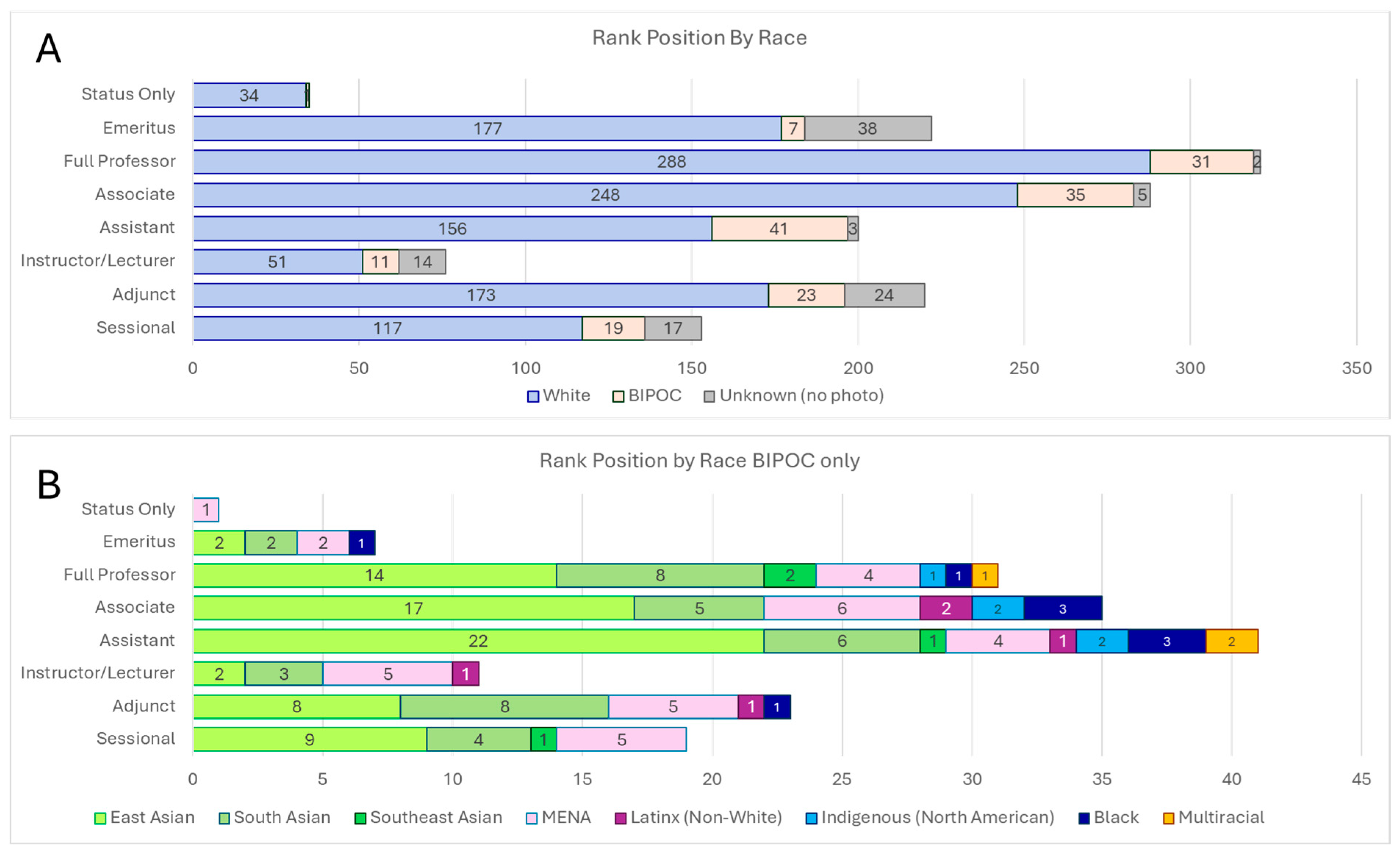
Psychologists of colour (herein referred to as BIPOC—Black, Indigenous, and People of Colour) contribute to diverse perspectives and also conduct critical research that addresses the significant disparities and challenges faced by communities of colour in accessing mental healthcare services. There has been some concern that BIPOC psychologists are underrepresented in academia, but this issue has yet to be evaluated in a Canadian context due to a lack of available data. This study examined the racial demographics of psychology faculty across 23 major universities in Ontario, Canada (n = 1421), the province with the largest number of universities. White psychologists are overwhelmingly overrepresented compared to BIPOC psychologists, reflecting significant underrepresentation relative to the province’s population. White faculty predominantly hold secure academic positions (tenured, tenure track) while BIPOC faculty are concentrated in precarious roles (adjunct, sessional, lecturer). Professors of East Asian heritage constituted the largest group among BIPOC faculty. Additionally, BIPOC psychologists are underrepresented across all professional subspecialties. Systemic racism, historical biases, and exclusionary practices were identified as major barriers. Our findings call for urgent reforms in university hiring practices and psychology training programmes to reflect the diversity of the population they serve and to dismantle systemic barriers that perpetuate racial inequalities in academia. 

Figure 2

Rank position by race and within race. (A) Depicts numbers of psychology faculty by their job seniority. White faculty are shown in blue and aggregate BIPOC faculty in pink. (B) shows numbers of faculty by job seniority excluding White faculty but including breakdown by race for the BIPOC group.
media/image002.png

Source: Out of sight, out of mind: underrepresentation of racialized faculty in Canadian psychology

Turcotte: Under pressure: How immigration is becoming a political fault line in Canada 

Pollara’s take on shifting attitudes. Not much new compared to other public opinion research. The question remains whether the Trudeau government’s trimming of immigration levels, and the Carney government’s maintaining the approach, will result in a positive shift in attitudes or not:

New polling on Canadian attitudes towards immigration

Pollara has been tracking Canadian attitudes toward immigration for decades, and to commemorate our 40th anniversary, we revisited this critical issue in a new national study. In a recent survey of 2,500 Canadian adults conducted from April 10 to 16, the most striking finding is the sharp increase in the number of Canadians who believe immigration levels are too high. When we first posed this question in 2002, only 34 percent held that view. Today, that figure has risen to 60 percent—a substantial 26-point jump that reflects a significant and lasting shift in public sentiment.i

Alberta stands out as the most critical province, with 65 percent of its residents saying immigration levels are excessive. Quebec (63 percent) and Ontario (62 percent) also show high levels of concern, reinforcing a regional pattern that now poses significant political and policy challenges for the federal government.

Cultural anxiety and fractured identity

The study finds a growing unease about the cultural implications of immigration. In 2002, most Canadians (58 percent) believed immigration enriched the national culture. By 2025, this consensus has eroded: just 33 percent of Canadians now hold the same view.

When examining the perceived cultural impact of immigration, the divide across regions is particularly striking in Quebec and Alberta.

Just 26 percent of Quebecers think accepting immigrants from different cultures makes our culture stronger, while 39 percent, the most of any province, think this weakens our culture. Alberta follows (29 percent strengthens/35 percent weakens), pointing to a notable undercurrent of skepticism towards multiculturalism. In contrast, more British Columbians (38 percent strengthens/31 percent weakens) and Atlantic Canadians (35 percent strengthens/28 percent weakens) express more favourable, if still cautious, assessments of immigration’s cultural contributions.

Signs of erosion 

Economic concerns around immigration are more pronounced than ever. In 2002, 40 percent of Canadians believed immigration increased unemployment. Today, a majority of Canadians (52 percent) share the same view. Once again, we see interesting regional differences with Albertans (56 percent) being the most worried.  Also, Canadians with college or high school education (55 percent) are particularly concerned about the impact of immigration on unemployment.

In the same vein, the overall impression about immigration has soured. When asked, “In general, what effect does immigration to this country have on your community?” almost half of Canadians (49 percent) back in 2002 felt positively. Twenty-three years later, only about one-third (35 percent) feel the same way.

This erosion of trust in immigration carries direct and growing consequences for the Carney government, which must now navigate a political landscape where support for immigration can no longer be assumed as a default consensus. For years, Canada’s pro-immigration stance was widely seen as a point of national pride—an expression of openness, pragmatism, and multicultural identity. But that consensus is beginning to fracture. Rising economic pressures, strained public services, and growing cultural anxiety have altered the public mood. What was once a source of political unity is now becoming a point of division.

The Carney government’s electoral focus on the external threat posed by Trump—while understandable and effective in mobilizing voters—has come at the cost of deeper engagement with emerging domestic tensions. The Trump issue remains real and immediate, particularly in the realms of trade, national security, and global democratic stability. But as the old saying goes, “This too shall pass.” The danger lies in mistaking a temporary crisis for a permanent framework of governance.

Source: DeepDive: Under pressure: How immigration is becoming a political fault line in Canada

Slim majority of Canadians found reduced immigration levels still too high: government polling

Not that surprising as echoes other public opinion research:

Shortly after cutting immigration levels, the federal immigration department heard through government-funded polling that a slight majority of Canadians still found this year’s number too high.

Immigration, Refugees and Citizenship Canada commissioned the survey as part of its annual tracking of public sentiment towards immigration and reported it publicly as part of the government’s disclosures on its public opinion research.

The survey, which was done last November, followed the federal government’s announcement that it would reduce the number of permanent residents by nearly 100,000 in 2025. The target was set at 395,000, down from 485,000 in 2024.

The survey found that 54 per cent of Canadians said they “felt there are too many immigrants coming to Canada.” Another 34 per cent said they felt the number was fine, according to the report.

“When informed that Canada plans to admit 395,000 immigrants as permanent residents in 2025, 52 per cent said that it is too many, 37 per cent that this is about the right number and five per cent that this is too few,” it read.

“When informed that 395,000 immigrants is roughly 20 per cent fewer than Canada planned to admit in 2024, 44 per cent feel this is too many, 39 per cent that this number is about right and 13 per cent that it is too few.”

A spokesperson for Immigration Minister Lena Metlege Diab said in a statement that work has begun on setting immigration levels for the next two years, with that plan scheduled to be tabled in the fall, as it has in years past.

“(Immigration, Refugee and Citizenship Canada) will continue work together with partners to establish the best paths forward to ensure that Canada is in position to attract the best talent in the world, while ensuring that overall immigration levels are more sustainable, and that the integrity of the system’s programs remain in tact,” wrote Renée LeBlanc Proctor, the minister’s press secretary. 

“We won’t speculate about specific future policy decisions at this time, but note that work on the 2026-2028 levels plan is already underway.”

Determining how many more permanent and temporary residents Canada will allow into the country has been challenged by changing public sentiments around immigration, connected to concerns regarding housing affordability, the availability of doctors and other social supports.

While federal officials say immigration accounted for nearly 98 per cent of Canada’s population growth in 2023, helping to offset an aging population and bringing the country’s population to 41 people million last year, housing experts, economists, and the Bank of Canada all warned that it has contributed to the country’s housing shortage.

Keith Neuman, senior associate at the Environics Institute, a non-profit that has been conducting public opinion research on attitudes around immigration for the past four decades, says Canadians’ perspectives have changed in terms of people thinking about how many immigrants the country could handle.

He says that represents a shift from what research has shown in the past, where Canadians previously focused on who immigrants were and where they were coming from.

“The capacity issue has never really been something that Canadians have thought about, up to this point. And so that’s where the real shift has happened,” he said in an interview.

“It is now become a public issue and a political issue.”…

Source: Slim majority of Canadians found reduced immigration levels still too high: government polling

A Traveler Waits in the Stars for Those Willing to Learn How to Look

Interesting long read and a reminder that the constellations we know are not the only ones we see and recognize, in this case those of the Dene and Inuit:

…In the past, Dr. Cannon’s collaborators told him, only those curious enough to take their own participatory journeys, and have a personal relationship with the stars, were meant to find this out. Only then could people recognize that the Traveler they knew from childhood stories was in the stars overhead, an ancient cosmic guardian watching over the world to this day.

Among the culture bearers who contributed to the book, many agreed to help commit this intimate knowledge to paper because Dr. Cannon was approaching the subject in the traditional hands-on way. Others were motivated because they recognized that they were among the few remaining people in their subcultures or languages to hold this knowledge.

Then he found it, visible only on clearer nights, an obscure star Western astronomers call 27 Lyn.

It had taken him three and a half years.

But whose heart really was it? The more Dr. Cannon learned, the more he became convinced again that the Traveler and the man-animal constellation were the same across many Northern Dene cultures.

Eventually he posed the relationship again to Mr. Herbert, underlining his own deeper convictions and the work he had put in. This time, Mr. Herbert gave a yes: The Gwich’in Traveler figure and Yahdii were one and the same.

In the past, Dr. Cannon’s collaborators told him, only those curious enough to take their own participatory journeys, and have a personal relationship with the stars, were meant to find this out. Only then could people recognize that the Traveler they knew from childhood stories was in the stars overhead, an ancient cosmic guardian watching over the world to this day.

Among the culture bearers who contributed to the book, many agreed to help commit this intimate knowledge to paper because Dr. Cannon was approaching the subject in the traditional hands-on way. Others were motivated because they recognized that they were among the few remaining people in their subcultures or languages to hold this knowledge.

“I have not spoken about this in 20 years,” Mr. Engles told Dr. Cannon in an interview. “I’m just grateful for the opportunity to put back what my grandfather gave me.”

Looking up at the Milky Way in the night sky. Trees line the bottom of the frame.
The Milky Way, seen from central-interior Alaska.Credit…Chris Cannon

Dr. Cannon’s book aims to fill what he considers a yawning gap. Although every civilization experiences the night sky, thorough studies of how people conceptualize the cosmos have been attempted for fewer than 1 percent of human languages, Dr. Cannon estimates.

“I felt a sense that this is needed,” said John MacDonald, who conducted a survey of astronomy with Inuit Elders in the 1990s, and served as an academic reviewer for Dr. Cannon….

Source: A Traveler Waits in the Stars for Those Willing to Learn How to Look

    Jamie Sarkonak: He mildly questioned DEI. His law school calls that ‘misconduct’

    Of note. May not have been from a neutral position but nevertheless a cautionary tale. Court case to watch:

    …Tim Haggstrom’s crime? Writing an open letter to his fellow students, from a neutral position, to foster dialogue and attempt to inject reason into the debate. His punishment? A campaign by other students to sabotage his career, culminating in an official finding of misconduct by a spineless university that appears to have forgotten its role in protecting free expression on campus.

    That campaign, at least, didn’t work. Now a lawyer (and the national director of the Runnymede Society, whose local chapter events I often attend) Haggstrom, via his legal team at civil liberties charity Freedoms Advocate, is asking the Saskatchewan Court of King’s Bench to have the misconduct ruling thrown out — along with the university policies that work to deny procedural fairness to those who don’t emphatically agree with diversity, equity and inclusion.

    For the university’s own sake, Haggstrom better win.

    He alleges unfair, Charter-infringing treatment in his court filings, and he’s got a strong argument. At the time Haggstrom expressed the need for discussion over affirmative action at the law school, the University of Saskatchewan had already adopted an identity-based worldview, aimed at elevating certain groups in the university.

    The institution had, since 2020, a diversity, equity and inclusion policy that implored the entire campus to uphold DEI values, cementing identity-based thinking — and with it, the idea that procedures are only fair when they result in equal outcomes between groups — into campus culture. That year, the university president committed himself to the “dismantling of institutional structures, policies and processes that contribute to inequalities faced by marginalized groups.”

    In 2021, the university signed a memorandum of understanding with the student union, committing to deliver anti-oppression and anti-racism training to staff, which was being rolled out by the next year. That initiative was led by anti-racist scholar Verna St. Denis, who has openly called for biasing university education to favour her own progressive, deeply racial worldview. St. Denis also contributed to the university’s Indigenous strategy, also released in 2021, which planned for institution-wide decolonial change.

    Further, according to the originating application filed in court by Haggstrom, the university had made training materials available on the topic of “power and privilege.” The materials are no longer on the university website, but were archived online. They teach a hierarchical understanding of race (specifically, that white people have better access to education and success); they characterize meritocracy as a feature of “settler mindsets”; they state that internalized colonialism causes oppressed people to commit sexual assault; they instruct readers to “refute colonialism” (that is, the very basis of our nation) to assist in making Canada “the friendly, open, welcoming country it espouses to be.” They remark that anti-oppressive education “ought to be uncomfortable as white students begin to unlearn what they have been taught through their previous learning experiences.”

    The course ends on a question: “As an individual how can you decolonize yourself and what can you do with your power and privilege to help in the betterment of Canada?”…

    Source: Jamie Sarkonak: He mildly questioned DEI. His law school calls that ‘misconduct’

    Ottawa told Trump that visa crackdown led to fewer Indians, Bangladeshis illegally crossing the border

    Of note:

    Ottawa flagged to the incoming Trump administration that it had stopped more than 2,000 Indians and Bangladeshis from boarding flights to Canada, resulting in a drop in illegal border crossings to the U.S., internal government briefing documents show. 

    In an attempt to reassure President Donald Trump and his border czar, Tom Homan, that Canada is serious about clamping down on illegal crossings, Ottawa lauded investigations into visa fraud that targeted Indians and Bangladeshis.

    The previous Liberal government, under Justin Trudeau, was trying to dissuade Mr. Trump from imposing tariffs on Canada, saying it was improving border security to reduce illegal crossings and fentanyl smuggling. 

    After he was elected, Mr. Trump had threatened to slap tariffs on goods entering the U.S. from Canada on his first day in office, unless Ottawa curbed the flow of drugs and illegal migrants across their border. Canada was among the countries that were eventually hit by tariffs

    Briefing documents, drawn up days before Mr. Trump took office on Jan. 20, outline “key messages for outreach with U.S. interlocutors.” The Global Affairs papers, dated Jan. 15, set out efforts to reinforce border security that are “already showing results.”

    One document set out messages for a January meeting between then-foreign affairs minister Mélanie Joly and Mr. Homan. “The number of illegal crossings from Canada into the U.S. continues to decline, thanks to our tougher visa policy and practices for Mexican, Indian and Bangladeshi travellers,” it says. 

    It adds that the government has also “taken enforcement action to address smuggling through First Nation reserves.”

    The internal Global Affairs briefing documents say “over 2,000 people of Indian and Bangladeshi origin have been denied boarding on flights to Canada following a targeted review of visa issuance for cases of fraud … since March 2024.” 

    They add that “in summer 2024, IRCC refocused efforts on screening and processing for high-risk countries,” referring to Immigration, Refugees and Citizenship Canada. …

    Source: Ottawa told Trump that visa crackdown led to fewer Indians, Bangladeshis illegally crossing the border

    Treasury Board reports gains on diversity and equity in public service, but will cuts hamper progress?

    Good question:

    The federal public service continued to increase the number of women, Indigenous people, visible minorities, and people with disabilities in its ranks between 2023 and 2024, according to the latest report on employment equity. But as the federal public service now begins to shrink for the first time in over 10 years, some have raised concerns that job cuts will hamper progress for equity-seeking groups….

    Source: Treasury Board reports gains on diversity and equity in public service, but will cuts hamper progress?

    TBS publishes some rich infographics and infographics: Employment Equity Demographic Snapshot 2023–2024

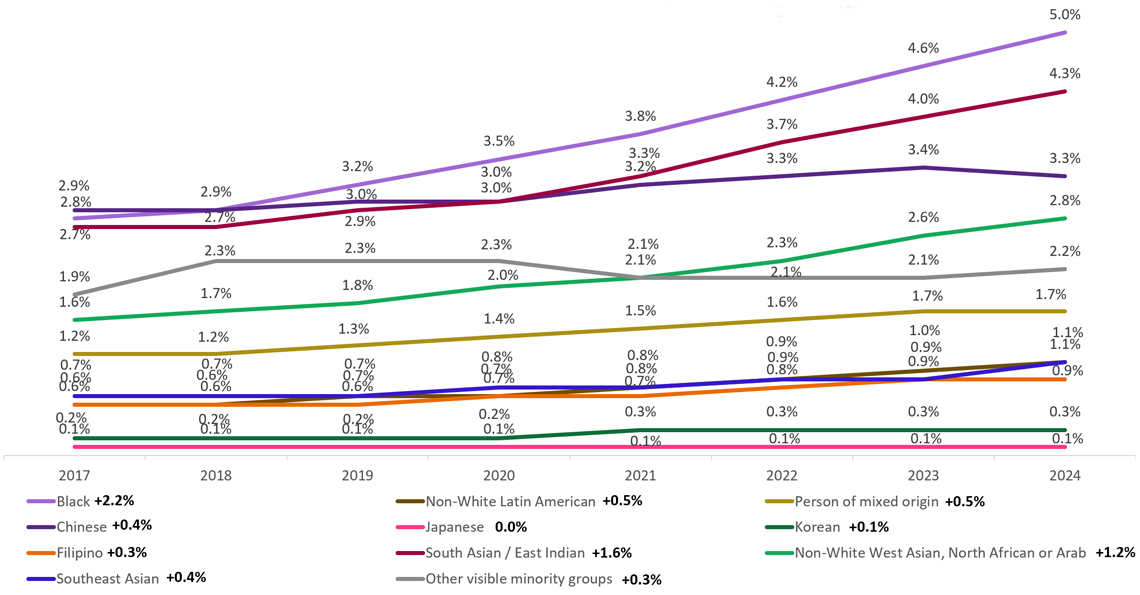
    Figure 33: Representation trends for members of visible minorities by subgroup – percentage

    Text version below:


    Is addressing anti-Black racism in Canada still a policy priority?

    Suspect it will become a lower priority given more pressing issues but hopefully become more focussed on results and outcomes and more in-depth evaluations on which government programs are more effective:

    …Placating the anti-equity backlash has left Canada unable to achieve or sustain the goal of employment equity. The federal government and its institutional post-secondary partners should instead commit to following more transformative paths laid out by Black scholars. These recommendations include: 

    • Redressing anti-Black racism and supporting Black inclusion in universities and colleges by following actions set out in the Scarborough Charter
    • Advancing equitable participation of Black researchers by upholding the SSHRC’s action plan. 
    • Heeding Blackett’s call to meaningfully pursue equity by affirming the quasi-constitutional status of employment equity legislation. This would include focusing attention on removing barriers for Black workers. 

    Much Black effort has gone into showing us what policies and actions are needed to address anti-Black racism. The question is do Canadian institutions have the moral fortitude to follow through in the face of mounting anti-EDI backlash? 

    Source: Is addressing anti-Black racism in Canada still a policy priority?

    ICYMI: Twelve IRCC employees tried to interfere with immigration files, misconduct report finds

    Small numbers but good that this breach was caught and acted upon:

    Staff at the federal immigration department tried to interfere with applications to enter and stay in Canada, with one asking a colleague whether they would accept money to approve a study permit, a report published Friday on misconduct and wrongdoing found.

    The first ever report on misconduct at Immigration, Refugees and Citizenship Canada discloses that in 2023-2024, 12 staff took advantage of their ability to access IRCC’s systems to look at people’s files. 

    Some checked or asked about the status of immigration files for family members, friends and acquaintances, or checked their status out of curiosity. 

    In some cases IRCC employees tried to get immigration cases fast-tracked, or asked a colleague to make corrections to a file. 

    IRCC produced the report to demonstrate its commitment to transparency, and show the actions it had taken to deal with wrongdoing. …

    Source: Twelve IRCC employees tried to interfere with immigration files, misconduct report finds

    Inside Trump’s Extraordinary Turnaround on Immigration Raids

    Another TACO moment, forced by reality and resulting political pressure by the base:

    On Wednesday morning, President Trump took a call from Brooke Rollins, his secretary of agriculture, who relayed a growing sense of alarm from the heartland.

    Farmers and agriculture groups, she said, were increasingly uneasy about his immigration crackdown. Federal agents had begun to aggressively target work sites in recent weeks, with the goal of sharply bolstering the number of arrests and deportations of undocumented immigrants.

    Farmers rely on immigrants to work long hours, Ms. Rollins said. She told the president that farm groups had been warning her that their employees would stop showing up to work out of fear, potentially crippling the agricultural industry.

    She wasn’t the first person to try to get this message through to the president, nor was it the first time she had spoken to him about it. But the president was persuaded.

    The next morning, he posted a message on his social media platform, Truth Social, that took an uncharacteristically softer tone toward the very immigrants he has spent much of his political career demonizing. Immigrants in the farming and hospitality industries are “very good, long time workers,” he said. “Changes are coming.”

    Some influential Trump donors who learned about the post began reaching out to people in the White House, urging Mr. Trump to include the restaurant sector in any directive to spare undocumented workers from enforcement.

    Inside the West Wing, top White House officials were caught off guard — and furious at Ms. Rollins. Many of Mr. Trump’s top aides, particularly Stephen Miller, his deputy chief of staff, have urged a hard-line approach, targeting all immigrants without legal status to fulfill the president’s promise of the biggest deportation campaign in American history.

    But the decision had been made. Later on Thursday, a senior official with Immigration and Customs Enforcement, Tatum King, sent an email to regional leaders at the agency informing them of new guidance. Agents were to “hold on all work site enforcement investigations/operations on agriculture (including aquaculture and meat packing plants), restaurants and operating hotels.”…

    Source: Inside Trump’s Extraordinary Turnaround on Immigration Raids