Judge halts non-binary person’s deportation to the U.S. as Trump dismantles trans rights

Conditions have changed and assessments need to be updated but with nuance:

A Federal Court judge halted a non-binary American’s deportation from Canada pending review. Advocates say the ruling sets “an important precedent” for 2SLGBTQ+ immigrants and refugees coming to Canada from, or through, the U.S.

…Jenkel was scheduled to be deported from Canada this month. But a Federal Court judge issued a stay of removal, arguing the immigration officer who examined their case failed to take into account their role in caring for their fiancé, or the “current conditions for LGBTQ, non-binary and transgender persons” in the U.S.

Advocates for 2SLGBTQ+ migrants say this could set a precedent for other cases like Jenkel’s, and help change the way Canada’s immigration system deals with applications from the U.S.

Immigration, Refugees and Citizenship Canada (IRRC) declined to comment on Jenkel’s case, citing privacy concerns.

…Deportation order ‘failed to reflect the current reality’

Jenkel was ordered to be deported on July 3 after an initial risk assessment determined they didn’t face a credible threat in the U.S.

But Justice Julie Blackhawk halted that deportation, pending review. In her ruling, she wrote Jenkel’s risk assessment was “flawed and unreasonable.”

That’s because the immigration officer conducting the review used outdated information — a government dossier on the United States that was last updated in January 2024, says Jenkel’s lawyer.

“It’s a marked recognition that the conditions have deteriorated … since the Biden administration has left office,” Sarah Mikhail, of Smith Immigration Law in Toronto, told As It Happens host Nil Kӧksal.

“These changes are significant enough that, when assessing trans and non-binary individuals’ circumstances in Canada, this is something that needs to be taken into consideration.”

Source: Judge halts non-binary person’s deportation to the U.S. as Trump dismantles trans rights

Immigration fuels Atlantic Canadian ‘economic renaissance,’ authors argue

Of note. In talking to friends who know Atlantic Canada, reasonably accurate picture although much of the growth is in the urban centres, not rural Atlantic Canada, who also note that governments and others have made considerable efforts to prepare the host population to understand the value of immigration:

Canada is struggling with the effects of an unprecedented immigration boom: Housing shortages, youth unemployment, overtaxed social programs and more.

But in Atlantic Canada, those irritants are largely overshadowed by a much different story: the transformation of moribund and stagnant economies that made the region Canada’s poor cousin.

The authors of a new book detail the dramatic improvements newcomers are bringing to the East Coast — and argue this is no time to swerve. They argue only for a more strategic immigration policy, one that reflects the region’s economic needs.

In Toward Prosperity, The Transformation of Atlantic Canada’s Economy, former pollster Don Mills and economist David Campbell highlight how increasing immigration in the past five years has boosted the economy of a stagnant region with the oldest population in the country.

“Provincial governments across Atlantic Canada have finally understood the implications for an aging population and the need for population growth: all four provinces in the region now have population growth strategies, with immigration as a core focus of those strategies,” they write.

Nova Scotia seeks to double its population to two million by 2060, and New Brunswick, where the population was pegged at 854,355 last year, is aiming for one million people within the decade, according to their 2025 book published by Halifax-based Nimbus.

“Most of the region’s largest municipalities now have their own population growth strategies as well,” Mills and Campbell write. “All these population strategies acknowledge the critical role of immigration to drive labour force and population growth.”

Last year, after three years of especially rapid growth in Canada’s immigration population, the Liberals under Justin Trudeau announced they were reducing the number of permanent residents admitted to the country by 21 per cent. Earlier this year, Prime Minister Mark Carney pledged to cap the total number of temporary workers and international students to less than five per cent of Canada’s population within two years.

Conservative Leader Pierre Poilievre this month called for “very hard caps” on the number of newcomers allowed into the country. He told reporters the country has struggled to integrate newcomers and he wants to see more people leaving than coming in “while we catch up.”

“We have millions of people whose permits will expire over the next couple of years, and many of them will leave,” Poilievre said. “We need more people leaving than coming for the next couple years.”

In 2022, the Canadian population rose by over a million people for the first time in history — and then kept growing faster. According to Statistics Canada, the population reached 40,769,890 on Jan. 1, 2024. That was an increase of 1,271,872 people in a single year — a 3.2 per cent jump, marking the highest annual population growth rate in Canada since 1957.

In an interview, Mills said Atlantic Canada needs smarter and targeted immigration.

“I believe in growth under control,” Mills said. “It got a little out of hand under the Trudeau Liberals. They opened the gates too quickly and it really hurt the housing market and put strains on our health-care and education systems for sure.”…

Source: Immigration fuels Atlantic Canadian ‘economic renaissance,’ authors argue

McWhorter: Listen Up. Ketanji Brown Jackson Is Speaking to You.

Nice post on the use of language. Plain language vs legalese:

When Justice Ketanji Brown Jackson wrote her ringing dissent in the case of Trump v. CASA, which severely curtailed the ability of lower courts to serve as a check on unlawful executive orders, she wanted to make abundantly clear the danger of what she regarded as a “seismic shock” to American legal norms. “Courts must have the power to order everyone (including the executive) to follow the law — full stop,” she wrote. She continued, in a voice dripping with sarcasm, “The majority sees a power grab — but not by a presumably lawless executive choosing to act in a manner that flouts the plain text of the Constitution. Instead, to the majority, the power-hungry actors are … (wait for it) … the district courts.”

Social media platforms exploded with outrage.

One user asked, in apparent disbelief, “Did Ketanji Brown Jackson actually pop that stupid little ‘wait for it’ gag in a SCOTUS opinion?” Another said the dissent “single-handedly degraded 235 years, four months, and 25 days of SCOTUS precedent.” The worst of them turned the justice’s language back on her as a weapon. “Ketanji Brown Jackson is … (wait for it) …” — well, I won’t repeat the insult here, but for good measure, commenter added, “full stop.”

Her critics were right to note that Justice Jackson was doing something unusual. And it wasn’t just those examples. She peppered the whole dissent with expressions like “Why all the fuss?” “Do not take my word for it,” “Here is what I mean,” and the assessment — again with unmistakable sarcasm — “That is some solicitation.”

You won’t find anything like that in Marbury v. Madison.

What’s striking about Justice Jackson’s turns of phrase is that they employ what we typically regard as oral language — spontaneous, spoken words — in an extremely serious written text. That choice and the blowback it encountered are a chance to consider the arbitrariness and narrowness of the conventions dictating how legal opinions should be written. The expectation that their language be timeless, faceless and Latinate is a matter of custom, not necessity. “Why all the fuss?” indeed.

Justice Jackson is, at 54, the second-youngest justice on the court. She was raised in the 1980s, a time when America’s writing culture was getting markedly less hidebound. Waving aside the hats and girdles and stuffy dance steps of old, the counterculture had shown America how to let its language hang out, too. A new, looser style of writing allowed a play between the oral and the written, and the result enriched the culture rather than impoverishing it.

I can’t speak for Justice Jackson, but that shift had a big impact on a great many people who grew up in that era’s wake. It definitely had a big impact on me. I write in what I hope is a conversational style. Like Justice Jackson, I have sometimes been scolded for it by people who would prefer that I write “with a tie on,” as it were.

Justice Jackson isn’t the only writer to experiment with mixing orality into rarefied texts. Saul Bellow reveled in the highflying lexicographic richness of the English language, but then every so often paused for a fillip of the colloquial. In “Seize the Day,” he describes a character in language so precise and vivid that it verges on poetry: “And in the dark tunnel, in the haste, heat, and darkness which disfigure and make freaks and fragments of nose and eyes and teeth, all of a sudden, unsought, a general love for all these imperfect and lurid-looking people burst out in Wilhelm’s breast. He loved them. One and all, he passionately loved them.” Just a bit later, Bellow renders the character’s thoughts, and he does so in the baggier structure of speech: “That’s the right clue and may do me the most good. Something very big. Truth, like.”

Key is the “Truth, like,” approximate and slangy, the way that the character would really talk and think. In its immediacy and urgency, oral language pulls us in, makes us listen once we have sat still. Weaving it together with a more formal written style is Bellovian jazz.

Back to Justice Jackson. Behind all the harrumphing is an assumption that language that is accessible cannot also be precise. But Justice Jackson’s own words show that this assumption is mistaken. “It is odd, to say the least,” she wrote, “that the court would grant the executive’s wish to be freed from the constraints of law by prohibiting district courts from ordering complete compliance with the Constitution. But the majority goes there.” The second-sentence shift to spoken language conveys fervor, urgency and concern, but it doesn’t lessen the scalpel-like precision of the first sentence. And its “Oh-no-you-didn’t!” informality heightens the sense that this is not a remote matter of merely academic interest.

And, as always, orality grabs your attention. Think about how much less powerful her point would be if she stuck to more traditional, formal language such as “the majority ventures this regardless.”

The evolution of language always encounters resistance, and sometimes outrage. When the word “ain’t” appeared in Webster’s Third New International Dictionary in 1961, purists freaked out — and The Times demanded its removal. That response didn’t age well, and neither does the hue and cry over Justice Jackson’s impassioned attempts to convey a sense of urgency. Call it Jacksonian jazz, if you like. But calling it stupid is just nastiness — full stop.


Source: Listen Up. Ketanji Brown Jackson Is Speaking to You.

Rempel Garner: 50K+ jobs to foreign workers in Q1. Why?

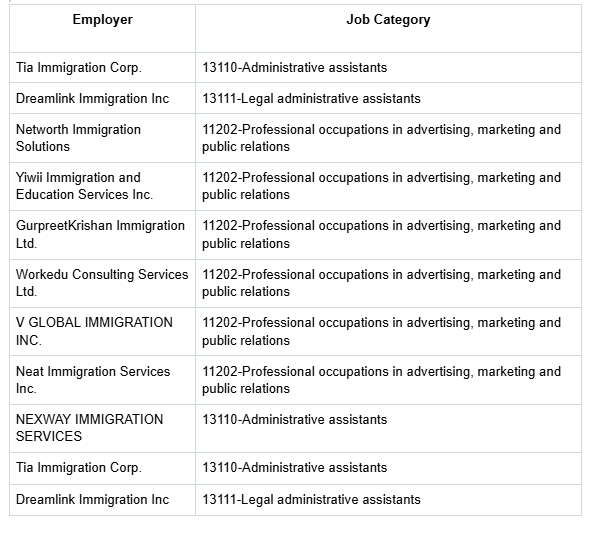
Interesting list of which companies and organizations, and for which occupations, had approved LMIAs (Rempel Garner neglects to mention Kenney’s earlier mistake and rhetoric regarding expanded access for Temporary Foreign Workers but his correction was both quick and efficient).

The chart below shows the overall shift to lower skilled occupations, particularly a greater shift to the lowest skill levels, with some correction in the latter half of 2024:

The Q1 List of Shame

To illustrate the dysfunction, consider these (few) examples (there are many, many more, and I encourage you to look through the list yourself):

Companies and public sector entities that got approved to hire entry-level and food services labour:

Companies and public sector entities that got approved to hire white collar jobs with TFWs (my personal favourite here is the Grain Growers of Canada(a lobby group) receiving a positive LMIA decision for a communications position….come on guys, for real??):

Immigration consulting firms that often help companies get approved for TFWs got approved for TWFs too:

Companies that got approval to fill trades jobs with TFWs:

The arguments that many companies most commonly use to justify their use of the TFW program (particularly the low-skilled stream) are that:

  • Canadians don’t want to do the work
  • That only a foreigner could do the job, or
  • That government benefit programs often prevent people from taking jobs. 

In many cases, these arguments wouldn’t pass the smell test for an ordinary Canadian, so they shouldn’t for the Liberal government either.

In reality, outside of a very few regions where unemployment levels significantly defy the current national rate of 6.9%, and in certain segments of the seasonal agricultural industry, many of these jobs can and should go to available Canadians. And, there won’t be change unless the Liberals stop buying into bunk arguments for temporary foreign labour and find ways to reform the program, or, as the case may be, incent Canadians to work. Wages that aren’t suppressed by an open floodgate of low skilled temporary foreign labour would probably be a good place to start.

Ironically, on that front, all the Liberals had to do upon taking office in 2015 was not bend to the will of powerful corporate lobbyists clamouring for the reversals of program changes made by the former Harper Conservative government. I was in cabinet at the time and remember the gnashing of teeth and wailing from employers that were accused of seriously abusing the program.

Nonetheless and to his credit, Jason Kenney, as Minister of Employment and Social Development, introduced major reforms to the TFW program and LMIA process in 2013 and 2014. In 2013, key changes included requiring employers to pay temporary foreign workers at prevailing wages, introducing processing fees for LMIA applications, extending job advertising periods to recruit Canadians first, and adding scrutiny on outsourcing impacts. The 2014 overhaul was more comprehensive: it imposed a 10% cap on low-wage foreign workers per worksite (phased in from higher limits), barred low-wage hires in regions with unemployment above 6%, limited low-wage worker stays to two years, introduced moratoriums in sectors like food services, boosted inspections and fines for violations, and split the TFW program from the International Mobility Program to reduce overall reliance on foreign labor, leading to an 80% drop in low-skilled approvals.

Source: 50K+ jobs to foreign workers in Q1. Why?

Lederman: The Giller Prize was a rare CanLit success story. Now it might become a casualty of a foreign war

Sad (hope the authors who won previous Gillers and protested Scotiabank involvement with Israel have some second thoughts):

…Deep-pocketed institutions don’t sponsor culture to get embroiled in controversy. Who wants to pay all that money only to get booed and a PR black eye?

Who would want to sponsor the prize now? As the Giller people are finding out, what organization with that kind of money wants to risk being drawn into this drama? Which financial institution wants people scouring its records for any connection to Israel, followed by angry taunts and tweets? 

So now, the Giller wants the government to rescue it. Ha. In this economy? Ottawa is currently looking to cut spending. The federally funded Canada Council for the Arts already supports the Governor-General’s Literary Awards. And no doubt the Canada Council will also be looking for funding cuts. If Ottawa has more for CanLit, there are some struggling Canadian writers, publishers and independent bookstores that might like a word (and some cash). The arts are struggling right now, period – including the CanLit ecosystem. With fewer book reviews, and festivals under financial pressure, the Giller was a rare success story. 

Maybe the Giller reinvents itself, ditches the splashy gala, the pricey author tours. Maybe the prize money is reduced. Maybe the Giller folds, altogether.

That would be a big loss. And a very sad ending, indeed.

Source: The Giller Prize was a rare CanLit success story. Now it might become a casualty of a foreign war

Documents used to assess asylum cases fail to account for Trump’s edicts, advocates say

Valid point:

Canada’s Immigration and Refugee Board is assessing refugee claims using outdated briefing documents about the U.S. that fail to mention President Donald Trump’s edicts on mass deportations and detention, as well as his orders rolling back the freedoms of non-binary and trans people. 

Lawyers representing refugee claimants and migrants facing deportation from Canada are calling for an urgent update for the official package of documents on conditions in the U.S. 

National documentation packages are used by the IRB, an independent body that considers asylum claims. 

The packages, which include briefing materials from a variety of sources about conditions in different countries, are also used by Immigration Department staff to help assess the risk posed to foreign nationals facing deportation. 

The U.S. package of documents was last updated in January, 2024, when Joe Biden was president. 

Lawyers warn that failure to update the U.S. file could lead to flawed decision and more challenges of decisions in court, leading to even bigger backlogs of immigration cases. 

Immigration lawyer Yameena Ansari, whose client, a young transgender American, filed an asylum claim with the IRB last month, warned that the outdated file creates a “dangerous blind spot” for adjudicators. She said claimants “are being assessed against an artificial version of the United States − one that no longer exists.”

“That can lead to wrongful decisions, and potentially life-threatening deportations,” she said. “The IRB’s documentation must reflect the current reality on the ground.”…

Source: Documents used to assess asylum cases fail to account for Trump’s edicts, advocates say

Before the cuts: a bureaucracy baseline from an employment equity lens 

As this article is behind the Hill Times paywall, am sharing this analysis on my blog (have added Indigenous hiring, separation and promotion tables):

French: ‘Superman’ Is MAGA Kryptonite

Good post:

Think for a moment of the immigrant experience. If you’re a child, you come without your consent. You find yourself in a place that you’ve never known. Even if you’re an adult, and you want to make America your home, you start out in a state of isolation and vulnerability.

Is it any wonder that new immigrants often create or seek out ethnic enclaves? From the Irish and Italian quarters of cities in the 19th century to the barrios of the 20th and 21st centuries, immigrants can ease into their new life by holding onto remnants of the old.

We look at immigrants and often demand that they assimilate. Be like us, we say. Conform to our culture. And that’s usually an easy ask — after all, adult immigrants want to be here. They want to participate in American life. For children, assimilation tends to happen quickly. Immigrant children who grow up in America quickly become more American than they are Mexican or Nigerian or Polish.

Assimilation doesn’t mean abandonment. There are millions of patriotic Americans who are also proud of their national heritages. When the waters of the Chicago River turn green on St. Patrick’s Day, we celebrate with Irish Americans. Should Mexican Americans experience any less joy on Cinco de Mayo?

When I served in Iraq, I served with immigrant soldiers who expressed pride in their homelands but fought in one uniform under one flag, and no one in our squadron ever questioned where their ultimate loyalties lay.

But if we ask immigrants to assimilate, then our nation has its own obligation. We must adopt them. If we want immigrants to love us, then it is our sacred obligation to love them back. Nations can’t love immigrants like adoptive parents love their children, but there is a parallel — a nation can tell a person, “You are one of us.”

That doesn’t mean that we open our borders to anyone who wants to come. Of course we should regulate the flow of immigrants into our country. Too many people arriving too quickly can overwhelm social services, strain local economies and create the conditions for rivalry and conflict that destabilize our politics.

But our default posture should be one of open arms. We should take immense pride that people want to come here. And we should welcome as many as we can reasonably absorb. This is our national heritage, marred though it is by sometimes-long periods of backsliding….

Source: ‘Superman’ Is MAGA Kryptonite

Opinion | Canada’s immigration system, once admired for its fairness and balance, has drifted into crisis

Hard hitting critique, not unjustified:

…Worse still, Ottawa’s enforcement mechanisms have faltered. The federal government acknowledged that Canada may now have up to 500,000 undocumented residents. Tens of thousands of people overstay visas each year without consequence. A system that overlooks such lapses is not generous — it is negligent. It jeopardizes the very trust on which public support for immigration depends.

Support for immigration still runs deep in Canada, but it’s not without limits. Canadians value immigration when it’s fair, focused and transparent. But when the system starts to look porous or easily gamed, confidence frays. And everyone pays the price: the immigrant who played by the rules, the patient waiting for a family doctor, the student without housing or work, and the community stretched thin.

Canada needs immigrants. We need health care workers in rural hospitals, care aides in long-term care homes, and early childhood educators across the country. But meeting those needs doesn’t require a floodgate — it needs a funnel. One that matches admissions to housing, health care capacity, and real labour demand.

Prime Minister Carney now holds the mandate — and the moment — to restore credibility to Canada’s immigration system. That means criminal vetting must be immediate and enforceable. Study permits must be tied to accredited programs with proven pathways to employment. Intake levels must be scaled in line with infrastructure and economic absorption capacity. And Ottawa must publish clear, transparent audits showing how homes, hospital beds, and transit systems will match future growth.

Fixing immigration is not a peripheral policy. It is the first test of whether the new government is prepared to govern for results rather than optics. The promise of immigration lies not in how many arrive, but in how many thrive. It lies in our ability to match aspiration with capacity, and compassion with competence.

Because if we can admit 17,000 people with criminal convictions, yet leave skilled, law-abiding applicants in limbo — and push even the most qualified newcomers into survival jobs — then something is deeply broken. And if we don’t fix the system now, we risk losing not just public trust, but the very foundation of a nation built on rules, trust, and earned opportunity.

Dr. Debakanta Jena is a first-generation immigrant, Chief of Orthopedic Surgery at Medicine Hat Regional Hospital and Assistant Professor at the University of Calgary.

Source: Opinion | Canada’s immigration system, once admired for its fairness and balance, has drifted into crisis

Hall | In a world of symbolic gestures, we challenged Canada to be better. Here’s how we did

Of note:

Five years ago, the world changed — and so did we.

In the wake of George Floyd’s murder and a global reckoning on racial injustice, we chose to act. In July 2020, more than 500 organizations across Canada joined us to say enough is enough: enough of looking the other way, and enough of a system that too often overlooks or sidelines Black Canadians while claiming to support progress.

The leaders of these organizations signed on to the BlackNorth Initiative Pledge committing to dismantle anti-Black racism in their organizations and beyond. They include CEOs, board chairs, and senior executives from Canada’s largest banks, law firms, corporations, universities, government agencies and non-profit institutions.

As we mark the five-year anniversary of the BlackNorth Initiative, we say with clarity and conviction: we have made change happen. It was not symbolic. It was structural.

Executives have been hired. Boards have diversified. Procurement systems have been restructured. Black youth are breaking into sectors that once kept them out. Equity has moved from the margins of corporate decks to the core of strategic operations. We have redefined what leadership looks like in Canada and who gets to be seen as a leader.

The numbers bear this out. Notably, among TSX-listed companies that committed to the BlackNorth Initiative’s voluntary pledge, Black board representation reached 3.3 per cent, double that of non-BNI companies at 1.6 per cent. The proportion of Black executives also rose from 1.0 per cent in 2020 to 1.5 per cent in 2022, aligning with the 1.5 per cent representation seen among BNI signatories.

These findings underscore the power of voluntary commitments to drive real, systemic change and to foster greater inclusion at the highest levels of leadership.

And the results go beyond numbers. Companies that signed the pledge are speaking up. Leaders across sectors have testified that committing to the Pledge has strengthened their talent pipelines, innovation capacity, and overall performance.

This is the ripple effect of equity done right. Diverse companies are better companies.

And yet, even now, the urgency has not faded.

Wes Hall is the founder and chairman of the BlackNorth Initiative and founder & CEO of Kingsdale Advisors & Executive Chairman & Founder of WeShall Investments. Dahabo Ahmed Omer is the CEO of the BlackNorth Initiative.

Source: Opinion | In a world of symbolic gestures, we challenged Canada to be better. Here’s how we did