Record number of groups to speak at Supreme Court case against Quebec secularism law 

As expected given stakes. Case to watch:

A record number of groups have been given standing to present legal arguments at the Supreme Court of Canada as it hears a challenge to Quebec’s secularism law, a case that could reshape how governments across the country use the Charter’s notwithstanding clause.

At issue is Quebec’s Bill 21, a 2019 law that bans public-sector workers, including teachers and police, from wearing religious symbols such as hijabs or crosses at work. The Quebec government used Section 33 of the Charter of Rights and Freedoms, the notwithstanding clause, to shield the law from legal challenges.

The notwithstanding clause allows a government to override fundamental rights such as freedom of religion. Courts in Quebec have twice upheld Bill 21, rejecting an array of legal challenges and ruling the province’s use of the notwithstanding clause was valid. Last January, the Supreme Court agreed to take on the politically explosive case.

Last week, Chief Justice Richard Wagner granted standing to 38 outside groups – interveners – to file their legal views, which are due in mid-September.

It is a record number of interveners, according to Supreme Advocacy, an Ottawa-based firm that closely tracks the top court. Interveners include the Canadian Council of Muslim Women and the Ontario Human Rights Commission….

Source: Record number of groups to speak at Supreme Court case against Quebec secularism law
USA: Despite grand claims, a new report shows noncitizen voting hasn’t materialized

No surprise. Unfortunately, will not change many minds:

After President Trump and many other Republicans warned that vast numbers of non-U.S. citizens would influence last year’s election, states and law enforcement have devoted more resources than ever before to root out those ineligible voters.

More than six months into Trump’s second term, they haven’t found much.

New research out Wednesday tracking state government efforts across the country confirms what election experts have said all along: Noncitizen voting occasionally happens but in minuscule numbers, and not in any coordinated way.

“Noncitizens are not a large threat to our election system currently,” said David Becker, the executive director of the Center for Election Innovation & Research (CEIR), which conducted the research. “Even states that are looking everywhere to try to amplify the numbers of noncitizens … when they actually look, they find a surprisingly, shockingly small number.”

Source: Despite grand claims, a new report shows noncitizen voting hasn’t materialized

Le Devoir editorial: Gouverner, le cœur en moins [immigratiion]

Merited strong critique:

…Il existe en gouvernance une règle qui n’a rien de sorcier et qui tombe sous le couvert du gros bon sens : avant de prendre une décision susceptible de toucher de manière directe la sécurité financière et la stabilité de familles déjà jugées vulnérables, il est préférable d’effectuer une solide collecte d’informations et d’obtenir une validation juridique, surtout si l’on suspecte un « flou » dans la rédaction d’un article de loi. Québec a plutôt provoqué une secousse dans le train-train de familles immigrantes avant de vérifier si sa décision était la bonne.

Voilà une manière de gouverner à rebrousse-poil, et le cœur en moins.

Les faux pas et les maladresses s’accumulent dans le champ crucial de l’immigration, qui marie la vitalité de notre économie à nos compétences comme société d’accueil. La bienveillance devrait y figurer en tête de liste, ce qui ne l’empêcherait pas de cohabiter avec des facteurs clés comme le respect de nos valeurs, la vitalité du français (notamment à Montréal) ou nos capacités à offrir des services en santé, en éducation et en soutien à la famille. Les déclarations politiques s’additionnent désormais pour faire valoir que nos systèmes craquellent notamment en raison d’un volume trop important d’entrées

Source: Gouverner, le cœur en moins

… There is a rule in governance that is not rocket science and that falls under the guise of common sense: before making a decision likely to directly affect the financial security and stability of families already considered vulnerable, it is preferable to carry out a solid collection of information and obtain legal validation, especially if we suspect a “blur” in the drafting of an article of law. Instead, Quebec caused a shock in the train of immigrant families before checking whether its decision was the right one.

This is a way to govern backwards, and the heart less.

Missteps and clumsiness accumulate in the crucial field of immigration, which combines the vitality of our economy with our skills as a host society. Benevolence should be at the top of the list, which would not prevent it from coexisting with key factors such as respect for our values, the vitality of French (especially in Montreal) or our ability to offer health, education and family support services. Political statements are now adding up to argue that our systems are cracking, in particular because of too many entries

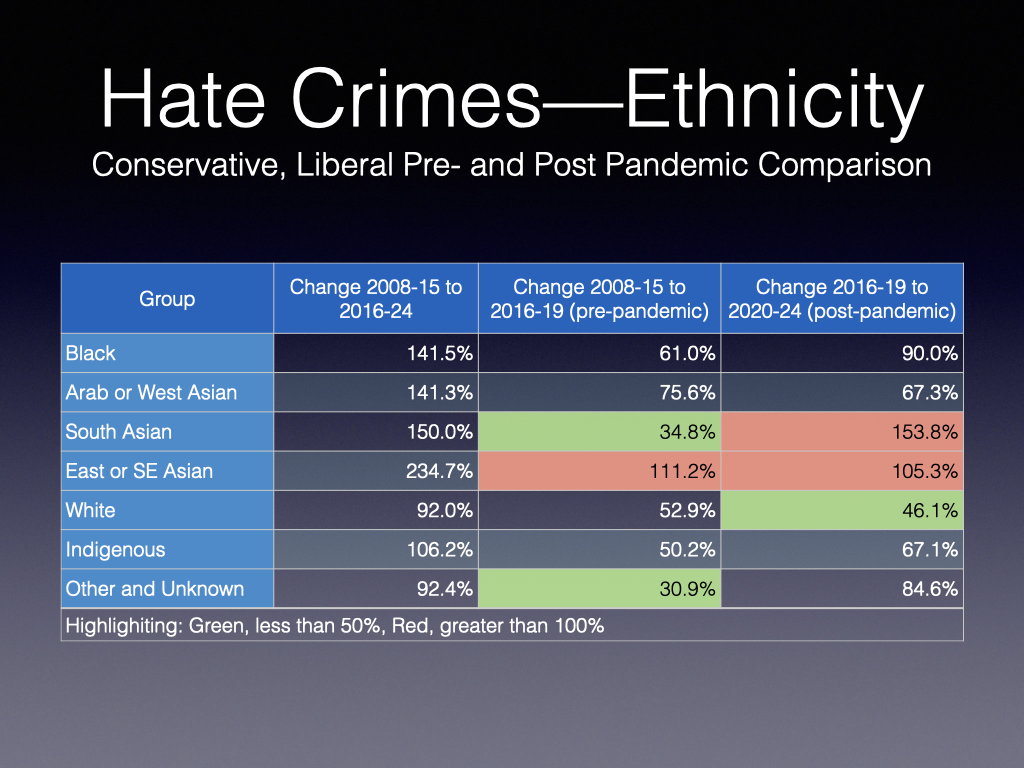
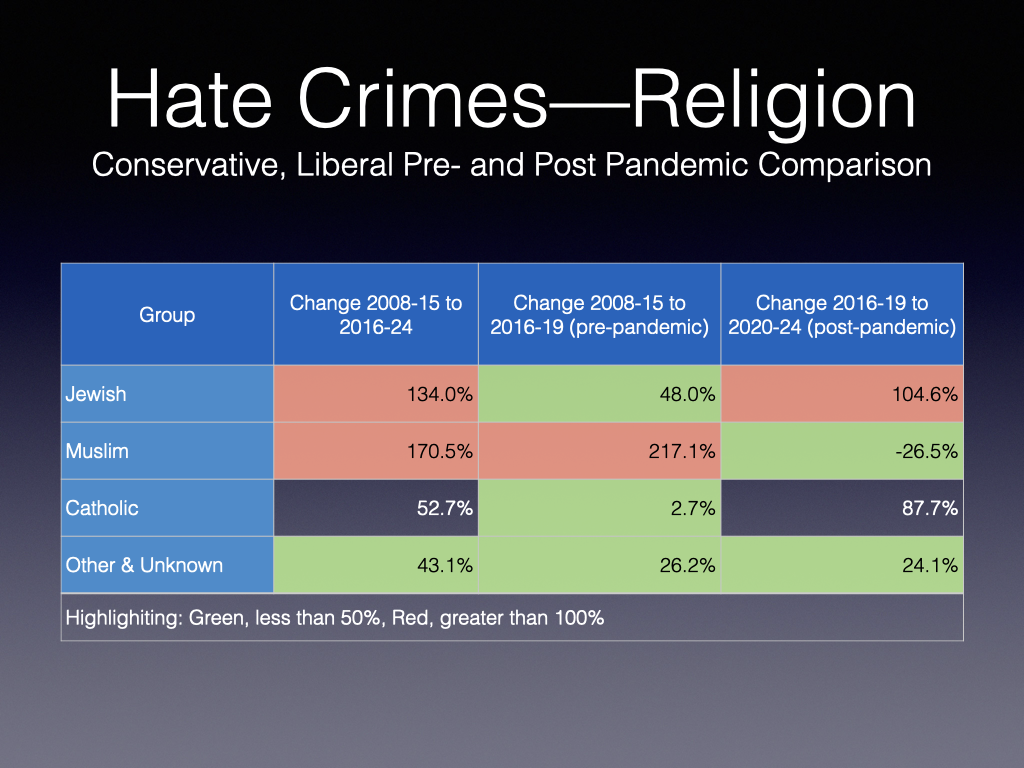
Hate crimes 2024

My latest analysis of the data, 2008-24. This year I have broken the data into three periods: Harper government, Trudeau government pre-pandemic, and Trudeau government post-pandemic and the ongoing increases save for anti-Muslim hate crimes post-pandemic.

The two key comparison slides are below:

StatsCan link: https://www150.statcan.gc.ca/n1/pub/71-607-x/71-607-x2023026-eng.htm?utm_source=mstatcan&utm_medium=eml&utm_campaign=statcan-statcan-mstatcan

Canadian passport continues to plummet in power according to new global ranking. How does it compare to other countries?

What a silly, stupid and misleading headline, dropping one level hardly plummeting:

Over the last two decades, the Canadian passport has been one of the world’s strongest but a recent report suggests it is plummeting. 

Canada’s passport ties with Estonia and the United Arab Emirates (UAE) at 8th place out of 199 in the world with visa-free access to 184 countries, according to the latest data from Henley Passport Index . 

The recent ranking shows the Canadian passport is down from seventh place since the last index update in January, losing visa-free access to four nations while seeing a much larger drop from Canada’s 2014 peak when it ranked second. 

Although the Canadian passport has consistently ranked within the top 10 globally, in recent years, other countries are gaining visa-free access to destinations quicker than Canada, which is among five countries to have seen the largest plunge in rankings over the past decade. 

Here’s how Canada’s passport ranks compared to other countries including the U.S. 

Which countries have the most powerful passports?

Singapore’s passport has once again topped the list allowing citizens to enter 193 destinations out of a possible 227 without a prior visa. On the other end of the spectrum, Afghanistan remains at the bottom of the list, with its passport gaining visa-free access to just 25 countries— a massive mobility gap of 168 countries compared to Singapore. 

Other Asian countries are also topping the list, with Japan and South Korea tied for second place, giving holders visa-free access to 190 countries. 

Seven European nations take the third spot with visa-free access to 189 countries, including Denmark, Finland, France, Germany, Ireland, Italy and Spain. The fourth and fifth places are also largely dominated by other European countries, but New Zealand is the one outlier who shares fifth place with Europe’s Greece and Switzerland. 

Since six months ago, India has seen the largest jump in ranking, shooting up from 85th place to 77th with citizens granted access to 59 visa-free destinations, but only gaining entrance to two additional countries. In the latest data, Saudi Arabian citizens can now travel to 91 countries after adding four destinations, making this the largest gain in visa-free access from all passports since the start of the year. 

Source: Canadian passport continues to plummet in power according to new global ranking. How does it compare to other countries?

Kang: We need an official policy prohibiting removal of at-risk trans and non-binary people to the U.S.

Predictable and understandable call:

…A temporary public policy, like a stay of removal, serves as a mechanism to delay or prevent deportation under specific circumstances. They can differ significantly in terms of their purpose, application and duration, but a temporary suspension-of-removal policy could offer a meaningful – albeit short-term – solution for trans and non-binary Americans who fear being removed to the U.S. Under this type of policy, the Canadian government can temporarily change or suspend certain immigration requirements in response to international crises, with targeted immigration measures for specific groups of people. Set for a limited timeframe, the Canadian government can reassess the policy and, if necessary, extend it until circumstances change…

Joycna Kang is a partner and Benjamin Merrill is an articling student at Battista Migration Law Group, an LGBTQ immigration firm based in Toronto.

Source: We need an official policy prohibiting removal of at-risk trans and non-binary people to the U.S.

Lack of action on Gaza eroding Muslim-Canadians’ sense of belonging, envoy says

Not surprising, along with similar erosion of Jewish Canadians sense of belonging given rise in anti-semitic and anti-Israel demonstrations and incidents. Sad fraying and inability to have cross-community conversations as former antisemitism envoy Lyons pointed out:

…Elghawaby said the grief felt by Muslim-Canadian families over the suffering of loved ones in Gaza is being compounded by a sense that Ottawa isn’t doing enough to prevent the suffering, despite issuing “very clear statements” on the situation.

“‘Devastated’ is not even strong enough a word to describe how people are feeling,” she said.

“[These are] their loved ones, their family members, who are starving, who are continuing to face bombing and displacement, and who are just desperate – desperate for this to end.”

On social media, Elghawaby wrote that the fear felt by Canadians with family in the region grows “with each day that passes without meaningful action towards upholding international humanitarian law.”

In the interview, Elghawaby said she doesn’t have the mandate or enough detailed information to say whether Canada is doing enough. She said she can only convey the feeling widespread in Muslim and Arab communities that Ottawa is dropping the ball.

“How can it be – is what people are asking me – that international humanitarian law is violated in this way, and nothing is actually happening, or not enough is happening?” she said….

Source: Lack of action on Gaza eroding Muslim-Canadians’ sense of belonging, envoy says

Almost 600 foreign nationals with criminal records due to be deported are missing, CBSA says

Will likely not contribute to perception of government managing immigration, along with related broader issues of removals and visa overstays:

Canadian border agents are trying to track down almost 600 foreigners with criminal records who are due to be deported but have gone missing – 431 of whom have been found guilty of serious crimes such as sexual assault.

Figures from the Canada Border Services Agency show that 1,635 foreign nationalsguilty of committing crimes in Canada are currently facing deportation, but 599 of them have failed to attend deportation proceedings and have been placed on the agency’s “wanted” list. 

Of those 599, 315 have been evading deportation for more than three years. Another 46, according to CBSA figures obtained by The Globe and Mail, have been evading the authorities for more than two years. 

Of the foreign nationals due to be deported, 401 are serving a prison sentence and must leave the country after they get out of custody. …

Source: Almost 600 foreign nationals with criminal records due to be deported are missing, CBSA says

‘1984’ Hasn’t Changed, but America Has

All too true, even if there have been previous chilling periods:

…Banning books doesn’t stop at the local level.This year, after Mr. Trump signed three executive orders aimed at combating “wokeness,” the Department of Defense’s education agency removed and reviewed more than 500 titles from its school system, including, according to one report, Aldous Huxley’s “Brave New World,” which the C.I.A. had sent to the Eastern Bloc. Federal funding agencies have compiled a list of more than 350 banned words and phrases, including “women,” “diversity” and “ethnicity.”

In the Cold War, the United States chose “freedom” — democratic freedom, freedom of speech, intellectual freedom and freedom of choice — as its key point of difference with the Soviet enemy. Since the end of World War II, U.S. presidents from both parties have wrapped themselves in the rhetoric of the “free world” that they led. When Ronald Reagan — who spearheaded the Cold War “freedom” agenda and oversaw an upswing in C.I.A. literary programs — spoke to the British Parliament in 1982, he invoked “the march of freedom and democracy,” which would “leave Marxism-Leninism on the ash-heap of history.” It was no coincidence that George Minden, the leader of the C.I.A. book program, once described his operation as “an offensive of free, honest thinking.”

Mr. Trump, JD Vance, Ron DeSantis and their fellow travelers expound the virtues of the First Amendment while dismantling guardrails against disinformation and working to suppress political ideas they oppose. Book bans aren’t their only tool. They also block access for independent journalistsintimidate news organizations and defund outlets they perceive as hostile to the MAGA agenda, including NPR, Radio Free Europe/Radio Liberty, Radio Free Asia and Voice of America.

There are two lessons from the history of the C.I.A. book program that the book banners would do well to heed. One is that censorship — whether by Communists, fascists or democratic governments — tends to create demand for the works it targets. (That, and Mr. Trump’s Orwellian tactics, may explain why “1984” has been surging up the book charts in recent years.)

The other is that the totalitarians lost the Cold War, and freedom of thought won the day. The former Polish dissident Adam Michnik, whose own works were promoted by the C.I.A., presumably without his knowledge, said: “It was books that were victorious in the fight. We should build a monument to books.”

Charlie English is the author of, among other books, “The CIA Book Club: The Secret Mission to Win the Cold War with Forbidden Literature.”

Source: ‘1984’ Hasn’t Changed, but America Has

Key takeaways from trial over Trump administration’s ‘ideological deportation’ policy

Chilling:

A trial over the extraordinary measures taken by the Trump administrationto detain foreign scholars over their pro-Palestinian speech revealed previously unknown details about the extent to which immigration officials broke with precedent in their campaign against university activists.

The case, which was brought by the national American Association of University Professors (AAUP); its Harvard, Rutgers and New York University chapters; and the Middle East Studies Association (Mesa) after the arrest of several noncitizen students and scholars who had been outspoken about Palestinian rights, marked the first time the administration was asked to defend its position that it has the authority to deport noncitizens over constitutionally protected speech.

The plaintiffs argued the government’s actions amounted to an illegal “ideological deportation” policy.

“The Trump administration is imprisoning and expelling people because of their political viewpoints,” said Jameel Jaffer, executive director of the Knight First Amendment Institute, which represented the plaintiffs along with the law firm Sher Tremonte. “It would be difficult to conceive of a policy more offensive to the first amendment, or to the values the first amendment was meant to serve.”

While the four arrested scholars – including the Columbia University graduate Mahmoud Khalil and Tufts University student Rümeysa Öztürk – have all been released from detention while their legal cases proceed, others have left the country to avoid arrest and one is in hiding.

The trial ended in Boston on Monday. The judge in the case, Reagan appointee William G Young, is not expected to rule on the case for at least a few weeks. Any decision he makes will almost certainly be appealed, possibly up to the US supreme court.

These are some of the revelations that came out of the trial.

  1. The Trump administration relied on lists from shadowy pro-Israel groups Among the trial’s most explosive revelations was the fact that the government relied on dossiers compiled by the rightwing Canary Mission, a secretive, pro-Israel group dedicated to doxing thousands of pro-Palestinian students, scholars and activists, as well as information by the far-right Zionist group Betar USA, which even the pro-Israel Anti-Defamation League lists as an extremist organisation. Both Canary Mission and Betar had been involved in compiling “deportation lists”, sending “thousands of names” to government officials. While that had been previously reported, the testimony of senior US immigration officials revealed for the first time the extent to which the government relied on such lists. Peter Hatch, a senior official within Immigration and Customs Enforcement’s Homeland Security Investigations (HSI) division, testified that the agency assembled a group of officials – known internally as the “Tiger Team” – dedicated to investigating student protesters. The team rapidly compiled more than 100 reports based on a list of 5,000 individuals identified on the Canary Mission website. The dossiers the agency compiled on Öztürk, Khalil and others highlighted their pro-Palestinian speech, Hatch testified, included their Canary Mission pages, as well as, in Öztürk’s case, an op-ed she wrote in a student paper. “The direction was to look at the website,” Hatch said in court. “That we should look at the individuals named in the Canary Mission website.”
  2. Immigration officials admitted to the unprecedented nature of the arrests Four of the officers involved in Öztürk and Khalil’s arrests, as well as in the arrests of Columbia graduate Mohsen Mahdawi and Georgetown postdoctoral fellow Badar Khan Suri, said that orders to prioritize the scholars had come from high up within the Trump administration.  They also admitted they had never taken part in such arrests before.  A New England Immigration and Customs Enforcement (Ice) agent involved in Mahdawi’s arrest, William Crogan, said that he had never seen a noncitizen removed from the US based on similar factual allegations and that his superiors had ordered him to prioritize the case. Patrick Cunningham, an Ice agent in Boston, said the same of Öztürk’s case, while Darren McCormack, an agent in New York, said that the request to arrest Khalil was unusual and that he was told the US secretary of state, Marco Rubio, and the White House were specifically interested in Khalil’s case.  Andre Watson, a senior HSI official, testified that early in the Trump administration, Ice and the state department coordinated on a new process to implement the president’s executive orders targeting student protesters. 
  3. The government tried to block the release of documentsDuring the trial, the government’s attorneys sought to block the release of documents detailing its processes and reasons for revoking student visas and issuing determinations of removability for green card holders such as Khalil and Mahdawi.  The records for only five of the targeted students were released in the end; many others were not. The government also succeeded in blocking the release of a state department report detailing the administration’s policies on the matter. The government has claimed the authority to deport noncitizens who have committed no crimes but whose presence it deems poses a threat to US foreign policy and national security, and it has said that the students’ presence in the US interfered with its stated efforts to combat antisemitism. The US Department of Justice did not immediately respond to a request for comment but in court filings it called claims of an ideological deportation policy the product of plaintiffs’ “imagination”. But John Armstrong, the most senior official at the state department’s bureau of consular affairs, admitted under questioning that statements critical of Israel or US foreign policy could qualify noncitizens for deportation. He also admitted that officials who were instructed to compile allegations about the individuals targeted received no guidance about what constitutes antisemitism even as they sometimes invoked “antisemitic conduct” in their memos. The administration’s lawyers have also equivocated on whether noncitizens have the same constitutional rights as US citizens, at one point saying they do, but later adding that there are “nuances” related to national security, immigration and foreign policy matters. 
  4. A huge chilling effect Both citizen and noncitizen scholars testified about the climate of fear created by the arrests. Megan Hyska, a Canadian philosophy professor at Northwestern University in Chicago, said in court that she decided not to publish an op-ed she had written about organising resistance to the Trump administration’s policies out of fear of being targeted for arrest. Nadje Al-Ali, a German anthropologist and former director of the Center for Middle East Studies at Brown University, said she canceled plans to travel abroad and stopped pursuing research related to Palestine because of similar concerns. Veena Dubal, the AAUP’s general counsel, testified that the government’s fearmongering campaign has fundamentally altered the group’s activities. She said that members who had previously been very active within the group stopped attending meetings.Aslı Bâli, Mesa’s president, warned in a statement to the Guardian that the impact of the government’s policies risked only growing worse. “The government is abducting individuals, and thereby separating families and squandering public resources, purely on the basis of protected political speech that they disagree with,” she said. “They need to be held to account, and our rights need to be defended, because otherwise we will find these protections gone – and the chilling effect will be pervasive.”

Source: Key takeaways from trial over Trump administration’s ‘ideological deportation’ policy