Citizenship articles of interest March 2026

Articles and opinions related to citizenship that I found of interest in March:

Idées | Après la loi C-3, un réveil franco-américain

This is the second article that has focussed on potential applicants from early waves of Canadian francophone emigrants to the USA. This possibility was never raised I believe in either House or Senate hearings on C-3 and its predecessors, and the focus and discussion was on second generation, not earlier generations (Indian media did flag possibility). I will be making a data request in 2027 and have asked IRCC whether their data collection will distinguish between second and earlier generations:

…“Pour comprendre l’onde de choc, il faut revenir au fameux « plafond » : la limite de première génération. En clair, les enfants nés à l’étranger de parents canadiens pouvaient être citoyens canadiens, mais ne pouvaient pas transmettre automatiquement leur citoyenneté à leurs propres enfants si eux aussi naissaient à l’étranger. La chaîne s’arrêtait après une génération née hors du pays.

Une décision rendue en Ontario en décembre 2023 a jugé ce régime inconstitutionnel dans certains cas, ce qui a forcé Ottawa à corriger le tir. C-3 permet donc la citoyenneté au-delà de la première génération née à l’étranger, mais en posant une condition de « lien substantiel » : la citoyenneté peut circuler plus loin dans la chaîne familiale à condition qu’il y ait une ancre réelle au pays, démontrée par 1095 jours — trois ans — de présence physique cumulative au Canada.

Et voilà ce qui change tout : pour beaucoup, il ne s’agit pas de « demander » la citoyenneté comme un privilège, mais de faire reconnaître un statut qui s’appuie maintenant sur des règles précises afin d’obtenir une preuve de citoyenneté. Psychologiquement, ce n’est pas la même posture.”

Pourquoi la Nouvelle-Angleterre s’enflamme

Si cette loi fait battre le cœur de la Nouvelle-Angleterre, ce n’est pas un hasard. Entre 1830 et 1970, près d’un million de Québécois ont traversé la frontière — surtout vers les villes industrielles — pour travailler dans les filatures et les manufactures. Le résultat démographique est immense : leurs descendants représentent aujourd’hui près de dix millions d’Américains.

Cette diaspora a longtemps été racontée comme une épopée ouvrière : un peuple qui quitte la terre, cherche du travail, construit des quartiers, des paroisses, des clubs, fondent des journaux. Mais c’est aussi une histoire de hiérarchie sociale : des Canadiens français devenus main-d’œuvre bon marché, comme tant d’autres groupes dans l’Amérique industrielle. Ce double héritage explique la charge émotionnelle du moment : la loi C-3 ne touche pas seulement un cas juridique ; elle réveille une mémoire.

Surtout, elle arrive des années après qu’une fierté franco-américaine s’est reconstruite « par en bas » : balados, blogues, festivals, initiatives locales. Parmi ceux qui s’activent aujourd’hui, il y a des amis à moi qui animent un balado franco-américain très écouté, d’autres qui ont fondé le PoutineFest du New Hampshire — devenu assez solide pour essaimer, avec des éditions à Burlington, au Vermont, et dans “le Maine — et d’autres encore qui tiennent depuis longtemps des blogues franco-américains. La fierté n’a pas attendu Ottawa. Mais l’accès, lui, oui.

L’Amérique pousse, le Québec attire

Pourquoi maintenant ? Parce que l’Amérique inquiète. Dans mes échanges, je sens moins une mode qu’une fatigue : fatigue politique, fatigue institutionnelle, fatigue culturelle. La citoyenneté canadienne devient un filet de sécurité pour certains : un passeport, oui, mais surtout une option familiale.

Mais réduire ce mouvement à une fuite serait une erreur. Beaucoup ne parlent pas d’abord de soins de santé ou d’élections. Ils parlent de langue. Ils parlent d’immersion. Ils parlent d’un désir de vivre — enfin — dans un endroit où le français n’est pas un folklore, mais un espace public.

Plusieurs se disent fièrement Franco-Américains. D’autres se décrivent carrément comme « Québécois », avec ce mélange de fierté et d’envie : envie d’une société qu’ils perçoivent comme plus cohérente, plus collective, moins brutale. Et ils sont lucides : tous ne pourront pas transférer leur carrière ici. Les avocats, les fiscalistes, ceux qui ont des professions encadrées le savent. Pourtant, ils avancent, parce que ce n’est pas seulement une équation économique : c’est une trajectoire.

Bienvenue chez vous »… mais préparons-nous

Soyons francs : cette loi a un impact particulier — et probablement disproportionné — sur les descendants de Québécois aux États-Unis. Elle ne déclenchera pas automatiquement une migration de masse. Les démarches restent exigeantes : prouver la filiation, retrouver les bons documents, faire valider les chaînes.

Mais la direction du courant est claire. Et le Québec doit regarder cette réalité en face : une partie de cette diaspora va frapper à sa porte, non pas comme des étrangers, mais comme des « revenants » — avec une attache réelle, un imaginaire familial, parfois un français brisé, parfois un français intact.

La question n’est donc pas seulement de savoir combien viendront, mais comment on les accueillera. Oui, la citoyenneté donne des droits. Mais l’installation au Québec implique aussi des devoirs, des choix, un ancrage. Et si une partie de cette vague devient une immigration durable, elle peut aussi être un gain : démographique, économique, culturel — et, franchement, linguistique, si ces nouveaux arrivants viennent précisément chercher le français.

Alors, oui : Québécois et Canadiens français, préparez-vous à dire « bienvenue chez vous ». Mais disons-le intelligemment : avec des parcours d’accueil réalistes, des ponts de francisation adaptés et un discours public qui évite de transformer des cousins en boucs émissaires.

Parce qu’au fond, C-3 ne fait pas que corriger une incohérence juridique. Elle réactive une vieille histoire : celle d’un peuple parti travailler ailleurs… et dont les descendants, un siècle plus tard, demandent non pas la permission, mais la reconnaissance de revenir toucher le fil.”

Rémi Francœur Franco-Américain, l’auteur est analyste politique et ancien directeur de campagnes politiques au New Hampshire. Il est installé à Montréal depuis 2015.

…”To understand the shock wave, we must return to the famous “ceiling”: the first generation limit. Clearly, children born abroad to Canadian parents could be Canadian citizens, but could not automatically transmit their citizenship to their own children if they were also born abroad. The channel stopped after a generation born outside the country.

A decision rendered in Ontario in December 2023 ruled this regime unconstitutional in some cases, forcing Ottawa to correct the situation. C-3 therefore allows citizenship beyond the first generation born abroad, but by placing a condition of “substantial link”: citizenship can circulate further in the family chain provided that there is a real anchor in the country, demonstrated by 1095 days – three years – of cumulative physical presence in Canada.

And this is what changes everything: for many, it is not a question of “asking” citizenship as a privilege, but of having a status recognized that is now based on precise rules in order to obtain proof of citizenship. Psychologically, it’s not the same posture.”

Why New England is on fire

If this law makes the heart of New England beat, it is no coincidence. Between 1830 and 1970, nearly a million Quebecers crossed the border — mainly to industrial cities — to work in spinning mills and factories. The demographic result is immense: their descendants now represent nearly ten million Americans.

This diaspora has long been told as a workers’ epic: a people who leave the earth, look for work, build neighborhoods, parishes, clubs, found newspapers. But it is also a story of social hierarchy: French Canadians who have become cheap labor, like so many other groups in industrial America. This double legacy explains the emotional charge of the moment: Law C-3 does not only affect a legal case; it awakens a memory.

Above all, it comes years after a Franco-American pride has rebuilt itself “from the bottom”: podcasts, blogs, festivals, local initiatives. Among those who are active today, there are friends of mine who host a much listened to Franco-American podcast, others who founded the PutinFest of New Hampshire – which has become solid enough to swarm, with editions in Burlington, Vermont, and in “Maine – and others who have long held Franco-American blogs. Pride did not wait for Ottawa. But access, yes.

America is pushing, Quebec attracts

Why now? Because America is worried. In my exchanges, I feel less a fashion than a fatigue: political fatigue, institutional fatigue, cultural fatigue. Canadian citizenship becomes a safety net for some: a passport, yes, but above all a family option.

But reducing this movement to a leak would be a mistake. Many do not first talk about health care or elections. They speak language. They talk about immersion. They speak of a desire to live – finally – in a place where French is not a folklore, but a public space.

Many proudly call themselves Franco-Americans. Others describe themselves flatly as “Quebecers”, with this mixture of pride and envy: desire for a society that they perceive as more coherent, more collective, less brutal. And they are lucid: not all will be able to transfer their career here. Lawyers, tax specialists, those who have supervised professions know it. However, they move forward, because it is not just an economic equation: it is a trajectory.

Welcome home”… but let’s get ready

Let’s be frank: this law has a particular — and probably disproportionate — impact on the descendants of Quebecers in the United States. It will not automatically trigger a mass migration. The steps remain demanding: prove filiation, find the right documents, have the channels validated.

But the direction of the current is clear. And Quebec must face this reality: part of this diaspora will knock on its door, not as foreigners, but as “revenants” – with a real attachment, a family imagination, sometimes a broken Frenchman, sometimes an intact Frenchman.

The question is therefore not only how many will come, but how they will be welcomed. Yes, citizenship gives rights. But settling in Quebec also implies duties, choices, an anchorage. And if part of this wave becomes sustainable immigration, it can also be a gain: demographic, economic, cultural – and, frankly, linguistic, if these newcomers come precisely for French.

So, yes: Quebecers and French Canadians, get ready to say “welcome home”. But let’s say it intelligently: with realistic welcome paths, adapted francization bridges and a public discourse that avoids turning cousins into scapegoats.

Because basically, C-3 does not only correct a legal inconsistency. It reactivates an old story: that of a people who have gone to work elsewhere… and whose descendants, a century later, ask not for permission, but the recognition of returning to touch the thread.”

Rémi Francœur Franco-American, the author is a political analyst and former director of political campaigns in New Hampshire. It has been based in Montreal since 2015.

Source: Idées | Après la loi C-3, un réveil franco-américain

Canadians living abroad are calling for increased turnout among overseas voters and arguing that barriers to casting a ballot could be affecting election results.

Looking forward the PROC report and recommendations. In contrast to the USA with relatively strong Republicans and Democrats Abroad, Canadian political parties do not appear to have the same interest although the Liberals seem to have a greater focus that the Conservatives (https://www.conservativesabroad.ca). The Liberals have the expansive multi-generational interpretation of C-3. As in the case of “Lost Canadians” and previous elections, the number who may be interested and vote is likely smaller than advocates believer.

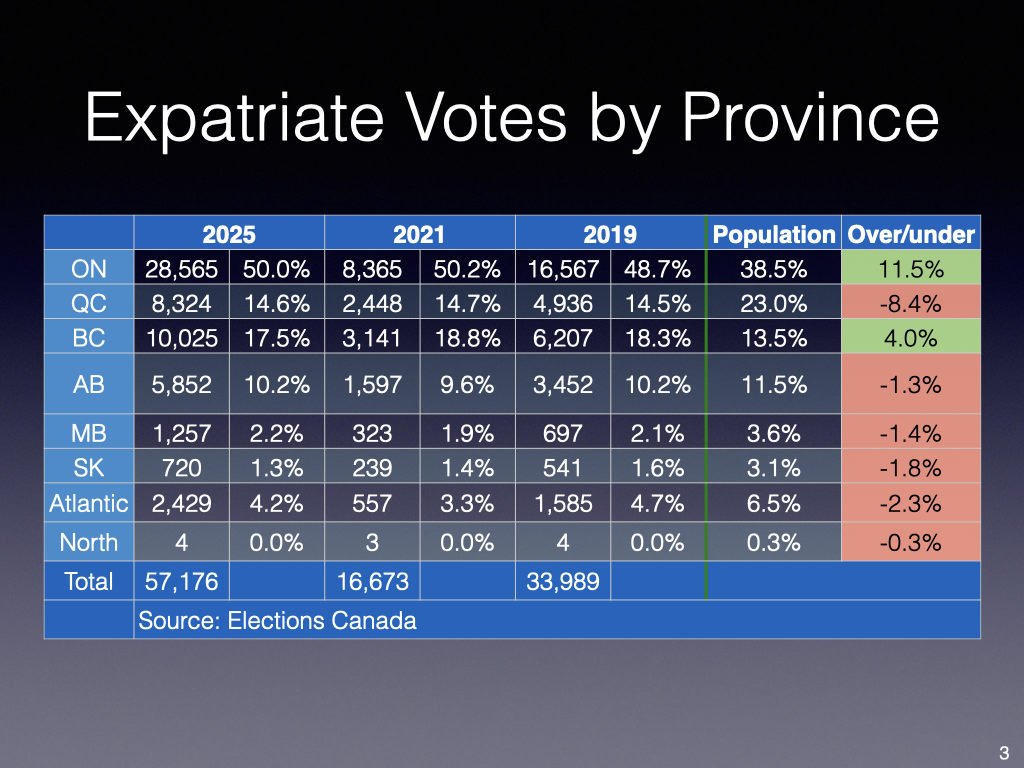
Upcoming analysis on the provincial and country breakdowns for the 2025 election, sample below, Ontario and British Columbia have higher proportions than other provinces:
Timothy Veale, the director of Grits Abroad — an organization aimed at connecting Canadian Liberal voters living worldwide — said nearly five million Canadians live outside the country and roughly 3.5 million of them are eligible to vote.

Veale said the share of non-resident Canadians voting in federal elections is mired in the low single digits. He said the causes include mail-only voting, compressed timelines, uncertainty about ballot arrival and delivery and a lack of outreach from party campaigns.

Daniel Scuka, a member of Grits Abroad living in Germany, said parties need to “wake up” and encourage Canadians overseas to vote. He said Elections Canada could also be directed to do more to support overseas voting.

Veale said federal parties should see overseas voters as an opportunity.

“I’d like to see a politician ask us for their vote,” he said. “In the last election … I don’t think anybody courted any of the five million people living overseas.”

Veale said the system “needs modernization” and Canadians should be able to vote in person at an embassy, consulate or high commission. He also pointed out that several countries allow online voting.

“We have the right to vote and a 37-day election was not designed for people abroad to apply to vote,” he said. “If you get approval, then you have to wait for the ballot to be sent to you, then you have to send it back. And imagine having to navigate over 200 different national postal systems around the world.

“We’ve seen how other countries operate and we can do way better than this. It’s just a matter of will, as I see it.”

Elections Canada said in an email that 101,690 voting kits were issued to electors living outside of Canada in the last general election. Of those, 57,440 were returned on time and tallied….

Source: Canadians living abroad looking to increase voter turnout ahead of byelections

As Americans in Canada prepare U.S. tax filings, lower citizenship renunciation fee offers a way out
Not to be cynical but given that Democrats abroad tend to be larger than Republicans….

The U.S. government’s decision to decrease its citizenship renunciation fee by more than 80 per cent may result in more Americans in Canada giving up their U.S. citizenship, cross-border tax experts say, as the deadline for Americans abroad to file their taxes approaches.

Earlier this month, the U.S. State Department announced that the consular services fee charged to Americans giving up their citizenship will drop to US$450, down from US$2,350, effective April 13.

Unlike Canada and most other countries, the U.S. bases its tax system on citizenship rather than residency. That means a U.S. citizen must file a U.S. tax return every year regardless of where they live. In addition, the U.S. requires Americans to report on their foreign financial accounts annually. 

The deadline for filing a U.S. tax return is April 15, but Americans living abroad receive an automatic filing and payment extension until June 15, and a possible further extension to Oct. 15, if they request it. To avoid interest charges, any taxes are still due by April 15….

Source: As Americans in Canada prepare U.S. tax filings, lower citizenship renunciation fee offers a way out
Multiculturalism articles of interest March 2026

Articles and opinions related to multiculturalism that I found of interest in March:

  • Racial and Ethnic Disparities
  • Activisim/Advocacy
  • Quebec Bill 21
  • Representation corporate boards and public serice

Disparities

Picard: To address racism in health care, we need to collect data on race

Agree, without data, over reliance on anecdotes:

…It’s important, of course, that data are collected voluntarily and that people’s privacy is respected as it is with all health records. 

The public needs to know, too, that the information will not appear on their health card or on medical charts. Rather, it is used in an aggregated fashion to reveal trends and inequalities between racial or ethnic groups, without identifying individuals. 

The big barrier to collecting and using race-based data is technical: digital health systems still need to adapt. But we know it’s doable, even on a large scale. 

During the pandemic, for example, the Coronavirus Rapid Entry Case and Contact Management System (CORES) included data on race, income and household size. As a result, we learned Black, Indigenous and people of colour in Toronto were over-represented in the tally of COVID-19 cases and deaths. That allowed, among other things, targeted vaccination campaigns. 

The data also allowed people who are too often marginalized and ignored to be heard, an important first step in correcting disparities. 

Race, culture, language and socio-economic status can all have a profound impact on health, individually and collectively. 

Allowing gaps in data collection to persist is bad for our health, and our health system. 

Source: To address racism in health care, we need to collect data on race 

StatsCan: Criminal court outcomes of Black accused persons in Canada, 2016/2017 to 2022/2023

Latest useful StatsCan study highlighting disparities

  • There were 100,450 Black accused persons in adult criminal courts between 2016/2017 and 2022/2023. Black people (6.2%) were overrepresented as accused persons in adult criminal courts over this period, relative to their representation among the adult population of Canada (3.7%).
  • The proportion of Black accused persons in adult criminal courts has generally increased over time, from 5.7% of all accused in 2016/2017 to 7.1% in 2022/2023. 
  • Between 2016/2017 and 2022/2023, the proportion of Black people in adult criminal courts in Nova Scotia and Ontario was more than two times higher than that of Black people in the total adult population of these provinces. Black people were also overrepresented as accused persons in criminal courts in Quebec, British Columbia, Alberta and New Brunswick compared with their representation in the total adult population.
  • More than 4 in 10 (42%) cases involving a Black accused person completed in adult criminal courts between 2016/2017 and 2022/2023 resulted in a guilty decision. This was equal to the proportion of cases involving Black accused persons that were withdrawn, dismissed or discharged over this period (42%).
  • Compared to the rest of the (non-Black) accused population, Black accused persons less often had their case result in a guilty decision and more often had it withdrawn, dismissed or discharged. 
  • Black accused persons most often received a guilty decision for cases where the most serious offence was a Criminal Code traffic offence such as impaired driving (69%) or an administration of justice offence such as breach of probation (49%), and least often for cases where it was a violent offence (33%). 
  • Between 2016/2017 and 2022/2023, just under half of violent crime cases (47%) and property crime cases (46%) involving Black accused persons were withdrawn, dismissed or discharged.
  • Similar proportions of Black and non-Black accused persons were sentenced to custody upon being found guilty in adult criminal courts (29% versus 27%). Probation was the most common sentence handed down to both Black and non-Black accused persons. 
  • It took nearly two months longer for court cases involving Black accused persons to be completed in adult criminal courts between 2016/2017 and 2022/2023, compared to non-Black accused persons (219 versus 165 days).

Source: Criminal court outcomes of Black accused persons in Canada, 2016/2017 to 2022/2023

CMA: Black Canadians more likely not to fill prescriptions because of financial constraints, study finds

Another insightful study:

Black adults in Canada are more likely not to fill prescriptions because of financial constraints than white adults, according to a new study that highlights disparities in prescription medication coverage as a major barrier to equitable health care.

The study was published in the Canadian Medical Association Journal on Monday. Its authors concluded that the prevalence of cost-related prescription non-adherence – defined as the inability to fill a prescription or delaying, splitting or skipping doses because of financial pressures – was 75 per cent higher among Black adults than white adults.

Coverage for prescription medications was also lower among Black adults, the study showed. In 2022, for example, 72.5 per cent of Black adults were covered compared with 80 per cent of white adults. 

One of the study’s authors, Oluwabukola Salami, a Canada Research Chair in Black and racialized peoples’ health at the Cumming School of Medicine at the University of Calgary, said this study is the first of its kind and broadens the understanding of how Black Canadians experience health inequities.

“We know that Black people are more likely to have cardiovascular disease, to have certain types of cancer and to die from any of these conditions. But we always looked at how access to care is a challenge to Black people,” Dr. Salami said.

“This study presents new findings related to medication specifically.”…

Source: Black Canadians more likely not to fill prescriptions because of financial constraints, study finds

Activism/Advocacy

Amira Elghawaby entend poursuivre son combat contre la laïcité à la québécoise

Suspect may be harder given lack of a government platform and support staff and resources:

Amira Elghawaby, ancienne représentante spéciale du Canada, continue de s’opposer à la loi 21 sur la laïcité malgré l’abolition de son poste.

Bien que son poste ait été supprimé par le gouvernement de Mark Carney, elle se dit en paix et prévoit de rester active dans la scène publique.

Elle exprime des inquiétudes quant à l’efficacité du nouveau comité consultatif sur la lutte contre le racisme et la haine.

Source: Amira Elghawaby entend poursuivre son combat contre la laïcité à la québécoise

Jamie Sarkonak: The crusading judge who helped Liberals build a race-based sentencing regime

Sarkonak appears to be following judges with activist backgrounds as seen in her previous column on Justice Go.

There is a judge on the Ontario Superior Court of Justice whose signature move is letting violent men walk free because of racism. One of the architects of race-based sentencing, his name is Faisal Mirza, and he was appointed to the bench by former prime minister Justin Trudeau in 2022.

Mirza’s flourish of race-based acquittals is not a case of a judge gone rogue: indeed, it’s perfectly on-brand. He was writing about the need for more racial considerations in the Canadian justice system in 2001, before he even became a lawyer. Back then, he argued in the Osgoode Hall Law Journal that mandatory minimum sentences for drug and weapons offences would be racist because of the disproportionate impact they’d have on Black people.

Toronto police, he asserted, were racist because of the arrest statistics they produced: in 1988, Black individuals comprised 51 per cent of drug arrests, 82 per cent of mugging arrests and 55 per cent of purse snatching arrests. This, he said, was evidence of over-targeting. He concluded that more mandatory minimums would exacerbate the effect, because the threat of being convicted on a charge with a guaranteed jail term would disproportionately pressure Black accused persons to make plea deals and forfeit the opportunity to expose racist police at trial.

This became a career pursuit. When the Supreme Court was deciding whether to strike down the mandatory minimum for illegally possessing a loaded firearm in 2014, he argued as an intervener in the case that its disproportionate impact on Black individuals needed to be taken into account. The court ultimately ruled that this mandatory minimum was unconstitutional.

In 2018, Mirza laid the foundation for Ontario’s racial sentencing regime. He was the defence lawyer of Kevin Morris, a Black man who was convicted of various firearms offences. They were lucky to draw the hyper-progressive, destructively lenient Shaun Nakatsuru for a judge. Mirza filed two racial context reports about Morris and Black people as evidence, and the judge emphatically agreed to consider them. He settled on a 15-month sentence to account for the racial factors, even though three years was considered the starting point. On appeal, the Ontario Court of Appeal made racial considerations in sentencing the province-wide rule in 2021….

To his credit, there have been instances where Mirza refrained from applying a racial discount, and from tossing out evidence because of racism, but it doesn’t excuse the other times when he let his biases reign. It’s undeniable that he has a habit of projecting racism in assessing any interaction with the state and undermining public safety with his assumptions. One day, it’s going to end up getting someone hurt — if it hasn’t already.

Source: Jamie Sarkonak: The crusading judge who helped Liberals build a race-based sentencing regime

Dummit: How accommodation hollowed out Canadian nationalism

Not an easy country to govern given differing regional and group interests. Will be interesting to see how the (still) forthcoming revision to the Harper era citizenship study guide provides a cohesive and coherent national perspective:

….Taken as a whole, this legacy of national hesitation makes governing difficult. Is it any wonder that Carney spends so much time abroad signing international agreements? Foreign policy is one of the few areas where a Canadian government can still act as a single whole with relative clarity about the national interest.

But Carney’s real test will come when he finally returns home.

Canada’s genius has always been accommodation. But accommodation, repeated often enough, can gradually hollow out the idea that the country itself even has a single political purpose.

When Carney eventually tries to move forward with projects deemed nationally significant—whether mining developments, high-speed rail, or (God forbid) a new pipeline—he will run directly into Canada’s familiar pattern of internal division.

That’s when we’ll truly find out who is willing to embrace an “Elbows Up” style of nationalism. Until then, we’re left wondering: whose elbows? Defending which nation?

Source: How accommodation hollowed out Canadian nationalism

This woman is suing Canada for its ban on adoption under Muslim law

Inevitable that the ban would be challenged. Of course, this predominant affects Muslim families but perhaps a more appropriate challenge would be with respect to Pakistan’s application of kafala:

A Toronto woman is being denied the right to reunite with her adopted children because Ottawa does not recognize adoptions from Pakistan under Islamic rules, a court has heard.

Jameela Qadeer is the maternal aunt of Salman, Umme and Umm; she and her husband raised them as their own in Pakistan after her sister died of a brain hemorrhage in 2012. The Pakistani court has granted them guardianship of the kids and authorization to travel after their biological father, who was absent in their lives, abdicated his responsibility for their care.

An Ahmadiyya Muslim, a sect of Islam deemed heretical in Pakistan, Qadeer fled to Canada in 2017 and was granted asylum. However, her adopted kids have not been allowed to join her. Since 2013, Ottawa has stopped accepting adoption from Pakistan because it says the Islamic rules known as kafala only allow for guardianship of children, but do not sever biological ties as required by Canadian law.

In a fight to reunite the family, Qadeer and her sister’s children, along with two Muslim organizations, have taken the federal government to court, challenging the refusals of permanent residence to the children, and the constitutionality of Canada’s ban on recognizing adoption from Pakistan. 

They contend that Canada’s immigration policy has disproportionately affected Muslim families and denied them equality rights under the Charter, even when a guardianship arrangement following traditional kafala is permanent and sanctioned by a foreign court. 

“That categorical refusal does not only affect the individual applicants,” Armaan Kassam, lawyer for the National Council of Canadian Muslims told the opening of a three-day Federal Court hearing this week. “It affects Muslim families across Canada who adopt through foreign court-supervised guardianship processes.”

Warda Shazadi Meighen, lawyer for the children, said her clients’ biological father officially abdicated his responsibility in 2013 to Jameela Qadeer. Before leaving for Canada in 2017, Qadeer and her husband were granted judicial guardianship by a Pakistani court under national guardianship laws, giving them exclusive custody. ,,,

Source: This woman is suing Canada for its ban on adoption under Muslim law

Quebec Bill 21

Khan: In Quebec, laïcité has become its own kind of religious orthodoxy

Ironic but accurate:

…In the meantime, there is no legal recourse to challenge laws that are clearly discriminatory. Those primarily affected by these bills are veiled Muslim women – whom Quebec ostensibly wants to liberate, while strengthening gender equality. In its oxymoronic quest to impose freedom, then, the government is excluding those very women from the job market and impeding their financial independence. And it’s so 1950s to hear the high priests of laïcité – François Legault, Bernard Drainville – tell women what they can and cannot wear.

Given the situation, it’s time to tell the world about Quebec’s laïcité mission. Canadian embassies, high commissions and consulates should be clear to prospective immigrants (especially from la Francophonie) that their religious freedoms and expression will be curtailed in la belle province. Here at home, the federal government, along with the governments of Ontario, New Brunswick and Manitoba, should help those adversely affected by Quebec’s laws resettle in francophone communities in the rest of Canada, if they wish to leave. They deserve an opportunity to thrive without compromising their faith.

And finally, something must be done about the notwithstanding clause. Governments show no slowdown in its use, while the wider public seems unaware of its fundamental threat to basic freedoms. Perhaps a jarring public education campaign is in order, using the spectre of Donald Trump. After all, his administration has overseen attacks on domestic human rights, circumvented judicial warrants, tried to suspend legal protections to immigrants and denied equality before the law. Little wonder he wants to absorb Canada: The notwithstanding clause would allow him to do all that legally.

Source: In Quebec, laïcité has become its own kind of religious orthodoxy

Kutty | When parents are shut out of classrooms over what they wear, we have a problem

Absurd and unreasonable:

Two mothers in Quebec were recently told they could no longer volunteer at their children’s elementary school unless they removed their hijabs. For one of them, it meant being shut out of a classroom she had supported for years — not because of anything she did, but because of what she wears.

They are not alone. Across Quebec, people of faith — including Muslim women who wear hijabs, Sikhs who wear turbans, and Jewish Canadians who wear kippahs — are being pushed out of classrooms and public life unless they conceal visible expressions of their identity. In a separate incident, twelve Muslim women reportedly lost their teaching jobs because they refused to remove their hijabs. These are the lived consequences of Quebec’s secularism law, Bill 21, which prohibits many public-sector employees — including teachers, police officers and government lawyers — from wearing visible religious symbols while performing their duties.

The constitutionality of this law is now poised for its most consequential test. Canada’s Supreme Court is now hearing arguments in a landmark case examining whether Bill 21 violates fundamental rights, including freedom of religion and equality under the Canadian Charter of Rights and Freedoms. Quebec has invoked the notwithstanding clause — Section 33 of the Charter — a rarely used constitutional mechanism that allows governments to override certain fundamental rights, including freedom of religion and equality, for renewable five-year periods….

Source: When parents are shut out of classrooms over what they wear, we have a problem

Representation

StatsCam: Representation of women on boards of directors and in officer positions, 2023

Useful study with breakdowns:

Statistics Canada is releasing new data on the gender composition of leadership and strategic decision-making roles within publicly traded corporations, privately held corporations and government business enterprises operating across a variety of industries in Canada.

This data helps inform the objective “More company board seats held by women, and more diversity on company boards” and the indicator “Proportion of board members who are women, by type of board” in the Leadership and democratic participation pillar of the Gender Results Framework.

Additional information and other studies and statistics related to gender and enterprises can be found in the Gender, diversity and inclusion statistics hub, the Business performance and ownership statistics portal and in the Representation of women on boards of directors and in officer positions: Visualization tool.

Women hold just under one-quarter of director positions

In 2023, women occupied just under one-quarter (23.2%) of seats on boards of directors, increasing 0.5 percentage points over the proportion of women recorded in 2022 (22.7%). 

Just over half of boards (50.3%) did not include any women directors in 2023. In addition, 25.8% of boards had one woman director, while boards with two or more women directors accounted for 23.9% of the total. 

Educational services has the highest representation of women directors, followed by the utilities and finance and insurance industries

Educational services had the highest proportion of women directors in 2023, with women holding 35.3% of board seats. This reflects an increase of 4.9 percentage points from 2022. 

The utilities industry recorded the second-highest share in 2023, at 34.1%. Corporations in finance and insurance followed, with women representing 28.2% of board members. 

The agriculture industry had the lowest proportion of women directors, with women occupying 8.8% of board seats….

Source: Representation of women on boards of directors and in officer positions, 2023

Treasury Board not tracking impact of public service job cuts on equity groups

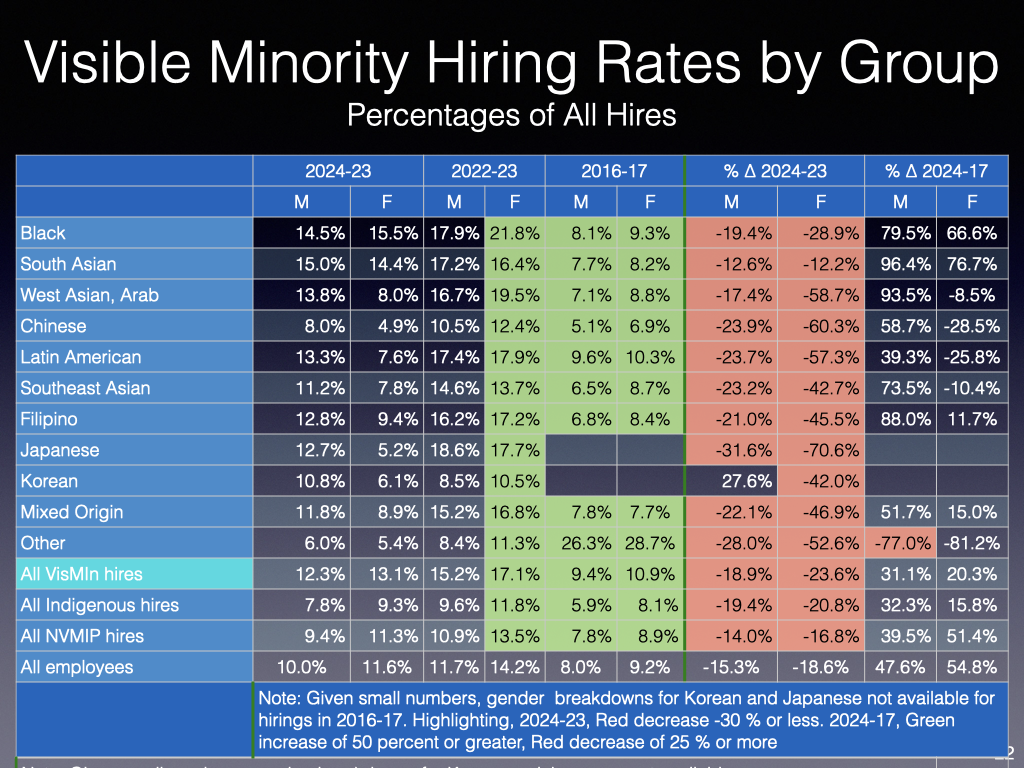
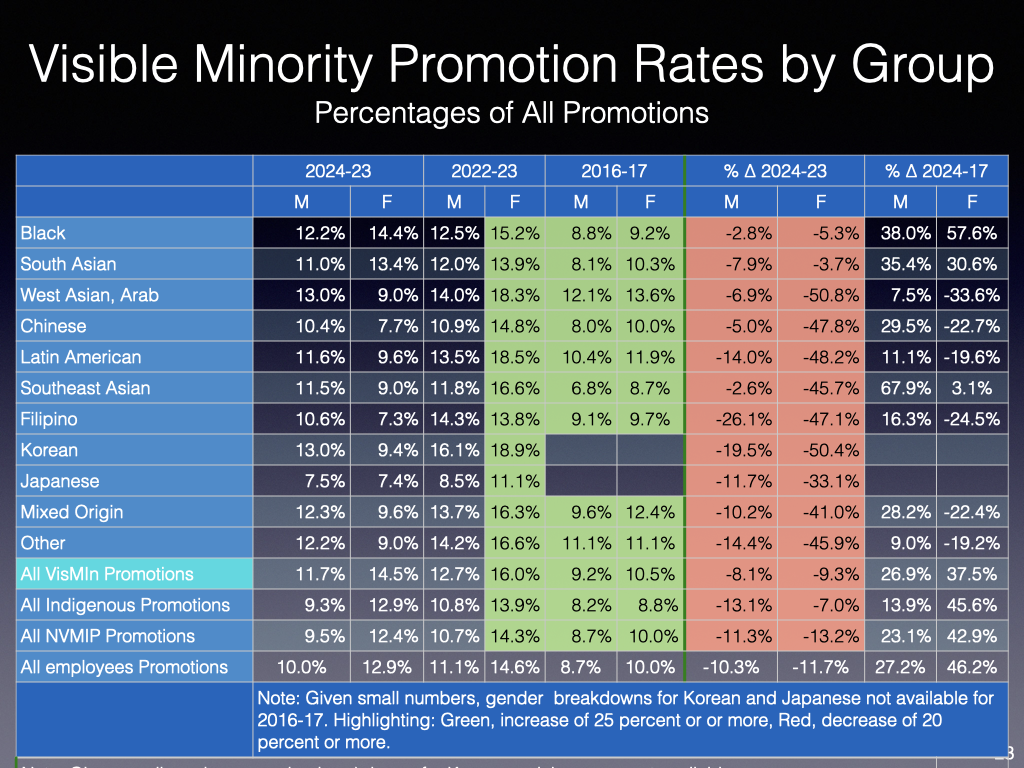
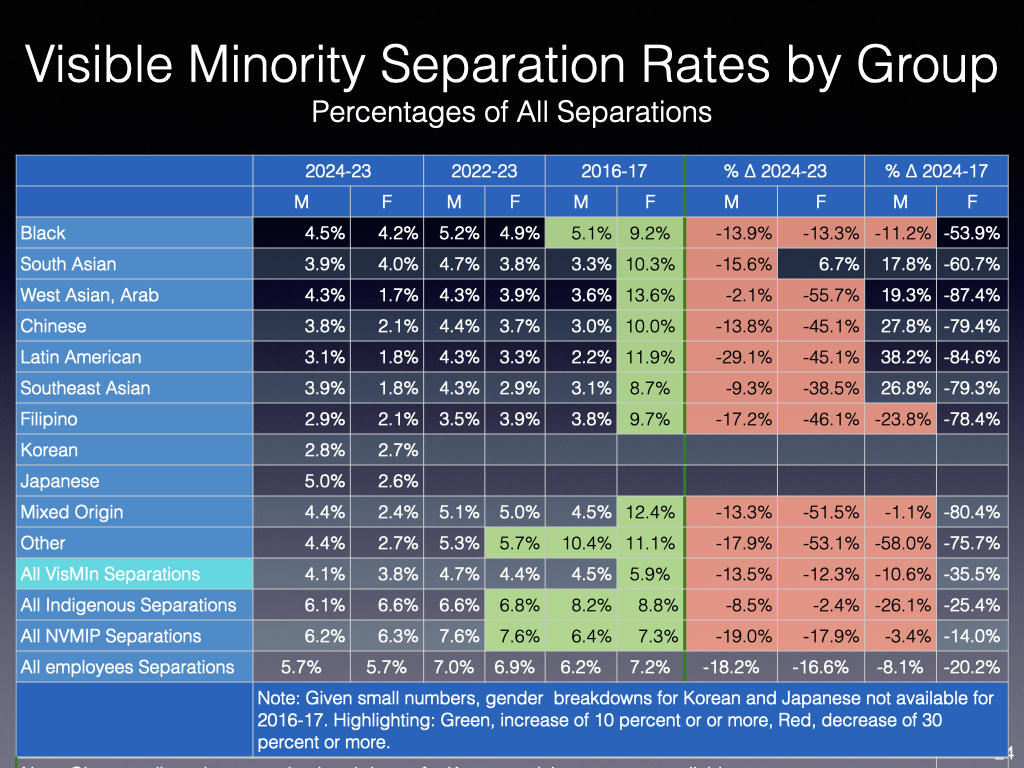
Will be curious to see the respective numbers of hirings, separations and promotions in the forthcoming TBS EE report. Hopefully, TBS will continue to provide the breakdowns by visible minority groups.

Slides from last year’s EE report.

Advocates are raising concerns about how job cuts will affect public servants in equity groups — something the Treasury Board of Canada Secretariat says it’s not tracking. 

The federal government has committed to cutting the number of public service jobs by about 40,000 from a 2023-24 peak of 368,000 as it looks to find savings.

Departments and agencies across the public service have started notifying staff of coming job cuts.

Barb Couperus, a spokesperson for the Treasury Board of Canada Secretariat — which oversees government operations — said the office does not collect information centrally on the impact of workforce adjustment on employment equity designated groups.

Equity groups include women, Indigenous people, people with disabilities and members of visible minorities.

Couperus said heads of departments are responsible for managing their workforces.

She said departments will continue to pay “close attention” to maintaining representation and meeting their obligations under the Employment Equity Act.

The act requires federally regulated employers, including the government itself, to take steps to eliminate employment barriers and maintain proportional representation in the workplace for members of equity groups.

During layoff periods, Couperus said, departments can prioritize keeping staff from equity groups if there are gaps in representation.

Nicholas Marcus Thompson, president and CEO of the Black Class Action Secretariat, said he is “disturbed” to learn the Treasury Board isn’t tracking the impacts of job cuts.

“What that suggests is that this is not a priority for this government,” he said.

Over the past five years, the government has hired approximately 5,000 Black workers throughout the entire federal public service, said Thompson. It also has increased the number of Black executives from around 99 in 2020 to more than 220, he said.

“What we’re seeing now is that those gains are being lost as a result of workforce adjustment,” said Thompson, adding his organization has started tracking data on workforce adjustment. “Many folks have reached out to us to find out what their rights are.

“Usually with workforce adjustment, the first to go are folks that were the last to come … So far our data is showing that, despite these equity gains, it’s now turning out to be equity losses.”

Thompson said his organization wants to see the government require equity impact assessments before workforce adjustment decisions are made. It also wants the government to be transparent about the process and publish data on which demographics are being affected.

Rabia Khedr, national director of Disability Without Poverty, said people with disabilities working in the public service will be feeling anxious.

“Generally speaking, a lot of times people with disabilities may be at an entry level position, so that makes them vulnerable,” said Khedr.

The most recent employment equity report for the public service says that as of March 2024, 9.7 per cent of federal executives were people with disabilities, up from 4.6 per cent in March 2019.

Khedr also said she’s unhappy about the lack of central tracking of the impacts of job cuts on equity groups.

“That then leaves it to the individual leadership within departments to make those critical decisions,” she said.

“It really depends on the leadership and their commitment to diversity and inclusion … There’s a risk that equity-denied groups might be more vulnerable in terms of who gets cut and who stays.”

Source: Treasury Board not tracking impact of public service job cuts on equity groups

Canadian citizenship test now entirely self-administered and online

Juno News caught this change. Deserves wider reading and concern given “take home test” is a further diminishment and integrity reduction of Canadian citizenship:

The majority of immigrants seeking Canadian citizenship will apply completely through a self-administered online citizenship test, which they will be permitted up to three attempts to pass.

The virtual format for the Canadian citizenship test, popularized throughout the COVID-19 pandemic, is now the default, according to new instructions from Immigration, Refugees and Citizenship Canada (IRCC).

Before 2020, citizenship tests were written in person by default. Applicants were generally given 30 minutes to complete the test. If they failed, they had one opportunity to rewrite it before being referred to a knowledge or language hearing.

The IRCC released updated information on Monday, formalizing a 45-minute time allotment for the online, self-administered test. Applicants must answer 15 of the 20 questions correctly.

Meanwhile, most citizenship ceremonies have also gone virtual, with the Conservatives pushing Ottawa to reinstate in-person ceremonies.

In December, Conservative immigration critic Michelle Rempel Garner calledon the Liberals to return to in-person ceremonies, which she called a “sacred event” where new Canadians “swear an out to the country and take on the responsibilities and obligations that come with citizenship.”

During a press conference in Ottawa, Rempel Garner said it was time for the Carney government to “restore the value of Canadian citizenship.”

“Last year, over half of the people who became Canadian citizens did so by clicking a box online. That’s crazy. There is no way to justify this practice, and with support for immigration at an all-time low, returning to inclusive nation-building ceremonies is a no-brainer,” she said at the time. “In person, citizenship ceremonies are the essential unifying bedrock of Canada’s civic life.”

She called for an immediate end to “one-click citizenship” and to “restore the full dignity and communal significance” of the in-person ceremonies for new Canadians.

“Just as with marriage, these are sacred events, and the responsibilities and obligations taken on swearing the Oath of Citizenship in front of an official should be upheld as an integral part of committing to those responsibilities that come along with being Canadian,” Rempel-Garner said. “The Liberals rejected every opportunity to restore in-person ceremonies. Justice Minister Sean Fraser even defended virtual ceremonies, saying the practice could be easier for bureaucrats to manage.”

This comes after the president of the Customs and Immigration Union, which represents the Canada Border Services Agency, revealed to an immigration committee that the majority of asylum claims are being done through an app. He warned Canadians that removing person-to-person interviews could compromise Canada’s security.

Source: Canadian citizenship test now entirely self-administered and online, Link to IRCC page Citizenship test: How the test works