Black and Griffith: Visible minority women are still sidelined in competitive ridings
2026/02/18 2 Comments
Our latest. Conclusion:
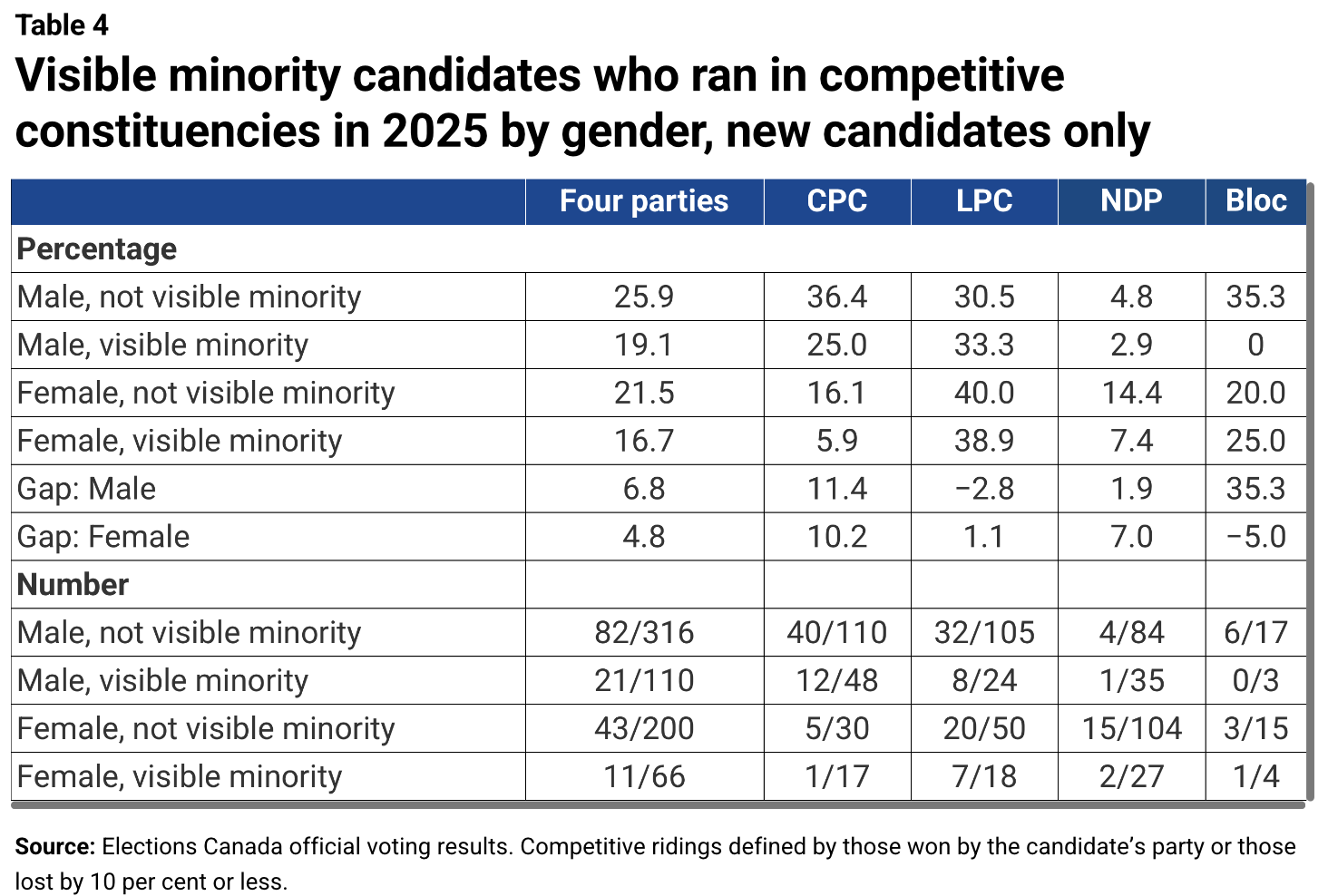
…In other words, party candidate selection incorporates affinity effects that give preference to visible minority candidates for all major parties in these ridings. Given this, it is less surprising that studies of election outcomes indicate that affinity effects are less important than “candidate competitiveness, Canada’s first past the post electoral system, and local context,” Elections Canada says, because those effects are effectively baked in at the candidate nomination stage.
This indicates positive discrimination for visible minority candidates in these ridings and the possible converse in ridings with lower numbers of visible minorities, largely rural ridings.
While one can make the crude case that nominating more visible minority women candidates would allow federal political parties to tick off two diversity boxes at once, the evidence indicates that this is not the case: women visible minority candidates do indeed have a higher percentage chance of being sacrificial lambs. This suggests they do experience biases in the political process across two fronts, as both women and visible minorities.
To encourage improved representation, the political parties should adopt a transparency approach similar to Senate Bill S-283 would require each party to provide annual information on the policies and programs they have enacted to increase the representation of designated groups (women, visible minorities, Indigenous Peoples and persons with disabilities).
This could be accomplished by the chief electoral officer administering a voluntary self-identification questionnaire to nominated candidates, thus allowing for post-election reporting on candidate and MP diversity.
Canada’s federal political parties may resist this transparency-based approach, but its use in federally regulated industries and the public service for close to 30 years has proven effective.
Source: Visible minority women are still sidelined in competitive ridings
 About Andrew
 Multicultural Meanderings
In order to go down the road of action or policy, instead of reporting data, it may be necessary not to allow electoral district associations not to select their candidate, subject to national party vetting. I’m not always a democrat; it is not always the case that the most democratic process leads to the optimal outcome, but let’s be clear that this pits goals of more equal representation against democracy at the local level. At a time when political engagement is generally low, I wonder if making a non-democratic choice is worth it.
Valid question. That’s why I like the reporting and transparency approach, rather than a more heavy handed approach as Grayson in the Hill Times advocates.