Chris Selley: Liberals wrap much-needed refugee reform in a terrible privacy-invading package

Another commentary arguing C-2 asylum provisions are reasonable:

…This sure looks like an attempt to leverage Trumpian mayhem for the same purposes. It will and should be fought on those grounds.

It’s especially unfortunate because Bill C-2 also proposes to inject some relatively hardhearted sanity into our perennially out-of-control refugee system — changes that by rights would be debated on their own, without invoking Donald Trump’s name every 30 seconds, because these problems are not at all of the president’s making. For example, Bill C-2 proposes a one-year deadline for being in Canada, after which you won’t be able to apply for asylum, which is a clear response to the number of temporary residents trying to hang on in Canada using the refugee system. And it proposes expanding the Safe Third Country Agreement such that anyone crossing illegally from the U.S. would be ineligible to claim asylum, no matter how long they lie low upon arrival.

These are reasonable measures, completely in keeping with countries with far better human-rights records than Canada’s. Someone doesn’t just suddenly remember being persecuted after a year of not mentioning it. The principle of seeking asylum in the first technically safe country you arrive in may be unrealistic: no one willing to risk their lives for a better life in the United States or Canada is likely to settle on Mexico, considering the ordeals most refugees from Central America have already been through. But when a country like Canada accepts hundreds of refugee claims a year from the U.S and Europe, you know things have been taken to an extreme….

…Refugee advocates will argue, reasonably enough, that the solution for a self-styled humanitarian beacon like Canada would be to devote enough resources to the refugee-determination system such that we could adjudicate them quickly and efficiently. But no government ever, ever does that. We have a backlog of 280,825 asylum claims — roughly 0.7 per cent of the Canadian population.

Something has to give. And that something has absolutely nothing to do with Canadians’ IP addresses.

Source: Chris Selley: Liberals wrap much-needed refugee reform in a terrible privacy-invading package

Barutciski: The tightening of Canada’s asylum laws was an inevitability

Indeed, and overdue:

…This is a reasonable response that partially harmonizes the Canadian system with the U.S. system. As controversial as this may seem to some, harmonization is the only way Western countries such as Canada will be able to bring migration under control. 

Democratic governments are continuing to bleed support because they are unable to assuage populations that are justifiably anxious about uncontrolled migration; the Netherlands is just the latest example

Whether the asylum-related provisions in Bill C-2 become the law of the land will ultimately show how serious the new Liberal government is in correcting immigration policy mistakes made by and acknowledged by the previous prime minister and then-immigration minister.

Yet it is one thing to amend laws to restore Canada’s seriousness on the immigration file; it is another to actually enforce them. If Ottawa cannot incentivize the large population of overstayers to leave by themselves, it will need to enforce its own laws, potentially with large-scale removals of foreigners who are unlawfully present in Canada. 

The government could propose a humane yet realistic carrot-and-stick approach involving financial aid to help migrants return home combined with future eligibility for legal residence if they do return.

Even assuming the government can resolve this dilemma, it will then have to propose new amendments to address the unmanageable backlogs that remain for the country’s largest administrative tribunal. 

Indeed, the gravity of the challenge is illustrated by the fact that the IRB had already seen both its operating budget and number of employees more than double between 2015 and 2023. 

Deep reform of Canada’s asylum law will have to come sooner rather than later. Bill C-2 is a solid start.

Source: The tightening of Canada’s asylum laws was an inevitability

How DOGE’s push to amass data could hurt the reliability of future U.S. statistics

Part of the destruction of government institutions under the Trump administration:

Falling public participation in surveys and trust in government have plagued the U.S. Census Bureau for decades.

And some of the agency’s current and former workers say there’s a new complication to gathering enough survey responses to produce key statistics for the country.

The Trump administration’s murky handling of data, which has sparked investigations and lawsuits alleging privacy violations, has become one of the reasons people cite when declining to share their information for the federal government’s ongoing surveys, these workers say.

“I got more people asking me how I know information isn’t going to be sold or given away,” says a former field representative, who says they were met with “a lot of suspicion” and specific mentions of Elon Musk, President Trump’s billionaire adviser who set up the DOGE team, from some households they tried to interview earlier this year. The former bureau employee, who was let go as part of the Trump administration’s downsizing of the federal government, asked not to be named because they fear retaliation.

A current field representative says they don’t “feel as comfortable” in their role as they felt asking questions for surveys last year — and neither do some people who had previously shared their information. One person specifically mentioned DOGE when declining a follow-up interview, says the current representative, who asked NPR not to name them because they are not authorized to speak publicly.

“It’s a system that runs on trust, and the trust, I would say, has been declining,” the current field representative says. “It makes me sad as an American that distrust is at that level. But I do understand it. I fear for the data I’m collecting. Is it going to be misused? And the privacy guarantees that I describe to people — are those going to be respected?”

These questions don’t surprise Nancy Bates, a former senior researcher for survey methodology at the bureau. Bates has tracked declining public participation in the census going back to the 1990 tally.

Federal law prohibits the bureau from releasing information that would identify a person or business to anyone, including other federal agencies and law enforcement. But a report Bates helped prepare during the first Trump administration found 28% of people surveyed in 2018 said they were very or extremely concerned the bureau would not keep their 2020 census answers confidential.

“Even prior to DOGE, the Census Bureau was always dealing with a level of mistrust about privacy and confidentiality,” says Bates, who, after retiring from the agency in 2020, helped lead its 2030 census advisory committee before the Trump administration disbanded it. “I absolutely can see why the public concern would be increased following these unauthorized and illegal access to data.”…

Source: How DOGE’s push to amass data could hurt the reliability of future U.S. statistics

Immigration au Québec | Un rapport propose d’accueillir 90 000 résidents permanents par année

Of note:

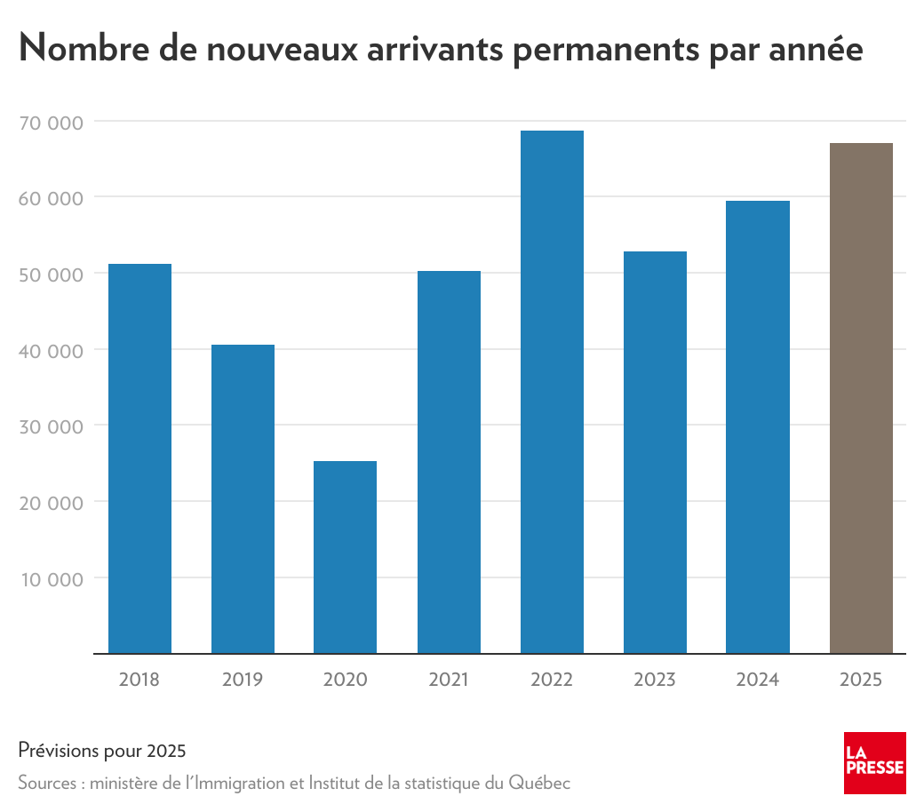
La cible proposée dans ce rapport, publié ce mercredi, contraste fortement avec les intentions de Québec, qui examine trois scénarios pour l’immigration permanente, tous sous la barre des 50 000 par année, selon des informations obtenues par La Presse1.

Le Québec compte aujourd’hui plus de 615 000 personnes à statut temporaire, un record. Travailleurs étrangers, étudiants internationaux, demandeurs d’asile : leur présence a soutenu la croissance, mais a aussi mis sous pression les services publics, le logement et les capacités d’intégration.

Parmi eux, les travailleurs étrangers temporaires (TET), notamment ceux recrutés par les employeurs à l’international, s’installent majoritairement en région. Selon le rapport de l’IDQ, 81 % des TET vivent à l’extérieur de Montréal, où leur apport a permis à plusieurs localités de freiner le déclin démographique et de maintenir certains services essentiels.

Face à cette situation, l’IDQ propose une solution de transition : réduire progressivement les admissions temporaires, tout en offrant la résidence permanente à un plus grand nombre de personnes déjà sur le territoire.

Le rapport recommande d’admettre temporairement 90 000 immigrants permanents par an. Il s’agirait en grande partie de personnes qualifiées, diplômées, bien intégrées, qui vivent déjà au Québec.

Le but est de réduire le roulement de main-d’œuvre précaire et d’offrir une trajectoire claire à ceux qui ont démontré leur capacité d’intégration.

Deux vitesses

Le recours massif aux statuts temporaires, qui ne mènent pas automatiquement à la résidence permanente, a créé un système à deux vitesses. Les employeurs recrutent rapidement, parfois en dehors des filières économiques prévues, tandis que les personnes admises temporairement restent dans l’incertitude, souvent confinées à des emplois peu qualifiés et à bas salaire.

« Ces dernières années, on a vu un peu les limites de ce modèle. Accueillir beaucoup d’immigrants, s’ils ont de la difficulté à trouver un emploi ou s’ils occupent des emplois moins bien rémunérés ou qui ne répondent pas à leurs aspirations, ça fait grossir la taille de l’économie, mais ça ne crée pas nécessairement de la richesse », affirme Emna Braham, directrice générale de l’IDQ….

Source: Immigration au Québec | Un rapport propose d’accueillir 90 000 résidents permanents par année

Carney government introduces bill to beef up border security

Predictable criticism from refugee and immigration advocates who invariably either cannot ackowledge abuses of the system or come up with possible measures to deal with the same, beyond calling for more resources.

One nugget that should improve processing and service for citizenship is:

“Make it easier for IRCC to share client information between different IRCC programs (e.g. using permanent residence application data to process citizenship applications).”

My sense is that the immigration and asylum provisions will likely be supported by the Conservative opposition but there will likely be tensions within the Liberal caucus:

…The bill was immediately met with concerns about privacy, refugee rights and its omnibus aspect.

NDP MP Jenny Kwan said the bill should be “alarming” to Canadians and risks breaching their civil liberties, particularly for its changes on immigration.

“They are trying to create this illusion that Canada’s border is more secure in some way, but however, a lot of the components within the bill targets Canada’s own immigration policies and processes that has nothing to do with the United States,” she said, questioning why there were no measures specifically targeting illegal guns coming from the U.S., for example.

“There are lots of pieces that I think should be concerning to Canadians.”

Anandasangaree, a former human rights lawyer, defended seeking those new powers Tuesday.

“I worked my entire life in the protection of human rights and civil liberties. That’s a marquee part of the work that I’ve done before politics, in politics,” he told reporters.

“In order for me to bring forward legislation, it needed to have the safeguards in place, it needed to be in line with the values of the Canadian Charter of Rights and Freedoms, and I fundamentally believe that we have striked the balance that, while expanding powers in certain instances, does have the safeguards and the protections in place to protect individual freedoms and rights.”

Those safeguards include not allowing information on immigration to be shared with other countries unless permitted by the minister, as well as judicial oversight that would require a warrant except in “exigent” circumstances. 

The proposed legislation, which will require the support of another party to pass in the minority Parliament, is meant to address the surge of asylum-seekers and the ballooning backlogs in refugee applications. Anyone who first arrived Canada after June 24, 2020 would not be allowed to make a refugee claim after one year, regardless of whether they left the country and returned; irregular migrants who enter Canada from the U.S. between land ports of entry would also be denied the rights to asylum.

“They’re coming up with all of these various ways to basically turn the tap off, to actually make it a more restrictive process,” said Queen’s University immigration and refugee law professor Sharry Aiken.

“That will harm vulnerable people and deny some groups of claimants their right to accessing a fair hearing” by the independent Immigration and Refugee Board, Aiken said.

Canada has seen the number of asylum-seekers triple in less than a decade, from 50,365 in 2017 to 171,845 last year. As of April, the refugee tribunal has 284,715 claims awaiting a decision.

More international students, visitors and foreign workers are seeking asylum to prolong their stays in Canada after Ottawa clamped down on the runaway growth of temporary residents and reduced permanent resident admissions amid concerns of the housing and affordability crisis.

The Canadian Council for Refugees said the proposed asylum changes mirror the American approach, where borders are militarized and securitized as refugees and migrants are viewed as a security threat.

“Under international law, there is no time frame on the right to seek protection. Where we do find this precedent is in the U.S.,” said Gauri Sreenivasan, the council’s co-executive director.

Anandasangaree said those who are affected by proposed ineligibility rules for asylum could ask for an assessment by immigration officials to ensure they would not face harm if sent back to their country.

However, critics said that process is less robust than a full hearing by the refugee board, and this would simply pass the administrative burden to the already strained Immigration Department and the Federal Court.

“It could force many people who have no choice because they are under threat in their country or in the U.S. to live underground without status,” Sreenivasan warned.

Source: Carney government introduces bill to beef up border security

And Althia Raj questions who pressed for these changes (likely under development for some time by IRCC officials given the numbers and abuses):

….Those who work with refugees are also alarmed.

Prime Minister Mark Carney’s first piece of legislation pulls away the welcome mat for asylum seekers. It makes it nearly impossible for those who have been in Canada for more than a year, either as students, permanent residents, or temporary workers, and those who’ve snuck into Canada between land border crossings and have been here for more than two weeks, from having their asylum cases heard.

“A lot of people are going to get rejected because they’re not going to have an opportunity to explain for themselves why they would be in danger when they go back (home),” said Adam Sadinsky, an immigration and refugee lawyer with Silcoff Shacter in Toronto.

On Parliament Hill, the NDP’s Jenny Kwan described the law as “violating people’s due process and taking away people’s basic rights,” and also noted that it will drive people underground.

A problem that could be fixed by beefing up the immigration system — staffing and resources — will instead encourage those who are in Canada, and fear being deported to their home country, to stay here illegally. It will make it much more difficult for federal, provincial and municipal authorities to know who is living here, where they are, and what services they need. And it may simply move staffing and resource pressures away from the Immigration and Refugee Board toward the federal court, who will now hear more requests for stays to remain in Canada and for judicial review of unfavourable decisions.

On CBC, Anandasangaree said his “comprehensive bill” was directly linked with what is happening at the Canada-U.S. border, but it also “responds to … the mandate (Canadians) gave us on April the 28th.”

Does it? Are these the values that Canadians voted to uphold?…

Source: Opinion | Border bill primed to give Mark Carney’s government sweeping new powers. Who asked for this?

High immigration is worsening Canada’s economic problems, says [OECD] report

Not different to what Skuterud, Worswick and others have been pointing out over the past few years and more:

By overseeing one of the most dramatic immigration surges of modern times, Canada has cratered housing affordability, kneecapped productivity and concealed the true state of its economic growth, according to a new profile by the Organisation for Economic Co-operation and Development (OECD).

The OECD is a club of 38 countries that effectively comprise the developed world. Every two years, each member state receives a comprehensive “economic survey” prepared by OECD economists.

Canada’s most recent survey — published just last week — focuses in particular on the issues of housing affordability and worker productivity, two areas in which Canada now ranks among the worst in the developed world.

And in both instances, the OECD fingers record-high immigration as having made the problems worse.

“Rapid population growth has exacerbated previous housing affordability challenges,” reads the report, adding the blunt recommendation that “housing supply should keep pace with immigration targets.”

Similarly, the OECD warns that Canada has been packing millions of new workers into its labour force without any comparable increase in “productivity-enhancing investment.” With the economy thus remaining relatively stagnant, Canada’s workers are receiving an increasingly small share of the overall economic pie.

On top of this, the report notes that while Canada used to prioritize high-skilled immigrants such as doctors and engineers, its migration flows are now mostly comprised of low-skilled workers.

“The skill composition of recent immigration, which included many students and temporary workers, has also likely reduced average labour productivity,” it reads.

The OECD’s own stats have long shown that Canada is an outlier in the realm of housing affordability. The OECD’s most recent tally of the “price to income” ratio of Canadian housing shows that it is the highest of all their member states save for Portugal.

Over the last 10 years, Canada has also been one of the worst performers in OECD rankings of GDP growth per capita.

From 2014 to 2022, Canada’s rate of per-capita GDP growth was worse than any other OECD country save Luxembourg and Mexico.

Across those nine years, the average Canadian saw their share of overall GDP rise by just 0.6 per cent per year.

Canada’s “GDP per capita growth has lagged in recent years, particularly compared to its close neighbour, the United States,” wrote the OECD.

In the U.S., GDP growth per capita from 2014 to 2022 was nearly three times higher than Canada, at 1.7 per cent.

The report isn’t entirely downcast on Canada’s economic future. In a summary, the authors declare that Canada’s economy is “resilient” and endowed with “robust public finances.”

But the document is one of the first outside sources to detail the unprecedented surge of Canadian migration overseen by Ottawa in the immediate wake of the COVID-19 pandemic.

“Canada’s population grew rapidly, by 3.0 per cent in 2023 and 2.6 per cent in 2024. This is much faster than in other OECD countries such as the United States or countries in Europe,” it reads.

About six times faster, in fact. In 2023, the average OECD country grew by just 0.5 per cent.

This worked out to about one million newcomers entering Canada each year. At the beginning of 2022, the Canadian population stood at about 38.5 million. Now, it’s at 41.6 million, an increase of more than three million.

It’s a surge in voluntary population growth like few in history. Although other OECD members have experienced comparable population surges, at least in the short term, they’re usually the result of war or other displacements.

The report also confirms a phenomenon that Canadian analysts have been warning about since 2023: That Canada has been in a “per capita” recession for several years, with overall GDP only seeming to grow because of rapid population growth.

The injection of three million people has seemed to increase GDP, simply because all the newcomers are paying rent, buying groceries and increasing the amount of money circulating in the economy.

But on an individual basis, the average Canadians’ wealth and purchasing power has only been dropping.

The OECD report highlights this disparity with two duelling charts. On a measure of “real GDP,” Canada is able to keep up with the OECD average perfectly. But when ranked by “real GDP per capita,” Canada’s economic performance suddenly falls dramatically behind.

“GDP growth has been supported by high population growth,” according to a subtitle.

Prime Minister Mark Carney has recently highlighted the issue of diminishing Canadian productivity, saying in a speech last week that it was making “life unaffordable for Canadians.” Carney’s proposed remedy is to reduce internal trade barriers and embark on a series of “nation-building” projects.

The OECD noted that Canada has backed off the peak highs of its immigration intake, writing that the Liberal government “has adjusted and recalibrated its immigration targets … and population growth has since begun to slow.”

Nevertheless, even under these new figures, Canadian immigration is set to be far higher than its pre-COVID levels.

Canada’s 2025 immigration targets are still set to bring in more than one million newcomers this year, mostly in the realm of non-permanent residents. Under the federal government’s latest Immigration Levels Plan, this year will see 395,000 new permanent residents, 305,900 new international students and 367,750 new temporary workers.
Source: FIRST READING: High immigration is worsening Canada’s economic problems, says report

The diversity of candidates and MPs stalled for some groups in this election

My latest collaboration with Jerome Black on the diversity of candidates and MPs. Stall for women and visible minorities, ongoing increase for visible minorities.

In summary, differences in political-party representation reflect dissimilarities in demographic trends (such as higher growth rates of visible minorities), overall election dynamics, political-party recruitment efforts, and the extent to which groups feel their concerns are reflected in political platforms and messaging.

Source: The diversity of candidates and MPs stalled for some groups in this election

American transgender woman files asylum claim in Canada after Trump’s edict on gender

To watch:

An American transgender woman has lodged an asylum claim in Canada, in what her lawyers say is a test case of whether U.S. President Donald Trump’s edicts on gender and other recent measures restricting equality rights constitute persecution.

Hannah Kreager, from Arizona, on Monday lodged an asylum claim with the Immigration and Refugee Board of Canada on the grounds that she has a well-founded fear of persecution in the U.S.

“This case is about safety. It’s about whether Canada will recognize the threat Hannah faces in the U.S.,” her lawyer Yameena Ansari said.

She said Canada considers the U.S. as a safe country to live in, but this is no longer true if you are transgender.

Ms. Ansari added Mr. Trump has singled out transgender people through executive orders, including one saying the federal government recognizes two sexes only – male and female. She said this has trickled down into a wider erosion of their rights and protections across the U.S.

She said the case is “precedent-setting on the basis of it not being safe in the U.S. for being trans.”

Source: American transgender woman files asylum claim in Canada after Trump’s edict on gender

Christopher Dummitt: Systemic discrimination is legal in Canada

Apart from the header, valid questions although I am not convinced the DEI programs necessarily “exacerbate ethnic conflict in Canada:”

…The question is: how long will this remain the case? And, even more importantly, what counts as evidence for disadvantage? Who gets to decide whether current-day disadvantage comes from discriminatory treatment or not?

The reality is that different social groups have different social outcomes. As Thomas Sowell pointed out years ago, it would be bizarre to think that they wouldn’t. The question is: are these differences a result of choices, cultures and random chance — or are they a more nefarious expression of discrimination, either systemic or outright?

One of the odd things to happen in our intellectual circles — our universities and even our law schools — is that this question is rarely asked with an open-ended curiosity as to what the answer might be.

One wonders whether it even comes up when employers or universities set about establishing discriminatory affirmative action programs. Or, more likely, are they working from a consensus within the institution that there really are disadvantaged groups — and that this is obviously caused by discrimination?

We should be clear: it’s entirely possible that disadvantages are caused by subtle forms of discrimination that continue despite Canada’s now very equal legal system. It’s certainly possible — and the idea ought to get a fair hearing.

But in many progressive circles today, it’s now considered rude to even ask the question — to wonder whether social and economic differences between groups might be caused by something other than prejudice.

This is why the topic of viewpoint diversity — in our universities, our law schools, in the world of expertise — isn’t the esoteric topic it might seem.

Even as the wider Canadian society seems to be retreating from the excesses of cancel culture and woke shibboleths (good news on that front), the staffing of our knowledge institutions, our universities and our law schools still overwhelmingly comes from those on the left — from the same groups who assume that socioeconomic variation is, de facto, linked to discrimination.

These are the people who get to decide when — if ever — the only legal form of systemic discrimination allowed in Canada (affirmative action) will ever end.

There’s plenty of evidence coming out of think-tanks and even Statistics Canada that the Canada of 2025 has moved a long way from the Canada of 1981, where affirmative action was justified. The most economically well-to-do Canadians are not those of European ancestry — despite the popular perception to the contrary. The groups of Canadians with the highest income — and highest levels of educational attainment — are those of South Asian and Chinese ancestry. Whites tend to come in the middle of the pack, while Black Canadians and Indigenous people are lower down the economic scale. If affirmative action is going to continue, the public needs to be reassured that those justifying its existence, at the very least, keep up to date with which groups are up and which are down — though even this framing shows how divisive such policies would be.

There’s also plenty of evidence that the “race conscious” programs allowed by the Charter — and pushed by DEI advocates — actually exacerbate ethnic conflict in Canada.

There could, of course, be evidence that continued systemic discrimination justifies affirmative action. But it would help to know that the organizations instituting these types of progressive discrimination are at least open to the idea that Canada can, and will, move on.

Source: Christopher Dummitt: Systemic discrimination is legal in Canada

Savoie: Public service reform is only possible if the Prime Minister champions the project

Yep:

…The government’s agenda can be developed by asking a series of questions. What government structure is needed to promote a unified, single Canadian economy? How can we best redirect resources to high-priority areas such as trade and national defence? How can Ottawa pull back from more areas of provincial jurisdiction? The federal government has nearly 300 organizations, and it’s time to weed out those that are past their best-before dates; the same can be said about some federal government programs. 

But unless the Prime Minister ensures that these questions are answered and action is taken, the government will be like the proverbial goldfish, going around and around in its bowl repeating nice castle, nice castle

Source: Public service reform is only possible if the Prime Minister champions the project