Akbar: Canada’s labour market is failing racialized immigrant women, requiring an urgent policy response

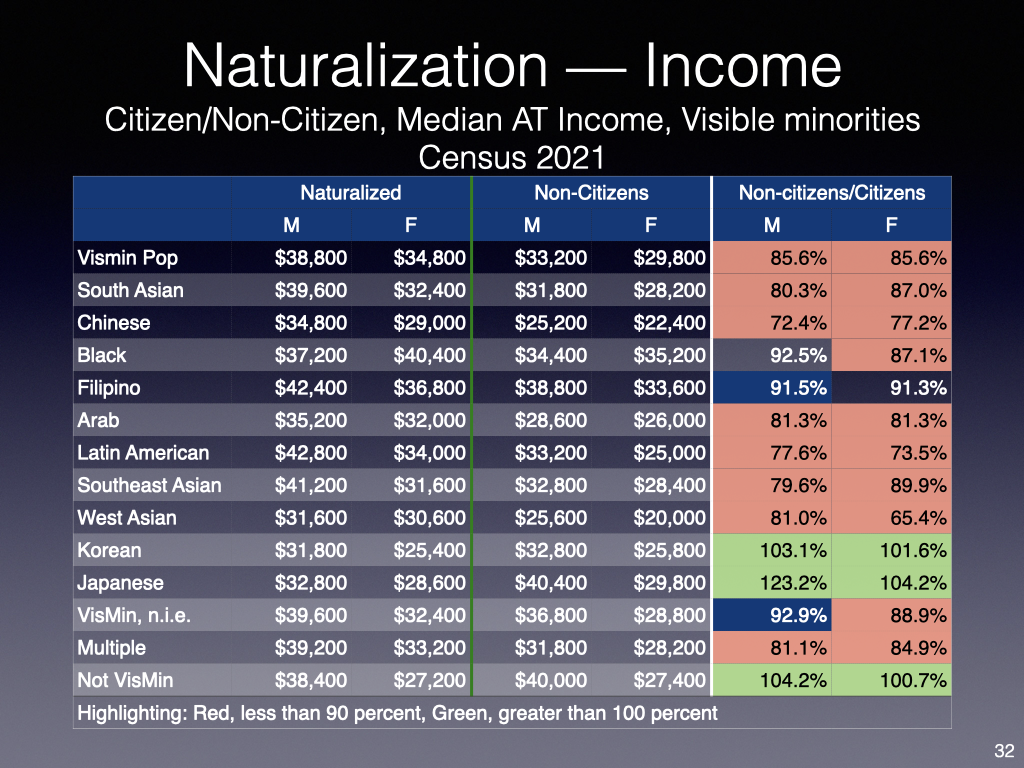
Would be helpful to have breakdowns by visible minority groups as they are significant (chart below compares citizens and non-citizens by visible minority group and not visible minority):

…To address these challenges, future research should adopt a problem-solving approach to address the root causes. Simultaneously, a comprehensive policy response is needed to tackle the systemic barriers in the labour market. 

Targeted solutions are needed to help racialized immigrant women. Strengthening credential recognition, for instance, can help employers assess transferable skills across countries. Implementing equitable hiring practices and workplace integration policies are also essential. 

Digital technology and artificial intelligence can also help eliminate bias in hiring and job matchingSettlement programsshould account for the intersecting identities of racialized immigrant women to provide tailored support.

Most importantly, it’s crucial to recognize that ensuring equitable access to meaningful employment is not only vital for advancing gender and racial equity, but also essential for unlocking Canada’s full economic potential.

Source: Canada’s labour market is failing racialized immigrant women, requiring an urgent policy response

Is Canada’s immigration system actually broken? Here’s how it changed under Justin Trudeau

Good overview and series of informative charts:

Canada’s rapid population growth recently has been driven by immigration, which accounted for 97.3 per cent of the 724,586 net growth in the country in 2024.

Since the early 1990s, successive federal governments had maintained a steady immigration level yearly that averaged 0.75 per cent of Canada’s overall population, regardless of the boom-and-bust economic cycle. Skilled immigrants were viewed as an economic stimulant during a recession and as a source of labour supply in time of prosperity.

The number of temporary residents was relatively small. Most international students came primarily to study while foreign workers ebbed and flowed supposedly based on labour needs; those whose time was up had to go home. In the mix were asylum seekers who would become permanent residents if granted protected status. 

Riding the popularity of Prime Minister Justin Trudeau’s “sunny ways,” the Liberal government welcomed tens of thousands of displaced Syrians and slowly raised the annual immigrant intake to 0.9 per cent of Canada’s overall population in 2019.

After a nosedive in immigration in 2020 — to 0.49 per cent of the population — due to pandemic border closures, Trudeau not only extended the stay of most temporary residents, but opened the door to more in response to skyrocketing job shortages, which reached about a million vacancies….

It didn’t help that Canada’s immigration system over recent years has prioritized the transition of temporary residents in the country, many toiling in lower-skilled jobs, to permanent residents. Instead of picking skilled economic immigrants with high scores in the point selection system, so-called targeted draws were introduced in 2023 to favour candidates with lower scores but who work in an in-demand occupation or are proficient in French.

“We are not selecting the best of the best,” said Planincic. “The intent is to meet labour market needs, but it really muddies the waters, especially when the categories can change at political whims.” 

A better indicator of an immigration candidate’s value to the community and the country, she suggested, is their current earnings, which should be part of the point system….

Immigration lawyer Mario Bellissimo attributes much of the system’s chaos to the myriad “ministerial instructions,” temporary directives issued by the minister to address intake, processing, selection, or to create pilot programs.

The extraordinary authority endowed with the minister — introduced in 2008 by Stephen Harper’s Conservatives — has contributed to a patchwork of ad-hoc immigration policies with little transparency.

The ballooning temporary resident population is further fuelled by Canada’s evolving “two-step” permanent residence selection system that favours those already in the country, with Canadian education credentials and work experience. In 2022, 36 per cent of all new permanent residents had previously been in Canada on work permits, up from 19 per cent in 2010 and 33 per cent in 2019.

The population of temporary residents got out of control “because they wanted this mass pool to draw from,” said Bellissimo, adding that immigration officials have been stretched thin handling these student, work and visitor applications, compromising services….

Most people used to look past the struggles of immigrants and focus on the success of their children, but now they expect newcomers themselves to hit the ground running. Paquet said it’s time for Canadians to have a debate about the objectives of immigration.

Immigration had generally been a non-issue in modern Canadian politics because of a consensus that it’s good for the country. Might this federal election be different?

Although Donald Trump and tariffs have dominated the early part of the campaign, immigration has become a major political issue in the last few years of Trudeau’s government.

“How much will the parties talk about it and how much of a central theme will it be?” asked Paquet, research chair in politics of immigration at Concordia. “When a party decides to do that, then that tells us a lot about how the political system is changing.”

Source: Is Canada’s immigration system actually broken? Here’s how it changed under Justin Trudeau

Trump Immigration Order Could Cost Americans $3,000 Per Baby

When the Harper government made a push for ending birthright citizenship, initial analysis included a cost estimate of $300,000 that would be absorbed by the government, not additional fees for those applying (the documents that I received from ATIP did not indicate any cost recovery plans). Given provincial opposition and the smaller numbers known at that time, the government dropped any change to current birthright citizenship.

Much simpler to do in Canada as the previous analysis indicated but like anything in government, always some complications to address:

Ending birthright citizenship would be chaotic and costly for many Americans due to new fees, paperwork requirements and other issues. So far, the constitutionality of Donald Trump’s executive order, which would no longer guarantee a child born on U.S. soil is an American citizen, has dominated the discussion. While critics and supporters of birthright citizenship have highlighted the legal issues, few people have examined the practical effects. Implementing the policy would create significant financial burdens for U.S.-born and immigrant parents. If the Trump administration succeeds in ending birthright citizenship, it will turn each birth in America into a federal event.

The Immigration Order Would Bring The Federal Government Into The Delivery Room

A National Foundation for American Policy analysis finds the Trump administration would impose a $3,000 or higher “birth tax” for each baby born in the United States to carry out the executive order ending birthright citizenship. The cost includes Form N-600, the 14-page Application for Certificate of Citizenship, which has a $1,385 government filing fee, and the attorney fees related to the form that range from $1,500 to $10,000. Parents also would need to submit biometrics to U.S. Citizenship and Immigration Services (or another agency), and the parents and baby would likely need to appear in person at a Social Security Administration office. Those actions could entail additional expenses. Costs could differ based on a parent’s details.

NFAP developed the updated estimates with Margaret Stock, an attorney at Cascadia Cross Border Law Group, who has helped many military families with the time-consuming process of documenting that a child born abroad is a U.S. citizen at birth. Stock authored a 2012 NFAP report that explained why changing the Citizenship Clause would be expensive and burdensome for individuals.

Unless the Trump administration intends their new birthright citizenship policy to operate on the “honor system,” which is unlikely, U.S.-born and foreign-born parents will spend considerable time and money if they want the federal government to certify their newborn is a U.S. citizen…

Practical Problems For Americans If The Government Implements The Immigration Order

Trump officials have not explained the new burdens the executive order would create for Americans or the process they intend to impose on new parents if judges ruled the administration’s new birthright citizenship policy constitutional.

Receiving a birth certificate after a child is born would no longer suffice to prove a baby is a U.S. citizen at birth. At a minimum, new parents would need to endure a process like when starting a new job: “Use Form I-9 to verify the identity and employment authorization of individuals hired for employment in the United States,” according to U.S. Citizenship and Immigration Services. “All U.S. employers must properly complete Form I-9 for every individual they hire for employment in the United States. On the form, an employee must attest to their employment authorization. The employee must also present their employer with acceptable documents as evidence of identity and employment authorization.”

Margaret Stock believes the process for parents would be more complicated than the current I-9 process companies use to document employment eligibility. “It will have to be much more extensive than the I-9 process,” she said. “Birth certificates showing birth in the United States will no longer prove U.S. citizenship. Someone at the Social Security Administration will need to collect several documents before issuing a Social Security number.”

She said SSA would demand to see a birth certificate with a time stamp on it that shows the time, date and location of birth. The government would also ask for the birth and immigration records of the biological mother and potentially DNA tests to establish the biological father. Officials would also need to see the birth and immigration records of the biological father.

“Only an immigration law expert can do the legal analysis because people’s statuses are a moving target,” according to Stock. “Here’s an example: What if USCIS approves a green card at a Service Center for a pregnant mother a few minutes before (or after) she gives birth? That’s the difference between the baby being a U.S. citizen under the executive order or the baby being an undocumented immigrant.” The Social Security Administration would need an army of expert immigration law adjudicators.

Stock notes that Alaska and Hawaii have federal statutes that do not include the phrase “subject to the jurisdiction.” She believes the executive order may not apply to births in those states.

Today, states, not the federal government, issue birth certificates. SSA relies on state records to issue Social Security numbers to U.S.-born citizens, and the State Department uses those records to issue passports.

“If the fact of someone’s birth within the U.S. is no longer sufficient to prove the person’s claim to U.S. citizenship, all of these bureaucratic systems must be re-tooled,” wrote Stock in the NFAP analysis. “At a minimum, it will require each state to establish a system for verifying claims to U.S. citizenship. More logically, a change to the Citizenship Clause will lead to the creation of a central and authoritative Federal citizenship records system that will register all U.S. citizens—and ultimately, this would likely, in turn, lead to a National Identification card.”

The Trump administration’s effort to end birthright citizenship would add deadweight costs to the economy and financially harm people least likely to possess spare resources. It would also likely create a two-tier caste society with a child’s success in life determined by whether they were born a U.S. citizen at birth.

Margaret Stock said changing birthright citizenship should only appeal to individuals who have not considered the cost and implications of verifying the immigration and citizenship status of every parent of every child born in America.

Source: Trump Immigration Order Could Cost Americans $3,000 Per Baby

Does size really matter? Rethinking public service reform

Larger public service does not equal improved public services as we have learned from the Trudeau years. That being said, more fundamental examination of program outcomes and efficiencies needed (e.g., program review exercise), but size and high growth rates are proxies that most people understand:

…Interestingly, neither Carney’s nor Poilievre’s perspectives acknowledge that higher program spending and larger headcounts has not led to significant improvement in public service delivery, as shown by a recent analysis by Jennifer Robson, one of our co-authors. 

This is a critical point. The effectiveness of public services cannot be accurately assessed by size alone. The simplistic equation of a larger public service with inefficiency, or a smaller one with effectiveness, ignores the complexities inherent in governance. 

Effective public service requires a nuanced approach that considers not just the quantity of personnel but also the quality of services provided, the efficiency of processes and the outcomes for citizens. 

While the Trudeau government expanded the public service, this did not necessarily translate into improved services. As Robson points out, this discrepancy suggests that merely increasing or decreasing staff numbers is not a panacea for the challenges facing public administration.  

The focus, therefore, should shift from a binary debate over size to a more comprehensive discussion about efficacy. 

This includes examining how public services are designed and implemented, how they adapt to changing societal needs and how they can be reformed to better serve the public without necessarily expanding or contracting the workforce arbitrarily. 

Such a perspective moves beyond partisan talking points and addresses the real issue: delivering high-quality public services that meet the needs of Canadians efficiently and effectively. 

This perspective would also better reflect nuanced public opinion. Concerns about government spending do not necessarily translate into support for across-the-board cuts. Instead, Canadians prioritize investment in essential services. 

This is not just a debate about numbers on a balance sheet. It is a battle over the role of government itself. 

By reducing it to a question of ideological alignment – big government versus small government, or populists versus bureaucrats – politicians risk weakening institutional legitimacy and public trust. 

This also diverts discourse and resources away from the core issues affecting public service efficacy, including procedural barriers, resource constraints, and training and talent management.  

Framing this debate as being over size makes for a slippery slope toward the deeply entrenched partisanship evident in the U.S. and toward an erosion of public trust in the public service. 

Canada now faces a defining question: Will we follow the U.S. in politicizing public institutions? Or will we maintain a commitment to evidence-based, professional and accountable governance? The answer will shape the future of Canada’s public sector – and the country’s political landscape – for years.  

Source: Does size really matter? Rethinking public service reform

Nicolas: Mode survie

Realism:

…Remarquez, je ne cherche pas ici à encenser ou à critiquer les limites du phénomène, je cherche plutôt à le comprendre. Visiblement, les Canadiens rejoignent maintenant les Américains, les Français et les Allemands parmi les peuples qui ont, dans la dernière année, appréhendé les options politiques qu’on leur présente à partir de leur instinct de survie.

Je ne vois pas comment analyser autrement l’effondrement des appuis néodémocrates, alors que les libéraux se repositionnent vers la droite, ou les difficultés du Bloc québécois devant un leader libéral dont le français reste parfois laborieux. Il ne s’agit pas ici d’un amour particulier pour Mark Carney, mais d’un mouvement ABC (Anything But Conservative, n’importe qui sauf les conservateurs) qui n’a pas de leader, pas d’organisation, qui ne dit pas son nom, mais qui semble d’une efficacité historique pour centraliser les intentions de vote… j’allais dire progressistes, mais entendons-nous pour « non conservatrices », au pays.

Même lorsque Poilievre ne parle pas de Trump et se drape du drapeau canadien, certains des thèmes que les conservateurs choisissent d’évoquer, du fentanyl aux wokes en passant par le « il n’y a que deux genres », rappellent nécessairement les discours de Trump. Et si ce ne sont pas les thèmes, alors il y a la manière hyperpartisane, abrasive envers les adversaires, ou encore contrôlante envers les journalistes, qui évoque nécessairement Donald Trump pour une partie de l’électorat canadien. Une partie de la peur populaire de Trump se déploie en peur d’un gouvernement de Pierre Poilievre. Le mouvement ABC se nourrit d’une inquiétude plus existentielle qu’à l’habitude.

Ce qu’il faut comprendre du mode survie, c’est qu’il permet… de survivre. Un modèle classique en psychologie (qui a ses limites, comme tous les modèles) est celui de la pyramide des besoins de Maslow. Tout à la base de la pyramide, il y a les besoins physiologiques (faim, soif, sommeil), puis ceux de sécurité (l’accès à un environnement stable et prévisible, sans crise à appréhender). Ensuite vient l’appartenance (le sentiment de faire partie d’un groupe), l’estime de soi (la confiance, le respect, la reconnaissance) et l’auto-actualisation (l’accès à la liberté et à l’espace créatif pour devenir la meilleure version de soi-même).

Sans établir un lien trop direct entre les besoins individuels et les dynamiques sociétales, on peut constater qu’un électorat qui opte pour la survie aura tendance à agir en fonction de ses besoins de base (le coût de l’épicerie, la capacité à se loger) et de son besoin de sécurité et de stabilité malgré la multiplication des crises. Lorsque Jagmeet Singh interpelle les électeurs progressistes en fonction de leurs valeurs communes ou qu’Yves-François Blanchet parle du refus de Mark Carney de participer au Face-à-Face de TVA comme d’un manque de respect envers les Québécois, ils font appel à des notions qui se trouvent plus loin dans la liste de priorités des gens. Certainement trop loin pour des gens qui cherchent à survivre.

Même les questionnements éthiques soulevés par certains éléments de la carrière de Mark Carney dans le milieu des affaires n’arrivent pas vraiment à retenir de manière significative l’attention des gens. Donald Trump veut détruire l’économie canadienne, la déstabilisation géopolitique s’accélère : une bonne partie de la population n’a pas accès à l’espace mental dont elle dispose habituellement pour ce genre d’actualité.

Autant s’aligner sur la survie permet parfois une forme de recentrage sur ce qui est le plus important dans nos vies, et nous permet d’apprécier sous un œil nouveau une partie de notre quotidien que l’on tenait pour acquise, autant cette stratégie annonce déjà une forme de rétrécissement de l’espace de délibération démocratique.

Personne n’est au mieux avec la stratégie de la survie. Il n’est pas question d’épanouissement, mais de faire des choix pour éviter le pire. Les critiques inefficaces, ou plutôt l’absence d’espace cognitif pour les critiques envers Mark Carney, m’apparaissent comme un symptôme d’un Canada qui s’en remet à son instinct de survie.

Si « le pire » est évité, j’espère qu’on retrouvera la capacité à aspirer au meilleur. Après avoir « choisi ses conditions de résistance », il faut après tout ne pas oublier de résister.

Source: Mode survie

… Notice, I am not trying here to praise or criticize the limits of the phenomenon, I am rather trying to understand it. Apparently, Canadians are now joining the Americans, the French and the Germans among the peoples who, in the last year, have apprehended the political options presented to them from their survival instinct.

I do not see how else to analyze the collapse of New Democratic support, while the Liberals are repositioning themselves to the right, or the difficulties of the Bloc Québécois in front of a liberal leader whose French sometimes remains laborious. This is not a particular love for Mark Carney, but an ABC (Anything But Conservative) movement that has no leader, no organization, that does not say its name, but which seems to be historically effective in centralizing voting intentions… I was going to say progressive, but let’s mean “non-conservative”, in the country.

Even when Poilievre does not talk about Trump and drapes himself with the Canadian flag, some of the themes that conservatives choose to evoke, from fentanyl to wokes to “there are only two genders”, necessarily recall Trump’s speeches. And if these are not the themes, then there is the hyperpartisan way, abrasive towards opponents, or controlling towards journalists, which necessarily evokes Donald Trump for part of the Canadian electorate. Part of Trump’s popular fear is unfolding in fear of a Pierre Poilievre government. The ABC movement feeds on a more existential concern than usual.

What must be understood about the survival mode is that it allows… to survive. A classic model in psychology (which has its limits, like all models) is that of Maslow’s pyramid of needs. At the very base of the pyramid, there are physiological needs (hunger, thirst, sleep), then those of security (access to a stable and predictable environment, without crisis to apprehend). Then comes belonging (the feeling of being part of a group), self-esteem (trust, respect, recognition) and self-actualization (access to freedom and creative space to become the best version of oneself).

Without establishing too direct a link between individual needs and societal dynamics, we can see that an electorate that opts for survival will tend to act according to its basic needs (the cost of groceries, the ability to house) and its need for security and stability despite the multiplication of crises. When Jagmeet Singh challenges progressive voters based on their common values or Yves-François Blanchet speaks of Mark Carney’s refusal to participate in the TVA Face-to-Face as a lack of respect for Quebecers, they use concepts that are further in the people’s list of priorities. Certainly too far for people looking to survive.

Even the ethical questions raised by some elements of Mark Carney’s career in the business world do not really manage to hold people’s attention in a significant way. Donald Trump wants to destroy the Canadian economy, geopolitical destabilization is accelerating: a good part of the population does not have access to the mental space it usually has for this kind of news.

As much as aligning ourselves with survival sometimes allows a form of refocusing on what is most important in our lives, and allows us to appreciate with a new eye a part of our daily life that we took for granted, this strategy already announces a form of narrowing of the space of democratic deliberation.

No one is at their best with the strategy of survival. It is not a question of fulfillment, but of making choices to avoid the worst. Ineffective criticism, or rather the lack of cognitive space for criticism of Mark Carney, appear to me to be a symptom of a Canada that relies on its survival instinct.

If “the worst” is avoided, I hope that we will regain the ability to aspire to the best. After “choosing your conditions of resistance”, you must after all not forget to resist.

Todd: In Canada, ‘housing nationalism’ shouldn’t be an epithet

Important reminder and lesson:

…The story of this type of Canadian nationalism, which aims to make it possible for young, working Canadians to have a chance at affordable housing, is spelled out in a new study by B.C. housing experts Joshua Gordon, David Ley and Andy Yan. 

Gordon is with the digital society lab at McMaster University, Ley is author of Housing Booms in Gateway Cities and Yan is director of Simon Fraser University’s City Program.

They rebut big players in the Canadian development industry and their allies, whom they dub the “growth machine.”

These powerful forces are often guilty of “playing the race card” as an “ideological tactic” to stop the public from realizing how offshore capital and wealthy immigrants have contributed to astronomical house prices in Canada, say the authors.

The trio’s paper, Crafting the Narrative: Wealth migration, growth machines and the politics of housing affordability in Vancouver, is published in The Journal of Ethnic and Migration Studies. It is a direct response to a 2023 article by two prominent B.C. researchers that was published in the same journal.

In their article, University of B.C. professor Nathanael Lauster and Vancouver statistician Jens von Bergmann defended investment of offshore capital in Canadian housing, arguing that opposition to the phenomenon is a baseless “moral panic” in the guise of “housing nationalism,” a movement they deem to be a “hammer in search of nails.”

Lauster and von Bergmann argued in their 2023 paper, which echoed the views of many in the development industry, that such economic nationalism “blames and penalizes the foreign” and, specifically, is “anti-Chinese.”

In addition to their high profiles as commentators in the media, Lauster and von Bergmann were key players in the legal attempt to force the repeal of B.C.’s foreign-buyers tax, which failed. B.C. Appeal Court judges concluded in 2019 the tax didn’t promote racism or reinforce “racial stereotypes” about people from Asia.

The new paper by Gordon, Ley and Yan compiles data showing foreign capital has indeed been a dramatic factor in raising B.C. housing values, a fact they say is often “celebrated behind closed doors by the real estate industry.”

Their paper frequently quotes business speeches by Vancouver condo marketer Bob Rennie, including when he told an audience of developers that buyers from Mainland China were at one point responsible for 90 per cent of the homes sold for more than $2 million on the west side of Vancouver.

The tremendous volume of high-end housing purchases by non-Canadians was confirmed in a 2015 study by Yan. This new paper provides further context. It notes how what was happening to Metro Vancouver was also occurring at the same time in the U.S., which, unlike Canada, keeps track of foreign investment in property.

The U.S., between 2015 and 2018, experienced a six-times surge in the volume of housing purchases made by buyers from China. The multi-billions of dollars were much more geographically spread around than in Canada, however, where the money was concentrated in Vancouver and Toronto.

While acknowledging that some people can indeed be xenophobic, Gordon, Ley and Yan say there is no evidence of that in regard to opposition to excessive foreign capital in Canadian housing. Polls, they say, show popular resistance to these global flows of capital came from across ethnic groups, including people of Chinese ancestry.

The scholars also provide evidence that B.C. residents’ grassroots opposition to “foreign ownership” — a term in which they include “satellite families” who earn most of their money outside of the country, where it’s not subject to Canadian taxation — has come largely from centrist and left-wing people.

They explain how B.C.’s foreign-buyers tax, and the speculation and vacancy tax, have been moderately successful in curbing house-price inflation.

Before the two taxes were introduced in 2016 and 2018 the west side of Vancouver had seen detached house prices jump by 67 per cent between 2014 and 2016. Prices in the same two-year period spiked by a “remarkable” 84 per cent in Richmond.

After the two taxes came into effect, the price of houses in the same parts of the city, which had drawn the most interest from foreign buyers and rich investor immigrants, fell by about one-fifth.

Reflecting on political philosophy, the authors take exception to Lauster and von Bergmann’s claim that opposition to such price jumps came from “reactionaries,” a term normally used to describe right-wing people who oppose progress or reform.

Their article says protective policies like the foreign buyers and speculation taxes have instead had “egalitarian effects, generating tax revenue from landowners, property developers and wealthy buyers that helped support government spending on lower-income individuals, including affordable housing.”

The authors, including Ley, a UBC geography professor emeritus who this week publicly endorsed the candidacy of TEAM’s Colleen Hardwick in Vancouver’s April 5 byelection, recommend a novel idea for governments to go further in limiting foreign wealth in B.C. housing.

“More aggressive action is possible,” they say, “such as property surtaxes that can be offset by income tax paid, with exemptions for seniors, which would more comprehensively tax foreign-capital-based home ownership.”

The authors readily acknowledge the “growth machine” opposes such policy ideas: It would rather continue to “instrumentalize charges of racism to support neo-liberal agendas” and maximize profits.

The trouble, suggest the authors, is that such name-calling taints legitimate debate about housing and the nature of healthy nationalism.
Source: In Canada, ‘housing nationalism’ shouldn’t be an epithet

Immigrants and visible minorities also have biases, national poll finds

No real surprise here, people are people, same pattern has existed even before my time at the multiculturalism program, many years ago under the Harper government:

Immigrants and visible minorities have negative views of other groups in Canada at similar, and sometimes higher, rates as the general Canadian population, a new survey has found.

The poll by Leger for the Association for Canadian Studies challenges the conventional view that prejudice in Canada follows a simple “majority vs. minority” pattern, revealing that negative sentiment is more widespread and complex. The survey, which was conducted ahead of the International Day for the Elimination of Racial Discrimination on March 21, suggests that prejudice exists across multiple demographic groups and varies by factors such as age, language and immigration status.

Jack Jedwab, president and CEO of the Association for Canadian Studies, says these results challenge how policy-makers and the public discuss discrimination.

“Too often, we assume that those who experience prejudice do not express it themselves, but the data show a more complicated reality,” he said. “If we truly want to address discrimination, we need to move beyond the idea that prejudice is always about a dominant majority versus a marginalized minority.”

The survey found that overall, Arab Canadians face the highest levels of negative sentiment, with 26 per cent of respondents reporting unfavourable views of them. Black Canadians were viewed the least negatively at 11 per cent, while 14 per cent expressed negative views of Jewish and Indigenous Canadians, and 15 per cent for Chinese Canadians.

The results also highlight that while racial and religious minorities continue to be the primary targets of prejudice, negative sentiment is not limited to one group expressing bias toward another. It is expressed across multiple ethnic and racial groups.

Twenty-two per cent of visible minorities and 20 per cent of immigrants held negative views of Jewish Canadians, compared to 11 per cent of “not visible minorities” and 12 per cent of non-immigrants.

Seventeen per cent of visible minorities and 15 per cent of immigrants expressed negative views of Indigenous people, compared to 14 per cent each for not visible minorities and non-immigrants.

For Black people, 19 per cent of visible minorities and 16 per cent of immigrants expressed negative views, compared to nine per cent of not visible minorities and 10 per cent of non-immigrants.

Chinese people were viewed negatively by 19 per cent each of visible minorities and immigrants, compared to 11 per cent of not visible minorities and 14 per cent of non-immigrants.

Arabs were the only group viewed similarly by the four categories. For immigrants and not visible minorities, 27 per cent had unfavourable views and it was one per cent lower for not immigrants and visible minorities.

Additionally, 26 per cent of South Asians held negative views of Arabs, while the same percentage of Arabs expressed negative views of South Asians.

Jedwab said these findings demonstrate that prejudice is not limited to one group targeting another, but rather exists in complex, intersecting ways across Canadian society.

“Social tensions are often framed as ‘them vs. us,’ assuming that people instinctively know who ‘them’ and ‘us’ refer to,” he said. “But the reality is much more complicated.”

The study also examined views on religion and found Islam is viewed significantly more negatively than Christianity and Judaism. Nearly half of respondents (49 per cent) reported a negative view of Islam, compared to 27 per cent for Christianity and 25 per cent for Judaism.

The study found a strong link between religious prejudice and ethnic bias.

A majority of Canadians who hold very negative views of Islam also hold negative views of Arab Canadians (62 per cent). The same is true for Jews. Of those who hold very negative views of the religion, 65 per cent have negative views of Jews.

Jedwab warned that if policymakers and institutions continue relying on outdated assumptions about prejudice, efforts to promote equity and inclusion may be ineffective.

“As we grow more diverse, our approach to inclusion must also evolve,” he said. “Otherwise, terms like ‘diversity’ and ‘equity’ risk becoming empty slogans rather than meaningful commitments to social progress.

The online Leger poll surveyed 1,539 Canadians on March 1 and 2. A margin of error cannot be calculated for an online poll, but a probability sample of this size would yield a margin of error plus or minus 2.5 per cent, 19 times out of 20.

Source: Immigrants and visible minorities also have biases, national poll finds

Trump threats open ‘floodgate’ of inquiries from U.S. physicians about moving north

“Floodgate” might be an exaggeration in a macro sense but still notable:

…Concerns over the political climate in the U.S. has opened a “floodgate” of inquiries about moving to Canada, according to recruiter Michelle Flynn. 

“The amount of interest has more than doubled over the last several months,” she told CBC. 

The COO of CanAm Physician Recruiting Inc., Flynn recruits U.S.-trained physicians to work in Canada and places Canadian specialists in roles in the U.S.

Lately though, she has struggled to get any Canadians interested in moving south. 

“I started a position for an [obstetrician-gynecologist] in the U.S. before President Trump was elected,” she said. “We since have had to scrap that idea totally. Nobody is going to the U.S.”

To deal with the influx of inquiries from American physicians wanting to come to Canada, Flynn said she is now conducting interviews five days a week, up from three days a week previously. 

“We’re getting 60-plus physicians coming to and registering on our website a month,” she said. 

Source: Trump threats open ‘floodgate’ of inquiries from U.S. physicians about moving north

More Canadians with Iranian backgrounds stopped from entering the U.S.

More evidence of bias and over-reach:

Canadian citizens born in Iran say they are routinely being stopped at the U.S. border and interrogated – and often not allowed to enter – as American authorities signal they are focusing their attention on preventing the entry of foreigners they characterize as a national-security threat.

Six Iranian Canadians have told The Globe and Mail that they have been prevented from entering the country on their Canadian passports since the election of Donald Trump. The Globe has also spoken to family members of Iranian Canadians who were stopped from entering the United States, as well as immigration lawyers contacted by Iranian-born Canadians who were turned away.

They said the treatment they receive at the border has become more aggressive, including being detained for hours for questioning, causing them to miss flights, as well as being fingerprinted.

Some said their luggage was rummaged through and their phones taken away, and that U.S. border agents asked them to provide their passcodes. One Canadian man with family in the U.S. who has travelled there without problems in the past said he was detained in a holding cell, handcuffed after hours of questioning, and turned back at a land border crossing on the way to visit his brother….

Source: More Canadians with Iranian backgrounds stopped from entering the U.S.

Launch of immigration program for caregivers marred by website crash

Sigh…:

The rollout of a much-anticipated immigration program for nannies and personal support workers was marred by severe technical difficulties when it launched this week – resulting in many prospective applicants losing their only chance at obtaining Canadian permanent residency.

Scores of temporary residents working as caregivers who intended to apply for the Home Care Worker Immigration Pilot encountered error messages and faced challenges uploading documents to the application portal when it first opened on Monday morning. The website is run by Immigration, Refugees and Citizenship Canada (IRCC), the federal immigration department.

For many, Monday morning was a critical time in their immigration journey: Ottawa had allocated just 2,750 spots each in two immigration streams that would grant permanent residency to child caregivers or home support workers already living and working in Canada. The system took applicants on a first-come, first-served basis…

Source: Launch of immigration program for caregivers marred by website crash