Christopher Dummitt: Canadians need a proud, not guilt-ridden Canada

Ongoing arguments for a needed correction:

…The second key element of any national cultural policy ought to be a more realistic approach to pluralism. Canadians live in a country of different ethnic, linguistic, and religious groups. We aren’t unified. But the fundamental error of the last decade was to do diversity wrong — to engage in a downward spiral of national subtraction. Out of a well-intentioned, but horribly mistaken desire to protect certain historically marginalized groups, we kept demoting our national heroes out of a belief that they “harmed” people in the present.

A pragmatic pluralism would recognize that one people’s hero will be another’s villain. This absolutely should not mean dishonouring anyone because one group says they are hurt.

Heritage harm is a choice. No one has to be offended when they walk into a school named after someone whom they don’t respect. Conservatives aren’t psychologically damaged when they fly out of Pearson airport. Nor do Liberals suffer when they tour the Diefenbunker. Francophones don’t need to avert their gaze as they drive through Durham region just because Lord Durham once advocated for their assimilation. And a Wendat/Huron Canadian doesn’t need to feel threatened when driving past Tyendinaga Mohawk Territory just because the Mohawk people once wiped out Huronia.

Any Canadian party that wants to be seriously considered as a defender of the nation should promise a pragmatic pluralism which builds up and doesn’t tear down our country. Each group of Canadians should be allowed to keep their historical heroes. Instead of tearing down John A. Macdonald statues, a new federal government should promise to raise statues of figures like Tecumseh or Big Bear. Canada is a diverse country. We can have a diverse set of historical heroes. No one gets a veto. Individual Canadians can choose to be harmed by a name if they want — but our national government needs to be bigger than this — stronger and more resilient.

What’s more, a third key promise ought to be the adoption of a culturally mature notion of diversity. Canada hasn’t always looked the way it does today. People in the past didn’t think the same or act the same. A responsible national government would take pride and celebrate this diversity.

Canada’s prehistory was dominated by Indigenous peoples who have fascinating histories that long-predate the origins of Canada itself. We ought to celebrate these histories. And this shouldn’t mean just pretending that pre-contact Indigenous peoples were benign environmental-loving hippies. We should tell the more accurate and much more fascinating stories of conflict and war and struggle.

From the time of New France up to the 1960s, most Canadians could trace their ancestors back to two places — France and the British Isles. This is just a fact of history and demography. We don’t need to apologize for it. We were an overwhelming white western European colony. We shouldn’t expect our historical figures for much of our history to represent the diversity of multicultural Canada in 2025. They didn’t, and they don’t.

We could instead celebrate the amazing fact of Canadian governments in the 1960s — first under Diefenbaker and then under Lester Pearson — to remove racism from our immigration system. This was an astounding decision. Most groups, for almost all of human history, have wanted homogeneity — to insist on sameness. It’s not odd that Canada was similar before the 1960s, but it is quite amazing that Canada changed its tune. A build-it-up national cultural policy would celebrate this fact, and the Canadians who came before. It doesn’t have to be one or the other. Our heritage should be about building up and adding on, not deleting.

Finally, a more mature approach to diversity would acknowledge that Canadians are sophisticated and not bigoted. They don’t have to share the same identity characteristics of our heroes to appreciate Canadian history. That kind of racial in-group thinking is a barrier to true national belonging. You don’t have to be Black to admire Viola Desmond. You certainly don’t need to be white or German-Canadian to be proud of Diefenbaker’s “One Canada vision” and his championing of a Bill of Rights.

Who will offer this proud Canadian vision? Which party will turn its back on the subtraction-heritage distraction of the last decade?

The way ahead ought to be clear: a vision of the country where pride and dignity comes first; a proud pluralism that allows every Canadian group to have its heroes and its stories; and a mature approach to diversity that assumes a resilient Canadian population, one that sees and celebrates our differences over time, and assumes that any Canadian, regardless of their background or when their ancestors arrived here, can share in the story.

Source: Christopher Dummitt: Canadians need a proud, not guilt-ridden Canada
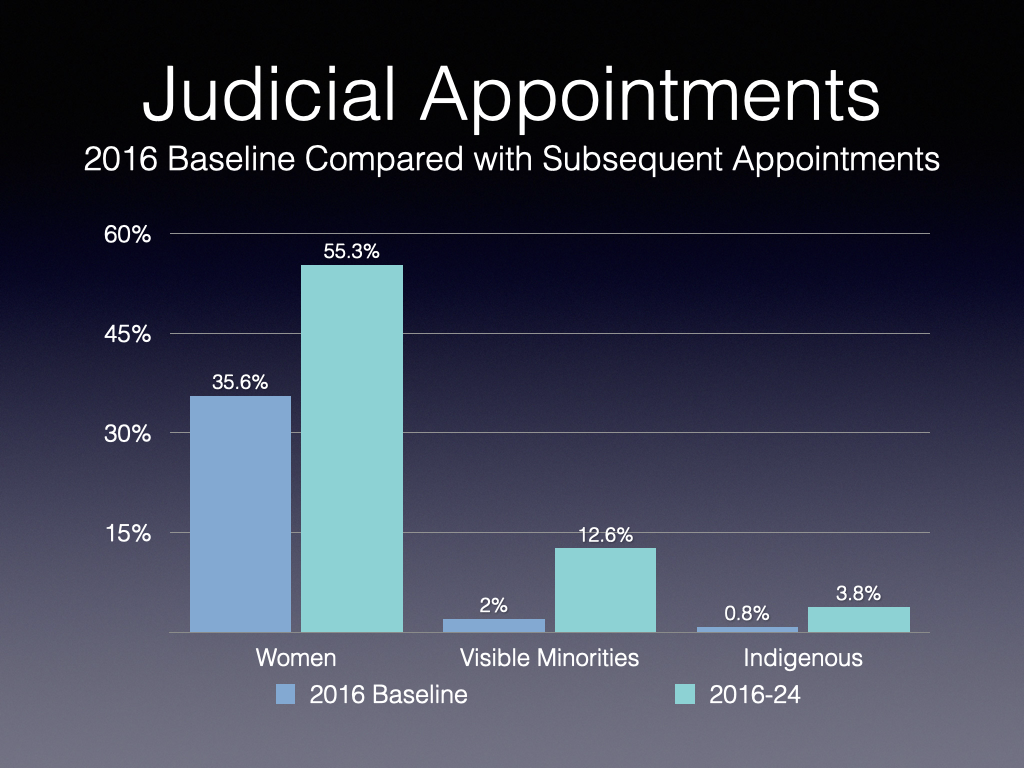
Surge of new judges on top courts cut vacancies to lowest level after years of alarm

Of note. The most recent stats on diversity can be found at: https://www.fja.gc.ca/appointments-nominations/StatisticsCandidate-StatistiquesCandidat-2024-eng.html. My summary, comparing the Harper government baseline and subsequent appointments is below:

The federal Liberals have cut judicial vacancies on top courts across the country to their lowest level on record, new data show, after allowing the problem to get out of control for several years.

A flurry of 31 appointments in recent weeks leaves only 13 vacancies, as of mid-March, among the 1,000 full-time positions for judges on federally appointed benches, according to government data.

The previous low in vacancies was 14 in mid-2015, based on a review of data going back to 2003.

The latest appointments, made as a federal election is expected soon, further address unusually sharp and public criticism in recent years about unfilled positions on federally appointed benches. Those include the Supreme Court of Canada, provincial appeal and superior courts, and the Federal and Tax courts….

Source: Surge of new judges on top courts cut vacancies to lowest level after years of alarm

HESA: Nobody is Coming to Save Us, But

Sensible and ambitious, with potential medium and long-term benefits:

…Now, there just happens to be one kind of change that is suddenly going very cheap, and that is the ability to add top-class academic talent. The carnage down south, with the National Institutes of Health NIH being at least partially dismantled and entire universities being threatened with loss of hundreds of millions of dollars unless they submit to an unspecified number of random administrative fiats from the trump administration, is about to start hemorrhaging talent. It’s not just foreign scholars who are going to leave; top American talent is suddenly footloose, too, because it has become apparent that the damage being done to American science is unlikely to be fully reversible. And even if it could be reversed, you’d never be more than 4 years away from another group of anti-Enlightenment jackals coming and taking another wrecking ball to the whole system. The age of American Science is over, and it’s not coming back any time soon. The opportunity exists, therefore, for ambitious universities to scoop up a fair bit of top new talent.

But wait a minute, you say. Talent requires salaries, and salaries are under pressure, and Big Philanthropy doesn’t cover that. Well, actually, it can, but only if you package it and structure it correctly.

It would indeed be hard for a university to get a philanthropist to pick up the tab in order to grab a new talent across a range of disciplines. There’s nothing “new” about hiring additional profs to plug holes or provide upgrades to an institution’s existing staff. But some philanthropists probably could be persuaded to cover the costs if a university presented a structured package of targeted hires. That is, a set of hires that built on a set of existing strengths and moved the institution closer to world-class status in a specific discipline (e.g., Hegelian Philosophy, Dentistry) or cluster of related disciplines (Human and Animal Health/Vaccines, Water protection, etc.). 

Basically what you would want to do is create a package that encompassed: i) a half-dozen or so fully-funded named chairs, some of which could go to existing staff, others to new star hires, which would mean no net charges to the operating budget ii) money for whatever new space, laboratory or otherwise, was required to house these new scholars and their work, iii) funding for a reasonable number of graduate students, iv) at least some funds for ongoing innovative activities and v) some kind of collective identity. Wrap the whole thing in a bow, name it the [Philanthropist name here] Centre for [Discipline/Grand Challenge name here], hire ambitiously from across the United States to create a cluster of excellence on a level that can really make a mark on a global scale. Normally, this kind of thing would not be possible. But with chaos south of the border, I think right now, it is. And it could be game-changing for a few universities if they could pull it off….

Source: Nobody is Coming to Save Us, But

May: Transition How-Tos [Zussman]

Good list, drawing from Zussman. Rings true from my experience under the Harper government (Policy Arrogance or Innocent Bias: Resetting Citizenship and Multiculturalism):

Here are a few do’s and don’ts from seasoned bureaucrats who’ve weathered many a transition:

This is a test of impartiality and neutrality. Many public servants have only worked for a Trudeau government and this will be their first transition. A new government, especially under a new party, may want to undo, change or scrap policies, programs and your pet projects. Don’t be attached to the programs you worked on — it’s not your role.

Zussman argues deputy ministers must ensure employees are prepared for these shifts and get “past the mindset that they have formed over the last decade and to think in different terms.”

Time for the PS to shine. Be well-prepared, do your homework, know the platform, and show you’re a committed, non-partisan public service that can be relied upon. That builds trust. Have some “early wins” ready for them. Don’t say things can’t be done.

Keep it professional. Don’t greet a new government like an overeager puppy. Don’t try to be their best friend or badmouth the outgoing one. Your role is simple: work with them, understand and implement their agenda, and recognize the legitimacy of their agenda. (They are elected. Public servants aren’t.) If you can’t live with that, it’s time to move on and leave.

Let them lead. Some incoming governments have been watching, planning, and know the system better than public servants assume. Treating them like rookies can backfire — especially if they’ve seen the bureaucracy in committee, dodging questions. “Let them lead the dance,” said one bureaucrat. They know what they want, and the public service’s job isn’t to teach them “government 101” but to deliver.

Expect skepticism. New coach, new game. One former deputy minister likened a newly elected government to a new coach who comes in because the previous leadership was seen as not delivering. So, expect the new government to be skeptical that the public service is up to the job and can execute its agenda. This skepticism is justified. Acknowledge and adapt to it. Demonstrate you can work under the new leadership and deliver its priorities.

Don’t assume you know what the new government’s relationship with stakeholders will be.

Don’t recycle the last government’s or minister’s contact list of stakeholders to call. That could backfire.

Be cautious.

Let the incoming team define its own relationships without speaking for the stakeholders.

Source: May: Transition How-Tos [Zussman]

How Trump’s Targeting of Immigrants With Legal Status Departs From the Norm

Of note (as does virtually everything the Trump administration does):

…Mahmoud Khalil, a 30-year-old green card holder who was detained last week and transferred from New York to a facility in Louisiana, is one of the most high-profile immigration detainees in custody. President Trump said in social media this week that Khalil’s detention is related to his involvement in pro-Palestinian protests at Columbia University, where he earned a master’s degree last year.

Khalil’s legal team has described his arrest — as a permanent legal resident — as unprecedented, while some legal bloggers and journalists have placed it in a larger context of what they describe as politically-motivated enforcement targeting pro-Palestinian activists. Immigration researcher and Syracuse University professor Austin Kocher explained this week that both understandings are, in fact, correct.

On the one hand, “green card holders and even U.S. citizens are arrested and detained by immigration authorities more often than most people are aware,” and a number of those arrests have involved Palestinian activists. On the other hand, Kocher writes, use of “the specific law that might allow the U.S. to deport Mahmoud is extraordinarily rare in recent history.”

The law that Kocher is referring to is an element of the Immigration and Nationality Act, which was last used in 1995, according to The New York Times. The Trump administration has argued the provision allows the Secretary of State to deport permanent legal residents if they represent a threat to national security. Secretary of State Marco Rubio shared a Department of Homeland Security statement claiming that Khalil satisfied that criteria by having “led activities aligned to Hamas,” during the protests. The White House cited unreleased “intelligence” to defend the claim, the New York Post reported.

Some legal scholars have argued this law was struck down as unconstitutional in 1996 by a federal district court after the Clinton administration targeted a Mexican national for deportation. That decision was later reversed by an appeals court on procedural grounds, without weighing in on the merits of the case.

In a twist of irony, the judge behind that district court decision was Maryanne Trump Barry — the president’s late older sister.

“The issue,” Barry wrote, “is whether an alien who is in this country legally can, merely because he is here, have his liberty restrained and be forcibly removed to a specific country in the unfettered discretion of the Secretary of State and without any meaningful opportunity to be heard. The answer is a ringing ‘no.’”

Source: How Trump’s Targeting of Immigrants With Legal Status Departs From the Norm

How a Columbia Student Fled to Canada After ICE Came Looking for Her

Another example of over-reach and where legal system will be tested (Canadian woman who was detained in U.S. immigration jails returns to Vancouver provides another example of over-reach and stupid or incompetent administration):

…Unlike Mr. Khalil, Ms. Srinivasan said she was not an activist or a member of any group that organized demonstrations on campus.

Ms. Srinivasan said she was an architect who came to the United States from India as part of the Fulbright program in 2016 and that she enrolled at Columbia in 2020. She said she was in the fifth year of an urban planning doctoral program at the Graduate School of Architecture, Planning and Preservation, and was supposed to graduate in May.

She said that her activity on social media had been mostly limited to liking or sharing posts that highlighted “human rights violations” in the war in Gaza. And she said that she had signed several open letters related to the war, including one by architecture scholars that called for “Palestinian liberation.”

“I’m just surprised that I’m a person of interest,” she said. “I’m kind of a rando, like, absolute rando,” she said, using slang for random.

It was March 5 when she received an email from the U.S. Consulate in Chennai, India, indicating that her visa had been revoked. The notice did not provide a reason, saying only that “information has come to light” that may make her ineligible for a visa….

Source: How a Columbia Student Fled to Canada After ICE Came Looking for Her

They came to Canada to chase a dream. Now they’re being forced to leave and feel betrayed

They were, by both levels of governments, by education institutions (particularly private and public colleges), recruiters and others, which created and encouraged these expectations before reality intruded:

…For some migrants invited to Canada for a shot at permanent residence, it’s a feeling of betrayal. For others, a missed opportunity. Still others harbour hopes of returning.

Amid a year of seismic immigration changes that have turned Canada into a less welcoming and open country, many migrants have seen their journeys upended and dreams shattered.

The Liberal government has set aggressive targets to rein in the number of temporary residents in the wake of public outcry over the runaway population growth amid a national housing crisis and rising costs of living. It also cut the annual intake of permanent residents by 20 per cent to 395,000 in 2025, 380,000 in 2026 and 365,000 in 2027.

The measures are meant to tighten the rules and restore confidence in what some critics call an “out-of-control” immigration system. As a result, many study and work permit holders are at the end of their rope — unable to renew status or obtain permanent residence — and must go home. 

The Star spoke to some former international students and foreign workers who have recently left or are leaving about the repercussions of Canada’s unfulfilled promise, as well as their new life and future. 

Some are struggling. Others have found opportunities they couldn’t get here. All are still chasing that elusive better life….

Source: They came to Canada to chase a dream. Now they’re being forced to leave and feel betrayed

Snyder – Blame Canada: Our warmongering, drugged-out conspiracy theory

 Uncomfortable parallel between Canada and USA with Ukraine and Russia:

… War with Canada is what Trump seems to have in mind. Fentanyl is not the only the big lie. That Canada does not really exist is the other. The way that this fiction is formulated is strangely Putinist. Trump’s rhetoric about Canada uncannily  echoes that of Russian propagandists towards Ukraine. The claim that the country is not real; that its people really want to join us; that the border is an artificial line; that history must lead to annexation… This is all familiar from Putin, as is Trump’s curious ambiguity about a neighbor: they are our brothers, they are also our enemies; they are doing terrible things to us, they also don’t really exist. 

The imperialist rhetoric has to be seen for what it is, which is preparation not just for trade war but for war itself. And, it goes without saying, a disastrous one, in every sense, for everyone. (Except Putin and Xi, perhaps: the American-Canadian conflict is one way that Trump is handing them the world on a platter.)

Just because someone treats you politely and speaks your language does not mean that they want to be invaded by you. This was an underlying Russian mistake about Ukrainians. Ukrainian public culture, before the Russian invasion, was bilingual and polite. In general people simply adjusted to whichever language was most comfortable for the other person. Visiting Russians therefore had the experience of Ukrainians speaking their language, and then could arrogantly assume that this was because Ukrainians were in fact Russians and wanted to be part of Russia. I fear that Americans, or at least some Americans in the White House, are making a similar mistake.

Canada also has a polite public culture, less bilingual in practice than Ukraine’s, but unlike Ukraine’s with an official second language. Canadians, whether their first language is French or English, will naturally speak English with monolingual Americans. This is simple courtesy, but it leads Americans away from considering Canada’s differences, one of which is that the official language of its largest province is French and that the entire country has two official languages. Canadian elected officials use both, at least at the beginning of their speeches. They have to debate each other in both. The Canadian foreign minister is from Quebec. When she is talking circles around us, we don’t necessarily pause to consider that she is doing so in her second language. 

Canadians tend to be (or tended to be) patient with us. Canadians know Americans well, and tend (or have tended) to see us as our best selves. All of this is to their credit; none of this means that they want to become the fifty-first state (a phrase so dumb it hurts my fingertips to type it). Canada is a very interesting and a very different country, with a very different history. Canadians have quite different institutions, and live quite different (and longer) lives. Canadians have a profound sense of who they are; anyone who suggests the contrary simply has not taken the time to come to the country or to listen with any attention.

The notion that Canada is not real is an example of the complaisant lies that imperialists tell themselves before beginning doomed wars of aggression. The specific association of Canada with fentanyl is a big lie that allows Americans to shift responsibility away to a chosen enemy and enter a world of geopolitical fantasy. Anyone who plays with the idea that Canada is not a real place or repeats the fentanyl slander is warmongering and preparing the way for North American catastrophe. 

Big lies are powerful; but they are also vulnerable, at least before war begins. Wars begin with words, and we have to take words seriously, at the time when they matter most, which is now. When we see the truth of where this is all meant to go, we can prevent it: by calling out the big liars and telling the small truths.

Source: Snyder – Blame Canada: Our warmongering, drugged-out conspiracy theory

‘Lost Canadians’ legislation delayed once again

Really have to wonder about Justice Akbarali given only a month or so extension when Parliament prorogued and a likely imminent election call. Her seeing “no evidence” flies in the face of Bill C-71 that died because of prorogation and could quickly be revived, ideally with the residency requirement needing to be met within the same five-year period as for permanent residents:

A court has granted another reprieve for the federal government to make the country’s citizenship law Charter-compliant so children born abroad to Canadian citizens won’t be discriminated against under the current second-generation cut-off rule.

On Thursday, the Ontario Superior Court of Justice gave Ottawa until April 25 to pass legislation that grants citizenship to the so-called “lost Canadians,” who are denied automatic citizenship because their parents also happened to be born abroad.

It was a fourth extension to a court-mandated deadline — most recently set for March 19 — since Justice Jasmine Akbarali ruled in late 2023 the law unconstitutional and initially gave Ottawa six months to fix it. The Liberal government introduced Bill C-71, which died when Prime Minister Justin Trudeau suspended Parliament in January.

Earlier on Thursday, the government had sought a further 12-month extension, arguing it intended to continue and expand the interim measures in place right now “to mimic, to the extent possible, the framework established in the remedial legislation” introduced in that bill.

But Akbarali said that wasn’t good enough.

“I have nothing in the evidence on this motion other than broad, aspirational statements from the respondent about what it intends to do to mitigate the impact of the unconstitutional legislation,” the judge wrote in a three-page decision.

“There is no evidence of what policy will be adopted to implement its intention. There is no evidence about how any such policy will be communicated to people affected by the unconstitutional legislation.

“There is nothing to allow me to evaluate how effective the expanded interim measures will be in attenuating the impact of the ongoing rights violations that the respondent proposes.”

Instead, Akbarali ordered the government to file additional evidence of its “expanded interim measures” by April 2 and any further legal argument by April 4. The parties will reconvene on April 11.

“I am prepared to grant the respondent some additional time to adduce the necessary evidence and place it before the court, so that I am able to properly consider all relevant factors in determining whether a further suspension ought to be granted, and if so, its length,” she said in her ruling….

Source: ‘Lost Canadians’ legislation delayed once again

What are Canadians’ perceptions on race relations? Here’s what a national survey found

Always useful to have tracking over time. Encouraing:

Canadians are more optimistic about race relations than they were three years ago, despite a world that’s increasingly defined by inter-group conflict and social divisiveness, says a national survey on racism, race relations and discrimination.

The survey shows that those who view race relations as generally good outnumber those who think otherwise by a three-to-one ratio — with many believing that people from different groups get along with one another and have equal opportunity to succeed, said the report by Environics Institute and the Canadian Race Relations Foundation.

The 2024 survey found that most Canadians acknowledge the reality of racism, prejudice and hate, recognizing these issues both from personal experience and through their understanding of broader societal trends.

Keith Neuman, senior associate at Environics and the report’s lead author, said that compared to racialized people surveyed in 2021, the experiences of those surveyed this time didn’t worsen, and their perceptions of race relations improved slightly. “That, I think, is a point of optimism,” he said.

The survey comes at a time when Canada’s immigration policy is at a crossroads, with anti-immigrant sentiment rising, most recently directed at South Asians here as international students and foreign workers, scapegoated for the housing crisis and socioeconomic challenges. The ongoing war between Hamas and Israel has also led to tensions in Canada

This was the third wave of a national survey that started in 2019 to monitor the attitudes, perceptions and experiences of race relations among Canadians. The second survey in 2021 was in the wake of the racial reckoning from the Black Lives Matter Movement and surge of anti-Asian racism amid the pandemic….

Source: What are Canadians’ perceptions on race relations? Here’s what a national survey found