Survey shows more newcomers choose immigration consultants over lawyers — and that can be risky, experts say

General rule of thumb. When something or some offer appears to good to be true, it generally is. As always, the “bad apples” undermine trust in all:

The legal challenge comes as more newcomers are choosing the services of immigration consultants over lawyers, according to a new survey commissioned by CBC News.

The survey, conducted by market research firm Pollara in November, asked 1,507 people who arrived in Canada in the past 10 years about their immigration experiences and found 33 per cent used consultants, while 16 per cent used lawyers. A national survey of that size would normally have a margin of error of +/- 2.5 per cent.

Immigration experts say newcomers may prefer consultants because they’re convenient and affordable. But they also say the College of Immigration and Citizenship Consultants (CICC) hasn’t done enough to punish bad actors in the industry.

They also say victims need better recourse, including a compensation fund promised years ago that has yet to come to fruition.

“I’ve worked with excellent immigration consultants, but the problem is that there are bad actors that are unscrupulous,” said Vancouver immigration lawyer Jae-Yeon Lim, who also teaches immigration law at Queen’s University to those seeking to become consultants. She clarified that she was speaking about her own experiences with clients and not on behalf of her employers….

Overhaul of regulatory body

In 2019, the federal government announced an overhaul to the regulatory body for immigration consultants and the creation of the CICC, which opened about two years later.

Since 2004, two other bodies were not able to effectively regulate consultants because they lacked legislative authorities, the federal government said in briefing notes obtained by CBC News.

CICC was given powers to investigate complaints made against consultants and to publish the names of those being investigated on the college’s website.

It has undertaken more than 70 disciplinary actions against consultants, ranging from fines and suspensions to revocations of licences, according to IRCC.

The college has issued about $300,000 in fines and ordered a total of about $365,000 in restitution to be awarded to clients.

But lawyers Logan and Lim have concerns about the length of time the college takes to discipline consultants.

For example, CICC suspended Lucion about 30 months after the college received complaints about her, during which she was able to continue practising.

“The rules on paper are good. There’s a very good code of conduct. But the actual enforcement of these rules has been lacking,” Logan said.

In another case, a consultant was disciplined in 2023 relating to complaints from 2016. (The regulator transitioned into the CICC for part of that period).

Another consultant was suspended in 2024 in relation to complaints made in 2019 and 2020.

“The impact is that they’re re-traumatizing the victims through these lengthy processes … for something that should have been done in a more expedient manner,” Lim said, adding that victims may lose their legal status in Canada and have to leave before the issue is resolved.

CICC declined interview requests from CBC News. In a statement, it said its goal is to handle complaints in a fair and efficient manner….
Source: Survey shows more newcomers choose immigration consultants over lawyers — and that can be risky, experts say

Opinion | The Diaspora Dilemma: Taxation, Dual Citizenship, And Voting Rights

Interesting take from an Indian perspective (interestingly, Canada does not figure among destination countries perhaps reflecting fewer taxation issues but Canadian NRIs form 6.4 percent of total, 2024 data):

In 2023, India received a staggering $125 billion in remittances. The number of NRI and OCI card holders is upwards of 32 million individuals. The numbers are staggering, undeniably highlighting the immense contribution of the Indian diaspora. However, beneath these impressive figures lies a complex relationship, a balancing act between celebrating the global Indian presence and addressing their very real challenges and aspirations.

The Tax‘ing’ Reality

One of the most persistent hurdles for Non-Resident Indians (NRIs) is navigating the labyrinthine Indian tax system. Double taxation looms large, a significant concern for many. Indeed, a recent survey revealed that double taxation is a primary concern for a considerable percentage of NRIs across various countries: 14.11 per cent in Australia, 13.10 per cent in the UK, and 8.06 per cent in the US, to be precise.

Compounding this issue is the difficulty in accessing necessary taxation documents from abroad. The same survey highlighted this struggle, with 12.10 per cent of NRIs in the US, 9.05 per cent in the UK, and 6.02 per cent in Australia reporting this as a major challenge.

Furthermore, accessing crucial taxation documents from abroad adds another layer of difficulty. For 12.10 per cent of NRIs in the US, 9.05 per cent in the UK, and 6.02 per cent in Australia, simply obtaining the necessary paperwork is a significant challenge.

Despite government efforts, tax-related issues continue to proliferate. Streamlining these processes would be a tangible step towards acknowledging the economic contributions of the diaspora.

A Voice Without A Vote?

Democracy thrives on participation, yet for many NRIs, the right to exercise their franchise remains largely symbolic. The numbers paint a concerning picture of poor electoral participation among overseas Indian voters in the 2024 Lok Sabha polls. Despite nearly 1.2 lakh NRIs registering as electors, a minuscule number actually turned up to vote.

The Election Commission’s data reveals a stark truth: only 2,958 overseas electors flew down to India to participate in the “largest democratic exercise in the world,” and a staggering 2,670 of those were from Kerala alone. The fact that several large states like Karnataka, Uttar Pradesh, and Tamil Nadu saw zero turnout of overseas electors speaks volumes.

The reasons behind this dismal participation are not hard to fathom. The current electoral law mandates that registered NRI voters must physically travel to their respective Lok Sabha and assembly constituencies to cast their vote, presenting their original passports as proof of identity. This requirement poses significant logistical and financial hurdles. Travel costs, employment obligations, and educational commitments abroad make it virtually impossible for the vast majority of NRIs to exercise their right to vote.

The Election Commission itself acknowledges these challenges, having proposed extending the Electronically Transmitted Postal Ballot System (ETPBS) facility to overseas voters – a move that, unfortunately, is still in the works.

The Dual Citizenship Conundrum

The concept of dual citizenship for Indians living abroad is a topic of enduring debate, fraught with both promise and perceived peril. As External Affairs Minister S Jaishankar rightly pointed out in 2023, offering dual citizenship presents “security and economic challenges.” Concerns linger about the potential for divided loyalties and the complexities of managing citizens with allegiance to multiple nations.

However, the desire for dual citizenship among the diaspora is palpable, driven by a yearning to maintain their connection with India while fully participating in their adopted homelands.

The OCI card, while offering certain privileges like multiple entries and a lifelong visa, falls short of granting full citizenship rights. It excludes OCIs from political and electoral life, preventing them from holding government jobs or acquiring agricultural land. For many, the OCI status feels like a consolation prize, not a true recognition of their continued connection to India.

NRIs And National Interest

India’s diaspora is far more than just a reliable source of remittances; it’s a vibrant and powerful extension of India’s global influence. Their achievements paint a compelling picture of Indian talent and capability on the world stage. Consider the example of Indian-origin CEOs leading global tech giants – their success stories become India’s success stories, bolstering its image as a hub of innovation and technological prowess.

Similarly, the growing number of Indian-origin politicians in positions of power across Western nations offers India valuable access and understanding within these critical geopolitical spheres.

This widespread network acts as a bridge, fostering greater cultural understanding and goodwill. The global popularity of Indian cuisine, yoga, and Bollywood, often championed and celebrated by the diaspora, introduces aspects of Indian culture to a wider audience, creating a positive association with the country. Moreover, these established communities often serve as vital conduits for diplomatic and economic engagement.

Bridging The Divide

The challenges faced by the Indian diaspora are not insurmountable. Addressing them requires a nuanced approach that carefully balances national interests with the genuine needs and aspirations of its global citizenry. Streamlining taxation processes, exploring viable options for remote voting, and seriously considering the merits of dual citizenship are crucial steps towards fostering a more robust and mutually beneficial relationship. Ignoring the challenges risks alienating a significant segment of the Indian community, a community whose contributions are vital to India’s economic and cultural standing on the world stage.

Source: Opinion | The Diaspora Dilemma: Taxation, Dual Citizenship, And Voting Rights

Globe editorial: The Liberals open the door to foreign interference

Absolutely. Shameful, and almost disqualifying given all the reports and the ongoing enquiry. Will see whether the caucus meeting Wednesday injected some common sense and reality:

…As we’ve said before, all the parties are guilty of having lax rules that increase the possibility of foreign interference in their nomination and leadership races. But the Liberal Party’s are particularly lax and not up to the moment, given what is at stake in its upcoming leadership race.

Only Canadian citizens normally have a say in which party forms government and who will serve as prime minister; permanent residents aren’t allowed to vote in federal elections.

If the Liberals want to extend that right to permanent residents in the case of their leadership race, so be it; other parties do that as well. But for the sake of the integrity of the process, they should stop there, and also increase the age limit to 18 out of deference to regular eligible voters.

Doing so would send the message that the Liberal Party won’t brook foreign interference, and that it respects the significance of the outcome of its leadership race.

On the other hand, it could do nothing and reinforce the view held by so many Canadians that the party is out of touch with this country – the very thing that made the leadership race necessary in the first place.

Source: The Liberals open the door to foreign interference

HESA: Credulous Nonsense on Colleges from the CBC

Good analysis and critique. Shameful that the CBC declined to interview Usher as part of their reporting:

…So why did the CBC react as if it did?

This was the question I asked them when a CBC producer tried to get me to comment on the story on December 27th. Why would you do a story on so little evidence? I said I didn’t think the evidence merited a story but agreed to speak to them if they wanted someone to explain exactly why the evidence was so thin. You will no doubt be shocked to learn that CBC then declined to interview me.

Upon reading the story, it’s not hard to understand why. With zero evidence, they got a bunch of experts to repeat talking points about the awfulness of student visas that they’ve been repeating for months now.

Raj Sharma, a Calgary-based immigration lawyer, told said “If the allegations are true, it reveals shocking gaps in our integrity protocols.… This is deeply, deeply concerning and problematic,” adding that the allegations suggest “wide-scale human smuggling.”

(The “if” in that sentence is doing a hell of a lot of work – AU)

Kelly Sundberg, a former Canada Border Services Agency officer who is a professor of criminology at Mount Royal University, said the system has no oversight and is “being exploited” by transnational criminals. “This type of fraud, of gaming our immigration system has been going on for quite some time actually,” he said, noting that the volume of those potentially involved “is staggering.”

Ken Zaifman, a Winnipeg-based immigration lawyer, says that from his experience, the responsibility of oversight should lie with the educational institutions, but that they did not do so because “they were addicted to international students to fund their programs.”

Ok, so, these comments about fraud and oversight are worth examining. I’m trying to imagine how either the government of Canada or an educational institution could legitimately “prevent fraud” or “exercise oversight” in a case like this one. Are colleges and universities supposed to be like the pre-cogs in the movie Minority Report, able to spot criminals before they commit a crime? I mean, there is a case to be made that in the past Canada made such cross-border runs more tempting by allowing students’ entire families to join them in Canada while studying (as was the case in the Dingucha affair), but that loophole was largely closed ten months ago when the feds basically stopped giving open work permits to partners of students unless they were enrolled in a graduate degree.

Anyways, this is where we are now: our national broadcaster sees no problem running evidence-free stories simply as a platform to beat up on public colleges because that’s a great way to get clicks. Crappy journalism? Sure. But it’s also evidence of the disdain with which Canadian PSE institutions are now viewed by the broader public: CBC wouldn’t run such a thin story unless it thought the target was “soft.” And there’s no solution to our funding woes until this gets sorted out.

Source: HESA: Credulous Nonsense on Colleges from the CBC

Human rights tribunal chair showed unconscious bias in dismissing immigration complaint: Federal Court

Of note:

The former head of Canada’s human rights watchdog demonstrated an “apprehension of unconscious bias” and lost “the necessary objectivity” in dismissing a complaint against the Immigration Department for discrimination, a court has ruled.

In criticizing the decision by David Thomas, the former chair of the Canadian Human Rights Tribunal, the Federal Court concluded the adjudicator breached the duty of procedural fairness by failing to properly address the allegation of bias levelled against him during the human rights complaint proceedings.

Instead, the court said, Thomas erroneously made his own findings on the accusation in an “unexpected addendum” in rejecting the complaint by Amir Attaran that Ottawa discriminated against parents and grandparents by delaying the processing of their permanent residence applications based on age, race, family status and national/ethnic origin.

“The panel did not give the Applicants an opportunity to know the case against them and to fully and fairly respond,” wrote Justice Henry Brown in a rulingon Friday to send the case back to the tribunal for redetermination.

“The panel lost its necessary objectivity by engaging personally and subjectively in the assessment of the bias allegation against him.”

Thomas, in his analysis, denied having unconscious bias against people of Persian background such as the complainant because “some of my closest friends are from Iran.” 

The court decision has added another side note to the already lengthy legal battle by Attaran, a University of Ottawa law professor and American-born Iranian, who filed his complaint to the rights tribunal in 2010 over the Immigration Department’s processing delays for parent/grandparent sponsorships.

At the time of the complaint, it was taking immigration officials 42 days to screen the sponsors of spouses and children — but 37 months for those who wanted to bring their parents and grandparents to Canada.

After some legal wrangling and delays caused by COVID-19, Attaran’s complaint was heard in 2021 by Thomas, who left the tribunal later that year but continued to preside over the case….

In a written statement, Charlotte-Anne Malischewski, the human rights watchdog’s interim chief commissioner, said the decision was important in the evolving jurisprudence in cases involving racial discrimination.

“It clarifies that the legal test for reasonable apprehension of bias is not about the actual state of mind of the adjudicator, but rather whether a reasonable observer would believe them to be biased,” she said.

“If left unchallenged, the (tribunal) decision could be used to make it harder for people to prove discrimination.”

Source: Human rights tribunal chair showed unconscious bias in dismissing immigration complaint: Federal Court

Newcomers feel Canada accepts ‘too many immigrants’ without proper planning, CBC survey finds

Good long detailed article with a mix of data and testimonies. Not surprising that immigrants have many of the same concerns as non-immigrants regarding lack of planning with respect to housing, infrastructure etc among other issues raised in a fairly comprehensive survey:

More than 80 per cent of newcomers to Canada feel the country is bringing in too many people through its immigration system without proper planning, a poll commissioned by CBC News has found.

The survey conducted by market research firm Pollara Strategic Insights in November asked 1,507 people about their experiences coming to Canada. Among its findings was that four in five newcomers believe the Canadian government has accepted “too many immigrants and international students with no planning for adequate housing, infrastructure or having sufficient job opportunities.”

Shabnoor Abdullateef, a physician who immigrated to Canada from Iran in 2022, says she agrees with this statement.

“There was absolutely no thinking behind this,” said Abdullateef, who graduated from the health-care administration management program at Fanshawe College in London, Ont., last spring….

Source: Newcomers feel Canada accepts ‘too many immigrants’ without proper planning, CBC survey finds

Why Legal Immigration Is Impossible for Nearly Everyone

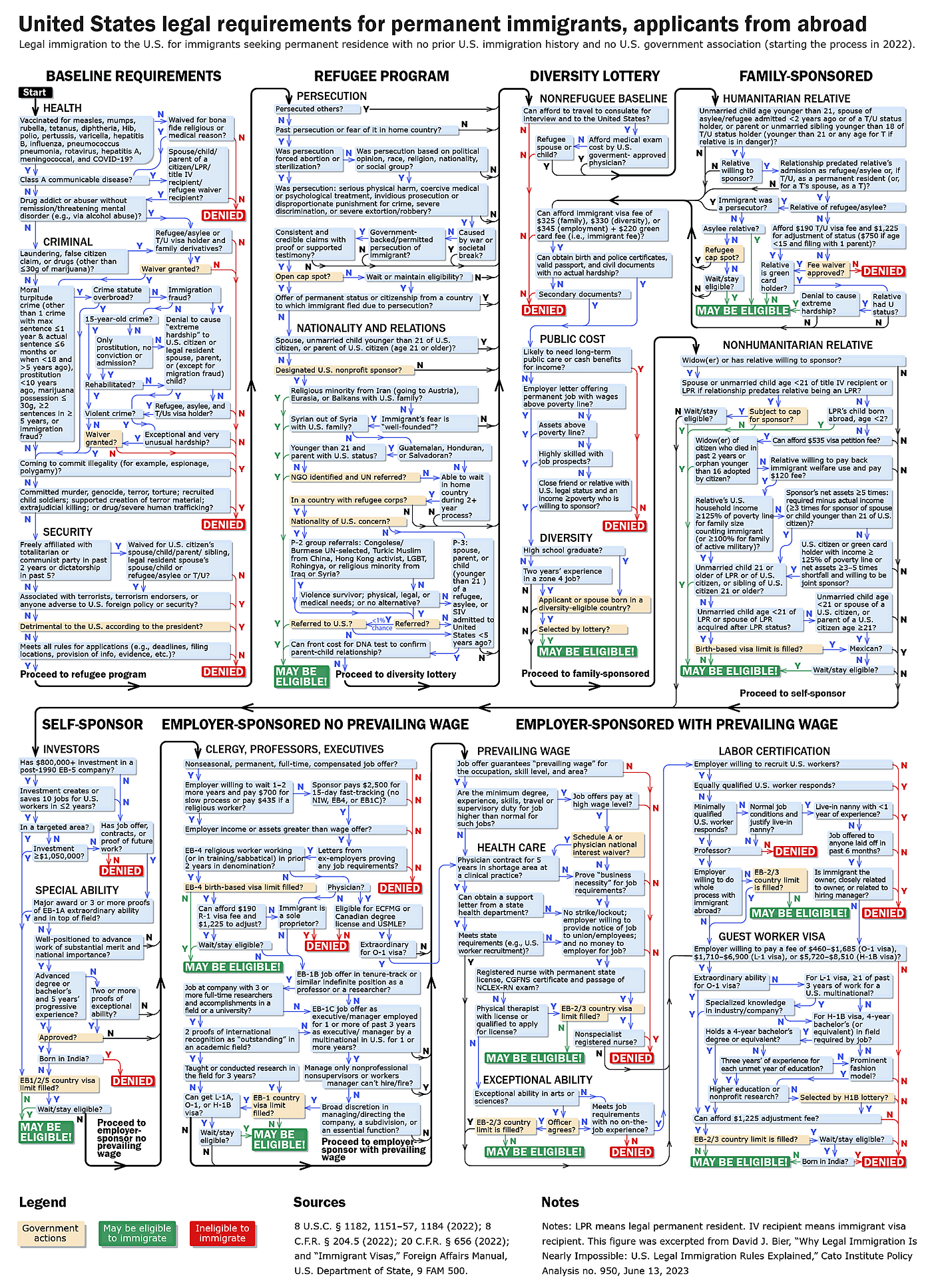
Wonderful graphic illustrating the complexity of immigration to the USA. Canadian system if anything is more complex, given Provincial Nominee Program and the various “boutique” or targeted programs. Would be nice if IRCC could prepare such a chart as part of the briefing package for the expected incoming Conservative government as a basis for streamlining, simplification and automation:

My latest policy analysis published today explains why it is impossible for nearly all immigrants seeking to come permanently to the United States to do so legally. The report is a uniquely comprehensive and jargon-free (to the extent possible) explanation of U.S. legal immigration. Contrary to public perception, immigrants cannot simply wait and get a green card (permanent residence) after a few years. Legal immigration is less like waiting in line and more like winning the lottery: it happens, but it is so rare that it is irrational to expect it in any individual case.

The figure below shows the U.S. legal immigration system for people who are abroad who presently intend to immigrate permanently to the United States. Below I briefly describe the main problems and choke points in this labyrinth.

Flow chart of the entire legal immigration system

Guilty Until Proven Innocent

Until the Immigration Act of 1924, everyone in the world was eligible to immigrate to the United States unless the government proved they fell into an ineligible category. In other words, innocent until proven guilty. Since then, the foundational principle of U.S. immigration law is that everyone in the world is ineligible to immigrate unless they prove to the government they fit into an eligible category. The result is that over 99 percent of all those wanting to immigrate to the United States cannot do so legally.

Source: Why Legal Immigration Is Impossible for Nearly Everyone

Todd: Can Ottawa solve the problem of millions of expiring Canadian visas?

More commentary on immigration policy and program failures:

…How did we get to this muddled state, where the government admits the numbers are out of control — and that it can’t even track, let alone control, the movement of hundreds of thousands, if not millions, of the country’s guest workers and foreign students?

In 2019 I wrote an optimistic column about how the Canada Border Services Agency was going to bring in “exit controls” to help fix our infamously leaky borders.

The upshot was that proper exit controls would increase the likelihood officials catch homegrown terrorists, individuals who illicitly take advantage of taxpayer-funded health care and, particularly, people who overstay their visas.

The plan was to better track when people leave the country by land, sea or air — using techniques long in place in Australia, the U.S. and the European Union. But even though upgraded exit controls were instituted in 2019, they have not made an obvious difference in compelling people to follow the rules regarding how long they can stay in the country.

To add to the disorder, 2024 had a drastic rise in the volume of temporary residents — 130,000 — trying to overstay their work and study visas by applying for refugee status. That’s up from 10,000 less than a decade ago. The asylum claims process can take several years.

In response to questions from Postmedia, the CBSA said it does what it can to monitor and penalize people who overstay. Specifically, officials said that for various reasons it issued more than 3,700 “removal orders” in 2024, compared to 1,517 in 2020.

Sam Hyman, a retired Vancouver immigration lawyer, said Canada, unlike many countries, doesn’t have exit immigration controls that require all travellers who leave to be examined and their departure confirmed. But, he said, there is a certain degree of border-crossing monitoring.

Vancouver lawyer Richard Kurland, publisher of a monthly migration newsletter called Lexbase, says more rigorous entry and exit controls, while useful, won’t solve Canada’s border crisis alone.

He’s more concerned the government is trying a number of strategies to avoid taking blame for the migration turmoil, first by “denying” it, then by “distracting” from it and now by “repackaging” it, while making new promises.

After Trudeau spent years accusing critics of his high migration policies of being xenophobic or racist, Kurland said he and Miller last year “did a 180 (degree turn) and offered a mea culpa,” admitting to overshooting.

However, they then compounded their blundering, Kurland said, by promising temporary residents who overstay their visas a general amnesty.

“But when you have immigration amnesties, why obey rules, when all you have to do is to hide and wait for the next amnesty?” Kurland said. After the public rose up in criticism, Kurland said the Liberals had to pull back their scheme.

“We are left with the chicken in the python,” Kurland said, “which will be a ticking immigration time bomb for whoever replaces the Trudeau government.”

Source: Can Ottawa solve the problem of millions of expiring Canadian visas?

Jamie Sarkonak: Good riddance to all the Liberal bills that Trudeau just culled

…Also dead is that bill that would have made thousands of people around the world eligible for Canadian citizenship.

Bill C-71, if you remember, would give the children of Canadians born abroad citizenship through descent, as long as the parents can establish a “substantial connection” to Canada. The guardrail wouldn’t be a secure one, since some judges don’t believe that there are any citizens who lack a connection to the country.

The bill’s proponents marketed it as a remedy to a rare problem that sometimes afflicts Canadian families who live abroad, such as military families. However, in trying to solve their problems, the bill would have made it much easier for citizenship to be obtained by the grandchildren of birth tourists (people who who travel to Canada to give birth, which secures Canadian citizenship for their child)…

Source: Jamie Sarkonak: Good riddance to all the Liberal bills that Trudeau just culled

Saudi Arabia presses Florida man to give up US citizenship over critical tweets, family says

Of note:

Saudi Arabia has forced a Florida retiree to try to renounce his American citizenship after jailing him over social media posts critical of the kingdom’s crown prince, according to the man’s son.

The retiree, 74-year-old Saad Almadi, is one of at least four dual Saudi-American nationals who accuse Crown Prince Mohammed bin Salman’s government of pressuring them to give up their U.S. citizenship, a U.S.-based Middle East human rights group said.

The alleged tactic by a key strategic partner of the U.S., which has not been previously reported, tracks with similar efforts to silence even mild criticism, including the threat of imprisonment and exit bans like the one that has kept Almadi from returning to the U.S. after being released from more than a year in a Saudi prison.

“There are Saudi princes that come to the U.S. for routine medical checkups, so why can’t an American citizen return home for his health?” Ibrahim Almadi said of his father.

“It’s all because we don’t want to upset our ally’s feelings,” he said in an interview from Washington. “If this were Russia, Iran or North Korea, he would’ve been declared wrongfully detained months ago.”

The Saudi Embassy in Washington acknowledged receiving a request for comment on the allegations but did not otherwise respond. The Saudi government doesn’t recognize dual citizenship. It regularly rejects criticism of its actions, saying they are part of a multiyear crackdown on corruption, terrorism and other security threats.

The plight of the elder Almadi and others could complicate U.S. efforts to turn the page on tensions arising from the 2018 killing of Washington Post columnist Jamal Khashoggi….

Source: Saudi Arabia presses Florida man to give up US citizenship over critical tweets, family says