Coren: Islam and Western Society

Note: Article dates from 2009 which I should have caught and his views, like most of us, have likely evolved somewhat.

—-

Surprising to see Coren writing for a more right of centre publication but he raises uncomfortable yet valid questions that his usual outlets might be uncomfortable with:

…Can Islam evolve, as has Christianity and Judaism? In that it is an exclusive monotheistic religion, it can never be as inclusive as Hinduism, but surely, as with Catholic or Protestant Christianity, it can hold to exclusive truth and still be tolerant of others who disagree. The problem is that there is limited evidence that this is happening. The Islamic heartland of the Middle East and Pakistan and even Nigeria and Indonesia evince a severe lack of acceptance for people who leave Islam for another faith, marry outside of the religion or criticize the founder, Mohammad, or the primary text, the Koran. Syria may not be as bad as Iran, Jordan may not be as bad as Saudi Arabia and Malaysia may not be as bad as Egypt, but it is only Turkey – where a militantly secular regime won a Kulturkampf against Islam, where anything resembling Western pluralism exists. It is, however, a pale imitation, and polls repeatedly reveal a personal intolerance of Christians and Jews unparalleled anywhere else in Europe.

In Canada, there have been several cases of so-called honour killings where fathers and brothers murder daughters and sisters who shame the family by becoming too Western. While this does occur outside of Muslim communities, it is overwhelmingly an Islamic phenomenon. Polygamy also occurs in Canada, with multiple and illegal marriages performed by Imams, and the police and judicial authorities are too timid to intervene. There are also cases of violent and hateful sermons delivered in Mosques, death threats made to critics and financial, moral and even physical support for foreign terrorists fighting and killing Canadian soldiers in Afghanistan and elsewhere.

This makes for depressing reading and paints a bleak picture of the Western, including Canadian, future. Obviously many Europeans already believe this, proved by the increasing support for right wing and sometimes even semi-fascist parties in countries such as Holland and Britain where tolerance is a way of life. We must also be extremely careful not to paint all Muslims with the same brush of suspicion. Most followers of the faith are peaceful people more concerned with paying the rent than preparing a rebellion. What, though, when Islam’s numbers grow and give it something other than cringing minority status? Christians in the Middle East will tell you that there are two radically different Islams: that of the minority and that of the majority.

If this problem is to be solved in a civilized manner, we have to transform the conversation and reform the vocabulary. First, the word “Islamophobia” must be expunged from the debate. It is meaningless, but it is used to silence contrary opinion and to place all critics of Muslim actions on the defensive. Second, there must be a collective show of courage and solidarity from assorted media and a willingness to display pictures and publish articles and books that, while not gratuitously offensive, are as cutting and critical of Islam as are those habitually drawn and written about Christianity. Third, we must hold Muslims to the same standard as anyone else and not indulge in the racism of lowered expectations. It is genuinely patronising to assume that a brown Muslim cannot act according to the same rules of civility and tolerance as a white Christian. Fourth, we must break from self-denial and admit that while we are not at war with Islam or Muslims, our liberal values are in conflict with many of the core concepts and precepts of Islam. We won the Cold War because most of us were prepared to say that capitalism, for all of its faults, was morally superior to communism. Today we are confused about what we believe, frightened to promote what we love and terrified of being seen as intolerant.

If enough people are willing to stand, read, write, act and know, we can carve out a new and successful West that includes the finer points of Islamic culture and history. If we are not – well, the thought is horribly rhetorical.

Source: Islam and Western Society
Quebec’s attack on refugee sponsorship

Of note but unlikely to influence change in policy in Quebec:

There is a rich history of communities across Canada working together to raise funds to sponsor refugees who come to our country. Local groups with humanitarian goals are focused on ensuring a brighter future for people forced to flee their homelands. However, groups in Quebec are facing challenges not experienced elsewhere in Canada.

Sponsoring refugees changes lives and enriches our society. The arrival of refugees from Vietnam, Cambodia and Laos in the late 1970s was a notable point in our history, as was the more recent arrival of Syrians, about a decade ago. Both times, Quebec played an important role in these initiatives.

Perhaps less well-known is that more than 400,000 people have immigrated to Canada through refugee sponsorship. Sponsorship allows Canadians to respond to humanitarian crises and express solidarity. Today, groups support Afghans, Iraqis, Congolese and Eritreans. They also support other refugees, including LGBTQ individuals whose rights are not protected in their home countries.

The program relies on citizens who form sponsorship groups and provide financial aid and integration support for a refugee’s first year in Canada. Groups choose who they will help. Often, the refugee is a friend or relative of a group member. In all but Quebec, the program is administered solely by the federal government.

Many immigration policies in Quebec are distinct from the rest of Canada as the federal government allows the province more control over its affairs. Since the late 1990s, Quebec’s government has controlled aspects of refugee sponsorship. Four key differences show how Quebec’s program is threatened by its own government.

Reduced and insufficient landing targets

Quebec has drastically reduced the number of sponsored refugees allowed in the province. As part of its annual immigration target, the government has cut the figures this year to between 1,850 and 2,100 from a maximum of 4,400 six years ago.

Once targets are set, both levels of government must work to reach them, but Quebec has consistently failed in recent years to hold up its end, as figure 1 shows.

Travel restrictions during the COVID-19 pandemic dampened numbers in 2020 and 2021. But the following year, as the world began to emerge from restrictions, 2,010 sponsored refugeesarrived out of a target of 2,750 to 3000. In 2023, the same goal was set, but only 1,190 arrived. This is in stark contrast to the over 4,000 sponsored refugees who arrived in Quebec each year from 2016 to 2018.

Quebec’s lower targets and inability to meet them contrast with the rest of the country, where targets have increased and have been met. Some 22,517 sponsored refugees arrived in Canada in 2022 and 27,655 in 2023. Quebec has the lowest rate of resettlement of all provinces.

Lengthy processing times

Finalizing fewer applications causes wait times to increase. News reports a year ago revealed the Quebec government had shelved applications from Afghan refugees while Ottawa prioritized those requests. As reported in Le Devoir, an application submitted by a Toronto group saw an Afghan family arrive within six months. But a Montreal group was still waiting a year later for Quebec to assess an application made at the same time.

Quebec Immigration Minister Christine Fréchette promised that all applications would be processed and sent to the federal government by the end of 2023, yet many organizations have not received any response on requests  submitted as far back as 2022, even as advocates for refugee sponsorship made clear calls for improvement.

Lengthy wait times leave refugees overseas in perilous situations. Afghan families who fled to countries such as Pakistan or Tajikistan to escape the Taliban often need to pay bribes to extend their immigration status or find housing. Some develop health concerns. Sponsor groups end up sending money abroad to help refugees, who can do little more than wait.

Lack of consultation and collaboration

Sponsored refugees receive permanent residence status upon arrival in Canada and their sponsors help them adjust to their new country. Governments and sponsorship groups need to work together for this approach to succeed.

The federal government makes significant efforts to collaborate with sponsorship groups. It funds training and supports co-ordination efforts by experienced sponsorship organizations, including regular meetings. This ensures clear communication and good program management.

The Quebec government provides some funding to employ a resource person for refugee sponsorship, but there is minimal interaction between organizations and government officials. Sponsor groups are left in the dark when policy changes are introduced.

Roadblocks for experienced organizations

Both federally and in Quebec, there are three types of sponsorship. First, small groups of individuals can step forward on an ad hoc basis in the group of five program at the federal level and the group of 2 to 5 program in Quebec. Second, community organizations can apply through specific programs in both jurisdictions. Third, large bodies with significant experience in sponsorship work with local groups or co-sponsors to help refugees once they arrive. These are known as sponsorship agreement holders (SAHs) in all but Quebec where they are called “experienced organizations.”

The larger, established organizations provide expertise to refugee sponsors and ensure consistent outcomes. At the federal level, most applications are supported by SAHs. In contrast, the Quebec government appears to prefer working with ad hoc groups. Over half the spots available for sponsorship applications in the province are reserved for them.

The Quebec government uses a lottery to select a limited number of applications. This is not the case under the federal program, although intake controls are under consideration. Refugee sponsorship advocates in Quebec have decried the lottery system.

Requirements for financial support vary depending on the type of sponsorship organization. All groups whose applications move forward must have enough money to support the refugees they sponsor. At the federal level, sponsors are encouraged to raise funds and keep them in a trust account. In Quebec, ad hoc sponsors are assessed on the income of the two to five membersin the group. A recent policy change in Quebec targets experienced sponsors and weakens program oversight.

Quebec recently notified organizations that keeping funds in trust is forbidden after investigating suspected cases of fraud. This has left sponsorship groups exasperated and uncertain how to manage. There was no discussion between the government and the sponsorship community on this new policy. Long-standing organizations have indicated they are uncertain if they can continue their work.

Prohibiting groups from keeping trust funds goes against the best practices for refugee sponsorship. These accounts ensure sponsors can provide for the needs of refugees once they arrive. Quebec’s approach of banning trusts and preferring ad hoc groups leaves no way to ensure compliance or good management of sponsorships.

Quebec must change course

Refugee sponsorship has long been a part of Canada’s identity. If Quebec wants to ensure sponsorship remains viable and that humanitarian objectives are respected it needs to reform its program. Many individuals and groups in the province are willing to sponsor refugees, but are disheartened by the roadblocks resulting from the government’s approach.

Targets must be raised, processing times must decrease, more collaboration is needed and sponsor groups should be encouraged to hold funds in trust to ensure a good welcome for newcomers. These changes would also support citizens who are eager to help refugees start a new life in Quebec.

Source: Quebec’s attack on refugee sponsorship

In some countries, immigration accounted for all population growth between 2000 and 2020

Interesting overview. While Canada not mentioned, it is also in the same situation:

The global population ballooned by about 1.7 billion people between 2000 and 2020. But growth was uneven around the world and, in some places, immigration played a key role.

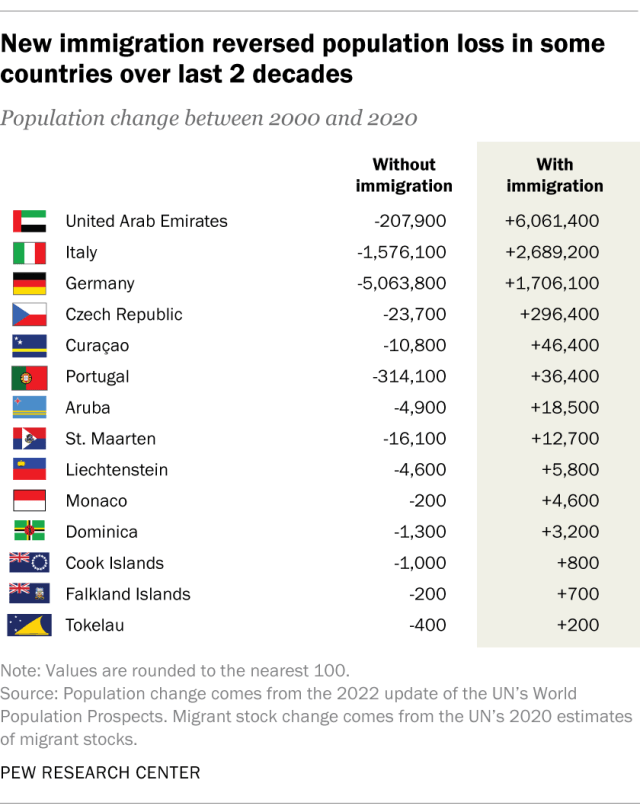
In 14 countries and territories, in fact, immigration accounted for more than 100% of population growth during this period, meaning that populations there would have declined if not for the arrival of new immigrants.

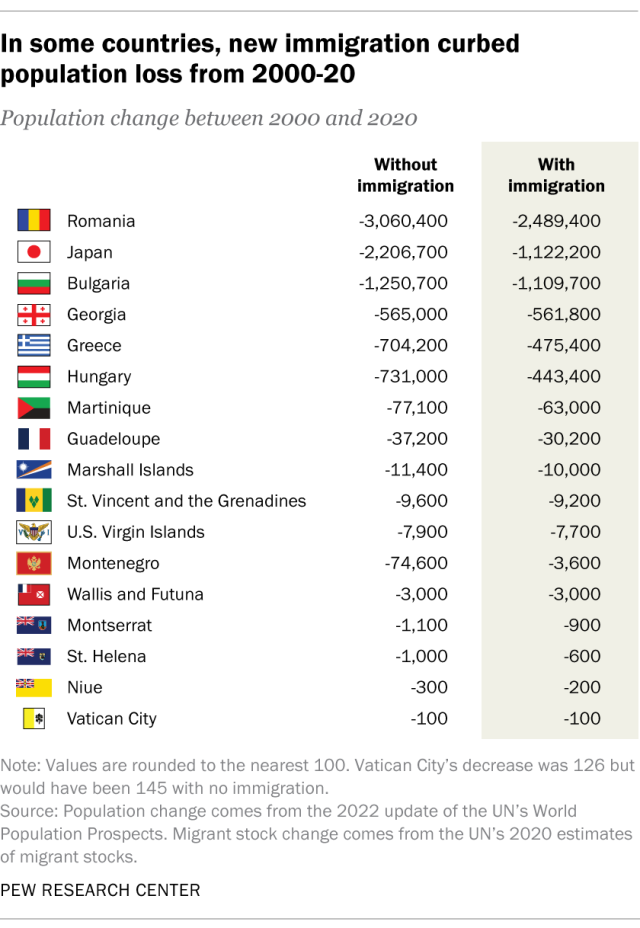
In 17 other countries, populations did decline between 2000 and 2020. But the decreases were smaller than they otherwise would have been due to growth in these countries’ immigrant populations.

How we did this

The places where populations grew only through immigration between 2000 and 2020 – and those where population losses were mitigated by immigration – are geographically scattered. What they tend to have in common is low fertility rates and aging populations. The only way a country’s population can increase, aside from having more births than deaths, is through immigration.

Population decline can be a challenge for countries experiencing it. When deaths and emigration outnumber births and immigration, countries are left with aging populations and dwindling numbers of working-age people to fill out the labor force and support older adults.

Where immigration staved off population losses

The places where immigration accounted for all population growth between 2000 and 2020 range from large countries in Europe to small island nations in the South Pacific.

A table showing that new immigration reversed population loss in some countries over last 2 decades.

Germany’s population grew by 1.7 million people between 2000 and 2020. But it would have shrunk by more than 5 million people without the arrival of new immigrants. During these years, many new immigrants arrived in Germany from Poland, Syria, Kazakhstan and Romania. Women in Germany have 1.5 children on average – far below the fertility rate of about 2.1 children per woman needed for each generation to replace itself – and half of people in Germany are older than 45.

Italy’s population grew by 2.7 million people between 2000 and 2020. However, if not for immigration from places like Romania, Ukraine and Albania, Italy’s population would have declined by 1.6 million people. Italy’s fertility rate is only 1.3 children per woman and its median age is 46.

In the Czech Republic, the overall population grew by 300,000 in 20 years, but immigrants again accounted for all growth. Without new immigrants – many of whom came from other European countries – the Czech population would have shrunk by more than 20,000. As of 2020, women in the Czech Republic had an average of 1.7 children, while the country’s median age was 42.

Portugal’s population grew modestly between 2000 and 2020 – by fewer than 40,000 people – but it would have shrunk by more than 310,000 people without new immigrant arrivals. Many migrants to Portugal were born in Angola, Brazil or France. Portugal’s fertility rate is 1.4 and its median age is 45.

Apart from Europe, immigration also played an important role in avoiding population losses elsewhere in the world.

The population of the United Arab Emirates grew by 6.1 million people between 2000 and 2020 but would have declined by 210,000 without new immigrants. Many of the UAE’s new arrivals were from South Asian countries or Egypt. The average woman in the UAE has 1.5 children, while the country’s median age is 32.

Several smaller countries and territories were also spared population decline only through the arrival of new immigrants. Aruba, the Cook Islands, Curacao, Dominica, the Falkland Islands, Liechtenstein, Monaco, Sint Maarten and Tokelau were all in this category.

Where immigration mitigated population losses

In 17 other countries and territories, populations declined between 2000 and 2020 but would have dropped even more – in some cases much more – without growth in their immigrant populations.

A table showing that, in some countries, new immigration curbed population loss from 2000-20.

In Japan, fertility rates have plummeted to an average of only 1.3 children per woman and the median age is now 48. More people are dying each year than are being born, and Japan’s population declined by over 1.1 million people between 2000 and 2020. However, Japan’s population would have fallen by twice as much (2.2 million people) during this period if not for the arrival of new immigrants. During these years, the foreign-born population of Japan grew from 1.7 million to 2.8 million. Many immigrants to Japan have come from China, South Korea, Vietnam and the Philippines.

Romania’s population shrank by about 2.5 million between 2000 and2020 but would have declined by more than 3 million if not for new immigrants, many of whom are from Moldova. Romania has a fertility rate of 1.7 and a median age of 42.

Greece’s population declined by about 500,000 people between 2000 and 2020. But it would have decreased by 700,000 if not for an increase in the country’s foreign-born population. Similarly, Hungary’s population shrank by 440,000 – but would have fallen by 730,000 without new immigrants. Both countries have low fertility rates and older populations.

In other countries where populations declined, immigrant populations did not increase between 2000 and 2020. This can happen when deaths and departures among earlier immigrants outnumber new immigrant arrivals.

Causes and consequences of population decline

Around the world, women are having fewer children. Women have increasingly put off or forgone childbearing as their average years of education increase, rates of workforce participation climb, and reliable family planning methods become more accessible.

Globally, the total fertility rate – the number of children born to an average woman – declined from 2.7 to 2.3 between 2000 and 2020, a sizable drop in only two decades. It takes an average of about 2.1 children per woman for each generation to replace itself. Naturally, populations age as birth rates dwindle. During these years, the world’s median age increased from 25 to 30.

While fertility is declining all over the world, the impact on population change is uneven. Women still have an average of more than six children in a few African countries, while the average woman in South Korea and Singapore now has less than one child. Median ages, meanwhile, range from 14 in Niger to older than 50 in Monaco and the Vatican.

Source: In some countries, immigration accounted for all population growth between 2000 and 2020

‘Not a back-door entry to citizenship’ Marc Miller stresses importance of caps on international students

His messaging continues to get clearer and firmer:

The era of uncapped intake of international students is over, federal immigration minister Marc Miller said during a visit to Calgary, adding the cost of lost revenue borne by post-secondary institutions from students who would have been enrolled must be replaced by provincial investment in education.

“We have to make this a system that is more quality-oriented,” Miller told Postmedia.

“We have to make sure that we have more diversity, more qualified, more talented bunch of people coming into the country, and to make sure that they know exactly what they’re getting into — Canada is not a cheap place to live in.”

Miller’s comments on the federal government’s renewed approach to immigration came in an interview on Saturday following a ceremony at Stampede where 25 people were granted Canadian citizenship. The special guests at the event included Miller and Mayor Jyoti Gondek.

Miller stressed the path to citizenship for those people had been a long, grinding one. “And they’re going to make Canada even better than what it is already the best country in the world.” But he also emphasized citizenship was a privilege and not a right for everyone who entered the country.

He added: “We need to take a step back and look at the historic volumes of people coming here and their impact on housing and health care, on education and the infrastructure needs of this country,” while recognizing, “that a lot of those people are necessary to maintain the health-care system that we have as part of our national identity.”

Source: ‘Not a back-door entry to citizenship’ Marc Miller stresses importance of caps on international students

Where Germany’s Immigration Debate Hits Home

Of note. Incidents like this naturally raise worries and fears:

The leafy market square, ringed by Middle Eastern restaurants in a quiet city where nearly half the residents have immigrant backgrounds, seems like the last place that would spur Germany’s latest explosive wave of nationalist backlash.

But it was in Mannheim where prosecutors say an Afghan man stabbed six people in May at an anti-Islamist rally, killing an officer who had intervened. No motive has yet been determined. But the death and the fact that the man accused had his asylum claim denied years ago set off calls for the expulsion of some refugees. Such sentiments were once viewed as messaging mostly reserved for the far right.

That this could occur in Mannheim, a diverse community of over 300,000 people known for its sensible plotting along a grid as a “city of squares,” has rattled Germany. It has been particularly painful for the longtime Muslim population of the city, where, according to some estimates, nearly one in five people are of Turkish descent.

Overtly, the political discussion concerns refugees, but in the lived experience of German Muslims, many said they felt like they were steps away from becoming a target. That worry has heightened since January, when an exposé revealed a secret meeting by members of the extreme right during which the deportation of even legal residents of immigrant descent was discussed.

Some expressed fears that what happened in Mannheim may have broken a dam.

Source: Where Germany’s Immigration Debate Hits Home

It’s Time for Corporate Canada to Take Action on Antisemitism

Of note with similar need for anti-Muslim bias:

…Geist’s poignant entreaty that “Canadians simply believe us” underscores that Canada needs a new forum for Jews and non-Jews to come together to combat this ancient hatred. This is an issue for non-Jews to address, as Comper wisely noted some twenty years ago, and business leadership can be crucial to progress. With the scourge of antisemitism on the rise, it’s time for today’s generation of CEOs to step up and show real leadership and allyship – not just in their own workplaces, but in the broader community – to ensure that the Jewish community feels not just believed, but supported.

Hon. Kevin Lynch was Clerk of the Privy Council and vice chair of BMO Financial Group. Paul Deegan is CEO of Deegan Public Strategies and was a public affairs executive at BMO and CN.  

Source: It’s Time for Corporate Canada to Take Action on Antisemitism

Researchers seek to reduce harm to multicultural users of voice assistants

Interesting analysis:

Users of voice assistants such as Siri, Alexa or Google Assistant know the frustration of being misunderstood by a machine.

But for people who may lack a standard American accent, such miscommunication can go beyond simply irritating to downright dangerous, according to researchers in the Human-Computer Interaction Institute (HCII) in Carnegie Mellon University’s School of Computer Science.

In a new study published in the Proceedings of the CHI Conference on Human Factors in Computing Systems, HCII Ph.D. student Kimi Wenzel and Associate Professor Geoff Kaufman identified six downstream harms caused by voice assistant errors and devised strategies to reduce them. Their work won a Best Paper award at the Association for Computing Machinery’s Conference on Human Factors in Computing Systems (CHI 2024).

“This paper is part of a larger research project in our lab looking at documenting and understanding the impact of biases that are embedded in technology,” Kaufman said.

White Americans are overrepresented in most datasets used to train voice assistants, and studies have shown that these assistants are far more likely to misinterpret or misunderstand Black speakers and people with accents or dialects that vary from standard American.

Earlier researchers tended to look at this problem as a technical issue to be overcome, as opposed to a failure that has repercussions on the user, Kaufman said. But having speech misunderstood, whether by a person or a machine, can be experienced as a microaggression.

“It can have effects on self-esteem or your sense of belonging,” Kaufman said.

In a controlled experiment last year, Kaufman and Wenzel studied the impact that error rates by a voice assistant had on white and Black volunteers. Black people who experienced high error rates had higher levels of self-consciousness, lower levels of self-esteem and a less favorable view of technology than Black people who experienced low error rates. White people didn’t have this reaction, regardless of error rate.

“We hypothesize that because Black people experience miscommunication more frequently, or have more everyday experience with racism, these experiences build up and they suffer more negative effects,” Wenzel said.

In the latest study, Wenzel and Kaufman interviewed 16 volunteers who experienced problems with voice assistants. They found six potential harms that can result from seemingly innocuous voice assistant errors. These included emotional harm as well as cultural or identity harm caused by microaggressions.

They also included relational harm, which is when an error leads to interpersonal conflict. A voice assistant, for instance, might make a calendar entry with the wrong time for a meeting or misdirect a call.

Other harms include paying the same price for a technology as other people even though it doesn’t work as well for you, as well as needing to exert extra effort—such as altering an accent—to make the technology work.

A sixth harm is physical endangerment.

“Voice technologies are not only used as a simple voice assistant in your smartphone,” Wenzel said. “Increasingly they are being used in more serious contexts, for example in medical transcription.”

Voice technologies also are used in conjunction with auto navigation systems, “and that has very high stakes,” Wenzel added.

One person interviewed for the study related their own hair-raising experiences with a voice-controlled navigation system. “Oftentimes, I feel like I’m pronouncing things very clearly and loudly, but it still can’t understand me. And I don’t know what’s going on. And I don’t know where I’m going. So, it’s just this, this frustrating experience and very dangerous and confusing.”

The ultimate solution is to eliminate bias in voice technologies, but creating datasets representative of the full range of human variation is a perplexing task, Wenzel said. So she and Kaufman talked to the participants about things voice assistants could say to their users to mitigate those harms.

One communication repair strategy they identified was blame redirection—not a simple apology, but an explanation describing the error that doesn’t put the blame on the user.

Wenzel and Kaufmann also suggest that voice technologies be more culturally sensitive. Addressing cultural harms is to some extent limited by technology, but one simple yet profound action would be to increase the database of proper nouns.

“Misrecognition of non-Anglo names has been a persistent harm across many language technologies,” the researchers noted in the paper.

A wealth of social psychology research has shown that self-affirmation—a statement of an individual’s values or beliefs—can be protective when their identity is threatened, Kaufman said. He and Wenzel are looking for ways that voice assistants can include affirmations in their conversations with users, preferably in a way that isn’t obvious to the user. Wenzel is currently testing some of those affirmations in a follow-up study.

In all these conversational interventions, the need for brevity is paramount. People often use voice technologies, after all, in hopes of being more efficient or able to work hands-free. Adding messages into the conversation tends to work against that goal.

“This is a design challenge that we have: How can we emphasize that the blame is on the technology and not on the user at all? How can you make that emphasis as clear as possible in as few words as possible?” Wenzel said. “Right now, the technology says ‘sorry,’ but we think it should be more than that.”

Source: Researchers seek to reduce harm to multicultural users of voice assistants

Tunisian historian tackles the complexities of 12 centuries of ‘Slavery in the Muslim World’

Of interest:

In a dense but succinct new work, Tunisian historian M’hamed Oualdi takes the complex subject of slavery head on, while also examining contemporary traumas.

In his tome L’Esclavage dans le Monde Musulman (Slavery in the Muslim World), published in French by Amsterdam, M’hamed Oualdi, a professor at Sciences Po Paris says he wants to “cut through the endless controversy surrounding this supposedly taboo subject”.

Oualdi, also an associate professor of history and Near Eastern studies at Princeton University in the US, knows his subject inside out, having already published two books and a research project on slavery in the Muslim world.

First, in 2011, came Esclaves et Maîtres (Slaves and Masters), a study of the mamluks, mercenaries and slaves of European origin who converted to Islam and served the governors of the Ottoman province of Tunis from the 16th to the 19th centuries.

Then, in 2020 he published Un Esclave Entre les Empires (A Slave Between Empires), which looks at the transition from Ottoman tutelage to French colonisation in Tunisia, based on the life of one of the last mamluks of Tunis, Husayn, between the 19th and 20th centuries.

In the meantime, Oualdi has also published a research project on the narratives of slaves (white prisoners, Black slaves and Ottoman servants) during the abolition era in 19th-century North Africa.

His work is part of a growing interest in the issue throughout the Arab world, including literature, cinema, academic works and museums. So while the “Islamic” slave trade is still subject to censorship under certain authoritarian political regimes and is still relatively neglected by publishers and the media, it is no longer a taboo subject.

Ideological and political instrumentalisation

Slavery in the Muslim World is broader in scope but still concise (237 pages), covering the first slave trades at the end of the 7th century and post-slavery trauma in Arab and Muslim societies. Above all, however, it is the work of a historian, a “rigorous clarification” of the subject, well-documented to quell any myths or other ideological and political issues.

Oualdi shows that the clichés about the “Islamic slave trade” are a way “for certain writers” to exonerate European slavery (particularly the Atlantic slave trade) by pointing the finger at “Muslim slavery”.

Two specific points support the historian’s argument. First is the very notion of the “Eastern slave trade” or “Islamic slave trade”, which in reality encompasses disparate trades (the Saharan slave trade, the East African slave trade on the Swahili coast, and the Red Sea slave trade), and which fails to take into account the enslavement of Muslims by other Muslims (Berbers, Circassians, Shiites) within the Muslim worlds, but which is also linked to global trade.

Millions of victims

This homogenisation leads to a second point: the famous battle of statistics between the “Islamic slave trade” (which spanned more than 12 centuries) and the Atlantic slave trade (four centuries). French historian Olivier Grenouilleau has put forward the figure of 17 million victims of the Eastern slave trade compared with 12 million slaves who were victims of the Atlantic slave trade, while claiming to want to avoid falling into a “competition of remembrance”, but suggesting all the same that, after all, Westerners are less evil than Arabs.

While there were indeed millions of victims on both sides, precise estimates are difficult to obtain. M’hammed Oualdi argues that the “slave trade organised by Europeans in the Indian Ocean” has never been added to the Atlantic slave trade.

However, the author does not play down the Eastern slave trade. Rather, he aims to show the complexity and heterogeneity of this practice, which originated in different regions and was regulated differently according to political and sociological systems and Islamic legal schools of thought.

White slaves and ‘racialisation’

Oualdi also identifies three main types of slaves in the Muslim world:

  • Domestic servants
  • Concubines (or so-called royal slaves)
  • Agricultural slaves

It was among the “royal slaves” that the highest number of Europeans or Caucasians who had converted to Islam and joined the Ottoman harems as well as the administration and military apparatus (mamluks) could be found.

Some of these mamluks had extraordinary destinies: there was the concubine who became the mother of a sultan and a sultana herself (Chajarat ed-Or, who ruled Egypt and Syria in the 13th century); or those who became sultans in medieval Egypt. Via this group, Oualdi also examines the origins of “racialisation”, in which white slaves – very much in the minority – were differentiated from Black slaves, who were in the majority.

While reviewing at length the process that led to the abolition of slavery, both by Muslims and Europeans (which in part fuelled their imperialist conquests), the historian studies the traumas left by slavery, and its persistence, in Arab-Muslim societies. He establishes a direct link between contemporary anti-Black racism and slave trade and suggests that the slave trade is one of the sources of the region’s political authoritarianism. It’s a fascinating, informative and uncompromising read.

 L’esclavage dans le monde musulman (The Slave Trade in the Arab-Muslim World), by M’hamed Oualdi, published in French by Amsterdam editions, 256 pages, €19).

Source: Tunisian historian tackles the complexities of 12 centuries of ‘Slavery in the Muslim World’

Canadian Immigration Tracker- May 2024 update

Highlights

Permanent Residents increased but percentage of TR2PR slipped to 53 percent of all Permanent Residents. 

Asylum claimants stable at about 16,000 per month.

Study permit applications increased (seasonal). Study permit web interests have declined by over 25 percent the past year, January to June).

IMP numbers have increased while TFWP numbers have decreased save for those with LMIA.

Citizenship numbers increased. 

Slide 3 has the overall numbers and change.

https://www.slideshare.net/slideshow/canadian-immigration-tracker-key-slides-may-2024-pdf/270213627

Business acumen is the antidote to the political backlash against migration

Interesting initiative, similar to Talent Beyond Boundaries:

…Some of those businesses, including Saint-Gobain, Colas, Purolator, Lafarge and Fragomen, are already participating in a new partnership launched by the France Canada Chamber of Commerce (Ontario), or FCCCO, this past February.

Project Starfish – the initiative’s name is a nod to returning stranded starfish to the sea – is working with the IOM to provide companies with access to globally displaced talent. Migrants, meanwhile, benefit from job opportunities that allow them to immediately contribute to the Canadian economy. The workers, who originally hail from Djibouti, Costa Rica and Mexico, only arrive in Canada after securing a job and a work permit.

“Virtual Interviews and recruitments are ongoing by companies,” said Riva Walia, founding managing director of FCCCO, adding that 52 candidates were being considered for various jobs as of last week.

Ms. Walia and Sanjay Tugnait, president and chief executive of Fairfax Digital Services, are also conducting a roadshow to solicit more corporate participation in Project Starfish.

“Canada is the best in class when it comes to matching work force needs with a migration policy,” Ms. Pope said. “And that gives Canada a competitive edge compared to other countries. That will become more and more relevant as we see these demographic trends become more and more acute.”…

Source: Business acumen is the antidote to the political backlash against migration