Budget 2024: Statement on Gender, Diversity, and Inclusion, varia
2024/04/18 Leave a comment
Definitely worth a look, for the richness of the data as well the insights into the government’s diversity and inclusion priorities and how it stitches the narrative together with political and Canadian public priorities.
Intro has the key messages:
- “Early Learning and Child Care, which is supporting better economic outcomes for women, by making it possible for more women to participate in the workforce, while securing access to quality child care and learning, thus contributing to positive childhood development and the future well-being of children.
- The interim Canada Dental Benefit has helped hundreds of thousands of children get the oral health care they need, and once fully implemented in 2025, the new Canadian Dental Care Plan will improve the long-term health of 9 million Canadians, who may have previously been unable to visit an oral health professional due to the cost.
- The National Action Plan to End Gender-Based Violence provides targeted action to protect Canadians who experience or are at risk of experiencing violence because of their sex, gender, gender identity, gender expression, or perceived gender.
- The Federal 2SLGBTQI+ Action Plan advances the rights and equality for Two-Spirit, lesbian, gay, bisexual, transgender, queer, intersex, and other sexually and gender diverse people in Canada.
- The Implementation of the National Action Plan to End the Tragedy of Missing and Murdered Indigenous Women and Girls is providing targeted, culturally-appropriate supports to Indigenous women, girls, and 2SLGBTQQIA people, while working to address the root causes of the violence they face.
In Budget 2024, the government is making investments to close the divide between generations. For younger Canadians, the government is taking new action to reduce tax advantages that benefit the wealthy, is investing to build more homes, faster, is strengthening Canada’s social safety net, and is boosting productivity and innovation to grow an economy with better-paying opportunities.
These efforts will improve the lives of all younger Canadians, and their impacts will be greatest for lower-income and marginalized younger Canadians, who will benefit from new pathways to unlock a fair chance at building a good middle class life.
This starts with a focus on housing. Resolving Canada’s housing crisis is critical for every generation and the most vulnerable Canadians. The government is building more community housing to make rent more affordable for lower-income Canadians, including through:
- The $618.2 million Federal Community Housing Initiative;
- The $15 billion Affordable Housing Fund, including a $1 billion top-up in Budget 2024;
- The $1.5 billion Co-Operative Housing Development Program; and,
- The $4.4 billion Housing Accelerator Fund, including a $400 million top-up in
These investments provide Canadians and younger generations with opportunity ––finding an affordable home to buy or rent; having access to recreational spaces, amenities, and schools to raise families.
Having a place to call home creates a broad range of benefits. When survivors of domestic partner violence can find affordable housing, this creates a safe home base for their children to break cycles of violence and poverty. When Indigenous people can find affordable housing that meets their specific needs that means they can access culturalsupports to help heal from the legacy of colonialism. When persons with disabilities are able to find low-barrier or barrier-free housing, this enables them to utilize the entirety of their homes.
To ensure that young people and future generations benefit from continued actions for sustained and equitable prosperity for all, this budget makes key investments to guarantee access to safe and affordable housing, help Canadians have a good quality of life while dealing with rising costs, and provide economic stability through good-paying jobs and opportunities for upskilling.”
Interestingly, no mention of the employment equity task force and its recommendations, although it is mentioned in the Budget.
Immigration aspects are limited to “continued funding for immigration and refugee legal aid” (but the Budget has significant funding for immigration and reflects the government’s pivot away from unlimited temporary workers and international students and post 2015 ending annual increases).
The Budget also has a reference to “Permit the Financial Transactions and Reports Analysis Centre of Canada (FINTRAC) to disclose financial intelligence to provincial and territorial civil forfeiture offices to support efforts to seize property linked to unlawful activity; and, Immigration, Refugees and Citizenship Canada to strengthen the integrity of Canada’s citizenship process (with little to no detail).”
No surprise, but the 2019 and 2021 election platform commitments to eliminate citizenship fees remain unmet.
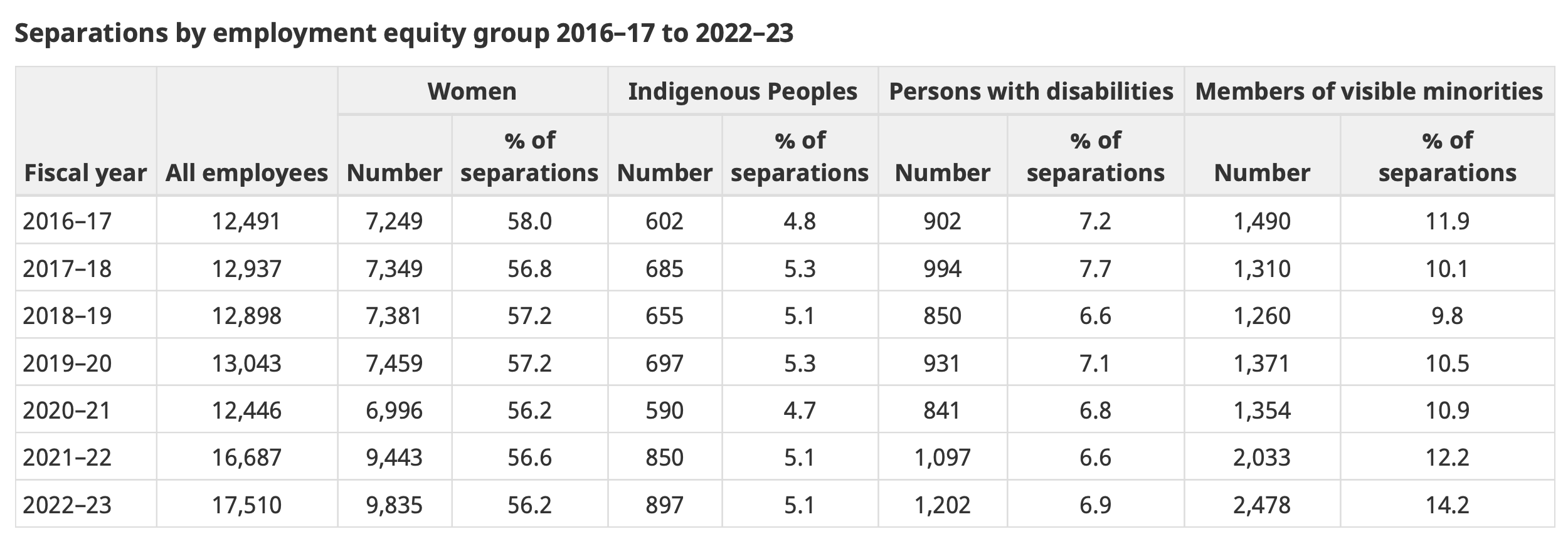
The Government’s proposed reduction in the public service by 5,000 public servants over four years (1,250 per year) is meaningless as the 2022-22 EE report shows annual separations more than 10 times that:
One thought that crossed my mind while browsing this close to 40 page document is whether this level of detail and effort would survive a change in government. Unlikely IMO, given the pressure to reduce spending and the CPC general aversion to excessive employment equity reporting and measures.
Source: Budget 2024, Statement on Gender Equality, Diversity, and Inclusion
 About Andrew
 Multicultural Meanderings