Do you know what Canadians think about immigration?
2023/11/10 Leave a comment
Nice breakdown on relative immigration category priorities and related analysis:
If you follow the news, you’ll have seen coverage of our new report on attitudes toward immigration in Canada. Our Focus Canada survey (in partnership with Century Initiative) included a wider range of questions than most – not all of which could fit into the initial coverage. Here’s one that should not get overlooked.
For the first time,* this year’s survey asked about six different categories of immigration as follows:
Each year, Canada accepts immigrants under different categories. Please tell me whether you personally believe the government should place a high priority, a medium priority or a low priority on accepting each of the following categories of immigrants?
Here are the overall results:
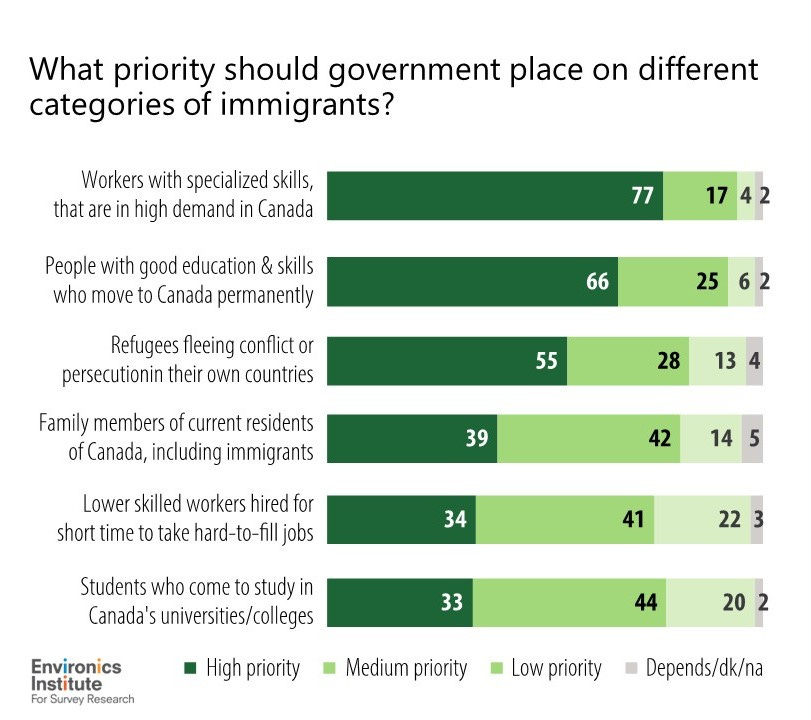
The public is most likely to prioritize skilled workers (whether those with specialized skills in high demand, or new permanent residents arriving with a good education). This may not seem surprising, but that’s precisely the point: it’s now widely accepted that our economy needs more skilled workers than we can produce at home. Theoretically, it would have been possible for people to see highly skilled immigrants as rivals who threaten to take away the best jobs from Canadian-born workers. But this is not the case. This type of immigration is seen as a win-win and not a zero-sum scenario.
The next striking finding is that refugees are fairly high up on the list of top priorities (while not quite as popular as skilled immigrants, a majority of Canadians say that accepting refugees should be a high priority). It remains the case that many Canadians continue to value the humanitarian goals of our immigration system, and not just the economic ones.
Next comes family reunification. It’s worth noting that there is a significant gender gap on both this item and the previous one about refugees. Women are significantly more likely than men to say that the government should place a high priority on bringing in family members of current residents, and accepting refugees.
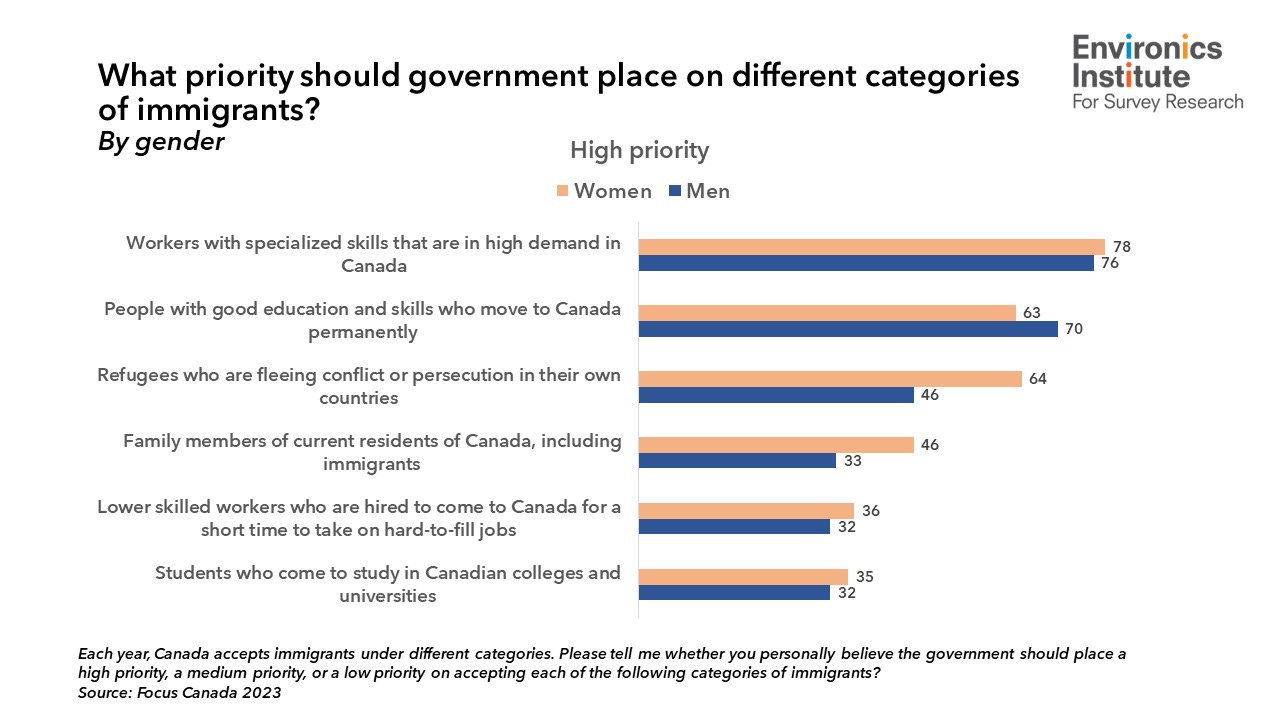
Last on the list of high priorities are two types of temporary immigrants: lower-skilled workers and students – something that’s notable at a time when these categories are the ones that have seen the most unexpected increases. Personally, I was surprised to see international students at the bottom of the list; I wonder if the heads of universities and colleges are too.
So much for the high priorities; it’s just as interesting the look at the results the other way around. Relatively few Canadians think any of these six types of immigrants should actually be a low priority. The highest figures come in the cases of lower skilled temporary workers (22%) and students (20%) – but even here, only about one in five say the government should place a low priority on accepting these categories of immigrants.
The continuing openness of Canadians to immigration becomes even more apparent if we count up how many of each of the six categories mentioned in the survey are seen as high or low priorities. The count of high priorities has a nice normal distribution: most people are in the middle (66% name two, three or four high priority types of immigrant) and relatively few people are at either end of the spectrum (16% name zero or one high priorities, and 17% name five or six).
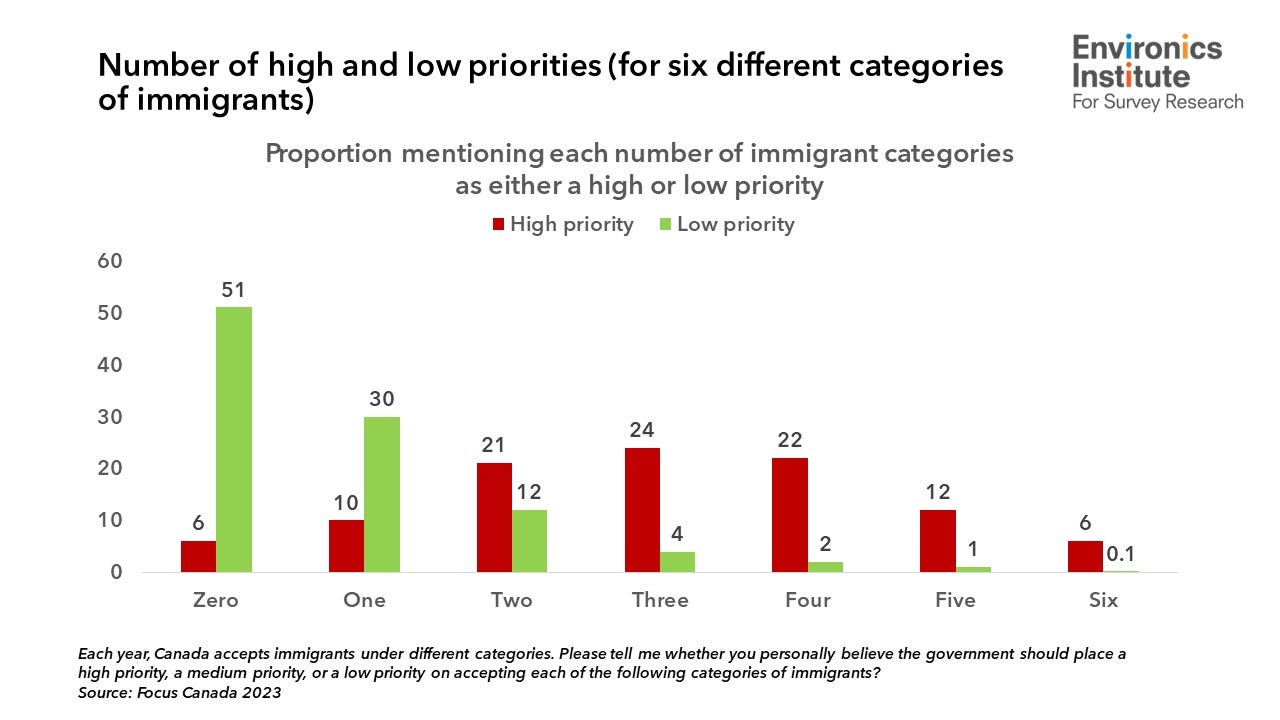
The picture is very different when we count low priorities. One in two Canadians do not answer “low priority” for any of the six categories of immigrant. Four in five (81%) name no more than one. Only three percent list at least four of the six categories as low priorities. In a survey of 2,002 Canadians, a grand total of three people (0.1%) think all six categories should be a low priority for the government.
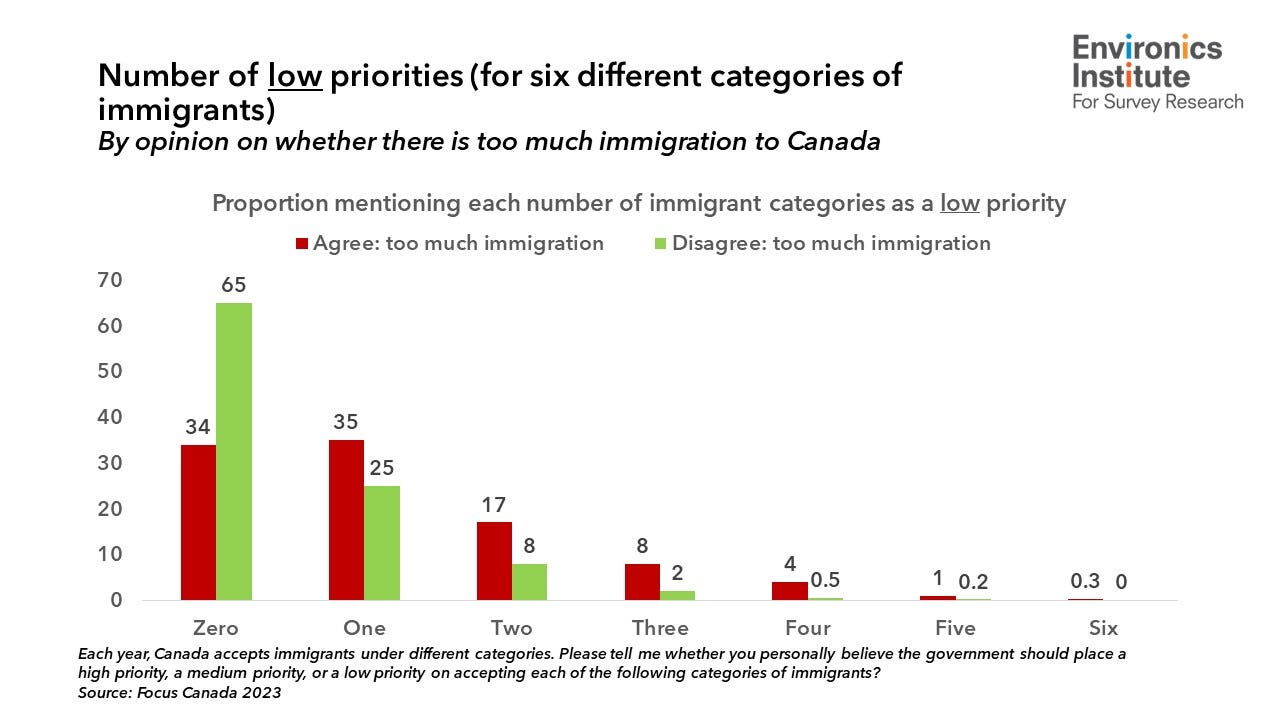
This is important context for interpreting the main headline from the survey, which is that there has been a big jump in the past year in the proportion of Canadians who agree there is currently too much immigration (from 27% in 2022 to 44% in 2023). This is certainly an expression of anxiety about the current state of the economy in general, and housing availability and affordability in particular. But it’s not an expression of growing opposition to the idea of Canada as a country that welcomes immigrants.
To back up this interpretation, consider the following additional findings:
- First, a majority of those who agree that there is too much immigration to Canada nonetheless say that the government should place a highpriority on accepting each of the two categories of skilled immigrants mentioned in the survey.

- Second, and more generally, 91 percent of those who agree that there is too much immigration to Canada nonetheless say that the government should place a high priority on accepting at least one of the six categories of immigrants mentioned in the survey.
- Finally, only 14 percent of those who agree that there is too much immigration to Canada say that the government should place a lowpriority on accepting at least three of the six categories of immigrants mentioned in the survey.
In other words, while a lot of Canadians have concerns about the details of current immigrant policy, very few think it’s time to raise the drawbridge.
Source: Do you know what Canadians think about immigration?
 About Andrew
 Multicultural Meanderings