Griffith: Canada badly needs an immigration reset 

My latest, hoping to provoke a more concrete discussion on what a reset needs and what it would mean:

The government has largely ignored the impact of high levels of immigration on housing availability and affordability, health care and infrastructure. Belated recognition that current policies are not working to the benefit of all Canadians may be the reason behind the appointment of a new minister of Immigration, Marc Miller, and the reassignment of  the former minister of Immigration, Sean Fraser, to housing and infrastructure.

Minister Fraser arguably will have to deal with some of the mess he and the government created with the large increases in both permanent and temporary residents, pushing up housing costs and burdening existing infrastructure. Minister Miller will likely be more attuned to concerns about immigration given that he is from Quebec and thus more familiar with immigration critiques regarding the demographic impact on Quebec.

Moreover, the nature of conversations has changed. When, some two years ago I wrote an article for Policy Options entitled Increasing immigration to boost population? Not so fast, there were few voices questioning the government’s planned expansion of immigration. Now, there are almost weekly commentaries and reports, ranging from the banks to economists, the International Monetary Fund and others, noting deteriorating productivity, housing availability and affordability, stress on health care and infrastructure. Even the major boosters of increased immigration have shifted their messaging to “growing well” or even calling for a pause in increases.

While immigration is not solely responsible for the increase in housing costs, the link is being seen and could lead to newcomers being the scapegoats for poor policy decisions. The significant drop in support for the Liberal government may reflect this very personal issue to Canadians.

While at Immigration, Fraser was able to increase levels easily, whereas as housing and infrastructure minister, he will be confronted with the real time lags, making it impossible to show concrete results before the 2025 election. So it’s not a matter of “better communications” but rather of complex delivery with a wide range of government and private sector actors.

Miller, depending on his mandate letter, has an opportunity to reset or at least adjust  immigration policies and programs to take account of recent commentary and realities. He will not be able to ignore these issues even if his initial comments confirm planned increases. The annual plan on the number of immigrants this fall provides an opportunity for a reset should the government choose to do so.

Given that a complete pivot to a more evidence-based approach is unlikely, here are some modest suggestions that make sense from an immigration and economic perspective that may be politically sellable.

To start with, the plan should be broadened to include plans for temporary residents levels rather than just permanent residents levels, given that some 60 per cent of all new residents are temporary workers and students, many of whom transition to permanent residency.

Given time lags in building housing, increasing the capacity of the health-care system and addressing infrastructure gaps, the government should freeze 2023 levels of 465,000 for the next few years. More ambitiously, the government could reduce future levels to the lower 2024 range of 410,000.

The current open-ended levels on temporary residents (students and workers) should be replaced by hard ranges based on 2023 levels for similar reasons. Furthermore, the government needs to consider seriously the introduction of a cap-and-trade system for temporary residents to reduce the numbers over time to address weak productivity, as the University of Waterloo’s Mikal Skuterud has suggested.

Lastly, the government needs to take steps to further broaden the plan to include the impacts of immigration on housing, health care and infrastructure, including measures to address these impacts, rather than as a discrete program.

Miller’s mandate letter will indicate the extent to which this is possible. But these changes would not necessarily be perceived as divisive or xenophobic given that the impacts on housing, health care and infrastructure affect everyone, immigrants and Canadian-born alike. Failure to pivot to a more comprehensive approach that incorporates these considerations into immigration programs will not only worsen the quality of lives of Canadians but may prove politically damaging to a government long-in-the-tooth and losing popular support.
Source: Griffith: Canada badly needs an immigration reset

Veal: Amid Canada’s housing crisis, immigration needs to be slower, more focused 

Yet more questioning:

High expected immigration is the main reason that Canada’s total output will likely increase by 1.5 per cent annually in 2023 and 2024, according to the headline numbers from the International Monetary Fund World Economic Outlook. That would be the highest in the Group of Seven.

But that document also includes the predicted changes in output per person. That is a better measure of the change in the average standard of living, as it adjusts for Canada’s high population growth. The 2023 and 2024 predictions for the country are –0.6 and 0.1, a cumulative decrease over the two years. That’s the worst performance in the G7.

Part of this has to do with the lack of investment to complement the inflow of people. The most obvious symptom is Canada’s housing crisis.

The writer, Max Frisch, famously commented on European guest worker immigration: “We wanted workers, but people came.” People need homes, and Canada doesn’t have enough of them – even for its resident population. The high prices from the resultant high demand weigh heavily on the economy. While we wait for housing progress, this country needs slower and more focused immigration.

Immigration in general can be good for the economy. The fact that per capita GDP is expected to decline amid heavy immigration doesn’t mean that those already in Canada will on average be worse off; a good part of the reduction in that metric is due to low-income migrants bringing down the average.

Many of us already here will likely be made better off through the contributions of the newcomers. This is particularly clear in the caring and agricultural sectors. And in the long-term, while it is less clear at higher levels, immigration may bring important macroeconomic advantages. Immigrants can bring new ideas and entrepreneurship.

Moreover, Desjardins economist Randall Bartlett finds that these very high rates of immigration are the only way to prevent large increases in the proportion of the population that is 65 and over. Permanent immigrant families will also help share the national debt, especially as they experience increases in productivity and income.

But, as experts such as Mr. Bartlett have pointed out, high immigration is only sustainable if something can be done about housing, and this is not easy.

In the short term, the housing crisis cannot be solved – it can only be mitigated. Building new housing takes time. In the meantime, reducing immigration temporarily to prepandemic levels would help. Those levels would still provide ample room for home construction workers if necessary, as well as other high-skilled workers in strategic areas.

In principle, the current permanent immigration target could still be met with the reductions coming from the temporary side. For example, the student visa program could be limited with allocations used to incentivize educational institutions and their municipalities to do more on housing.

In the medium term, a solution requires more than doubling the inflow of housing units – Herculean even without the headwind of higher interest rates. It is no coincidence that federal cabinet minister Sean Fraser was recently shuffled from the immigration portfolio to housing.

But it is a three-levels-of-government problem, and municipalities do not face the same urgency from the aging population. In communities where most voters own rather than rent housing, the net political pressures may be against permitting increases in housing supply that might dampen housing prices.

Broader resistance to increased immigration will almost surely come. The brunt of unaffordable rents is borne by those with lower incomes. These are largely the same individuals who may be losing out on the higher wages, the greater flexibility in work arrangements, and the benefits of productivity-increasing capital and training that employers might turn to were there not the alternative options of hiring recent immigrants or accessing the Temporary Foreign Worker program.

But none of this is the fault of those who move here, and nothing changes the ultimate economic benefits of immigration. Canada must cherish immigrants, helping them settle as much as possible – but we need some breathing space to be able to do so properly.

Michael Veall is a professor of economics at McMaster University.

Source: Amid Canada’s housing crisis, immigration needs to be slower, more focused

New temporary foreign worker pilot program to speed up approvals for some employers

Good critical comments by Banerjee and Skuterud regarding possible abuse and the ongoing favouring of reduced labour costs to employers. That being said, for repeat users, simplification has merit but as in so many areas of immigration policy, these change fail to address the immigration-related challenges of housing, healthcare and infrastructure:

The federal government is making it easier for businesses to bring temporary foreign workers into Canada, announcing a new “recognized employer” program aimed at speeding up the approval process for companies with a track record of using foreign labour.

The three-year pilot program is designed to reduce the amount of paperwork companies need to submit to justify bringing in outside workers.

It’s the latest expansion of the temporary foreign worker (TFW) program, whose use has exploded over the past year as the federal government has eased restrictions on short-term foreign labour. And it comes alongside a record surge in immigration, which is increasing the country’s labour supply but also adding demand to Canada’s overheated housing market and public services.

Randy Boissonnault, the new Minister of Employment, Workforce Development and Official Languages, said the change to the TFW program would “cut red tape” and help companies manage widespread labour shortages.

The move was applauded by the Canadian Chamber of Commerce, which has long lobbied for a trusted employer carveout in the TFW program.

Some labour economists, however, warned that further expansion of the program could undercut wages in Canada and make it more difficult to identify companies that are exploiting vulnerable workers.

“It could be a good thing for addressing kinds of critical labour shortages,” said Rupa Banerjee, the Canada Research Chair in economic inclusion, employment and entrepreneurship of Canada’s immigrants at Toronto Metropolitan University.

“But if this kind of a system is not really closely monitored, scrutinized, audited, it’s easy for sort of mundane and everyday examples of abuse and exploitation to kind of become even more rampant in the system,” she said.

As it stands, companies need to submit a Labour Market Impact Assessment (LMIA) before applying to hire temporary foreign workers. The purpose of the LMIA is to show that there are no Canadians or permanent residents who are able to fill the job.

Under the new system, employers who can demonstrate “a history of complying with program requirements” will be given a three-year approval to bring in temporary foreign workers, and won’t have to submit an LMIA before each application. Eligible employers will need to have had three successful LMIAs in the past five years for workers who are deemed to be “in-shortage,” and will be subject to a “more rigorous upfront assessment,” the government said in a news release.

The pilot program will be open to agriculture businesses in September and employers from all other industries starting in January.

This is the second notable change to the TFW program in just over a year. Last spring, the federal government said companies could hire up to 20 per cent of their staff through the program’s low-wage stream, up from the previous 10-per-cent cap. And in seven industries with acute labour shortages – such as restaurants, construction and hospitals – the cap was moved to 30 per cent for a year, then extended to this fall.

The TFW program is largely used as a recruitment tool for farm workers. During the first quarter of this year, employers were approved to hire more than 25,000 workers through agriculture streams, according to figures published by Employment and Social Development Canada, which decides on LMIA applications. General farm workers are easily the most sought-after role in the TFW program, with more than 22,000 approved positions in the first quarter.

But as Ottawa has eased access to foreign labour, employers have ramped up their recruitment of low-wage employees from abroad. Companies were approved to fill about 22,000 roles through the program’s low-wage stream in the first quarter, an increase of about 275 per cent from four years earlier. Cooks are the No. 2 occupation of highest demand, with nearly 3,000 positions approved from January through March. Truck drivers, food counter attendants and seafood plant workers are also in high demand.

Diana Palmerin-Velasco, senior director of the future of work at the Canadian Chamber of Commerce, welcomed the announcement and said it could improve access to the TFW program for smaller employers.

“There are whole sectors of the economy that are dependent on temporary foreign workers,” Ms. Palmerin-Velasco said. “What we have heard from our members is that it’s not that easy for employers. There is a lot of administrative burden, it can be a very complex application process. And when we think about small businesses, it’s not really accessible.”

Mikal Skuterud, an economics professor at the University of Waterloo, questioned the government’s rationale for expanding the program. The Canadian labour market has been exceptionally tight over the past year-and-a-half, as demand for workers has outstripped supply. However, in recent months, job vacancies have been trending down and the unemployment rate has risen.

“We’ve had a 25-per-cent reduction in job vacancies since May, 2022, and if you measure labour market tightness, that’s also been dropping,” Prof. Skuterud said.

He added that recent research into temporary foreign workers suggests that they tend to suppress wage growth within companies that use them. “And so we’re going through a period where real wages for low skilled workers in this country are not increasing. The most recent data looks like they’re decreasing. And so it’s all about where this government’s priorities are,” he said.

Source: New temporary foreign worker pilot program to speed up approvals for some employers

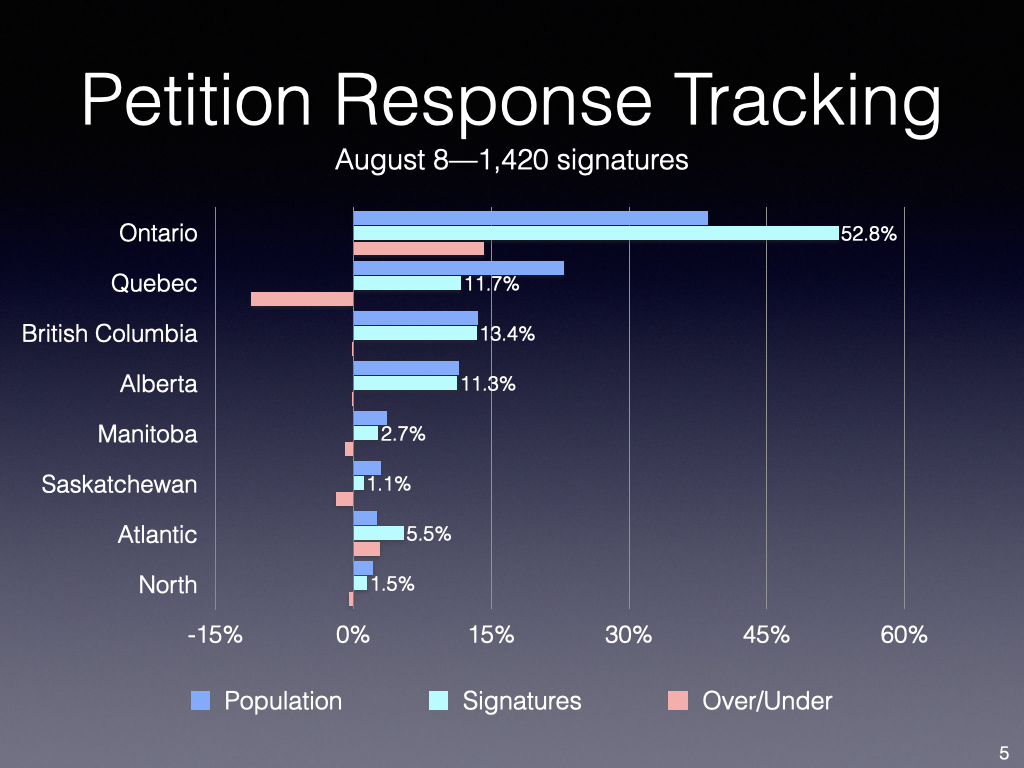
Petition e-4511 – Opposing self-affirmation of the #citizenship oath “citizenship on a click” – Signatures to August 8

The chart below breaks down the 1,420 signatures as of 8 August by province. No major changes by province although Nova Scotia had the highest weekly increase of over 100 percent.

And if you haven’t yet considered signing the petition, the link is here: https://petitions.ourcommons.ca/en/Petition/Details?Petition=e-4511

William Watson: In 2023 is it possible to have a reasoned discussion of immigration?

Good commentary, but ducking the numbers question:

Marc Miller just finished five years as a federal minister working on Indigenous issues. Now, ironically, he’s minister of immigration, encouraging an influx of new Canadians many Indigenous Canadians think hasn’t served them so well.

He’s better off than the person he’s replacing, however, rising Liberal star Sean Fraser. After 21 months at immigration, Fraser is off to housing, infrastructure and communities to work on the big headaches caused for, ahem, housing, infrastructure and communities by the record number of immigrants he let in. It’s just desserts of a sort you don’t often see in politics — even if the prime minister’s recent disavowal of federal responsibility for housing, motivated more by hot-potato politics than respectful regard for the constitutional division of powers, may let Fraser off the sharpest of those three hooks.

Minister Miller says he’ll listen to arguments about whether current immigration targets are correct. The official target has been bumped up to 500,000 a year from 400,000, though in 2022 we hit 1.2 million — the only target Ottawa has bested in recent years.

But the minister will only listen so much. Attack lines are at the ready. As he said shortly after taking his new office: “In every wave of migration that Canada has had, there has been a segment of folks that have blamed immigrants for taking houses, taking jobs, you name it. Those are people that don’t necessarily have the best interest of immigrants at heart and we have to call that out when we see it and we won’t hesitate to do that.” No one who has watched the prime minister drive wedge after wedge into Canadian policy debates over the last eight years has the slightest doubt the Liberals will do that. People who would like to debate the immigration targets may well be anti-immigrant, Miller’s statement suggests, which is but one step of slippery logic away from the R-word: racis

In this day and age, of course, we never actually discuss a policy issue: we look for the slightest doctrinal misstep in our ideological adversaries’ arguments and pounce, self-righteously claiming the moral high ground while accusing our opponents of having fallen into an ethical ditch.

Immigration seems an area where informed and informative debate will be especially difficult. So kudos to TD Economics for recently issuing a short study of the issue: “Balancing Canada’s pop in population,” by Beata Caranci, James Orlando and Rishi Sondhi. At a time when big banks seem to specialize in serving up politically correct pablum, this piece raises hard questions about how desirable a big boost in immigration is.

Nobody opposes some level of immigration. The question is: how much? In theory, there is an optimal level where the benefits brought by the next new member of our society just offset the costs he or she imposes. In theory, both short-run and long-run costs and benefits can be considered. In theory, they can even be discounted by an appropriate interest rate. Policy should hit that sweet spot and not go beyond it.

In practice, the optimal level is very hard to calculate. People will disagree — perfectly reasonably — on what, and how big, the benefits and costs are, how they may change as more people come, and what the discount rate should be. (Do you know what interest rates will be 10 years from now?) On the whole, I think the TD Economics folks are too optimistic about our ability to discover this right “balance,” but they do us all a great service by describing some of the costs of high rates of immigration.

For instance, if the inflow stays high, we may need 500,000 more housing units (i.e., homes) over the next two years — which seems a task well beyond the capacity of our politico/builders/planners complex. As for health care, the OECD ranked us 31st among 34 member-countries in acute care hospital beds per capita in 2019 — and we’re rapidly raising the number of our capitas without commensurate increases in beds.

There’s also some doubt as to whether immigration is serving the econo-strategic purpose governments have laid out for it, which is to provide young, skilled and therefore high-earning labour that can pay enough taxes to finance the health care and retirement incomes of us older folk. But 40 per cent of people in the rapidly expanding temporary foreign worker program work in agriculture, forestry and fishing, and another 15 per cent in accommodation and food. Those are important jobs which, increasingly, people born here won’t do. But they aren’t the tax bonanzas we locals are looking for.

Immigration may even raise interest rates. Eventually it increases the economy’s capacity but in the short run it boosts demand, which is the last thing we need as we fight inflation. To make sure that doesn’t get out of control, the Bank of Canada may have to keep interest rates 50 basis points higher than if immigration rates were lower. Which hardly helps us build new housing or infrastructure.

Every one of those points is debatable, of course. So let’s have the debate. And don’t anyone use the R-word.

Source: William Watson: In 2023 is it possible to have a reasoned discussion of immigration?

Castel: La dimension géopolitique du cabinet Trudeau

Reasonable analysis:

Les observateurs s’entendent pour dire que le remaniement du Conseil des ministres fédéral par Justin Trudeau a occasionné un bouleversement majeur, l’ensemble de l’opération devant lancer un message économique. Or le plus extraordinaire, c’est de constater que le découpage de la représentativité sociale et géographique des nominations est resté quasi identique.

Nonobstant l’importance des portefeuilles, la question de la parité femmes/hommes ne se pose plus depuis 2015. Avec le remaniement de janvier 2021, on compte désormais cinq femmes parmi les dix ministres au sommet de l’ordre de préséance.

Ledit découpage fait aussi référence à la préoccupation qu’il y a, autant du côté du premier ministre que du côté des premiers intéressés, à ce que les régions se sentent adéquatement représentées. Certains choix comportent une forme de remerciement régional en même temps que des arrière-pensées électorales.

Le nombre de ministres par province est resté inchangé : l’Ontario en a 16 (41 %) ; le Québec, 11 (28 %), les provinces de l’Atlantique, 6 (15 %), la Colombie-Britannique, 4 (10 %) et les provinces des Prairies, 2 (5 %). Ces proportions, les mêmes que celles ayant suivi les élections de 2021, sont d’abord le reflet du poids démographique des provinces, mais elles sont aussi motivées par la préoccupation de solidifier les bases libérales locales dans des régions fragilisées depuis 2019 (Atlantique, Québec rural) tout en envoyant un message attractif aux régions historiquement rébarbatives, comme les Prairies ou le sud de l’Ontario rural.

La force du Parti libéral du Canada (PLC) réside dans les régions urbaines. C’est aussi sa faiblesse, puisque l’accès au gouvernement se gagne moins avec des votes qu’avec des sièges. Treize ministres proviennent de la grande région de Toronto, six de la région de Montréal et quatre de la région de Vancouver. Hormis un ministère torontois supplémentaire, le premier ministre garde le même nombre de ministres urbains, avec trois nominations pouvant être motivées par un souci de solidifier un siège menacé : Arif Virani à Toronto, Soraya Martinez Ferrada à Montréal et Jenna Sudds à Ottawa.

Suivant les élections de 2019, le PLC s’appuie sur une chaîne de quelques petits blocs ruraux et une série de zones urbaines isolées. Plusieurs ministres (Patty Hajdu, Marie-Claude Bibeau, Pascale St-Onge, François-Philippe Champagne) viennent de ces espaces stratégiques.

Depuis lors, une douzaine de francophones font partie du Conseil des ministres. Au Québec, la progression du Bloc québécois renforce l’importance de chaque poste ministériel en dehors de Montréal. Hors Québec, le jeu de chaise musicale est délicat, car chaque perte est souvent mal ressentie. C’était le cas pour Ginette Petitpas Taylor en novembre 2019 et c’est maintenant le cas pour Mona Fortier à Ottawa.

Cela dit, certains coups comptent double, car l’Ouest est représenté, depuis 2021, par Randy Boissonnault, un francophone militant d’Edmonton, et Dan Vandal, un Métis de Winnipeg, appelé au cabinet en 2019.

Sous les gouvernements Trudeau, trois Autochtones ont fait partie du Conseil des ministres. Si 10 des 18 députés autochtones ont été élus sous la bannière libérale, les élections de 2019 on fait du Nouveau Parti démocratique la force montante dans les régions boréales et nordiques ainsi que dans les régions de Winnipeg, d’Edmonton et de Vancouver, où des candidats autochtones se présentent.

La question de la diversité ethnique et religieuse est devenue incontournable, notamment à Toronto. À commencer par la vice-première ministre, on peut avancer qu’une quinzaine de ministres ont une origine ethnique autre que britannique ou française. Onze ministres (28 %) correspondent à l’un des groupes que Statistique Canada associe aux minorités visibles.

L’entrée ou la sortie de chaque personne au cabinet affecte l’ensemble d’un édifice déjà compliqué. Le premier ministre s’est sans doute rendu compte que, vu le nombre de paramètres à considérer, la seule façon de sortir de la quadrature du cercle passait par une augmentation du nombre de ministres. Ainsi les cabinets sont-ils passés de 31 à 37, puis à 39 membres, à chaque lendemain d’élections (2015, 2019, 2021). C’est le remaniement de juillet 2018 qui inaugure cette tendance, avec 35 membres.

De plus, à la fin du premier mandat de Justin Trudeau, le Québec et surtout l’Ontario ont gagné en influence, alors que les Prairies ont perdu des plumes, ce qui ne fut pas favorable aux élections de 2019. En n’allant pas chercher de ministre supplémentaire dans l’Ouest pour plutôt ajouter un ministre de Toronto, tout en faisant des changements stratégiques à Montréal et à Ottawa, le chef du Parti libéral du Canada donne l’impression qu’il pense aux prochaines élections, où il jouera défensif, pour recourir au langage sportif.

Source: La dimension géopolitique du cabinet Trudeau

He was given a Canadian passport by mistake — then went on a legal battle to keep it

Fortunately, common sense prevailed and the judge refused the request to “a proud Egyptian”. Poster child of a would be “Canadian of convenience”:

Nader Abdellatif certainly appeared to be a Canadian expat.

For 15 years, the executive with multinational corporations travelled with a Canadian passport. He would be invited to events and festivities hosted by Canadian missions in Cairo and Saudi Arabia. His residency documents and employment contracts in the Middle East listed him as Canadian.

But when Abdellatif applied to renew his passport in 2017, the Canadian government refused.

It told the 56-year-old that his passport had, in fact, been issued to him by mistake. Not once, not twice, but three times.

And so, Abdellatif began a fight for his Canadian passport and for his highly debatable claim to the country where he was born — and which he left, when he was two years old.

When Abdellatif was born in Ottawa in 1967, his father was the first secretary of Egypt’s embassy in Canada. The family left the country when Abdellatif was a toddler, and moved with subsequent diplomatic postings in Lebanon, Jordan, Sudan and the Netherlands.

Abdellatif later returned to Egypt for university but was able to keep his Egyptian diplomatic passport until he was around 26.

“To be honest, I can’t claim that I considered myself Canadian. However, I was proud that I was born in Canada, and I always flaunted it by virtue of saying ‘I’m Canadian,’ taunting my brother and friends,” he told the Star with a chuckle.

“It was always special to me, because I was born there. It’s attached in my birth certificate,” he said. “I always have that connection with Canada.”

But he wasn’t, actually, Canadian.

It’s true that under Canada’s Citizenship Act, all babies — including those of non-residents such as refugees, undocumented migrants and foreign students and workers — born on Canadian soil are automatically granted citizenship.

But there is an exception for children of foreign diplomats who are born in Canada. They don’t get automatic citizenship. And passport rules stipulate that only Canadian citizens are eligible for Canadian passports.

Abdellatif wrongly thought that, by virtue of his birth, he was entitled to Canadian citizenship and passport, and that he hadn’t been given one only because his father had been an active diplomat.

Around 1993, he no longer had an Egyptian diplomatic passport, he said, and figured Canada might reconsider.

Abdellatif said the status of his Canadian citizenship had never been clear to him. At the back of his mind, he said, it had been something he wanted to explore, but he had been busy with his career and looking after his father, who battled cancer and died in 1997.

In June 2003, Abdellatif decided to apply for a passport at the Canadian embassy in Cairo with a Canadian document he did have — his birth certificate.

“I said, ‘OK, let me go to the embassy and apply.’ And that’s what I did. And, lo and behold, I got it.”

Why the issue with Abdellatif’s passport bid was immediately spotted, isn’t clear. And there were — quite clearly, in retrospect — signs that things weren’t quite right.

A few months after submitting his own application, he had applied for Canadian citizenship certificates for his two sons, both of whom were born outside of Canada. His boys’ applications were subsequently refused on the grounds that Abdellatif was not a Canadian citizen.

Abdellatif said he was confused. He said he presumed he was still a Canadian citizen on the basis that he had been able to acquire his original passport. He would subsequently and successfully renew it at the Canadian consulate in Dubai twice, in 2008 and 2013.

At one point, while relocating for a new job, he even travelled to Canada briefly to apply for his residence permit from the United Arab Emirates embassy in Ottawa.

“They gave (the passport) to me legitimately. I lived with it for five years. I went to Canada. I came out of Canada. I renewed it and lived with it for five years. I renewed it again,” said Abdellatif. “It did not cross my mind that something was wrong or that it was an error.”

In December 2013, Abdellatif again applied for his sons’ Canadian citizenship certificates, in which he declared his father was employed by a foreign government at the time of his birth in Canada. It was refused two years later. Officials said he was ineligible for citizenship by birth due to his father’s diplomatic status.

It wasn’t until late 2017, when Canadian authorities refused Abdellatif’s own passport renewal on the basis that he was not a Canadian citizen that he decided to seek clarity about his eligibility to citizenship.

After years of petitioning immigration officials and politicians to look into his case, Abdellatif turned to the immigration minister, asking him in 2021 to use his discretionary power to grant him Canadian citizenship, a request that was refused last year.

In April, Abdellatif challenged the minister’s decision before Canada’s Federal Court.

His lawyer John Rokakis said: “There’s a provision for special hardship. The government kind of created this special and unusual situation for my client by giving him three passports in the past, even though they were in error. He relied on them and got positions overseas based on the fact that he had these passports.”

The case, said Rokakis, raises the question of whether the federal government should grant citizenship to children born to foreign diplomats in Canada after their diplomatic immunity expires.

It also raises questions about the oversight of passport granting abroad.

“I really don’t know how he got them. Neither did (the Department of) Justice, nor the judge,” Rokakis said.

“All three of us were a little perplexed how this happened.”

In a court submission, Abdellatif argued he built his career as a “Canadian Egyptian” executive on the strength of his belief that he was Canadian, because he was issued a passport.

A proud Egyptian, Abdellatif said his Canadian connection did give him an edge in life, and the refusal of his citizenship application harmed his reputation, professional opportunities and “social status.”

“Canada is at a different perception level and status than Egypt. As I mentioned, in my career, in my contract, in my country status, in my travel and mobility and ability to jump over to the U.S., to Europe for executive meetings,” said Abdellatif, “all these became inhibited.”

However, there were yet more strikes against his bid to become a belated Canadian.

Government records showed Abdellatif’s father had once made an inquiry about his citizenship status in 1981, through the Canadian ambassador in Sudan, where he was serving on the Egyptian mission at the time.

The information that Abdellatif was not eligible for Canadian citizenship or a Canadian passport was relayed to the family then, according to the Federal Court.

Abdellatif told the Star that his father had never told him that, and passed away before Abdellatif’s endeavour to acquire Canadian status.

The court said Canadian officials had informed him in writing in 2007, 2015 and 2017 that he was not a citizen by virtue of birth but he did not challenge those decisions. Instead, it pointed out, he chose to apply for a discretionary grant of citizenship.

It didn’t help, according to immigration officials in their submission, that Abdellatif never worked, lived or paid income taxes in Canada after age two.

“The administrative error which resulted in the Applicant being issued a Canadian passport three times does not create citizenship nor does it have any binding effect if the underlying legislative requirements are not met,” Justice E. Susan Elliott ruled in July in dismissing the case.

Abdellatif said he was disappointed but respected the court decision, and may one day return to Canada.

After all, his two sons have now graduated here as international students.

“I always teased my (older) brother that I was Canadian and he’s not,” Abdellatif said. “He’s American now by living there and I dropped this one. So the table is turned.”

Source: He was given a Canadian passport by mistake — then went on a legal battle to keep it

Gee: Let’s not rename Dundas Street after all

Yep. Waste of $$ with no material effect on removing barriers or improving inclusion:

“The City of Toronto is broke,” its new mayor, Olivia Chow, said last month, turning her pocket inside out theatrically to show there was nothing in it.

She is not far off. City hall is a staggering $1.5-billion short of what it needs to keep the town running for the next two years. Naturally, it is looking around for ways to save money. One obvious way presents itself. It could reverse a costly and misguided decision to rename a major street.

Dundas Street spans the city core, linking the east and west ends. It crosses the Don Valley, passes the Eaton Centre and travels through Chinatown, extending all the way into the suburban city of Mississauga.

It is one of the city’s oldest and best-known thoroughfares. The first governor of Upper Canada, John Graves Simcoe, started building it in the late 18th century for military purposes. He named the road after the man who appointed him, Henry Dundas, a powerful Scottish politician who held leading posts in the British government.

Until recently, most Torontonians had no idea who Dundas even was. But during the global reckoning with racism that followed the killing of George Floyd by Minneapolis police, a petition circulated calling for Dundas Street to be renamed. Advocates said Dundas was instrumental in delaying Great Britain’s decision to abolish the transatlantic slave trade. Two years ago, city council voted 17-7 to strip his name not only from the street but from other city assets such as Yonge-Dundas Square.

Now is a good time to revisit the decision. If Toronto wants to acknowledge the sins of the past, there are better ways than toppling statues and erasing names. One is to teach young people about shameful episodes such as the establishment of residential schools. Another is to honour pioneers in the fields of racial and social justice by naming streets, schools or parks after them. Yet another is to put up educational plaques acknowledging the misdeeds of the city’s early leaders.

Dundas, who never so much as visited Toronto, is not one of those. The case against him was murky to begin with. His critics say that in 1792 he delayed the abolition of the slave trade by proposing a parliamentary amendment that added the word “gradually” to a motion saying it should be ended.

His defenders say that was merely a tactical move to get an abolition bill of some kind through the House of Commons and smooth the path for a final decision to end the trade. The fact that the House of Lords was opposed to abolition and that Britain was fixated on its war with revolutionary France were much bigger factors in the delay.

They also point out that, earlier in his career, when he was Lord Advocate of Scotland, Dundas helped argue the case of Joseph Knight, who fought in court for his freedom from the plantation owner who had brought him to Scotland from Jamaica.

If Toronto erases a historic street name on the basis of such mixed evidence, then it is open season. Its downtown is positively littered with names from its past as a distant outpost of the British Empire. City staff identified about 60 streets named after figures “that are no longer considered to be reflective of the city’s contemporary values,” among them “at least 12 streets named after slave owners.”

A city report in 2021 said erasing Dundas’s name alone would mean, among many other things, replacing 730 street signs, changing 129 signs and 35 info pillars in the city’s wayfinding system and renaming three parks and two subway stations.

That is not to mention the hassle for the 97,000 residents and 4,500 businesses on the street. Sixty of those businesses have Dundas in their names.

The latest estimate of the cost is $8.6-million, no trifle at a time when the city is striving to find the money for things such as housing the homeless. Veteran city councillor Shelley Carroll told a local radio station that, simply put, “we don’t have the money to do it right now,” and she is one of those who voted for the change two years back.

Yet Ms. Chow – she of the empty pocket – is saying she wants to push ahead. She should think again.

Source: Let’s not rename Dundas Street after all

Canada’s visa officers abroad to get anti-racism training amid allegations of discrimination

Look forward to seeing evaluations and whether or not a change in the public service employee survey occurs. Interesting, but not surprising, that Conservative immigration critic raised the issue as part of the apparent overall strategy of focussing on the administration of the immigration program:

Staff working in Canada’s visa posts abroad are to be given anti-racism training amid concerns that some local employees hired by the federal government are discriminating against Black people and members of other minorities and religious groups applying to come to this country

Immigration, Refugees and Citizenship Canada says staff processing visa applications in embassies and high commissions around the world will need to take anti-racism and diversity courses, as members of Parliament continue to raise the alarm that local employees’ personal prejudices may be influencing Canadian visa decisions.

As part of an initiative unfolding globally, IRCC told The Globe and Mail that in April this year it started requiring its employees in Canada’s High Commission in South Africa – including local staff employed to process Canadian visa and permanent residence applications – to take anti-racism and diversity training.

MPs have highlighted complaints from immigration consultants and applicants that South African IRCC employees processing visas in Pretoria may be discriminating against non-white applicants who want to visit and live in Canada.

One Canadian immigration consultant with clients living in South Africa told The Globe that in their experience, Black applicants – particularly Black women – faced higher refusal rates, and more questions and obstacles and delays than white clients. The Globe is not identifying the individual because they feared it would lead to their clients being discriminated against.

They said white South African staff in Canada’s Pretoria visa office tended to be quick to approve applications from white people wanting to come to Canada and often gave them a chance to correct files with errors in them. He said files of his Black applicants with any mistakes tended to face higher rates of rejection.

The consultant said applications they had made on behalf of non-white clients had a 50/50 chance of approval, with local staff looking for any reason to refuse them.

Conservative immigration critic Tom Kmiec said local prejudices were not just a problem in sub-Saharan Africa but in locally staffed visa sections of embassies in Turkey and the Middle East.

He said Ottawa should consider sending Canadian staff on rotation to work in visa posts abroad to replace local staff, or send the completed digital applications to Canada for final decisions to ensure fairness.

Canadian visa offices based in embassies and high commissions abroad run by the Immigration Department (IRCC), employ both Canadian and local staff. Canadian immigration officials oversee local employees and decision-making, but day-to-day processing of applications for those wanting to come to Canada is often done by staff from the country where the visa office is based.

Mr. Kmiec said he had seen cases from Turkey and the Middle East of minorities, including Kurds, Armenians, Chaldean Christians, Druze and Zoroastrians, facing steep refusal rates and a higher bar than other applicants.

“I have heard stories upon stories from people being denied visa applications – some of them are mortifying stories of people being denied visa applications where it was very evident they should get them,” he said. “Some of the rejections were very quick, like they barely had time to consider the applications. The department has a problem with racism both on the staff level and towards applicants as well.”

The Canadian immigration consultant also gave examples of non-white clients living in South Africa, but originating from other countries, who faced obstacles in Pretoria – including highly qualified professionals with jobs in Canada.

The consultant believed Canada had delegated visa decision-making authority to local white South Africans who had been in the visa section for too long. They said only Canadians should be signing off on visas in Pretoria.

Toronto MP Kevin Vuong, who has been highlighting immigration issues including homeless asylum seekers camping on the street in his constituency, has raised the issue of South Africa’s visa section three times in Parliament, and says he plans to continue pursuing it.

He said that among the non-white applicants who faced holdups by local staff in Pretoria was a surgeon with a job in Canada who had been vetted and approved by a Canadian health authority.

“This is unconscionable. Canadians are proud of our history of helping to end apartheid, we must ensure we live up to that legacy and our aspiration to be a truly inclusive country,” he said.

The House of Commons immigration committee highlighted examples of unfairness in immigration decisions in a report last year. In its response earlier this year, the IRCC said it needs to address “embedded systemic racism and other inequities within the Canadian immigration system.” It said its anti-racism strategy addresses unconscious bias and discrimination in decision making.

“The department agrees in principle that concrete steps need to be undertaken to increase diversity amongst locally engaged staff,” the IRCC response said.

The IRCC told The Globe in a statement that it upholds the “same standards and values of anti-racism, whether we are Canadians or locally hired staff” and anti-racism (AR) and diversity, equality and inclusion (DEI) training was held in Pretoria in April, 2023 “as part of IRCC’s anti-racism commitments.”

“As part of our anti-racism work, we also identify and address any sources of bias that might create barriers or unfairness in our procedures and processes,” it said, adding: “All overseas offices will be engaging in AR and DEI training.”

Source: Canada’s visa officers abroad to get anti-racism training amid allegations of discrimination

Myles: Le débat reste à faire

Good column noting the need for a discussion on immigration levels and their impact on housing etc. And that it is encouraging that this debate is possible without falling into xenophobic tropes:

D’abord confinée aux marges du débat politique, la décision unilatérale du gouvernement Trudeau d’accueillir 500 000 immigrants par année commence enfin à soulever des questions pressantes.

Depuis quelques semaines, les médias du Canada anglais se questionnent sur les capacités d’accueil du Canada. C’est tout un contraste avec la situation qui prévalait l’automne dernier, lorsque le premier ministre, Justin Trudeau, a annoncé son intention d’ouvrir les vannes à l’immigration à compter de 2025. Les premiers ministres des provinces, préoccupés par le vieillissement de la population et la pénurie de main-d’oeuvre, n’avaient rien trouvé à redire. Seul le premier ministre du Québec, François Legault, s’était inscrit en faux contre cette politique fédérale qui aurait mérité un débat public beaucoup plus exhaustif compte tenu de son ampleur.

Dans un entretien à La Presse, le chef du Bloc québécois, Yves-François Blanchet, a pris un malin plaisir à souligner ce revirement. En mai, le Bloc a présenté une motion critique des cibles en raison de leur impact sur le poids du français, le logement et les services publics déjà exsangues. Malgré l’appui des conservateurs, la motion a été rejetée sans ménagement par le couple libéral-néodémocrate. « Ce débat en soi est une excellente nouvelle. Jusqu’à tout récemment, c’était facile. On disait que les Québécois étaient des racistes, contre l’immigration, et que le Canada était un gentil pays d’accueil multiculturaliste. C’était simple de même », a ironisé M. Blanchet.

Mais voilà que la coupe est pleine avant même d’avoir enclenché la marche vers l’accueil d’un demi-million d’immigrants par année. La crise du logement, largement documentée dans Le Devoir, s’empare de toutes les grandes villes et même des villes intermédiaires du pays. À Toronto, la nouvelle mairesse, Olivia Chow, a lancé un cri d’alarme sitôt entrée en fonction. Il n’y a plus de place pour loger les migrants, à telle enseigne qu’ils occupent près du tiers des lits dans les refuges pour sans-abri.

La pénurie de logements est sans contredit le principal écueil de la politique fédérale, mais il y en a d’autres. Dans un rapport récent, la Banque TD prédit que la forte hausse de l’immigration entraînera un manque à gagner de 500 000 logements dès 2025, en plus d’exercer une pression sur les taux d’intérêt, la prestation des services publics et les infrastructures. Le Canada se classe au 31e rang sur 34 pour le nombre de lits d’hôpital par habitant en soins de courte durée. Rien ne laisse présager qu’une amélioration du bilan est à l’horizon.

Voilà donc une occasion inespérée de débattre des capacités d’accueil du Canada sans se faire taxer de sombres desseins ou de xénophobie rampante. Ce pays, de même que le Québec, est promis à des défis considérables. Au Canada, près de 19,5 % de la population a 65 ans et plus, comparativement à 20,5 % au Québec. En 2030, la cohorte des 65 ans et plus passera à 23 % de la population au Canada et à 25 % au Québec.

L’immigration n’est pourtant pas une panacée. Chiffres à l’appui, notre chroniqueur Gérard Bérubé expliquait récemment que « l’immigration débridée n’est qu’un remède temporaire à la pénurie de main-d’oeuvre et qu’un contre-pied parmi d’autres au vieillissement de la population ».

La politique libérale masque un problème de fond. La croissance de la population dope le PIB en général, mais si on s’attarde au PIB réel par habitant, qui permet de mesurer le niveau de vie, le Canada arrive dernier parmi les membres de l’Organisation de coopération et de développement économiques (OCDE). La productivité, sujet tabou s’il en est, n’est tout simplement pas au rendez-vous depuis 2014. Sans un redressement de cet indicateur, nous ne pourrons espérer que le bien-être économique des Canadiens s’améliorera par une stratégie misant sur la croissance démographique.

Bien sûr, l’immigration est un apport considérable pour la diversité et la vitalité du Canada et du Québec. Les sociétés monolithiques, réelles ou fantasmées, qui sont basées sur la recherche de mythes fondateurs et de valeurs consensuelles, offrent un spectacle d’une plate grisaille.

Il faut avoir la force de débattre des seuils d’immigration, sereinement, et demander au gouvernement fédéral de refaire ses calculs en fonction des capacités réelles d’accueil, et non des promesses électoralistes qui ont peu de chance de se matérialiser en matière de bonification de l’offre de logements et d’amélioration des services publics.

Pour le Québec, le défi est double. Il faut miser sur des politiques et des leviers d’intégration des nouveaux arrivants au fait français, en leur tendant la main au lieu de les stigmatiser. Et trouver une façon de préserver le poids démographique du Québec dans la Confédération sans le déposséder de ses attributs de gardien du fait français en terre d’Amérique. Les deux objectifs sont compatibles, mais ils n’en demeurent pas moins difficiles à atteindre dans un contexte d’immigration effrénée.

Source: Le débat reste à faire