Gerson: Want to ease Canada’s housing crisis? Let’s start by being responsible about international student visas

Gerson nails it. But goes beyond international students given housing and other pressures by increasing numbers temporary foreign workers and permanent residents:

Desperate calls by schools to urge local homeowners to rent out their rooms; students paying $650 a month to live three-to-a room in college towns boasting monthly rents upward of $2,000; a viral TikTok video purports to show an international student living under a bridge in Scarborough, Ont.

Housing is a complicated issue. It will take co-ordination, cash, and time to fix. But in the short term, there is at least one glaringly obvious – if surely controversial – way to help ease the challenge of finding affordable rental accommodation: We need to stop issuing so many international student visas.

Of course, this is not going to solve the housing problem in and of itself. But anybody who thinks that our desire to bring in as many fruitful international students as possible isn’t contributing to the housing crunch hasn’t looked at the figures lately.

Canada was home to more than 800,000 international students as of the end of last year. That number, which began growing under the Conservatives, has continued to increase at an extraordinary pace since the Liberals took office; it has roughly doubled since 2015.

International students, who actually dwarf the population of temporary foreign workers at the moment, comprise about 17 percent of university enrolment in this country. Further, the majority of those students are opting for schools where housing is exceptionally expensive and difficult to find – namely, in big cities in Ontario and British Columbia.

Why this is happening is fairly obvious. Firstly, the federal government is trying to use study as a method of attracting top international talent. Between 2010 and 2016, 47 per cent of international students who graduated from a Canadian postsecondary institution stayed in Canada.

Secondly, international students are cash cows. Tuition fees for domestic students are regulated by provincial governments. Not so for their international counterparts, which makes bringing in foreign learners incredibly lucrative for perpetually cash-strapped schools and universities. (The real growth is increasingly not just from universities, but also from private colleges.)

And these visas don’t come with anything else – that is, the schools don’t need to provide housing for the students they bring in. Student housing is annoying and expensive and a pain to manage, and most schools know that, which is why they are not particularly keen to do it. That’s why Canada’s stock of purpose-built student housing lags dramatically behind our counterparts in the United States and Europe.

This isn’t an isolated problem, either. These kids need to live somewhere, and their desperation ripples through the broader housing market, driving up demand for affordable rentals and even single-family housing.

I spoke recently with Mike Moffatt at the Richard Ivey School of Business, and he provided me with some research on the subject – including links to his own recently published report offering advice to governments on how to address the housing crisis.

Ontario alone needs to build 1.5 million housing units by 2031 to keep up with expected growth led by immigration and, yes, by international students. (The province is behind on its commitment to do so.)

And while there will be no quick fix, no silver bullet – at least one answer is painfully obvious, no?

Granting an ever-growing number of student visas to people we know will struggle to find housing is unethical at best and fraudulent at worst.

We need to dramatically cut the number of student visas, especially for private colleges, some of which are offering a quality of education that is less than desirable. We then need to tie student visas to housing availability – that is, a university shouldn’t be allowed to take on more international students than it can house in that community, for the duration of that person’s time studying in Canada. And we need to ensure schools don’t respond to this edict by pushing out less profitable domestic students, which only displaces the problem from one class of student to another.

That means we need to incentivize building more affordable rental housing. There will be a role for federal and provincial governments in this effort, perhaps in co-ordination with the private sector, to address this critical need as quickly as possible.

But I don’t see any way to address this problem unless we temporarily curtail the number of international students. The federal government needs to become far more restrictive about that particular avenue for immigration, and quickly.

If that edict seems extreme, I would remind everybody that reducing international student visas to a more manageable baseline would actually be among the easier levers to pull to relieve pressure in our housing market. Everything else from here on in is going to get much more difficult.

Jen Gerson is a contributing columnist for The Globe and Mail.
Source: Want to ease Canada’s housing crisis? Let’s start by being responsible about international student visas

SHEPHERD: Poilievre repeatedly refuses to offer his own immigration target numbers

Don’t normally post articles from “True” North but of interest that they are criticizing Conservative leader for not commenting or engaging on immigration targets.

Personally, I have some sympathy for his refusing to comment given that any reduction might well be portrayed as anti-immigration or even racist by the Liberals and NDP (which or course it would not be as I have argued elsewhere):

Immigration Minister Marc Miller hinted recently that he may soon announce an increase in Canada’s immigration targets. The usually outspoken Conservative leader Pierre Poilievre seemingly has nothing to say about that.

“Whether we revise them upwards or not is something that I have to look at,” Miller said earlier this month. “But certainly, I don’t think we’re in any position of wanting to lower them by any stretch of the imagination.”

Officially, Canada plans to bring in 465,000 permanent residents this year, 485,000 next year, and 500,000 by 2025.

But don’t be fooled: we also invite in hundreds of thousands of additional residents every year, such as temporary foreign workers and international students, so our population actually grew by 1.05 million in 2022 even though we have a below-replacement fertility rate of 1.40 births per Canadian woman.

Canada’s exorbitantly high immigration numbers are straining the housing supply, the healthcare system, and social services such as food banks.

Many journalists, myself included, have been asking Conservative leader Pierre Poilievre what his immigration targets would look like if he becomes prime minister.

In a July press conference for ethnic media, blogger Darshan Maharaja asked Poilievre whether reducing immigration targets could help relieve the demand side of Canada’s housing crunch.

“In order for housing to become affordable at current rates of immigration we need to build six million homes by 2030,” Poilievre answered. “Right now we’re on track to build about 1.4 million homes. So we have to choose, either we’re going to build more homes or we’re going to have a big problem.”

“We gotta build, we gotta build now,” Poilievre said.

When I asked Poilievre’s office whether he would keep Prime Minister Justin Trudeau’s immigration targets, and what he thinks about immigration minister Marc Miller possibly increasing the targets this fall, I received no answers to my questions and was instead sent a link to a CPAC video.

“My common sense policy on immigration will be driven by the number of vacancies that private sector employers want to fill, the number of charities that want to sponsor refugees, and the families that want to reunite quickly with loved ones,” Poilievre stated in the video during a stop in Ottawa.

“What’s wrong with the 500,000 target in your mind?” another journalist asks Poilievre.

“I think what’s wrong is Justin Trudeau’s incompetence… I’ll make sure we have housing and healthcare so that when people come here they have a roof overhead and care when they need it.”

People who would have been hesitant to say it out loud even a year ago are now admitting it: our high immigration levels make it more difficult for Canadians to house themselves.

Even individuals with full-time employment can’t keep up with the average rent of $2,000 per month ($3,000 in Vancouver), and end up living out of their vehicles at highway rest stops.

Immigration is now becoming a ballot issue for voters who historically may have only ever expressed support for our system. According to a poll commissioned by Bloomberg News, 68% of Canadians believe Trudeau’s immigration targets negatively impact the housing market.

So, yes, Poilievre should be offering up a quantitative figure to let us know where he really stands on the matter, instead of always deflecting with calls to ‘build, build, build.’

Until he does, we can only conclude that the Conservative party does, in fact, agree with Trudeau’s immigration targets.

With no opposition or critique of Trudeau’s immigration levels from any political party in the House of Commons, there will be no acknowledgment that Canada’s immigration plan actually does not work to counteract an aging population and workforce. Because immigrants themselves age and most come with dependents, parents, and grandparents, immigration does notultimately address the problem of replacing retirees.

Deeper questions arise once you know these facts: do our high immigration targets exist solely so that banks have an endless supply of debtors, landlords an endless supply of renters, and corporations an endless supply of workers who are less aware or assertive of their rights?

I await Poilievre’s answers and numbers.

Source: SHEPHERD: Poilievre repeatedly refuses to offer his own immigration target numbers

Despite Criticism, More People Than Ever Before Are Trying to Get ‘Golden Visas’ in Europe

Of note. Money quote: “It’s great for business” when countries threaten to close programs:

If you have the funds, buying your way into European citizenship is relatively easy—despite some politicians’ attempts to make it otherwise.

As such, demand for so-called golden visas across the European Union has skyrocketed, Bloomberg reported on Tuesday. These documents allow wealthy foreigners to basically buy residency—and in turn, a path to citizenship—by investing in real estate or financial assets in European countries. All over the continent, people are taking advantage of the programs while they still exist.

While a couple of countries no longer offer golden visas—Ireland and the United Kingdom, notably—others are seeing a surge in demand. In May, Portugal issued a several-year high of 180 golden visas, while Greece’s 412 that month was an 87 percent increase from the year prior. In 2022, Spain gave out a whopping 2,462 golden visas, up 60 percent from 2021, and Italy distributed 79, the most since the country launched its program in 2018.

Part of the demand may be due to politicians’ calls to end the golden-visa system, which they say is loosely regulated and leads to rising property costs as wealthy foreigners move in. “Every time governments threaten to shut these programs down, there’s a surge of demand of people trying to get through the door before they close,” Nuri Katz, the founder of the immigration consultancy Apex Capital Partners, told Bloomberg. “It’s great for business.”

Portugal said in February that it would be ending its golden-visa program, while Greece increased its investment threshold from $272,854 (€250,000) to $545,708 (€500,000) in certain areas. Spain is considering an even larger bump, from $545,708 (€500,000) to $1.09 million (€1 million). But for the people eyeing these programs as a way to nab European citizenship, that price tag may simply be a drop in the bucket.

“For people worth about $5 to $7 million, richer millionaires, a $500,000 investment to get EU residency is fine,” Katz said.

And despite the push among some groups to do away with golden visas, the programs have brought an influx of cash into the EU, which many experts say may be enough to keep them around. In the past decade, countries that issue golden visas have seen about $27.3 billion (€25 billion) in investment through the programs, with Portugal on its own gaining $7.3 billion (€6.8 billion). That sort of money, particularly in places that rely on foreign capital, might be hard for countries to turn down.

Source: Despite Criticism, More People Than Ever Before Are Trying to Get ‘Golden Visas’ in Europe

ICYMI: Don Wright: Why did Justin Trudeau switch sides in the ‘class struggle?’

More on the recent expansion of temporary foreign workers and relaxation of conditions, along with contrast when the PM was in opposition:

In 2014, Justin Trudeau wrote an op-ed arguing that the Stephen Harper government should dramatically scale back the Temporary Foreign Worker (TFW) program.

His reasoning was sound – both in moral terms and in economic terms. He wrote: “I believe it is wrong for Canada to follow the path of countries who exploit large numbers of guest workers.” He also pointed out that large numbers of TFWs “drives down wages.”

We might have expected, therefore, that things would change under his leadership. And indeed, they have. Between 2015 and 2022 the number of TFWs in Canada doubled!

But TFWs are actually only a small fraction of total Non-Permanent Residents (NPR) with work permits in Canada. There is another category known as the “International Mobility Program” (IMP) which provides work permits for international students, graduates of post-secondary programs and other categories. The number of IMP work permit holders almost tripled between 2015 and 2022. In total, NPRs with work permits now exceed 1.1 million people – and have grown from 2.1 per cent to 5.5 per cent of the Canadian labour force.

This hasn’t happened by accident. The current government has made a series of changes that have opened the door to higher numbers of NPRs. Last year, for example, the federal immigration minister made it significantly easier for employers to get permits for TFWs.

Perhaps more significantly, he eliminated the restriction on the number of hours that international students could work while they are supposedly studying. Previously, the limit was 20 hours a week. There are no limits on the number of international students that can be granted a student permit. All they need is acceptance from a “Designated Learning Institution.” In addition to the publicly funded universities, colleges and institutions, there are a large number of private, for-profit colleges that are in this business as well.

One doesn’t have to be too cynical to imagine that some private college operators would market themselves as a way to get a work permit in Canada, with a possible path to permanent resident status down the road, with the quality of the education being offered of secondary importance. Indeed, a casual search of the web will uncover many such stories.

One needs to be only a little more cynical to conclude that this was the federal government’s intention in lifting the restriction on working while studying. What an easy way to appease the demands from many in the employer community to deal with the “worker shortage.”

The jobs that NPRs fill are disproportionately low wage positions – jobs like food counter attendants, kitchen helpers, cooks, cashiers, retail salespersons, shore shelf stockers, clerks,delivery service drivers, and the like. Statistics Canada reports that, even with high educational attainment, NPRs were in occupations requiring no formal education proportionately more than the rest of the Canadian population.

You know, this kind of sounds like something that “those countries who exploit large numbers of guest workers” would do.

And let’s not lose sight of the other point that Mr. Trudeau made back in 2014. This all serves to depress the wages of Canadian workers. In particular, it disproportionately impacts low-wage earners – if employers couldn’t rely on the large number of NPR workers, they would have to raise the wages that they offer.

Why is the federal government aiding and abetting this? Apparently because they are responding to the consistent mantra from the employer community that there is a “worker shortage.” More precisely, there is a shortage of workers willing to work at the wages that certain employers prefer to pay. But whose side should the federal government be on?

Over the past 20 years “the bosses” have done much better than the workers. For example, Statistics Canada data shows that in 2003 the category of workers defined as “senior managers” on average earned 3.9 times more than the category of workers defined as “sales and service support.” In 2023 the multiple had widened significantly to 5.1 times. Sales and service support occupations include cashiers, service station attendants, store shelf stackers, food, accommodation and tourism workers, and cleaners – typical of the positions filled by many NPR workers.

Given this trend one needs to ask: who needs more help in the struggle for fair wages – the workers or the bosses? Why did the federal government apparently change sides in this struggle?

Don Wright was the former deputy minister to the B.C. Premier, Cabinet Secretary and former head of the B.C. Public Service until late 2020. He now is senior counsel at Global Public Affairs.

Source: Don Wright: Why did Justin Trudeau switch sides in the ‘class struggle?’

Ottawa lance une stratégie pour attirer les «nomades numériques» sans rien changer

Of note, will see how situation evolves:

Le ministre fédéral de l’Immigration a lancé cet été — et en grande pompe — « une stratégie pour attirer les nomades numériques » au pays. Deux mois plus tard, rien n’a changé. Des centaines, voire des milliers d’entre eux, continuent de vivre au Canada dans la « zone grise » qui prévaut depuis des années.

Singapour, Inde, États-Unis, Philippines, Brésil… Diverses origines se croisent dans la résidence Nomad Coliving. Le bâtiment au centre-ville de Montréal loge quelques dizaines de ces nomades des temps modernes. Tous télétravaillent, à leur compte ou pour un employeur, et changent de pays au gré des saisons ou des échéances de visa.

Maria Kinoshita, gestionnaire de l’endroit, a organisé une fête avec tout ce beau monde lorsque l’ancien ministre de l’Immigration Sean Fraser a laissé supposer qu’un visa pour eux allait voir le jour.

« Nous allons lancer une stratégie pour les nomades numériques pour permettre aux personnes qui ont un employeur étranger de venir travailler au Canada jusqu’à 6 mois », avait-il lancé en juin dernier sur une grande scène d’un événement techno de Toronto. « Et si elles reçoivent une offre d’emploi pendant qu’elles sont là, nous allons autoriser qu’ils continuent de rester et de travailler au Canada. »

« Plusieurs ont eu l’espoir d’avoir un statut, raconte Maria Kinoshita. Ils ont reporté leur demande de visa en se disant qu’ils pourraient appliquer pour un visa de nomade. » Deux mois plus tard, rien n’a changé. Le fameux visa se fait attendre.

Ottawa prévoyait aussi consulter « des partenaires des secteurs privé et public afin de déterminer s’il serait souhaitable d’adopter d’autres politiques pour attirer les nomades numériques au Canada ».

Maria Kinoshita n’a pas été contactée. Même silence autour d’elle, elle qui connaît un peu tout le monde dans cet univers parallèle des travailleurs sans bureau fixe. Puisqu’elle a des origines japonaises, elle a cependant été appelée par le gouvernement du pays du Soleil levant, qui, au même moment, a lancé une stratégie similaire.

Le Devoir n’a pas pu trouver d’entreprises ou d’organismes québécois qui ont été consultés à ce sujet. Le gouvernement du Québec affirme aussi n’avoir pas été interrogé avant le lancement de cette stratégie.

Un nouveau ministre de l’Immigration, Marc Miller, a été nommé cet été. Ce dernier est « en retraite » deux semaines avec le nouveau cabinet, et n’a pas pu répondre aux questions du Devoir.

Les communications du ministère ont toutefois précisé les intentions d’Ottawa, en disant vouloir s’« assurer s’il serait utile qu’un nomade numérique ait un processus clair pour demander un permis de travail au Canada, s’il décidait par la suite de chercher un poste auprès d’un employeur canadien ».

Entrer pour ne plus repartir

Pour Claire Estagnasié, doctorante à l’UQAM en communication et spécialiste du nomadisme numérique, une telle annonce « pourrait clarifier une zone grise, mais, dans la pratique, ça ne change absolument rien ». Ces nomades vont et viennent toujours sous un visa de visiteur, travaillant hors du cadre des lois canadiennes.

« Pas un mot sur l’assurance maladie » de ces voyageurs longue durée, fait-elle remarquer. Ni sur la taxation de ces travailleurs. Pour l’instant, les nomades numériques ne paient des impôts que dans leur pays d’origine. Un Américain qui réside au Canada paie ses taxes uniquement aux États-Unis, s’il ne reste pas plus de 6 mois de ce côté-ci de la frontière. Et il peut toujours retourner très brièvement chez lui pour ne pas dépasser cette limite de six mois, faire le tour de la frontière, pour ensuite demander un second visa de touriste en rentrant au Canada.

« Pour les nomades numériques américains, ça leur ferait moins de paperasse. Pour les autres, ça ne change rien du tout », résume la chercheuse. « C’est un effet d’annonce, d’image. »

Le Canada cherche à sédentariser prochainement ces nomades, précise par ailleurs le ministère. « Ils peuvent très facilement demander à prolonger leur séjour en tant que résidents temporaires, ou demander un permis de travail au Canada s’ils trouvent un emploi sur le marché du travail canadien. »

Un besoin de logements

Maria Kinoshita, bien qu’enthousiaste à ce que Montréal devienne une plaque tournante pour ces nomades modernes, prévient qu’il faudrait inclure dans cette stratégie une politique de logements. Sa résidence, à mi-chemin entre l’auberge de jeunesse et la maison de chambres, est déjà pleine. Elle projette d’ouvrir d’autres résidences à Montréal et à Québec. Et déjà, les listes d’attente pour ses chambres sont toutes aussi pleines.

Les prêts, le zonage, les assurances : tout est compliqué pour transformer un multiplex de six logements en résidence de seize chambres. « Il y a beaucoup de monde partant pour partir des places comme ça, mais ils ont été découragés quand ils ont vu ce que j’ai traversé », assure la femme d’affaires, elle-même nomade à ses heures.

« Je densifie la bâtisse », précise-t-elle, soucieuse de ne pas retirer de logements d’un marché locatif très à l’étroit. « Et j’accepte les locaux qui ont besoin de cet espace-là. »

Ailleurs dans le monde, ce ne sont pas les exemples de « stratégies pour attirer les nomades numériques » qui manquent. Le nombre de pays avec des visas spécialement pour ces travailleurs a explosé ces dernières années. On en comptait un peu plus d’une dizaine il y a tout juste deux ans, selon une estimation des spécialistes du nomadisme Partout chez nous. Ces derniers recensent à l’heure actuelle 42 pays avec un tel type de visa.

Source: Ottawa lance une stratégie pour attirer les «nomades numériques» sans rien changer

Paul: What It Means to Call Prostitution ‘Sex Work’

Of note, like many terminology changes that blur meanings. Reminds me of the 1986 movie Working Girls:

Last week at the National Organization for Women’s New York office, women’s rights advocates, anti-trafficking groups and former prostitutes convened to galvanize New Yorkers to take action against the city’s booming sex trade. In addition to arguing for enforcement of existing laws — and for the penalization of buyers and pimps as opposed to the women and children who are their victims — they wanted to send an important message about the language used around the problem.

“The media uses terms like ‘sex work’ and ‘sex worker’ in their reporting, treating prostitution as a job like any other,” said Melanie Thompson, a 27-year-old woman from New York City who introduced herself as a “Black sex-trafficking and prostitution survivor.” The language of “sex work,” Thompson argued, implies falsely that engaging in the sex trade is a choice most often made willingly; it also absolves sex buyers of responsibility. (My colleague Nicholas Kristof recently profiled Thompson, who now works for the Coalition Against Trafficking in Women.)

“I urge the media to remove the terms ‘sex work’ and ‘sex worker’ from your style handbooks,” she said.

In reporting the event afterward, The New York Post used the term“sex workers.”

The Post is hardly alone. In what at first glance might seem like a positive (and possibly “sex positive”) move, the term “sex work” suddenly appears to be everywhere. Even outside academicactivist and progressive strongholds, “sex work” is becoming a widespread euphemism for “prostitution.” It can also refer to stripping, erotic massage and other means of engaging in the sex trade. It’s now commonly used by politicians, the mediaHollywoodand government agencies. But make no mistake: “Sex work” is hardly a sign of liberation.

Why, you might wonder, does exchanging money for sex need a rebrand? Derogatory terms like “hooker” and “whore” were long ago replaced by the more neutral “prostitute.” But “sex worker” goes one step further, couching it as a conventional job title, like something plucked out of “What Color Is Your Parachute?” Its most grotesque variant is the phrase “child sex worker,” which has appeared in a wide range of publications, including BuzzFeedThe Decider and The Independent. (Sometimes the phrase has been edited out after publication.)

The term “sex work” emerged several decades ago among radical advocates of prostitution. People like Carol Leigh and Margo St. James, who helped convene the first World Whores’ Congress in 1985, used “sex work” in an effort to destigmatize, legitimize and decriminalize their trade. Not surprisingly, this shift toward acceptability has been welcomed by many men, who make up a vast majority of customers. The term subsequently gained traction in academic circles and among other progressive advocacy groups, such as some focused on labor or abortion rights.

I first heard the term in the early ’90s while living in Thailand, where I offered to volunteer for an organization aimed at helping local women caught up in prostitution. I’d been in enough bars with friends where underage girls flung themselves onto my companions’ laps, showering them with compliments, encouraging them to drink. Just being present seemed like complicity in what felt like a mutually degrading ecosystem. We all knew many of these girls had been sold into sex slavery by their own desperately poor parents.

But rather than focus on challenging systems of exploitation, the organization I was planning to help, led largely by Western women, aimed to better equip “sex workers” to ply their trade, such as negotiating for more money. I changed my mind about volunteering. I certainly didn’t want to make life more difficult for girls and women caught up in prostitution rings, but I couldn’t in good conscience help perpetuate the system.

No advocacy worker wants to stigmatize the women or children who are trafficked or who resort to prostitution. Survivors of the sex trade should never be blamed or criminalized. Nor should the humanity of individuals working in the sex trade be reduced to what they do for money. Both opponents and advocates of the term “sex worker” share these goals. Many of those urging legitimacy for the sex trade also take a stand vehemently — and presumably without seeing any contradiction — against child labor, indentured servitude and slavery.

But as with those close competitors for the title of “oldest profession,” the reality of prostitution isn’t worth fighting for. Though data is often incomplete, given the difficulties of tracking a black market, research from those who work with survivors indicates that only a tiny minority of people actively want to remain in prostitution. Those who enter the sex trade often do so because their choices are sorely circumscribed. Most prostitutes are poor and are overwhelmingly women; many of them are members of racial minorities and immigrants; many are gay, lesbian or transgender. Many, if not most, enter the trade unwillingly or underage (one oft-cited statistic shows the most common age of entry is between 12 and 16; some have also disputed this). They are frequently survivors of abuse and often develop substance abuse problems. Many suffer afterward from post-traumatic stress disorder. To say that they deserve attention and compassion is to acknowledge the breadth of their experience, not to deny them respect nor cast them solely as victims.

That some prostitutes eventually come to terms with their situation does not mean that they would have chosen it if they had better options. Melanie Thompson, who was kidnapped and sold as a prostitute at age 13, said at the meeting last week that by age 16, she told herself prostitution was her own choice. “We had to believe that in order to continue to endure,” she explained.

The urge to maintain that illusion is understandable. The term “sex work” whitewashes the economic constraints, family ruptures and often sordid circumstances that drive many women to sell themselves. It flips the nature of the transaction in question: It enables sex buyers to justify their own role, allowing the purchase of women’s bodies for their own sexual pleasure and violent urges to feel as lightly transactional as the purchase of packaged meat from the supermarket. Instead of women being bought and sold by men, it creates the impression that women are the ones in power. It is understandable that some women prefer to think of themselves that way, and certainly a vocal portion of them do.

But we owe it to listen to the other side as well. “We are not here out of a sense of morality about sex,” said Alexander Delgado, the director of public policy at PACT, an organization working to end child trafficking and exploitation and which co-sponsored last week’s event (along with Mujeres en Resistencia NY/NJ, Voces Latinas, World Without Exploitation and several other organizations). “The sex trade is a place where violence occurs and not a place where work happens.”

At a time when labor rights have gained traction and the Me Too movement has raised awareness around sexual harassment and abuse, it’s important that activists choose their targets wisely. The momentum of their hard-won victories should not be misplaced. A small, often elite, minority of people who work happily in the sex trade shouldn’t dictate the terms for everyone else.

“Prostitution is neither ‘sex’ nor ‘work,’ but a system based on gender-based violence and socio-economic inequalities related to sex, gender, race and poverty that preys on the most marginalized among us for the profitable commercial sex industry,” Taina Bien-Aimé, the executive director of the Coalition Against Trafficking in Women, told me.

In recent years, language has undergone drastic shifts in an effort to reduce harm. Sometimes these shifts result in contorted language that obscures meaning. Sometimes these shifts make people feel better without changing anything of substance. And sometimes they do move the needle toward positive change, which is always welcome. But the use of “sex work,” however lofty the intention, effectively increases the likelihood of harm for a population that has already suffered so much. To help people hurt by the sex trade, we need to call it like it is.

Source: What It Means to Call Prostitution ‘Sex Work’

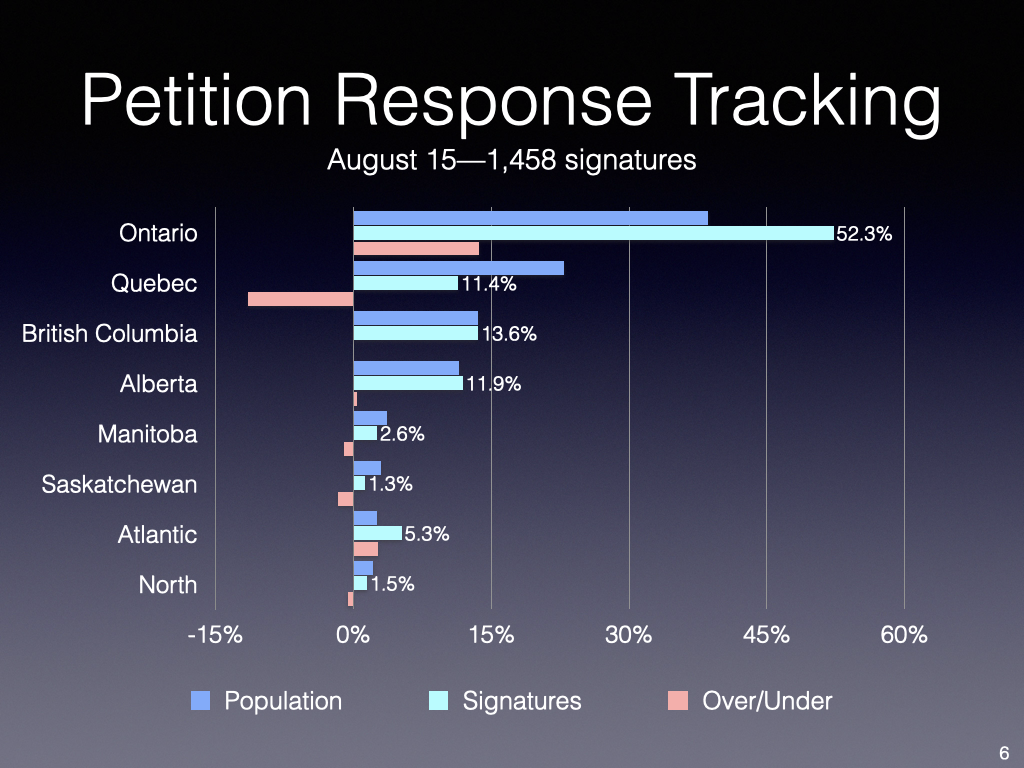
Petition e-4511 – Opposing self-affirmation of the #citizenship oath “citizenship on a click” – Signatures to August 15

The chart below breaks down the 1,458 signatures as of 15 August by province. No major changes by province as numbers plateau.

And if you haven’t yet considered signing the petition, the link is here: https://petitions.ourcommons.ca/en/Petition/Details?Petition=e-4511

Colby Cosh: Nonsense for Trudeau to open immigration, but not the economy

Kind of funny column as he turns around the left wing critique of mobility of capital and restrictions on mobility of people to a critique of mobility of people and restrictions on capital. Reflects his ideology but nevertheless interesting contrast:

This week, the Wall Street Journal, a strong candidate for “best newspaper in the English-speaking world,” became the latest news outlet to lift a questioning eyebrow at Canadian immigration policy. WSJ’s superb Ottawa reporter Paul Vieira gestures, for the benefit of his paper’s international audience, at facts most of our readers already know well. Inflexible, highly regulated parts of the economy like housing, medicine and transport are screaming under the burden of immigration levels with few precedents anywhere — levels the Liberal government has done nothing but increase.

Recent immigrants themselves are starting to become disillusioned with the promise of Canada, and pollsters say the broad public is beginning to balk at the “more, more, more” approach to immigration — no wonder, because our per-capita economic output is now in active decline. Our multi-decade embrace of super-high immigration was supposed to flood our country with entrepreneurs and innovators; the practical overall result appears to be stagnant labour productivity, along with frank inattention to research and development on the part of our businesses. Everywhere you look it is economists who are shooting warning flares into the sky, and even the central bank is making Marge Simpson dissatisfaction noises. Only federal politicians, fearful of a third rail that may soon be totally disconnected from any power, remain quiet.
Something maddening struck me for the first time while reading Vieira’s piece, even though there’s nothing in it you and I don’t know. It’s that when it comes to economic policy, Canada’s philosophy has strong, inherited cultural-nationalist premises. In law, large parts of our economy are protected from the taint of foreign capital, lest it serve as a wedge for the destruction of our precious sovereignty.
Some of the economic ills I just mentioned are attributable to this. We’re subject to a strangling oligopoly in telecom services because our phones, for some damn reason, require cultural protection (culture is the explicit legal pretext for the foreign-ownership limits in that line of business). Our news industry, up against similar fences, grows ever leaner; our airlines subject us to unapologetic unredressed abuse; the internet, a realm of unlimited bandwidth, turns sludgy before our eyes as our government quarrels with foreign “tech giants” of a sort we could never grow here. And if I so much as mentioned foreign corporate involvement in a super-protected setting like health care, I’d probably be picketed by my own readers before the end of business.So let me ask: isn’t this double stupidity? How can our besetting economic nationalism be reconciled with haphazardly controlled mass immigration? Something called our “economy” is a precious national treasure that might come to harm if we let Verizon or Gannett or KLM trod our sacred soil. But when it comes to nose counts, no one will admit that anything valuable, anything distinctively Canadian, is at stake or might be threatened by unruly immigration. (Such as, say, your ability to afford a house or find a doctor.)

I’m a libertarian: I think the classic economic story of immigration’s benefits is essentially true, or can be true in a free and liberal economy. But Milton Friedman is supposed to have once remarked that you cannot have both free immigration and a welfare state. I suspect that’s right, but what seems especially clear, whether you regard Friedman as a hero or a devil, is that you really cannot have both free immigration and economic nationalism. And why would you want that? For one purpose we are Fortress Canada, and for another closely related purpose we have walls made intentionally from Kleenex?

Source: Colby Cosh: Nonsense for Trudeau to open immigration, but not the economy

John Robson: So we need more immigrants … to build homes for all the immigrants?

Robson captures the circular argument before his overall rant:

With the Australian government hiring a consultant for advice on dealing with consultants, Momus, the Greek god of satire, retreats helplessly from the stage. Which is too bad since we could use a satirical hand, or mouth, when told Canada’s minister of immigration says we must bring in an endless stream of immigrants to build houses for the endless stream of immigrants we’re bringing in to build … um … hang on a second.

Are Canadians incapable of constructing dwellings? I’m a journalist by trade, so presumptively as useful in real life as, say, a poet. Or a consultant. But I have built a sleeping cabin and helped on that most iconic of Canadian dwellings, a cottage. I have even mixed cement. And doubtless others in this land surpass me. Including pros.

The minister cannot possibly think absent mass immigration we couldn’t build any homes. Where did our existing stock come from? The real issue is whether the current flood of immigrants contains enough extra homebuilders to provide extra shelter for that flood and then some. Especially as the minister cannot possibly think Canadian immigration policy is structured to bring in hundreds of thousands of framers, joiners, engineers and guys who use “footer” in everyday conversation.

Of course it derives from the more general, insulting notion that Canadians are such shlumps that without new immigrants we won’t work hard or effectively at anything. And not just those of us born in this notorious land of slackers; the millions who have poured in over the past quarter-century, and their offspring, are evidently assimilated to our culture of sloth so rapidly they can no longer be bothered hoisting a two by four instead of a 2-4 or something.

It’s the demographic version of the “bicycle” economic theory popular in Japan, that if they stopped pedalling they’d fall over. Whereas Japan’s real problem, and ours, is a plunging birth rate as we increasingly regard life as a burden or, at best, a brief party followed by MAID when the music stops, not a precious gift to be passed on. And you can’t fix despair with immigration because you really will get assimilation to that anomie unless we find a fix from within.

Canadians are famously pro-immigrant. Possibly because we are so famously polite that we don’t dare question bringing in another 60-odd million people to turn our fabled environment into one continuous strip mall from Saint John to Surrey.

To dissent against mass immigration risks wild accusations of bigotry. But what doesn’t nowadays? Like the joke about the patient who calls every single Rorschach ink blot a nude woman, then when the psychiatrist suggests he has a sexual obsession retorts, “Hey doc, you’re the one showing all the dirty pictures,” our elites increasingly see white supremacy in every defence of our heritage then say “Hey Canuck, you’re the one obsessed with race.”

Not everyone goes as far as our prime minister with his claim of an ongoing genocide in Canada on his watch. But the federal cabinet did approve a state-funded pamphlet from the Canadian Anti-Hate Network declaring the Red Ensign a red flag for white supremacy because it “denotes a desire to return to Canada’s demographics before 1967 when it was predominantly white.”

Do the Trudeau Liberals not concede that someone from afar, not remotely white let alone predominantly, might regard Canada’s heritage of individual liberty, capitalist prosperity and resolute defence of freedom as something to be admired and embraced? That someone who does not look like me, or them, might take their children to the Vimy Memorial and shed tears over the fallen?

Apparently not. It only recently dawned on them, with Muslim parents protesting radical sex ed, that not every non-white person is automatically left-wing in every dimension. And the Liberals are still struggling with not every white person being a right-wing xenophobic clod, though Justin Trudeau himself is only occasionally cosmetically non-white. But trying to stifle real debate with nonsense about bringing in immigrants to build homes for immigrants we bring in to build homes for immigrants is insolent, particularly as the housing crisis gets worse, not better, as people pour in. (Toronto is nearly half foreign-born, for instance.)

Of course if you’re trying to immigrate to Canada you favour a relatively open border. But once you succeed, and realize this country is everything you hoped for plus lakes and loons, you might well decide that as soon as you bring in your immediate family we should reduce the inflow dramatically.

Even people who admired Canada from a distance need time to internalize the habits that make it what it is. Which are not sloth, incompetence and bigotry, it’s apparently necessary to add.

Or inability to use hammers.

Source: John Robson: So we need more immigrants … to build homes for all the immigrants?

Housing crisis: Feds stick by immigration plan, rethink international student flows

Possible partial pivot but limited to international students, Minister Miller linking this to fraud concerns, not permanent residents and temporary workers.

Kind of an interesting contradiction in the article between “pace of population growth, facilitated by immigration, is making the housing crisis worse” and “Most experts agree that the root causes of this housing shortage are unrelated to immigration.”

The alarm bells are becoming bull horns: Canada’s housing supply isn’t keeping up with the rapid rate of population growth.

Academics, commercial banks and policy thinkers have all been warning the federal government that the pace of population growth, facilitated by immigration, is making the housing crisis worse.

“The primary cause for (the) housing affordability challenge in Canada is our inability to build more housing that is in line with the increase in population,” said Murtaza Haider, a professor of data science and real estate management at Toronto Metropolitan University.

A TD report released in late July also warned that “continuing with a high-growth immigration strategy could widen the housing shortfall by about a half-million units within just two years.”

But the Liberals are doubling down on their commitment to bring more people into the country, arguing that Canada needs high immigration to support the economy and build the homes it desperately needs.

“Looking at the (immigration) levels that we have recently approved as a cabinet (and) as a government, we can’t afford currently to reduce those numbers,” Immigration Minister Marc Miller said in an interview with The Canadian Press.

That’s because Canada’s aging population risks straining public finances, he said, as health-care needs rise and the tax base shrinks.

A report by Statistics Canada published in April 2022 finds the country’s working population has never been older, with more than one in five people close to retirement.

At the same time, Canada’s fertility rate hit a record low of 1.4 children per woman in 2020.

The TD report, co-authored by the commercial bank’s chief economist Beata Caranci, notes that economists are the ones who have been warning of the economic consequences of Canada’s aging population.

“A ramp-up in skilled-based immigration offered a solution. Government policies have delivered, but now the question is whether the sudden swing in population has gone too far, too fast,” the report said.

The federal government’s latest immigration levels plan, released last fall, would see Canada welcome 500,000 immigrants annually by 2025.

In contrast, the immigration target for 2015 was under 300,000.

Although the half-million figure has caught considerable attention, it’s not just higher immigration targets that are driving the surge in population.

Canada is also experiencing a boom in the number of temporary residents who are coming to the country, which includes international students and temporary foreign workers.

In 2022, Canada’s population grew by more than one million people, a number that included 607,782 non-permanent residents and 437,180 immigrants.

Miller said in the interview that the federal government is open to reconsidering international student enrolments, particularly amid fraud concerns.

Earlier this year, hundreds of people were suspected of being caught in a fraud scheme that saw immigration agents issue fake acceptance letters to get students into Canada.

“There is fraud across the system that we are going to have to clamp down on,” Miller said.

The increased scrutiny of Canada’s immigration policies and population growth comes as the country faces a housing affordability crisis caused in large part by a shortage of homes.

Most experts agree that the root causes of this housing shortage are unrelated to immigration. Red tape and anti-development sentiment at the municipal level, for example, can lead to major delays in projects.

Federal tax incentives that helped spur purpose-built rental constructions were rolled back decades ago, leading to a massive shortage in rentals that has slowly built up over time.

Given these existing challenges, experts are concerned strong population growth will add fuel to the fire.

BMO published an analysis in May that estimated that for every one per cent of population growth, housing prices rise by three per cent.

The rebound of the Canadian real estate market this year also shows how immigration is helping to maintain demand for housing, despite decades-high interest rates.

In contrast, the immigration target for 2015 was under 300,000.

Although the half-million figure has caught considerable attention, it’s not just higher immigration targets that are driving the surge in population.

Canada is also experiencing a boom in the number of temporary residents who are coming to the country, which includes international students and temporary foreign workers.

In 2022, Canada’s population grew by more than one million people, a number that included 607,782 non-permanent residents and 437,180 immigrants.

Miller said in the interview that the federal government is open to reconsidering international student enrolments, particularly amid fraud concerns.

Earlier this year, hundreds of people were suspected of being caught in a fraud scheme that saw immigration agents issue fake acceptance letters to get students into Canada.

“There is fraud across the system that we are going to have to clamp down on,” Miller said.

The increased scrutiny of Canada’s immigration policies and population growth comes as the country faces a housing affordability crisis caused in large part by a shortage of homes.

Most experts agree that the root causes of this housing shortage are unrelated to immigration. Red tape and anti-development sentiment at the municipal level, for example, can lead to major delays in projects.

Federal tax incentives that helped spur purpose-built rental constructions were rolled back decades ago, leading to a massive shortage in rentals that has slowly built up over time.

Given these existing challenges, experts are concerned strong population growth will add fuel to the fire.

BMO published an analysis in May that estimated that for every one per cent of population growth, housing prices rise by three per cent.

The rebound of the Canadian real estate market this year also shows how immigration is helping to maintain demand for housing, despite decades-high interest rates.

Source: Housing crisis: Feds stick by immigration plan, rethink international …