Les cibles de Québec en immigration ralentissent le regroupement familial, confirme Ottawa

For once, not Ottawa’s fault:

Les longs délais pour parrainer l’immigration d’un conjoint vivant à l’étranger sont bel et bien causés par les cibles de Québec dans la catégorie du regroupement familial, qui sont plus basses qu’ailleurs au Canada.

S’il faut patienter 14 mois dans le reste du pays, l’attente s’étire maintenant jusqu’à 24 mois au Québec, puisqu’Immigration, Réfugiés et Citoyenneté Canada (IRCC) se voit forcé de fixer « des objectifs de traitement des demandes distincts », confirme ce ministère au Devoir.

Des centaines de familles déchirées ont lancé un cri du coeur la semaine dernière, dans une pétition en ligne et lors d’une manifestation samedi après-midi à Montréal. Plusieurs ont aussi confié au Devoir les difficultés d’être séparés de conjoints, maris ou épouses alors que des bébés sont récemment venus au monde.

36 800 

C’est le nombre de personnes en attente d’une résidence permanente dans la catégorie du regroupement familial au Québec, selon le MIFI. 

Les délais pour les demandes de parrainage faites à partir du Québec ont brusquement changé le 22 juin dernier, bondissant de 14 à 24 mois. Auparavant, plusieurs familles pensaient voir « la lueur au bout du tunnel », raconte la consultante en immigration Johanne Boivin-Drapeau, mais depuis, elle reçoit plutôt des « appels de gens en pleurs et désespérés ».

Toutes ces personnes ont déjà franchi la première étape du processus d’immigration, qui consiste à recevoir un certificat de sélection du Québec. Ces dossiers déjà sélectionnés sont ensuite transmis à IRCC.

Mais « comme IRCC reçoit plus de demandes de la catégorie du regroupement familial destinées au Québec que ce que le MIFI [ministère québécois de l’Immigration, de la Francisation et de l’Intégration] lui permet de traiter, un arriéré se forme », explique une relationniste du ministère fédéral. Avec comme résultat cette « disparité dans les délais d’attente ».

C’est en effet Québec qui fixe le nombre maximal d’immigrants qu’il souhaite accueillir dans la catégorie du regroupement familial, soit 10 600 pour l’année 2023. Tant le provincial que le fédéral assurent que ce seuil n’a pas encore été atteint, mais les données des mois de mai et de juin ne sont pas encore disponibles. L’an dernier, ce nombre avait été atteint au plus tard le 30 septembre, selon des documents officiels.

Année après année, IRCC a donc « trop de dossiers par rapport à la cible permise par Québec ». L’arriéré est d’environ 36 800 personnes dans cette seule catégorie, a indiqué le MIFI au Devoir.

Un seuil qui reste similaire

Cette tendance à accumuler les demandes en attente présage aussi des années à venir, car le gouvernement de François Legault a déjà fait part de son intention de ne pas accueillir davantage de familles ; même le seuil d’entrée total devait passer à 60 000 personnes.

En effet, dans les documents soumis en vue des consultations sur l’immigration qui doivent se tenir cet automne, le nombre de places destinées au regroupement familial reste de 10 400, peu importe le scénario.

Ce sont d’ailleurs les participants au programme de regroupement familial que François Legault avait accusés de mettre le Québec sur la voie de la « louisianisation » en 2022. La moitié d’entre eux ne parleraient pas français à leur arrivée, selon les données que le premier ministre avait alors avancées. En vertu de la récente réforme des programmes d’immigration annoncée par Québec, leurs dossiers devront ainsi bientôt inclure un plan d’intégration comptant des cours de francisation.

Quant aux demandes de visas de visiteur déposées par des conjoints vivant à l’étranger, le fédéral assure que leur traitement est déjà accéléré, comme annoncé le 26 mai dernier, y compris pour les « demandes dans l’inventaire ». Les témoignages recueillis par Le Devoir montrent plutôt d’autres disparités de traitement : plusieurs demandes sont refusées sous le motif que la personne a des « liens familiaux significatifs au Canada », selon les réponses consultées.

Source: Les cibles de Québec en immigration ralentissent le regroupement familial, confirme Ottawa

Grenada’s passport-selling boom offering rich Russians a Caribbean shortcut to US visas could be over

Incredibly low amount with virtually no meaningful restrictions:

Grenada is one of the five Caribbean islands offering a “golden passport” in return for an investment in the country.

Its “Citizenship by Investment” (CBI) program offers people the chance to purchase citizenship for a $150,000 donation to the country’s National Transformation Fund, which was set up to boost its economy by financing areas such as tourism and agriculture or a $220,000-minimum investment into real-estate development.

Applications to the program soared following the outbreak of the Russia-Ukraine war in 2022, as wealthy Russians looked to flee abroad, Richard Hallam, who helped develop the program, told Bloomberg. There was a striking uplift in numbers following Putin’s mobilization announcement in September 2022 — Russia’s first such decree since World War II.

The total number of applications in 2022 hit 1,251 — an increase of around 87% from 2020. That trend continued into the first quarter of 2023, with 576 applications to the program, up from just 164 in the first quarter of 2022, according to statistics from Grenada’s Ministry of Finance.

The “Isle of Spice” welcomed 980 new citizens in the first quarter of 2023, far above the 391 it had in Q1 2022.

Fleeing Russians seeking to evade the war in Ukraine were likely enticed by the access to travel that the Grenadian passport provides, as it enables holders to visit over 100 countries without visa restrictions, including the UK and all EU member states.

The anonymous process also requires “no interview, education, or management experience,” and there is no obligation to live in Grenada “before or after citizenship is granted.”

It may also have hinted at the increasing number of Russians aiming to move to the US. Grenadian citizens are entitled to apply for an E-2 visa, a nonimmigrant visa that lasts a maximum of five years but can be renewed indefinitely, to get to the US — something which Russians are currently unable to do.

Irina Batrakova, the founding attorney for the Batrakova Law Office, previously told Insider that her firm had mainly been dealing with inquiries from Russians seeking to move to the US.

But Grenada has flip-flopped on its decision to allow Russians to take part in the program. It initially banned Russian nationals from applying after the war with Ukraine broke out, Bloomberg reported. It then reversed the ban in June, before once again imposing it from April 2023.

While the new ban may stem the tide of applications to the program, Grenada’s favorable tax policies and the global mobility offered by the passport will likely ensure that it remains popular.

The office for the Grenada Citizenship by Investment program did not respond to Insider’s request for comment.

Source: Grenada’s passport-selling boom offering rich Russians a Caribbean shortcut to US visas could be over

Nepal implements new citizenship law, but long road ahead to end discrimination, statelessness

Of note (gender and wedlock discrimination), being addressed in part:

Growing up in Nepal, Neha Gurung hoped to become a doctor, but her dreams were shattered when she was barred from medical school because the country she called home did not recognise her as a national.

Gurung was raised by a single mother, but Nepal does not let women automatically pass citizenship to their children. With her father untraceable, she was left stateless – a fate she likened to “being a prisoner in my own country”.

Hundreds of thousands of people in the Himalayan nation exist in a similar limbo for a host of complex legal, social and historical reasons, but a long-awaited law could now transform their lives, providing access to jobs, education and healthcare.

The reforms could also spur other countries to take action ahead of a 2024 deadline for ending statelessness worldwide, which is way off track.

Certificates of citizenship are the key to basic rights in Nepal including formal employment. But legal experts say flawed laws – rooted in patriarchal and xenophobic attitudes – have left many shut out.

“The feeling of exclusion is very strong,” Gurung told Context.

“I couldn’t study, get a driving licence, open a bank account or travel. Without citizenship, I couldn’t even get a SIM card for my phone.”

Stateless people – who are not recognised as citizens of any nation – typically rely on informal, low paid jobs and cannot buy property, legally marry or vote.

Deprived of opportunities and legal protections, they are at risk of exploitation and easy prey for criminals.

Gurung, 28, who acquired citizenship in 2017 following a five-year legal battle, said laws that left people stateless not only had tragic consequences for individuals, but also held back development and entrenched poverty.

“Once a person is stateless, their children will be stateless – generation after generation. And that’s a huge loss to the country.”

After qualifying as a lawyer, Gurung joined the Forum for Women, Law and Development, a human rights non-profit which worked with parliament on the reforms.

The Forum anticipated that more than one million people could benefit.

They include an estimated 400,000 to 500,000 people whose parents were granted a form of citizenship that they could not pass on to their children, and many others whose mothers are Nepali but whose fathers cannot be traced.

However, campaigners said the law was still discriminatory and many people would remain stateless, including some Dalit communities in the southern plains that have been stateless for generations.

Politicised issue

As the authorities began releasing citizenship certificates, many newly recognised Nepalis shared their joy on social media, posting photos of themselves holding their prized identity documents.

Those celebrating included activist Indrajit Saphi, 31, who had spearheaded a national grassroots campaign for reforms, organised protests and helped thousands lodge applications.

Saphi hopes to become an engineer while his three brothers will now be able to apply for passports to take up jobs overseas.

“I am very happy. My entire family is very happy (that) we are now citizens of our country,” he said.

Perbej Alam’s lack of citizenship drove him to the brink of depression, but the 21-year-old now hopes to study public health.

“This has opened a path for my future,” he added.

The Nepal Citizenship (First Amendment) Act effectively came into force on June 22 following a long and tortuous legislative process and repeated challenges by populist politicians.

A last-minute delay sparked protests in the capital Kathmandu last month with one man trying to set himself alight after dousing himself in petrol.

Citizenship is a highly politicised issue in Nepal, a small country of 30 million sandwiched between the world’s most populous countries, China to the north and India to the south.

It shares a long open border with the latter allowing millions to cross both ways for work.

The number of people without citizenship is particularly high in the south where mixed marriages are common.

Campaigners said years of marginalisation had left many with mental health issues.

Forum for Women, Law and Development executive director Sabin Shrestha said some people were considering suing the government for compensation over lost opportunities due to the protracted delays.

Ending statelessness

There are no reliable data for the number of stateless people worldwide, but some estimates have suggested there could be 10 to 15 million.

In 2014, the UN launched a global campaign called “#Ibelong” to end statelessness in a decade, but progress has been extremely slow with only about 450,000 acquiring citizenship.

Monika Sandvik, head of the UN refugee agency’s statelessness section, said Nepal’s reforms could inspire other governments to follow suit and would bring broad benefits to the country.

“How many doctors, have they lost by not giving people citizenship? How many engineers? This reform now opens doors for people to fulfil their potential.”

Giving people a legal identity and access to jobs would also boost Nepal’s tax revenues, she added.

Subin Mulmi, a Nepali lawyer and executive director of Nationality For All, an organisation working to end statelessness in Asia, welcomed the reforms, but said there was still a need to address underlying discrimination in the country’s constitution.

Campaigners are particularly concerned about a provision in the new law requiring mothers submit a declaration that their child’s father is untraceable, with the threat of a three-year jail term if the information later proves false.

They said the stigma attached to making a statement in Nepal’s strongly patriarchal society combined with the threat of prosecution would act as a deterrent to many women.

Nepali women will also not be able to apply for citizenship for children born abroad, with serious implications for many migrant workers who give birth overseas, often as a result of rape, and for victims of trafficking.

“This is definitely not the end of the reform process,” Mulmi said. “There’s a lot of work still to be done.”

Source: Nepal implements new citizenship law, but long road ahead to end discrimination, statelessness

The names and faces at Ontario’s ‘call to the bar’ show immigration is working

Of note:

The Law Society of Ontario is one of the oldest and, until recently, one of the stodgiest institutions in the country.

Up till 2018, it was still known by its original name, the Law Society of Upper Canada. Founded in 1797, it has its offices in Osgoode Hall, the grand court complex that stands behind an imposing iron fence on Toronto’s Queen Street West. Pictures of its leaders hang on the walls. Until 1983, all of them were men.

But the law trade is changing. Last month, I had the opportunity to see a new crop of lawyers, my daughter among them, being officially admitted to the profession – called to the bar. One by one, they made their way across the stage at Roy Thomson Hall as their names were called out and parents and friends clapped and whooped.

The variety of those names would have astonished the dour men in those Osgoode Hall portraits. Spanish names. Italian names. African names. South Asian names. Eastern European names. Chinese names.

Anglo-Saxon names, too, but they were outnumbered. Three Patels and five Singhs heard their names read out, but not a single Smith, Brown or Taylor.

Remember that this was not a high school or community college graduation, where that sort of diversity is so common now as to be hardly noteworthy. This was a ceremony welcoming new members to one of the country’s leading professions. A law degree opens all kinds of doors. Among the men and women crossing the stage could be future judges, politicians and business leaders (along with a few ambulance chasers).

Law society figures from 2021 shows that just 5.7 per cent of surveyed Ontario lawyers aged 65 and older identify as racialized. That is the old generation, overwhelmingly white and predominantly male. The number rises to 24.3 per cent for those aged 45 to 54, and 35.7 for those under 35. A look at the group that was called to the bar last month suggests it will rise even further in years ahead.

The rise in the representation of women is just as striking. Fifty-six per cent of lawyers under 35 are women, compared with 18.5 per cent for those over 65. It is now routine for women to outnumber men in law school classrooms.

What I saw at Roy Thomson Hall is part of a much bigger story. For decades now, Canada has been taking in high numbers of immigrants, a deliberate policy choice that sets us apart from most other developed countries. Many laboured in menial jobs to make ends meet as they adapted to life in their new country. Others built themselves impressive Canadian careers. The federal government reports that immigrants account for 41 per cent of engineers, 36 per cent of doctors and 33 per cent of business owners with paid staff.

Now their sons and daughters, grandsons and granddaughters are climbing the ladder of success. In Toronto’s recent by-election for mayor, four of the leading candidates came to Canada from somewhere else when they were young. The winner, Olivia Chow, spent her childhood in Hong Kong.

The law society would no doubt be the first to admit that it has a way to go still. There are fewer Indigenous lawyers than the profession would like. Women are underrepresented in the top ranks of leading law firms. Many leave the practice of law and move to jobs in government, education and other fields.

But the arc of progress is unmistakable and vastly encouraging. Despite all the justified concern about lingering prejudice and continuing barriers for newcomers, Canada’s experience with mass immigration on the whole is a remarkable success story.

You can see it all around. In the schools. In the colleges and universities. In the city councils and the legislatures. In the downtown office towers. Even, yes, in the Law Society of Ontario.

Source: The names and faces at Ontario’s ‘call to the bar’ show immigration is working

Sous les hauts cris des puristes, entendez-vous battre le cœur de la langue française?

Of note, countering overall Quebec narrative:

Écoutez de plus près. Le Québec n’avalera pas sa langue de sitôt. Un collectif de linguistes francophones somme les prophètes de malheur de tourner sept fois leur langue dans leur bouche avant de crier à l’agonie du français, tant ici qu’ailleurs.

Le français va très bien, merci. Le titre résume en une boutade l’essai de 65 pages publié chez Gallimard et coécrit par 18 spécialistes de « la langue de Molière ». Pour renverser cette vision voulant que le français se meure, commencez donc par oublier cette expression, clament les auteurs. La langue de Molière n’est plus la langue de Molière depuis la mort de Molière. La langue du dramaturge du XVIIe siècle est devenue avec le temps, naturellement, la langue des Tremblay, Laferrière, Booba.

« Si on lisait vraiment Molière dans le texte original, on verrait qu’il y a beaucoup de différences, des mots qui sont disparus, des structures grammaticales vraiment différentes, des prononciations très différentes. Cette expression, à mon avis, illustre bien cette langue fantasmée », explique en entrevue la Québécoise Julie Auger, l’une des membres du collectif des « linguistes atterré·es ».

Le français n’a jamais été aussi vivant qu’aujourd’hui, si l’on compte le nombre de locuteurs dans le monde. Même au Québec, la place décroissante du français comme langue parlée à la maison ne traduit pas un déclin, renchérit la professeure de linguistique à l’Université de Montréal.

« Oui, la proportion de Québécois qui parlent français à la maison continue de diminuer, mais ce n’est pas au profit de l’anglais. C’est au profit des langues que les néo-Québécois ont apportées. Pour moi, ça, ce n’est pas un danger. »

Rappelons que 94 % des Québécois peuvent aujourd’hui parler et comprendre le français, quelle que soit leur langue maternelle… exactement la même proportion qu’au début du siècle.

La prochaine génération de francophones grandit surtout sous la menace des pointilleux qui exigent un français parfait des nouveaux arrivants, souligne Julie Auger, alors que ceux-ci lui donnent un deuxième souffle. « Ces gens-là pourraient tout à fait choisir de ne plus parler le français et de ne parler que l’anglais, parce que, quand tu parles anglais, tu n’as pas ce genre de critiques. »

Quid du « franglais », vilipendé par des érudits près de chez nous ? « Si l’on tient au terme “franglais”, il convient bien mieux à l’anglais qu’au français, rétorque le collectif. […] On estime à près de la moitié la part du lexique anglais empruntée à l’ancien français ou au normand. » Et l’anglais « se porte bien ».

Le français ? Yes, sir !

Les langues ne sont pas en guerre les unes contre les autres, soutiennent les experts, car « ce que “gagne” l’une, l’autre ne le perd pas ».

Qui utilise encore le mot « bâdrer », emprunt de « to bother », passé dans l’usage québécois comme un synonyme de « déranger » ? Qui se souvient de l’époque où l’anglicisme « some » était employé comme un adverbe pour parler de quelque chose de gros ? Les néologismes passent, le français demeure.

Et si un anglicisme finit par coller au palais des Québécois, il ne remplace pas pour autant les mots qui y logent déjà. Il permet d’apporter une nuance de sens. Que serait le parler d’ici sans les subtilités des expressions comme cheap ou lunch (qui désigne plus un repas qu’on traîne avec soi qu’un repas à une heure donnée) ?

Le français, langue flexible et souple, « incorpore et digère sans problème » les emprunts depuis des siècles, rappellent les linguistes coalisés. Les ajouts tout neufs du créole haïtien et de l’arabe dans les discussions à Montréal ne font pas exception.

L’oreille attentive entendra toute de même quelques changements récents dans le dialecte d’ici. On utilise de plus en plus l’infinitif du verbe en anglais là où on le conjuguait avant à la française. Autrement dit, les Québécois commencent à deal avec ça plus qu’à « dealer » avec ça.

Cet effritement de la grammaire — « le coeur d’une langue », dixit Julie Auger — s’observe déjà chez les Acadiens. Est-ce bien ou mal ? La linguiste québécoise ne le dit pas. « Les linguistes en sont conscients, qu’il y a beaucoup d’études qui portent là-dessus en ce moment. On est vraiment en plein milieu de ce qui peut être un changement, et donc on est à l’écoute, on essaie de voir ce qui se passe. »

Le français, langue féconde

Le français va très bien, merci s’adresse aussi aux grands parleurs, petits faiseurs qui rêvent de réformer la langue de tout le monde.

« Depuis le XIXe siècle, [l’Académie française] ne suit plus l’évolution de la langue : elle s’est opposée à la réforme de l’orthographe prévue en 1901 pour accompagner l’accès de tous les enfants à l’école », lit-on dans l’ouvrage. « Son Dictionnaire, seule production officielle actuelle, en est à peine à sa neuvième édition et n’est pas du tout à jour. […]. Si l’Académie n’est pas à jour sur le vocabulaire, elle ne l’est pas non plus en grammaire. Sa seule Grammaire date de 1932 et a été tellement critiquée qu’elle n’a plus osé en publier d’autres. »

Les dictionnaires privés, réputés plus flexibles, peinent tout autant à suivre les changements sans fin du nouveau vocabulaire. Le Petit Larousse et Le Petit Robert recensent chacun 60 000 mots, tandis que Le Grand Robert en compile 100 000. Il faut se tourner vers la production participative du Wiktionnaire pour calculer l’étendue des néologismes francophones. Les internautes y ont consigné 400 000 entrées.

Et ça continue de monter, entre autres grâce aux initiatives créatives d’institutions bien de chez nous.

Pensons au Concours de créativité lexicale de l’OQLF, qui demande aux élèves québécois du secondaire de créer des mots de toutes pièces.

Les victorieux de 2023 :

« spectatriche », pour remplacer le terme « stream sniping », qui consiste à regarder la diffusion en ligne d’un adversaire lors d’une compétition de jeu vidéo pour obtenir un avantage ; 

« iconotypique », pour traduire le mot anglais « on-brand », qui qualifie ce qui est typiquement représentatif d’une marque ou d’une image publique ; 

« éphraser », pour dénommer le fait de retirer une phrase d’un texte. 

Parlez-vous fr@nçais ?

L’autre menace fantôme que dénoncent les linguistes, c’est le terrible Internet et ses codes abscons. Le numérique constitue « une menace » pour le français, entend-on d’ailleurs dans les échos de couloirs de l’Assemblée nationale.

Pourtant, le français trône à la septième place des idiomes les plus utilisés dans le cyberespace.

Et en fouillant cet énorme corpus de données brutes, on découvre que la tendance lourde est le passage vers un français de plus en plus normatif.

« L’utilisation d’“avoir” au lieu d’“être”, par exemple “j’ai tombé”, c’est quelque chose qui diminue avec le temps, indique Julie Auger. Le français montréalais s’aligne davantage sur le français standard. Par contre, un élément qui est non standard, mais qui est en croissance, c’est l’utilisation du “tu” interrogatif. »

On parle-tu bien français ? Bien ou mal n’est pas la question, à vrai dire. Le bon français, c’est celui que l’on parle. Point.

Le français va très bien, merci

Collectif d’auteurs, Gallimard, Paris, 2023, 65 pages

Source: Sous les hauts cris des puristes, entendez-vous battre le cœur de la langue française?

Sabrina Maddeaux: Housing and health crises eroding Canada’s pro-immigration consensus

More commentary based upon the Abacus poll and findings re concerns on housing, healthcare and infrastructure:

For about as long as most politicians and voters alive today remember, Canada has been a solidly pro-immigration nation. Until now, public opinion was effectively unanimous, at least outside of Quebec, that more newcomers represent an absolute good.

This allowed us the luxury of being rather superficial about immigration policy. It was far from a matter that decided elections — in fact, it’s such a historic nonstarter, pollsters rarely bothered to include it when asking Canadians about what issues mattered to them.

Any discussion of it was usually one note: how do we get more immigrants, quicker? Differences between parties’ approaches were barely visible to the human eye.

But public opinion can shift rapidly when voters’ lived experiences, or even perceptions of them, change. Indeed, a new poll by Abacus Data’s David Coletto suggests we may already be on that path.

This is why, particularly with housing and health-care shortages causing pain from coast to coast, it was never a good idea to take Canada’s pro-immigration consensus for granted.

As housing and health-care problems slipped into full-blown crises, the federal Liberals continued to do exactly that. Not ones to favour policy nuances and high on moral hubris, Prime Minister Justin Trudeau’s government took the “more is always better” immigration ethos to the max.

While commentators, including me, and economists warned that this rapid-scaling approach may not be sustainable and risked souring Canadians on immigration, there’s been no sign anyone in power is listening.

Canada’s immigration targets soared to 500,000 a year, not including the Temporary Foreign Worker Program, which totalled over 200,000 new approvals in 2022, or international student visas, which are limitless and counted just over 550,000 new students last year. That’s well over a million new people entering Canada per year.

To help visualize the magnitude, that’s an entire Calgary (population: 1,019,942) added each year. Or approximately two Hamiltons (population: 519,949), or three Halifaxes (population: 359,111).

Meanwhile, there’s a surgical wait list of 6,509 children at Toronto’s SickKids hospital, 67 per cent of whom are beyond the recommended window for care. Wait lists for family doctors are reaching the 10-year mark in some locales. British Columbia is offloading at least 5,000 cancer patients to the U.S. because untenable wait times could lead to preventable deaths.

The Canada Mortgage and Housing Corporation (CMHC) said last year that we need at least 5.8 million homes by 2030 for housing to become affordable again. A year later, many municipalities across the country aren’t anywhere near on pace to build their share of the pie.

It’s also more and more often newcomers themselves, particularly temporary workers and students, who suffer the brunt of housing shortages when they arrive. This has led to increasing exploitation, from employers confiscating passports to landlords taking rent in the form of sexual acts.

This is certainly not the Canada many newcomers imagined, and it shouldn’t be one we’re proud to offer more and more of them with visions of our own economic gain dancing in our heads.

Any realist would see something has to give. Canada can’t have it all when it comes to immigration while shortages of basic goods and services persist. While the shortages aren’t immigrants’ faults, and they shouldn’t be blamed for them, that doesn’t preclude us from acknowledging our immigration policies need a sober second look.

Coletto’s national Abacus Data survey taken this June reports 11 per cent of Canadians now rank immigration as a top three issue. More revealing, 61 per cent of respondents consider Canada’s 500,000-per-year immigration target too high. Thirty-seven per cent of Canadians classify the 500,000 target as “way too high.”

I can’t help but wonder what the response would be had Abacus’s question cited the true one million newcomers entering per year. As it stood, 63 per cent of respondents think the number of immigrants entering Canada is having a negative impact on housing, and 49 per cent feel the same way about the impact on health care. Only 43 per cent believe immigration is positively impacting our economic growth.

Many federal politicians seem afraid to touch the complex immigration file for fear of being branded xenophobic or racist by political opponents. Yet, Coletto finds even a majority of immigrants think current targets are too high.

Barring a miracle on the housing or health-care fronts, and if public opinion continues in this direction, lawmakers can’t avoid the immigration file much longer. The question should be, how can we responsibly tailor our immigration policies now, so that we can continue to grow the country robustly into the future?

Canada’s been lucky to enjoy so many decades without having to think too hard about immigration, but the longer we wait to do so, the tougher the eventual conversation will likely be.

Source: Sabrina Maddeaux: Housing and health crises eroding Canada’s pro-immigration consensus

Toronto Sun editorial also picks up on this theme:

The Trudeau government’s commitment to dramatically increase immigration levels is causing widespread concern among Canadians.
A recent Abacus Data survey of 1,500 adults from June 23 to 27 found 61% believe Canada’s target of admitting about 500,000 permanent residents next year is too high, including 37% who feel it is “way too high.”
Abacus Data CEO David Coletto said 63% believe current immigration levels — the government is planning to bring in about 1.5 million immigrants from 2023 to 2025 — are having a negative impact on Canada’s housing shortage.
Almost half are concerned about the impact on Canada’s health-care system

There’s still a large percentage of Canadians who agree with Prime Minister Justin Trudeau’s arguments that immigration is important to increase the number of available workers in Canada because of our low birth rate (50%) and to contribute to economic growth (43%).

The underlying concern to us is that the federal government should be setting its immigration targets in close consultation with the provinces and particularly with major cities such as Toronto, Montreal, Vancouver, Calgary and Edmonton.
That’s because most immigrants don’t settle in “Canada” but in specific urban centres across Canada, stressing municipal and provincial governments in terms of providing public services.

While Canada’s annual admission levels of refugees are in a separate category from permanent immigration, the situation in Toronto illustrates the problem.

Toronto Mayor-elect Olivia Chow recently noted the city government this year will spend about $97 million accommodating refugee applicants who occupy about a third of the city’s shelter spaces.

Since this is the result of federal policies, Chow said, the Trudeau government needs to contribute to the costs of their care.
To be fair, the feds have given almost $200 million to shelter support for refugees in Toronto over the past five years, but the city says the ad hoc nature of these payments is unsustainable and they need to be made on a permanent and reliable basis.

Canadians have concerns about immigration levels not because they’re racists, but because they legitimately worry about their impact on already stretched municipal and provincial services across Canada

Since the Trudeau government is setting those targets, it also has a responsibility to consult with provinces and cities on how to accommodate them.

Source: EDITORIAL: Feds need to listen on immigration levels

Sean Speer: Not all population growth is created equal

An odd and unclear column.

The first two points are factual: that immigrants are older than people born in Canada (even if many come with young children or have children once in Canada), and that it tends to be more concentrated in out urban areas.

But conclusion seems deliberately opaque, suggesting a concern over composition and change of Canada’s population, that can be read as either a dog whistle or flirting with a variant of the “great replacement theory,” even if not his intent.

“A prudent position would be to recognize the benefits of large-scale immigration without assuming that it can be raised to unprecedented levels or become solely responsible for the country’s population growth free from consequence. Maximalist ends without due consideration of the consequences of maximalist means is rarely the basis of good public policy. Immigration is no exception.”

Last week the popular American economics blogger Noah Smith publishedan essay entitled “Maximum Canada” in which he outlined the success of Canadian immigration policy and the benefits of a bigger national population. 

His observations follow similar commentary in recent months in favour of the so-called “Century Initiative” in which Canada aspires to reach 100 million residents by 2100. The basic premise is that a much larger population would boost Canada’s economic and geopolitical influence around the world, lessen its asymmetry vis-à-vis the United States, and create a bigger domestic market for trade and commerce.

These arguments are generally compelling. There’s certainly something of a correlation between population size and global influence. The exceptions are far outweighed by the rule. 

The main problem with this analysis however is that it’s too focused on population growth as an end and fails to properly scrutinize the means. Globe and Mail columnist Andrew Coyne recently argued for instance that the target of 100 million Canadians by 2100 isn’t even that ambitious because it broadly tracks population growth patterns over the past several decades. As he explained: 

To get to 100 million in 77 years—two and a half times our current level—implies an annual growth rate of 1.2 per cent. By comparison, over the last 77 years, our population more than tripled, from 12.3 million in 1946. That works out to 1.5 per cent annually. To be sure, birth rates were higher in the 1950s and 1960s; population growth today comes almost exclusively from immigration. Fine: let’s take 1970 as our starting point. Average annual population growth: 1.2 per cent. The Century Initiative proposal is essentially a continuation of the status quo.

Yet there’s something qualitatively different about population growth that’s driven by a combination of natural growth (births minus deaths) and immigration and growth that solely comes from immigration. Smith, Coyne, and others fail to grapple with these key differences. 

It doesn’t mean that Canada shouldn’t aspire to have a larger population or even necessarily that we shouldn’t pursue an immigration policy that ultimately gets us there. But before fully signing onto “maximum Canada”, we need to account for the fact that all forms of population growth aren’t the same. (This isn’t, by the way, a normative judgement. It’s merely an observation about the practical differences between a society that draws on immigration to supplement its own natural growth and one that relies on it entirely.)

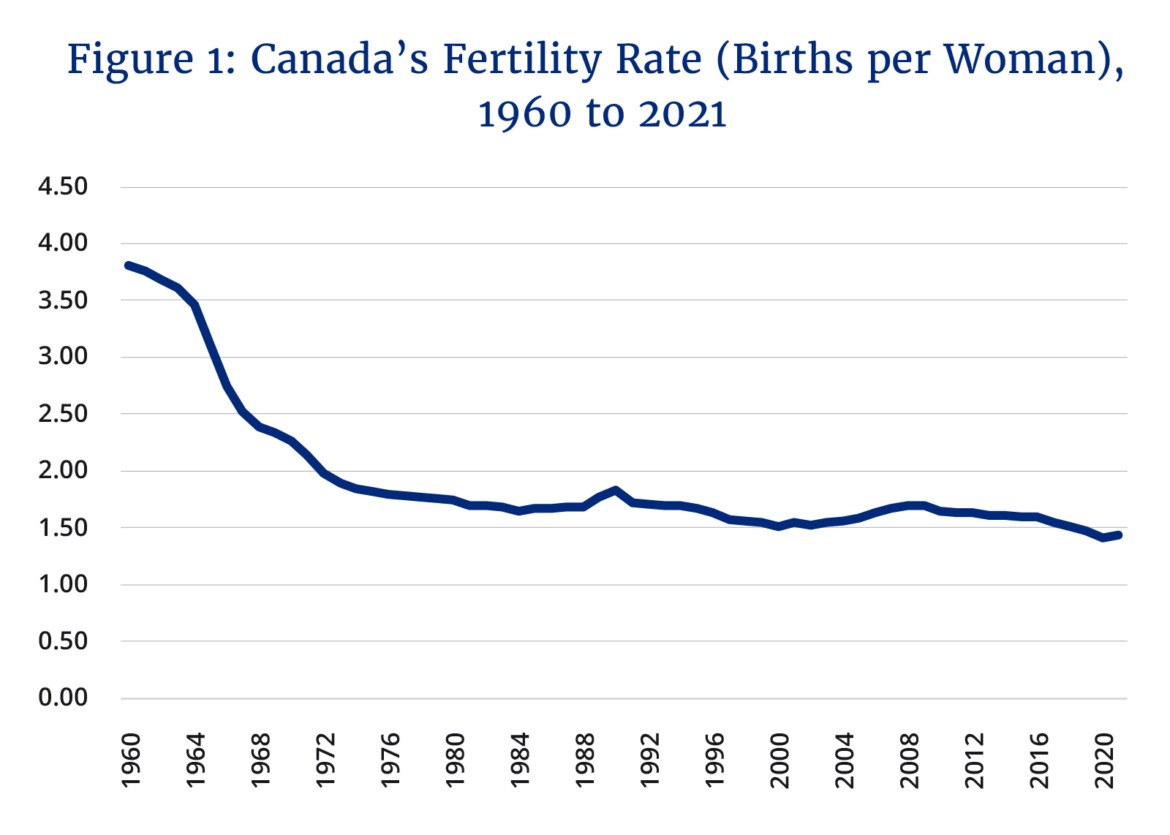
Let’s start with the data. Replacement level fertility is an average of 2.1 children per woman. As Coyne notes, Canada’s fertility rate dipped below replacement level beginning in the early 1970s. It’s now just 1.4 children per woman (see Figure 1).

Although the country’s fertility rate has been below the replacement rate for the past half century, its current rate represents an unprecedented low. As Figure 1 shows, it has steadily fallen to now below the G-7 average and is increasingly one of the lowest rates in the world.

Graphic credit: Janice Nelson

That means that immigration isn’t just doing most of the heavy lifting when it comes to population growth. It’s now nearly solely responsible. Take 2022 for instance. Canada’s population grew by more than 1 million people—the largest single-year growth since 1957—and immigration was responsible for roughly 96 percent. 

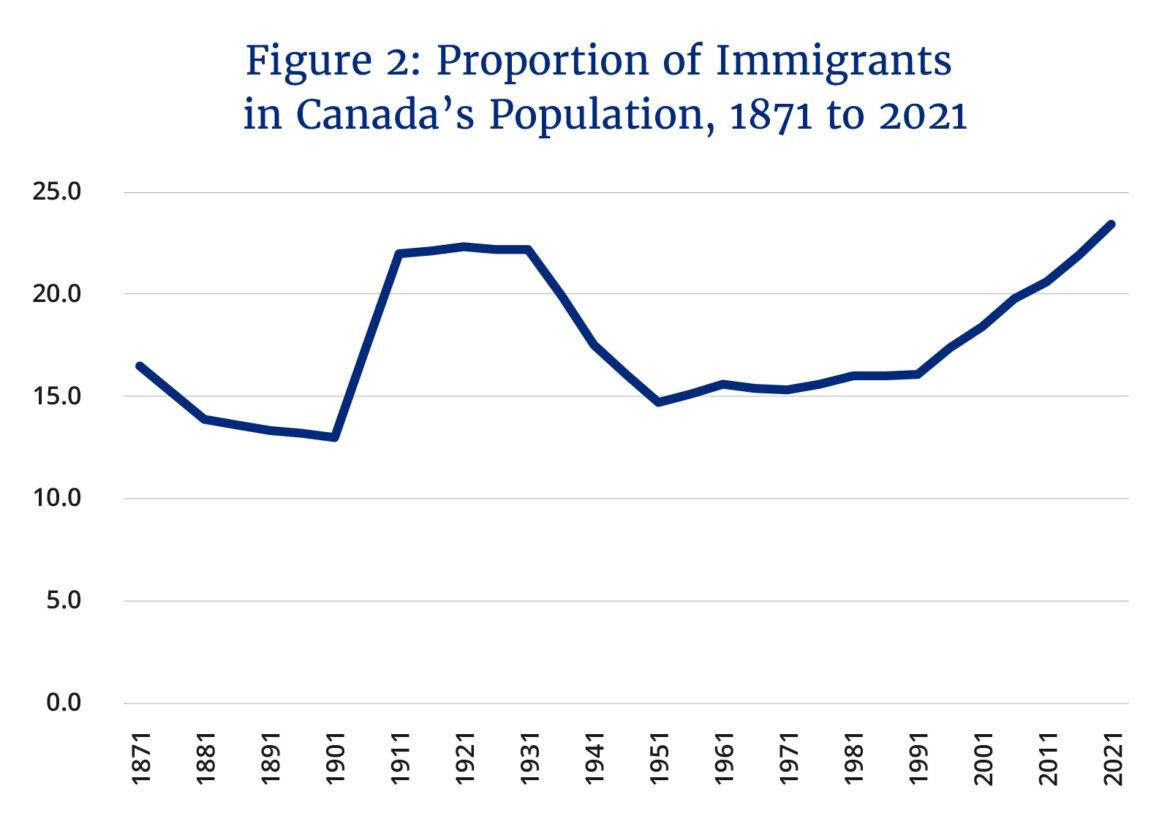
Estimates are that immigration will reach 100 percent of population growth by 2032 and will remain the main driver for the coming decades. As a result, Statistics Canada projects that the overall share of Canada’s immigrant population (which consists of landed immigrants) will rise from 23.4 percent in 2021 (see Figure 2) to as high as 34 percent in 2041. 

Graphic credit: Janice Nelson

There are various ways in which immigration-driven population growth is different than natural growth. These differences will ostensibly produce outcomes that are distinct from past experiences and therefore may limit the utility of historical instruction. There’s an onus on proponents of the Century Initiative to account for them in their analysis and advocacy. 

The first is that it’s older. Although the immigrant population is generally younger than the average age of non-immigrant residents, it’s still self-evidently older than babies. The majority of immigrants fall within the core working age group (25 to 54). Just over one quarter are aged 15 and younger. Immigration-driven population growth may slow the rise of (and even temporarily lower) the country’s average age but it won’t, according to leading economist David Green, “substantially alter Canada’s age structure and impending increase in the dependency ratio.”

The second is that it’s far less geographically distributed. More than half of recent immigrants settle in Montreal, Toronto, and Vancouver and nine of ten settle in a census metropolitan area. Natural growth by contrast would presumably more closely reflect the general distribution of population across the country. Immigration-driven population growth should therefore be expected to impose even greater pressure on housing and other infrastructure in our major cities and contribute to a growing urban-rural divide in our economic and political outcomes. 

The third is that it will reshape the country’s culture. That may not be a bad development—particularly in the eyes of those who value diversity—but it still represents a qualitative difference relative to natural growth that requires a bit more attention. 

Consider two scenarios. First, there’s a strong possibility that it erodes the place of the French language and francophone culture in our national life as Quebec’s share of the total population declines and its conception of binationalism is fully consumed by multiculturalism. Second, it’s also possible that it could at times conflict with the goal of Indigenous reconciliation to the extent that immigration-driven growth produces a growing share of the population that can plausibly argue that it has no role or responsibility for the historic injustices faced by Indigenous peoples. (There are growing calls—including from the Truth and Reconciliation Commission—to expand newcomer education about the Indigenous experience presumably to mitigate this risk.)

These considerations don’t challenge the case that immigration has been a net positive for the country or that we should maintain high immigration levels in the face of aging demographics or even that we should aspire to a bigger population. They do however dispute the idea that the source of population growth is irrelevant. Natural growth and immigration-driven growth may produce the same number but their effects are necessarily different. 

What is envisioned by the Century Initiative and others is essentially without precedent. Immigration has never been solely responsible for such a run-up of Canada’s population. History cannot provide much of a guide. Only prudence can. 

A prudent position would be to recognize the benefits of large-scale immigration without assuming that it can be raised to unprecedented levels or become solely responsible for the country’s population growth free from consequence. Maximalist ends without due consideration of the consequences of maximalist means is rarely the basis of good public policy. Immigration is no exception.

Source: Sean Speer: Not all population growth is created equal

Is racism behind denial of visas to African students?

Largely reflects the interests of education institutions and their financial pressures as much as concerns over differential treatment (given that immigration is inherently “discriminatory,” the question is more are their legitimate reasons and evidence to justify that discrimination):

In the five years between 2018 and 30 April 2023, officials at Immigration, Refugees and Citizenship Canada reportedly rejected 59% of the visa applications from English-speaking Africans and 74% from French-speaking Africans seeking to study in Canada’s colleges and universities.

In 2022, the disapproval rates were 66% for applicants from French-speaking African countries and 62% for applicants from English-speaking African countries.

Besides the higher rejection rate for francophone African students, the stats show a massively higher rejection rate for African students compared to students from Western countries. Refusal rates for Great Britain, Australia and the United States were 13%, 13% and 11%, respectively, while for France the refusal rate was 6.7%.

‘A certain rate of racism exists’

Referring to hearings held in 2022 by the House of Commons Standing Committee on Citizenship and Immigration (SCCI) during which Immigration, Refugees and Citizenship Canada (IRCC) admitted there was a problem, Etienne Carbonneau, director of research and support for internationalisation at Université du Québec in Québec City, said: “Let’s put it bluntly, we think there is a certain rate of racism that exists [in IRCC].

“By this I mean negative prejudices against, particularly, French-speaking African populations. When you look at IRCC’s responses, basically, the immigration officers who process the permit application files seem to be saying that they don’t believe the students.”

Both Carbonneau and Daye Diallo, senior economist at the Montreal-based Institut du Québec, underscored that while the high refusal rate of English-speaking Africans can also be attributed to racism at the IRCC, the impact on English universities such as McGill University in Montreal, or those in Ontario or elsewhere in the country, is not as severe.

“In Ontario, it [the rejection rate] is more than 50%. Serious too, but it is higher in Quebec. And because Quebec speaks French, the recruitment pools are more limited. In Ontario there are many students who come from Asia and English-speaking countries,” says Diallo, co-author, with Emna Braham, the institute’s executive director, of the study, “Portrait de l’immigration temporaire: attraction et rétention des étudiants étrangers au Québec”.

“We cannot go to India or China because Indians and Chinese are looking for training in English,” Carbonneau explained. “If I were at McGill University or University of British Columbia, and I saw that it was getting difficult on the Indian side [ie, recruiting from India], I would look to other markets. I don’t have that opportunity [recruiting for a French university].

“The potential for growth is really in French-speaking Africa, but this potential is cut off by the practices of Immigration, Refugees and Citizenship Canada. Presently, some 50% of French speakers worldwide live in African countries; by 2050, the continent will account for 50% of the world’s population growth.”

SCCI report evidence

The report of the Standing Committee on Citizenship and Immigration (SCCI), published in May 2022, titled Differential Treatment in Recruitment and Acceptance Rates of Foreign Students in Quebec and in the Rest of Canada, found evidence of racism both in the internal workings of the department and among IRCC’s visa officers vis-à-vis African applicants for study visas.

This evidence was contained in a report of a survey of IRCC conducted by the polling firm Pollara Strategic Insights following the international protests against the murder of George Floyd by members of the Minneapolis (Minnesota) police department in March of 2020, which sparked the Black Lives Matter protests.

Racialised respondents to the IRCC survey told Pollara that they “considered racism to be a problem in the department”, which, in its response to the report, IRCC acknowledged.

Pollara was told that some immigration officials referred to certain African countries as “the dirty 30”. Nigerians, the investigators were told, were considered “particularly untrustworthy”.

According to the SCCI, IRCC “acknowledged that due to the nature of its mandate to promote a strong and diverse Canada, it must hold itself to the highest possible standards so that the programmes, policies and client services are free from any racial bias”.

IRCC policy

IRCC reiterated this policy in an email that said, in part: “The Government of Canada is committed to the fair and non-discriminatory application of immigration procedures. We continually evaluate data and make concerted efforts to address the results and the differential strategies in order to improve our approaches so that we can overcome these issues.”

The email further explained: “The strategic review of the immigration policies and programmes will enable us to identify and address the issues relating to rejections and the International Student Program will be informed by this exercise.”

Among the steps IRCC has taken is the creation of a task force dedicated to the “elimination of racism in all its forms at IRCC”. This requires IRCC staff, including middle and senior managers, “to take mandatory unconscious bias training which is tracked”, and evaluate “potential bias entry points in policy and programme delivery [ie, deciding on visa applications]”.

As of May 2022, IRCC had “nearly two dozen projects under development to reduce and eliminate racial barriers – with a large focus on … African clients, due to the fact that this region historically faces longer processing times and lower approval rates”.

Nigerian students deemed ‘particularly untrustworthy’

While some IRCC staff considered Nigerians to be ‘particularly untrustworthy’, critics, including the University of Calgary’s Assistant Professor of Artificial Intelligence and Law Gideon Christian, who is also president of African Scholars Initiative, told the House of Commons committee that the 2019 pilot project, Nigerian Student Express (NSE), discriminated against Nigerians.

Pointing to documents he had obtained via an Access to Information and Privacy request, Christian showed that irrespective of whether the NSE improved processing times for Nigerian students by giving them the option to use a secure financial verification system, it discriminated against these students.

The NSE required Nigerians to provide different and more onerous financial data than did students from other countries that were part of the Student Direct Stream (SDS), Christian said.

Unlike students in the other 15 countries included in the SDS, such as China, Vietnam, Senegal, Brazil and Colombia, Nigerians seeking to study in Canada had to produce a bank statement showing that they had the equivalent of CA$30,000 (US$22,600) in their account for at least six months in the last year.

While testifying before the committee, Sean Fraser, minister of immigration, refugees and citizenship of Canada, defended the CA$30,000 figure, saying that it was fair because it did not include living expenses.

“The issue is that we don’t necessarily have financial partners on the ground in Nigeria, so having proof of funds of CA$30,000 is more equitable when you look across the requirements in other countries, where you have not only [the requirement to show] CA$10,000, but also the proof of funds to cover the cost of an international student tuition.”

In his testimony, Christian dismissed Fraser’s claim, noting that a “Nigerian is required to show proof of funds that are three times more than those of other SDS countries, and yet, when this applicant overcomes this high burden of proof, most of the study visa applications from Nigeria are still refused”.

Christian also told the SCCI that since all colleges and universities exempted Nigerians from English-language proficiency tests, “the language proficiency requirement imposed by the visa offices … exudes stereotypes and racism”.

SCCI Recommendation 4

The SCCI’s Recommendation 4 called for IRCC to reconsider the financial reporting requirements imposed on Nigerians and for IRCC to “remove the English-language proficiency required for Nigerian students”.

As with Canada’s English universities, French universities in Quebec recruit international students for a number of reasons. Carbonneau began by noting the importance of universities internationalising their student bodies.

“The career of a researcher who is from Quebec will involve collaborations with people who have been trained abroad and who have worked abroad. The integration of international students into our university programmes means that our Quebec students will have contact with people from other countries. They will be made aware of international issues and the issues of intercultural work and the taking into account of intercultural issues.

“We understand how the presence of international students, particularly at the graduate level, makes it possible to develop links between researchers and students that will be maintained over time.”

Recruiting in French-speaking Africa

International students contribute CA$22 billion (US$16.6 billion) to the Canadian economy and support more than 218,000 jobs, the SCCI heard. The portion of these funds spent in Quebec is part of the third reason Quebec’s universities recruit in French-speaking Africa. The other part is that the 217,660 French African students in the province’s colleges and universities help keep these institutions economically viable.*

The tuition for Quebec residents at the province’s French universities is approximately CA$6,000; international undergraduates payCA$30,000 more. Each international student also contributes some CA$15,000 to the province’s economy in living costs.

Since Quebec universities receive grants on a per student basis from the provincial government, for universities international students mean larger government grants.

According to Carbonneau: “We need students for the vitality of several of our university programmes. Quebec universities are funded per student, so when we have students, we have funding.”

Ontario’s universities, too, it should be noted, are hungry for international student fees. For the 2021-22 academic year, for example, the 22,728 international students at the University of Toronto, for example, paid on average CA$59,320 in tuition and fees, or a total of over CA$1.3 billion.

Recruiting university students from French Africa is also part of the government of Canada’s commitment to ensuring that approximately 72,000 of the nation’s immigrant target of 500,000 are French speaking. This policy was put in place to ensure that the percentage of French-speaking Canadians did not fall below the present 22.8%of the nation’s population of 40 million.

Although Fraser told the SCCI that “international students are excellent candidates for permanent residency” and that Canada has “increased our target efforts overseas to promote and attract francophone students and immigrants to Canada”, the committee heard of a number of roadblocks that prevented French African students from studying in Canada.

At the hearings, Alain Dupuis, executive director of the Fédération des communautés francophones et acadienne du Canada (Canadian Federation of Francophone and Acadian Communities), stated that irrespective of the government’s immigration goals, “we are closing the doors to them”.

Investment certificate roadblock

Denise Amyot, president and CEO of Colleges and Institutes Canada, told the SCCI that one of the main roadblocks is a requirement created, not by IRCC policy, but by its visa officers: the guaranteed investment certificate to demonstrate financial sufficiency and SDS.

While this certificate may have streamlined the application process, it ignored the fact, Amyot told the SCCI, that the banking systems “in certain countries are not as well developed, and students rely more heavily on family networks in ways that may seem atypical from a Canadian cultural lens”.

Referring to the cases for which he knew IRCC’s reason for denying the application for a study visa, Diallo told University World News: “The reason in these situations is that the student does not have enough real estate; he does not have a house in his country of origin.” He then asked, pointedly: “How can an 18 year old own buildings?”

The guaranteed investment certificate is more than a proof of financial resources, Diallo further explained. It serves as a proxy for the applicant’s attachment to his or her home country: ie, as proof that he or she plans to return to their home country.

Similarly, applicants have been denied study visas because they have not shown that they have enough family in their home countries, or that they have not established a travel history that shows that they have left and returned to their home country.

This is a requirement that one brief to the SCCI mocked by asking” “How many kids of the age 15-20 years old from other countries have travelled out of their shores at such a young age? What counts as sufficient travel history? This remains unclear,” says Carbonneau.

For his part, Diallo says: “There are reasons like that that are given. But they are ‘reasons’ which, in our opinion, are not necessary. [For] these reasons, the official can say that he believes the student will not return home. But these are not facts. There are no statistics that say that African students are more likely to stay here illegally when their visas expire.”

Residency roadblocks

Notwithstanding Fraser’s statement that “international students are excellent candidates for permanent residency”, the very document applicants for study visas must fill out puts them in a ‘catch-22 situation’ with regard to what’s called ‘dual intent’, says Shamira Madhany, managing director and deputy executive director at World Education Services, told the parliamentarians studying the issue.

Canada’s Immigration and Refugee Protection Act allows for international students to apply for permanent residency upon completion of their studies if “the officer is satisfied that they will leave Canada by the end of their period authorised for their stay” and wait outside Canada for their permanent residency to be granted.

However, in practice, one witness told SCCI: “If a student has the misfortune to check that box, their chances of getting a visa are nil … The authorities believe that they really do not intend to study in Canada, and they want to stay in Canada.”

According to Carbonneau, this situation is absurd.

“A student who comes to study with us with the intention of immigrating, which is deemed desirable by our government in Quebec [the lone province to issue its own study document accepting the prospective student], is using his studies, a bachelor degree or a masters degree or a doctorate, to integrate into Quebec or Canadian society – and then immigrate.

“For us it is desirable. But for the Government of Canada, I think the second most frequent response is that the application is refused because the Canadian government is not convinced that the student will return to his country after graduation.

“It’s really absurd because on the one hand Canada really needs qualified immigrants. We also need qualified French-speaking immigrants. But, on the other hand, we tell them once they graduate our expectation as a Canadian government is that you return home.”

Reform required

In his appearance before the committee, Fraser admitted the system needed reform but pushed back against critics by saying that Canada “need to prevent a lot of students coming with the purpose of staying permanently by claiming asylum, for example, when we have different streams for people who are coming for purposes other than studying”.

While Recommendation 15 does not expressly refer to the minister’s statement, by implication it rebuked him by calling on IRCC to clarify the dual intent provision of the Immigration and Refugee Protection Act, “so that the intention of settling in Canada does not jeopardise an individual’s chances of getting a study permit”.

Organisations and individuals involved in recruiting in Africa are concerned that Canada’s high rate of refusal of study visa applicants is hurting the country’s reputation in Africa. Amyot told the SCCI that he had heard of students who waited months for decisions only to find out that their study permits had been rejected “often for unclear and unfounded reasons”.

“We live in a world where the competition to attract the best brains is very important. Canada cannot afford to have these difficulties. Canada must work to reduce refusal rates from French-speaking African countries that have students who want to come to Canada,” said Diallo.

“We have a poor image internationally because Canada does not grant visas and the reasons why Canada does not grant visas are not the right reasons.”
Source: Is racism behind denial of visas to African students?

Malik: France has been laissez-faire on race, the US proactive. Clearly, neither of them has it right

Another call for greater analysis by class, but one that does not ignore identity and race:

Should public policy be “race conscious” or “colour blind”? Should it target the specific inequalities faced by minority groups or treat all citizens equally without any reference to individuals’ racial and cultural backgrounds?

The contrast between these two approaches has often been seen as that between Anglo-Saxon multiculturalism and French assimilationism, the one “based on the right of ethnic minorities, of communities”, the other “based on individual rights”, as Marceau Long, then the president of France’s Haut Conseil à L’Intégration, put it in 1991, adding that the Anglo-Saxon approach, unlike that of the French, was that of “another way of imprisoning people within ghettos”.

Thirty years on, we can see the issues as more complex and less given to simple binary oppositions. Two recent high-profile events illustrate this complexity: the debates around the US supreme court’s decision to strike down affirmative action and those around the riots that ripped through France after the police killing of teenager Nahel Merzouk.

While affirmative action improved prospects for middle-class black people, it left untouched those of the working-class

The supreme court’s verdict that Harvard’s race-based admission policy was illegal has led many to fear that the progress of African Americans in higher education will now stall. Yet, as the African American writer Bertrand Cooper observed even before the decision: “The reality is that for the Black poor, a world without affirmative action is just the world as it is – no different than before.”

Why? Because while affirmative action has improved prospects for middle-class black people, it has left untouched the lives of working-class African Americans. By 2020, the percentage of African Americans admitted to Harvard stood at almost 16% – higher than the proportion of black people within the US population. Black students in Harvard are, though, anything but representative of the African American community.

In most discussions about race, black Americans are regarded as constituting a singular community. However, black America has been, for most of the past half-century, the most unequal racial or ethnic group in the nation. White Americans in the top income quintile possess 21.3 times the wealth of white people in the lowest income quintile. For black people, that figure stands at a staggering 1,382. The poorest black people earn just 1.5% of the median black income.

This disparity shapes everything from education to incarceration. More than 70% of Harvard students come from the wealthiest 20% of families; 3% come from the poorest 20%. There were almost as many students from the wealthiest 1% as from the poorest 60%.

The greatest lack of diversity in America’s elite universities, in other words, is not racial but class-based. It is, though, one that deeply affects black Americans, because that same pattern of elite recruitment applies to African Americans as it does to the population as a whole. Affirmative action is action largely for the black elite.

This is not a new argument. In his seminal 1978 work, The Declining Significance of Race, the sociologist William Julius Wilson noted the changing contours of race and class and the development of a “deepening economic schism” within African American communities, “with the black poor falling further and further behind higher-income blacks”.

The title of Wilson’s book may seem ironic, given the centrality of race in public debate today. In material terms, Wilson’s thesis has proved largely accurate. Politically, though, there has been an increasing fixation with racial identities. This mismatch between material developments and political perceptions has ill-served the majority of African Americans.

It is not that racism does not continue to play an immense role in the lives of black people. It is rather that, as Cooper has observed: “Ignoring class divisions in Black America over the last 40 years has allowed the benefits of racial progress to be concentrated upon the Black middle and upper classes while the Black poor have largely been excluded.”

Many critics of race-conscious policies argue instead for the pursuit of “colour blind” policies that take no account of an individual’s race or culture. Perhaps the nation that most embodies such an approach is France. It is also the one that most reveals the problems with it.

‘Universalism’ has become a weapon with which to point out the ‘difference’ of particular peoples

French policy is rooted in its republican tradition and universalist principles, and a refusal to recognise racial distinctions in policymaking. The universalist belief that one should treat everyone as citizens, rather than as bearers of specific racial or cultural histories, is a valuable principle.

In practice, however, French policy has entailed being blind to racism in the name of being “colour blind”, and of using the demand for “assimilation” as a means of marking out certain groups – Jews in the past, Muslims and those of North African origin today – as not truly belonging to the nation. “Universalism” has become a weapon with which to point out the “difference” of particular peoples and to justify their marginalisation. France, as much as America, too often treats its citizens not as individuals but as members of racial or ethnic communities.

The French state not only refuses to recognise racial distinctions but also bans the collection of race-based data, making it far more difficult to evaluate the extent of racial discrimination, while providing a free pass to deny that such discrimination exists. A host of academic studies, attitudinal surveys and the use of categories, such as parent’s country of origin, that can act as surrogates for race and ethnicity, have exposed the degree to which France’s race-blind ideals are freighted with race-based assumptions, from racial profiling in policing to racial discrimination in employment.

And then there is the brutality of police violence, Nahel’s killing is but the latest example. Police perceptions of minority communities can be gauged by an extraordinary statement put out by two of France’s police unions during the riots, claiming that the police were “at war” with the “savage hordes” and warning that “tomorrow we will be in resistance” to the government.

In France, the refusal to recognise the social reality of racism in the name of “universalism” has helped create the very “ghettos” for which French politicians used to deride the Anglo-Saxon approach. In America, the preoccupation with policymaking by racial categories has neglected the very communities those policies are supposed to have benefited, by ignoring the many other features, such as class, that shape black lives, while also creating new social frictions – witness the tensions between African Americans and Asian Americans. What needs to be forged, beyond these two approaches, is a universalist perspective that embraces equal treatment but does not deny the reality of racial inequality

Source: France has been laissez-faire on race, the US proactive. Clearly, neither of them has it right

Ireland: Universities received millions under golden visa scheme

Yet another example of a corrupt citizenship-by-investment scheme, along with a new wrinkle, university complicity. Scrapped earlier this year:

A pro-democracy organisation has criticised a ‘golden visa’ scheme in Ireland which benefited Irish universities as well as businesses and community projects to the tune of millions of euros over the past decade.

The Irish Universities Association had said it provided a lifeline of income to universities requiring urgent investment in facilities, but it is now being investigated by the Irish police for potential fraud.

Although the Immigrant Investor Programme (IIP) has officially ended, there are still decisions to be made on almost 1,500 applications – mostly from Chinese business people – which were lodged before the scheme closed.

The Committee for Freedom in Hong Kong Foundation accused the Irish government of selling residency for an ‘incredibly cheap’ price.

Mark Sabah, its director of EU advocacy, told the Business Postnewspaper that successful applicants were required to spend just one day in Ireland to qualify for residency, compared to up to 90 days in other countries with similar schemes.

The programme allowed 1,677 Chinese with at least €2 million (US$2.18 million) in personal wealth each to obtain residency rights since it was set up a decade ago.

Successful applicants were required to invest €1 million in an Irish business or to make a €500,000 philanthropic donation or a €400,000 donation in certain cases – and Irish universities were among the recipients.

The scheme was ended abruptly earlier this year because of growing concerns about money laundering and tax evasion.

Police investigate possibility of fraud

The Irish police are still investigating the possibility of fraud and if multiple Chinese investors obtained residency using the same money. Some 94% of the successful applicants were Chinese.

An audit carried out by the Department of Justice found that controls were insufficient and not applied effectively. Similar schemes across Europe have also been closed down, mainly because of security concerns and uncertainty over the origins of funds offered by individual applicants.

Ironically, the acting minister for justice who closed the scheme was Simon Harris who is also Minister for Higher Education. He held the justice portfolio while his colleague Helen McEntee was on maternity leave. He has since returned full time to the higher education ministry and is well aware of how universities benefited from the programme.

The Irish Times reported that Dublin City University received €4.4 million under the scheme, University of Galway secured €1.6 million in donations, while it is understood Trinity College Dublin also benefited significantly.

Peak body backed the scheme

The Irish Universities Association was among the various organisations that were asked for their views on the scheme before it was wound up. The association argued for its retention saying that it had enabled significant funding for third level institutions.

It said that with construction costs soaring, the programme provided a ‘lifeline’ for universities requiring urgent investment in facilities. It claimed that the process for considering and approving applications under the scheme was robust.

“IIP provides an immediate, positive impact on the quality of universities’ educational provision by investing in state-of-the-art, technology-enabled classrooms and spaces that facilitate project-based, production-oriented learning,” it said in its submission, which was recently released.

However, since the programme was scrapped, the association has not made any official comment, nor have individual universities.

Source: Universities received millions under golden visa scheme